
Not Story, but Structure: How Project Hail Mary Reframes Meaning in the AI Era
By Paul C. Hong · Distinguished University Professor, University of Toledo

Executive Summary
Project Hail Mary unfolds not as a traditional narrative, but as a process of discovery shaped by fragmentation, iteration, and delayed understanding. Through a solitary protagonist navigating uncertainty, the film reveals how problem-solving itself becomes a form of survival — and ultimately, a pathway to connection. In the AI era, its structure reflects a deeper shift: from storytelling as linear experience to storytelling as systems thinking, where understanding is assembled rather than delivered.
Keywords: Problem-Solving · Isolation · AI Cognition · Nonlinear Narrative · Cooperation

Figure 1. Galaxy Cluster in Deep Space
Credit: NASA, ESA, CSA, and STScI (2022). Public domain.
The image of distant galaxies evokes the vast scale of uncertainty in Project Hail Mary, where understanding cannot simply be handed to the viewer but must be developed through exploration and inquiry. It reflects the film’s deeper structure — an environment of infinite unknowns in which insight arises through iterative reasoning rather than linear progression.
1. Introduction
I went to watch Project Hail Mary with an unusual group: myself, a university professor with over thirty years of experience in supply chain management; my daughter and her husband, both in their mid-forties; and three children — two in 5th grade and one in 7th.
We did not walk out of the theater with the same movie.

Project Hail Mary Image Source: https://wallpapercave.com/w/wp15979986
The youngest were animated, almost energized — talking rapidly about the science, the puzzles, and the strange yet compelling interaction with the alien presence. For them, the film was something to figure out, a kind of unfolding challenge. My daughter and her husband found moments of engagement, but also stretches that felt uneven. As for me, I was left with a different reaction altogether: a sense of disconnection, as though the film withheld too much for too long, asking for patience without offering immediate clarity.
That divergence of experience is not incidental. It reflects something deeper about how storytelling is being encountered across generations — particularly in an era increasingly shaped by artificial intelligence, where meaning is often inferred rather than directly presented. In this sense, Project Hail Mary is more than a science fiction film; it is a lens through which we can observe a quiet but significant shift in how narratives are processed, understood, and valued today (Weir, 2021). While based on the original novel by Andy Weir (2021), this article focuses specifically on its cinematic interpretation.
2. Movie Plots as Presented and Interpreted
Before examining the structure in detail, it is useful to step back and consider how the film is first encountered, where what initially feels disjointed reflects not absence of design, but a deliberate reordering of how understanding unfolds.
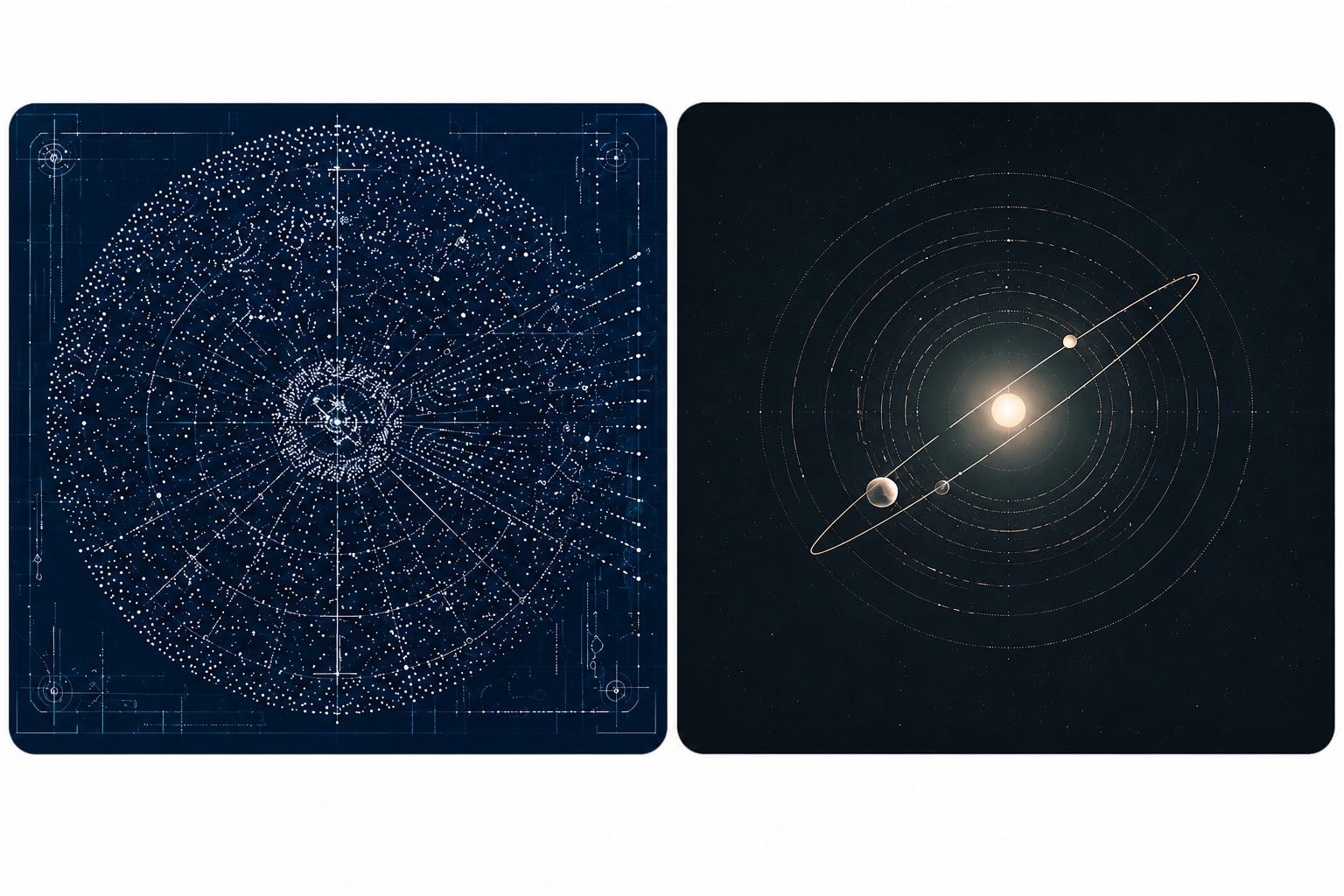
Figure 2
Celestial Navigation and Planetary Orbits: Mapping the Unknown
Source: Public domain, via Wikimedia Commons.
2.1. Fragmented Narrative as Presented
The narrative structure of Project Hail Mary (Lord & Miller, 2025) is intentionally disjointed, unfolding through a sequence of incomplete experiences rather than a continuous storyline. The protagonist awakens in isolation, without memory, and the audience is placed in the same position — uncertain, disoriented, and lacking context (Bruner, 1991). From this starting point, the film alternates between two temporal dimensions: the immediate present of survival in space and fragmented flashbacks that gradually reconstruct the mission’s origin.
This structure delays clarity. Key elements — global crisis, mission purpose, and character motivation — are revealed incrementally and often out of sequence. Much of the screen time is devoted to iterative problem-solving: observation, hypothesis, failure, and adjustment (Clark, 2016). While this reflects scientific reasoning, it also reduces conventional narrative momentum. Emotional engagement is similarly deferred, with relational depth emerging only after prolonged periods of technical focus.
As a result, the film presents itself less as a story being told and more as a process being experienced. For some viewers, this creates intellectual engagement; for others, it produces a sense of narrative absence.
2.2. Reconstructed Narrative as Interpreted (A–B–C Framework)
When reorganized into a linear structure, however, the underlying narrative reveals a much simpler and more classical form.
A. The Problem. Earth faces an existential threat as the sun’s energy is being diminished by a mysterious organism, prompting a global scientific response.
B. The Journey. A reluctant but capable individual is sent on a solitary mission to investigate, where he gradually regains memory, understands his purpose, and encounters an unexpected extraterrestrial counterpart facing the same crisis.
C. The Resolution. Through collaboration and shared reasoning, a solution emerges, culminating in a decision that reframes survival not merely as success, but as a matter of connection and responsibility.
In this reconstructed form, the narrative aligns with traditional storytelling conventions — clear stakes, progression, and resolution. The complexity lies not in the story itself, but in how it is delivered.
2.3. Comparative Interpretation
What appears to be narrative fragmentation is in fact structural displacement, where coherence exists, but is deferred to the viewer’s reconstruction.
Table 1 reveals a central paradox: the narrative of Project Hail Mary is structurally simple but experientially complex. The film does not obscure its story; rather, it redistributes it across time, requiring the audience to actively reconstruct meaning. This distinction is critical in understanding divergent audience responses.
For viewers accustomed to assembling fragmented information — often shaped by digital and AI-mediated environments — this structure may feel natural, even engaging. For others, it challenges established expectations of narrative coherence, producing a sense of disconnection rather than discovery.
Table 1
Narrative Structure in Project Hail Mary Presentation, Interpretation and Audience Response
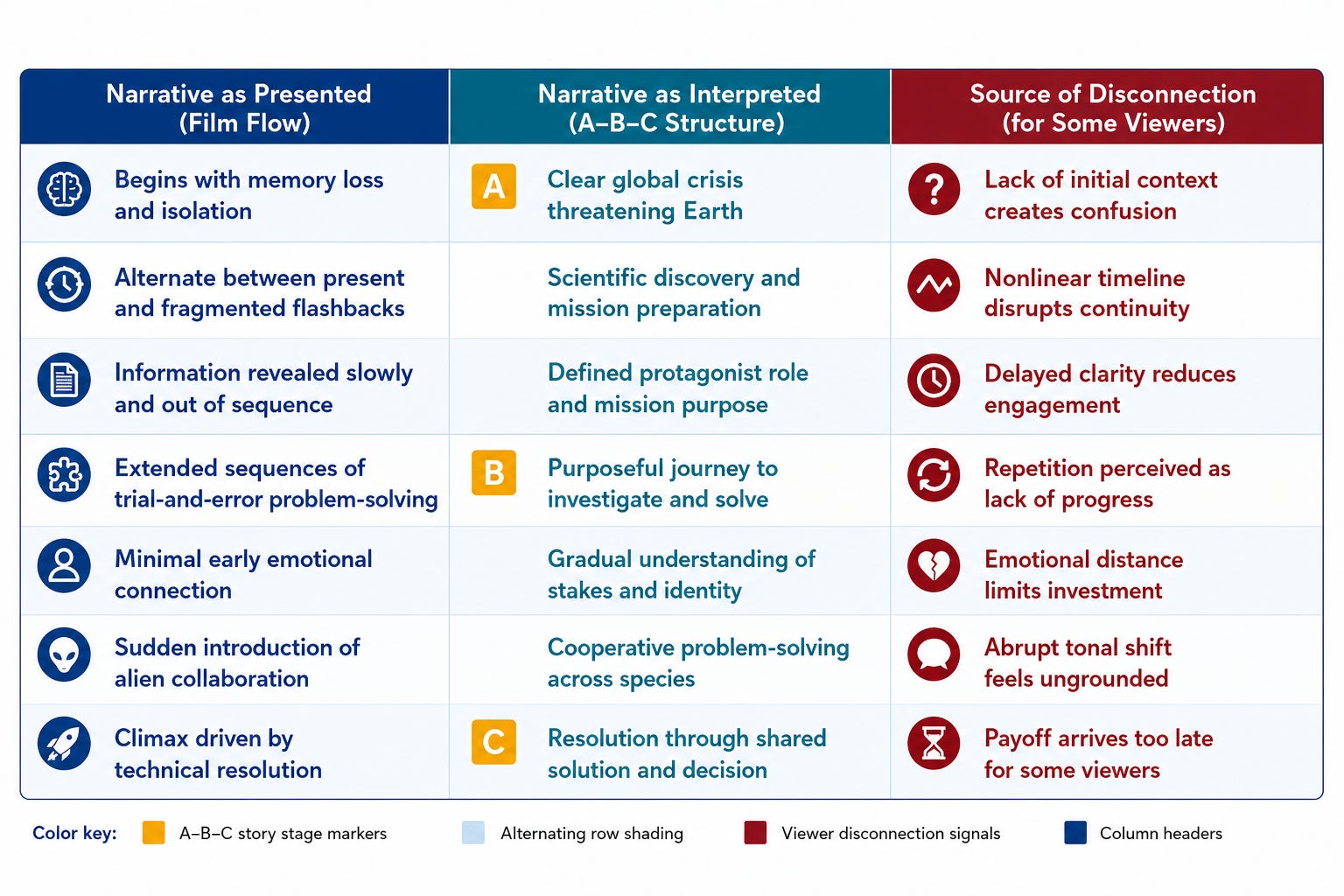
This structural contrast clarifies that the challenge lies not in the story itself, but in how understanding is distributed across the viewing experience. It is this shift — from narrative delivery to cognitive assembly — that shapes how characters and relationships come into focus over time.
At the hear of this film lies not a complex story, but a complex way of telling it.
3. Characters, Companionship, and Intergenerational Meaning
Connection in this film is not immediate, but achieved through sustained interaction. It unfolds not through familiarity, but through gradual alignment across difference. What begins as uncertainty becomes, over time, a shared framework for engagement.
3.1. Human Agency, Isolation, and Generational Engagement
At the center is Ryland Grace, whose role is defined not by heroism but by disciplined reasoning under conditions of isolation. His experience unfolds as a sequence of structured problem-solving processes, where observation, hypothesis, and iteration replace conventional interaction. The absence of immediate human connection shifts his engagement inward, making cognition itself a functional substitute for companionship. In this sense, his role represents a model of intelligence that is procedural, adaptive, and aligned with systems thinking (Russell & Norvig, 2020).
This process-oriented mode of engagement also reveals a generational divide in how such intelligence is perceived. Younger viewers, accustomed to environments where meaning is assembled through interaction and iteration, engage with this structure as a form of cognitive participation rather than narrative delay (Clark, 2016). Older viewers, by contrast, often expect clarity, emotional grounding, and linear progression, and may experience the same structure as disconnection. What differs is not the story, but the expectation of how understanding should unfold. Thus, isolation in the film becomes both a narrative condition and a reflection of differing cognitive habits across generations.
3.2. Encounter, Communication, and Constructed Connection
The introduction of Rocky transforms the narrative from solitary reasoning to relational problem-solving across fundamentally different forms of life. Their encounter is defined not by recognition, but by uncertainty, as neither possesses a shared framework for communication. Initial interaction proceeds through observation and cautious signaling, establishing the first layer of mutual awareness. This moment marks a transition from isolated cognition to the possibility of shared understanding.
Communication unfolds through a gradual, iterative process grounded in patterns, measurements, and repeatable signals, where shared understanding develops through alignment, correction, and verification over time (Norman, 2013). This process mirrors the operational logic of artificial intelligence, where learning advances through pattern recognition and refinement rather than instant comprehension (Russell & Norvig, 2020). As cooperation stabilizes, connection becomes possible — not as something assumed, but as something achieved through sustained interaction.
4. Meaning-Making in the AI Era
In the AI era, understanding is no longer passively received, but actively developed through engagement with fragmented information.
4.1. From Narrative Consumption to Cognitive Construction
The structure of Project Hail Mary reflects a broader transformation in how storytelling is experienced. Traditional narratives are designed to deliver meaning through clear progression, guiding the audience toward understanding with deliberate pacing and exposition. In contrast, this film presents a nonlinear, system-like structure in which coherence is not immediately available but must be pieced together over time (Bruner, 1991). The viewer is therefore repositioned, not as a passive recipient, but as an active interpreter who organizes dispersed elements into a meaningful whole.
This shift parallels the operational logic of artificial intelligence, where pattern recognition, iterative learning, and delayed convergence define the process of understanding (Russell & Norvig, 2020). Just as AI systems refine outputs through repeated adjustment, the viewer engages in a similar cognitive process, identifying patterns, testing interpretations, and gradually stabilizing meaning. The experience becomes less about following a narrative and more about participating in its construction. In this sense, the viewer increasingly functions like a “human algorithm,” reconstructing meaning from fragmented inputs rather than receiving it in fully formed sequence.
4.2. Redefining Intelligence, Connection, and Learning
Beyond narrative structure, the film also suggests a redefinition of intelligence itself. Intelligence is no longer portrayed as immediate comprehension or intuitive insight, but as a process grounded in iteration, adaptation, and sustained reasoning (Narayanan & Kapoor, 2024). The character of Ryland Grace embodies this shift, as his survival depends not on sudden brilliance but on disciplined, incremental problem-solving. His actions demonstrate that understanding emerges through engagement with uncertainty rather than its avoidance.
This process-oriented view of intelligence extends to the film’s portrayal of connection, particularly through the interaction with Rocky. Communication between fundamentally different beings does not begin with shared meaning, but with the gradual construction of it through patterns, signals, and verification. Their relationship illustrates that connection is not assumed or given, but established through mutual participation in an evolving process of understanding. In the AI era, this suggests a broader insight: learning, intelligence, and connection are increasingly defined not by immediacy, but by the capacity to engage, adapt, and refine shared meaning over time (Christian, 2020). This evolving understanding of intelligence and connection becomes even more visible when contrasted with earlier narrative forms that confronted uncertainty in fundamentally different ways.
4.3. From Absurd Waiting to Iterative Resolution: A Structural Contrast
A useful contrast emerges when Project Hail Mary is viewed alongside Waiting for Godot (Beckett, 1954), a work that similarly centers on uncertainty, delay, and the absence of immediate clarity. In Beckett’s play, two characters wait for a figure who never arrives, repeating conversations without progression. Time passes, but nothing fundamentally changes; the structure resists resolution, and coherence remains perpetually deferred. Written in the aftermath of World War II, Beckett’s work reflects a generation shaped by disillusionment, where established systems of meaning — religious, political, and philosophical — had fractured, leaving behind a condition of existential suspension. By contrast, Project Hail Mary begins from a comparable condition of disorientation and incomplete knowledge, yet diverges in its response. Rather than waiting for clarity, the protagonist advances through disciplined inquiry — testing, failing, and refining his understanding. What initially appears as delay becomes a mechanism through which insight gradually takes form.
This distinction marks a fundamental structural and generational divergence. In Waiting for Godot, repetition reinforces circularity, emphasizing the limits of resolution and the persistence of uncertainty. In Project Hail Mary, repetition becomes productive, enabling forward movement and eventual coherence through iterative problem-solving. The difference extends to how each work conceptualizes human connection. Beckett presents interaction as a way of enduring time, where dialogue fills silence but does not transform understanding. In contrast, Project Hail Mary portrays interaction — particularly across fundamentally different forms of life — as a cumulative process through which shared understanding is progressively achieved. These contrasting structures reflect broader historical shifts: Beckett’s mid-20th-century context foregrounds existential uncertainty and the absence of reliable meaning, while the contemporary AI era emphasizes adaptive reasoning, systems thinking, and the capacity to develop understanding through sustained engagement with complexity. Together, the two works illuminate not only different narrative forms, but different assumptions about whether — and how — understanding can emerge at all.
Connection in this film is not immediate, but gradually achieved through sustained interaction.
5. Conclusion
In the end, Project Hail Mary reveals less about space than about how we now think, learn, and connect in an increasingly complex world. What divides audiences is not the story itself, but the shifting expectations of how meaning should emerge — whether delivered clearly or constructed through effort. For some, the film feels distant; for others, it feels intuitive, reflecting a broader transition in cognitive engagement shaped by the AI era. As we left the theater, it became clear that we had not simply watched a different movie — we had processed a different way of understanding.
References
Beckett, S. (1954). Waiting for Godot: Tragicomedy in 2 acts. Grove Press.
Bruner, J. (1991). The narrative construction of reality. Critical Inquiry, 18(1), 1–21. https://doi.org/10.1086/448619
Christian, B. (2020). The alignment problem: Machine learning and human values. W. W. Norton & Company.
Clark, A. (2016). Surfing uncertainty: Prediction, action, and the embodied mind. Oxford University Press.
Lord, P., & Miller, C. (Directors). (2025). Project Hail Mary [Film]. Amazon MGM Studios.
Narayanan, A., & Kapoor, S. (2024). AI snake oil: What artificial intelligence can do, what it can’t, and how to tell the difference. Princeton University Press.
Norman, D. A. (2013). The design of everyday things (Rev. & expanded ed.). Basic Books.
Russell, S., & Norvig, P. (2020). Artificial intelligence: A modern approach (4th ed.). Pearson.
Weir, A. (2021). Project Hail Mary. Ballantine Books.
About the Author

Distinguished Professor, Dr. Paul Hong — University of Toledo
Paul C. Hong is a Distinguished University Professor and Chair of Information Systems and Supply Chain Management at the University of Toledo. His work focuses on leadership, governance, and decision-making in the AI era, integrating strategy, technology, and institutional trust. He has published extensively in leading academic journals and writes on how individuals and organizations navigate complexity, disruption, and global transformation.
© K-Global Scholars and Professionals Forum. All rights reserved. Content published in the K-GSP Forum may not be reproduced, distributed, or transmitted in any form without prior written permission from the K-GSP Forum, except for brief quotations with full attribution.
This essay goes beyond conventional science fiction criticism by offering a profound interpretation of how AI-era cognition is reshaping narrative experience through Project Hail Mary.
Its interdisciplinary perspective and structural insight demonstrate exceptional intellectual depth and a sophisticated understanding of contemporary digital culture.