

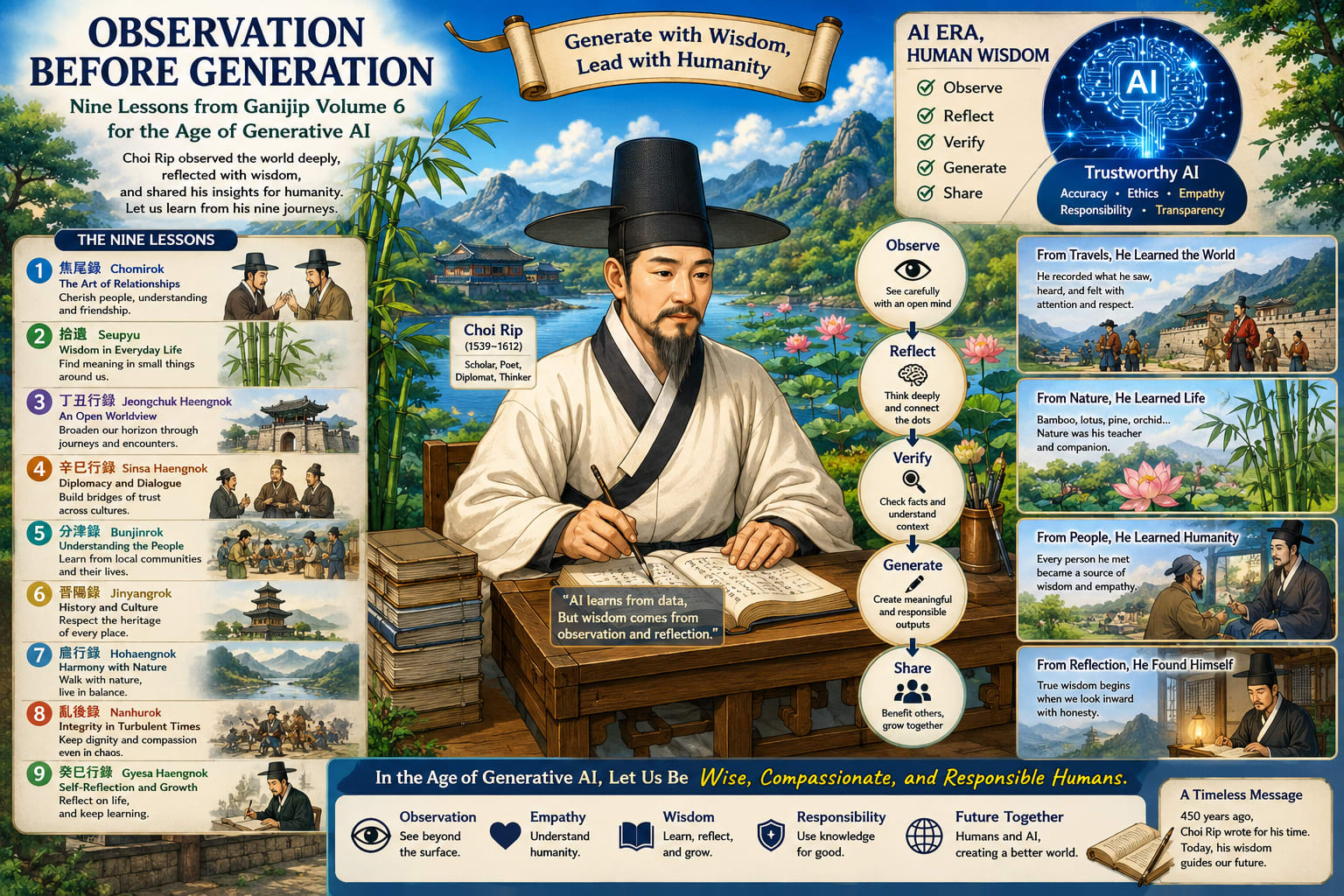
“AI learns from trillions of words, but Choi Rip drew a lifetime of wisdom from a single journey, a single encounter with another person, and even a single bamboo stalk. The more we live in an age of generation, the more we must rediscover the value of observation.”
1. Why Should We Read Gani-jip Volume 6 in the Age of AI?
Since 2022, Generative Artificial Intelligence has fundamentally transformed humanity’s knowledge ecosystem. We now live in a world where AI helps us write reports, create artwork, compose music, and even develop computer programs. Creativity is no longer the exclusive domain of human beings.
Yet as AI advances at an astonishing pace, several profound questions arise more frequently than ever before.
What is knowledge?
What is wisdom?
And above all,
What is the unique value that only human beings can offer?
Whenever I contemplate these questions, my thoughts turn to Choi Rip (崔岦, 1539–1612), a distinguished scholar and literary figure of the Joseon Dynasty who lived more than four and a half centuries ago.
Revisiting Volume 6 of The Korean Translation of Gani-jip, I was struck by an unexpected realization: this is far more than a collection of classical Korean literature. It is, in many ways, a timeless textbook on human wisdom whose relevance shines even more brightly in the era of Generative AI.
Volume 6 contains nine remarkable works:
Chomirok (초미록: 焦尾錄)
Seupyu (습유: 拾遺)
Jeongchuk Haengnok (정축행록: 丁丑行錄)
Sinsa Haengnok (신사행록: 辛巳行錄)
Bunjinrok (분진록: 分津錄)
Jinyangrok (진양록: 晉陽錄)
Hohaengnok (호행록: 扈行錄)
Nanhurok (난후록: 亂後錄)
Gyesa Haengnok (계사행록: 癸巳行錄)
At first glance, they appear to be little more than collections of poems and travel journals. Yet a closer reading reveals that these nine works are woven together by a single philosophical thread.
It is a philosophy of observing, reflecting, learning, and sharing.
Remarkably, these principles closely parallel what we now describe as the foundations of ‘Trustworthy Generative AI.’
2. Volume 6 Reveals Choi Rip’s Humanistic Philosophy
The earlier volumes of Ganijip introduce Choi Rip primarily as a government official devoted to serving his nation. He submits memorials to the king, drafts diplomatic documents, and faithfully carries out administrative responsibilities. He is a capable statesman and public servant.
Volume 6, however, introduces us to an entirely different Choi Rip.
Here we meet a man who longs for absent friends.
A man who bids farewell to companions embarking on distant journeys.
A man who contemplates the meaning of life while watching bamboo sway in the rain.
A man who sees the purity of human character reflected in the lotus flower.
A man who discovers profound lessons even through chance encounters with strangers along the road.
These writings remind us of an essential truth:
A truly great scholar is not merely one who reads many books, but one who deeply reads both humanity and nature.
Today’s Generative AI systems learn from unimaginably vast collections of data. Yet possessing enormous amounts of information does not necessarily produce wisdom.
Choi Rip demonstrates another path.
Rather than accumulating infinite data, he transformed a single experience into lifelong insight through deep reflection.
Perhaps this is the greatest distinction between artificial intelligence and human intelligence.
3. Nine Works Form One Grand Journey of Learning
Initially, each of the nine works appears independent.
Gradually, however, the reader realizes that they form one continuous intellectual and spiritual journey.
In Chomirok, we learn how to build meaningful human relationships.
In Seupyu, we discover life’s deeper meaning through ordinary objects.
In Jeongchuk Haengnok and Sinsa Haengnok, we broaden our understanding of the wider world.
In Bunjinrok and Jinyangrok, we learn to appreciate local communities and the lives of ordinary people.
In Hohaengnok, we walk alongside nature itself.
In Nanhurok, we cultivate integrity and noble character after times of turmoil.
Finally, in Gyesa Haengnok, we reflect upon life as a whole and examine our own hearts.
Together these works resemble an integrated educational curriculum.
Modern universities might describe such an approach as interdisciplinary education, because literature, history, diplomacy, philosophy, natural science, art, and human studies converge into one unified body of knowledge.
Generative AI is evolving in a similar direction.
It is no longer simply a language model.
It increasingly integrates multiple disciplines and diverse forms of knowledge.
Viewed from this perspective, Volume 6 anticipated today’s interdisciplinary thinking by several centuries.
4. Travel Does Not Expand Distance—It Expands Vision
Among the most fascinating writings in Volume 6 are the various Haengnok (Travel Records).
Whenever Choi Rip records his diplomatic journeys, he does far more than list the places he visited.
When he enters a city, he reflects upon its history and culture.
When he crosses a river, he contemplates the passage of time.
When he visits a marketplace, he seeks to understand the lives of ordinary people.
Modern travelers often reach immediately for their cameras.
Choi Rip did something very different.
He observed first.
He reflected second.
He wrote last.
This sequence is profoundly significant.
The same principle applies to modern AI.
A trustworthy AI system should first gather reliable information,
then understand its context,
next verify the facts,
and only then generate an answer.
When this order is reversed, mistakes occur.
In AI, we call these mistakes hallucinations.
Centuries before artificial intelligence existed, Choi Rip’s life quietly demonstrated an enduring lesson:
Generation without observation is dangerous.
5. Even a Single Flower Can Become Our Greatest Teacher
One of the most memorable aspects of Seupyu is Choi Rip’s extraordinary way of seeing the natural world.
He never regarded bamboo simply as bamboo.
Instead, he distinguished
young bamboo,
old bamboo,
rain-soaked bamboo,
wind-blown bamboo,
and withered bamboo.
Although they are all bamboo, each represents a different lesson about life.
The lotus flower is no different.
For Choi Rip, it is not merely a beautiful blossom.
Growing unstained from muddy waters, it symbolizes purity of character.
The pine tree represents unwavering integrity.
The orchid symbolizes quiet elegance and noble virtue.
Modern AI may learn from millions of photographs of flowers.
Yet it cannot easily understand
why flowers inspire hope,
why they symbolize beauty,
or why poets have celebrated them throughout history.
Choi Rip teaches us that nature is not merely data.
Nature is humanity’s teacher.
6. AI Cannot Succeed Without Understanding People
Volume 6 contains numerous farewell poems dedicated to friends.
Some express sorrow.
Others celebrate joyful reunions.
Many reveal deep longing.
Choi Rip never reduced human beings to numbers.
He understood them through relationships.
Today we often measure AI by the number of parameters it contains or by benchmark scores.
Human beings, however, cannot be measured by statistics alone.
Trust.
Compassion.
Empathy.
Responsibility.
These values transform technology into something that genuinely serves humanity.
Regardless of how powerful AI becomes, society will never fully trust systems that fail to respect human dignity.
Choi Rip reminds us that understanding people is the true beginning of scholarship.
The same principle remains true in the age of AI.
7. Reflection Is More Important Than Generation
Today’s AI systems can produce lengthy essays within seconds.
Yet generating quickly is not the same as thinking deeply.
Reading Choi Rip’s writings, one never senses haste.
He spends long hours observing before writing a single sentence.
He reflects deeply before composing a single poem.
His writings value depth more than speed.
Interestingly, modern AI research increasingly emphasizes reflection and self-correction.
After generating an answer, advanced AI systems are designed to review their reasoning, detect mistakes, and improve their responses.
Remarkably, Choi Rip practiced this intellectual discipline centuries ago.
His method of writing reflects precisely the direction toward which trustworthy AI research is now evolving.
8. The Greatest Legacy of Volume 6
As I finished reading Volume 6, one conviction became increasingly clear.
Choi Rip was far more than a poet.
He was a scholar who studied humanity.
A philosopher who interpreted the world.
A diplomat who connected cultures.
And above all,
he remained a lifelong learner.
Perhaps this is the most valuable lesson for those of us living in the age of Generative AI.
Technology changes rapidly.
AI models continue to evolve.
Yet certain human virtues remain timeless:
respect for people,
humility before nature,
careful observation,
and a lifelong commitment to learning.
These qualities never become obsolete.
The More Advanced AI Becomes, the More Human We Must Become
Closing Volume 6 of The Korean Translation of Gani-jip, I found myself contemplating a profound paradox.
AI increasingly speaks like humans.
It paints like humans.
It even appears to think like humans.
Yet ironically, human beings are beginning to live more like machines—always moving faster, producing more, and pausing less.
Choi Rip gently invites us to choose another path.
Walk a little more slowly.
Observe people more deeply.
Learn from nature.
Think carefully before speaking.
Generative AI will undoubtedly continue to improve. Future models will become more capable, more creative, and more powerful than those we know today.
Yet technological progress alone will never be enough.
Human wisdom must grow alongside artificial intelligence.
That is precisely the enduring lesson of Volume 6 of Gani-jip.
Chomirok teaches us the value of human relationships.
Seupyu reminds us to discover wisdom in ordinary life.
Jeongchuk Haengnok and Sinsa Haengnok cultivate an open global perspective.
Bunjinrok and Jinyangrok deepen our sense of responsibility toward communities.
Hohaengnok encourages harmony with nature.
Nanhurok nurtures dignity and resilience in difficult times.
Gyesa Haengnok inspires lifelong self-reflection.
These nine works are not isolated literary pieces.
Together they form a nine-stage journey toward becoming a better human being.
Generative AI will continue to provide us with more answers.
But Volume 6 of Gani-jip teaches us how to ask better questions.
Throughout history, humanity has advanced not because it possessed the greatest number of answers, but because it learned to ask the right questions.
That, perhaps, is the deepest and most enduring message Choi Rip offers to the twenty-first century from the sixteenth. +++
{Solti}
July 23, 2026
생성(生成)보다 관찰(觀察)이 먼저다
『국역 간이집』 제6권이 생성인공지능 시대에 전하는 아홉 가지 지혜
“AI는 수조 개의 단어를 학습하지만, 최립은 한 번의 여행과 한 사람의 만남, 한 그루의 대나무에서도 평생의 지혜를 길어 올렸다. 생성의 시대일수록 우리는 다시 관찰의 가치를 배워야 한다.”
1. AI 시대, 우리는 왜 『간이집』 제6권을 다시 읽어야 하는가
2022년 이후 생성형 인공지능(Generative AI)은 인류의 지식 생태계를 근본적으로 바꾸어 놓았다. 이제 우리는 보고서를 작성하고, 그림을 그리고, 음악을 만들며, 컴퓨터 프로그램을 개발하는 일까지 AI와 함께하는 시대를 살아가고 있다. 인간의 창의성은 더 이상 인간만의 전유물이 아니다.
그러나 AI가 놀라운 속도로 발전할수록 오히려 더 자주 떠오르는 질문이 있다.
“지식이란 무엇인가?”
“지혜란 무엇인가?”
그리고 무엇보다도,
“인간만이 줄 수 있는 가치는 무엇인가?”
이 질문 앞에서 나는 문득 450여 년 전 조선의 문인 최립(崔岦)을 떠올리게 되었다. 『국역 간이집』 제6권을 다시 읽으며 놀라웠던 것은, 이 책이 단순한 고전문학이 아니라 생성형 AI 시대에 더욱 빛나는 인간학의 교과서라는 사실이었다.
제6권에는 「초미록(焦尾錄)」, 「습유(拾遺)」, 「정축행록(丁丑行錄)」, 「신사행록(辛巳行錄)」, 「분진록(分津錄)」, 「진양록(晉陽錄)」, 「호행록(扈行錄)」, 「난후록(亂後錄)」, 「계사행록(癸巳行錄)」 등 모두 아홉 편의 작품이 담겨 있다. 얼핏 보면 시집과 기행문을 모아 놓은 것처럼 보이지만, 조금만 깊이 읽어 보면 이 아홉 편은 하나의 거대한 철학으로 연결되어 있음을 발견하게 된다.
그 철학은 바로 ‘관찰하고, 성찰하고, 배우고, 나누는 삶’이다.
그리고 놀랍게도 이것은 오늘날 우리가 추구하는 ‘신뢰할 수 있는 생성형 AI(Trustworthy Generative AI)’의 핵심 원리와도 맞닿아 있다.
2. 제6권은 최립의 ‘인간학’을 보여 주는 책이다
『간이집』의 앞선 권들을 읽으면 국가를 위해 일하는 관료 최립을 만나게 된다. 그는 임금에게 상소를 올리고, 외교문서를 작성하며, 행정을 수행하는 유능한 공직자였다.
그러나 제6권에 이르면 전혀 다른 최립을 만나게 된다.
친구를 그리워하는 사람.
먼 길을 떠나는 벗을 배웅하는 사람.
비 오는 날 대나무를 바라보며 인생을 생각하는 사람.
연꽃을 보며 인간의 품격을 이야기하는 사람.
여행길에서 만난 이름 모를 사람에게서도 삶의 의미를 배우는 사람.
이러한 모습은 우리에게 매우 중요한 사실을 알려 준다.
위대한 학자는 책을 많이 읽는 사람이 아니라 사람과 자연을 깊이 읽는 사람이라는 사실이다.
오늘날 생성형 AI는 엄청난 양의 데이터를 학습한다. 그러나 데이터가 많다고 해서 반드시 지혜로운 것은 아니다. 최립은 방대한 데이터가 아니라 한 번의 경험을 깊이 성찰함으로써 지혜를 만들어 냈다.
이것이 인간과 AI의 가장 큰 차이일지도 모른다.
3. 아홉 편의 작품은 하나의 거대한 배움의 여정이다
처음에는 아홉 편이 각각 독립된 작품처럼 보인다.
그러나 읽다 보면 하나의 긴 여행이라는 사실을 깨닫게 된다.
「초미록」에서는 사람을 만나는 법을 배운다.
「습유」에서는 작은 사물 속에서 삶의 의미를 발견한다.
「정축행록」과 「신사행록」에서는 세상을 향해 눈을 넓힌다.
「분진록」과 「진양록」에서는 백성과 지역사회를 이해한다.
「호행록」에서는 자연과 함께 걷는다.
「난후록」에서는 고결한 품성을 배우고,
「계사행록」에서는 삶 전체를 돌아보며 자신을 성찰한다.
이 모든 과정은 하나의 교육과정과도 같다.
오늘날 대학에서는 이를 ‘융합교육’이라고 부를 것이다. 문학, 역사, 외교, 철학, 자연과학, 예술, 인간학이 하나로 연결되어 있기 때문이다.
생성형 AI 역시 이제는 단순한 언어모델을 넘어, 여러 분야의 지식을 통합하는 방향으로 발전하고 있다. 이런 점에서 제6권은 수백 년 앞서 ‘융합적 사고’의 모범을 보여 준다.
4. 여행은 거리를 넓히는 것이 아니라 시야를 넓히는 것이다
제6권에서 가장 인상 깊은 작품 가운데 하나는 여러 편의 행록(行錄)이다.
최립은 여러 차례의 여행과 사행을 기록하면서 단순히 “어디를 갔다”는 사실만 적지 않는다.
그는 도시를 보면 그 도시의 역사와 문화를 생각하고,
강을 보면 세월의 흐름을 떠올리며,
시장을 보면 백성들의 삶을 이해하려고 노력한다.
오늘날 우리는 여행을 가면 먼저 사진부터 찍는다.
그러나 최립은 먼저 바라본다.
그리고 생각한다.
마지막으로 기록한다.
이 순서는 매우 중요하다.
현대 AI도 마찬가지이다.
좋은 AI는 먼저 데이터를 수집하고,
맥락을 이해하고,
사실을 검증한 뒤,
비로소 답을 생성해야 한다.
이 순서를 거꾸로 하면 오류가 생긴다.
AI에서는 이것을 환각(Hallucination)이라고 부른다.
최립은 이미 수백 년 전에 “관찰 없는 생성은 위험하다.”는 사실을 자신의 삶으로 보여 주고 있었던 셈이다.
5. 작은 꽃 한 송이도 최고의 스승이 될 수 있다
『습유』를 읽으면서 가장 놀랐던 점은 최립의 시선이었다.
그는 대나무를 보아도 여러 종류의 대나무를 구별한다.
젊은 대나무.
늙은 대나무.
비를 맞는 대나무.
바람 속의 대나무.
마른 대나무.
같은 대나무인데도 각각 다른 삶의 의미를 읽어 낸다.
연꽃도 마찬가지이다.
연꽃은 단순한 꽃이 아니다.
진흙 속에서도 맑음을 잃지 않는 인간의 품격이다.
소나무는 변하지 않는 절개를 의미하고,
난초는 은은한 향기를 품은 군자의 덕을 상징한다.
오늘날 AI는 수백만 장의 꽃 사진을 학습할 수 있다.
그러나 꽃이 인간에게 왜 아름다운지,
왜 희망의 상징이 되는지,
왜 시인이 꽃을 노래하는지를 완전히 이해하기는 어렵다.
최립은 우리에게 자연은 단순한 데이터가 아니라 인간을 성장시키는 스승이라고 말한다.
6. 사람을 이해하지 못하면 AI도 성공할 수 없다
제6권에는 친구를 보내는 시가 유난히 많다.
슬픔도 있고,
기쁨도 있으며,
그리움도 있다.
최립은 사람을 숫자로 보지 않았다.
관계로 보았다.
오늘날 우리는 AI의 성능을 매개변수(parameter)의 개수나 벤치마크 점수로 평가한다.
그러나 인간은 점수만으로 평가할 수 없는 존재이다.
신뢰.
배려.
공감.
책임.
이러한 가치가 함께할 때 비로소 기술은 사람을 위한 기술이 된다.
AI가 아무리 뛰어나도 인간의 존엄을 존중하지 않는다면 사회는 그 AI를 신뢰하지 않을 것이다.
최립은 사람을 이해하는 것이 학문의 출발점이라고 말한다.
AI 시대에도 이 원칙은 변하지 않는다.
7. 생성보다 중요한 것은 성찰이다
오늘날 AI는 몇 초 만에 긴 글을 쓴다.
하지만 빠르게 생성하는 것과 깊이 생각하는 것은 다르다.
최립의 글을 읽으면 조급함이 없다.
한 줄을 쓰기 위해 오래 관찰하고,
한 편의 시를 위해 깊이 생각한다.
그의 문장은 속도보다 깊이를 추구한다.
오늘날 AI 연구에서도 ‘Reflection’과 ‘Self-Correction’이 중요한 연구 분야가 되고 있다.
생성 이후 다시 검토하고,
오류를 발견하며,
더 나은 답을 만들어 가는 과정이다.
놀랍게도 최립의 글쓰기 방식은 이러한 현대 AI 연구 방향과도 통한다.
8. 『간이집』 제6권이 후대에 남긴 가장 큰 유산
나는 제6권을 읽으며 한 가지 확신을 갖게 되었다.
최립은 단순한 시인이 아니었다.
그는 사람을 연구한 학자였고,
세상을 읽은 철학자였으며,
문화를 연결한 외교관이었다.
그리고 무엇보다도 그는 평생 배우기를 멈추지 않은 학습자였다.
이것이 바로 생성형 AI 시대를 살아가는 우리에게 가장 필요한 자세가 아닐까.
기술은 빠르게 변한다.
AI 모델도 끊임없이 바뀐다.
그러나 사람을 존중하는 마음,
자연에서 배우는 겸손,
세상을 깊이 관찰하는 습관,
배움을 멈추지 않는 자세는 시대가 달라져도 결코 변하지 않는다.
AI 시대일수록 우리는 더 인간다워져야 한다
『국역 간이집』 제6권을 덮으며 나는 한 가지 역설을 생각하게 되었다.
AI는 점점 더 인간처럼 말하고,
그림을 그리고,
생각하는 것처럼 보인다.
그러나 정작 인간은 AI처럼 빠르게만 살아가려고 한다.
최립은 우리에게 그 반대의 길을 권한다.
조금 천천히 걸으라고.
사람을 깊이 바라보라고.
자연을 통해 삶을 배우라고.
그리고 충분히 생각한 뒤 말하라고.
생성형 AI는 앞으로도 계속 발전할 것이다. 더 강력한 모델이 등장하고, 더 뛰어난 성능을 보여 줄 것이다. 그러나 그 발전이 진정으로 인류에게 도움이 되기 위해서는 기술만이 아니라 인간의 지혜가 함께 성장해야 한다.
『간이집』 제6권은 바로 그 지혜를 보여 준다. 「초미록」은 인간관계를, 「습유」는 일상의 성찰을, 「정축행록」과 「신사행록」은 열린 세계관을, 「분진록」과 「진양록」은 공동체에 대한 책임을, 「호행록」은 자연과의 공존을, 「난후록」은 인격의 품위를, 「계사행록」은 자기 성찰을 일깨운다. 이 아홉 편은 서로 다른 작품이 아니라, 더 나은 인간이 되기 위한 아홉 단계의 여정이다.
생성형 AI는 우리에게 더 많은 답을 줄 것이다. 그러나 『간이집』 제6권은 더 좋은 질문을 던지는 법을 가르쳐 준다. 그리고 인류의 미래는 언제나 정답을 많이 만드는 기술보다, 올바른 질문을 던질 줄 아는 지혜 위에서 발전해 왔다.
그것이 바로 최립이 16세기에서 21세기의 우리에게 전하는 가장 깊고도 오래 남는 메시지일 것이다. +++
2026년 7월 23일
{솔티}

Prof. Dr. Young Choi (Editor in Chief) — Regent University
Young B. Choi is a Professor in the Department of Engineering & Computer Science at Regent University. He published 38 books with ‘Selected Readings in Cybersecurity’ (2018) (over 800 copies archived globally at university/college libraries around the world) and ‘Cybersecurity Applications and Artificial Intelligence’ (2023) available in seven major world languages. He proposed the world’s first global and universal telecommunications “Service Order Handling (SOH)” Model (T-SOH Model) (1995) with Dr. Adrian Tang. With this innovative research work, he received the IEEE NOMS ’96 Best Paper Award and became the first recipient of the Outstanding Contribution Award of the TeleManagement Forum in 1998. His research areas include Natural Language Processing-focused AI, AI-applied cybersecurity, network and telecom service management, and Korean studies on Gani Choi Rip’s Jeonggwan (靜觀: Quiet Contemplation) philosophy and Shilhak ( 實學: Practical Learning).