

EXECUTIVE SUMMARY
Korean proverbs condense generations of lived experience into practical wisdom about judgment, resilience, timing, character, and human behavior. This article examines twelve familiar sayings to show how traditional insights can illuminate modern challenges in leadership, organizations, relationships, and strategic decision-making. Taken together, the proverbs suggest that enduring wisdom remains valuable when it is interpreted thoughtfully and applied with awareness of context, consequences, and changing circumstances.
Keywords: Korean Proverbs; Strategic Judgment; Resilience; Timing; Character
1. Introduction
Many people encounter short quizzes, word games, proverb-completion exercises, and memory puzzles that are presented as ways to keep the mind active and reduce concerns about cognitive decline or dementia (치매). A familiar Korean exercise might begin with only the first half of a proverb—“발 없는 말이…” or “원숭이도 나무에서…”—and ask the participant to recall the rest. Whether or not such exercises can prevent dementia in a medical sense, they illustrate something important: proverbs remain deeply embedded in long-term memory because they compress complicated experiences into short, memorable expressions.
Korean proverbs are more than verbal puzzles from an earlier generation. Expressions such as “발 없는 말이 천 리 간다” (words can travel far), “소 잃고 외양간 고친다” (repairing the barn after losing the cow), and “원숭이도 나무에서 떨어진다” (even a monkey falls from a tree) contain observations about reputation, preparedness, mistakes, risk, and human limitations. Others emphasize persistence, habit, opportunity, learning, and adaptation. Their language is simple, but the situations they describe recur repeatedly in families, organizations, markets, and societies.
What makes these sayings especially interesting today is the distance between their traditional origins and the modern contexts in which their wisdom can be applied. Digital communication makes words travel much farther and faster than “a thousand ri”; organizational crises reveal the cost of repairing systems only after failure; experienced leaders still make mistakes; and habits developed early continue to shape individual and organizational behavior. Proverbs therefore function not merely as cultural artifacts but as compact mental models that help people recognize recurring patterns of action and consequence.
This article revisits twelve familiar Korean proverbs through the lens of judgment, resilience, timing, and character. Rather than treating each proverb as an absolute rule, it asks what strategic principle lies beneath it, under what conditions that principle remains useful, and how it might inform contemporary leadership, organizational behavior, relationships, and decision-making. In this sense, remembering old proverbs can do more than exercise memory: it can reconnect inherited wisdom with the practical challenges of modern strategic life.
2. Strategic Meanings of Korean Proverbs
Korean proverbs often describe ordinary events, but beneath their simple wording lie recurring patterns of human behavior, organizational life, and strategic decision-making. The twelve sayings considered here can be organized into three broad themes: communication and consequences, resilience and timing, and learning and character. Viewed this way, traditional wisdom becomes a practical framework for understanding how actions accumulate, how opportunities emerge, and how habits shape long-term outcomes.
2.1. Communication, Consequences, and Accountability
Several Korean proverbs emphasize that actions rarely remain isolated. “발 없는 말이 천 리 간다” literally means “Words without feet travel a thousand ri.” Its meaning is that speech, rumor, and information can spread far beyond the speaker’s control. In the digital age, this principle applies to social media, leadership credibility, organizational communication, brand reputation, and information integrity.
“가는 말이 고와야 오는 말이 곱다” literally means “If outgoing words are kind, incoming words will be kind.” Its meaning is that respectful communication tends to invite reciprocal consideration. In professional settings, constructive feedback and attentive listening can improve cooperation, although reciprocity is not guaranteed.
“꼬리가 길면 잡힌다” literally means “A long tail will eventually be caught.” Its meaning is that repeated questionable behavior becomes detectable as patterns accumulate. Isolated misconduct may escape attention, but recurring ethical lapses leave traces; organizations therefore need transparency, internal controls, and early recognition of behavioral risks.
“소 잃고 외양간 고친다” literally means “Repair the cowshed after losing the cow.” Its meaning is that preventive action is preferable to belated correction. Organizations often improve safeguards only after disruption, cyberattack, quality failure, or supply-chain breakdown; the practical lesson is to anticipate vulnerabilities while recognizing that post-failure learning still has value.
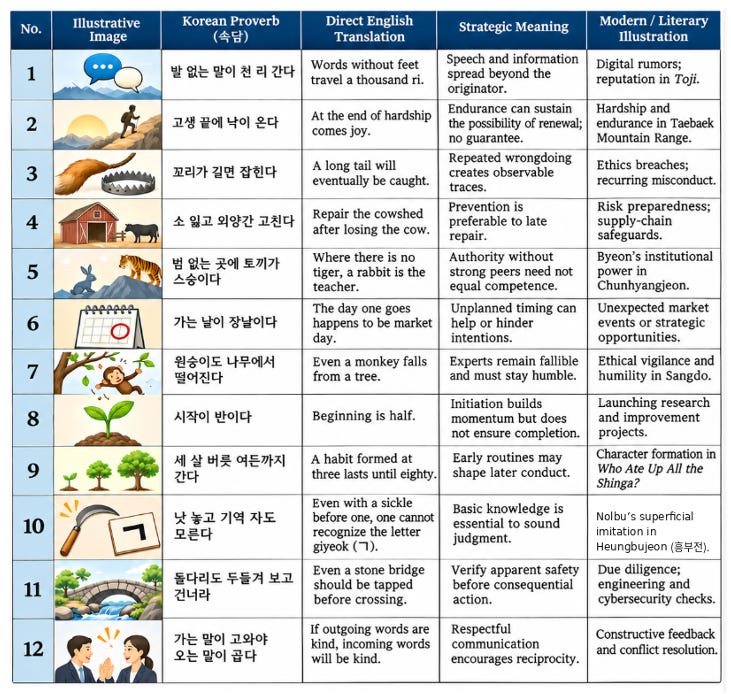
Table 1 presents the twelve Korean proverbs examined in the article, together with their core meanings and contemporary or literary illustrations. It condenses traditional sayings into a structured framework that links inherited wisdom to themes such as communication, resilience, preparedness, timing, humility, habit, and foundational knowledge. By combining concise interpretation with modern examples, the table shows how familiar proverbs can function as practical guides for strategic judgment and everyday decision-making.
Table 1. Twelve Korean Proverbs: Literal Translations, Strategic Meanings, and Illustrations
[Table 1 to be inserted]
Source: Author’s conceptual synthesis and interpretation, with AI assistance in visual development. Literal translations precede interpretive explanations.
2.2. Resilience, Timing, and Opportunity
A second group of proverbs focuses on uncertainty, adversity, and constructive responses to changing circumstances. “고생 끝에 낙이 온다” literally means “At the end of hardship comes joy.” Its meaning is that endurance and sustained effort can preserve the possibility of better circumstances. This is a hopeful principle, not a promise that every hardship will automatically produce success.
“가는 날이 장날이다” literally means “The day one goes happens to be market day.” Its meaning is that events may unexpectedly coincide with one’s plans, for better or worse. Strategic decision-makers must therefore remain alert to circumstances, recognizing both serendipitous opportunities and unanticipated obstacles.
“시작이 반이다” literally means “Beginning is half.” Its meaning is that initiating a worthwhile endeavor overcomes a major obstacle and creates momentum. In entrepreneurship, research, innovation, and organizational change, the first meaningful step converts abstract intention into learning and action; it does not eliminate the need for execution.
2.3. Learning, Humility, Habit, and Competence
The remaining proverbs concern personal development, capability, and the limits of experience. “원숭이도 나무에서 떨어진다” literally means “Even a monkey falls from a tree.” Its meaning is that even experts can make mistakes. Effective leaders combine confidence with humility, verification, and learning from failure (Sitkin, 1992).
“세 살 버릇 여든까지 간다” literally means “A habit formed at three lasts until eighty.” Its meaning is that early routines and behavioral patterns may persist for many years. Individuals and organizations must therefore cultivate constructive habits deliberately while recognizing that reflection and learning can still change established routines (Schein, 2010).
“낫 놓고 기역 자도 모른다” literally means “Even with a sickle laid before one, one cannot recognize the letter giyeok (ㄱ).” Its meaning is that someone may lack even elementary knowledge despite an obvious visual clue. Applied strategically, sound decisions require foundational literacy—financial, technological, cultural, or operational—before advanced judgment is possible.
“범 없는 곳에 토끼가 스승이다” literally means “Where there is no tiger, a rabbit is the teacher.” Its meaning is that when stronger experts or authorities are absent, a less capable actor may attain influence. The proverb invites leaders to assess competence against substantive standards rather than merely accepting rank or local prominence. Its lesson concerns contextual authority and the danger of confusing position with wisdom.
“돌다리도 두들겨 보고 건너라” literally means “Even a stone bridge should be tapped before crossing.” Its meaning is that apparent safety does not remove the need for careful verification. Leaders should test assumptions, inspect hidden weaknesses, and assess risks before consequential action; prudence should support, rather than paralyze, timely decisions (Reason, 1997; Weick & Sutcliffe, 2015).
Taken together, these twelve proverbs reveal a surprisingly coherent strategic logic: words create consequences, adversity demands resilience, timing shapes opportunity, mistakes require humility, and character is built through repeated habits and disciplined learning.

3. A 2×2 Framework for Applying Proverbial Wisdom
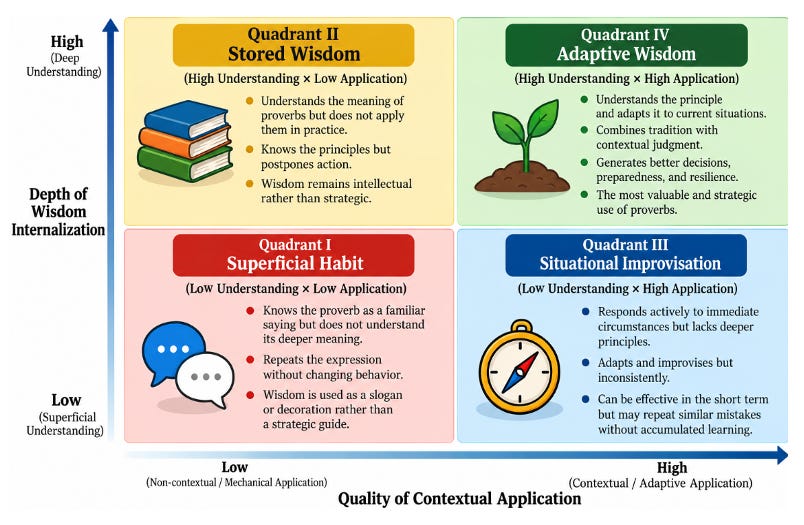
The value of a proverb does not come merely from remembering it. Strategic value emerges when inherited wisdom is both understood deeply and applied appropriately to present circumstances. A useful 2×2 framework can therefore be built around two dimensions: Depth of Wisdom Internalization (Low–High) and Quality of Contextual Application (Low–High).
Figure 1. A 2×2 Framework for Applying Proverbial Wisdom
Source: Author’s conceptual synthesis and interpretation, with AI assistance in visual development.
Figure 1 introduces a 2×2 framework for applying proverbial wisdom based on two dimensions: depth of wisdom internalization and quality of contextual application. The four quadrants—Superficial Habit, Stored Wisdom, Situational Improvisation, and Adaptive Wisdom—distinguish between merely remembering a proverb and applying its deeper principle effectively in practice. The figure emphasizes that the highest value of traditional wisdom emerges when inherited lessons are understood deeply and adapted thoughtfully to contemporary circumstances.
3.1. Quadrant I — Superficial Habit: Low Understanding × Low Application
In this quadrant, proverbs are remembered as familiar expressions but are neither deeply understood nor meaningfully applied. People may repeat sayings because they are culturally familiar, yet the underlying lessons about timing, character, communication, or preparation do not influence their actual behavior. A person may know “소 잃고 외양간 고친다” while repeatedly failing to prepare for foreseeable problems.
At the organizational level, this condition resembles symbolic learning without behavioral change. Lessons are discussed after failure, slogans are repeated, and policies may be written, but operating routines remain unchanged. Traditional wisdom becomes decorative rather than strategic.
3.2. Quadrant II — Stored Wisdom: High Understanding × Low Application
Here, individuals understand the meaning of inherited wisdom but fail to translate it into action. They may recognize that “꼬리가 길면 잡힌다” warns about cumulative misconduct or that “세 살 버릇 여든까지 간다” emphasizes the persistence of habits, yet they postpone corrective action.
This quadrant illustrates the gap between knowing and doing. Wisdom without application has intellectual value but limited strategic effect. Organizations likewise may understand their vulnerabilities while failing to invest, reorganize, or change until circumstances force them to act.
3.3. Quadrant III — Situational Improvisation: Low Understanding × High Application
In this quadrant, people respond energetically and adaptively to immediate circumstances but lack deeper principles that guide their decisions. They may seize opportunities when “가는 날이 장날” or launch initiatives because “시작이 반이다,” yet their actions can become fragmented when there is no accumulated wisdom behind them.
Improvisation can be valuable in rapidly changing environments, but excessive reliance on short-term adaptation creates inconsistency. Leaders may react effectively to one crisis while repeating similar mistakes later because experience has not been converted into deeper learning.
Thus, responsiveness alone is not enough. Strategy improves when immediate adaptation is linked to enduring principles.
3.4. Quadrant IV — Adaptive Wisdom: High Understanding × High Application
This is the strongest form of proverb-based strategic reasoning. Individuals understand inherited wisdom but do not follow it mechanically. Instead, they interpret its deeper principle and adapt it to changing circumstances.
The lesson of “발 없는 말이 천 리 간다” becomes a lesson about digital reputation and information diffusion. “원숭이도 나무에서 떨어진다” encourages expert humility and verification. “시작이 반이다” promotes action while still recognizing the need for preparation and disciplined execution.
Adaptive wisdom therefore combines memory with judgment, tradition with context, and experience with action. It preserves the insight of the past while avoiding blind attachment to the past.
3.5. From Remembered Wisdom to Strategic Capability
The 2×2 framework suggests that the strategic usefulness of proverbs depends on two transformations. First, familiar sayings must be converted from memorized language into understood principles. Second, those principles must be translated into context-sensitive action.
This leads to several broader propositions:
Proposition 1: The strategic value of inherited wisdom increases when individuals understand the principle beneath the proverb rather than merely remembering its wording.
Proposition 2: Wisdom produces stronger outcomes when traditional lessons are adapted to contemporary circumstances instead of being applied mechanically.
Proposition 3: Repeated experience becomes strategic capability when lessons are converted into habits, routines, and preventive action.
Proposition 4: Humility increases the usefulness of expertise because it encourages verification, learning, and correction even among highly experienced decision-makers.
Proposition 5: The strongest form of practical wisdom combines historical memory, contextual judgment, disciplined action, and continuous learning.
4. Korean Literature as Illustrations of Proverbial Wisdom
Korean literature provides a rich narrative setting in which the practical logic of traditional proverbs can be observed in human relationships, social structures, hardship, ambition, failure, and renewal. Proverbs compress experience into a sentence; literature unfolds that experience through characters, conflicts, and consequences. Reading the two together allows proverbial wisdom to move from abstract advice to lived reality.
4.1. Reputation, Consequences, and Social Judgment
Works such as Park Kyung-ni’s Toji (The Land; Park, 2006) vividly portray how words, reputations, family histories, and social relationships travel across generations and communities. In such settings, “발 없는 말이 천 리 간다” becomes more than a warning about gossip: information shapes trust, status, alliances, and conflict. What people say—and what others believe they have said—can alter relationships long after the original event.
The same literary world also illustrates “꼬리가 길면 잡힌다.” Hidden motives, recurring misconduct, and unresolved tensions rarely remain concealed indefinitely. Literature repeatedly shows that actions accumulate consequences and that reputation is formed not by one isolated moment but by patterns that others eventually recognize.
From a strategic perspective, these literary illustrations reinforce a simple principle: reputation is cumulative capital, but misconduct is cumulative liability.
4.2. Hardship, Endurance, and the Possibility of Renewal
Korean literature frequently explores poverty, displacement, political upheaval, family fragmentation, and social inequality. In Jo Jung-rae’s Taebaek Mountain Range (Jo, 1989) and other modern Korean narratives, characters often confront circumstances far beyond their individual control. Their lives illustrate the emotional and social depth behind the proverb “고생 끝에 낙이 온다.”
The saying should not be interpreted as a guarantee that suffering automatically produces reward. Literature is often more realistic than that. Instead, it shows how endurance, solidarity, adaptation, and hope can preserve the possibility of renewal even when outcomes remain uncertain.
This literary perspective deepens the strategic meaning of resilience. Resilience is not passive waiting; it is the capacity to continue learning, preserving relationships, and adapting while conditions remain difficult.
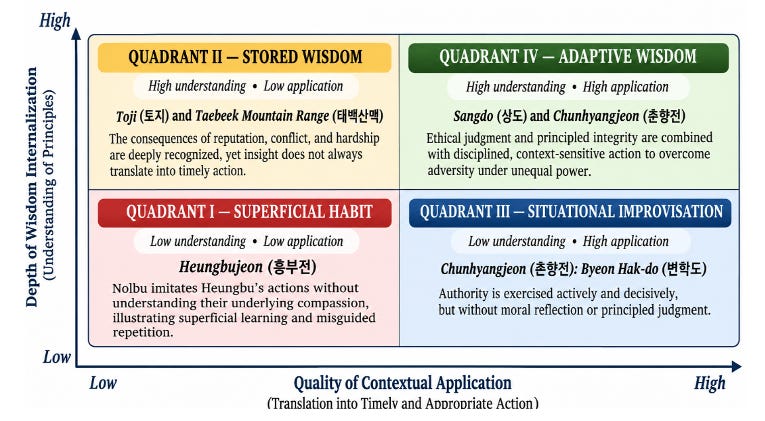
Figure 2 offers interpretive literary illustrations—not definitive classifications—of the same two dimensions used in Figure 1. The quadrants distinguish understanding of inherited principles from the quality of their contextual application. Literary characters may exhibit qualities associated with multiple quadrants; the examples highlight particular decisions rather than categorizing entire novels or persons. Chunhyang’s principled resistance is contrasted with Magistrate Byeon’s misuse of authority, while Sangdo exemplifies ethical judgment grounded in learning.
Figure 2. Integrating Korean Proverbs and Korean Literature in a 2x2 Framework
Source: Author’s conceptual synthesis and interpretation, with AI assistance in visual development.
Note: Quadrants are illustrative readings of particular behaviors, not categorical classifications of literary works.
4.3. Error, Humility, and the Limits of Expertise
Choi In-ho’s Sangdo (상도; Choi, 2000) illustrates how commercial success requires not only expertise but also humility, ethical restraint, and disciplined judgment. Through the life of the legendary Joseon merchant Im Sang-ok, the novel demonstrates that experience and achievement must be accompanied by an awareness of human limitations. The proverb “원숭이도 나무에서 떨어진다” reminds readers that even highly capable individuals remain vulnerable to mistakes, overconfidence, and changing circumstances. In Sangdo, the emphasis on controlling greed and maintaining ethical principles illustrates the importance of preventing success from becoming a source of complacency.
The classical Korean narrative Chunhyangjeon (춘향전; Korean Classical Literature Research Society, 2007) provides a contrasting perspective on authority and integrity. Magistrate Byeon Hak-do uses office and coercion without the ethical discipline that responsible leadership requires; Chunhyang resists despite unequal power. Read alongside “범 없는 곳에 토끼가 스승이다” (“Where there is no tiger, a rabbit is the teacher”), his behavior illustrates why occupying a position of authority is not equivalent to deserving intellectual or moral trust. Chunhyang’s persistence, by contrast, illustrates principled judgment rather than mere situational improvisation.
Together, Sangdo and Chunhyangjeon highlight two complementary lessons about leadership. The former emphasizes humility and ethical discipline among capable individuals, while the latter exposes the dangers of authority disconnected from character and accountability. Strategic judgment requires both the competence to lead and the humility to recognize the limits of one’s competence.
4.4. Habit, Learning, and the Formation of Character
Park Wan-suh’s autobiographical novel Who Ate Up All the Shinga? (그 많던 싱아는 누가 다 먹었을까; Park, 2021) illustrates how childhood experiences, family relationships, education, and historical circumstances influence the formation of character. Growing up during Japanese colonial rule and the turbulent period surrounding the Korean War, the narrator encounters experiences that shape her understanding of identity, responsibility, and society. The proverb “세 살 버릇 여든까지 간다” provides a useful lens for considering how early experiences and repeated practices influence later behavior, although the novel also reveals the continuing capacity for learning and adaptation.
The traditional Korean narrative Heungbujeon (흥부전) offers a powerful illustration of the difference between superficial imitation and genuine understanding. When Heungbu compassionately cares for an injured swallow and receives unexpected rewards, his greedy brother Nolbu attempts to reproduce the same outcome by deliberately injuring another swallow and subsequently treating it. This contrast can be interpreted through the Korean proverb “낫 놓고 기역 자도 모른다,” literally meaning “Even with a sickle placed before one, one cannot recognize the letter giyeok (ㄱ).” While the proverb traditionally refers to a lack of elementary knowledge, Nolbu’s behavior illustrates a related failure of practical and ethical understanding: he recognizes the observable action but fails to comprehend the compassion that gives it moral significance. His superficial imitation demonstrates how copying successful practices without understanding their underlying principles can produce misguided decisions and harmful consequences. The strategic lesson is that genuine wisdom requires understanding why an action is appropriate, not merely knowing how to reproduce it.
These literary examples demonstrate that character formation involves both continuity and change. Early habits and experiences influence long-term behavior, but learning, reflection, and deliberate action can challenge established patterns. This is where “시작이 반이다” becomes especially meaningful: personal development begins when awareness is transformed into a concrete decision to learn or act differently. Good habits build lasting character, but continuous learning makes lasting growth possible.

5. Conclusion
Korean proverbs preserve accumulated social experience in compact forms that continue to illuminate contemporary questions of communication, preparedness, resilience, timing, learning, and character. Korean literature—including Park Kyung-ni’s Toji, Jo Jung-rae’s Taebaek Mountain Range, and Choi In-ho’s Sangdo—extends this wisdom by showing how such principles operate through actual human conflict, hardship, ambition, error, and moral choice; Sangdo, for example, reconstructs the life of merchant Im Sang-ok around themes of economic philosophy and business ethics. Proverbs therefore provide memorable strategic principles, while literature reveals the contextual complexity that determines whether those principles lead to sound or misguided action. The enduring lesson is that old wisdom becomes most valuable not when repeated mechanically, but when combined with contextual judgment, humility, disciplined action, and continuous learning.
References
Choi, I. H. (2000). Sangdo [The way of commerce]. Yeobaek Media.
Choi, J., & Mai-Dalton, R. R. (1998). On the leadership function of self-sacrifice. The Leadership Quarterly, 9(4), 475–501.
Dweck, C. S. (2006). Mindset: The new psychology of success. Random House.
Gigerenzer, G. (2007). Gut feelings: The intelligence of the unconscious. Viking.
Hong, P. C., Singh, N., Kim, S. C., Lee, A., & Park, Y. W. (2025). Pathways to global leadership for Korean firms: Unveiling the strategic evolution of LG and SK in the market dynamics. Asia Pacific Business Review, 1–29. https://doi.org/10.1080/13602381.2025.2499913
Hong, P. C., Singh, N. P., Elangovan, N., & Yeon, G. (2022). Responding to pandemic challenges: Leadership lessons from multinational enterprises (MNEs) in India. Journal of Management Development, 41(4), 205–222.
Jo, J. R. (1989). Taebaeksanmaek [The Taebaek Mountain Range]. Hangilsa.
Kahneman, D. (2011). Thinking, fast and slow. Farrar, Straus and Giroux.
Kim, D., & Jung, B. (2017). A study of Heungbomanborok, a new version of Heungbujeon. Korean Language and Literature, 179, 89–113. https://doi.org/10.17291/kolali.2017..179.003
Korean Classical Literature Research Society. (2007). Chunhyangjeon [The story of Chunhyang] (Korean–English bilingual ed.). Baekam.
March, J. G. (1991). Exploration and exploitation in organizational learning. Organization Science, 2(1), 71–87.
Park, K. N. (2006). Toji [The land]. Naman. (Original work published 1969–1994).
Park, W. S. (2021). Geu manteon singaneun nuga da meogeosseulkka [Who ate up all the Shinga?]. Woongjin ThinkBig. (Original work published 1992).
Reason, J. (1997). Managing the risks of organizational accidents. Ashgate.
Schein, E. H. (2010). Organizational culture and leadership (4th ed.). Jossey-Bass.
Sitkin, S. B. (1992). Learning through failure: The strategy of small losses. Research in Organizational Behavior, 14, 231–266.
Weick, K. E., & Sutcliffe, K. M. (2015). Managing the unexpected: Sustained performance in a complex world (3rd ed.). Jossey-Bass.
About the Author

Paul C. Hong (Editor-in-Chief) - Distinguished University Professor, University of Toledo
Full list of his K-GSP columns:
Paul C. Hong is a Distinguished University Professor at the University of Toledo whose academic background integrates economics, manufacturing management, engineering, and global supply chain strategy. He earned a B.A. in Economics from Yonsei University, an M.A. in Economics from Bowling Green State University, and a Ph.D. in Manufacturing Management and Engineering from the University of Toledo. His research focuses on global supply chain management, strategic benchmarking, manufacturing competitiveness, resilience, industrial policy, and geo-economics, with particular interest in how trade policy, technological change, economic security, and geopolitical competition reshape international production networks and national competitiveness. His current work increasingly examines the intersection of global supply chains, strategic industries, AI-enabled transformation, and geo-economic relations among major economies, emphasizing how firms and nations can balance efficiency, resilience, strategic autonomy, and international cooperation in an increasingly complex global environment.
Suggested Citation
Hong, P. C. (2026, November 19). Old proverbs, modern strategy: Twelve Korean lessons on judgment, resilience, timing, and character. K-GSP Forum. 1-13.
Original Article:

한글 요약
옛 속담, 현대 전략: 판단, 회복탄력성, 타이밍, 인격에 관한 열두 가지 한국적 교훈
한국의 속담은 짧지만 오래 살아남은 지혜이다. 이 글은 열두 가지 한국 속담을 원문, 영어 직역, 전략적 의미, 현대적·문학적 적용의 순서로 분석한다. “발 없는 말이 천 리 간다”와 “가는 말이 고와야 오는 말이 곱다”는 언어의 확산과 상호 존중을, “소 잃고 외양간 고친다”와 “돌다리도 두들겨 보고 건너라”는 예방과 검증의 중요성을 일깨운다.
“고생 끝에 낙이 온다”는 고난 뒤의 회복 가능성을 말하지만 성공을 보장하지는 않는다. “가는 날이 장날이다”는 예측하지 못한 상황과 타이밍을, “시작이 반이다”는 실천의 첫걸음을, “원숭이도 나무에서 떨어진다”는 전문가의 실수 가능성을 보여 준다. “세 살 버릇 여든까지 간다”는 습관의 지속성을, “낫 놓고 기역 자도 모른다”는 기초 지식의 중요성을 강조한다. “꼬리가 길면 잡힌다”는 반복되는 잘못의 흔적을, “범 없는 곳에 토끼가 스승이다”는 권위와 실제 역량의 차이를 드러낸다.
본 글은 지혜의 내면화 수준과 맥락적 적용의 질을 두 축으로 하는 2×2 틀을 제시한다. 피상적 습관, 저장된 지혜, 상황적 즉흥성, 적응적 지혜의 네 유형은 속담의 암기와 실천이 서로 다르다는 점을 설명한다. 특히 적응적 지혜는 옛 교훈의 원리를 정확히 이해하면서도 변화하는 환경에 맞게 적용하는 역량이다.
박경리의 『토지』, 조정래의 『태백산맥』, 최인호의 『상도』, 박완서의 『그 많던 싱아는 누가 다 먹었을까』, 고전 『흥부전』, 고전 『춘향전』은 속담이 현실의 갈등, 불확실성, 도덕적 선택 속에서 어떻게 시험받는지 보여 준다. 문학 작품에 대한 네 사분면의 배치는 정해진 분류가 아니라 선택된 행동을 해석하는 예시이다. 오래된 지혜는 기계적으로 반복할 때보다 맥락적 판단, 겸손, 검증, 책임 있는 실천과 결합할 때 더욱 가치가 있다.
Paul C. Hong은 미국 University of Toledo의 Distinguished University Professor로, 글로벌 공급망 관리, 기업 전략, 제조업 경쟁력, 회복탄력성, 조직과 리더십 분야를 연구한다. 최근에는 한국 역사와 문학, 문화적 지혜를 현대의 전략적 사고와 연결하는 글을 발표하고 있다.
© K-Global Scholars and Professionals Forum. All rights reserved. Content published in the K-GSP Forum may not be reproduced, distributed, or transmitted in any form without prior written permission from the K-GSP Forum, except for brief quotations with full attribution.