

Echoes of Ink and Stone: Premodern Literary Sites of Seoul
Following the collapse of the Goryeo Dynasty (918-1392), Seoul became the capital of the Joseon Dynasty (1392-1910). It remained the political center of Korea throughout the period of Japanese colonial rule and, following the division of the Korean Peninsula, has continued to serve as the capital of South Korea. For more than six centuries, Seoul has stood at the heart of the nation’s political, economic, and cultural life. Countless writers and poets have called the city home, shaping Korea’s literary traditions and influencing artistic movements across the country.
Whenever I visit South Korea, I enjoy meeting friends in Seoul over a meal before exploring literary sites based on my prior research. Some of these places are destinations I have sought out in advance; others I have discovered unexpectedly while wandering through the city. Korea has demonstrated a deep commitment to preserving its cultural heritage, with both national and local governments dedicating significant resources to restoring and maintaining these sites as educational resources and destinations for cultural tourism. Amid the demands of modern urban life, some residents may pass by these hidden treasures without noticing them. For overseas visitors like me, however, they offer delightful discoveries and foster a deeper appreciation of Korea’s efforts to preserve and share its cultural legacy.
This essay presents photographs of premodern literary sites I have encountered during my visits to South Korea since around 2017. The Korean government often places small stone monuments at locations associated with renowned literary figures of the past. Throughout parks and along streets, visitors can find numerous stones inscribed with celebrated poems. On one occasion, I even discovered an old sijo prominently displayed on the interior wall of a restaurant.
This photographic journey begins at and around Seoul Station, a historic building completed in 1925, and continues through several other parts of the metropolitan city. Through these images, I hope to show how literature continues to inhabit Seoul’s physical spaces, connecting the voices of the past with the rhythms of the present. Each original text—whether in Classical Chinese or Korean—is accompanied by my English translation.
Although contemporary South Korea is a fast-paced, capitalist, and technology-driven society, it retains a deep and enduring appreciation for literary art. Having lived in the United States for many years, I find this cultural commitment both refreshing and inspiring. After all, literature has the power to refine, enrich, and elevate the human spirit.
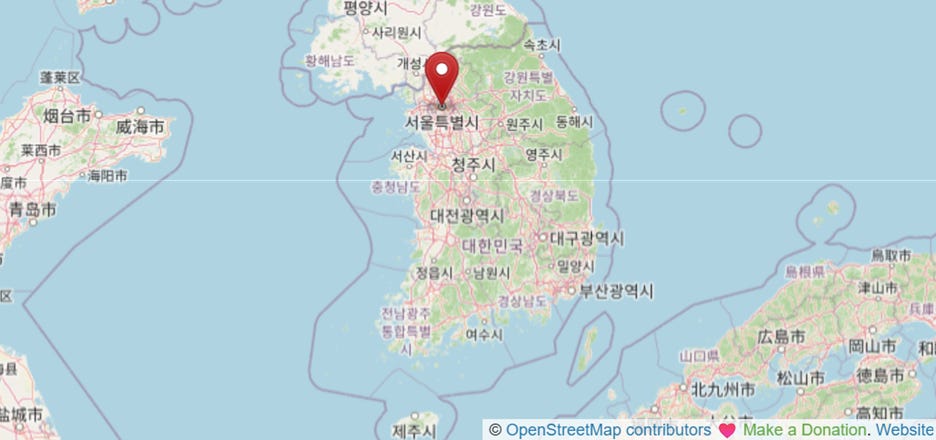
Seoul lies only about 45 miles south of Kaesong by road. Once the capital of the Goryeo Dynasty (918-1392), Kaesong is now located in present-day North Korea, just north of the Korean Demilitarized Zone (DMZ). Composite image based on map data © OpenStreetMap contributors.
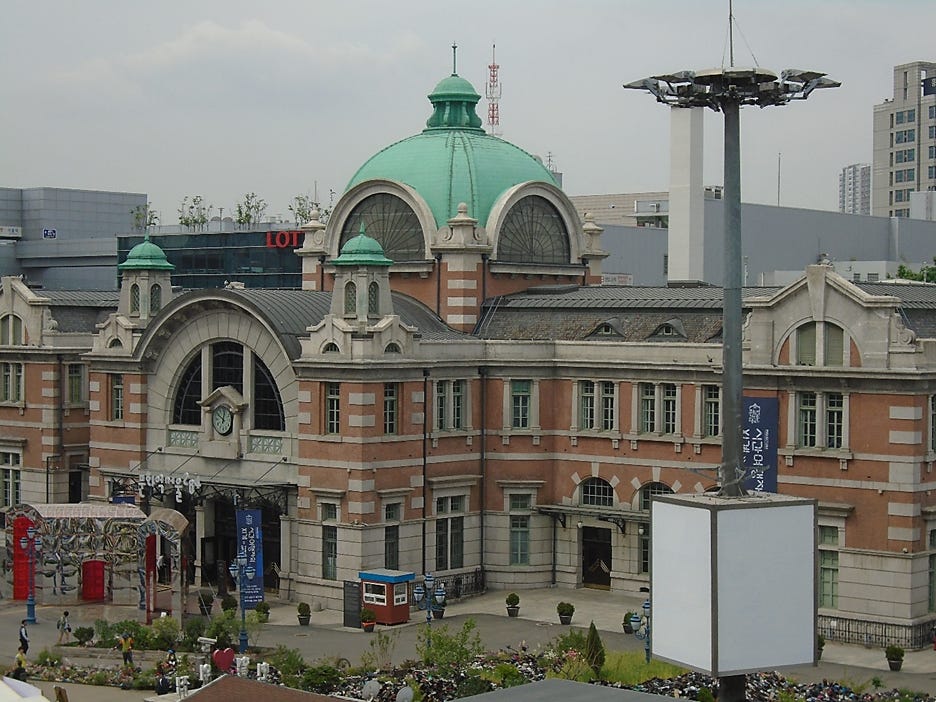
Seoul Station is viewed from Seoul Sky Garden, a 1-kilometer-long elevated linear park in central Seoul created from a former highway overpass. Opened in 2017, the pedestrian walkway connects neighborhoods around Seoul Station while offering visitors a unique perspective on one of the city’s most historic transportation hubs. From this elevated vantage point, the Renaissance-style Seoul Station building, completed in 1925 during the Japanese colonial period, stands as a reminder of Seoul’s layered history—a city where traces of modern transformation coexist with memories of the past.
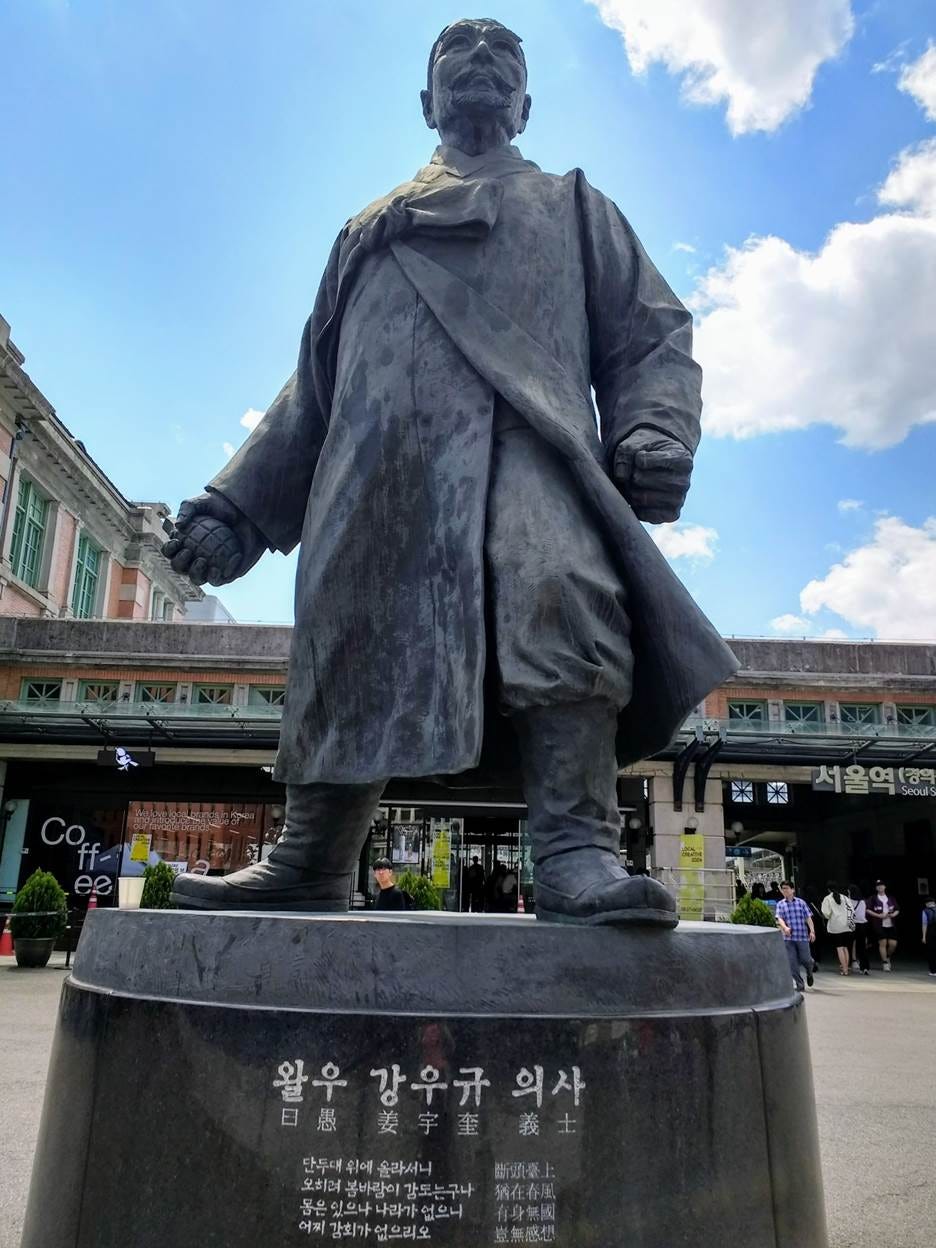
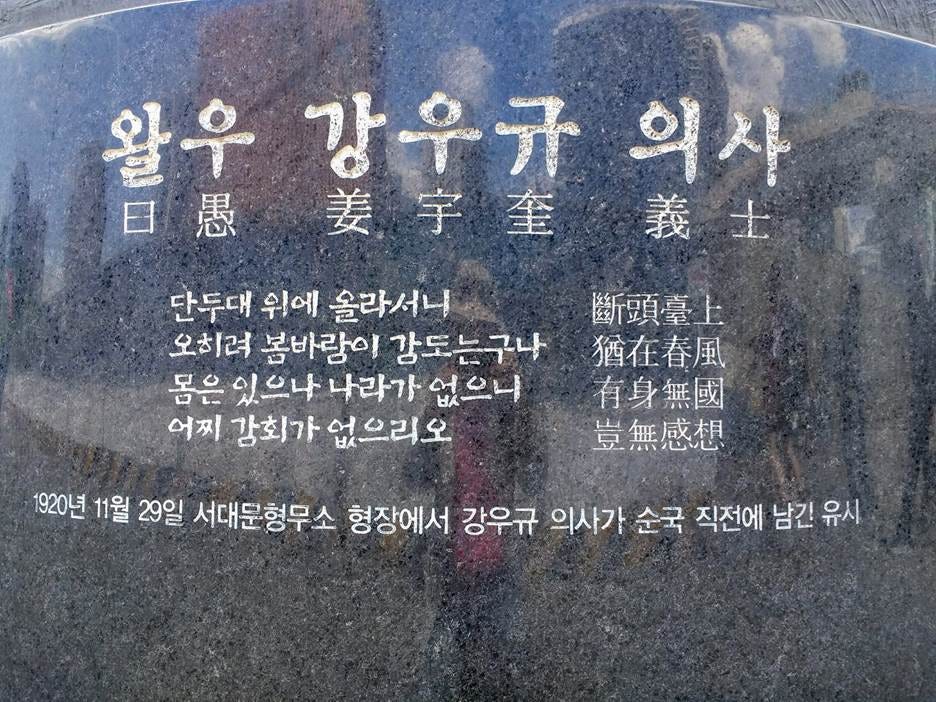
Statue of Kang U-gyu at Seoul Station. Standing outside Seoul Station, the statue of Kang U-gyu (姜宇奎, 1855-1920) honors one of Korea’s most revered independence activists. A practitioner of traditional Korean medicine, Kang joined the Korean independence movement after Japan’s annexation of Korea in 1910. On September 2, 1919, at the age of sixty-four, he attempted to assassinate Saitō Makoto, the newly appointed Japanese Governor-General of Korea, by throwing a bomb during the official welcoming ceremony at Seoul Station. Although the attempt failed and several bystanders were injured, Kang accepted full responsibility for his actions and was sentenced to death. Before his execution at Seodaemun Prison on November 29, 1920, he declared that he regretted only that he had done too little for his country and hoped his sacrifice would awaken Korea’s youth to the cause of national independence. In 1962, the Republic of Korea posthumously awarded him the Order of Merit for National Foundation.
Although Kang U-gyu lived during the modern era, I include him among the premodern poets in this collection for two reasons. Born in 1855, he belonged to the last generation educated in the classical literary tradition, and his final poem was composed in literary Chinese (hanmun), the language that had served as the principal medium of scholarly writing in Korea for centuries. His death poem, uttered in response to a Japanese prosecutor’s question about his thoughts as he awaited execution, reflects the moral dignity of the Confucian scholar as well as the patriotism of the modern independence movement.
斷頭臺上
猶在春風
有身無國
豈無感想
On the Execution Platform: A Death Poem
Upon the execution platform,
the spring breeze still blows.
Though I still possess this body,
how could I feel nothing when my country is gone?
His brief poem transforms a moment of personal suffering into a meditation on national loss and moral conviction. The gentle image of the spring breeze contrasts with the brutality of the execution platform, while the final line expresses profound sorrow for a nation deprived of its sovereignty. In only sixteen Chinese characters, Kang transforms his final words into a lasting testament of courage, patriotism, and unwavering devotion to Korea’s independence.
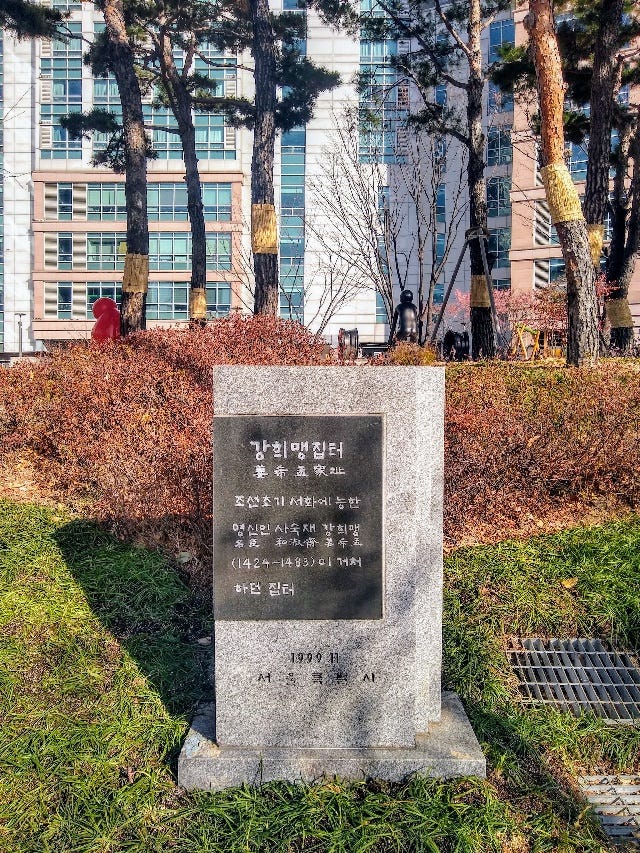
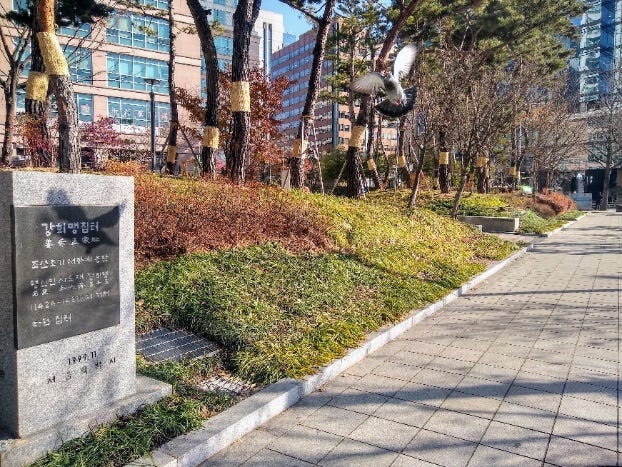
This is where Kang Hee-maeng’s residence once stood. Kang Hee-maeng (1424-1483) was a scholar, courtier, writer, poet, painter, and agricultural expert during the early Joseon Dynasty. On December 26, 2024, I strolled around Seoul Station, heading toward Yeomcheon Bridge. After crossing the bridge, I discovered a marker located about a seven- to ten-minute walk from the station. The marker reads: “This is the site where the house of Kang Hee-maeng, an esteemed writer and painter of the early Joseon period, once stood.”
Kang compiled two collections of his writings, Miscellaneous Records of Geumyang (Chinese: 衿陽雜錄) and Chondam’s Casual Conversations (Chinese: 村談解燎). He also produced Jinsan Family Collection (Chinese: 晋山世稿), which compiles the poems of his grandfather, father, and older brother Heean. Kang is known for several celebrated Chinese poems, including “Composed After an Illness,” which portrays the comfort and tranquility found in nature:
病餘吟成
南窓終日坐忘機
庭院無人鳥學飛
細草暗香難覓處
淡煙殘照雨霏霏
Composed After Illness
Sitting by the southern window all day, I forget the worries of the world.
No one lingers in the garden as young birds learn to fly.
In a place where even the subtle fragrance of tender grass is difficult to find,
A gentle rain falls through the clear mist and fading sunlight.
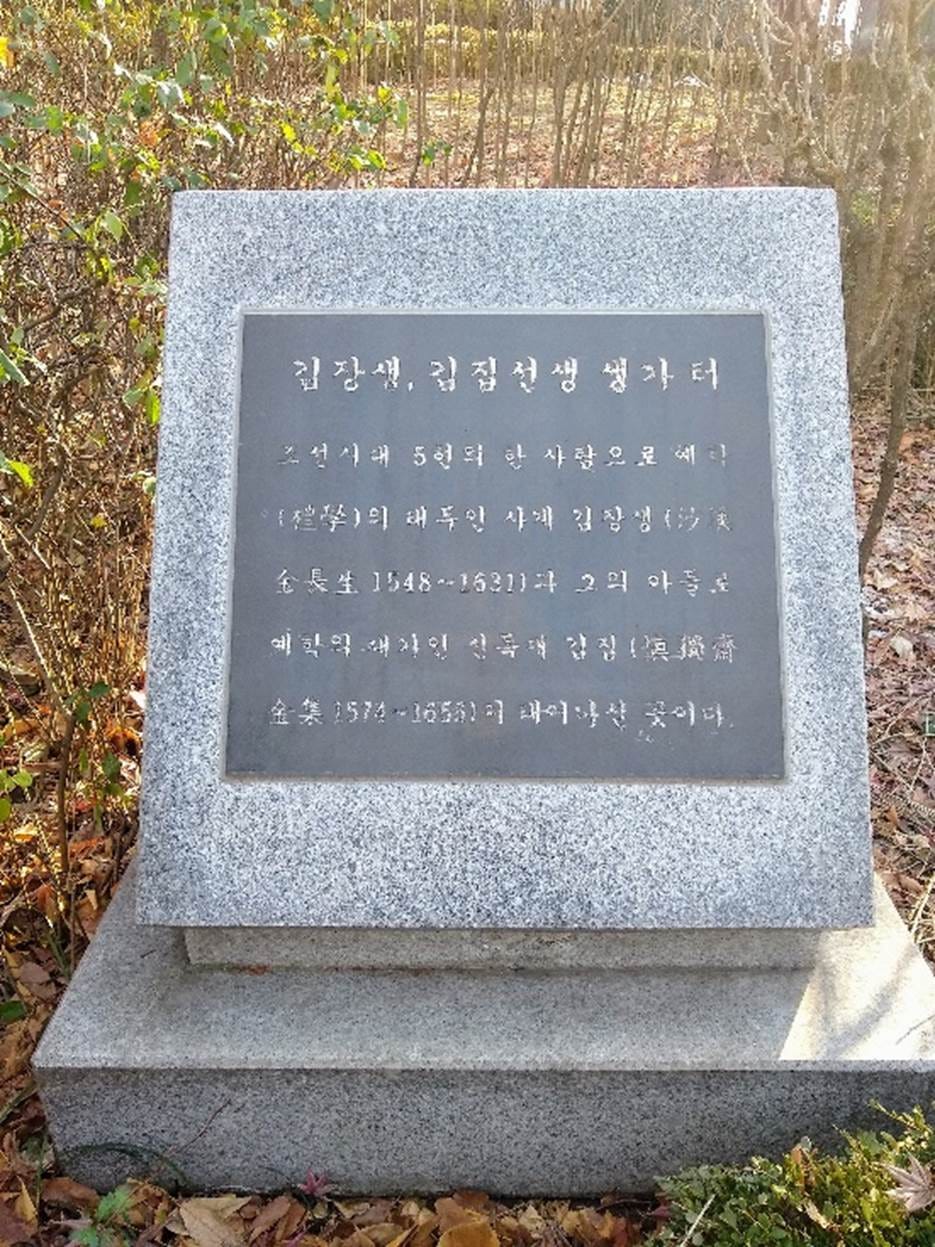
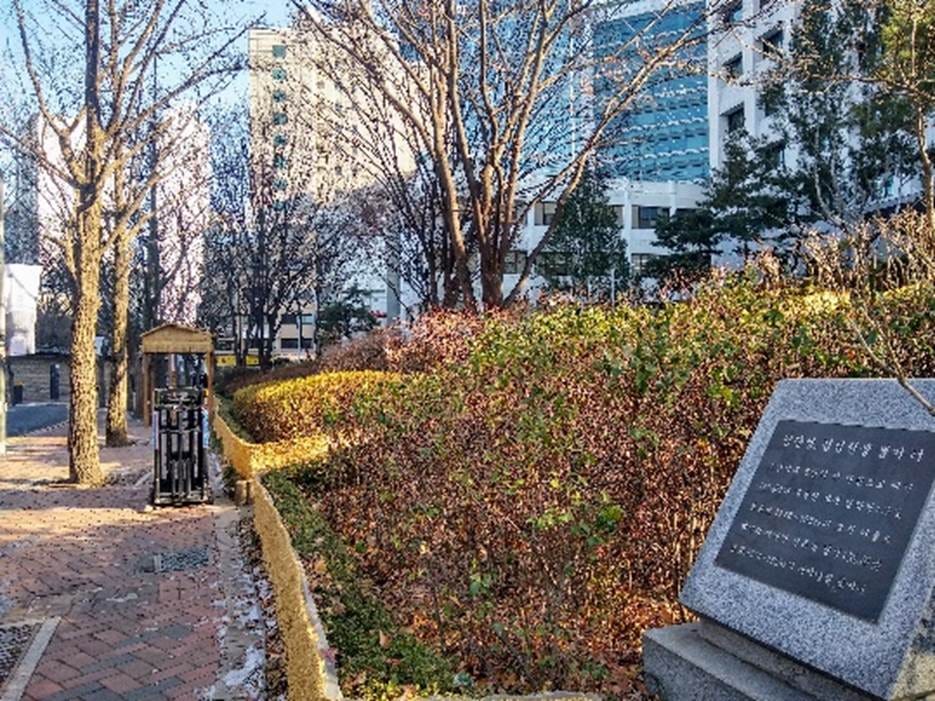
This is the birthplace of Kim Jang-saeng and Kim Jip. After viewing Kang Hee-maeng’s marker, I continued toward Deoksugung Palace, one of the royal palaces of Seoul. After walking for about ten minutes, I came across a stone marker commemorating the birthplace of Kim Jang-saeng (1548-1631) and his son, Kim Jip (1574-1656).
Kim Jang-saeng was a Neo-Confucian scholar, politician, writer, and civil official of the Joseon Dynasty. He is regarded as a pioneer in the study of Confucian rituals. He authored eight books, including Collection of Family Rituals (Chinese: 家禮輯覽) and Essentials of Funeral Rites (Chinese: 喪禮備要).
Kim Jip, whose pen name was Sindokjae (愼獨齋), was a Confucian scholar, writer, and civil official who held various government positions during the mid-Joseon period. He is known for compiling two works: The Collected Writings of Sindokjae (Chinese: 愼獨齋文集) and Continued Explanations of Doubts Regarding Rituals (Chinese: 疑禮問解續).
Below are two well-known Chinese poems, one by Kim Jang-saeng and the other by his son. In the first poem, Kim Jang-saeng recalls the cherished memory of meeting his friend Yun Jeong-gyeong amid the natural beauty of Gayasan Mountain. In the second, Kim Jip expresses his longing for home as he awakens to a peaceful early spring morning.
Kim Jang-saeng:
伽倻山逢 尹正卿
邂逅伽倻寺
行裝帶雨痕
相逢方一笑
相對卻 忘言
Meeting Yun Jeong-gyeong at Gaya Mountain
—At Gaya Mountain, I meet Yun Jeong-gyeong.
At Gaya Temple, we meet by chance,
Our travel garments still bearing traces of rain.
At our reunion, we exchange a joyful laugh;
Facing each other, we fall into wordless silence.
*
Kim Jip:
春曉
虛室人初覺
春天夜已闌
孤雲依水宿
殘月映松閒
心靜都忘世
夢恬不出山
緬思故園竹
長得幾何竿
Spring Dawn
In an empty chamber, I awaken alone;
The spring night has already drawn to a close.
A solitary cloud rests above the waters,
The fading moon shines quietly through the pines.
My heart is tranquil, and I forget the world;
My peaceful dream keeps me within these mountains.
I think with longing of the bamboo in my old garden—
How many stalks must have grown since I departed?
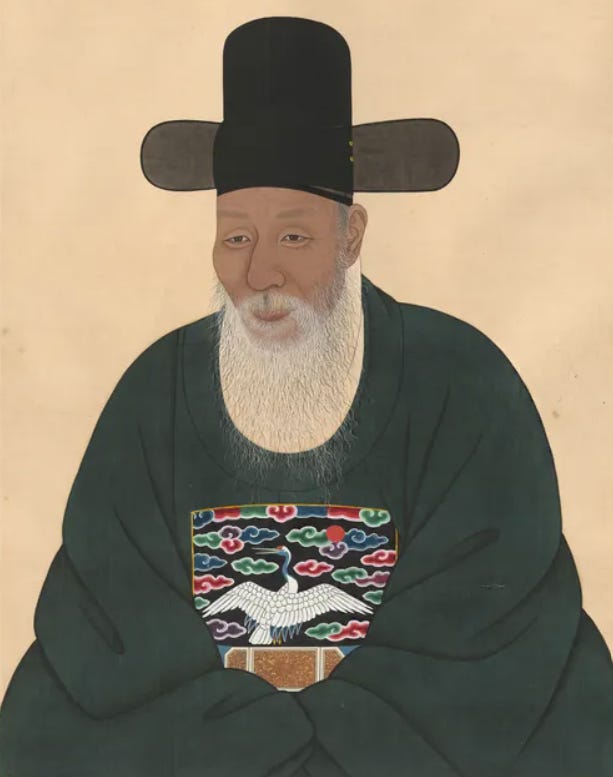
Image credit: Portrait of Kim Jangsaeng, 17th century, unknown artist, National Museum of Korea. Public domain image via Wikimedia Commons; Korea Open Government License Type 1.
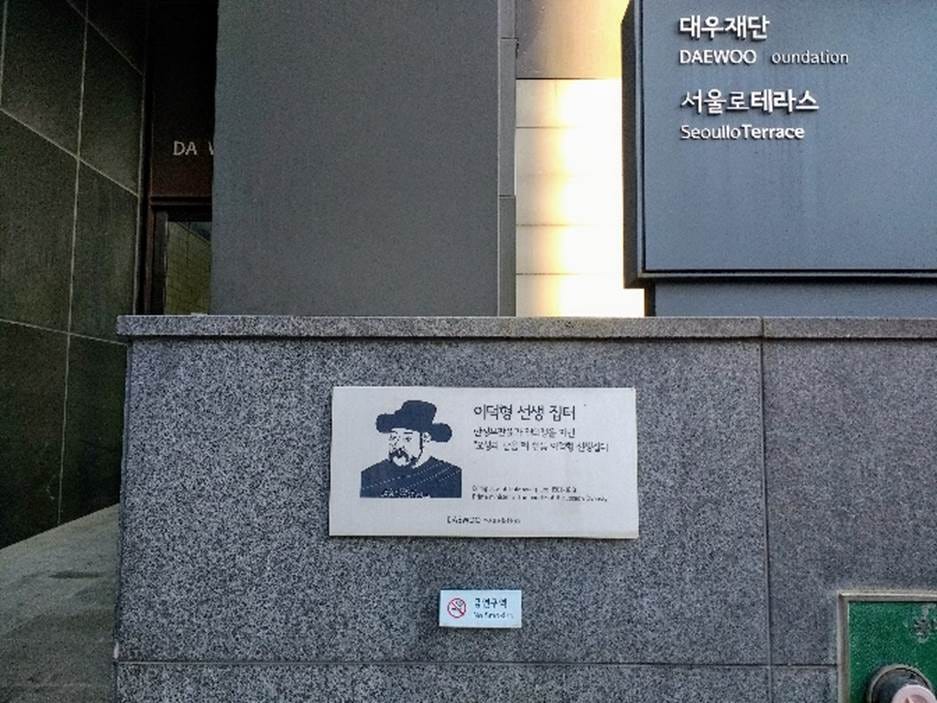
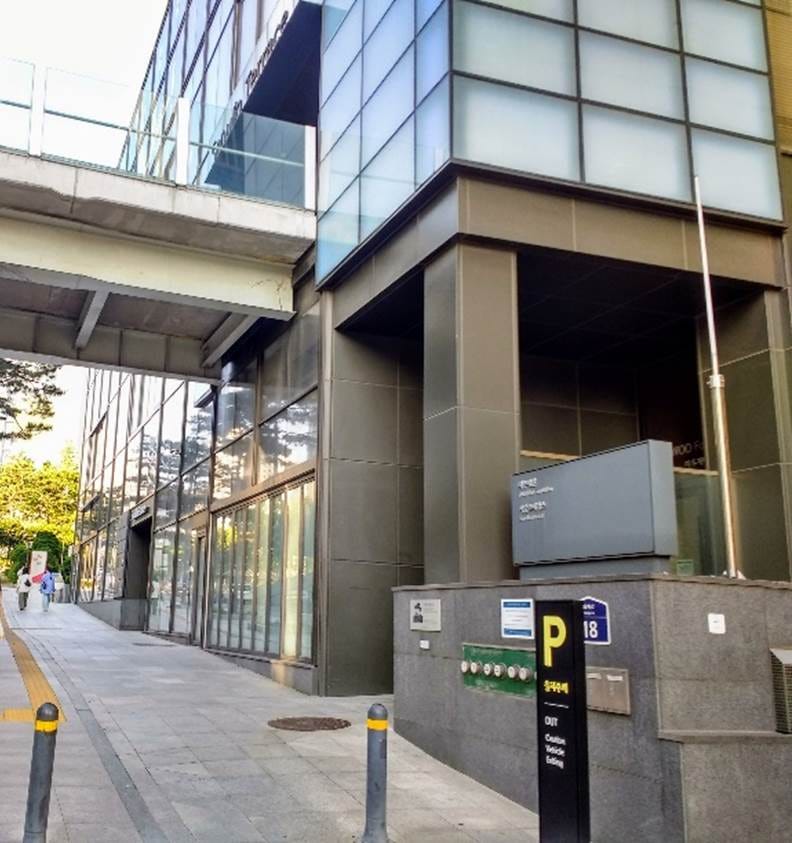
This is the site of Yi Deok-hyeong’s former residence. On June 1, 2024, I strolled around Seoul Station on my way to Namsan Mountain, where I planned to visit several cultural landmarks. Across the street from the station, I noticed a plaque attached to the base of the Daewoo Building. It commemorates the former residence of the famous courtier and writer Yi Deok-hyeong (李德馨, 1561-1613), whose Korean sijo, “The Red Persimmon,” is a widely studied poem among Korean middle and high school students. The poem expresses the Confucian virtue of filial piety as the poet laments the absence of his parents. Upon seeing a ripe red persimmon, he reflects on how deeply he wishes he could offer it to them if they were still alive.
(Korean)
반중(盤中) 조홍(早紅)감이 고와도 보이나다
유자(柚子) 아니라도 품은 즉 하다마는
품어가 반길 이 없을 새 글로 설워하나이다
The Red Persimmon
The early red persimmon in the tray appears so beautiful.
Though it is not a yuzu, it would still be a worthy gift to offer.
Yet there is no one left to receive it from my hands;
and so I grieve, expressing my sorrow in this poem.
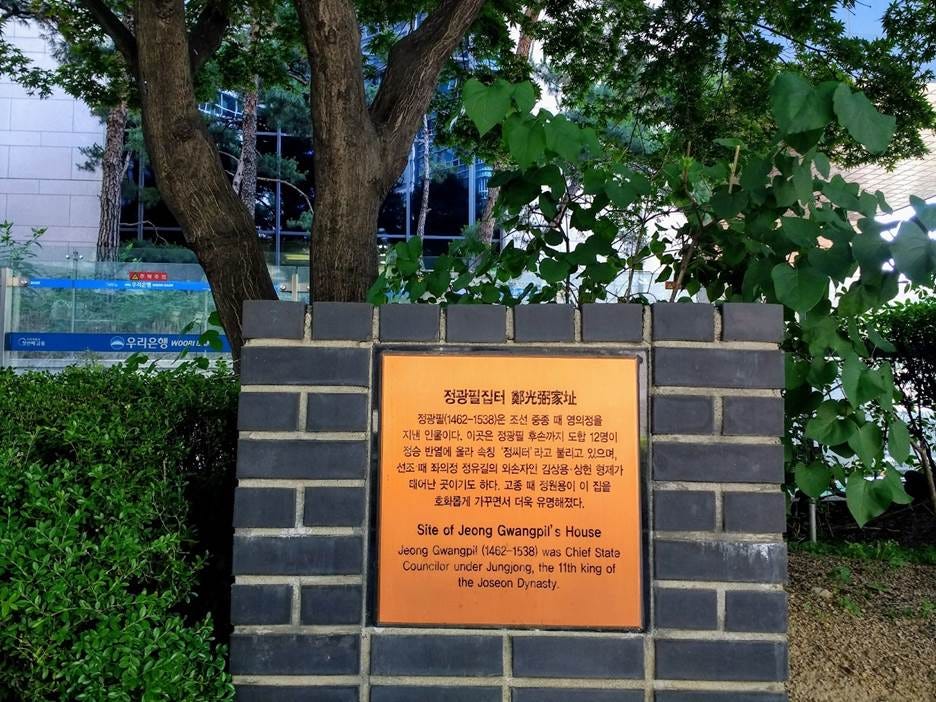
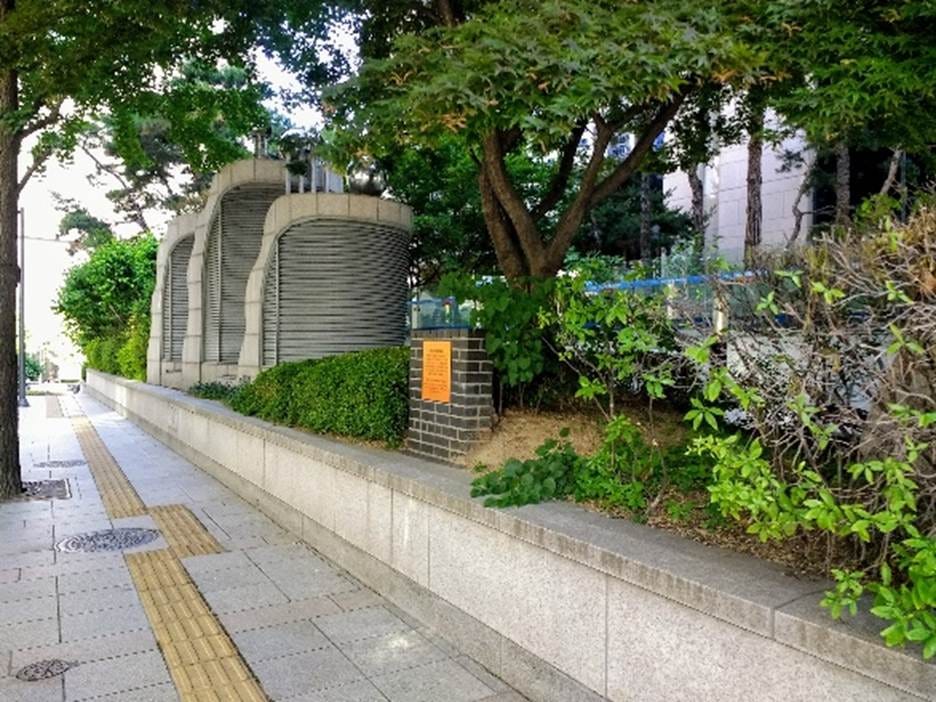
This is the site of Jeong Gwang-pil’s former residence. The plaque reads:
Site of Jeong Gwang-pil’s House
Jeong Gwang-pil (鄭光弼, 1462-1538) was Chief State Councilor during the reign of King Jungjong, the 11th monarch of the Joseon Dynasty.
On June 2, 2024, I left my hotel in Hoehyeon-dong, central Seoul, to visit Myeong-dong, a historic district associated with Korea’s modernization. While walking along the sidewalk, I encountered a familiar name from premodern Korean politics and literature: Jeong Gwang-pil. Like many scholar-officials of his time, he was skilled in composing poetry, and one of his works is translated below. Written during his journey into exile, this Chinese poem expresses Jeong’s gratitude toward the king as well as the loneliness and desolation of his surroundings.
自懷德向金海途中吟
積謗如山竟見原
此生無計答天恩
十登峻嶺雙垂淚
三渡長江獨斷魂
漠漠孤峯雲潑墨
茫茫大野雨翻盆
暮投臨海東城宿
草屋蕭蕭竹作門
Written During the Journey from Hoedeok to Gimhae
Though slander rose like a mountain, I was finally vindicated.
In this life, I have no way to repay Heaven’s grace and the king’s favor.
Over ten steep ridges, tears fell from both my eyes;
Across three great rivers, my lonely heart was broken with sorrow.
A solitary peak fades into the distance, clouds spreading like spilled ink;
The boundless plain stretches away, rain pouring down like overturned basins.
At dusk, I find lodging in an eastern town beside the sea;
A desolate thatched hut stands with bamboo forming its gate.
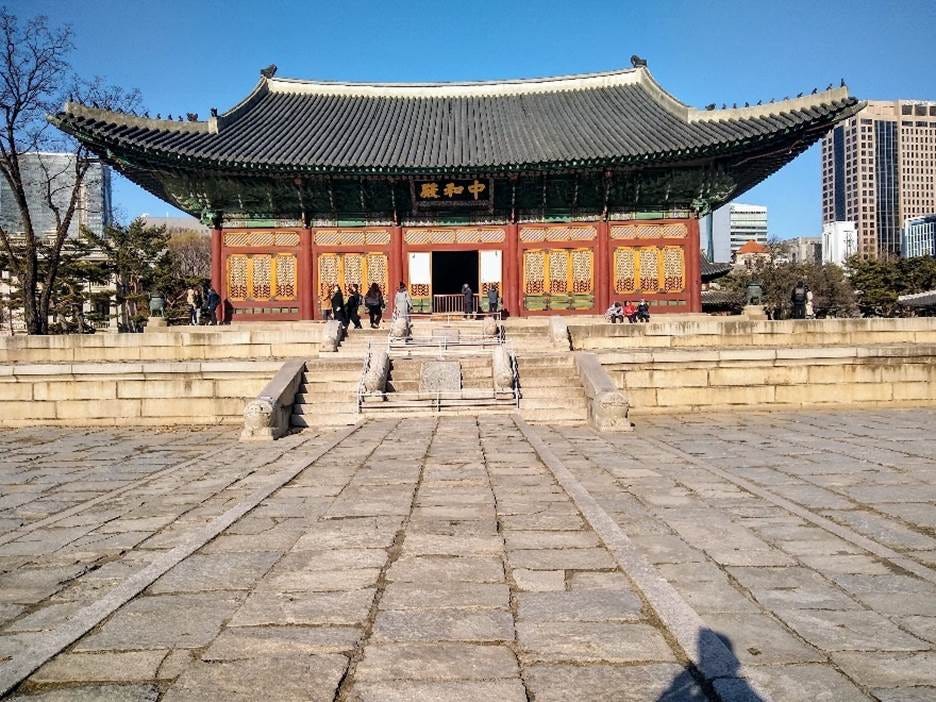
After walking a mile north from Seoul Station, I arrived at Deoksu Palace, located west of Seoul City Hall, on December 26, 2024. The palace served as the main royal court of the Daehan (Great Korean) Empire from 1897 to 1910. Ironically, there was little “great” about the so-called empire, as Korea was on the verge of annexation by Japan, which ruled the Korean Peninsula from 1910 to 1945. Many Koreans believe that the Joseon Dynasty (1392-1897) contributed to the country’s downfall by over-relying on China, prioritizing literary scholarship and Confucianism over military and technological advancement, and failing to embrace Western culture early enough. By contrast, Japan became a world power just half a century after opening its doors to the West—strong enough to defeat Russia in the Russo-Japanese War (1904-1905).
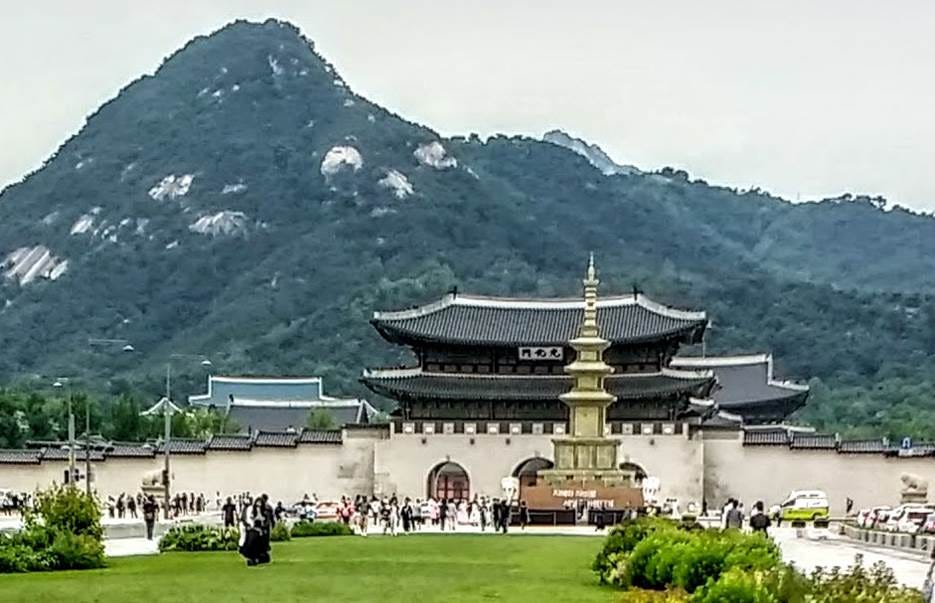
Gwanghwamun, the imposing southern gate of Gyeongbokgung Palace, marks the principal entrance to the royal palace founded in 1395 as the first palace of the Joseon Dynasty. Behind the gate lies Gyeongbokgung, where generations of kings governed Korea and where King Sejong the Great later oversaw the creation of Hunminjeongeum (訓民正音), the original name of the Korean alphabet now known as Hangul. Destroyed during the Japanese invasions of the sixteenth century, partially restored in the nineteenth century, and heavily damaged during the Japanese colonial period, the palace has undergone extensive restoration since the late twentieth century. Today, Gwanghwamun stands once again as one of Seoul’s most enduring symbols of Korea’s cultural heritage and historical resilience.
The statesman, scholar, and poet Jeong Do-jeon (鄭道傳, 1342-1398), a chief architect of the Joseon Dynasty and one of the principal planners of its new capital, celebrated the splendor of the royal city in his classical Chinese poem “Eight Views of the New Capital” (Sindo Palgyeongsi, 新都八景詩). The following excerpt from the poem evokes the grandeur and vitality of the newly established palace and capital.
新都八景詩
城高鐵甕千尋
雲繞蓬萊五色
年年上苑鶯花
歲歲都人遊樂
From “Eight Views of the New Capital”
The city walls soar, an iron fortress a thousand fathoms high,
While palace halls gleam amid clouds in five radiant hues.
Year after year, blossoms bloom as orioles sing in the royal gardens;
Season after season, the people of the capital delight in their flourishing city.
Written shortly after the founding of Joseon, these lines portray the new capital not merely as a seat of political power but as a place of beauty, harmony, and prosperity. They capture the optimism surrounding the birth of a new dynasty and the enduring significance of Gyeongbokgung as the symbolic heart of the Korean nation.
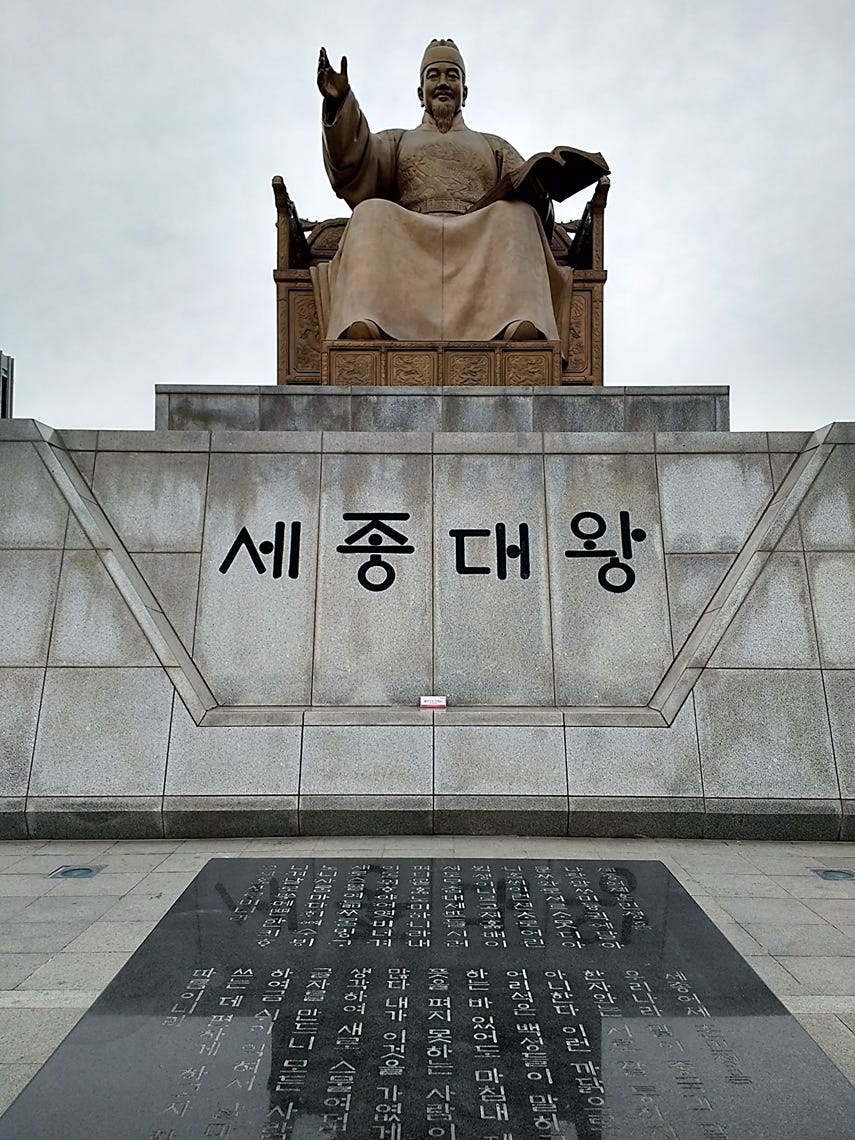
Located at Gwanghwamun Plaza in the heart of Seoul, the Statue of King Sejong the Great commemorates the fourth monarch of the Joseon Dynasty (r. 1418-1450) and one of Korea’s most admired historical figures. Unveiled in 2009, the golden statue stands near Gyeongbokgung Palace, the principal royal palace of Joseon, and has become one of Seoul’s most recognizable landmarks. King Sejong is best remembered for creating and promulgating Hunminjeongeum (訓民正音), the original name of the Korean alphabet now known as Hangul, in 1446—an achievement that transformed Korean literacy and culture. Beyond linguistics, however, he was also a devoted patron of literature, science, agriculture, and Confucian learning. His reign represented one of the most intellectually and culturally productive periods in Korean history.
Among the writings attributed to King Sejong, “A Poem Composed in a Dream” (Mongjungjak, 夢中作) is the only classical Chinese poem by him preserved in the Annals of the Joseon Dynasty. Written in 1446, the year of the promulgation of Hunminjeongeum, this seven-character quatrain expresses both the prosperity of the kingdom and the king’s personal humility and sense of responsibility as a ruler.
夢中作
雨饒郊野民心樂
日暎京都喜氣新
多慶雖云由積累
只爲吾君愼厥身
A Poem Composed in a Dream
Rain nourishes the fields beyond the city,
And the people rejoice with grateful hearts.
The sun shines upon the capital,
Bringing a renewed spirit of joy.
Though abundant blessings may arise
From accumulated virtue and good deeds,
A ruler must above all else
Remain cautious and humble in his conduct.
In this brief poem, King Sejong presents a vision of an ideal kingdom blessed by nature and harmony, yet he attributes its prosperity not to his own achievements but to accumulated virtue and the proper conduct of a ruler. The poem reveals a side of Sejong often overshadowed by his monumental contributions to Korean culture: a thoughtful leader who viewed moral self-discipline as the foundation of good governance.
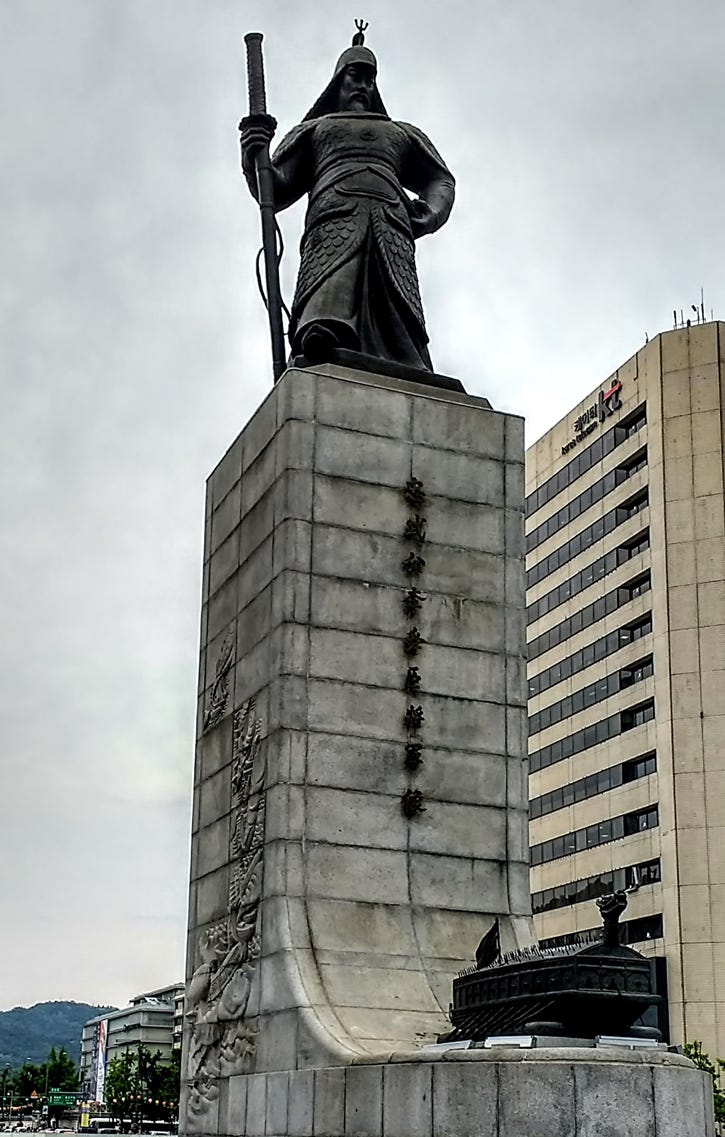
Standing at the southern end of Gwanghwamun Plaza, the Statue of Admiral Yi Sun-sin commemorates one of Korea’s greatest military heroes. Erected in 1968, the bronze statue portrays the admiral standing with a sword in hand, symbolizing courage, loyalty, and determination. In front of the statue stand a model of the geobukseon (turtle ship), the famous warship associated with his naval victories, and two ceremonial drums representing his military campaigns.
Admiral Yi Sun-sin (李舜臣, 1545-1598) served during the Imjin War (1592-1598), when Japan launched invasions of Korea. Despite being outnumbered and facing numerous hardships, he achieved a series of remarkable naval victories and played a crucial role in defending the nation. His strategic brilliance, unwavering loyalty, and personal integrity have made him one of the most revered figures in Korean history. Yet beyond his identity as a military commander, Yi was also a gifted writer whose poems reveal his inner struggles, patriotism, and emotional sensitivity.
The following sijo was written while Yi was stationed on Hansan Island during the Imjin War. Rather than celebrating victory, the poem captures a moment of solitude as the admiral reflects on the uncertain fate of his country. The sound of a distant flute intensifies his sorrow and reveals the burden carried by a leader responsible for the survival of his nation.
(Korean)
한산섬 달 밝은 밤에 수루(戍樓)에 홀로 앉아
긴 칼 옆에 차고 깊은 시름하는 적에
어디서 일성호가(一聲胡笳)는 남의 애를 끊나니
On a Moonlit Night at Hansan Island
On a night when the bright moon shines over Hansan Island,
I sit alone inside the watchtower.
With my long sword resting at my side,
I remain lost in deep sorrow for the fate of my kingdom.
From somewhere in the distance comes the sound of a single flute,
Its mournful melody piercing my heart with sorrow.
In this celebrated sijo, the moonlit island becomes a landscape of reflection and loneliness. The sword beside him represents duty and readiness, while the distant flute evokes the pain of separation and uncertainty. The poem reveals a different dimension of Yi Sun-sin—not only as a victorious admiral but also as a human being who carried profound emotional and moral responsibility during one of Korea’s darkest moments.
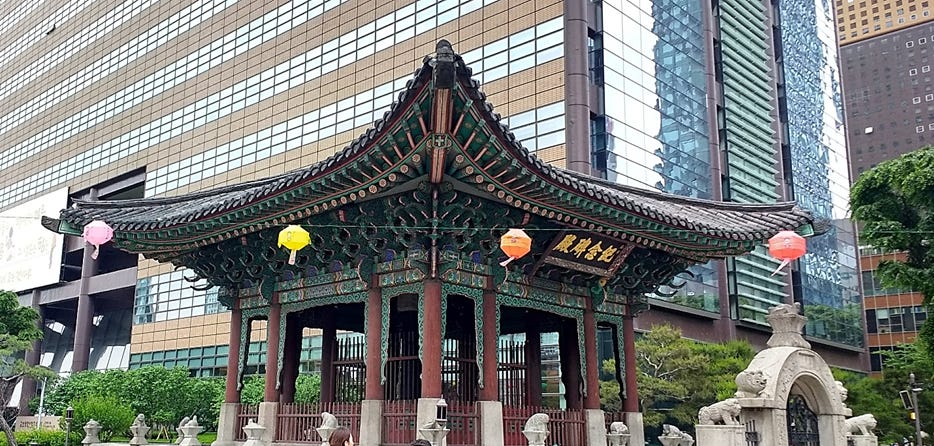
Located near Gwanghwamun Square in central Seoul, beside Kyobo Book Center, the Monument Commemorating the 40th Anniversary of Emperor Gojong’s Enthronement (1902) preserves a significant moment in the final years of the Joseon Dynasty and the founding era of the Korean Empire. Designated Historic Site No. 171 of South Korea, the monument was erected in 1902 to celebrate the 40th anniversary of Gojong’s accession to the throne and his entry into the Giroso (Office of Senior Officials) at the age of fifty-one.
The inscription on the monument records the proclamation of the Korean Empire in 1897, when King Gojong performed the imperial enthronement ceremony at Wongudan (Altar of Heaven), declared himself emperor, and adopted the reign title Gwangmu. The inscription was composed by Yun Yong-seon (尹容善, 1829-1904), who served as Chief State Councilor of the Korean Empire, and calligraphed by Min Byeong-seok (閔丙奭, 1858-1940). The title inscription at the top of the monument was written by Crown Prince Sunjong, who later became the second and final emperor of Korea. Yun’s classical Chinese inscription poem celebrates the founding of the Korean Empire and expresses wishes for the longevity and prosperity of Emperor Gojong.
圜丘展禮
丕顯鴻名
國號曰韓
紀元光武
四十御極
五十有一
耆社展慶
萬壽無疆
Song of the Monument Commemorating Emperor Gojong’s 40th Anniversary of Rule
by Yun Yong-seon (尹容善)
At Wongudan, the rites to Heaven are performed,
And the great and radiant imperial name is proclaimed.
The name of the nation is called Daehan,
And the new era is named Gwangmu.
Forty years have passed since he ascended the throne,
And he has reached the age of fifty-one.
Entering the Office of Senior Officials,
May he enjoy celebration and honor.
May his life be without end;
May he enjoy boundless longevity.
The poem reflects the hopes and aspirations surrounding the establishment of the Korean Empire. By invoking Heaven, the imperial title, and the continuity of royal rule, the inscription presents Gojong’s reign as a moment of national renewal and dignity during a period of profound political change.
Amid Seoul’s busy urban life, one can often encounter unexpected traces of Korea’s literary heritage. On the interior wall of a restaurant, I discovered a famous sijo by Maeng Sa-seong (孟思誠, 1360-1438), a prominent scholar-official of the early Joseon Dynasty. Maeng passed the civil service examination in 1386 and served in several important government positions, including Minister of Rites, Minister of Personnel, Right State Councilor, and Left State Councilor. Even after retiring from public office, he remained highly respected, and the court continued to seek his counsel on important matters.
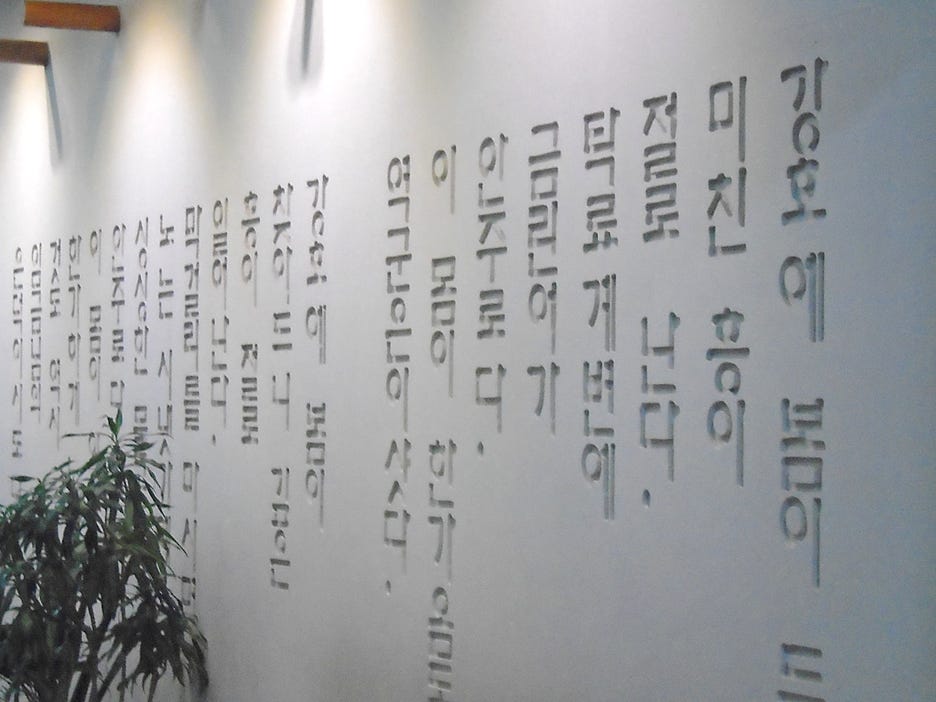
Beyond his political achievements, Maeng was also known for his appreciation of music and the arts. In his later years, after withdrawing from government service, he turned to the natural world for inspiration and composed “Ode to the Four Seasons” (Ganghoga, 江湖歌, also known as Sasihanjeongga, 四時閒情歌), a four-part yeonsijo (連時調) celebrating the changing seasons along rivers and lakes. Each poem begins with the phrase “At the rivers and lakes” (gangho, 江湖) and concludes with the refrain “Indeed, this too is the king’s grace” (yeokgun-eun, 亦君恩), expressing his gratitude for the peaceful life he enjoyed after leaving government service. Below, the original Korean text of the first of the four parts is followed by an English translation.
(Korean)
江湖(강호)에 봄이 드니 미친 興(흥)이 절로 난다.
탁료 계변에 錦鱗魚(금린어) 안쥐로다.
이 몸이 閒暇(한가)해옴도 亦君恩(역군은)이샷다.
Ode to the Four Seasons
—A yeonsijo by Maeng Sa-seong (孟思誠)
Spring
Spring arrives upon the rivers and lakes,
and joy rises beyond my restraint.
By the stream where I share a cup of unrefined rice wine,
fresh golden-scaled fish make a delightful meal.
That this old man may live so freely and at ease—
indeed, this too is the king’s grace.
Through simple images of wine and fishing, Maeng Sa-seong transforms an ordinary life close to nature into a meditation on gratitude and contentment. The repeated phrase “the king’s grace” reflects the Confucian ideal of loyalty, but it also reveals the poet’s appreciation for a peaceful existence away from political ambition. This sijo, preserved unexpectedly on a restaurant wall in modern Seoul, demonstrates how deeply classical literature continues to inhabit Korea’s everyday spaces.
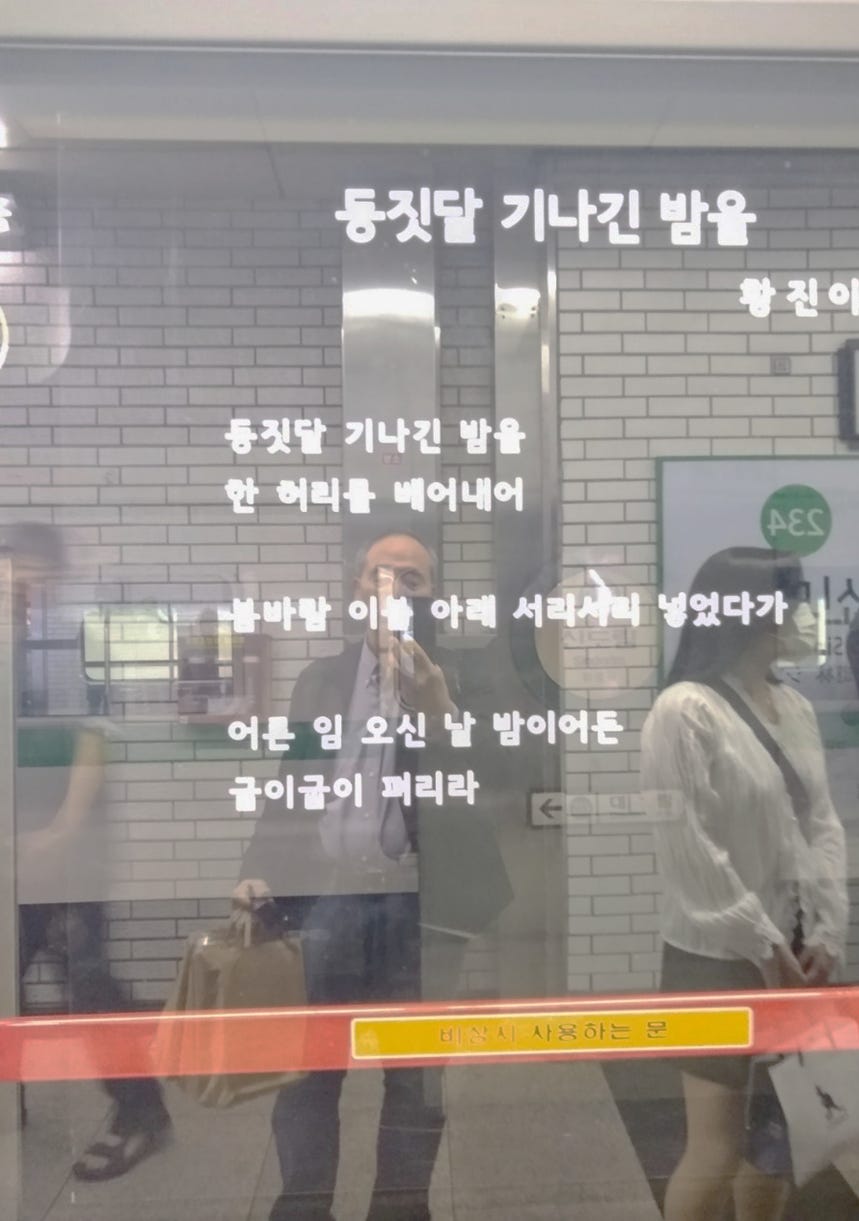
Hwang Jin-i’s Sijo on a Platform Screen Door. While waiting for a subway train bound for Gangnam, Seoul, in May 2023, on my way to dinner with two fellow alumni from the University of Nebraska-Lincoln, I noticed an unexpected literary treasure. Inscribed on the platform screen door was one of Korea’s best-loved sijo composed by Hwang Jin-i (황진이, 黃眞伊, c. 1506-c. 1567), the legendary courtesan-poet of the Joseon Dynasty. Throughout Seoul’s subway system, platform screen doors occasionally display famous poems, transforming ordinary moments of commuting into encounters with Korea’s literary heritage.
Born in Gaeseong to a scholar-official and his concubine, Hwang Jin-i became celebrated not only for her extraordinary beauty but also for her accomplishments as a poet, singer, dancer, painter, calligrapher, and intellectual. Although she lived as a gisaeng (courtesan), she associated with many of the leading scholars of her age and earned lasting fame through the emotional depth and artistic refinement of her poetry. Her sijo often express longing, loneliness, and the fleeting nature of love, revealing a woman of remarkable sensitivity and literary talent. The following poem, one of the most beloved in Korean literature, imagines cutting the long winter night in half, storing part of it away, and unfolding it again when her absent lover finally returns.
(Korean)
동지(冬至)ㅅ달 기나긴 밤을
동지(冬至)ㅅ달 기나긴 밤을 한 허리를 버혀 내여,
춘풍(春風) 니불 아레 서리서리 너헛다가,
어론님 오신 날 밤이여든 구뷔구뷔 펴리라.
The Long Winter Night
The long night of the winter solstice—
I would cut it neatly in half,
fold it away beneath my spring quilt.
Then, on the night my beloved returns,
I would unfold it, fold by fold,
so we might linger together until dawn.
About the Author
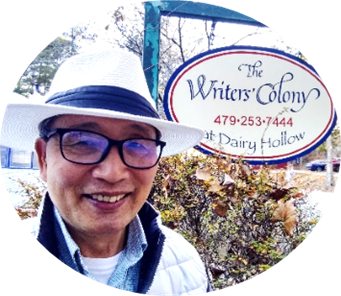
Professor of English and Creative Writing and Associate Dean of the School of Humanities and Theology, Missouri Baptist University
John J. Han, PhD, is the author, editor, co-editor, or translator of 35 books. His forthcoming book, Echoes from the Hills: Critical Essays on Ozarks Literature (co-edited with C. Clark Triplett), will be published by the University of Arkansas Press. He has also published nearly 3,000 poems in a wide range of journals and anthologies. In addition to his long tenure at Missouri Baptist University, he has taught at Kansas State University, the University of Nebraska–Lincoln, Nebraska Wesleyan University, and Washington University in St. Louis. He has also served as a visiting scholar at Georgia College & State University and the University of Ljubljana in Slovenia.
© K-Global Scholars and Professionals Forum. All rights reserved. Content published in the K-GSP Forum may not be reproduced, distributed, or transmitted in any form without prior written permission from the K-GSP Forum, except for brief quotations with full attribution.
제가 서울 광화문에 다녀온 것 같습니다. 생생한 글 감사합니다. ^^
정성들여서 찍으신 사진 그리고 풍부한 문학적인 배경 설명... 너무 좋습니다. 그리고 감사합니다. 서울의 역사 그리고 문화적인 배경을 새로운 각도에서 보게되어 재미있습니다.
물론 조그만 국토에서 서울에 너무나 많은 모든 것들이 집중되어 있는 현상은 이제 어느 정도 점차적으로 하나씩 개선되어야하지 않을까 개인적으로 생각해 봅니다.