

From the Wandering Poet to the Christian Poet: Literary Gwangju
The Legacies of Kim Sat-gat and Kim Hyeon-seung
As a teenager, I spent three years attending a boys’ high school in Gwangju, then the capital of South Jeolla Province. Although those years may seem relatively brief, childhood experiences can leave lasting impressions on our memories. I still remember riding city buses from Gwangsan District to my school in eastern Gwangju, Chosun University High School, and admiring the cosmos flowers blooming along the paved road that stretched for miles. Across the street from the Sangmudae Military Training Facility was a small lake where people could rent row boats for recreation. In 1994, after the military base relocated to Jangseong County, the area became an administrative and business center of Gwangju. It was during my high school years that I developed a passion for literature and decided to pursue a life devoted to literary study and creative writing.
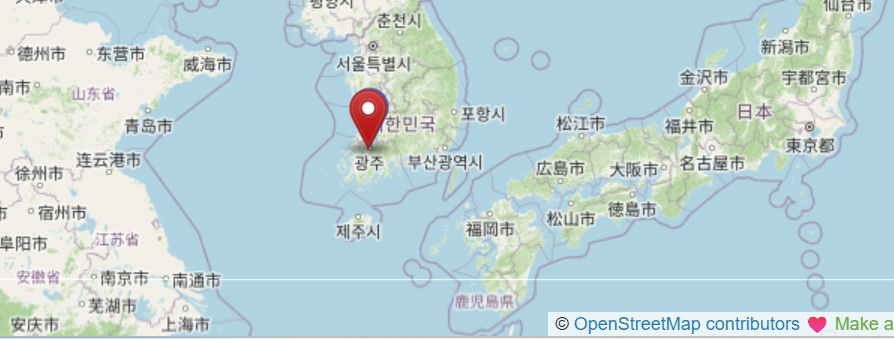
Map of Gwangju: Gwangju Metropolitan City is the largest city in the Jeolla region. Long the capital of South Jeolla Province, it became administratively separate from the province in 1986 but merged with it again in July 2026, when the province and the city were combined to form the provincial-level Jeonnam-Gwangju Integrated Special City. Composite image based on map data © OpenStreetMap contributors.
Long after I emigrated to the United States, Gwangju remained in my heart. When I began visiting Korea almost every year in 2005, I had opportunities to return to the city. In addition to reuniting with old friends, I wanted to explore some of its literary sites. Amid my busy itineraries, I managed to visit several locations. The first were monuments dedicated to the memory of the poet Kim Sat-gat (1807-1863), a wandering Korean poet known for his witty, satirical poems. I visited them in May 2017.
Then, in June 2024, I visited sites associated with the modern poet Kim Hyeon-seung (1913-1975) in Yangnim-dong: Kim Hyeon-seung Literary Park and Honam Theological University and Seminary. Born in Pyongyang, North Korea, he grew up in Daedong, South Pyeongan Province; Jeju Province; and Gwangju City, South Jeolla Province. In Gwangju, he attended Gwangju Elementary School and Gwangju Soongil Boys’ High School but did not complete his studies. He graduated from Soongsil College in Pyongyang, a Protestant institution founded by an American missionary, Dr. William Baird. Kim served as a teacher at Soongil Middle School in Gwangju (1936), as a professor of Korean literature at Chosun University in Gwangju (1951-59), and as a professor at Soongsil University (1960-75).
Kim Sat-gat Monuments at Mount Mudeong
Kim Sat-gat (literally, “Kim the wearer of a bamboo hat”) is the nickname of Kim Byeong-yeon (김병연, 金炳淵). Born in Yangju County, Gyeonggi Province, he reportedly passed the county-level civil examination—the first step toward the state-level civil examination—at the age of sixteen. As was customary, the examination required him to compose a poem in Chinese. The prompt read, “論鄭嘉山忠節死 嘆金益淳罪通於天” (“Discuss the loyal death of Gasan County Executive Jeong and condemn Kim Ik-sun’s sins that reach unto heaven”).
Kim Ik-sun (1764-1812) was a high-ranking military officer who surrendered to rebel forces during the Hong Gyeong-nae Rebellion in 1812 and was later beheaded for treason. In his poem, Kim Sat-gat harshly condemned and mocked Kim Ik-sun. Part of the poem reads: “The late king is watching you, so you will not enter even the deepest level of the underworld. Dying once was too light a punishment for you; you deserved ten thousand deaths. Your disgrace shall forever remain a mockery in the history of the Eastern Kingdom [Korea].”
After passing the examination, Kim Sat-gat returned home with great excitement. However, when he shared the content of his poem with his mother, she revealed to him—for the first time—that Kim Ik-sun was his grandfather. Shocked by the revelation, the young man lived as a recluse for four years before beginning to wander the country. As a vagabond, he wore a bamboo hat, which symbolized that, having insulted his grandfather, he did not deserve to look upon the sky. He wrote poems in exchange for food and shelter until his death in Hwasun, South Jeolla Province. After his death, his remains were initially buried in Hwasun before being moved to Yeongwol County, Gangwon Province. Below are three of his many jueju poems (four-line poems in classical Chinese verse) translated into English. I originally published these translations under the title “‘After Burying My Wife’ and Other Poems” in Fireflies’ Light: A Magazine of Short Poems, no. 19 (June 2020), pp. 72-77.
喪配自輓
遇何晩也別何催 未卜其欣只卜哀
祭酒惟餘醮日釀 襲衣仍用嫁時裁
窓前舊種少桃發 簾外新巢雙燕來
賢否卽從妻母問 其言吾女德兼才
Self-Lament for the Loss of My Wife
How late we met, how swiftly we part;
I never knew joy, only foresaw sorrow.
The sacrificial wine is the brew made for our wedding day;
The shroud is cut from the cloth prepared for your wedding dress.
Before the window, the old peach tree has scarcely begun to bloom;
Beyond the curtain, a pair of swallows returns to its new nest.
Whether you were virtuous or otherwise, I ask your mother;
She says, “My daughter possessed both virtue and talent.”
Note:
In this poem, Kim Sat-gat speaks in the voice of a husband who has lost his wife soon after their marriage. The final two lines reflect the premodern Korean custom of arranged marriage, in which a bride and groom might marry without having had an opportunity to know each other—and, in some cases, without even meeting before their wedding day.
*
離別
可憐門前別可憐 可憐行客尤可憐
可憐莫惜可憐去 可憐不忘歸可憐
Parting
At Ga-ryeon’s door, parting is so pitiful;
This poor traveler is even more pitiful.
Dear Ga-ryeon, do not pity this poor man’s departure;
I will not forget Ga-ryeon and will return—how pitiful.
Note:
In this poem, Kim Sat-gat employs wordplay through the repeated use of 可憐 (가련, Ga-ryeon), which means “pitiful” or “sad” in classical Chinese but is also a Korean female given name. He repeats Ga-ryeon eight times, making the poem both a farewell to a woman named Ga-ryeon and an extended play on the word’s meaning. The Korean pronunciation is shown below:
Ga-ryeon mun-jeon-byeol Ga-ryeon
ga-ryeon haeng-gaek-u ga-ryeon
Ga-ryeon mak-seok ga-ryeon geo
Ga-ryeon bul-mang-gui Ga-ryeon
*
風俗薄
斜陽鼓立兩柴扉 三被主人手却揮
杜宇亦知風俗薄 隔林啼送不如歸
A Heartless Custom
At sunset, I stand knocking at two rough wooden gates;
Three times, the master waves me away with his hand.
Even the cuckoo seems to know how heartless people have become;
From beyond the woods, it cries, “Better to return home.”
Note:
As a penniless wanderer, Kim Sat-gat depended on the kindness of others for nightly lodging, sometimes sleeping at Buddhist temples, Confucian schools, or private homes. This poem humorously describes his difficulty finding a place to stay for the night. The final line alludes to the cuckoo’s familiar cry, “불여귀” (bul-yeo-gwi), traditionally interpreted as “It is better to return home.” Kim uses the bird’s cry to suggest that even the cuckoo understands the unwelcoming customs of the people he encounters.
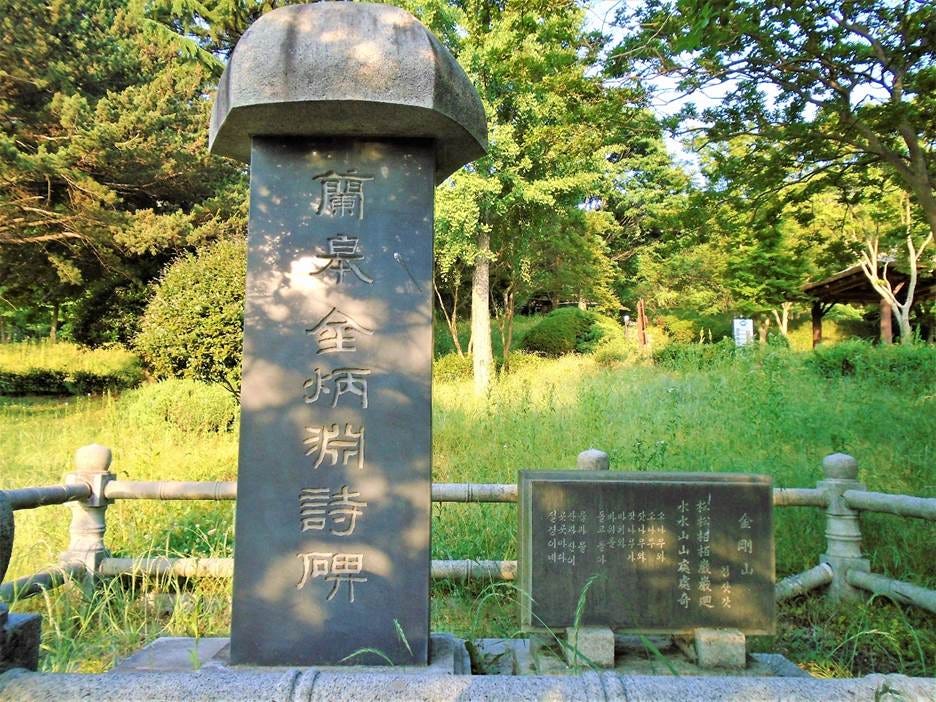
A pair of stone monuments to the poet Kim Sat-gat. The upright tablet bears his given name in Chinese characters, and its inscription reads, “A Monument to the Poet Kim Byeong-yeon, Nicknamed Nan-go.” Nan-go was Kim’s literary name in Chinese, but he is better known by his Korean nickname, Sat-gat (삿갓). The smaller stone bears his poem “Mount Geumgang” in Chinese and Korean. Erected in 1978 by a group of Kim’s descendants and supporters, the two stone tablets stand at the foot of Mount Mudeung in Gwangju Metropolitan City, approximately ten miles from Hwasun County, where Kim died in 1863 at the age of fifty-seven.
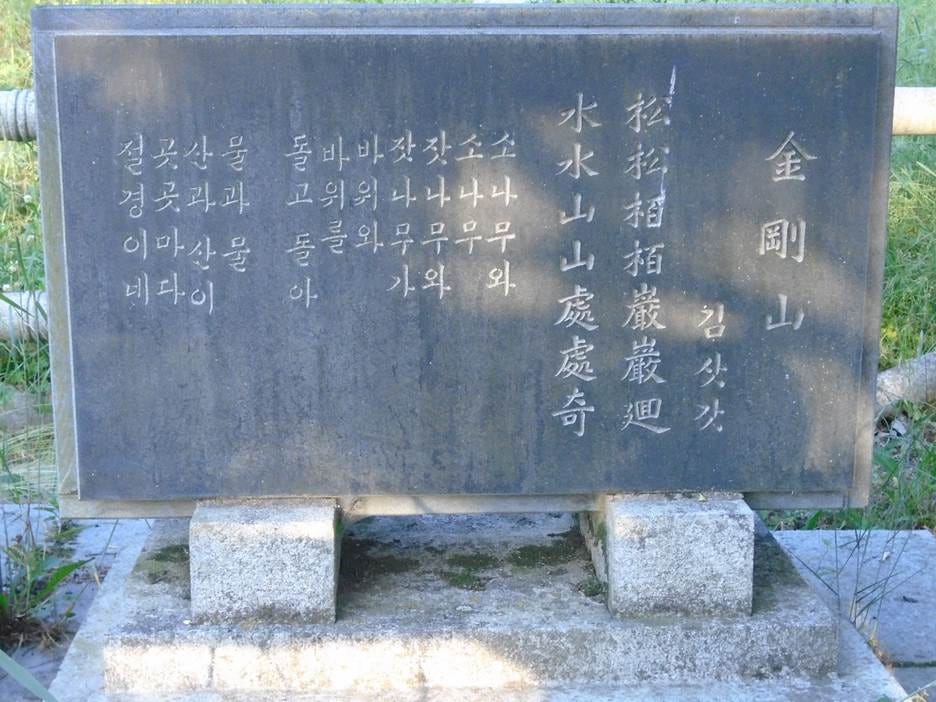
A close-up view of Kim’s poem “Mount Kumgang.” The text reads from right to left and from top to bottom. The first line gives the title in Chinese (金剛山), followed by his Korean pen name, 김삿갓 (Kim Sat-gat). Below are the poem’s two lines in Chinese, followed by an eleven-line Korean translation. In English, the poem reads:
I turn around—pine trees, more pine trees,
pine nut trees, more pine nut trees; rocks, more rocks.
Water here, water there; a mountain here, a mountain there . . .
A scene of unparalleled beauty wherever I turn!
Mount Kumgang is in the southeastern part of present-day North Korea. In premodern times, many Korean poets and artists made pilgrimages to Mount Kumgang in search of inspiration.
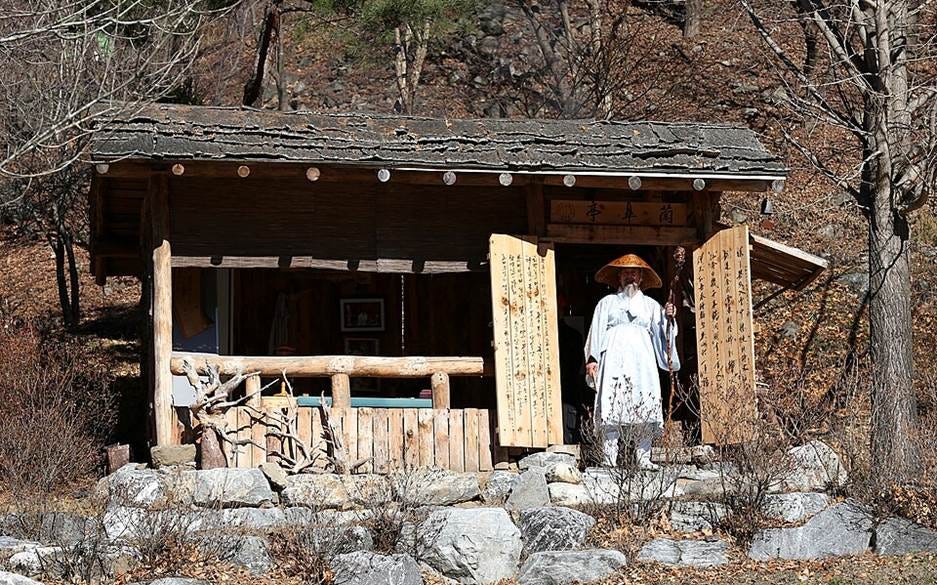
A replica of poet Kim Sat-gat stands at the entrance to his modest dwelling in Yeongwol, Gangwon Province, where he spent part of his wandering life. Kim was born, presumably, in Yangju County, Gyeonggi Province; died in Hwasun County, South Jeolla Province; and is buried in Yeongwol County, Gangwon Province. Photo: Korea.net / Korean Culture and Information Service (Jeon Han), CC BY-SA 2.0. Used under a Creative Commons Attribution-ShareAlike 2.0 license.
Poet Kim Hyeon-seung Sites in Gwangju
Kim Hyeon-seung was a leading Christian poet of modern Korea. Born in Pyongyang (now in North Korea) as the son of a pastor, he moved to Gwangju, South Jeolla Province, at the age of seven and grew up there. His poetry collections include Selected Poems of Kim Hyeon-seung (1957), The Defender’s Song (1963), Solid Solitude (1968), and Absolute Solitude (1970). Kim died while leading a congregational prayer during chapel at Soongsil University in Seoul, formerly Soongsil College in Pyongyang.
My translations of the following five poems originally appeared under the title “‘Country Church’ and Other Poems” in Intégrité, vol. 13, no. 1 (Spring 2014), pp. 64-71.
村 禮拜堂
깊은 산골에 흐르는 맑은 물소리와 함께
나와 나의 벗들의 마음은 가난합니다
주여 여기 함께 하소서.
밀 방아가 끝나는 달 뜨는 수요일 밤
肉松으로 다듬은 당신의 壇 앞에 기름불을 밝히나이다
주여 여기 임하소서.
여기 산 기슭에 잔디는 푸르고
새소리 아름답도소이가.
주여 당신의 장막을 예다 펴리이까 나사렛의 주여
우리와 함께 여기 계시옵소서.
Country Church
Along with the sound of clear water flowing through this deep mountain valley,
the hearts of my friends and me are poor.
Lord, be here with us.
On a moonlit Wednesday night, when the water mill falls silent,
we light an oil lamp before your altar,
smoothed from a piece of wood.
Lord, come and be present here.
Here at the foot of the mountain, the grass is green,
and the birds sing beautifully.
Lord of Nazareth, shall we spread your tent here?
Please remain here with us.
*
눈물
더러는
옥토(沃土)에 떨어지는 작은 생명이고저.......
흠도 티도, 금 가지 않은
나의 전체는 오직 이뿐!
더욱 값진 것으로 드리라 하올 제,
나의 가장 나아종 지닌 것도 오직 이뿐.
아름다운 나무의 꽃이 시듦을 보시고 열매를 맺게 하신 당신은
나의 웃음을 만드신 후에
새로이 나의 눈물을 지어 주시다.
Tears
Sometimes,
I wish to be a little life falling upon fertile soil…
Without blemish or flaw, without a single crack,
this is all that I am!
When you ask me to offer something more precious,
this alone is the most precious thing I have left.
Seeing the flowers of a beautiful tree wither,
you caused it to bear fruit.
After creating my laughter,
you created my tears anew.
*
감사
감사는 곧
믿음이다.
감사할 줄 모르면
이 뜻도 모른다.
감사는
반드시 얻은 후에 하지 않는다. 감사는
잃었을 때에도 한다. 감사하는 마음은
잃지 않았기 때문이다.
감사는
곧
사랑이다.
감사할 줄모르면
이 뜻도 알지 못한다.
사랑은 받는 것만이 아닌
사랑은 오히려 드리고 바친다.
몸에 지니인
가장 소중한 것으로—
과부는
과부의 엽전 한푼으로,
부자는
부자의 많은 보석으로
그리고 나는 나의
서툴고 무딘 訥辯의 詩로……
Gratitude
Gratitude is
faith.
If you do not know how to give thanks,
you do not understand this either.
Gratitude
is not something we offer only after we have received something.
We give thanks
even when we have lost something,
because we have not lost
a grateful heart.
Gratitude is
love.
If you do not know how to give thanks,
you do not understand this either.
Love is not merely something we receive;
rather, love is what we give and offer,
from what we carry within us,
the most precious thing we possess—
for a widow,
a single coin;
for a rich man,
his many jewels;
and for me,
poetry in my clumsy, halting words…
*
가을의 碑銘
봄은 입술로 말하더니 가을은 눈으로 말을 한다.
말들은 꽃잎처럼 피고 지더니 눈믈은 내 가슴에
보석과 같이 오래 남는다. 밤 이슬에 나아와
十月의 이마 위에 손을 얹어 보았는가. 대리석과 같이 찰 것이다.
그러나 네 영혼의 피를 내어 그 돌에 하나의 물음을 새기는 이만이,
굳은 열매와 같이
種子 속에 길이 남을 것이다!
Autumn Epitaph
Spring spoke with its lips,
but autumn speaks with its eyes.
Words bloomed and withered like flower petals,
while tears remain in my heart
like precious gems.
Have you ever come out into the night dew
and placed your hand upon October’s forehead?
It will be cold like marble.
Yet only those who carve a question into that stone
with the blood of their souls
will remain forever within the seed,
like a ripened fruit!
*
新年頌
단 한 마디를
열 마디와
백 마디로
利潤을 남기면서,
五十도 넘도록
나는 천국의 노래를 불렀다.
보석과 눈물과
하얀 치아가 반짝이는
이방의 시를 썼다.
그 백 마디를
이제는 열 마디와
한 마디로
겸손을 배우면서,
모든 언어의 재산을 팔아
나의 마지막 침묵을 지키는
내 언어의 寡婦가 되고저.
Song for New Year’s Day
With a single word,
I made the profit of ten words,
then a hundred words,
and for more than fifty years
I sang songs of heaven.
I wrote poetry of a foreign land,
sparkling with jewels, tears,
and white teeth.
Now, with humility as my teacher,
I wish to reduce those hundred words
to ten words, then to one,
selling all the wealth of my words
and becoming a widow of my own language,
to guard my final silence.
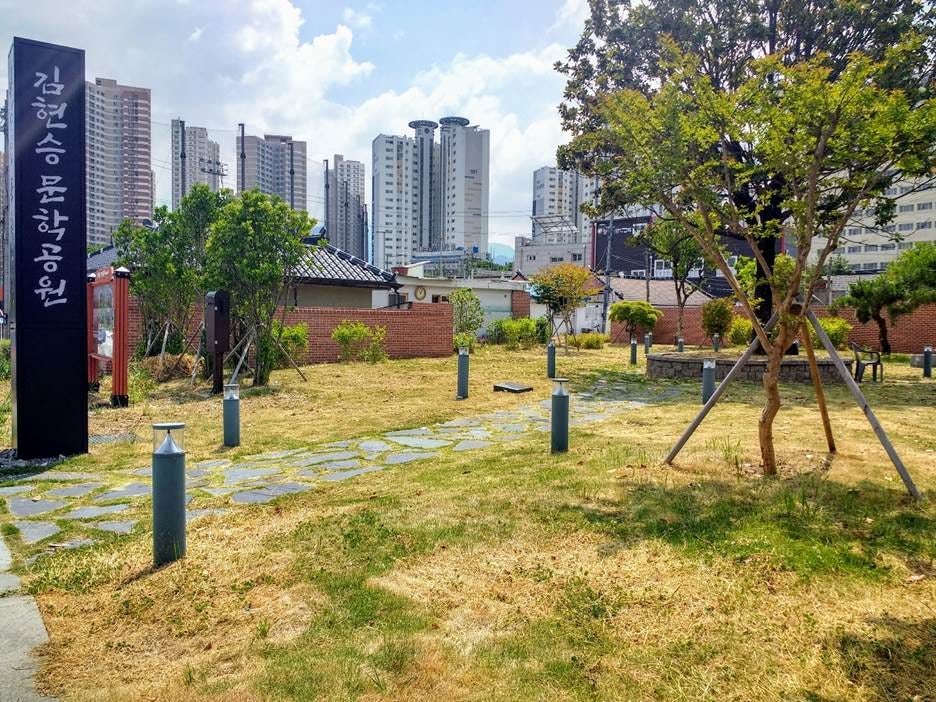
A subway ride from Songjeong Station took me to Yangnim-dong, a district in eastern Gwangju known for its rich cultural heritage and the work of American missionaries a century ago. Photographed above is Kim Hyeon-seung Literary Park. Although parts of Yangnim-dong are quite hilly, this small park is located at the foot of the hills.
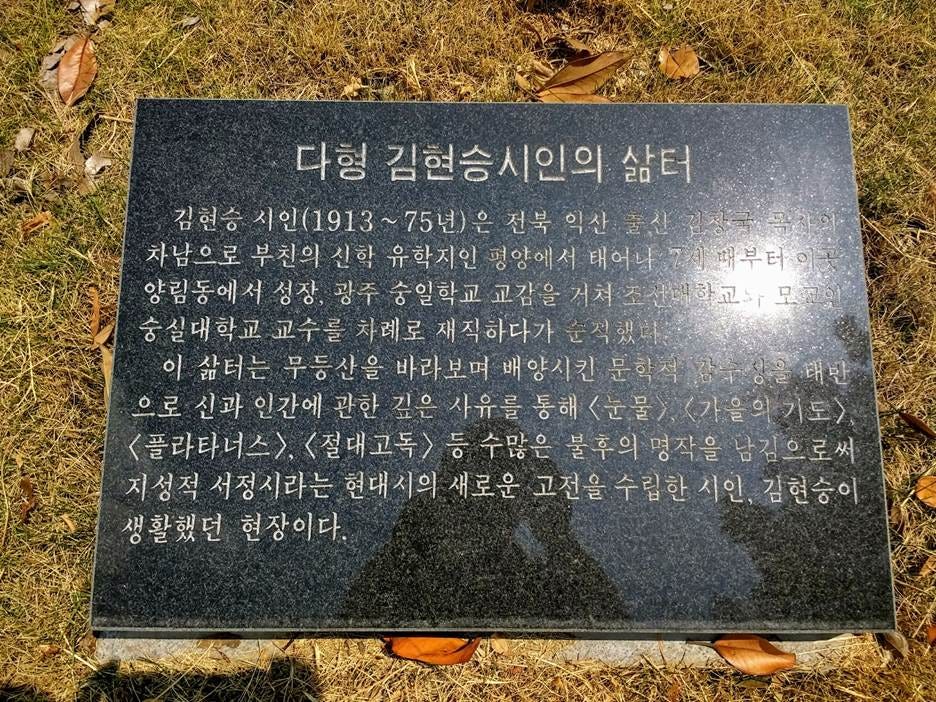
This plaque commemorates the former home of poet Kim Hyeon-seung, one of Korea’s leading modern lyric poets, at Kim Hyeon-seung Literary Park in Yangnim-dong. The park marks the place where the poet lived and developed his distinctive poetry of faith, humanity, and intellectual reflection. The plaque reads:
The Place Where Poet Kim Hyeon-seung Lived
Poet Kim Hyeon-seung (1913-1975) was born in Pyongyang, where his father, a native of Iksan, North Jeolla Province, had gone to study theology, and he spent his childhood from the age of seven in Yangnim-dong. After serving as vice principal of Soongil School in Gwangju, he became a professor at Chosun University. He died while serving at Soongsil University, his alma mater.
This was the place where Kim Hyeon-seung lived and wrote poetry while gazing toward Mt. Mudeung. Through profound reflections on God and humanity, he produced numerous enduring works, including “Tears,” “Autumn Prayer,” “The Sycamore,” and “Absolute Solitude.” Kim is regarded as a poet who established a new tradition in modern Korean poetry, characterized by intellectual lyricism.
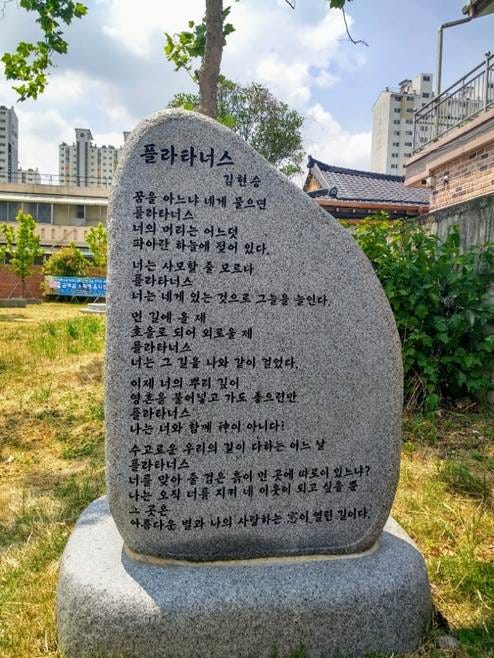
A rock at Kin Hyeon-seung Literary Park bears the Korean text of “The Sycamore.” In translation, it reads:
The Sycamore
Kim Hyeon-seung
When I ask you
if you know what a dream is,
Sycamore, your head is already drenched
in the blue sky.
You do not know how to long for someone,
Sycamore, yet with what you have,
you spread your shade.
When I set out on a long journey,
when I am alone and lonely,
Sycamore, you walked that road
alongside me.
Now, if only I could breathe
my soul deep into your roots
and leave it there,
Sycamore, but I am not God
like you!
When, one day,
our weary journey comes to an end,
Sycamore, is there somewhere far away
a separate patch of dark earth
that will receive you?
I only wish to watch over you
and become your neighbor.
There lies a road where beautiful stars shine
and the window I love
stands open.
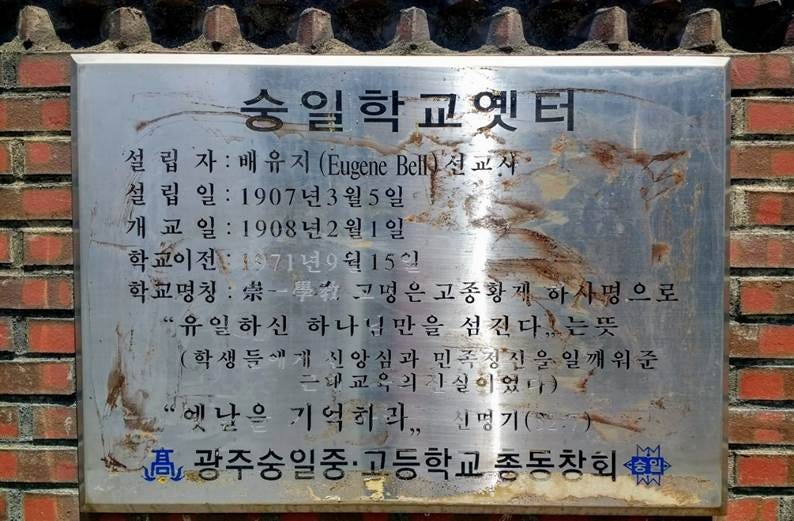
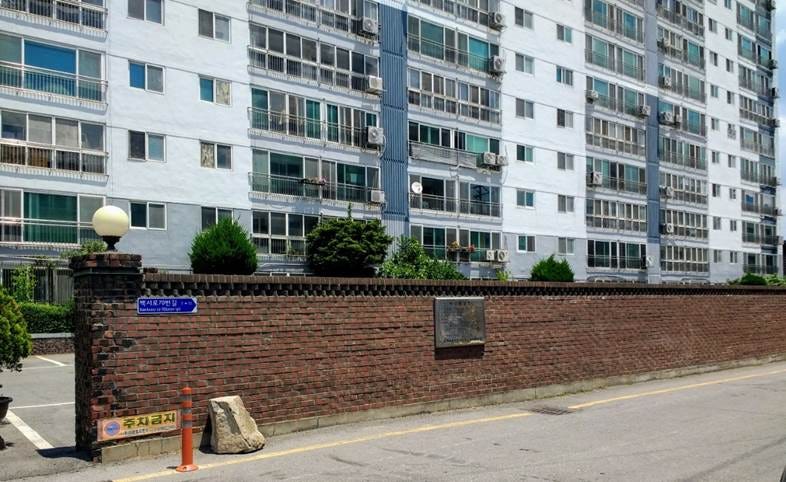
On the brick fence of an apartment complex hangs a plaque marking the site where Soongil School once stood. Founded in 1907, the school opened the following year. Its founder, missionary Eugene Bell (1868-1925), was a legendary Southern Presbyterian missionary who played a pivotal role in establishing churches, hospitals, and mission schools throughout South Jeolla Province.
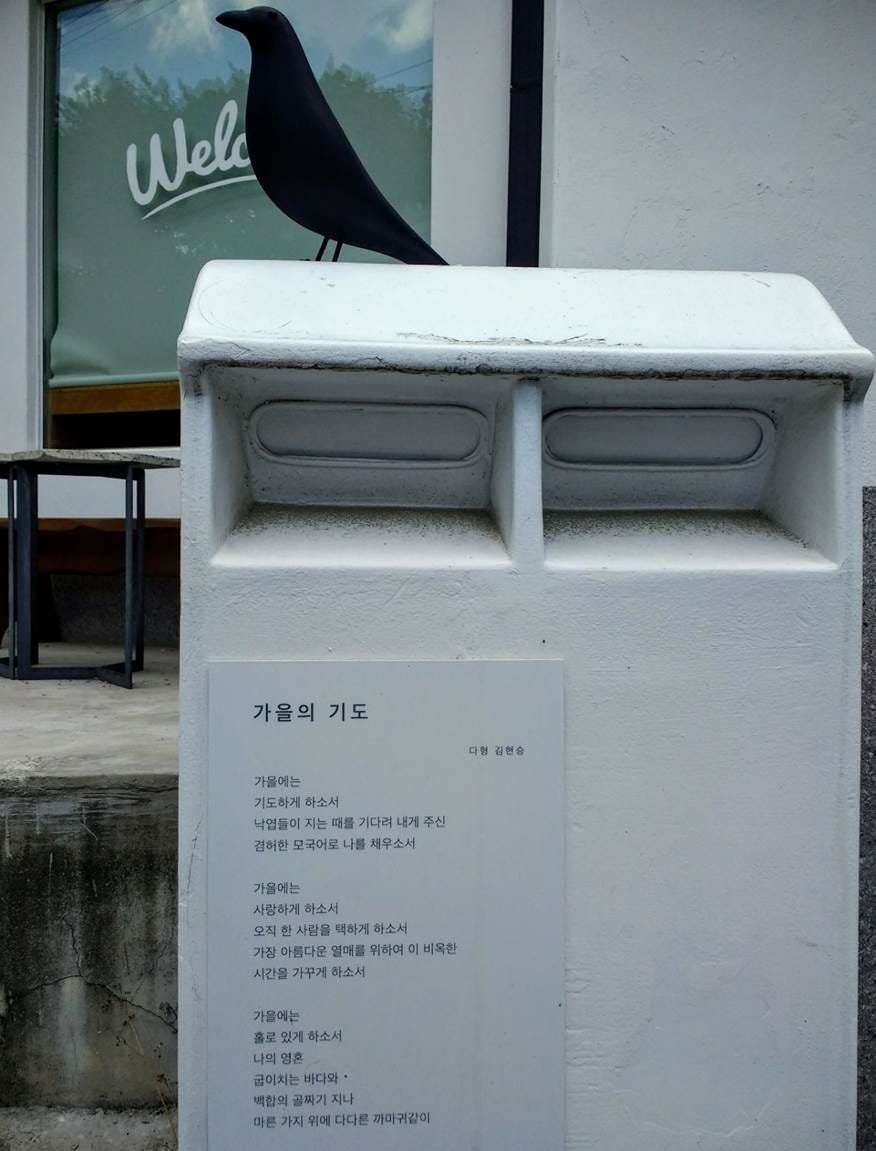
On my way to Honam Theological University and Seminary, I passed a café that displayed the text of Kim Hyeon-seung’s celebrated poem “Autumn Prayer” outside its entrance. The poem can be translated as:
Autumn Prayer
Kim Hyeon-seung
In autumn,
let me pray.
As I wait for the time
when the fallen leaves descend,
fill me with the humble mother tongue
you have given me.
In autumn,
let me love.
Let me choose only one person.
For the most beautiful fruit,
let me cultivate this fertile season.
In autumn,
let me be alone.
My soul,
like a crow that has crossed
the winding sea
and the valley of lilies,
and come to rest
upon a withered branch.
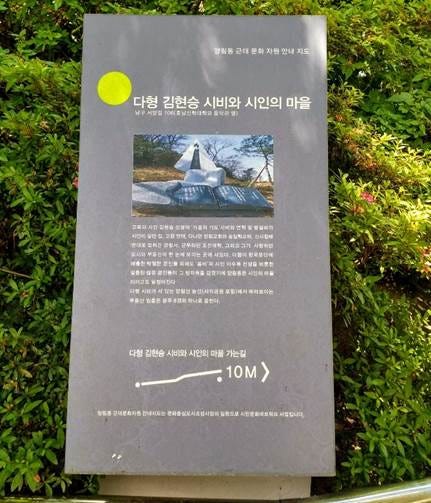
Here is a translation of the roadside sign:
Yangnim-dong Modern Cultural Resources Guide Map
Dahyeong Kim Hyeon-seung: The Village of Poetry and Poets
106 Seoyang-ro, Nam-gu
(next to the Music Hall of Honam Theological University and Seminary)
The monument and stone inscription commemorating poet Kim Hyeon-seung’s poem “Autumn Prayer” stand at a site from which one can see the house where the poet lived, the hills of his hometown, the site of Soongil School, Yangnim Church, which he attended, the police station where he was taken for opposing compulsory Shinto shrine worship, Chosun University, where he taught, and the city and Mt. Mudeung that he loved. In addition to the prominent writers from Yangnim-dong whom Kim helped launch, many literary figures, including poet Yi Su-bok, the poet of “Bombi,” also spent time here. For this reason, Yangnim-dong is sometimes called the Village of Poets.
The foothills of Mt. Mudeung visible from Yangnimsan Hill (including Sajik Park), where Kim Hyeon-seung’s poem stands, are considered one of the Eight Scenic Views of Gwangju.
Path to Dahyeong Kim Hyeon-seung’s Village of Poetry and Poets
10 m →
The Yangnim-dong Modern Cultural Resources Guide Map is part of the Citizen Cultural Network Project, an initiative of the Cultural-Centered City of Gwangju.
Note:
“Bombi” (봄비), mentioned in the sign, means “spring rain.” Dahyeong (茶兄, 다형) was Kim Hyeon-seung’s literary pen name. It consists of two Chinese characters: 茶 (차), meaning “tea,” and 兄 (형), meaning “elder brother” or “older brother.” Literally, 茶兄 can be rendered as “Tea Brother” or “Brother of Tea,” suggesting an affectionate or respectful relationship with tea.
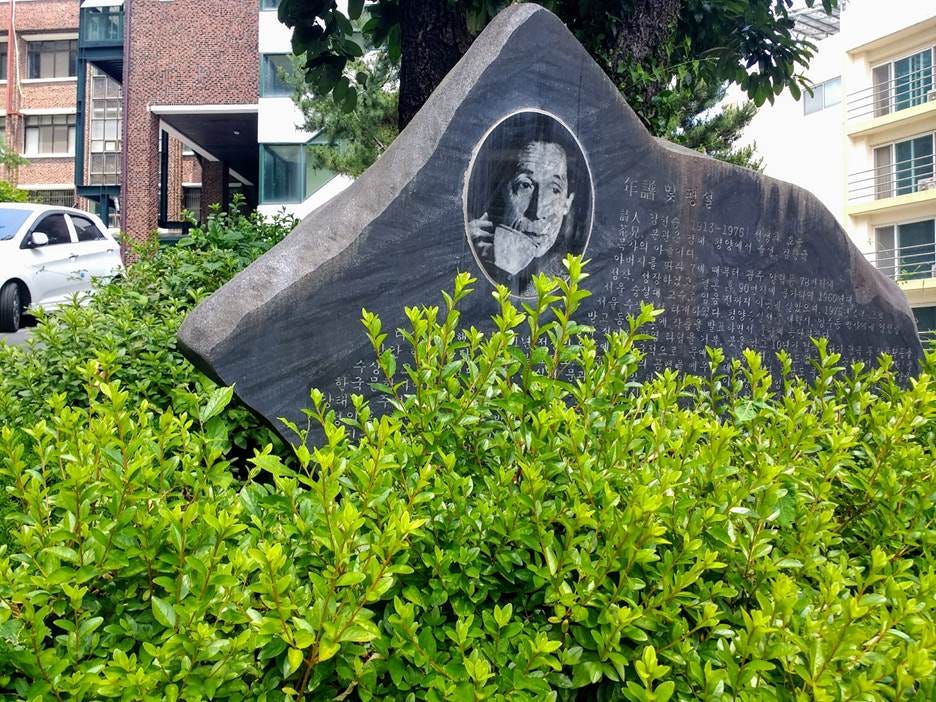
A stone inscription commemorating Kim Hyeon-seung’s poem “Autumn Prayer,” accompanied by a photograph of the poet holding a coffee cup, stands on the campus of Honam Theological University and Seminary.
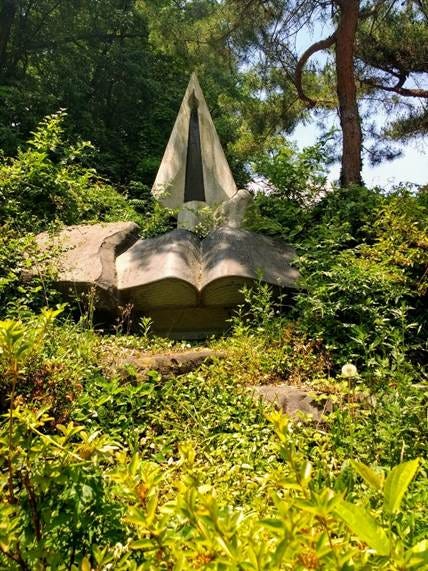
Poetry monument for Kim Hyeon-seung’s “Autumn Prayer” (가을의 기도) on the campus of Honam Theological University and Seminary. Inscribed on the stone is the poet’s beloved poem, which reflects on spiritual renewal, humility, and the desire for a deeper faith. The monument commemorates Kim’s literary legacy and his connection to the Christian community of Gwangju. Set among the trees of the campus, the stone inscription brings together poetry, faith, and place.
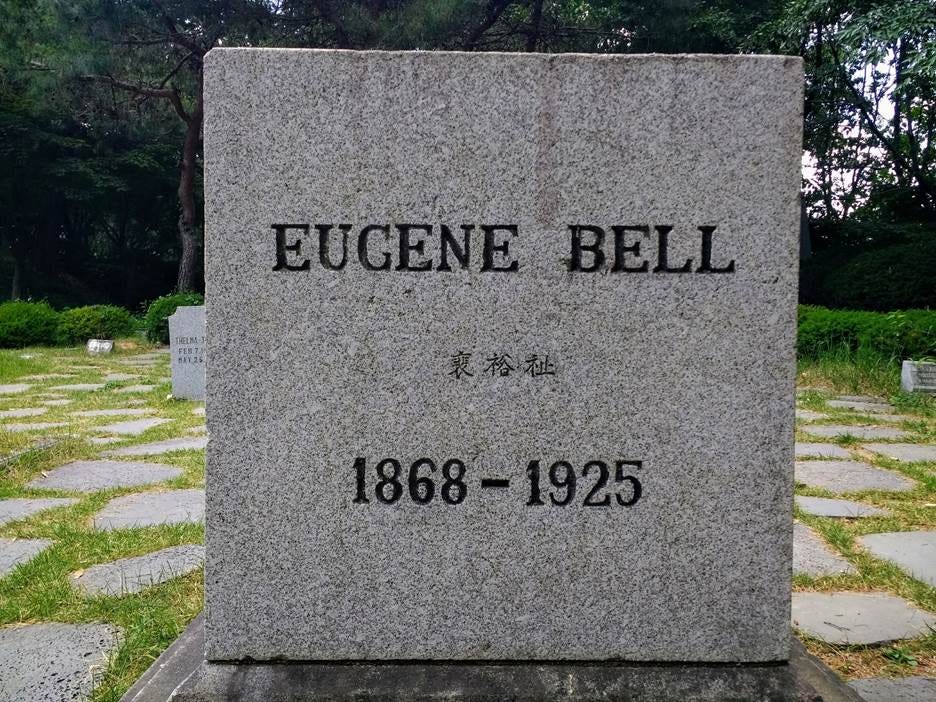
Gravestone of Eugene Bell (1868-1925), known by his Korean name, 배유지 (Chinese: 裵裕祉), on the campus of Honam Theological University and Seminary. A missionary of the Presbyterian Church in the United States, Bell arrived in Korea in 1895 and became a pioneering figure in Christian mission work in the Honam region. He helped establish mission stations in Mokpo and Gwangju and supported the founding of schools, hospitals, and churches, earning him the title “Father of Honam Mission.” His work laid an important foundation for the development of modern education, medicine, and Christianity in southwestern Korea. Bell’s legacy continued through his descendants, several of whom served as missionaries in Korea and maintained deep ties with the country.
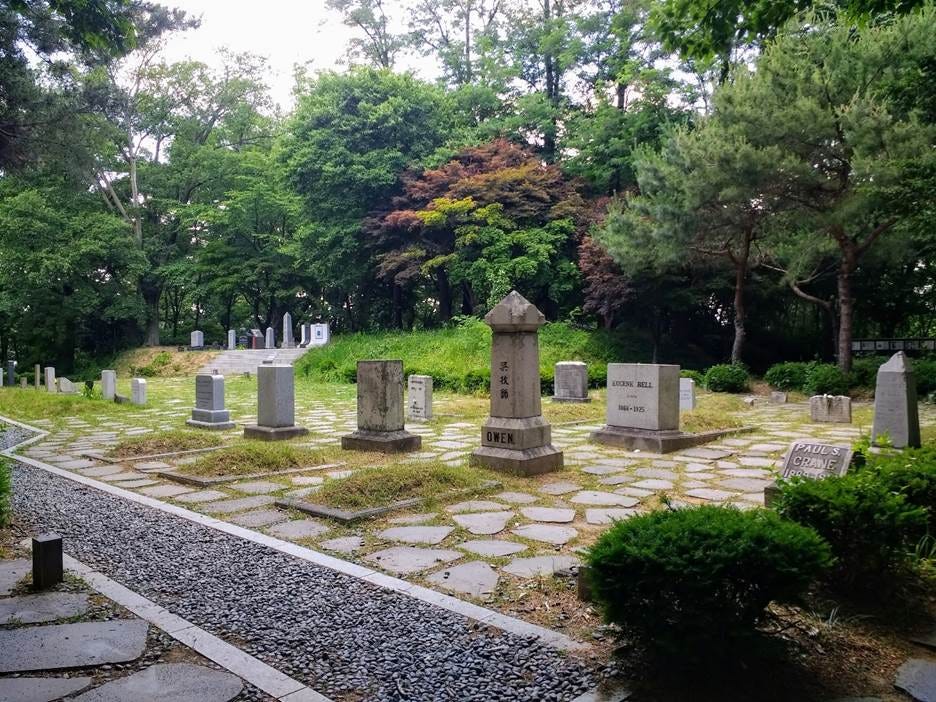
Honam Theological University and Seminary is the only institution of theological learning in South Korea that houses a foreign missionary cemetery. It is well worth visiting for anyone interested in the history of Christian missions in southwestern Korea a century ago.
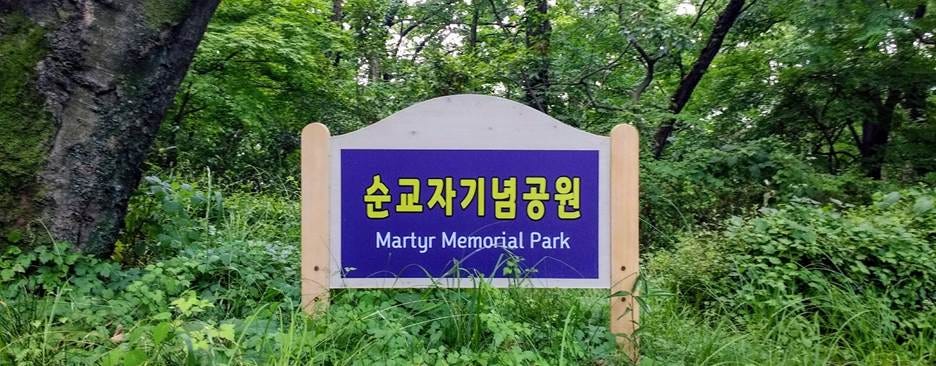
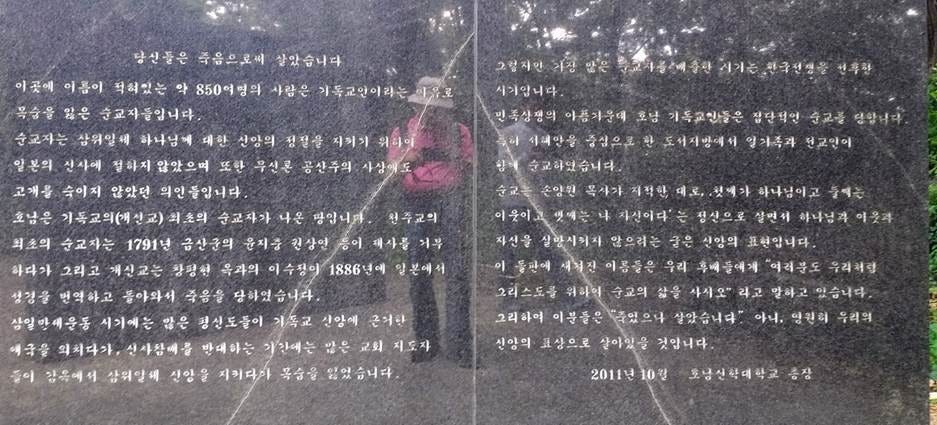
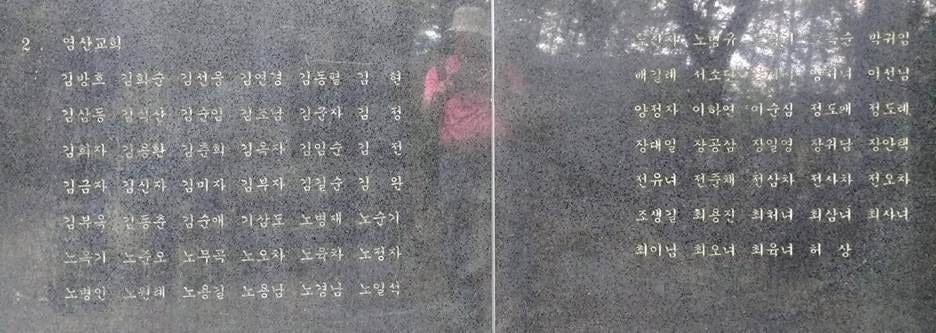
Martyr Memorial Park at Honam Theological University and Seminary honors more than 850 Korean Christians who lost their lives for their faith.
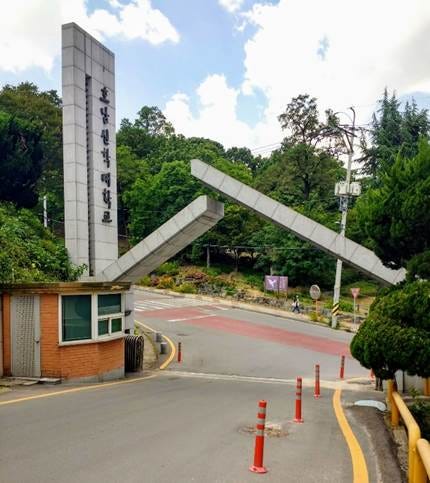
The entrance to Honam Theological University and Seminary. Founded in 1955 by the Korean Mission of the Presbyterian Church in the United States as the three-year Honam Bible Academy, the institution was renamed Honam Theological Seminary in 1963. It became Honam Theological University in 1989 and Honam Theological University and Seminary in 1992. Its motto is “Faith, Learning, and Service.”
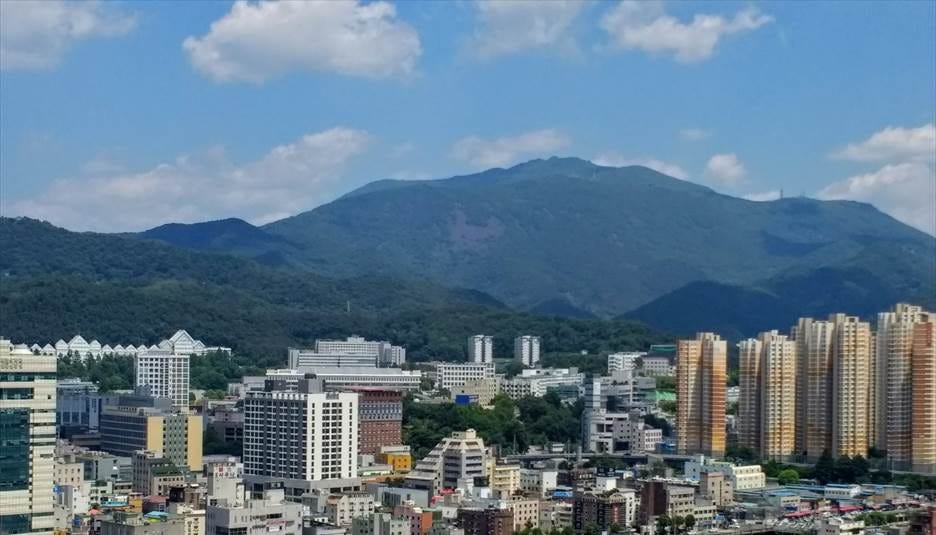
The white structure stretching along the foot of Mt. Mudeung is the main building of Chosun University. It is distinguished by its striking series of triangular, peaked roofs. Originally built with five roof peaks, the building was expanded over the years to its present 19-peaked form, making it one of Gwangju’s most recognizable landmarks.
Chosun University has produced numerous poets who have left significant marks on the history of modern Korean literature. Among them are Mun Byeong-ran (1935-2015), Yi Su-bok (1924-1986), and Kim Jun-tae (b. 1948). These poets contributed not only to the development of regional literature but also to the broader traditions of Korean nationalist and lyrical poetry.
About the Author
Professor of English and Creative Writing and Associate Dean of the School of Humanities and Theology, Missouri Baptist University
John J. Han, PhD, is the author, editor, co-editor, or translator of 36 books. His forthcoming book, Echoes from the Hills: Critical Essays on Ozarks Literature (co-edited with C. Clark Triplett), will be published by the University of Arkansas Press. He has also published more than 3,000 poems, primarily haiku, in a wide range of journals and anthologies. In addition to his long tenure at Missouri Baptist University, he has taught at Kansas State University, the University of Nebraska–Lincoln, Nebraska Wesleyan University, and Washington University in St. Louis. He has also served as a visiting scholar at Georgia College & State University and the University of Ljubljana in Slovenia.
© K-Global Scholars and Professionals Forum. All rights reserved. Content published in the K-GSP Forum may not be reproduced, distributed, or transmitted in any form without prior written permission from the K-GSP Forum, except for brief quotations with full attribution.