

Gangjin: Where Poetry Blossomed a Century Ago
Dasan Jeong Yak-yong (1762-1836), a renowned Confucian scholar of the Joseon Dynasty, left a lasting literary legacy in Gangjin, making the county a destination for those who admire his literary, philosophical, and social contributions. A century after Dasan’s years of exile in the county, it continued to nurture a vibrant literary spirit. In the early twentieth century, Gangjin produced two prominent poets: Kim Yun-sik (1903-1950), better known by his pen name Yeongnang (영랑 김윤식, 永郞 金允植), and Kim Hyeon-gu (김현구, 金玄鳩, 1904-1950). Kim Yun-sik’s “모란이 피기까지는” (“Until the Peonies Bloom,” 1934) and “누이의 마음아 나를 보아라” (“My Sister, Look at Me,” 1935) remain widely studied poems in Korean language textbooks. Although less widely recognized than Kim Yun-sik, Kim Hyeon-gu was an important member of the Simunhakpa (시문학파, 詩文学派), a 1930s literary movement that promoted pure poetry, alongside Kim Yun-sik.
The literary legacies of the two Kims are well preserved in Gangjin’s county seat. Visitors can explore Yeongnang’s birthplace, where peonies bloom in spring; Kim Hyeon-gu’s forest trail; the Simunhakpa Memorial Hall (시문학파기념관) near Yeongnang’s home; and a nearby alley adorned with representative poems by the two poets. Since these sites are located close to one another, visitors can explore them at a leisurely pace. I visited these places on June 2, 2018, when the weather was especially pleasant. The following brief biographies introduce the poets whose literary footprints continue to shape Gangjin’s cultural landscape.
Yeongnang was one of Korea’s foremost lyric poets and a leading member of the Simunhakpa (Poetic Literature School). He adopted the pen name “Yeongnang” when he began publishing in the journal Simunhak in 1930. After studying at Hwimun School in Seoul and later at Aoyama Gakuin in Japan, his education was interrupted by the 1923 Great Kantō Earthquake. During the March First Independence Movement in 1919, he was imprisoned for six months after attempting to organize demonstrations in his hometown. Following Korea’s liberation in 1945, he became active in public affairs, serving as director of the Publication Bureau in the Ministry of Public Information and participating in local politics. He died in 1950 after being struck by stray gunfire during the Korean War.
Kim published more than eighty poems, translations, essays, and literary reviews, but he is remembered above all for his lyrical poetry. His early poems, including “The Heart Shining on Camellia Leaves” (Dongbaekip-e Bitnaneun Maeum), “Lying on the Hillside” (Eondeoge Baro Nuwŏ), and the beloved “Until the Peonies Bloom?” (Moran-i Pigi-kkajineun), are celebrated for their musical language, emotional restraint, and delicate evocation of nature. Around 1940, however, his poetry took a darker turn, reflecting the despair and oppression of the late colonial period in works such as “Carrying Poison” (Dogeul Chago) and “Geomungo.” After liberation, his poems expressed renewed hope and a commitment to rebuilding the nation. Today, Kim is regarded as one of the greatest modern Korean poets, and his poetry remains widely taught in Korean schools and cherished for its lyrical beauty and artistic refinement.
Kim Hyeon-gu was educated at Paichai High School and later in Japan. He made his literary debut in 1930 by publishing four poems—including “My Love, the River Is So Blue” (Imiyeo Gangmuri Mopsido Pureotseumnida), “A Seagull Floating on the Water,” “Holy Spring and Sorrowful Spring” (Georukan Bomgwa Seulpeun Bom), and “Nirvana” (Jeokmyeol)—in the second issue of the influential literary journal Simunhak. He later published notable poems such as “Lying on the Grass” (Pul Ue Nuwo), “Where My Heart Dwells” (Nae Maeum Saneun Got), and “The Road” (Gil).
Although less prolific and less widely known than his contemporary Yeongnang, Kim Hyeon-gu was an important member of the Simunhakpa. He wrote sparingly, carefully crafting poems distinguished by their gentle musicality, emotional restraint, and sensitive reflections on nature and human experience. A posthumous collection of his poems, Hyeon-gu Sijip (Collected Poems of Hyeon-gu), was published in 1970, helping preserve the legacy of a poet whose quiet voice remains an integral part of modern Korean literary history.
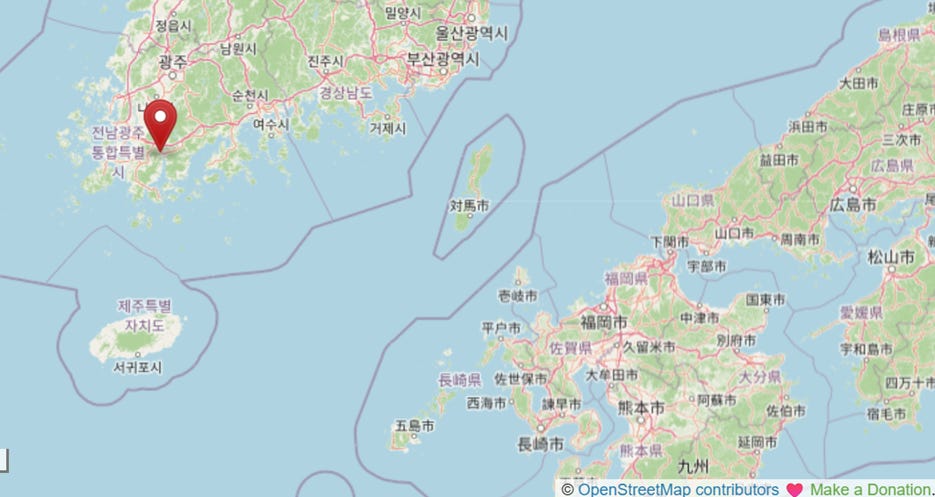
Gangjin County, South Korea, lies along the southern coast of the Korean Peninsula. Across Gangjin Bay to the south is Wando County, which adjoins Dadohaehaesang National Park (the National Park of the Sea of Many Islands). Composite image based on map data © OpenStreetMap contributors.
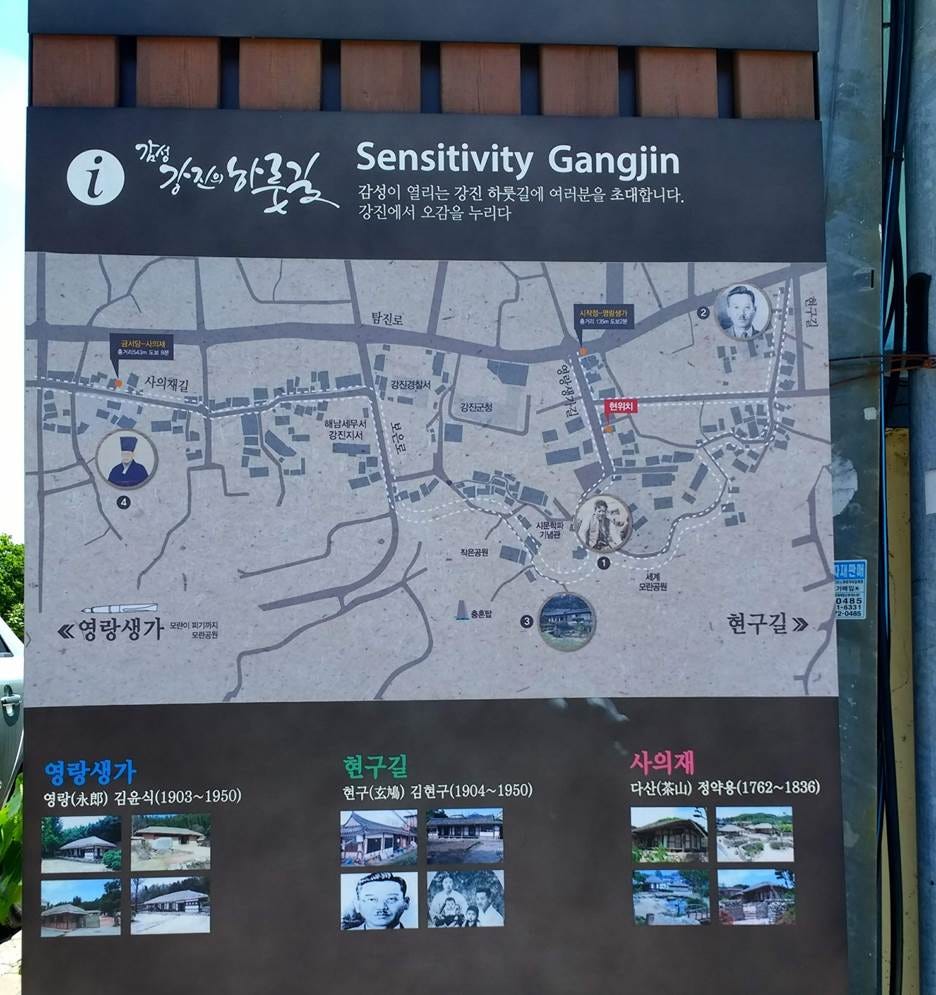
The information board introduces three landmarks in Gangjin County associated with Yeongnang, Kim Hyeon-gu, and Dasan Jeong Yak-yong.
NOTE: In translating 감성 강진, “Gangjin of Sensibility” or “Gangjin, a Place of Sensibility” would sound more evocative than “Sensitivity Gangjin.” 감성 is usually translated as emotional sensitivity or aesthetic awareness, whereas sensitivity can suggest being easily offended or emotionally delicate.
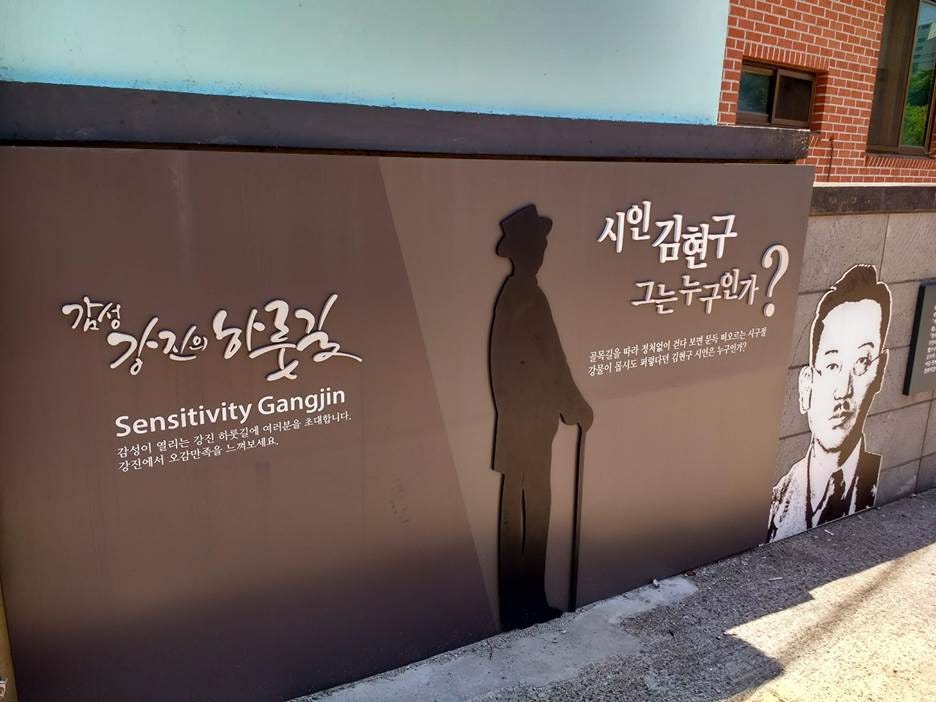
An alley in the county seat of Gangjin features murals of the poets Kim Yeongnang and Kim Hyeon-gu. The panel in this photo asks, “Who was the poet Kim Hyeon-gu?”
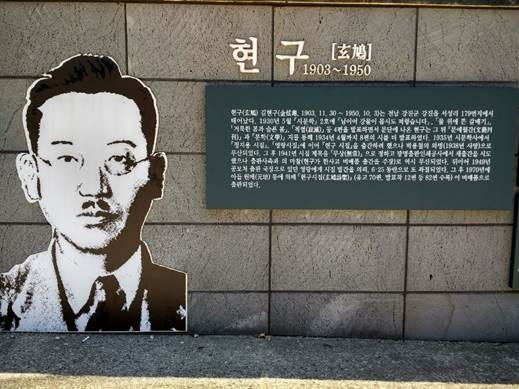
This panel offers a brief biography of the poet Kim Hyeon-gu. Below is a full translation. One thing worth noting is that his repeated efforts to publish a collection of his poems during his lifetime never came to fruition for one reason or another. His insistence on publishing the book as a noncommercial edition created yet another obstacle.
Hyeon-gu (玄鳩), 1903-1950
Kim Hyeon-gu (김현구, 金玄鳩; November 30, 1903–October 3, 1950), pen name Hyeon-gu (玄鳩), was born at 179 Seoseong-ri, Gangjin-eup, Gangjin County, South Jeolla Province.
In May 1930, he published four poems in the second issue of Simunhak (Poetic Literature), including “My Love, the River Is So Blue,” “A Seagull Floating on the Water,” “Holy Spring and Sad Spring,” and “Nirvana” (“Extinction”). After making his literary debut, Hyeon-gu published eight more poems through the journals Munye Wolgan (Literary Monthly) and Munhak (Literature) through April 1934.
In 1935, Simunhaksa planned to publish Hyeon-gu’s Poems, following the publication of Jeong Ji-yong’s Poems and Yeongnang’s Poems. However, the plan fell through because of Park Yong-cheol’s illness, which led to his death in 1938. In 1941, Hyeon-gu planned to publish the collection under the title Musang (Impermanence) and attempted to have it reissued by Gwangmyeong Publishing and Printing Company. This attempt also failed because of a dispute with the publisher, as Hyeon-gu insisted that the book be published as a noncommercial edition.
In 1949, he asked Yeongnang, who was then director of publications at the Ministry of Public Information, to arrange for the publication of his poetry collection, but the project was again thwarted by the outbreak of the Korean War in 1950. Finally, in 1970, his son Won-bae and others published Hyeon-gu’s Poems (玄鳩詩集) as a noncommercial edition. The volume contains 82 poems, including 70 posthumously discovered poems and 12 poems that had been published during his lifetime.
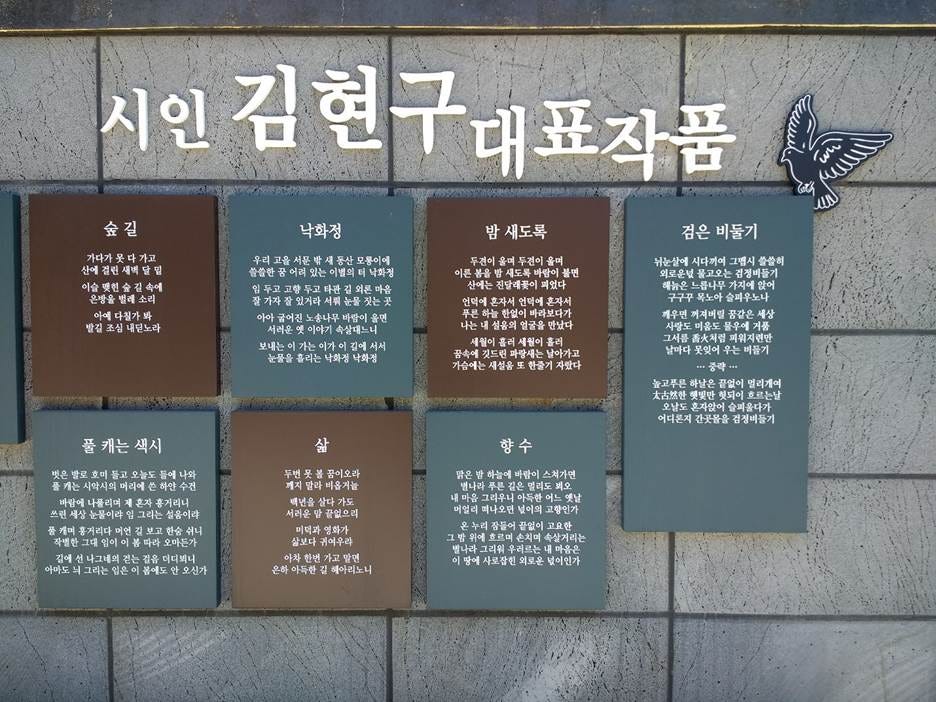
Seven representative poems by Kim Hyeon-gu are displayed on a wall along the alley: “Forest Path,” “Pavilion of Falling Blossoms,” “All Through the Night,” “Black Dove,” “The Young Bride Gathering Greens,” “Life,” and “Nostalgia.”
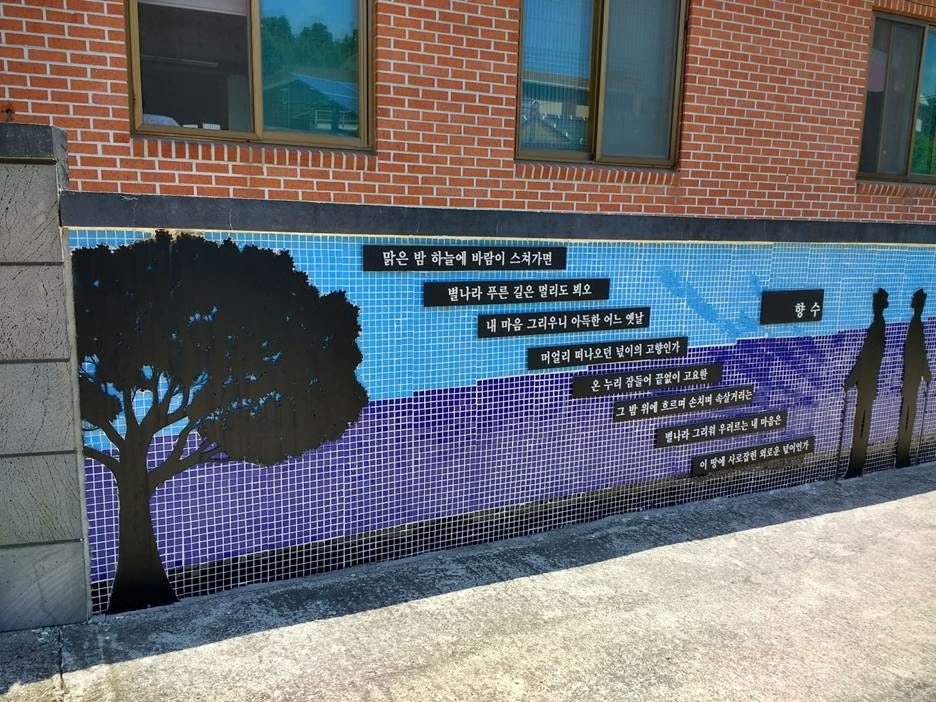
Featured on an alley wall is the complete text of Kim Hyeon-gu’s poem “Nostalgia,” translated below:
Nostalgia
Kim Hyeon-gu
When a breeze brushes the clear night sky,
I see, far away, the blue road to the land of stars.
My heart longs for something—
is it the distant homeland of a soul
that departed long ago?
While the whole world sleeps
in endless stillness,
my heart, gazing upward,
longs for the land of stars
that drifts across the night, waving and whispering.
What lonely soul has it captured?
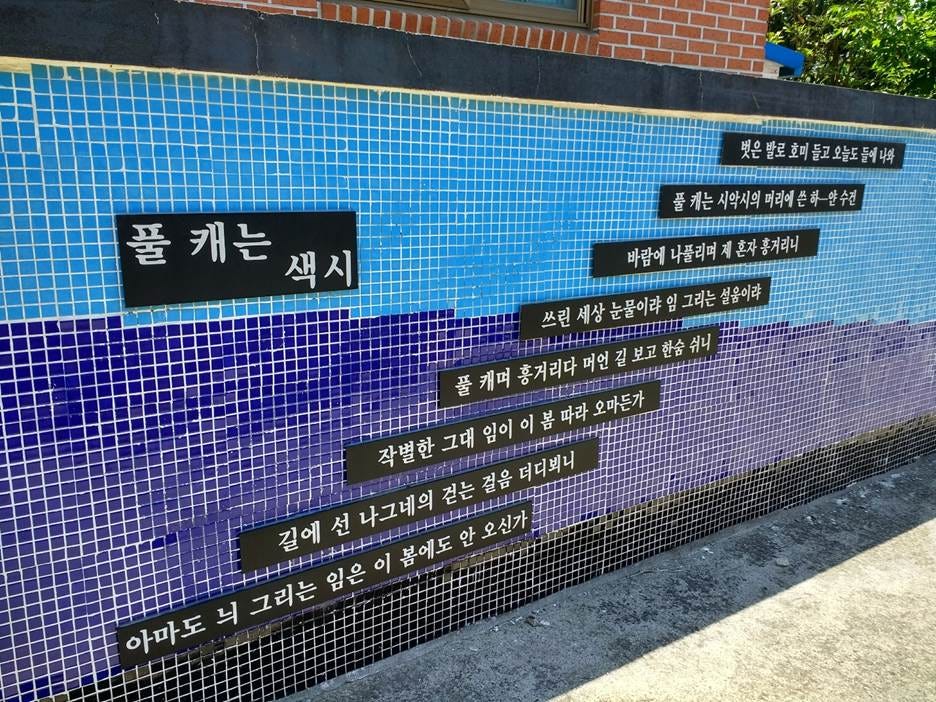
A wall along the alley features the complete text of Kim Hyeon-gu’s poem “The Young Bride Gathering Greens,” translated below:
The Young Bride Gathering Greens
Kim Hyeon-gu
Barefoot, hoe in hand, she comes to the fields again today.
The white kerchief on the head of the young bride gathering greens
flutters in the wind as she hums to herself.
The tears of this painful world—how they are the sorrow of longing for her beloved.
Humming as she gathers greens, she gazes down the distant road and sighs:
Will the one she parted from return with this spring?
Seeing a traveler’s footsteps slow along the road,
she wonders: has the one she longs for not come, even this spring?
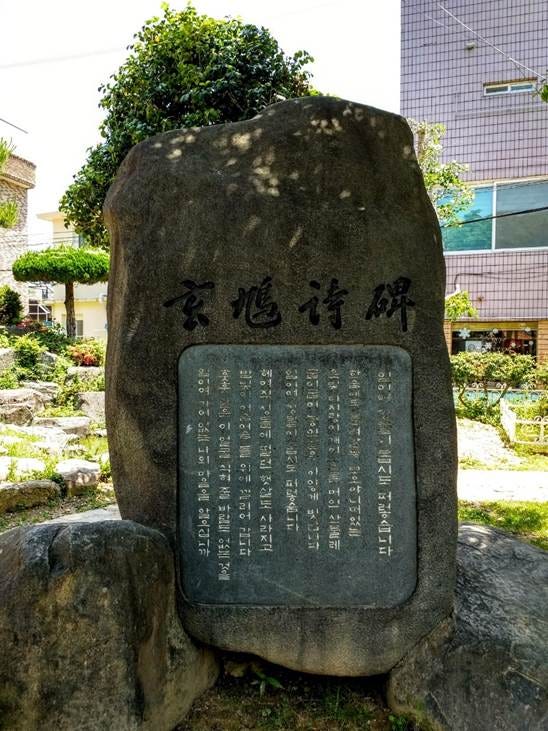
Kim Hyeon-gu’s poem “My Love, the River Is So Blue” is inscribed on a rock. Below is a translation:
My Love, the River Is So Blue
Kim Hyeon-gu
As though a sigh might carry them away,
silver haze floats in the distance,
rippling over the far-off mountain ridges.
The winding old road shines white.
My love, the river is so blue.
The sunlight that trembled
on the broken castle stones has disappeared,
and the dim moonlight
spreads slowly across the fields.
There is not even a breeze
to cool this burning face.
My love, do you know
how boundless my heartache is?
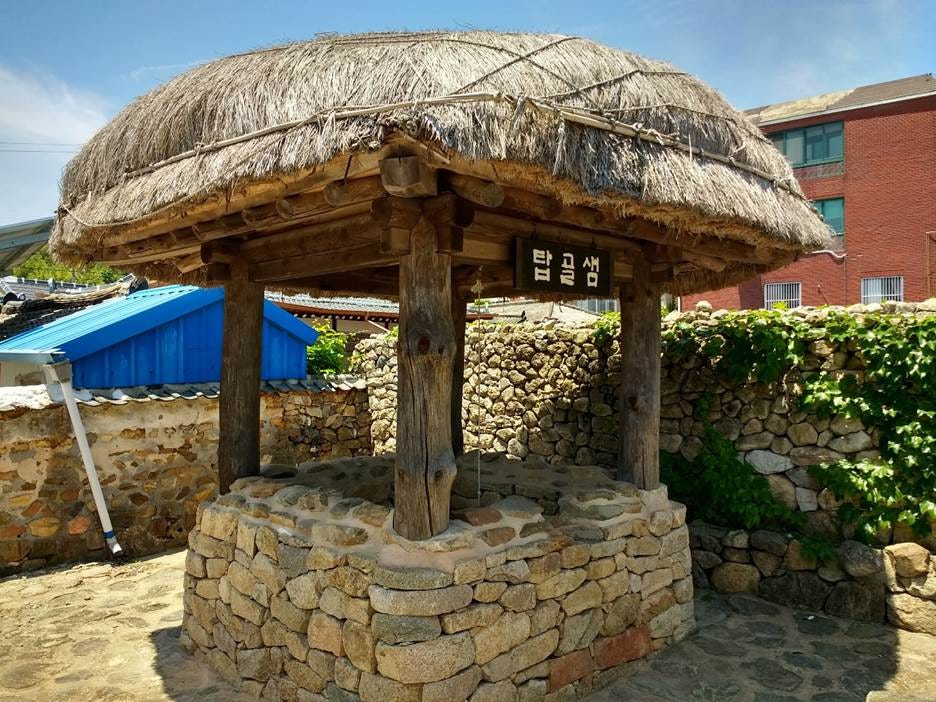
Tapgol Well, located at the entrance to Yeongnang’s birthplace, is an old village well that inspired the poet’s imagination and serves as the symbolic starting point of the Gangjin-eup Literary Walking Trail.
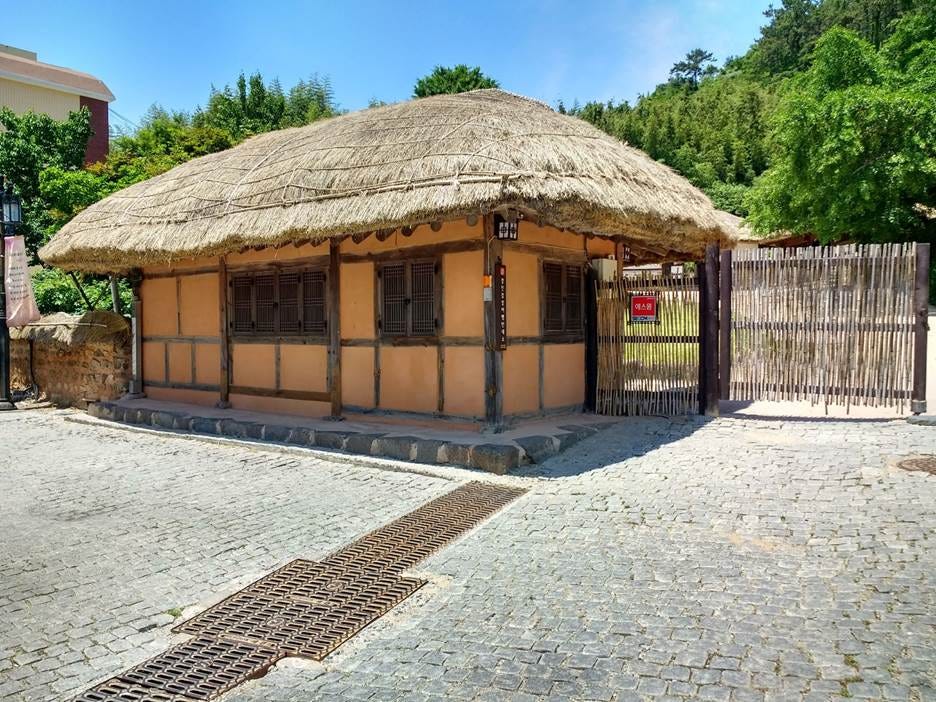
The thatched-roof Gangjin Sensibility Travel Information Center on the Gangjin-eup Literary Walking Trail.
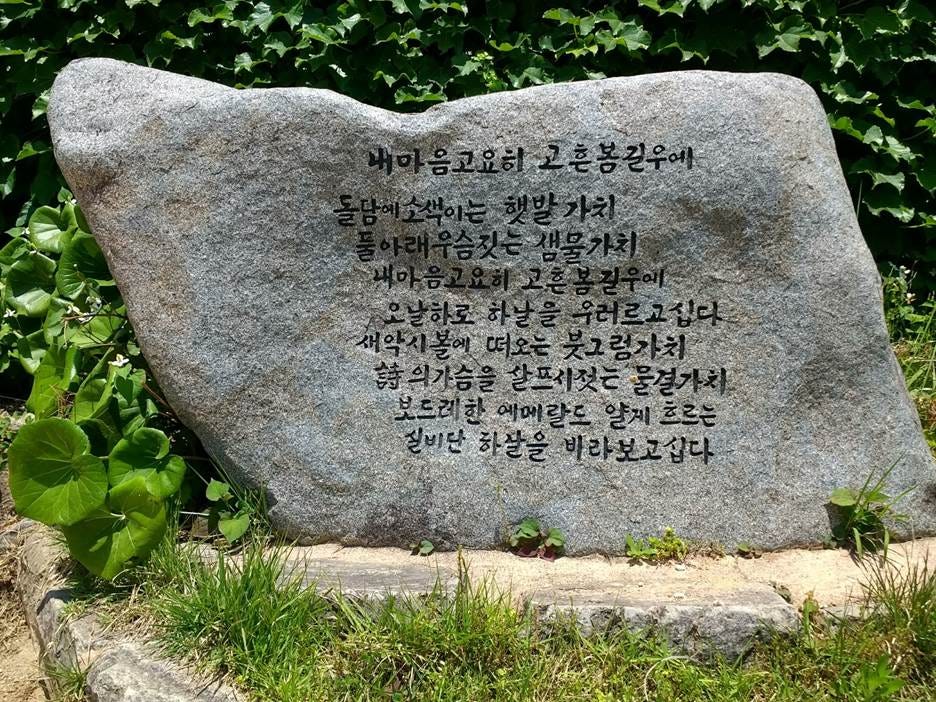
This rock bears the text of Yeongnang’s poem “Upon the Spring Path Where My Heart Flows Quietly.” Below is a translation of the poem:
Upon the Spring Path Where My Heart Flows Quietly
Kim Yeongnang
Like sunlight whispering along a stone wall,
like spring water smiling beneath the grass,
upon the beautiful spring path
where my heart flows quietly,
today, just for a day,
I wish to gaze up at the sky.
Like the blush rising on a young maiden’s cheek,
like a gentle wave softly moistening the heart,
I wish to gaze upon
a tender emerald sky
flowing lightly like silk.
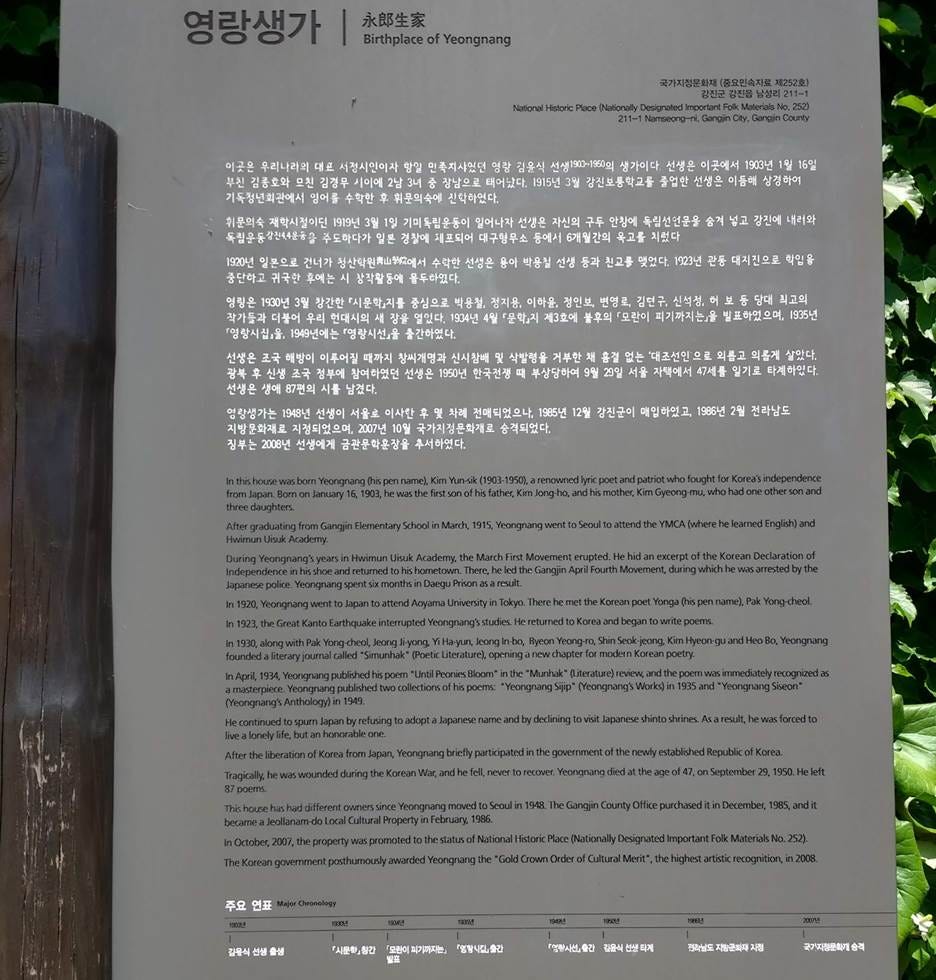
This information board introduces the birthplace of Yeongnang, providing a biography and chronology of the poet. The final paragraph states:
After the poet moved to Seoul in 1948, his birthplace changed hands several times. In December 1985, Gangjin County purchased the property, and in February 1986, it was designated a provincial cultural heritage site by South Jeolla Province. In October 2007, it was elevated to a nationally designated cultural heritage site. In 2008, the Korean government posthumously awarded him the Order of Cultural Merit, Geumgwan (Gold Crown).
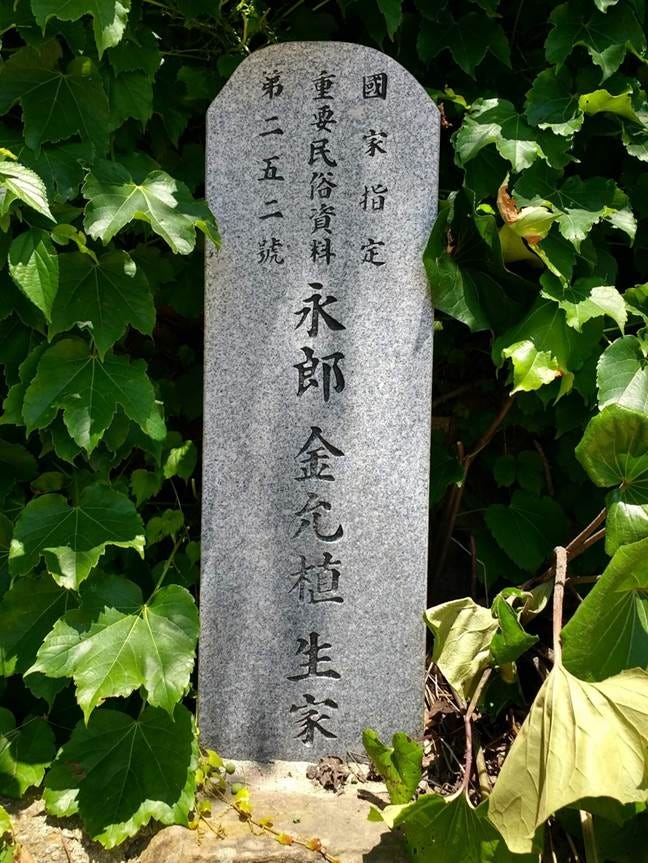
This stone marker stands at the entrance to the birthplace of Yeongnang. The inscription in Chinese characters reads, “Nationally Designated Important Folklore Cultural Heritage No. 252: Birthplace of Yeongnang Kim Yun-sik.”
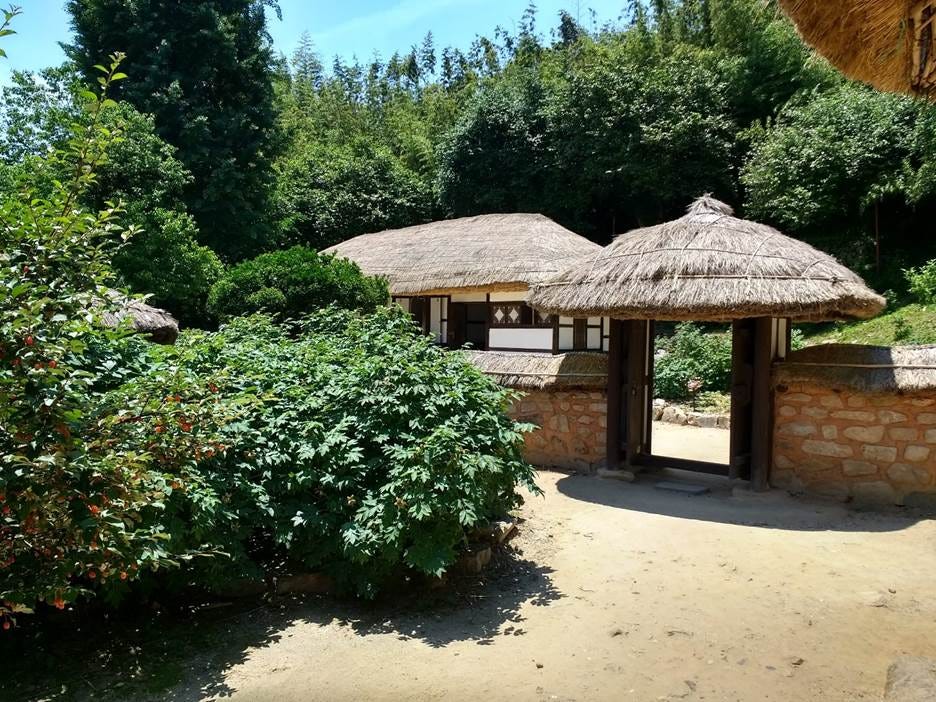
The open gate to the birthplace of Yeongnang. This is a typical view of a thatched-roof house, once common in rural South Korea until the 1970s and 1980s. Today, such houses are rare and are preserved mainly as cultural heritage at the Korean Folk Village and other heritage sites.
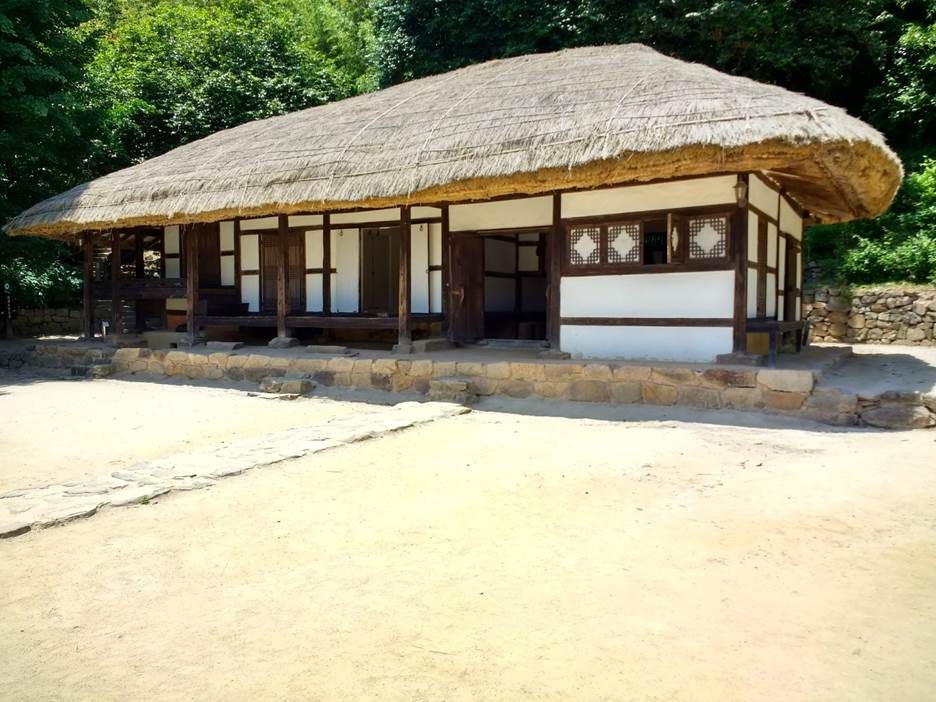
This is Yeongnang’s neatly preserved birthplace in a quiet neighborhood of Gangjin-eup.
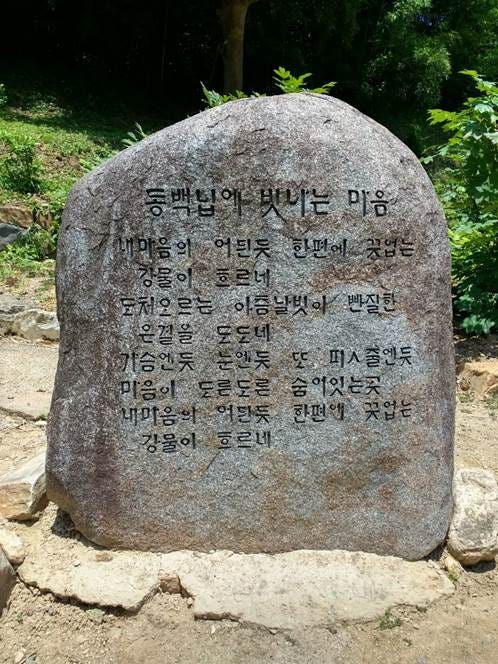
Yeongnang’s poem “A Heart Shining on Camellia Leaves” is inscribed on this rock. The poem reads in translation:
A Heart Shining on Camellia Leaves
Kim Yeongnang
Somewhere within my heart,
an endless river flows.
The rising morning light
glints upon its silvery ripples.
As though in my breast, my eyes,
or even in my veins,
my heart lies quietly hidden,
trembling softly in its secret place.
Somewhere within my heart,
an endless river flows.
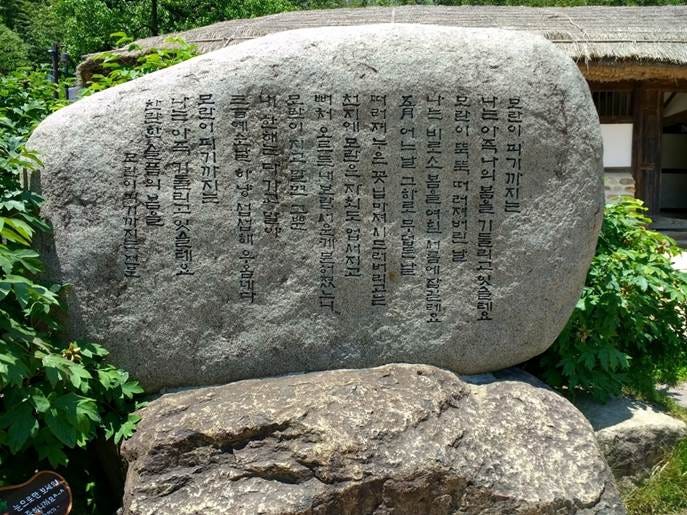
This rock bears Yeongnang’s “Until the Peonies Bloom,” one of the most celebrated poems of modern Korean literature. Below is a translation:
Until the Peonies Bloom
Kim Yeongnang
Until the peonies bloom,
I shall continue to wait
for my spring.
On the day the peonies
fall, petal by petal,
I shall finally sink
into the sorrow of having lost my spring.
One day in May,
on that sweltering day,
even the fallen petals wither away,
and the peonies disappear
without a trace from the world.
Then my rising hope
collapses in disappointment.
Once the peonies have withered,
that is all—my year is over,
and for all three hundred and sixty days
I shall grieve in sorrow.
Until the peonies bloom,
I shall continue to wait
for the spring of radiant sorrow.
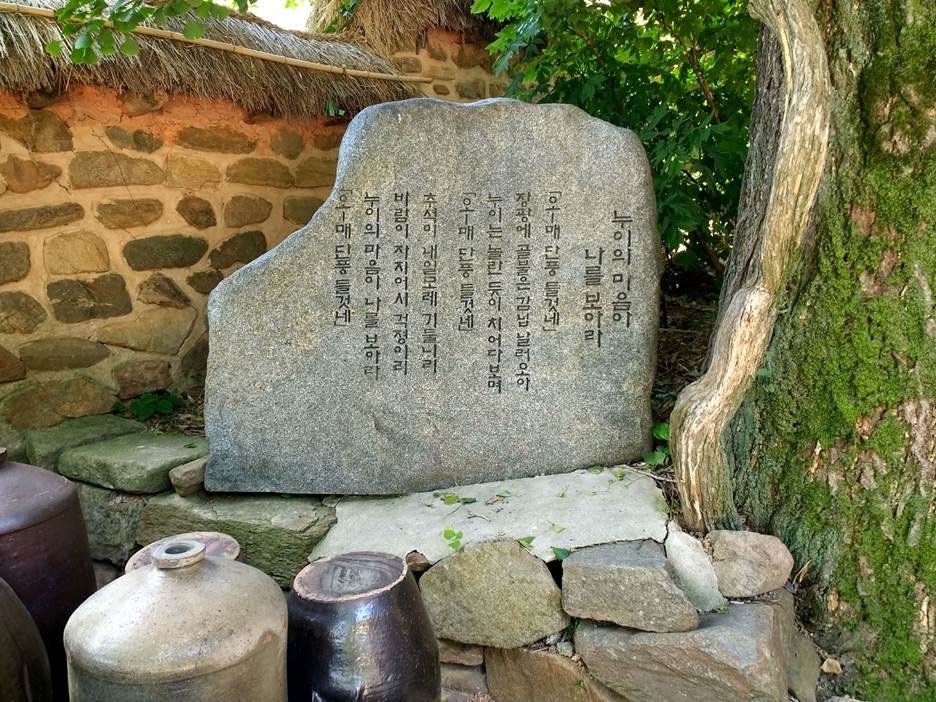
Yeongnang’s poem “My Sister, Look at Me” is inscribed on this rock. The poem captures a sister’s quiet anxiety as autumn approaches. Below is a translation:
My Sister, Look at Me
Kim Yeongnang
“Oh my, the autumn leaves are turning.”
Red persimmon leaves,
burning in the courtyard,
come fluttering down.
My sister looks up, startled.
“Oh my, the autumn leaves are turning.”
With Chuseok just a day or two away,
she must be worried
because the wind has finally gone still.
My sister, look at me.
“Oh my, the autumn leaves are turning.”
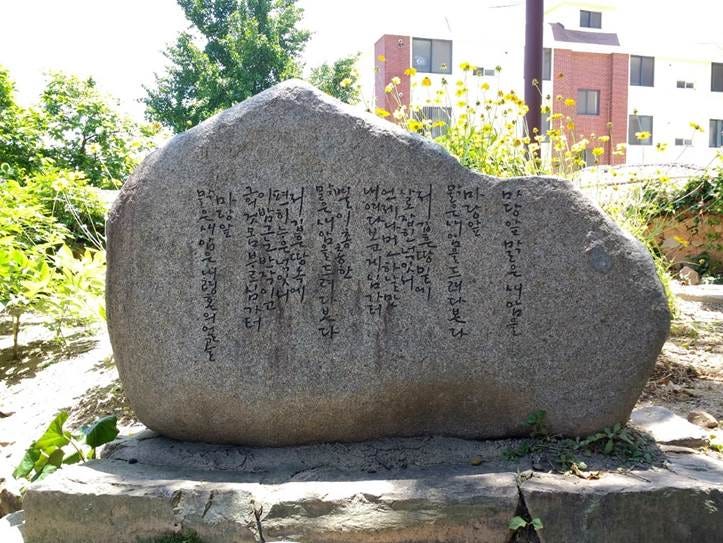
Yeongnang’s poem “I Gaze into the Clear Well Before the Courtyard” is inscribed here. Below is a translation:
I Gaze into the Clear Well Before the Courtyard
Kim Yeongnang
I gaze into the clear well
before the courtyard.
Deep beneath the earth,
a captive soul
seems always to be gazing up
at the distant sky.
I gaze into the clear well,
clear and filled with twinkling stars.
Deep beneath the earth,
a soul lies peacefully at rest.
Tonight, its eyes are sparkling,
as though calling out
to its body above.
The clear well
before the courtyard
is the face of my soul.
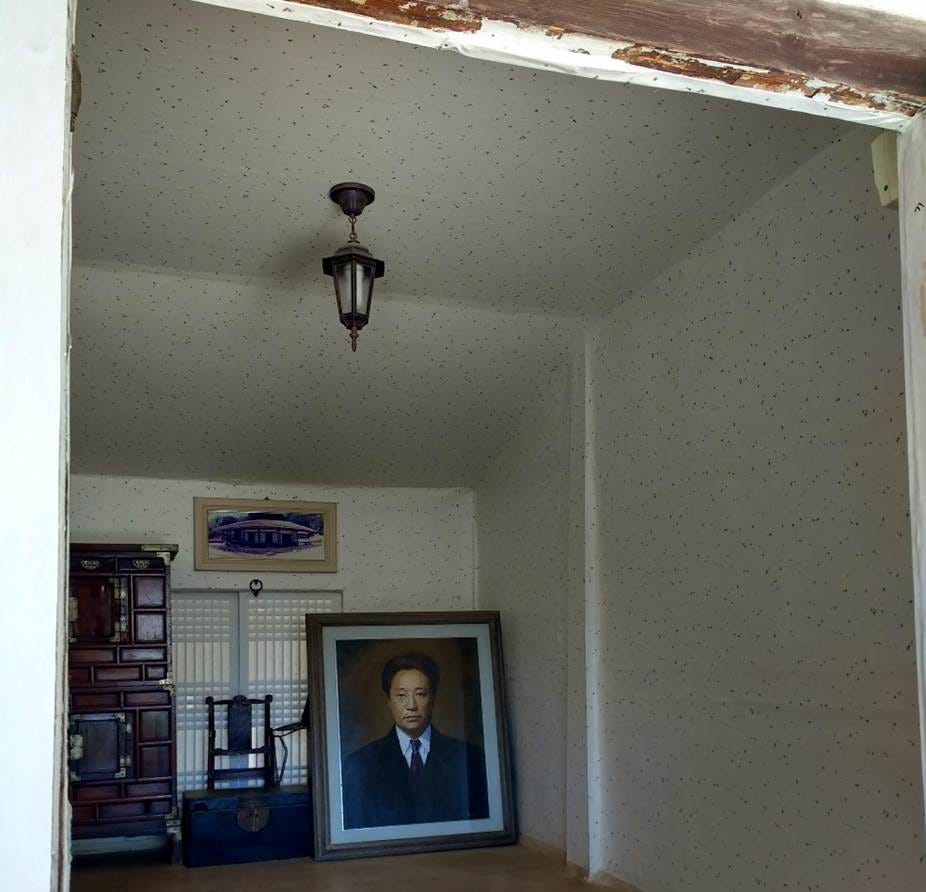
A portrait of Yeongnang leans against a wall in one of the rooms at his birthplace.
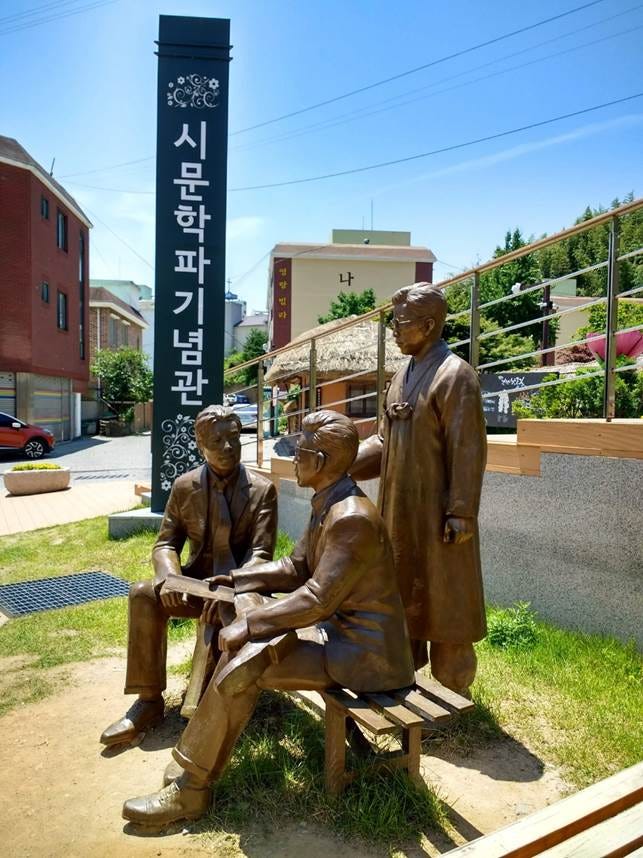
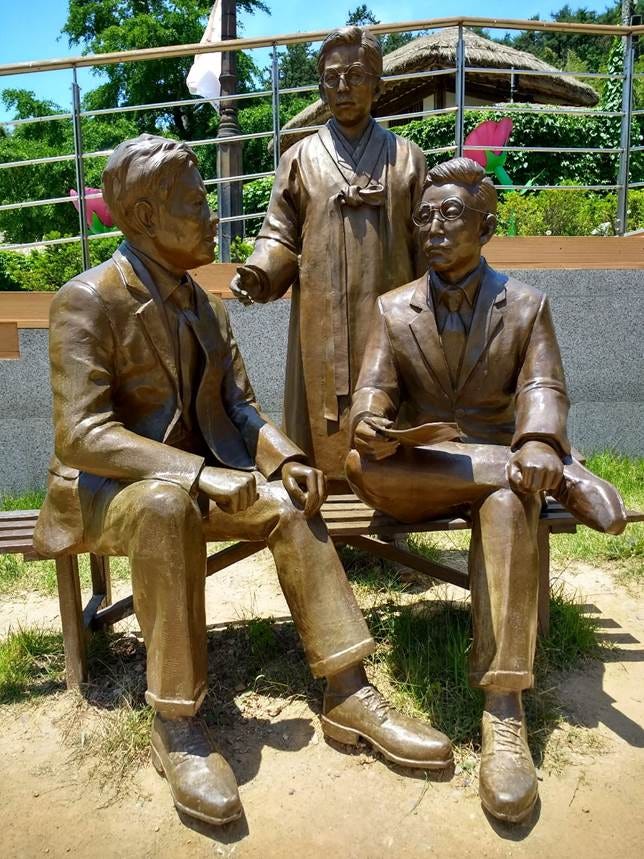
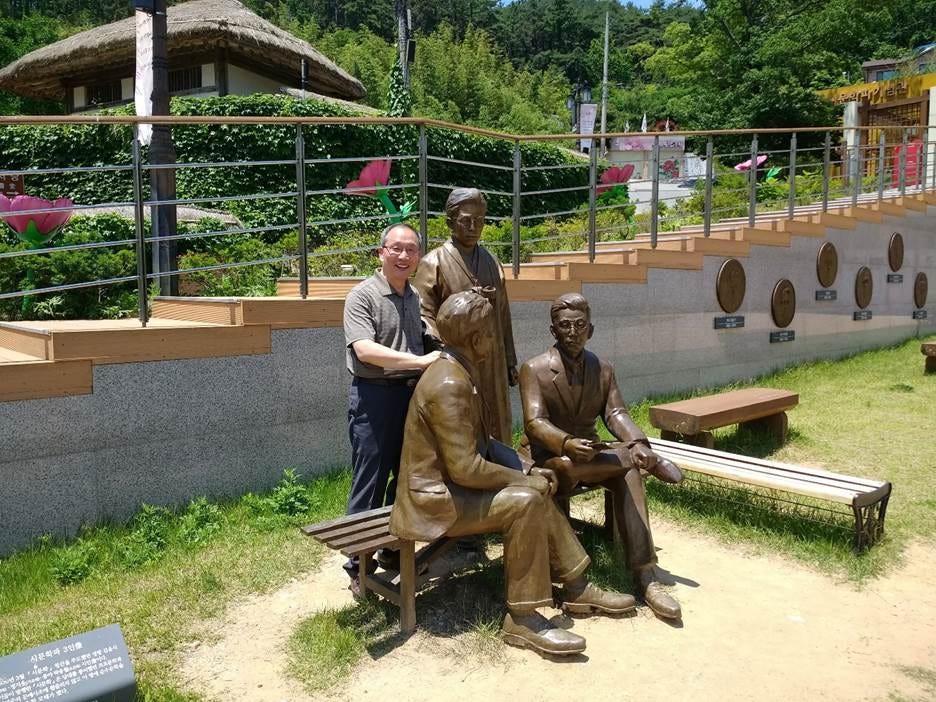
Near Yeongnang’s birthplace stands the Simunhakpa Memorial Hall. The three statues at the entrance commemorate Yeongnang Kim Yun-sik, Jeong Ji-yong, and Yonga Park Yong-cheol, the leading poets who spearheaded the founding of Simunhak (Poetic Literature), a literary journal launched in 1930 that played an important role in the development of modern Korean pure poetry.
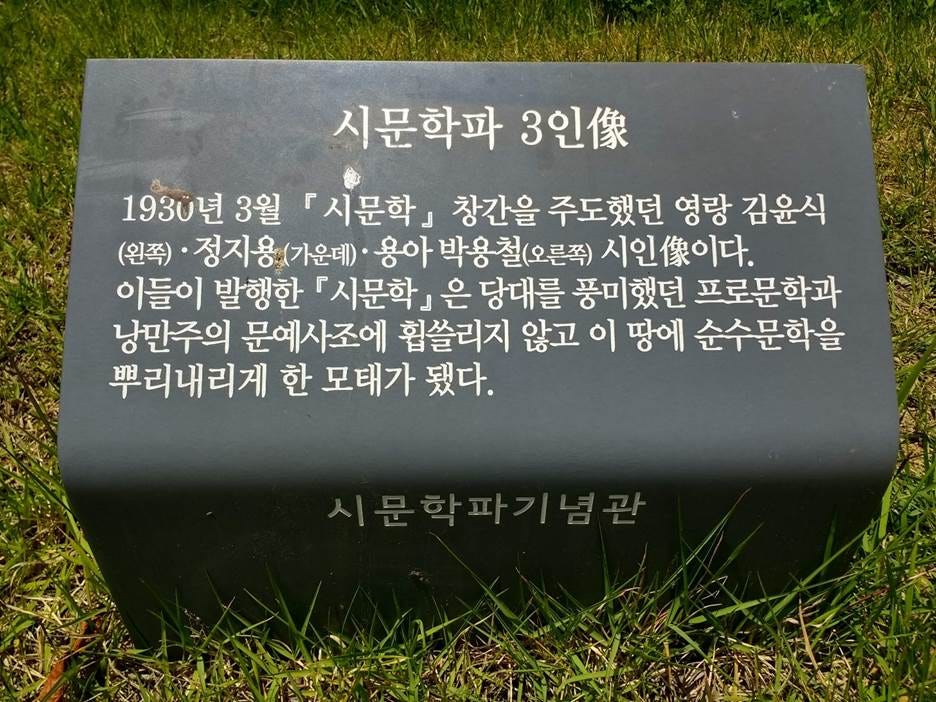
An interpretive sign on the ground identifies the statues, from left to right, as Yeongnang, Jeong Ji-yong, and Yonga Park Yong-cheol, respectively.
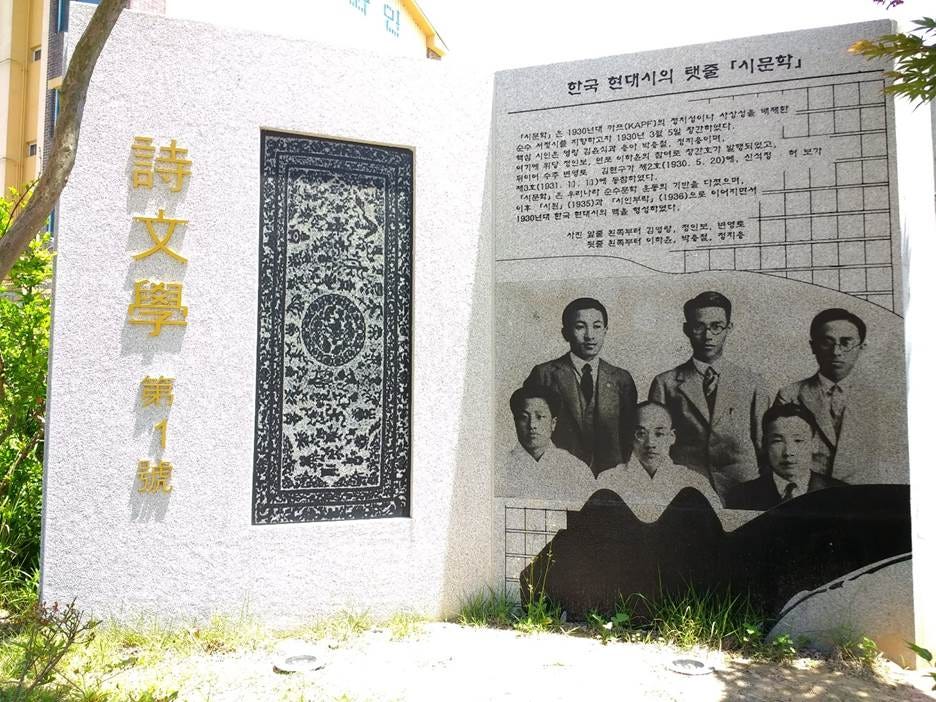
The left side features an enlarged, inscribed reproduction of the cover of the first issue of Poetic Literature. The right side explains the journal’s importance as the “umbilical cord” of modern Korean poetry and displays photographs of six of its prominent members.
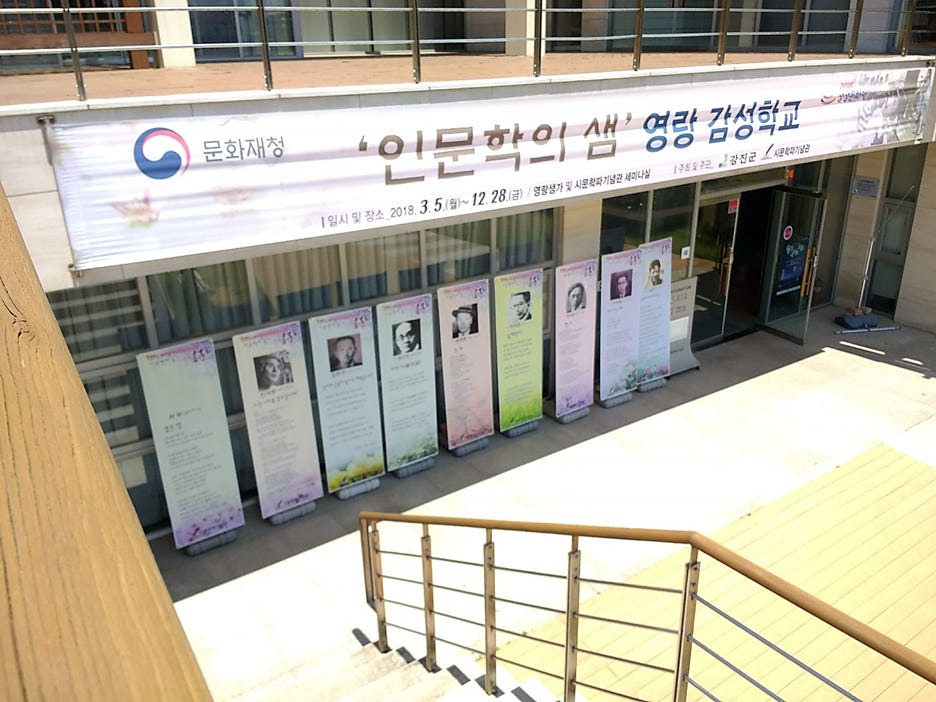
The Simunhakpa Memorial Hall hosts various literary events. The banner in the photo announces “A Wellspring of Humanities: Yeongnang Sensibility School,” a program held at both the memorial hall and Yeongnang’s birthplace from March 5 to December 28, 2018. All the photos in this photo essay were taken on June 2, 2018. After visiting sites related to Yeongnang and Kim Hyeon-gu, I headed to places connected with Dasan Jeong Yak-yong, which are featured in a separate photo essay.
About the Author
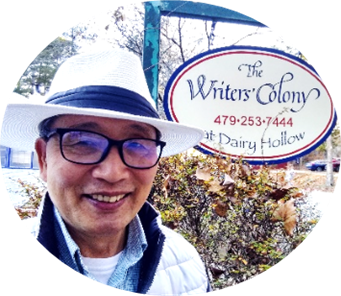
Professor of English and Creative Writing and Associate Dean of the School of Humanities and Theology, Missouri Baptist University
John J. Han, PhD, is the author, editor, co-editor, or translator of 36 books. His forthcoming book, Echoes from the Hills: Critical Essays on Ozarks Literature (co-edited with C. Clark Triplett), will be published by the University of Arkansas Press. He has also published more than 3,000 poems, primarily haiku, in a wide range of journals and anthologies. In addition to his long tenure at Missouri Baptist University, he has taught at Kansas State University, the University of Nebraska–Lincoln, Nebraska Wesleyan University, and Washington University in St. Louis. He has also served as a visiting scholar at Georgia College & State University and the University of Ljubljana in Slovenia.
© K-Global Scholars and Professionals Forum. All rights reserved. Content published in the K-GSP Forum may not be reproduced, distributed, or transmitted in any form without prior written permission from the K-GSP Forum, except for brief quotations with full attribution.