
Literary Gangjin: Walking in the Footsteps of Jeong Yak-yong
During the Joseon dynasty, Jeolla Province was one of the regions most often used for political exile because of its distance from the capital and its relative isolation from the center of government. Officials, scholars, and members of the royal family who fell out of political favor were often banished there, sometimes for years or even for life. Among the best-known exiles was Dasan Jeong Yak-yong (다산 정약용, 茶山 丁若鏞, 1762-1836), one of Korea’s greatest Confucian scholars, who spent eighteen years in exile in Gangjin County, where he wrote many of his most influential works on philosophy, government, and practical learning. Another prominent exile was Yun Seon-do (1587-1671), the celebrated poet and scholar, who lived on Bogildo Island off the Jeolla coast and produced some of the finest examples of classical Korean poetry.
This photo essay visits Gangjin, where Jeong Yak-yong spent eighteen years in political exile (1801-1818). He is better known by his pen name Dasan (literally, “Tea Mountain”), one of several literary names he adopted during his lifetime. Jeong was also a leading figure of the Silhak (실학, 實學, Practical Learning) movement, which sought to reform Neo-Confucianism by addressing the practical needs of society. During his lifetime, he wrote more than 500 books and over 2,700 poems. Most of his major works were composed in Gangjin and cover an extraordinary range of subjects, including poetry, linguistics, philosophy, economics, public administration, medicine, geography, criminology, and engineering.
Located along the southern coast of the Korean Peninsula, Gangjin was a place of isolation, yet it also became the setting for Dasan’s most productive years as a writer, thinker, teacher, and mentor to younger scholars. Separation from the royal court, his fellow scholar-officials, and his wife and three children for nearly two decades brought him profound personal suffering. Yet one cannot help wondering whether he could have maintained such an extraordinary level of scholarly productivity had he remained immersed in the demands of official life in Seoul. Ironically, the tragedy of exile became the catalyst for contributions that enriched Korean literature, philosophy, public administration, and even civil engineering.
Before exploring the sites associated with Dasan in Gangjin, it is helpful to trace the course of his remarkable life. Born in Gwangju County, Gyeonggi Province, he was the son of Jeong Jae-won, a provincial government official, and Yun So-on (윤소온), a descendant of Yun Seon-do. Dasan’s father taught him to read and write at an early age. At the age of seven, he composed the following Chinese poem:
小山蔽大山
遠近地不同
A small mountain hides a great mountain
Because distance makes the difference.
This ten-character poem reveals the child’s keen powers of observation and imagination. Three years later, he compiled his childhood poems into the Three Eyebrows Collection (삼미자집, 三眉子集). The title refers to the scar left above his right eyebrow by a bout of smallpox.
In 1776, at the age of fifteen, Dasan married Hong Hye-wan (홍혜완, 洪惠婉, 1761-1838), the daughter of a royal secretary. The couple had nine children, although six died in childhood. At twenty-two, he passed the preliminary civil service examination and studied at Sungkyunkwan, the kingdom’s highest educational institution, until the age of twenty-eight. He then passed the higher civil service examination and began serving in a succession of government posts.
When he was twenty-three, Dasan became interested in Roman Catholicism through the influence of Yi Byeok (이벽, 李蘗, 1754-1785), the brother-in-law of his eldest brother. As the royal court intensified its persecution of Catholics, culminating in the execution of more than 300 converts in 1801, Dasan publicly renounced the faith. His elder brother Jeong Yak-jong (정약종, 丁若鍾, 1760-1801) was among those executed. Seeking to demonstrate his loyalty to Confucian orthodoxy, Dasan urged Korean Catholics to abandon their faith and resume ancestral rites, a Confucian practice that the Catholic Church regarded as incompatible with Christian belief.
Nevertheless, Dasan’s earlier association with Catholicism remained a political liability amid the intense factional struggles that dominated Joseon politics from the late sixteenth century into the early nineteenth century. Though spared execution, he was first exiled to Janggi Fortress in Gyeongsang Province for several months before being transferred to Gangjin County, where he remained for eighteen years.
At the age of fifty-seven, Dasan’s exile was finally lifted, allowing him to return home, where he lived until his death at seventy-five. Three days before his death, he composed his final Chinese-language poem, “Wedding Anniversary Poem,” celebrating sixty years of marriage with his beloved wife. Rich in allusions, the poem reads:
回婚詩
六十風輪轉眼翩
穠桃春色似新婚
生離死別催人老
戚短歡長感主恩
此夜蘭詞聲更好
舊時霞帔墨猶痕
剖而復合眞吾象
留取雙瓢付子孫
Wedding Anniversary Poem
Sixty years have turned like a wheel in the blink of an eye;
Spring’s luxuriant peach blossoms are as fresh as our wedding day.
Partings in life and death hasten the coming of old age,
Yet joys have far outweighed sorrows, thanks to Heaven’s grace.
Tonight, the wedding songs sound sweeter than ever,
And traces of your bridal robe still linger in the ink.
Split apart, then joined again—such has been our life together;
May our paired gourds remain as an heirloom for our descendants.
Even after his death, the consequences of Dasan’s earlier association with Catholicism continued to affect his family. His sons were barred from holding government office for nearly twenty years, a lasting reminder of the political and religious tensions that shaped his life.
Below are five Chinese-language poems by Jeong Yak-yong that I translated and published in Fireflies’ Light: A Magazine of Short Poems, no. 21 (December 2020). They appeared under the title “‘Laughing to Myself’ and Four Other Poems by Dasan Jeong Yak-yong.”
獨笑
有粟無人食
多男必患飢
達官必憃愚
才者無所施
家室少完福
至道常陵遲
翁嗇子每蕩
婦慧郞必癡
月滿頻値雲
花開風誤之
物物盡如此
獨笑無人知
Laughing to Myself
The household that has grain has no child to eat it;
the one with many sons suffers from hunger.
All high officials are fools;
gifted men have no place to use their talents.
Few households are blessed with complete happiness;
the Way of truth always declines.
When the father is frugal, the son is wasteful;
when the wife is wise, the husband is foolish.
When the full moon appears, clouds often gather;
when flowers bloom, winds come to scatter them.
Everything in the world is like this.
I laugh alone, and no one knows why.
*
穉子寄栗至
頗勝淵明子
能將栗寄翁
一囊分瑣細
千里慰飢窮
眷係憐心曲
封緘憶手功
欲嘗還不樂
惆悵視長空
On Receiving Chestnuts from My Son
A little better than Tao Yuanming’s1 sons,
he sent me chestnuts.
Though the sack was small, he divided them carefully,
and from a thousand li2 away, he worried that I might be hungry.
I cherish his loving heart,
and imagine the hands that sealed the package.
I wish to taste the chestnuts, yet I cannot rejoice;
I gaze sadly at the distant sky.
[1] (365?-427) Chinese official and poet whose nickname is the “Poet of the Fields” (田園詩人).
[2] he li was the basic distance unit in traditional Korea. A thousand li is equal to 393 kilometers (244 miles).
*
元陵輓詞
蠟炬連宮陌
龍輴度御溝
山巒猶自立
江漢不能流
德澤涵窮蔀
眞游屬寢丘
嗚呼信英主
謨烈照千秋
Elegy for King Yeongjo1
Torches line the road to the palace,
and the king’s bier crosses the royal moat.
The mountains still stand in silence,
and even the rivers cease to flow.
Having bestowed virtue and grace
upon the poorest of his people,
he now journeys to his resting place,
where he will find true peace.
Alas, he was truly a great ruler,
whose achievements and wisdom will shine for a thousand years.
[1] King Yeongjo of the Korean Joseon Dynasty was born in 1694 and died in 1776. During his reign, which lasted nearly fifty-two years, he reformed the tax system, reaffirmed Confucianism as the kingdom’s ideological foundation, and implemented the “Magnificent Harmony Policy” (蕩平策), which sought to remove political factionalism (朋黨).
*
晩晴
晩涼收雨氣
晴色入禪樓
映日峯黃嫩
含風竹翠柔
心隨滄海遠
身與老僧謀
怊悵玆山路
潮頭見小舟
Sky Clearing After the Rain
The cool evening breeze gathers the rain away,
and clear light enters the meditation pavilion.
The sun illuminates the mountain peaks with tender yellow,
and the bamboo, holding the wind, sways with gentle green.
My heart travels far across the blue sea,
while my body keeps company with an old monk.
On this sorrowful mountain path,
I see a small boat upon the rising tide.
*
獨立
秋山衰颯暮湍哀
獨立江亭意味裁
風鴈陣欹還自整
霜花莟破未輕開
空懷竹杖游僧院
徑欲瓜皮汎釣臺
百事思量身已老
短檠依舊照書堆
Standing Alone
Autumn mountains fade in the evening;
the rushing waters sound mournful.
Standing alone in the riverside pavilion,
I lose myself in thought.
The flock of geese in the wind tilts,
then gathers itself again.
The chrysanthemums break open their buds,
but do not yet bloom.
I long to take up my bamboo staff
and wander through a monk’s temple;
I wish to float a small boat
and fish from a quiet shore.
I ponder a hundred things,
but my body has already grown old.
A small lamp still shines, as before,
upon my piled-up books.
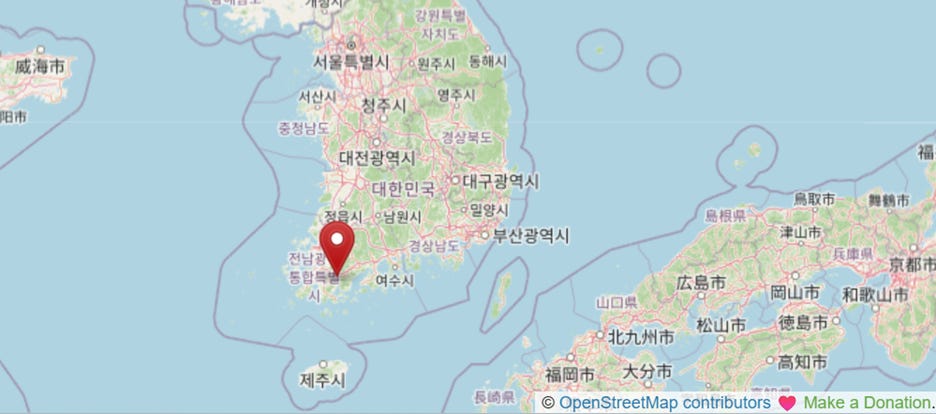
Gangjin County is located along the southern coast of the Korean Peninsula. After the Dutch sailor Hendrick Hamel (1630-1692) and his crew were shipwrecked on the shores of Joseon, they lived in the kingdom as captives for thirteen years. From 1656 to 1663, they were confined to Gangjin, where they remained under government supervision.
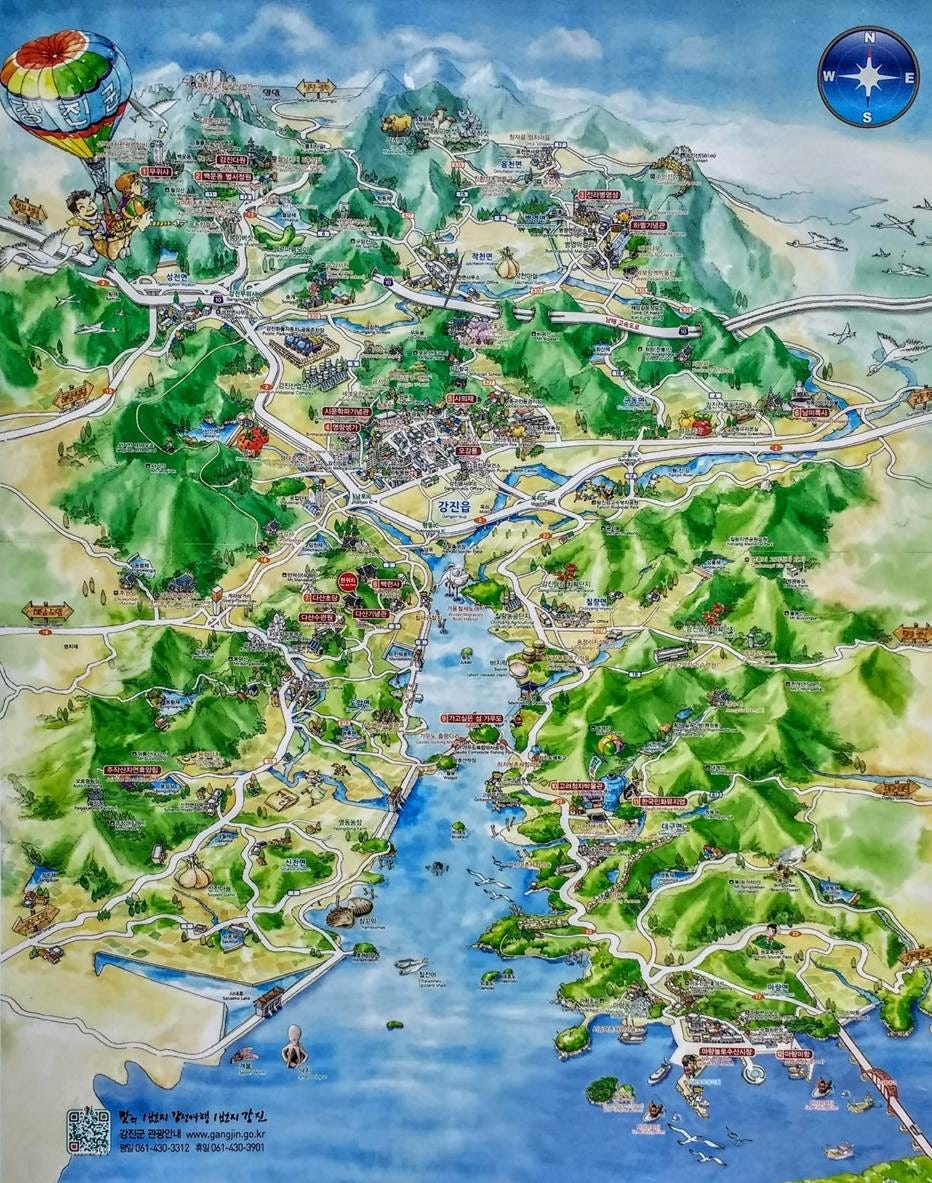
This pictorial map posted by Gangjin County shows that Dasan Memorial Hall, Dasan Chodang (다산초당, 茶山草堂, “Dasan’s Thatched Hall”), and the Dasan Training Center are located on the slopes of Mt. Mandeoksan (408 meters), approximately seventeen miles south of the county seat. All photos in this essay were taken by the author on June 2, 2018.
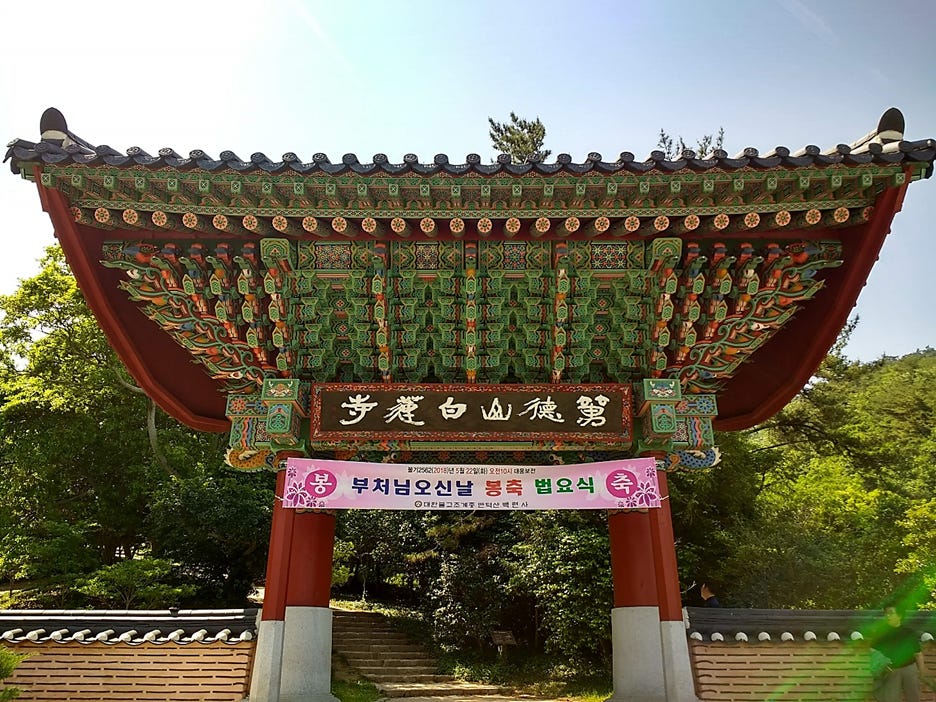
This is the entrance to Baengnyeon Temple (White Lotus Temple), which played an important role in Dasan’s life during his exile in Gangjin. Connected to Dasan Chodang by a 1.5-kilometer forest path, the temple remains a peaceful reminder of Dasan’s friendship with the monk Hyejang (惠藏, 1772-1811), with whom he exchanged Confucian and Buddhist ideas while deepening his appreciation of Korean tea culture.
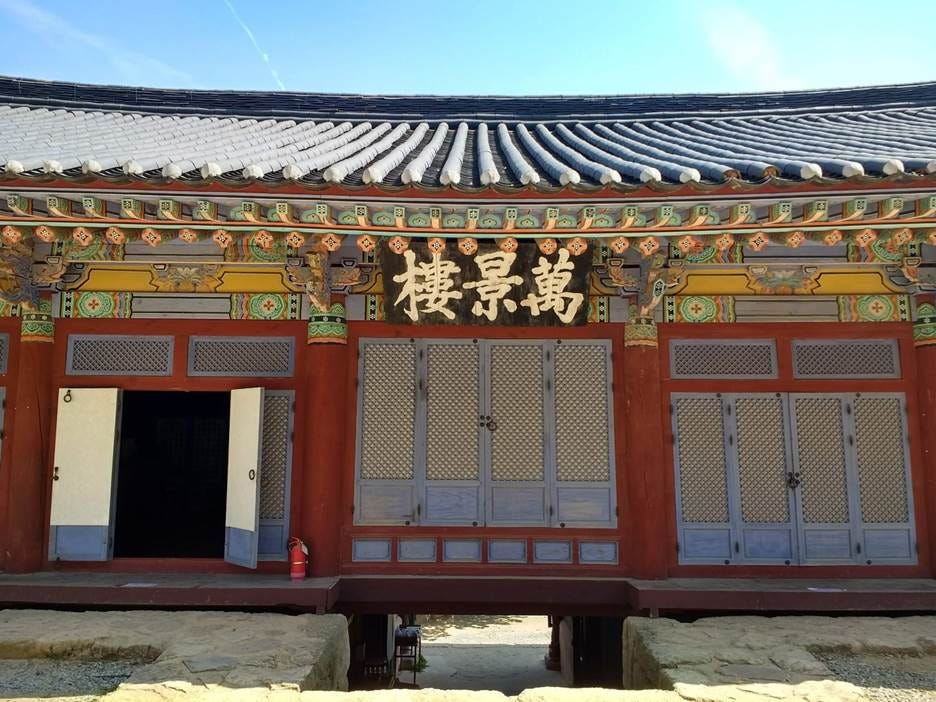
Mangyeongnu (萬景樓, Pavilion of Ten Thousand Views) stands within Baengnyeon Temple in Gangjin. The pavilion reflects the temple’s serene natural setting, offering views of the surrounding mountains and landscape that inspired contemplation and poetic appreciation.
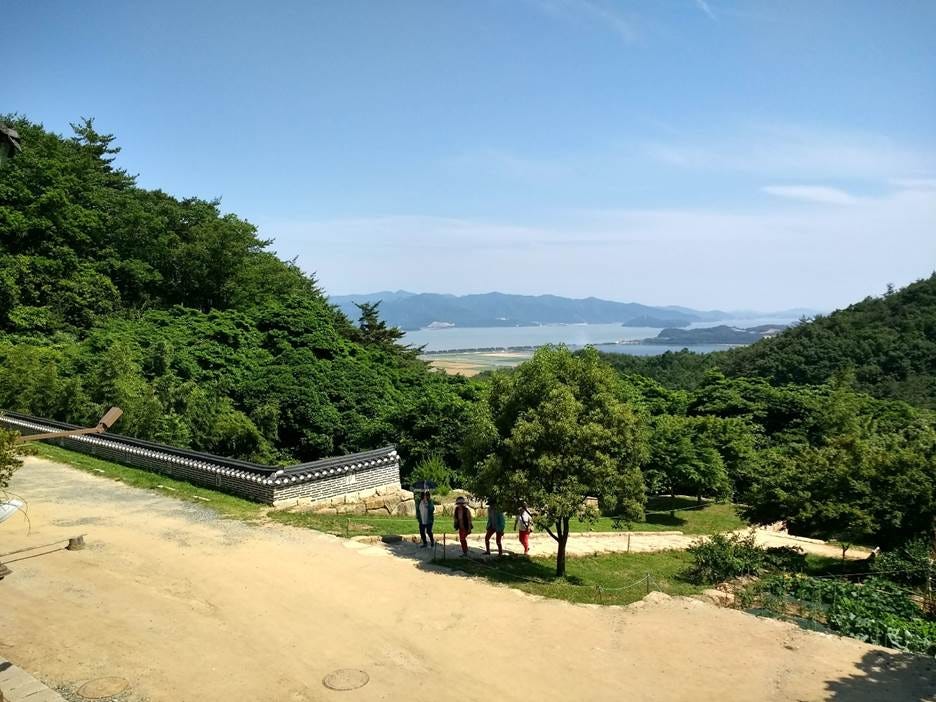
Gangjin Bay viewed from Baengnyeon Temple.
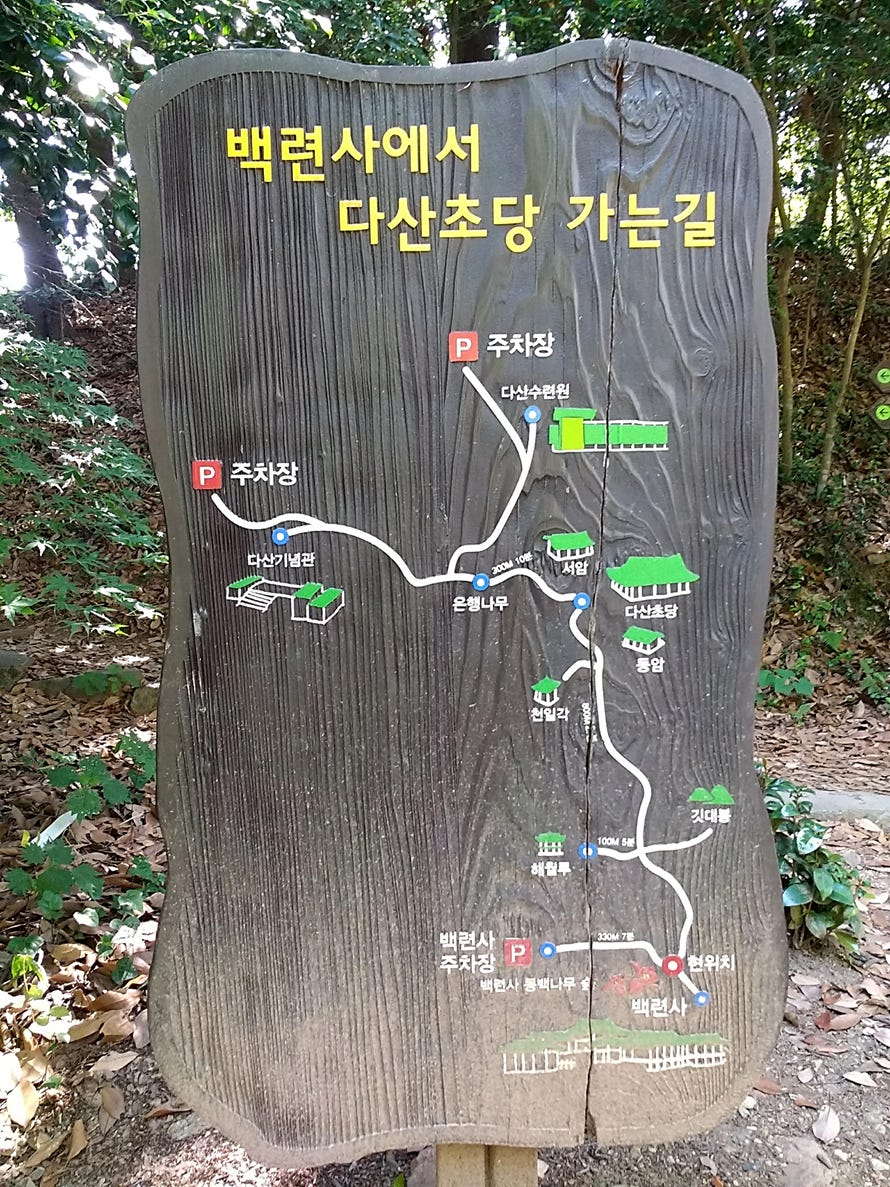
This guidepost indicates the 1.5-kilometer path connecting Baengnyeon Temple and Dasan Chodang.
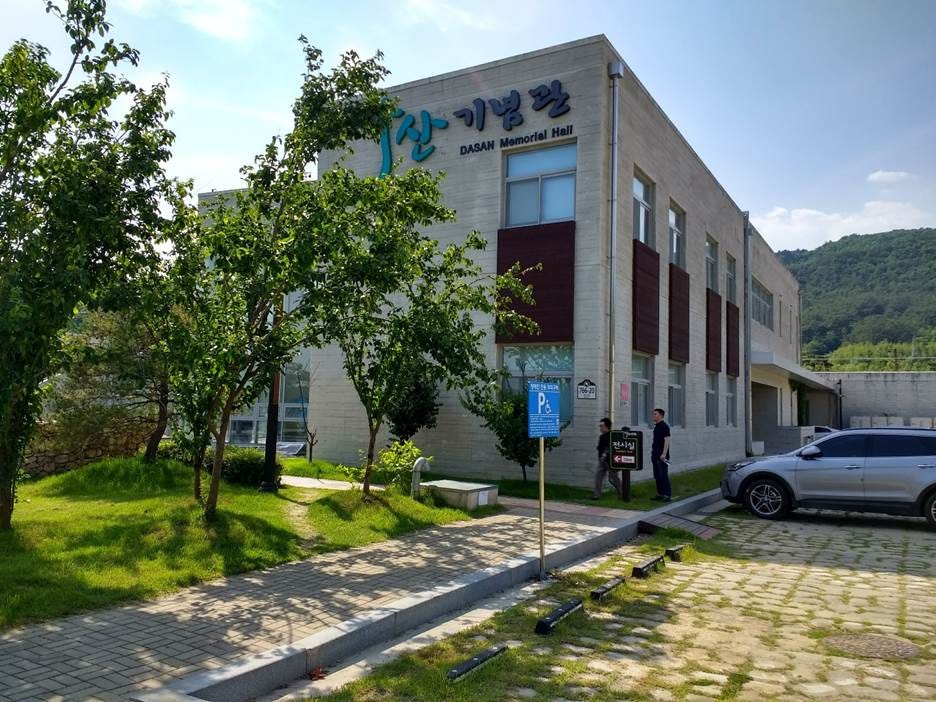
Dasan Memorial Hall in Gangjin preserves the legacy of Jeong Yak-yong, the great Joseon scholar of the Silhak (Practical Learning) movement. Through its exhibitions of his writings, letters, and scholarly achievements, the museum introduces visitors to the intellectual world he created during his eighteen years of exile.
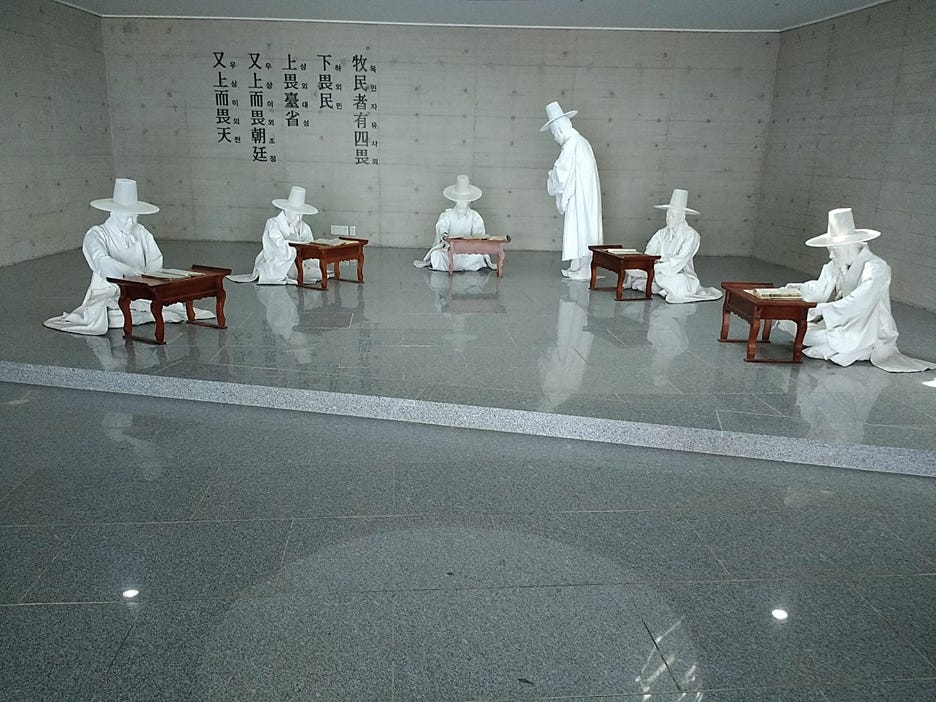
This display in Dasan Memorial Hall portrays Jeong Yak-yong sharing his knowledge with his followers during his years of exile in Gangjin County.
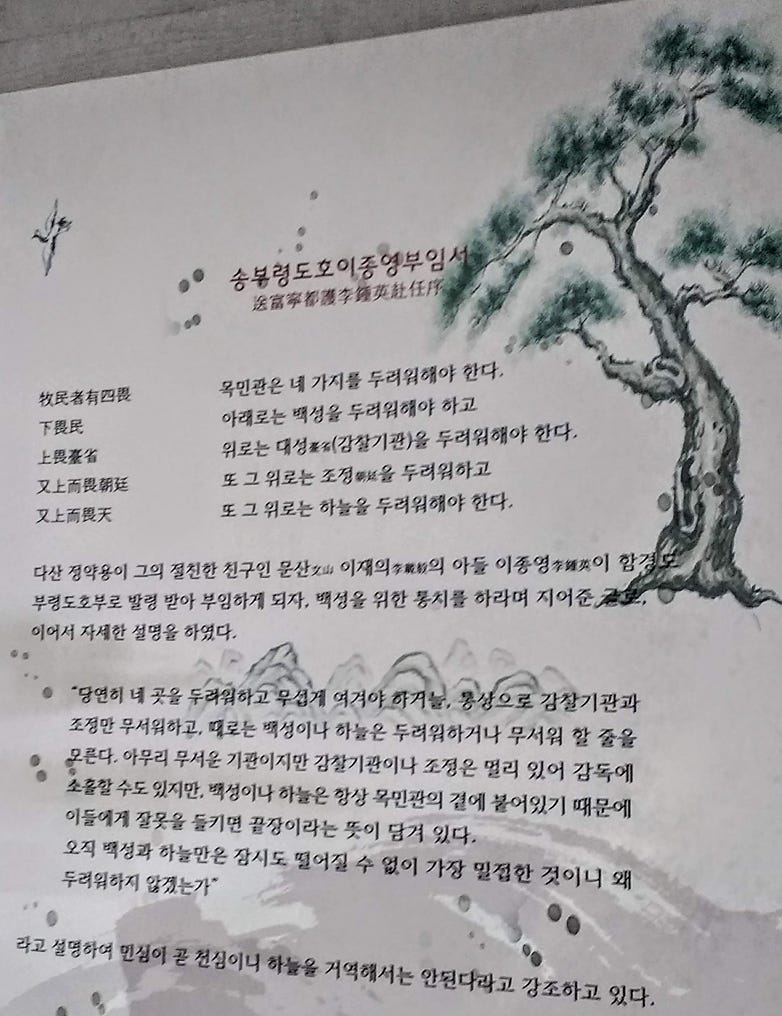
This Chinese poem by Jeong Yak-yong was written for Yi Jung-young, the son of Dasan’s close friend Yi Jae-ui, upon his appointment as magistrate of Bureong in Hamgyeong Province. In offering advice to the young official, Dasan emphasizes the central principle of Silhak: a government exists to serve the people, and a true leader must always be mindful of their hardships.
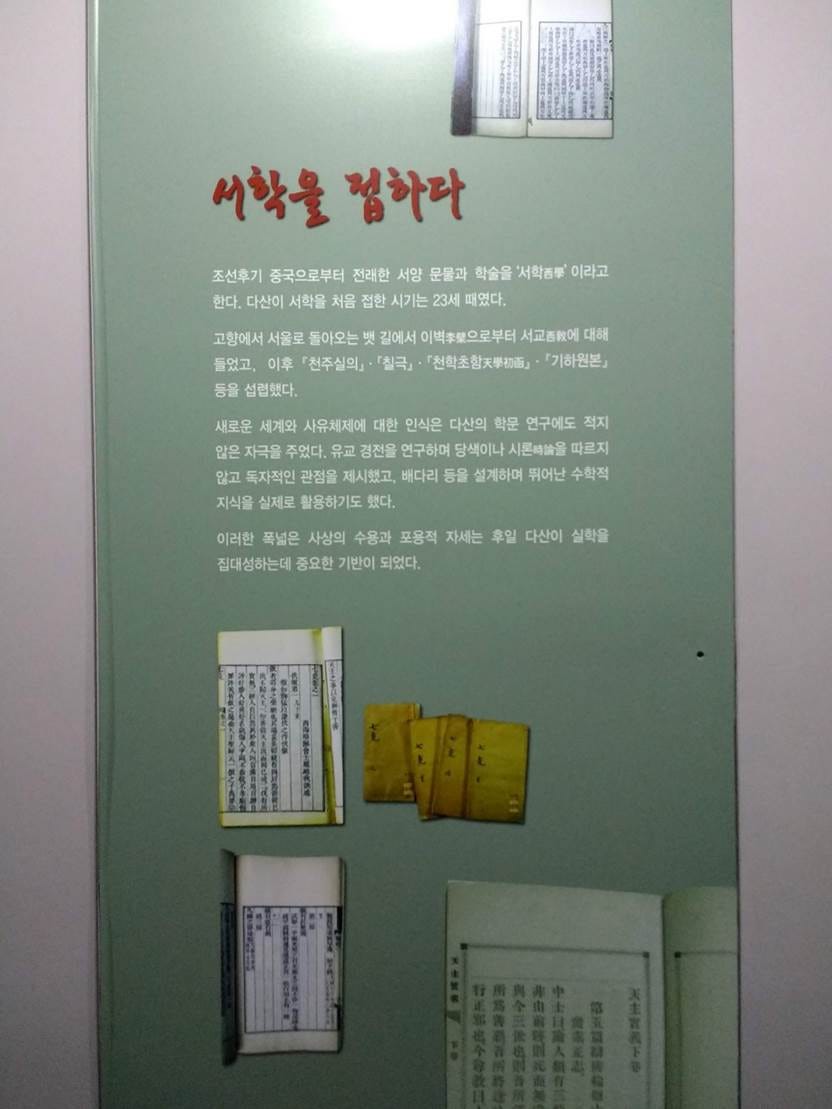
This panel introduces Jeong Yak-yong’s first encounter with Western Learning, including Catholic Christianity, at the age of twenty-three, and its impact on his development of Silhak thought.
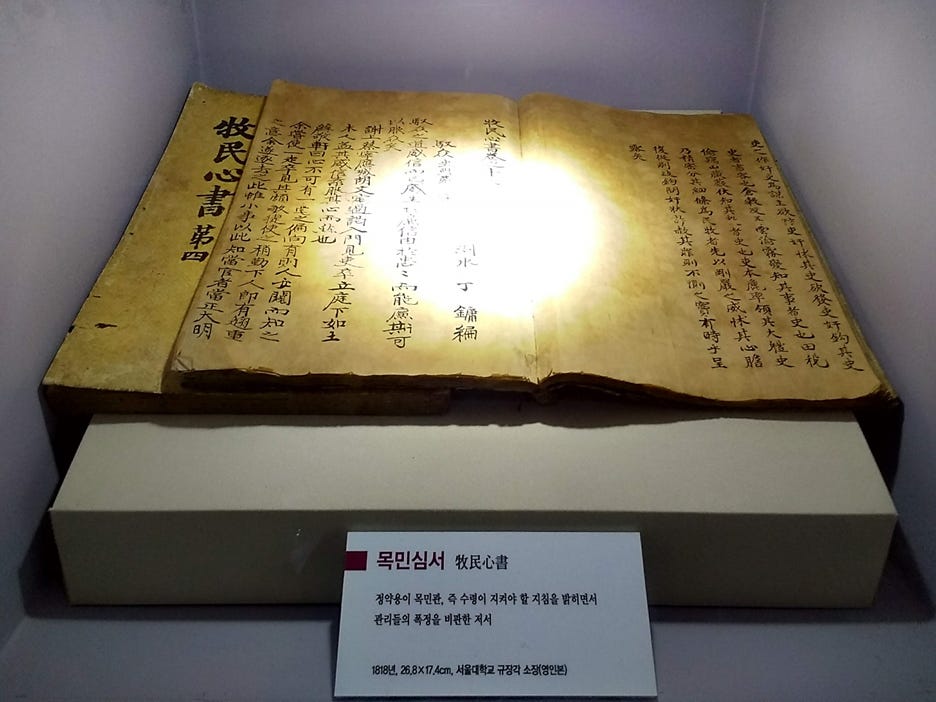
Displayed here is Jeong Yak-yong’s best-known political treatise, Mokminsimseo (목민심서, 牧民心書, The Mind of Governing the People). The original manuscript is housed at Seoul National University.
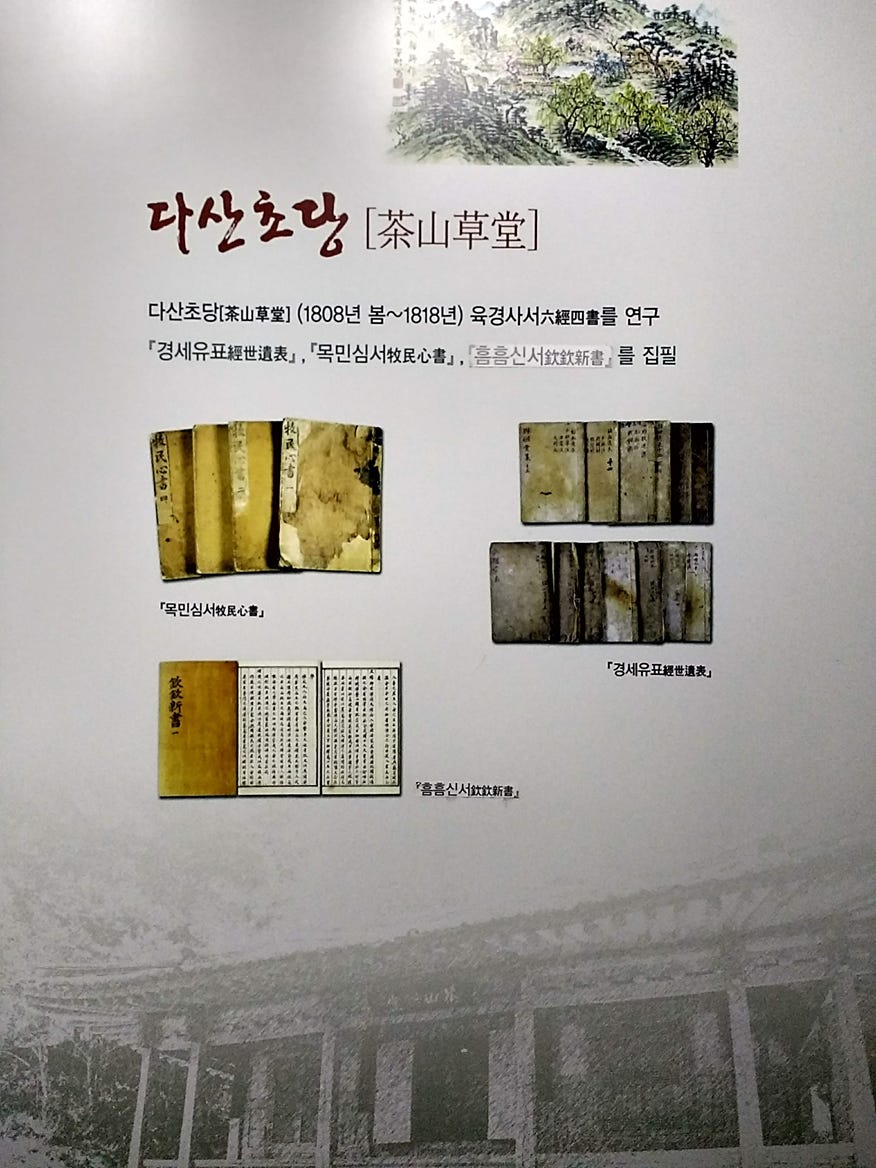
During his residence at Dasan Chodang (1808-1818), Jeong Yak-yong devoted himself to the study of the Four Books and Five Classics of Confucianism. During this period, he also authored such important works as Mokminsimseo (The Mind of Governing the People), Gyeongseyupyo (Design for Good Government), and Heumheumsinseo (Admonitions on Criminal Justice).
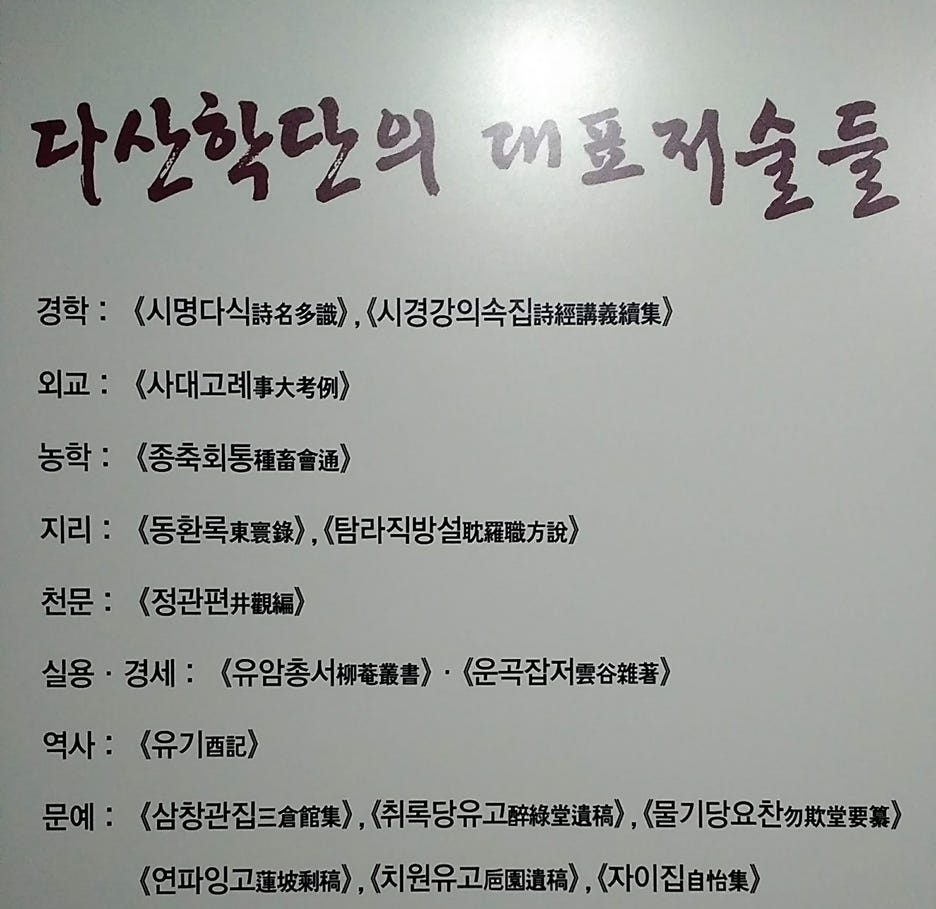
Jeong Yak-yong’s works listed above reflect his wide-ranging expertise in fields such as Confucian studies, diplomacy, agriculture, geography, practical statecraft, history, and literature and the arts.
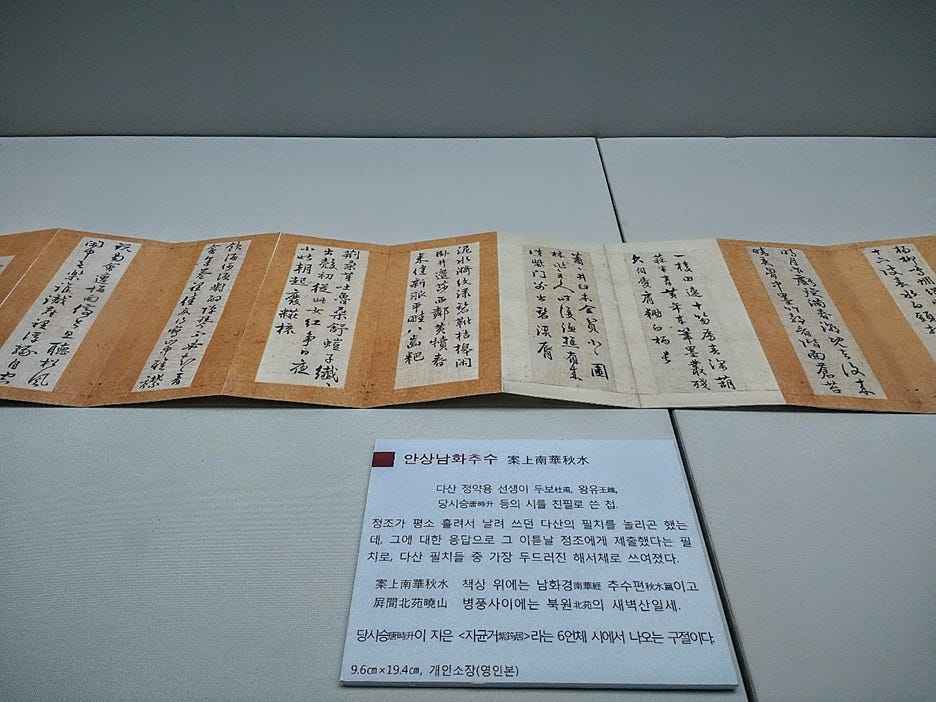
Jeong Yak-yong’s Ansang Namhwachusu (案上南華秋水) is a handwritten collection in which he copied poems by renowned Tang dynasty poets, including Du Fu and Wang Wei, during his years of exile in Gangjin. This calligraphic album reflects his continued engagement with classical Chinese literature and poetry despite the hardships of exile.
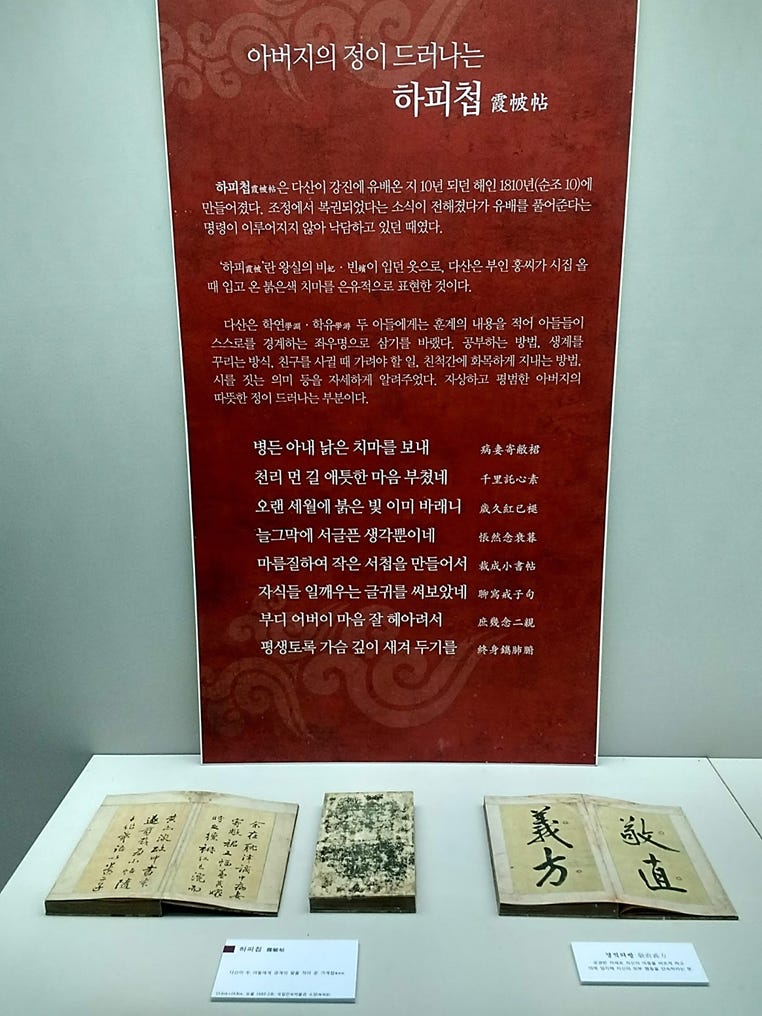
Hapicheop (霞帔帖, Album Made from a Red Skirt) is a treasured handwritten album created by Jeong Yak-yong during his exile in Gangjin in 1810. After receiving a faded red silk skirt from his wife Hong, who had kept it from the time of their marriage, Jeong transformed the worn fabric into a small book and wrote messages of guidance for his two sons, emphasizing the virtues of diligence (geun, 勤) and frugality (geom, 儉). Now designated a national treasure, Hapicheop reveals both his devotion to scholarship and his deep affection for his family despite years of separation.
The poem “Byeongcheo Gipegun” (病妻寄敝裙, “A Sick Wife Sends a Worn Skirt”) was written on the skirt and expresses Jeong’s longing for his ill wife, who remained far away in Seoul. In the poem, he reflects on the faded garment as a symbol of enduring love and family bonds, then turns it into a means of teaching his sons the values of virtue and filial responsibility.
病妻寄敝裙
千里託心素
歲久紅已褪
悵然念衰暮
裁成小書帖
聊寫戒子句
庶幾念二親
終身鐫肺腑
A sick wife sends a worn skirt;
from a thousand miles away, she entrusts her heartfelt affection.
Years have passed, and its crimson color has faded;
I sorrowfully think of our declining years.
I cut it into a small writing album
and write these words of counsel for my sons.
May they remember the hearts of their parents
and engrave these lessons upon their souls forever.
Through Hapicheop, a simple piece of clothing becomes a profound testament to Jeong Yak-yong’s love as a husband and father, as well as his belief in moral education and self-cultivation.
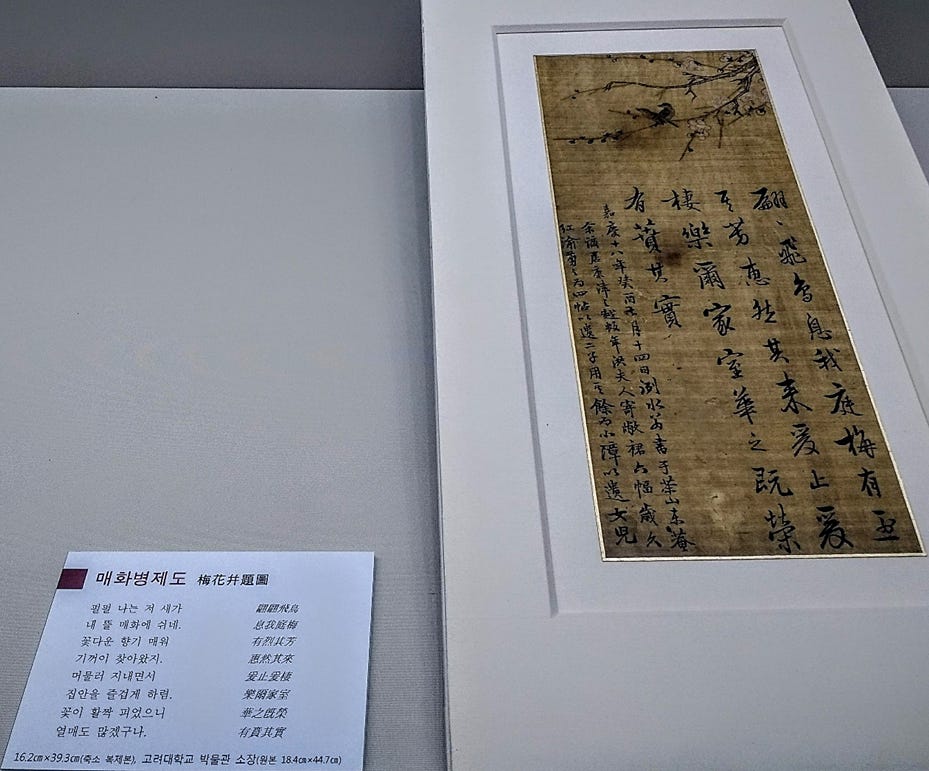
“Maehwabyeongjedo” (梅花倂題圖, “Plum Blossoms and Inscribed Poem”) is a painting and poem created by Jeong Yak-yong during his exile in Gangjin for his only daughter. Using the remaining pieces of the faded red silk skirt sent by his wife, Jeong painted a pair of birds perched on a plum branch and composed a poem expressing his hopes for his daughter’s happiness and a harmonious marriage.
The work was created from the same garment that inspired Hapicheop (霞帔帖). After transforming portions of the skirt into a calligraphic album for his two sons, Jeong used the remaining fabric to create this painting for his married daughter. The plum blossoms and the pair of birds symbolize marital affection, harmony, and enduring companionship. The accompanying poem reads:
翩翩飛鳥
息我庭梅
有烈其芳
惠然其來
爰止爰樓
樂爾家室
華之旣榮
有賁其實
Two birds flutter gracefully
and gather in harmony.
They perch upon my plum branch
and drink the sweet rain.
May they enjoy the blessings of each day
and speak words that bring lasting happiness.
Through “Maehwabyeongjedo,” Jeong Yak-yong expressed a father’s love and concern for his daughter while separated from his family during exile. Like Hapicheop, this work transforms an ordinary piece of cloth into a lasting testament to family devotion, moral guidance, and the enduring bonds of affection.
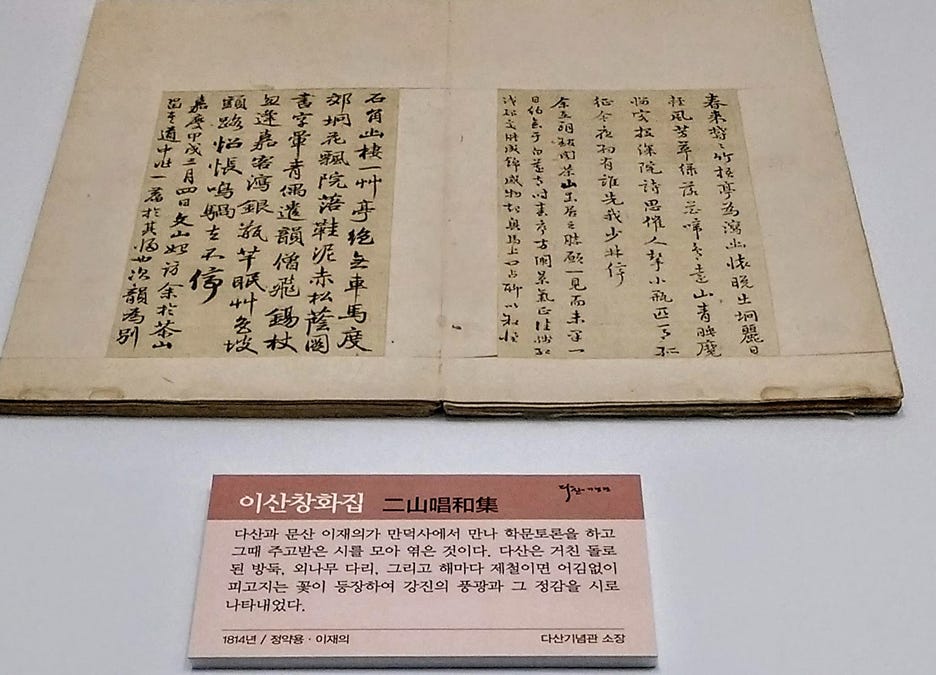
Isanchanghwajip (二山唱和集, Collected Poems of Isan’s Exchange) records the poetic and scholarly exchange between Jeong Yak-yong and Munsan Yi Jae-ui (文山 李載毅, 1772-1839) during the late Joseon period. The collection contains poems written in their own hands, through which the two scholars shared their intellectual reflections, exchanged ideas, and expressed their friendship.
Their relationship was remarkable because it transcended political factions and personal circumstances. Despite their different political backgrounds, Jeong Yak-yong as a member of the Namin faction and Yi Jae-ui associated with the Noron faction, the two Confucian scholars maintained a deep intellectual companionship. In 1814, Yi visited Dasan Chodang during Jeong’s exile, and the two engaged in discussions on the Confucian classics through poetry and scholarly dialogue.
In Isanchanghwajip, their poems reveal mutual respect and admiration, with Jeong compared to a steadfast pine tree and Yi to a resonant geomungo (Korean zither). The manuscript stands as a valuable record of friendship, intellectual exchange, and the power of scholarship to transcend political divisions in late Joseon Korea.
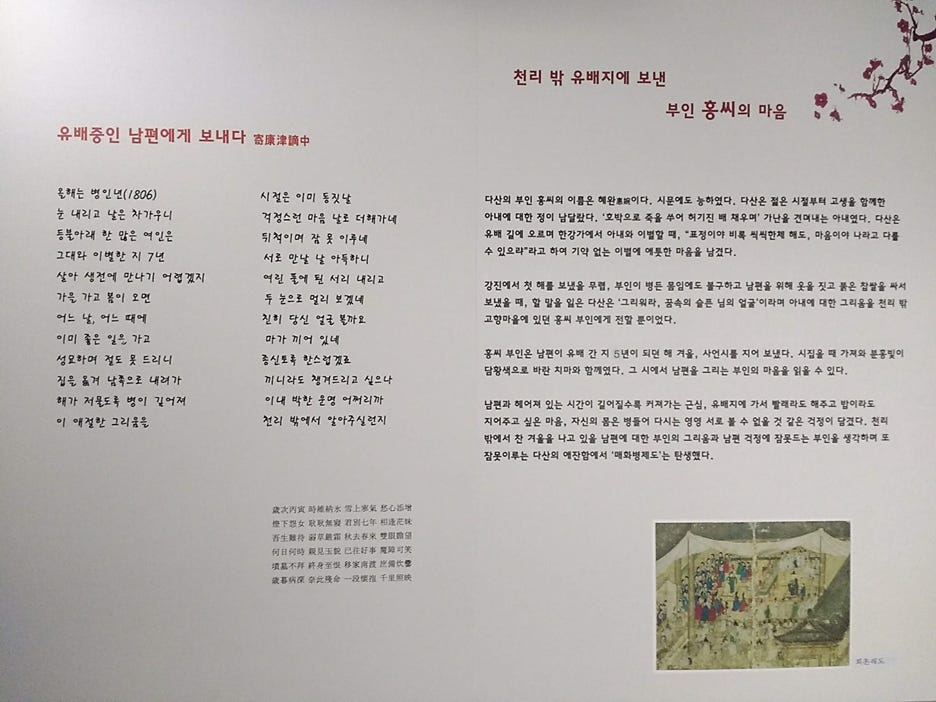
“Giganjinjeokjung” (寄康津謫中, Sent to My Husband Exiled in Gangjin) is a heartfelt Chinese poem written by Hong Hye-wan, the wife of Jeong Yak-yong, and sent to him during his exile in Gangjin. Written in 1806, during the seventh year of their separation, the poem expresses her sorrow, longing, and anxiety as she endured illness and the hardships of life apart from her husband.
The poem reveals Hong’s deep affection and unwavering devotion. The faded red skirt and this poem, sent during their long separation, later inspired Jeong Yak-yong to create Hapicheop (霞帔帖) for his sons and Maehwabyeongjedo (梅花倂題圖) for his daughter, transforming a symbol of marital love into lasting works of art and moral instruction. Below are the original text and an English translation:
歲次丙寅
時維納氷
雪上寒氣
愁心添增
燈下怨女
耿耿無寐
君別七年
相逢茫昧
吾生難待
弱草嚴霜
秋去春來
雙眼瞻望
何日何時
親見玉貌
已往好事
魔障可笑
墳墓不拜
終身至恨
移家南渡
庶備炊爨
歲暮病深
奈此殘命
一段懷抱
千里照映
The year is Byeongin (1806);
the season has reached the coldest month.
The chill upon the snow
only deepens my sorrow.
Beneath the lamp, a grieving woman
remains awake through the night.
Seven years have passed since you departed;
the hope of meeting again grows dim.
Like tender grass beneath a heavy frost,
I have endured the passing seasons,
watching autumn depart
and spring return with my eyes fixed on the distance.
On what day and at what hour
shall I see your face again?
The joys we once shared
now seem like a distant dream.
My greatest regret for this lifetime
is that I cannot bow before my ancestors’ graves.
If only I could move southward
and prepare your meals with my own hands.
As the year ends and my illness deepens,
what shall I do with this remaining life?
Yet this one longing in my heart
shines across a thousand miles to you.
Hong Hye-wan’s poem provides a rare glimpse into the personal suffering behind Jeong Yak-yong’s years of exile. Beyond political hardship, it reveals the emotional cost of separation and the enduring bond between husband and wife that later became a source of inspiration for Dasan’s most intimate works.
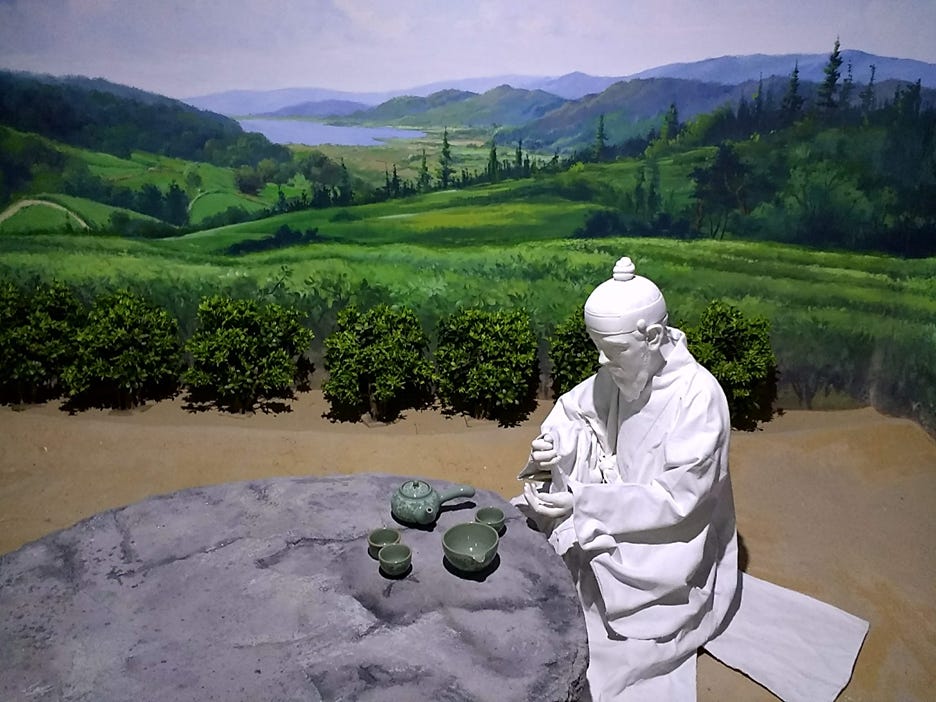
During his eighteen years of exile in Gangjin, Jeong Yak-yong considered tea not only a medicinal drink but also a means of self-cultivation and scholarly practice. He studied methods of tea production, developed his own techniques for making tea, and shared his knowledge with disciples who formed the Dasin-gye (茶信契, Fellowship of Tea and Trust) to preserve their connection through tea.
Dasan also approached tea from a practical perspective. In his writings, he considered ways that tea production and exchange could contribute to the national economy. For him, tea represented more than a beverage—it embodied health, friendship, learning, and the ideals of Silhak (Practical Learning).
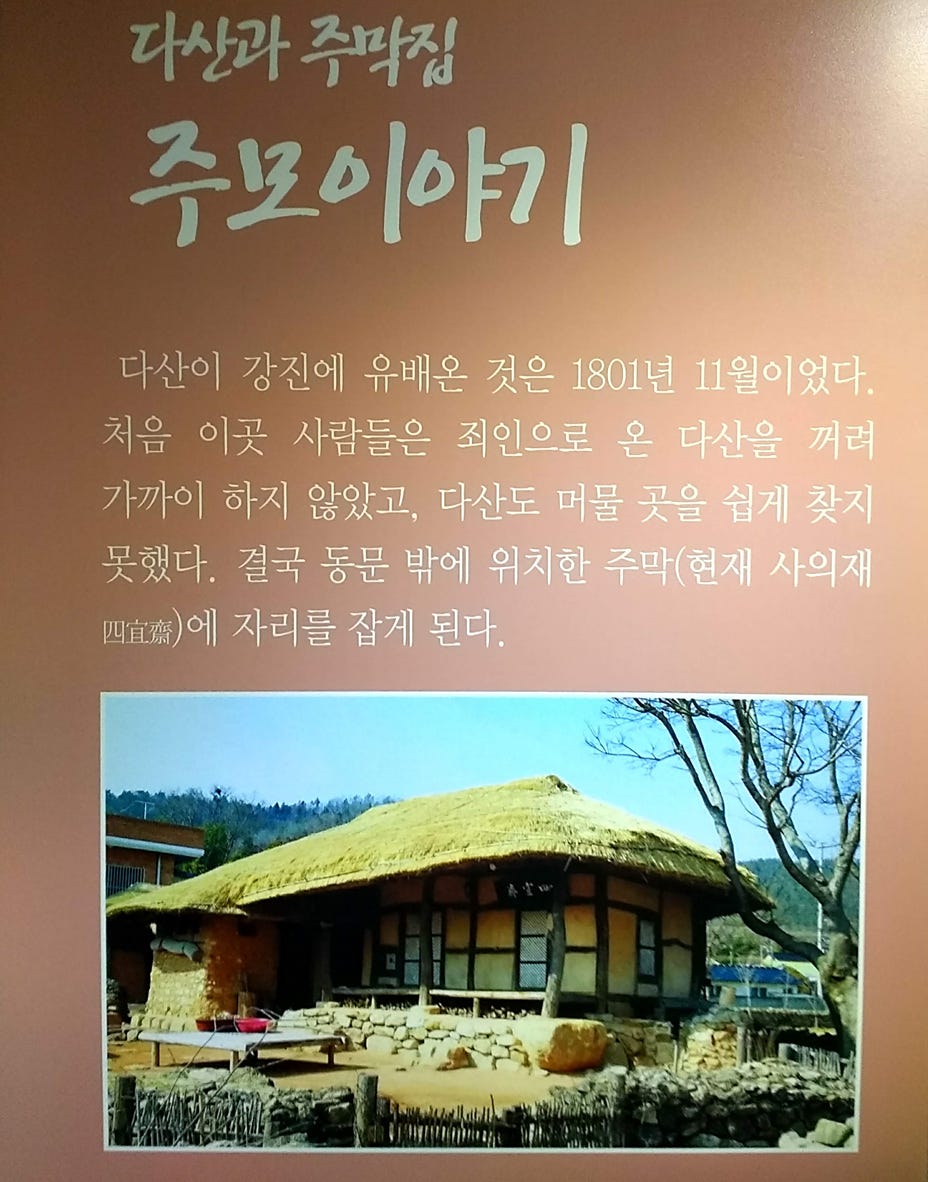
Saeuijae (四宜齋, “Room of the Four Principles”) was the first residence of Jeong Yak-yong after he arrived in Gangjin as an exile in November 1801. Housed in a small tavern, this humble room marked a turning point in his life. Because he had been banished in the aftermath of the 1801 Catholic Persecution, many residents were reluctant to associate with him or offer him lodging. Overcome by despair, Jeong was encouraged by the elderly tavern owner to devote himself once again to learning rather than waste his life in sorrow. Inspired by her words, he named the room Saeuijae, meaning “a place where one cultivates the four proper qualities,” and began a new chapter of scholarship, teaching, and writing. Located on the outskirts of the county seat of Gangjin, the reconstructed Saeuijae recreates the atmosphere of the modest dwelling where Dasan turned the hardships of exile into one of the most productive periods of his intellectual life.
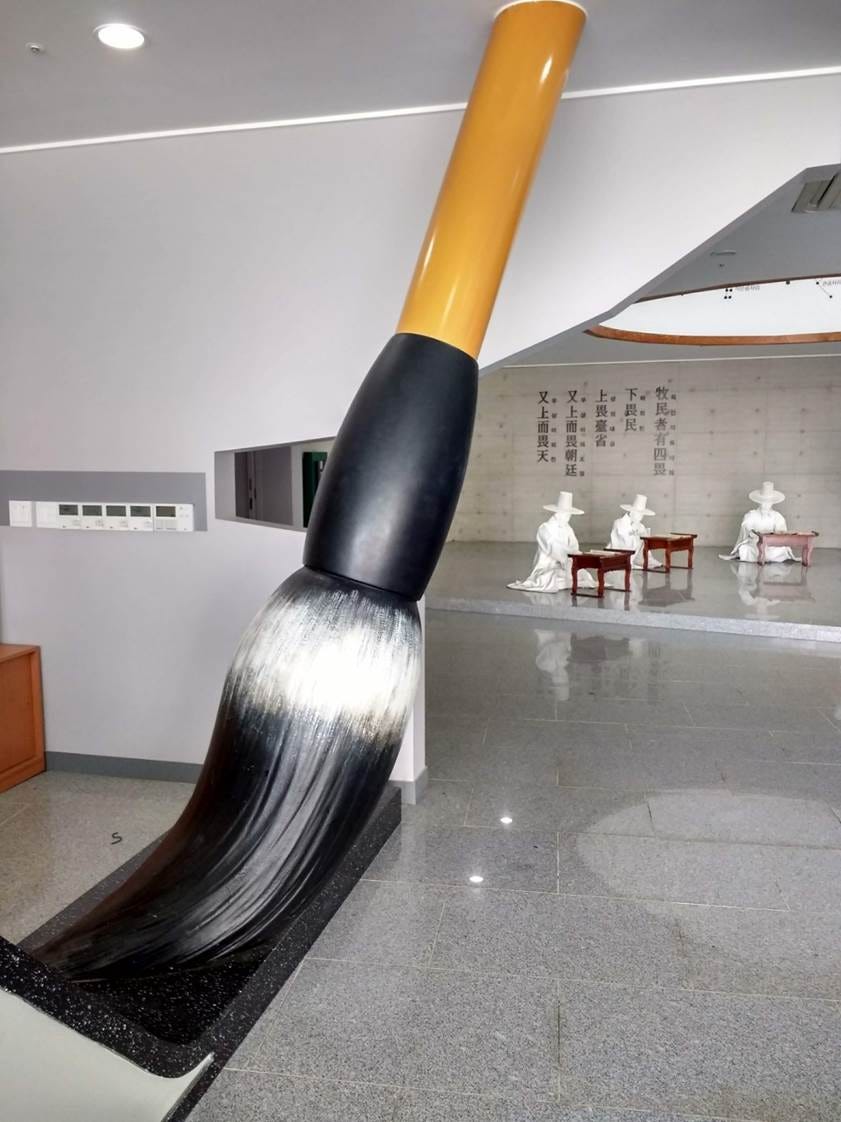
The oversized writing brush spanning the floor and ceiling of Dasan Memorial Hall symbolizes Jeong Yak-yong’s lifelong dedication to scholarship and writing.
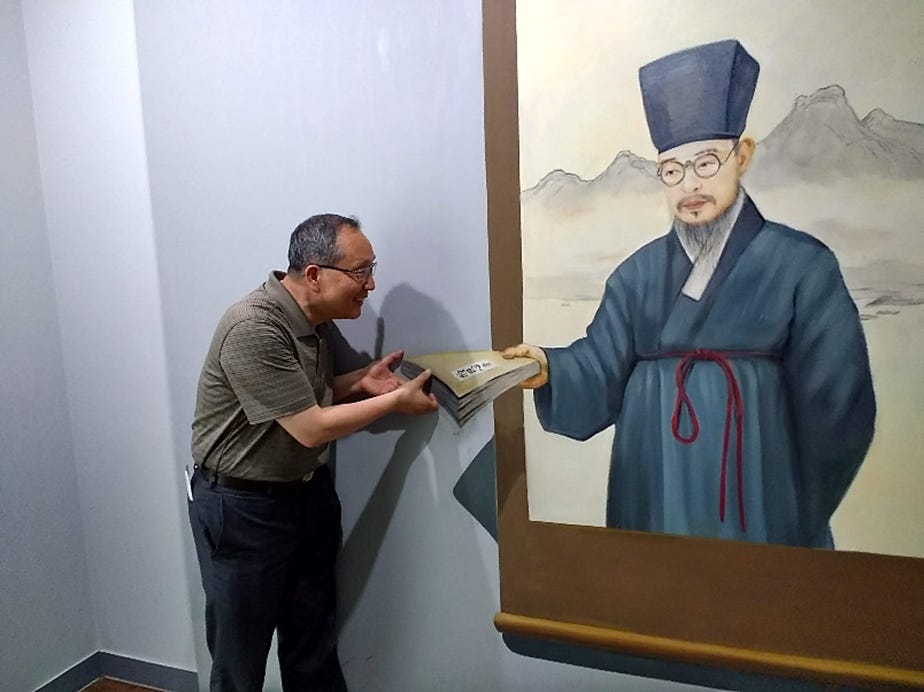
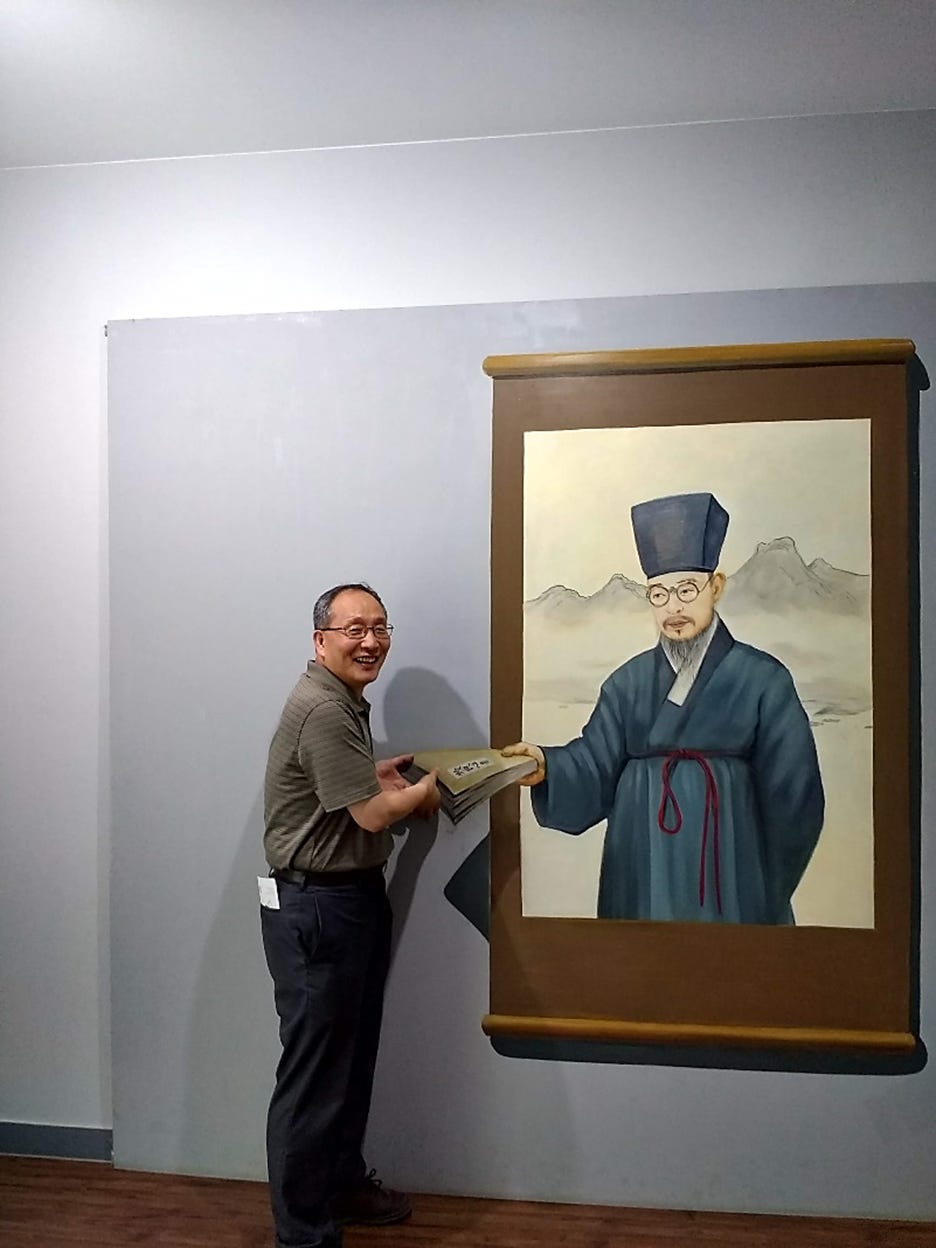
A photo-op corner inside Dasan Memorial Hall. I am honored to receive a copy of Mokminsimseo from Jeong Yak-yong himself, who graciously presents the same copy to dozens of visitors every day.
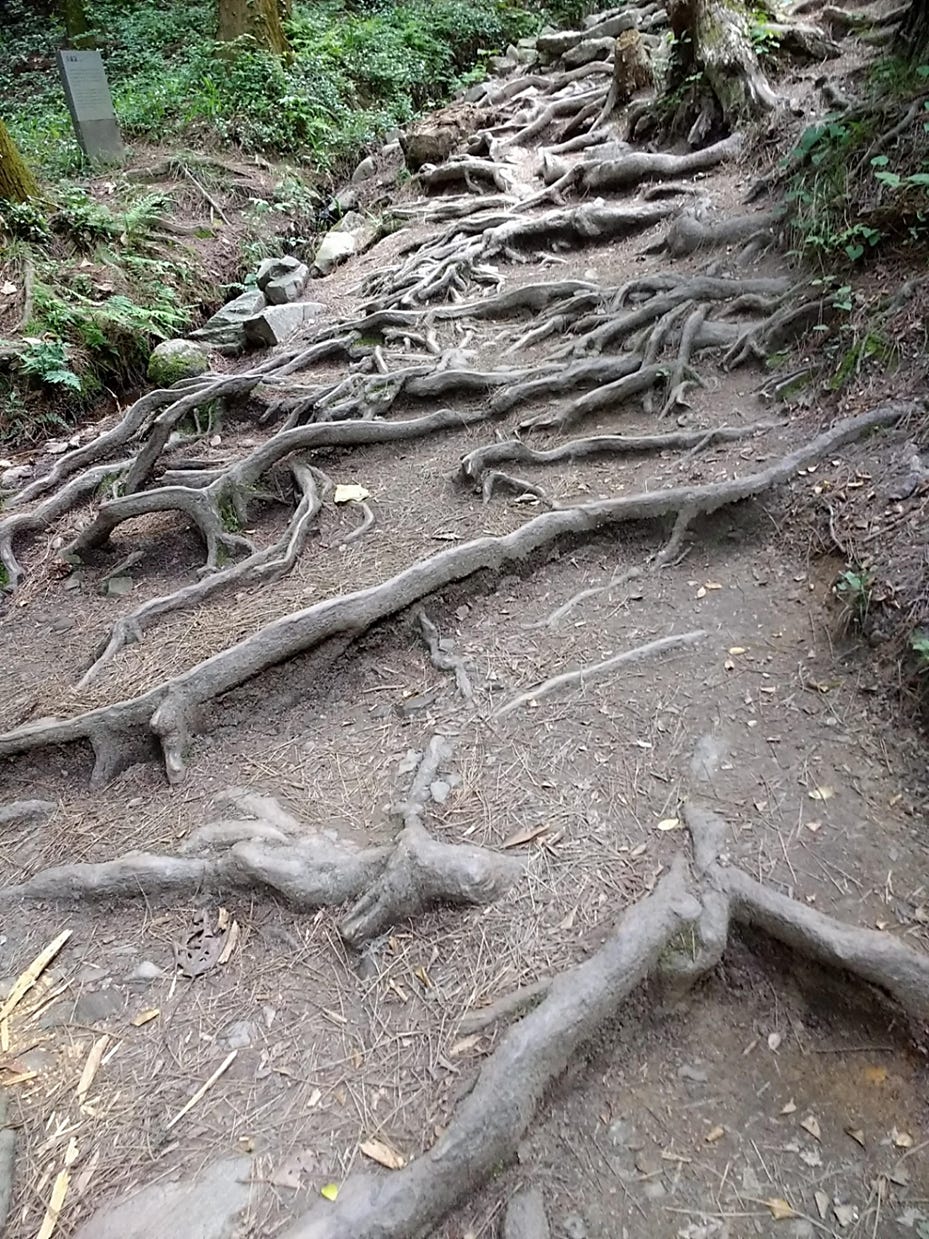
The steep and rugged path to Dasan Chodang, the secluded residence where Jeong Yak-yong spent his years of exile in Gangjin.
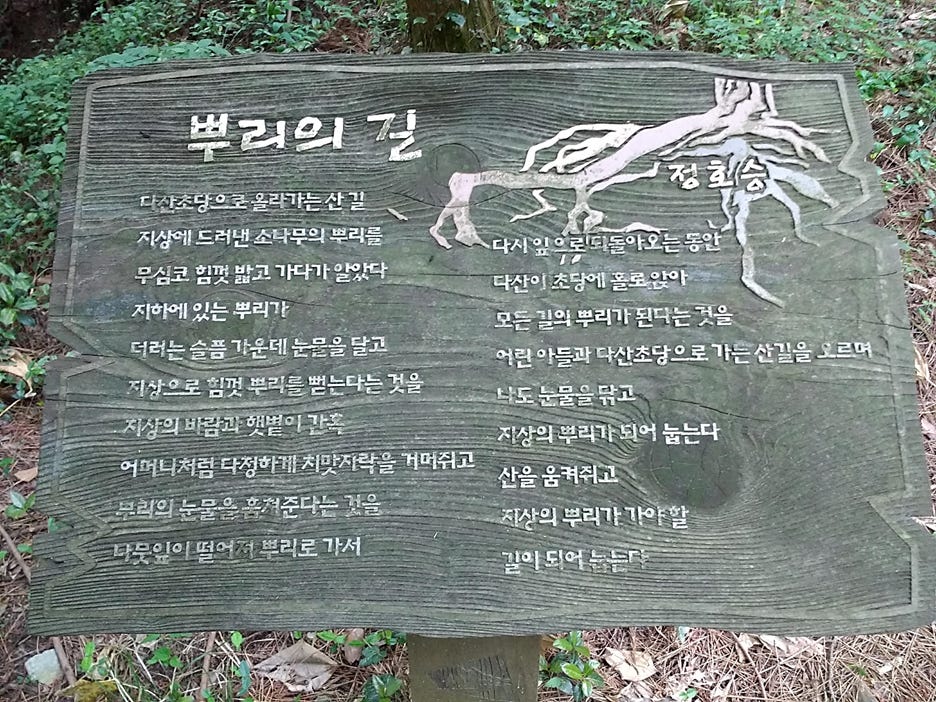
The poem in the image is “The Way of the Roots” (Ppuri-ui Gil, 뿌리의 길) by Jeong Ho-seung (정호승, b. 1950). Here is a translation:
The Way of the Roots
by Jeong Ho-seung
As I climbed the mountain path
leading to Dasan Chodang,
I saw the roots of a pine tree
exposed above the ground.
I passed by without much thought,
walking firmly along the path,
but later I realized
that the roots beneath the earth,
buried in sorrow and tears,
were reaching upward,
pushing their way through the soil.
The wind and sunlight above the ground
gently, like a mother,
stroked the roots
and wiped away their tears.
As the tree branches fell away
and returned to become roots again,
as Dasan sat alone at Chodang,
he came to understand
that the roots of every path
become the path itself.
Climbing the mountain trail
to Dasan Chodang with my young son,
I too close my eyes in tears.
I become a root beneath the earth,
covering the mountain,
becoming the path
that the roots must follow.
The poem draws a powerful connection between the exposed pine roots on the trail to Dasan Chodang and Jeong Yak-yong’s life in exile. The “roots” symbolize suffering, humility, endurance, and the hidden foundations that allow growth.
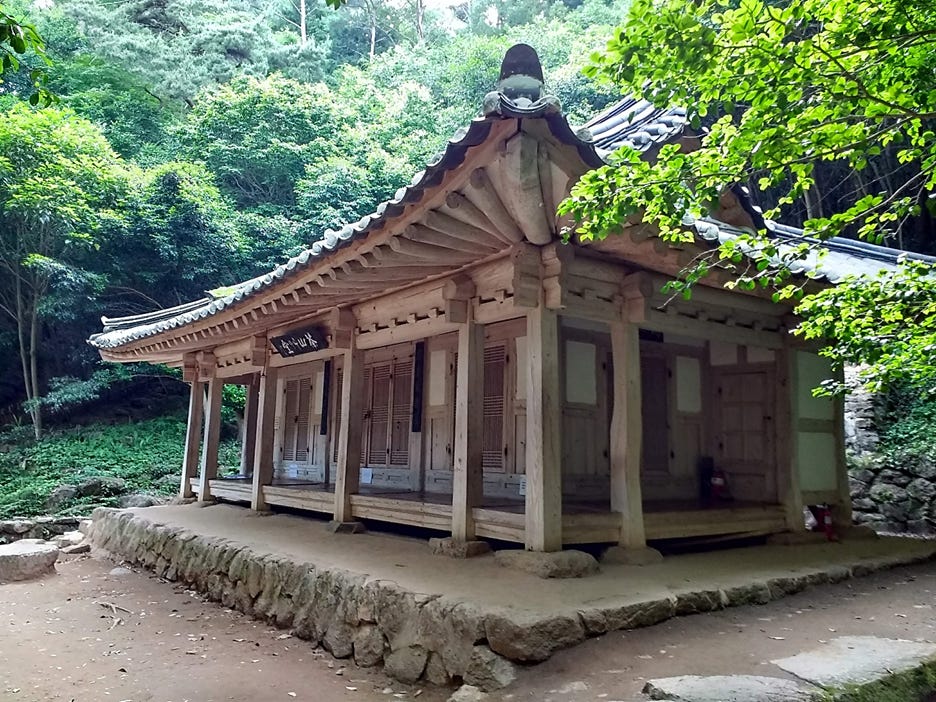
Dasan Chodang (“Dasan’s Thatched Hall”), the secluded residence where Jeong Yak-yong taught his disciples and produced many of his poems and prose works during his years of exile. Although originally thatched, the building was restored with a tiled roof in 1957 under the direction of the Dasan Historic Site Preservation Committee.
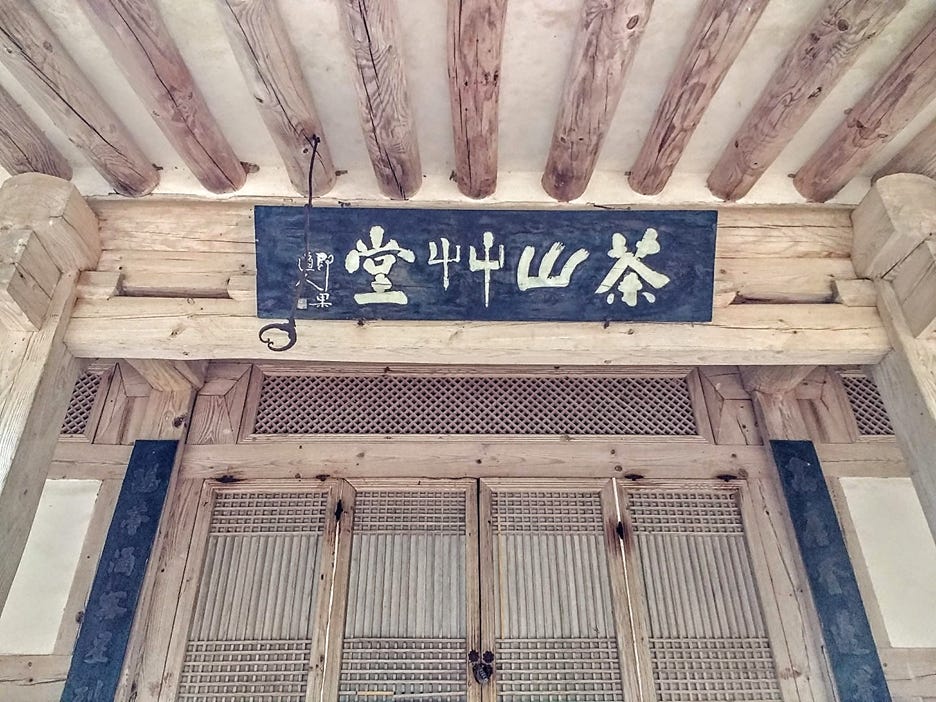
The wooden tablet above the front doors of Dasan Chodang displays the inscription “Dasan’s Thatched Hall,” preserving the original name of Jeong Yak-yong’s humble residence during his exile. He lived here for eleven years, from 1808 to 1818, a period during which he produced many of his major scholarly and literary works.
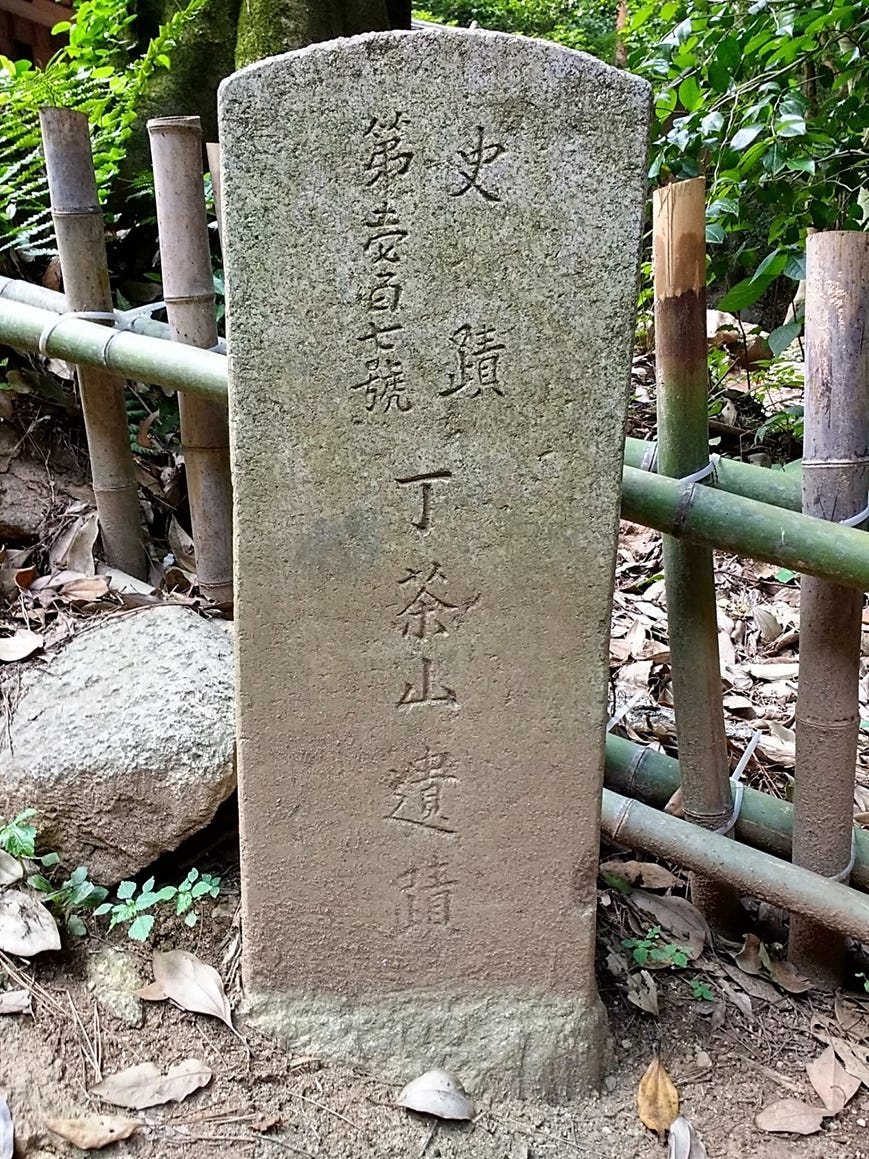
The inscription on the stele identifies the site as “Historic Site No. 107: Jeong Dasan Historic Site,” commemorating the residence and scholarly achievements of Jeong Yak-yong during his years of exile in Gangjin.
About the Author
Professor of English and Creative Writing and Associate Dean of the School of Humanities and Theology, Missouri Baptist University
John J. Han, PhD, is the author, editor, co-editor, or translator of 35 books. His forthcoming book, Echoes from the Hills: Critical Essays on Ozarks Literature (co-edited with C. Clark Triplett), will be published by the University of Arkansas Press. He has also published nearly 3,000 poems in a wide range of journals and anthologies. In addition to his long tenure at Missouri Baptist University, he has taught at Kansas State University, the University of Nebraska–Lincoln, Nebraska Wesleyan University, and Washington University in St. Louis. He has also served as a visiting scholar at Georgia College & State University and the University of Ljubljana in Slovenia.
© K-Global Scholars and Professionals Forum. All rights reserved. Content published in the K-GSP Forum may not be reproduced, distributed, or transmitted in any form without prior written permission from the K-GSP Forum, except for brief quotations with full attribution.