
Poet Jeong Ji-yong’s Birthplace and the Jeong Ji-yong Literary Museum in Okcheon-eup, South Korea
Okcheon-eup is best known as the hometown of former First Lady Yuk Young-soo (1925-1974), but in literary circles it is equally celebrated as the birthplace of the lyric poet Jeong Ji-yong (정지용, 鄭芝溶, 1902-1950). Yuk Young-soo was born in Gyodong-ri, while Jeong Ji-yong was born in Hagye-ri. The old town center is home to Jeong Ji-yong’s Birthplace and the Jeong Ji-yong Literary Museum, both of which commemorate the area’s rich cultural and literary heritage.
Jeong married Song Jae-suk (1902-1971) and attended Okcheon Public Elementary School before enrolling at Hwimun High School in Seoul. There he helped publish the student literary magazine Yoram with fellow poet Park Pal-yang and participated in the Literary Friends Society. During the March First Movement in 1919, he joined fellow students in organizing an anti-Japanese demonstration that called for shortened class hours, an act that led to his suspension before it was overturned through the efforts of prominent literary figures.
In 1923, Jeong entered the English Department at Doshisha University (同志社大学) in Kyoto. While studying in Japan, he published dozens of poems, including “Café France,” in the Korean students’ magazine Hakjo (Academic Tide) and other literary journals. He converted to Roman Catholicism in 1928, taking the baptismal name Francis, and completed a graduation thesis entitled The Imagination in the Poetry of William Blake.
After graduating in 1929, Jeong returned to Korea and taught English at Hwimun High School, his alma mater, until Korea’s liberation in 1945. He became a founding member of the influential literary journal Simunhak (Poetic Literature) in 1930 and, as editorial adviser to Catholic Youth, helped introduce the poetry of Yi Sang to a wider audience. In 1933, he joined the modernist literary circle Guinhoe (The Group of Nine), participating in public lectures and the publication of the journal Poetry and Fiction.
Following Korea’s liberation, Jeong resigned from Hwimun High School and joined the faculty of Ewha Womans University, then known as Ewha Womans Professional School. When the institution became Ewha Womans University in 1946, he continued as a professor before resigning in 1948 and retiring to a modest home in Nokbeon-ri (now Nokbeon-dong, Seoul).
During the Korean War, Jeong Ji-yong disappeared without a trace. Because the circumstances of his disappearance and death remained uncertain, the South Korean government classified him as a writer who had gone to North Korea, banned his works, and discouraged even scholarly research on his poetry. For many years, his name was partially censored in print as “Jeong X-yong,” and his poems were effectively taboo.
The ban was finally lifted in 1988, more than three decades later, allowing his work to be rediscovered and restored to the Korean literary canon. His best-known poem, “Nostalgia” (鄕愁, Hyangsu), is now included in Korean language textbooks. The Ji-yong Poetry Prize was established in 1989, with Park Du-jin receiving the inaugural award. A Jeong Ji-yong Memorial Project was launched in 1995, followed by the reconstruction of his birthplace in 1996. Commemorations marking the centennial of his birth were held in 2002, and in 2005 a memorial stone honoring him was erected at Doshisha University in Kyoto.
I visited the Jeong Ji-yong site with the guidance of Dr. Hyo-sik Hwang, a close friend since our Ph.D. days in Lincoln, Nebraska, in the 1990s and now professor emeritus of English at Chungbuk National University. At his invitation, I served as a guest lecturer in the university’s English Department several times. After giving a lecture there in 2012, we drove to Jeong’s birthplace before visiting the birthplace of Yuk Young-soo. The area was quiet and peaceful, making me feel as though I had returned to my own childhood village. Jeong’s birthplace and the artifacts associated with his life were well preserved, and because the site was not crowded, the visit was especially enjoyable.
Below is Jeong Ji-yong’s lyric poem “Nostalgia,” composed in 1923 while he was a student in Japan and first published in the March 1927 issue of the socialist-oriented literary magazine Joseon Jigwang (조선지광, 朝鮮之光). It is presented in both modern Korean and my English translation. The original Korean text contains several archaic characters.
鄕愁
넓은 벌 동쪽 끝으로
옛이야기 지줄대는 실개천이 휘돌아 나가고,
얼룩백이 황소가
해설피 금빛 게으른 울음을 우는 곳,
―그곳이 차마 꿈엔들 잊힐리야.
질화로에 재가 식어지면
뷔인 밭에 밤바람 소리 말을 달리고,
엷은 졸음에 겨운 늙으신 아버지가
짚벼개를 돋아 고이시는 곳,
―그곳이 차마 꿈엔들 잊힐리야.
흙에서 자란 내 마음
파아란 하늘 빛이 그리워
함부로 쏜 화살을 찾으려
풀섶 이슬에 함추름 휘적시던 곳,
―그곳이 차마 꿈엔들 잊힐리야.
전설바다에 춤추는 밤물결 같은
검은 귀밑머리 날리는 어린 누이와
아무렇지도 않고 예쁠 것도 없는
사철 발벗은 아내가
따가운 햇살을 등에 지고 이삭 줍던 곳,
―그곳이 차마 꿈엔들 잊힐리야.
하늘에는 석근 별
알 수도 없는 모래성으로 발을 옮기고,
서리 까마귀 우지 짖고 지나가는
초라한 지붕,
흐릿한 불빛에 돌아앉아 도란도란 거리는 곳,
―그곳이 차마 꿈엔들 잊힐리야.
Nostalgia
At the eastern edge of the wide plain,
a murmuring brook, rich with old stories, winds its way,
where a brindled white ox
lets out a slow, golden cry at dusk—
How could I ever forget that place, even in my dreams?
When the embers fade in the earthen brazier,
the night wind gallops across the empty fields,
and my aged father, heavy with gentle drowsiness,
adjusts his straw pillow before lying down—
How could I ever forget that place, even in my dreams?
My heart, grown from the earth,
longed for the azure sky;
there I searched for arrows I had carelessly shot,
brushing through dew-soaked grasses—
How could I ever forget that place, even in my dreams?
There my young sister,
her black hair dancing like the night waves
upon a sea of legends,
and my barefoot wife,
who was neither ordinary nor pretty,
gleaned fallen ears of grain
beneath the burning sun—
How could I ever forget that place, even in my dreams?
Above, a sky scattered with countless stars;
below, my feet wandered toward unknowable sandcastles.
Frost crows cried as they passed
over a humble roof,
where people gathered around a dim lamp,
chatting softly—
How could I ever forget that place, even in my dreams?
Jeong Ji-yong’s “Nostalgia” shares affinities with the lyric poetry of Shin Seok-jeong (신석정, 辛夕汀, 1907-1974), particularly in its focus on memory, rural landscapes, and emotional reflection within the broader context of 1920s-1930s Korean lyric poetry. At the same time, while both poets wrote during a period of literary experimentation and the rise of left-wing literature, Jeong’s work is marked by a more modernist precision in imagery and structure, whereas Shin’s poetry tends to be more direct, pastoral, and emotionally transparent.
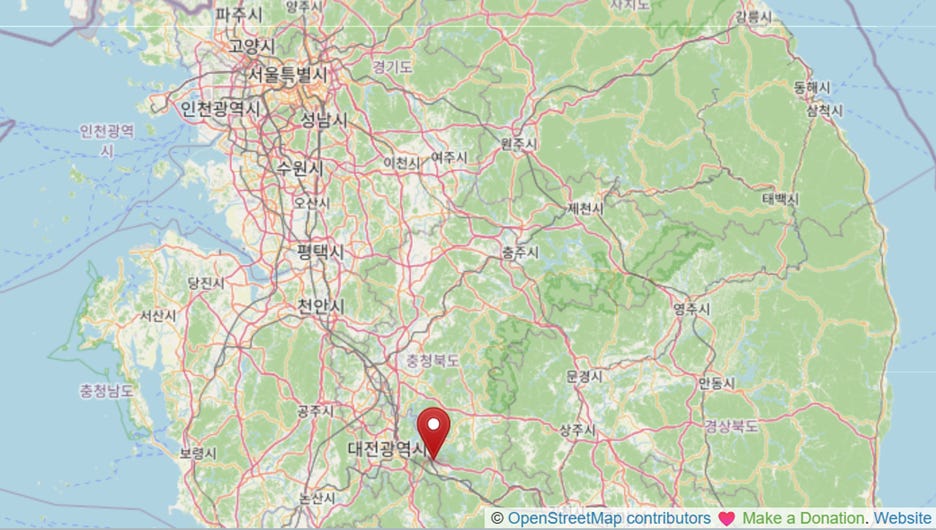
Okcheon-eup is the administrative seat of Okcheon County, North Chungcheong Province, South Korea. It is one of the few eup (towns) in the country where more than half of the county’s population resides. Located in the northwestern part of the Okcheon Basin, Okcheon-eup serves as the county’s administrative and transportation center. Composite image based on map data © OpenStreetMap contributors.
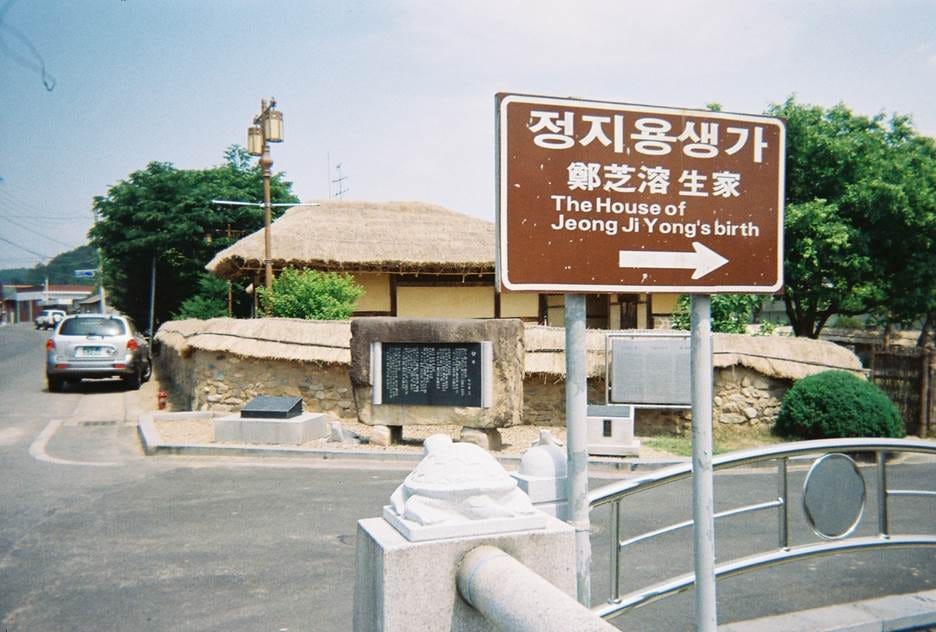
A sign indicates that we have arrived at Jeong Ji-yong’s birth home.
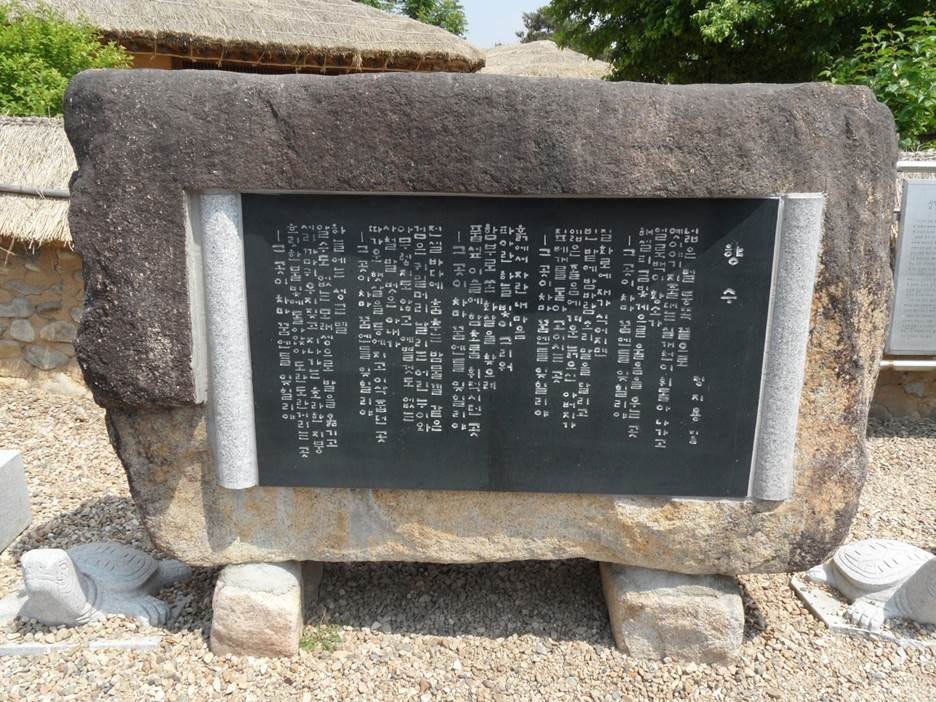
In front of his house, a stone bears the inscribed text of Jeong Ji-yong’s poem “Nostalgia.”
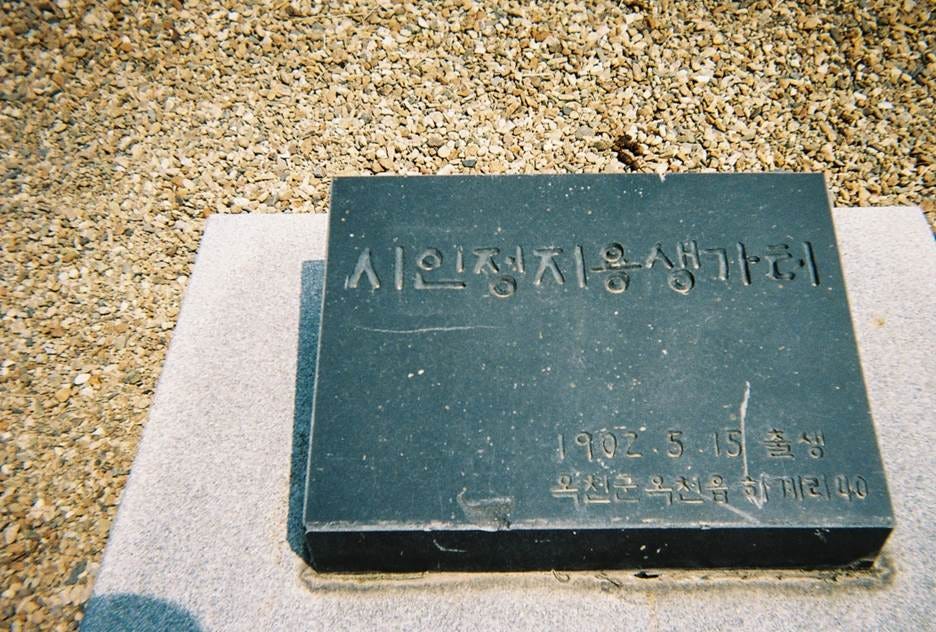
A stone marker indicates the site where poet Jeong Ji-yong’s birth home once stood. The present house is a reconstruction of the original structure.
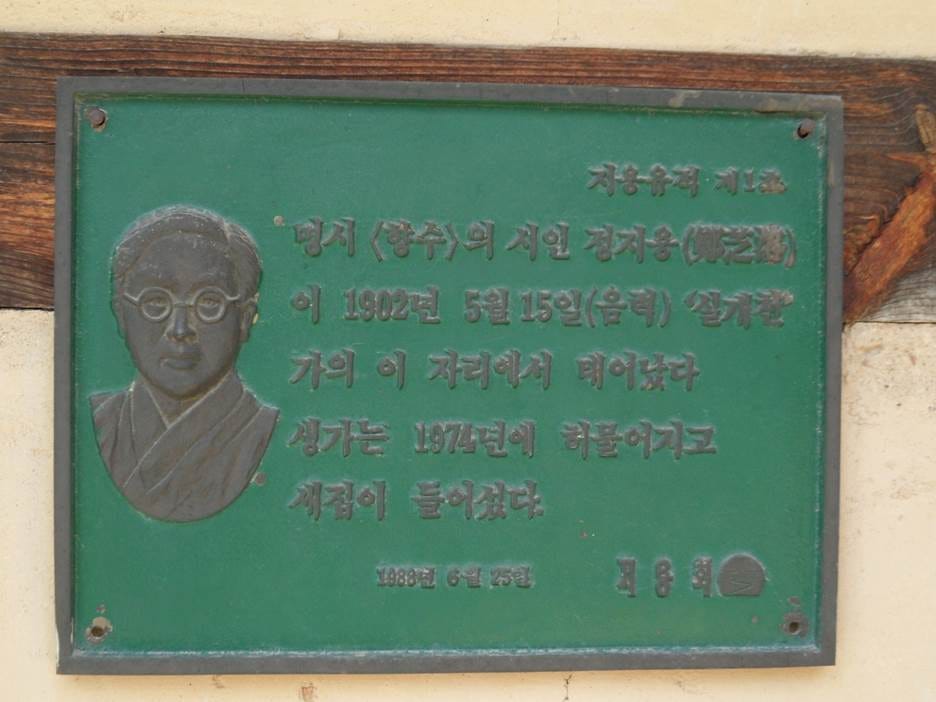
This marker, erected by the Ji-yong Society in 1988, states: “The poet Jeong Ji-yong, author of the renowned poem ‘Nostalgia,’ was born on May 15, 1902 (lunar calendar), at this site by the ‘brook.’ The original house was demolished in 1974 and later replaced with a new house.”
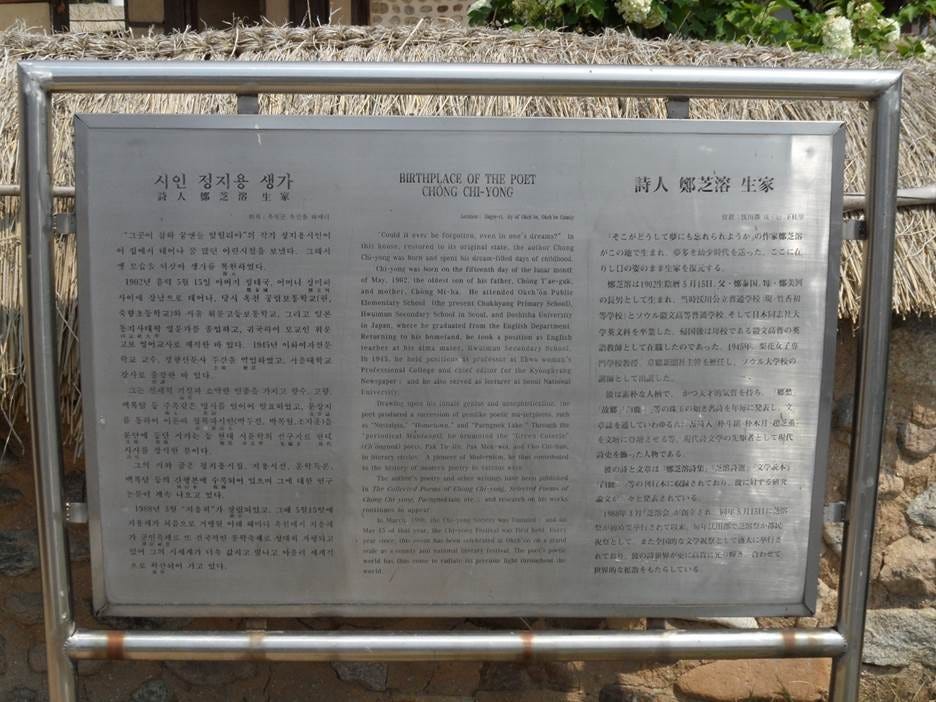
An interpretive sign provides a brief account of Jeong Ji-yong’s life and legacy in Korean, English, and Japanese. It notes that the poet was born in this house and spent a dream-filled childhood here, leading to the restoration of his birthplace to its original appearance. Possessing both a gifted poetic sensibility and a modest character, he went on to publish a series of celebrated poems, including “Nostalgia” and “Baekrokdam” (Baekrok Crater). In March 1988, the Ji-yong Society was founded, and on May 15 of that year the first Ji-yong Festival was held. Since then, the festival has been celebrated annually in Okcheon as both a county-wide event and a nationally recognized literary festival, contributing to the continued appreciation and growing global reach of his poetry.
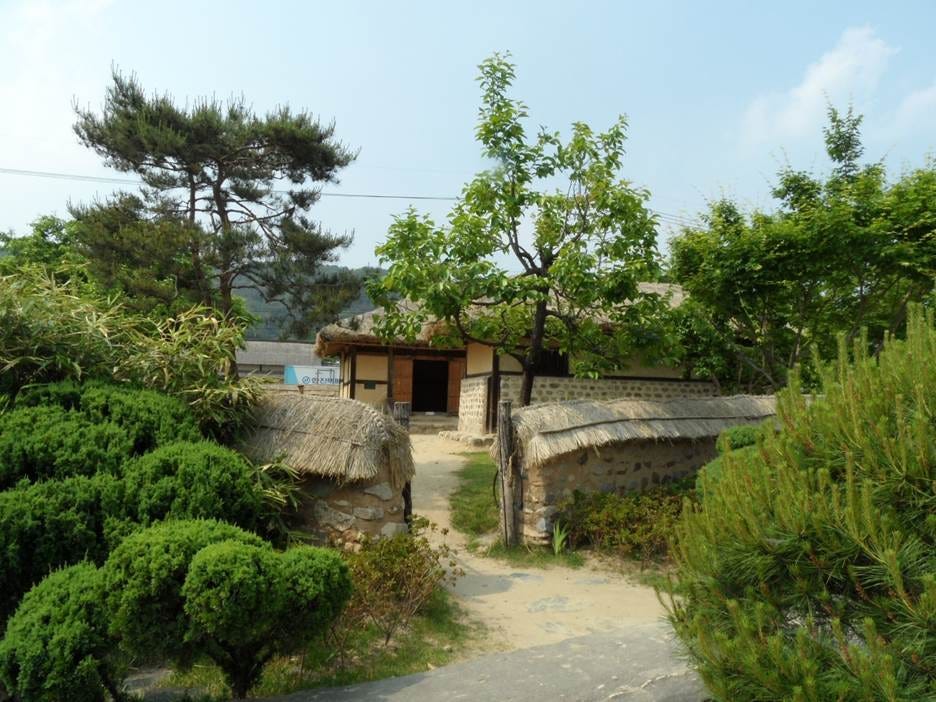
Jeong Ji-yong’s childhood home was reconstructed on its original site in 1996. A typical traditional rural dwelling in Korea, it consists of a thatched-roof house with a dirt courtyard enclosed by a clay-and-stone wall.
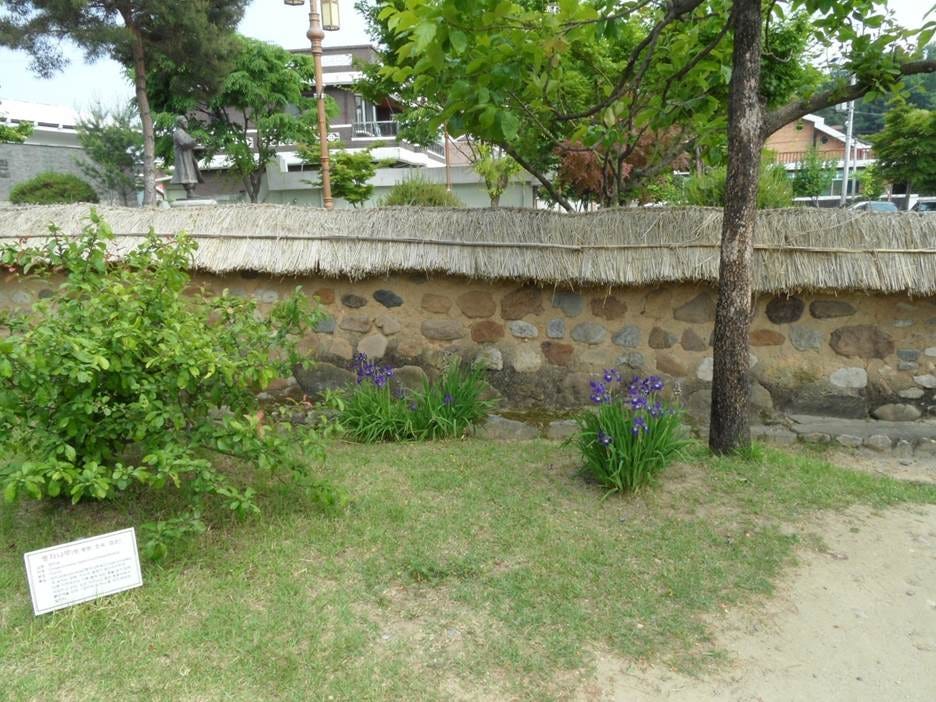
A clay-and-stone wall, topped with thatch, marks the boundary of the house.
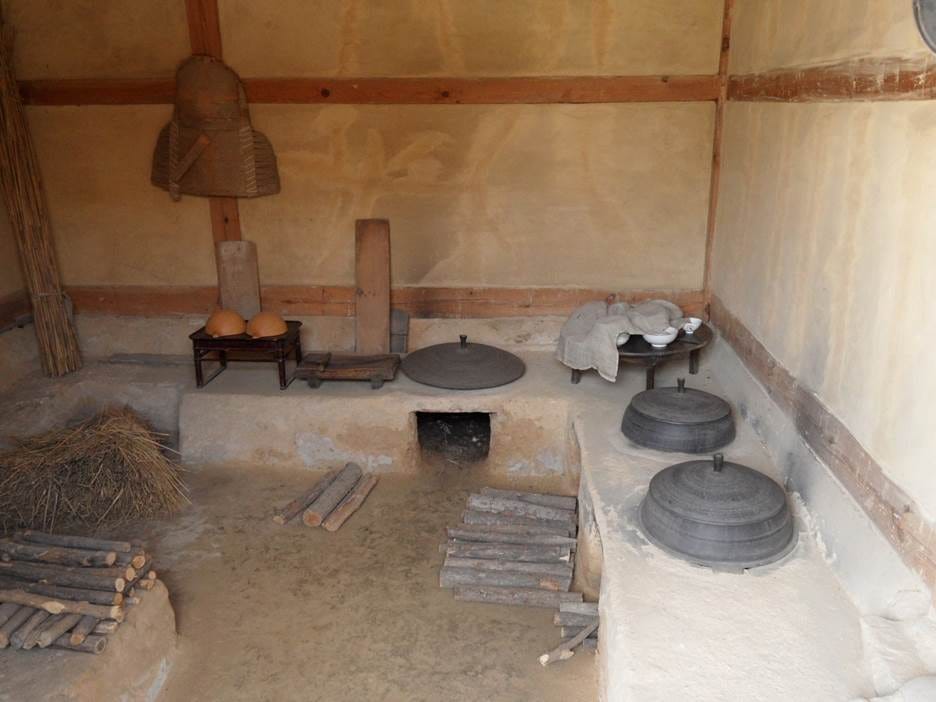
A traditional kitchen in a rural house, this space is furnished with woks, low sitting tables, and materials such as wood and straw. Wood and straw were used both for cooking and for heating the ondol floor system.
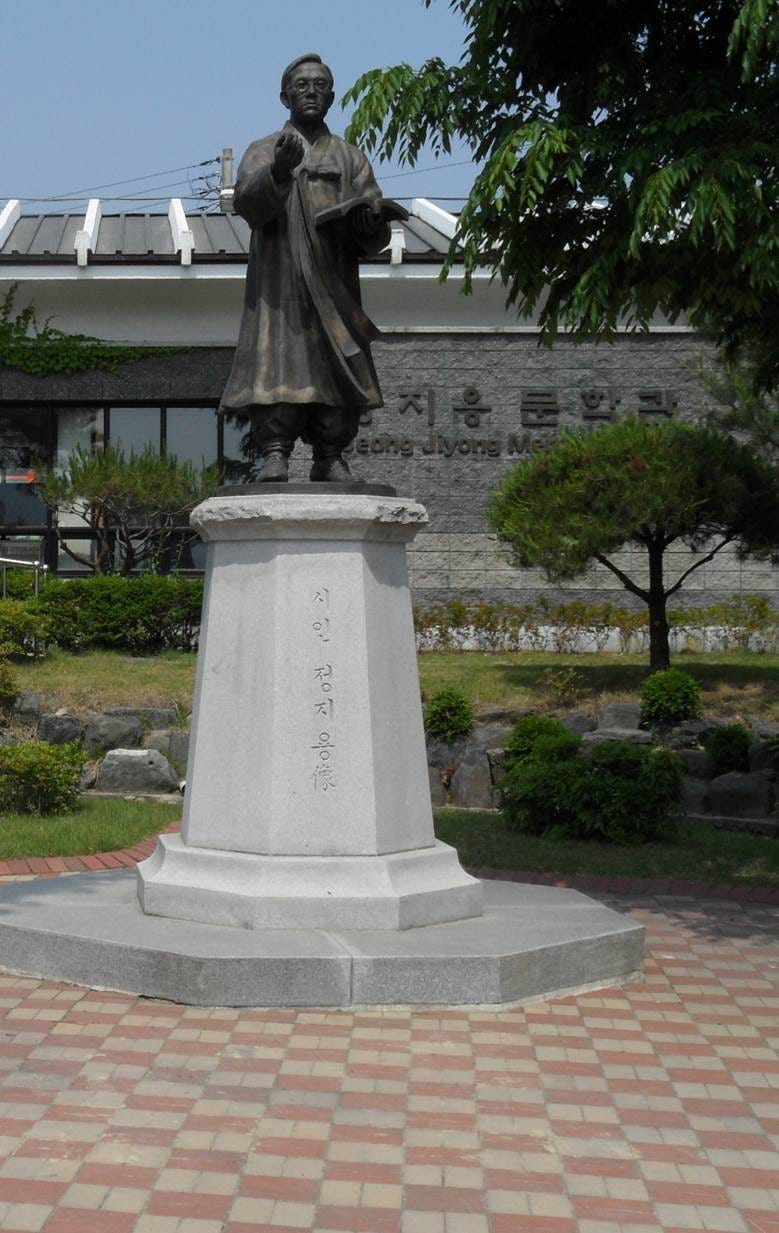
A statue of the poet stands before the Jeong Ji-yong Literary Museum.
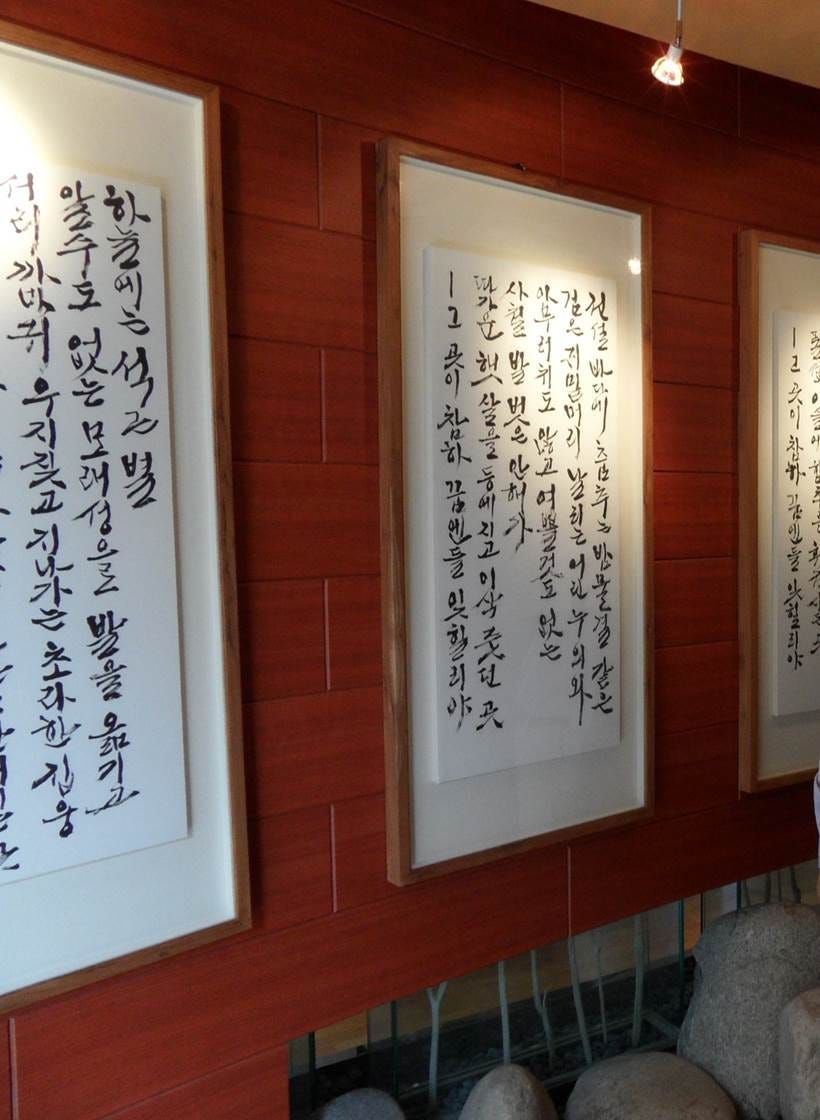
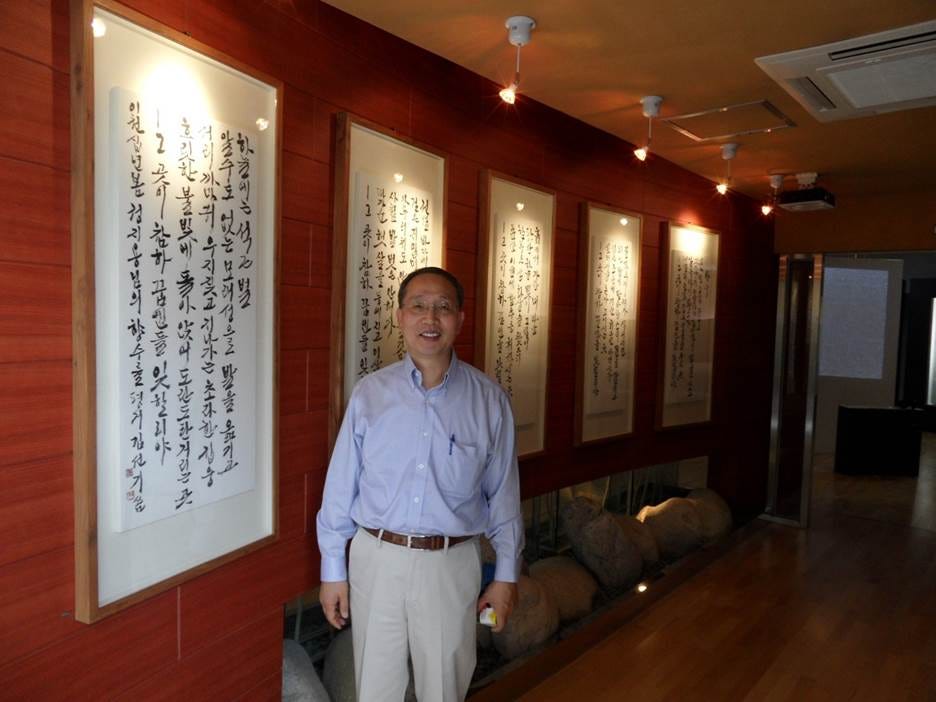
Framed versions of some of Jeong’s best-known poems are displayed on the museum walls.
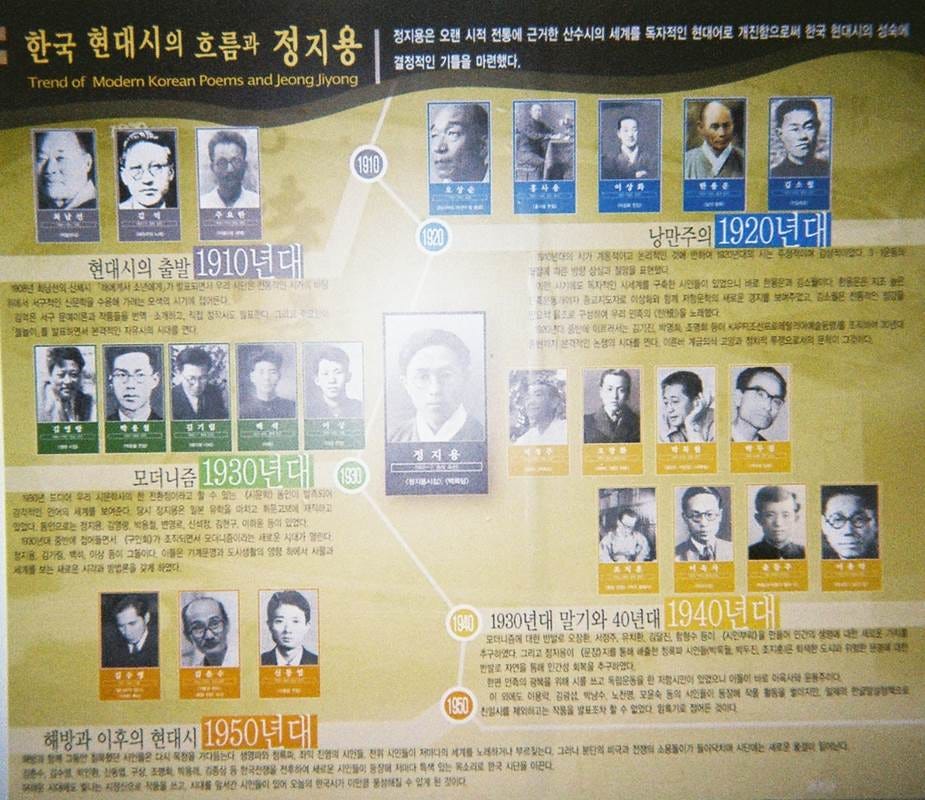
The museum outlines the development of modern Korean poetry and Jeong Ji-yong’s literary significance, noting that he “played a decisive role in the maturation of modern Korean poetry by reworking the long tradition of landscape poetry into a distinctive modern poetic language.”
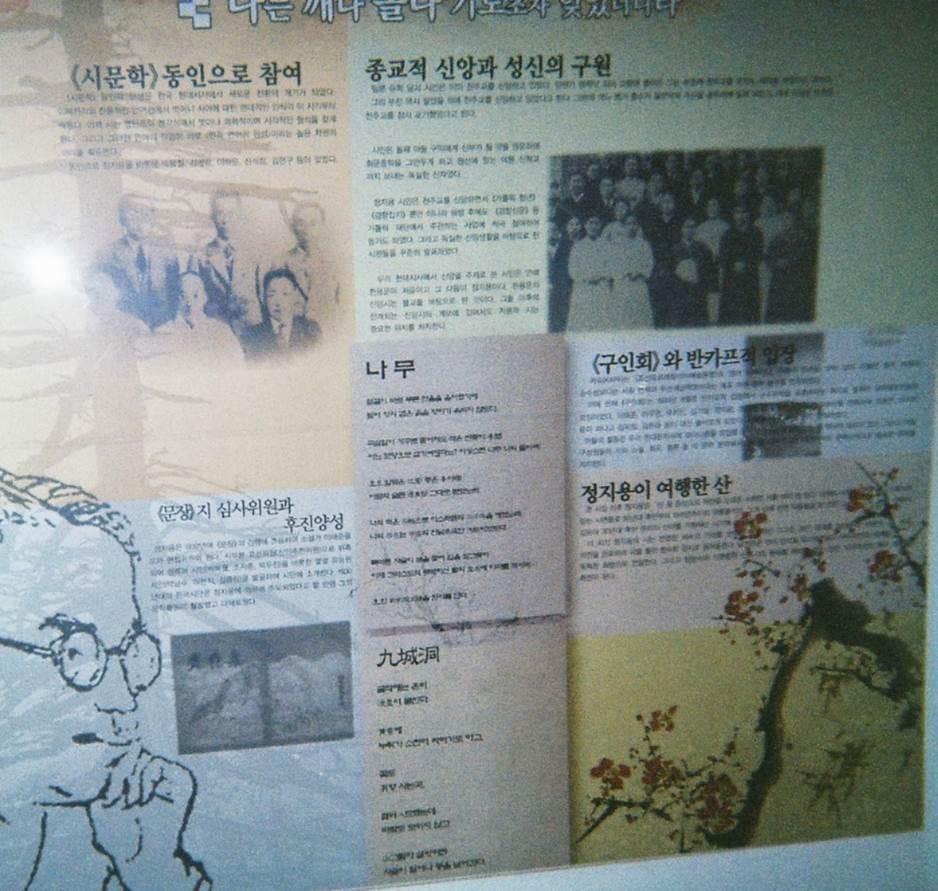
The exhibit panel highlights two representative poems and outlines key aspects of Jeong’s life and literary activity. Jeong Ji-yong was a member of Poetic Literature (시문학, 詩文學, Simunhak) and the League of Nine (구인회, 九人會, Guinhoe), both of which advocated pure literature and opposed proletarian literary movements. As a co-founder of the literary magazine Literature (문장, 文章, Munjang), he also mentored emerging writers. In 1928, he converted to Catholicism.
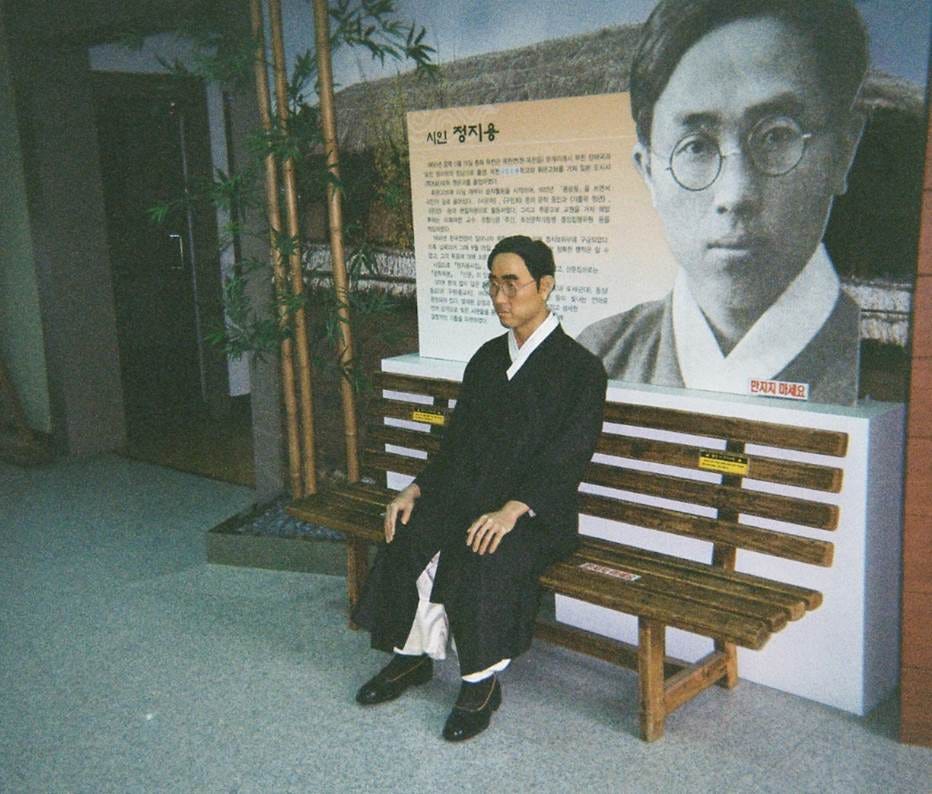
Inside the museum, a lifelike figure of Jeong Ji-yong sits on a wooden bench.
Having left my country of birth nearly forty years ago, I find it especially meaningful to visit cultural sites in Korea. Like Japan and China, South Korea is committed to preserving its literary and artistic heritage, and visiting such places evokes a sense of pride in the country I once left. During my first semester as a graduate student in Kansas, the 1988 Olympic Games were held in Seoul. At that time, Korea was regarded as a country with great potential, yet some academics, journalists, and other professionals who had the opportunity chose to leave in search of better prospects abroad—not only in the United States and Canada but also in Latin America. One prominent journalist, for example, emigrated to Argentina in the mid-1980s. It is remarkable to consider that, in less than four decades, South Korea has become one of the world’s leading nations in terms of its political influence, economic strength, and military capability.
About the Author
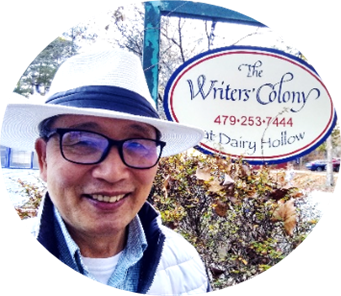
Professor of English and Creative Writing and Associate Dean of the School of Humanities and Theology, Missouri Baptist University
John J. Han, PhD, is the author, editor, co-editor, or translator of 35 books. His forthcoming book, Echoes from the Hills: Critical Essays on Ozarks Literature (co-edited with C. Clark Triplett), will be published by the University of Arkansas Press. He has also published nearly 3,000 poems in a wide range of journals and anthologies. In addition to his long tenure at Missouri Baptist University, he has taught at Kansas State University, the University of Nebraska–Lincoln, Nebraska Wesleyan University, and Washington University in St. Louis. He has also served as a visiting scholar at Georgia College & State University and the University of Ljubljana in Slovenia.
© K-Global Scholars and Professionals Forum. All rights reserved. Content published in the K-GSP Forum may not be reproduced, distributed, or transmitted in any form without prior written permission from the K-GSP Forum, except for brief quotations with full attribution.