
The Mokpo Museum of Literature
As a native of South Jeolla Province, I have long enjoyed visiting literary sites in the region whenever I return to Korea. One of them is the Mokpo Museum of Literature, located along Yeongsan Lake. I had the pleasure of visiting it in May 2012. The museum commemorates four prominent writers associated with Mokpo: Kim U-jin (1897-1926), Park Hwa-seong (1903-1988), Cha Beom-seok (1924-2006), and Kim Hyeon (1942-1990). This photo essay presents selected images from that visit, beginning with brief biographical sketches of these four literary figures.
Kim U-jin was a pioneering Korean playwright, theater theorist, poet, and critic whose work helped lay the foundation for modern Korean drama during the Japanese colonial period. Born in Jangseong County, South Jeolla Province, he spent much of his childhood in Mokpo and later studied English literature at Waseda University in Tokyo. There he encountered Western literary and theatrical movements, organized early theater groups, and became the first Korean dramatist to experiment extensively with expressionism. Although he produced only five plays, including Shipwreck (Nanpa) and Wild Boar (Sandwaeji), he exerted a lasting influence through his innovative dramas, poetry, and critical essays. Troubled by personal and social conflicts, he and the soprano Yun Sim-deok (1897-1926) committed suicide in the Korea Strait while traveling from Shimonoseki, Japan, to Busan, Korea. Today, he is widely considered a pioneer of modern Korean theater and literary modernism.
Park Hwa-seong was born Park Gyeong-sun in Mokpo. She graduated from Jeongmyeong Girls’ Middle School in Mokpo and Sookmyung Girls’ High School in Seoul. She later studied English literature at Nihon Women’s College in Tokyo but returned to Korea without completing her degree. Often regarded as the first female novelist in Korea, she penned works such as Before and After the Flood (홍수 전후, 1932), White Flower (백화, 1932), “People Without a Hometown” (고향 없는 사람들, 1936), and Inactive Volcano (휴화산, 1977). Park had three sons and one daughter. Her eldest son, Cheon Seung-se (1939-2020), became a novelist and playwright, while another son, Cheon Seung-geol (b. 1941), served for many years as a professor of English at Seoul National University before retiring.
Born in Mokpo, Cha Beom-seok was a leading playwright and theatre director in twentieth-century Korea. After graduating from the Department of English at Yonhee University (now Yonsei University) in 1948, he worked as a teacher at Mokpo Bukgyo Elementary School, Mokpo Middle School, and Deokseong Girls’ High School. He later served as a full-time professor in the Department of Theatre and Film at Cheongju University and held leadership positions as president of the Korea Theatre Association and vice president of the Federation of Artistic and Cultural Organizations of Korea. A prolific dramatist, he wrote numerous plays, including Homecoming (1956) and Forest Fire (1963).
Kim Hyeon, whose real name was Kim Kwang-nam, was born on Jindo Island, not far from Mokpo. After graduating from Mokpo Bukgyo Elementary School and Mokpo Middle School, he continued his studies in Seoul and later in France, eventually becoming a professor of French literature at Seoul National University. In the twentieth century, he was widely regarded as one of Korea’s three most prominent literary critics, alongside Baek Nak-cheong and Kim Yun-sik. He authored several collections of literary criticism, including Existence and Language (1964), and co-authored, with Kim Yun-sik, The History of Korean Literature (1973).
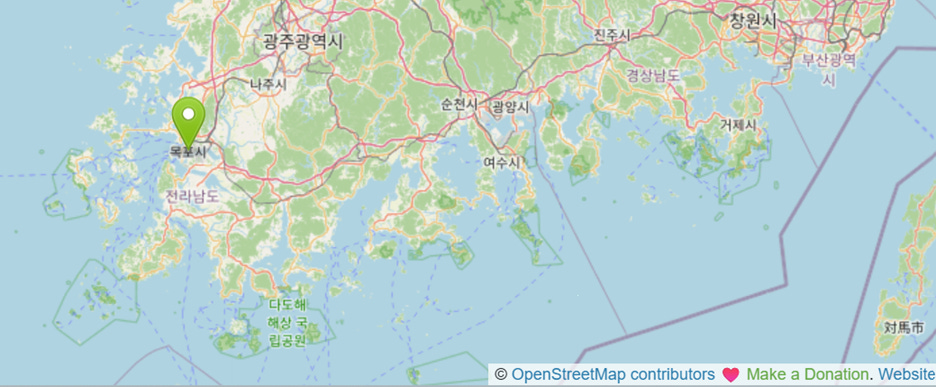
Mokpo is a harbor city situated on the southwestern tip of South Korea. Historically, the area belonged to the Mahan Confederacy (194 BCE-6th century CE). Its name evolved over time from Mul’ahye-gun to Myeonju and then to Mullyang-gun before assuming its current name during the Goryeo Period (918-1392). Composite image based on map data © OpenStreetMap contributors.
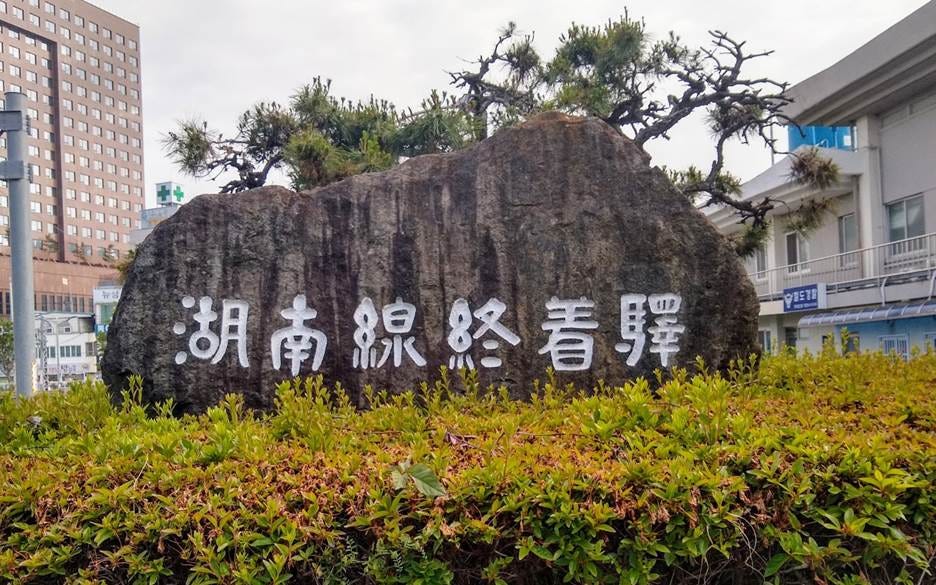
Mokpo serves as the southern terminus of the Honam Line, which links the city to Seoul via KTX (Korea Train Express) and SRT (Super Rapid Train) services. Upon arriving at Mokpo Station, passengers are greeted by a Chinese sign that reads, “The Final Destination of the Honam Line.”
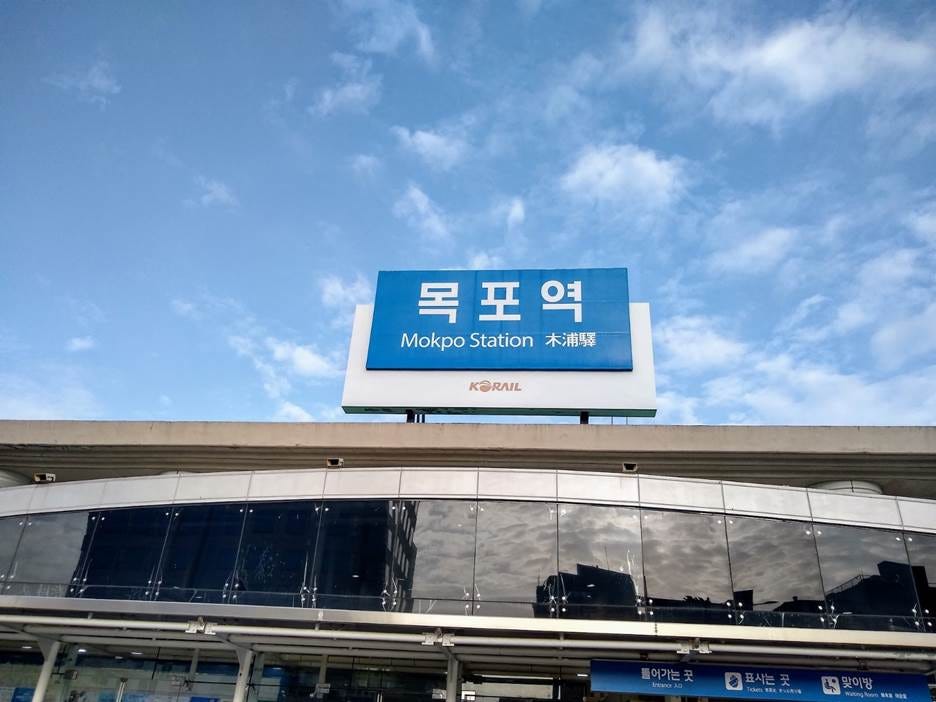
Mokpo Station is located near the city’s historic downtown, once the center of commercial and cultural activity. Today, much of that activity has shifted to the Hadang district and nearby Namak New City and Oryong, areas within Muan County that form the administrative seat of South Jeolla Province.
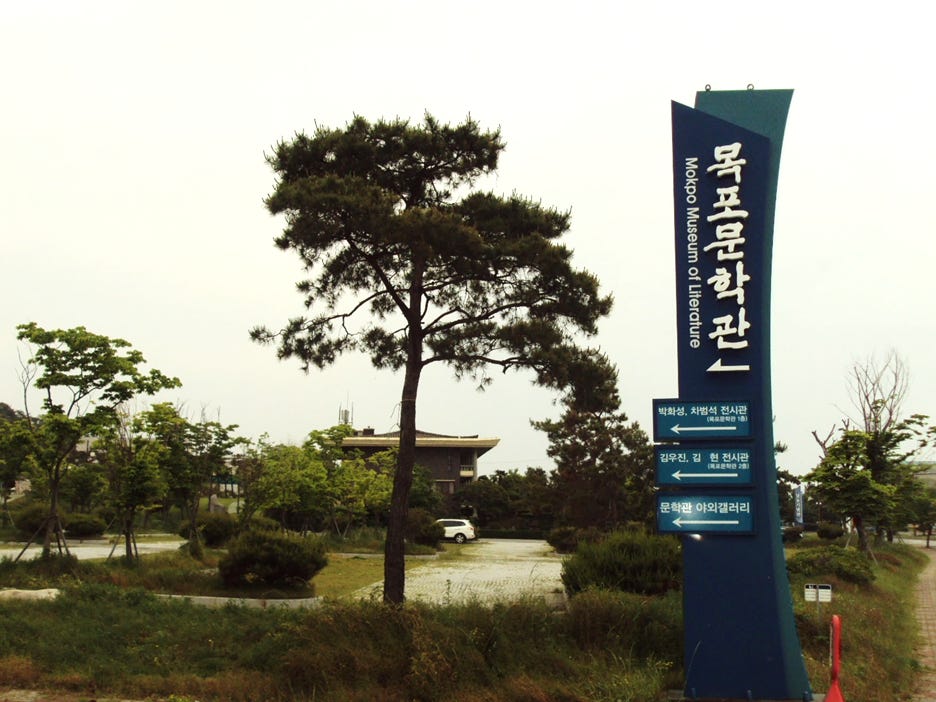
A sign at the Mokpo Museum of Literature displayed outside the building.
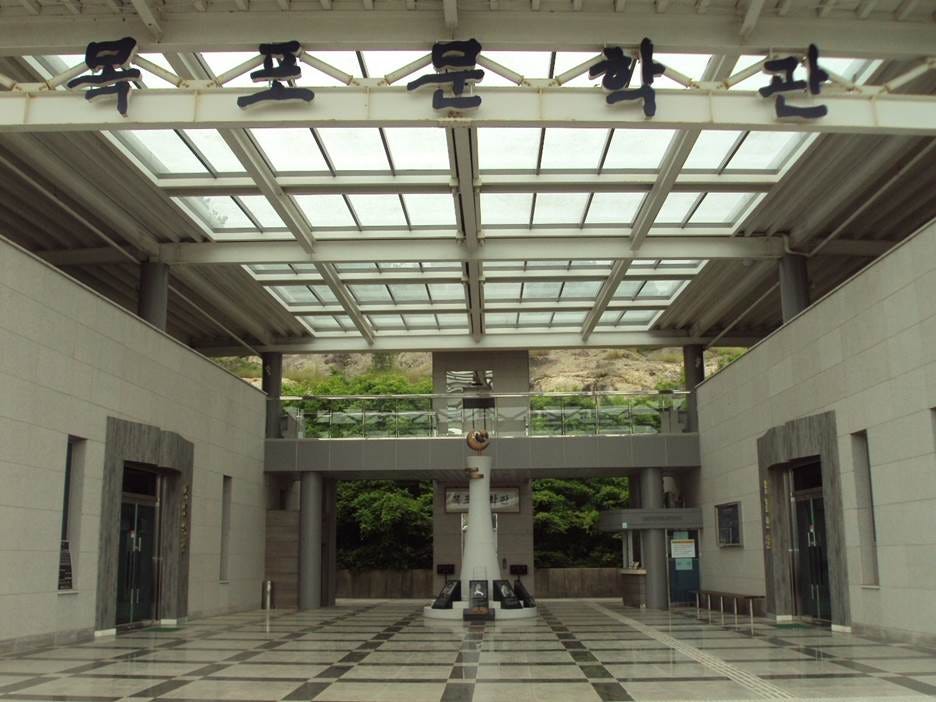
Entrance of the Mokpo Museum of Literature. The Korean sign reads “The Mokpo Museum of Literature.”
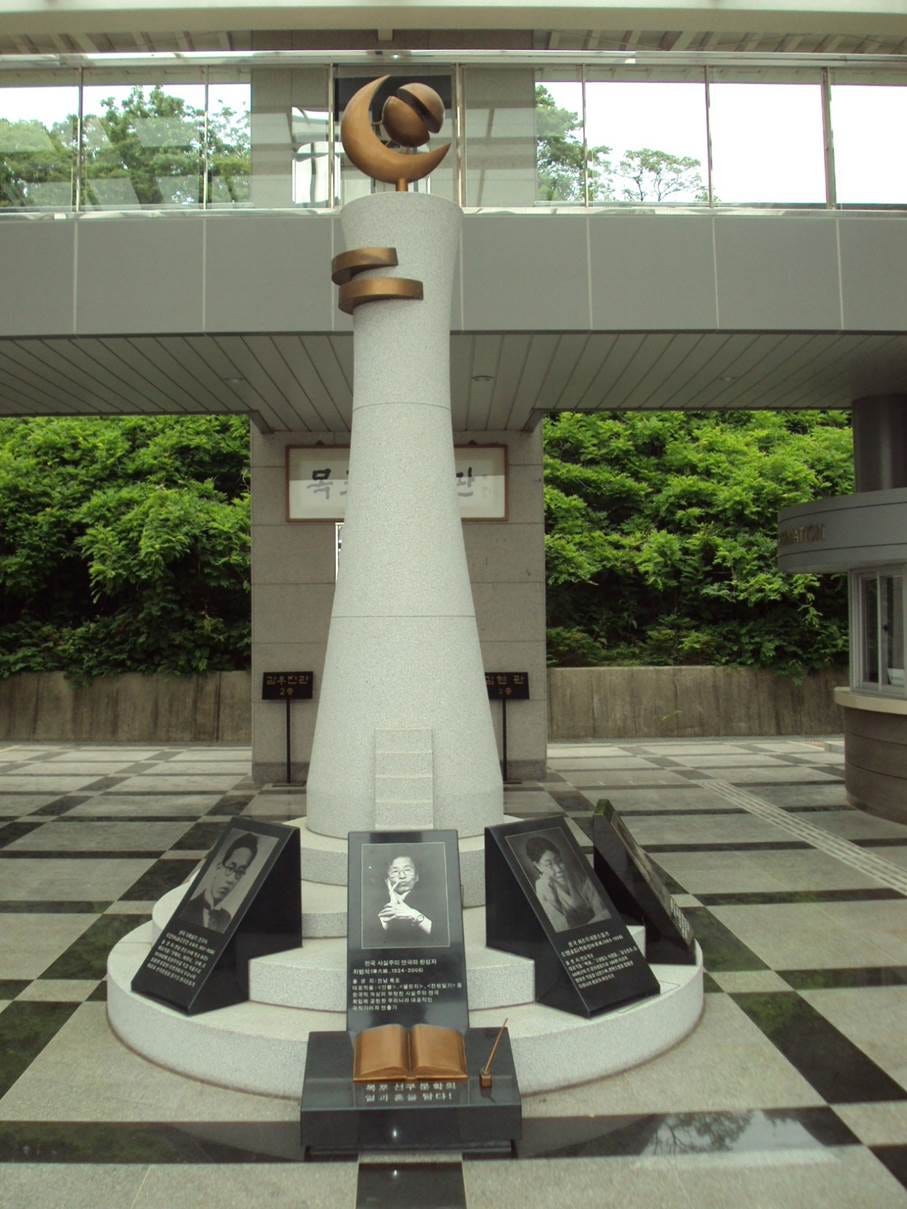
Displays in the hallway leading to the entrance of the Mokpo Museum of Literature. Arranged around a freestanding stone structure are photographs of the four writers, each accompanied by a brief caption.
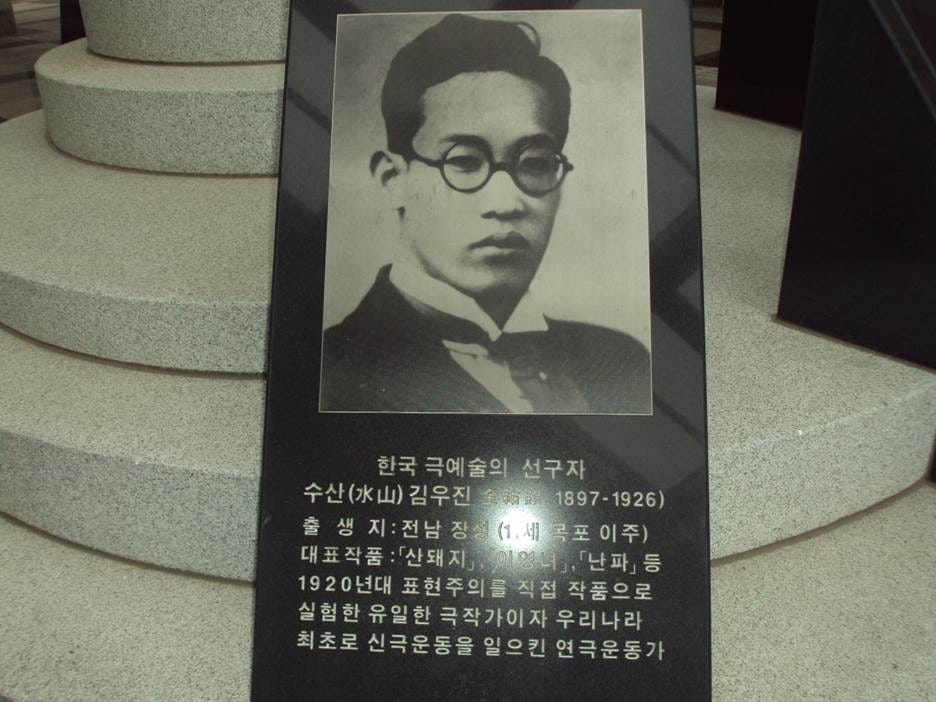
Defining him as “a pioneer of Korean theater,” the stone plaque states that Kim U-jin was “the only playwright in the 1920s to experiment directly with expressionism in his works and the first theater activist in Korea to initiate the New Theater movement.”
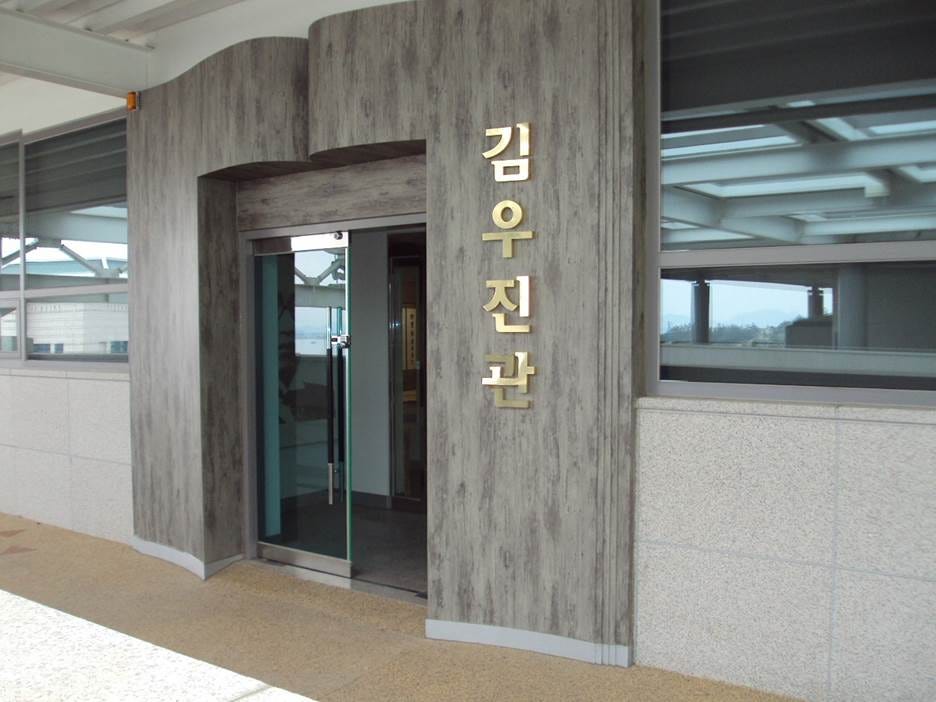
Entrance to the Kim U-jin Exhibition Hall.
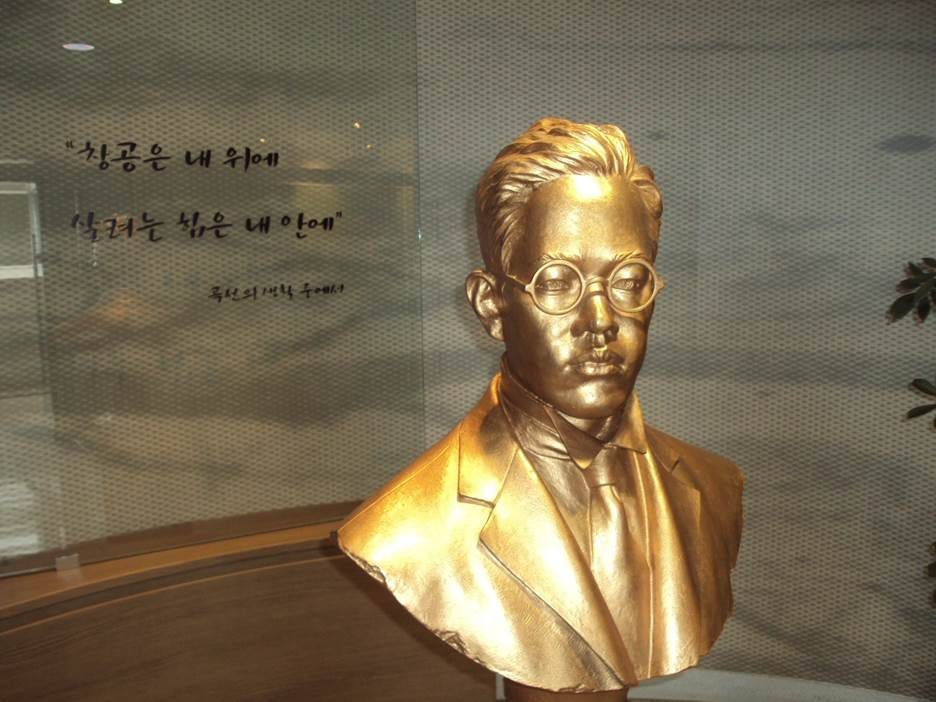
A bust of Kim U-jin is displayed in front of a wall inscription that reads, “창공은 내 위에, 살려는 힘은 내 안에.” It can be translated as “The vast sky is above me, and the will to live is within me.”
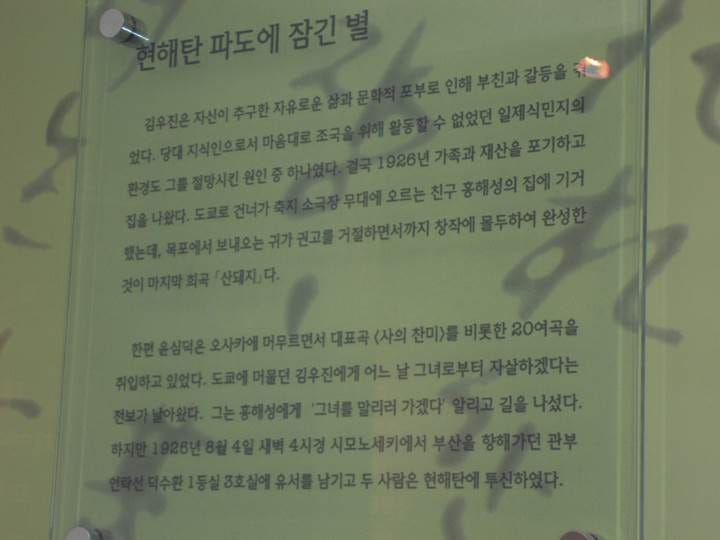
Under the title “A Star Drowned in the Waves of the Korea Strait,” the display explains how Kim U-jin and Yun Sim-deok, both of whom were students in Tokyo, committed suicide around 4:00 a.m. on August 4, 1926. Resisting his father’s instruction to return to Mokpo, Kim devoted himself to playwriting. Meanwhile, Yun informed him of her intention to die by suicide through a telegram. Intending to dissuade her, he followed her. They boarded a ferry that left Shimonoseki for Busan and, together, are believed to have jumped into the waters of the Korea Strait after leaving a will in their cabin.
Note: Kim and Yun’s so-called “love suicide” has become a legendary story in Korea, but the incident is also shrouded in uncertainty. Their bodies were never recovered; they simply disappeared. Some scholars argue that Kim, a married man, and Yun, a single woman, were not lovers at all. Meanwhile, The Dong-A Ilbo published the following report in its August 5, 1926, edition:
Amid raging waves in the Korea Strait, a young man and woman committed suicide together. The man was Kim U-jin, and the woman was Yun Sim-deok. At around 11:00 p.m. on the night of August 3, the Gwanbu Liner Deoksu Maru, which had departed Shimonoseki bound for Busan, was passing near Tsushima at around 4:00 a.m. on August 4, when a woman in Western dress and a middle-aged gentleman suddenly embraced on the deck and threw themselves into the sea. The ship immediately stopped and searched the area, but no trace was found. The passenger list recorded the man as Kim Su-san and the woman as Yun Su-seon, but these were not their real names; they were later identified as Kim U-jin and Yun Sim-deok. This was the first reported double suicide by Koreans aboard the Gwanbu ferry.
(quoted in https://www.cultura.co.kr/news/articleView.html?idxno=736; translated by John J. Han)
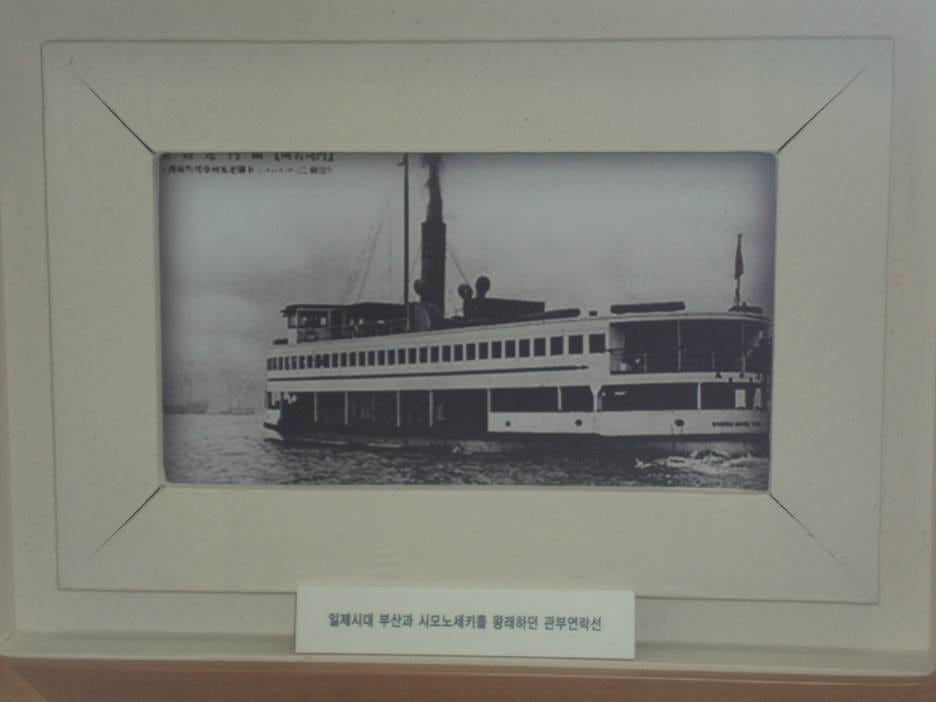
Caption translation:
The Gwanbu ferry line that operated between Busan and Shimonoseki during the Japanese colonial period.
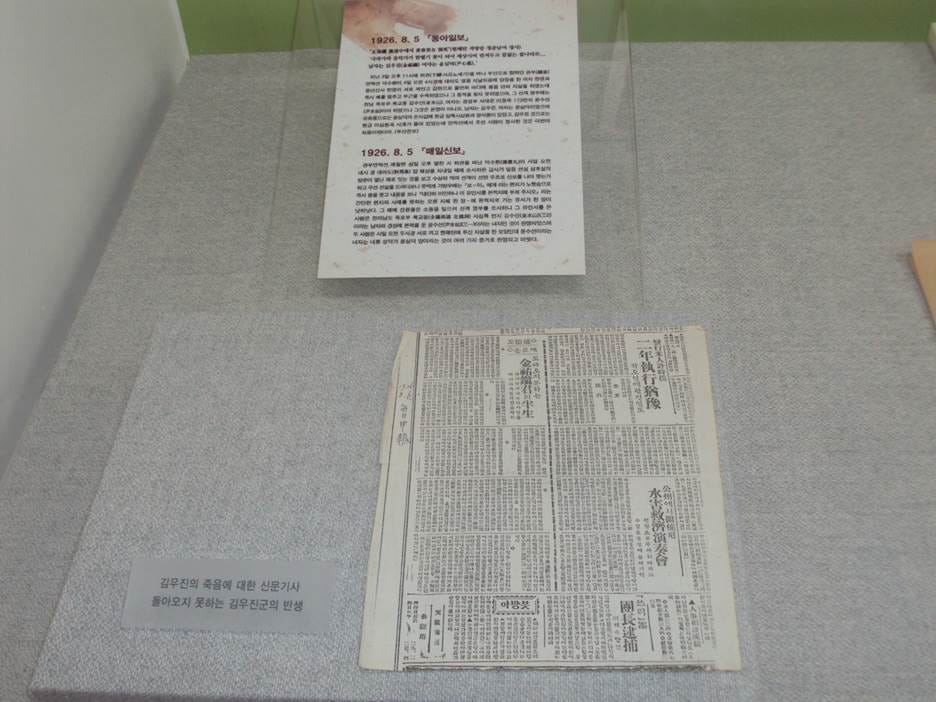
Caption translation:
Newspaper articles on Kim U-jin’s death
“The Life of Kim U-jin, Who Could Not Return”
Note: The second line of the caption refers to the title of an article that appeared in the August 6, 1926 edition of The Maeil Shinbo.
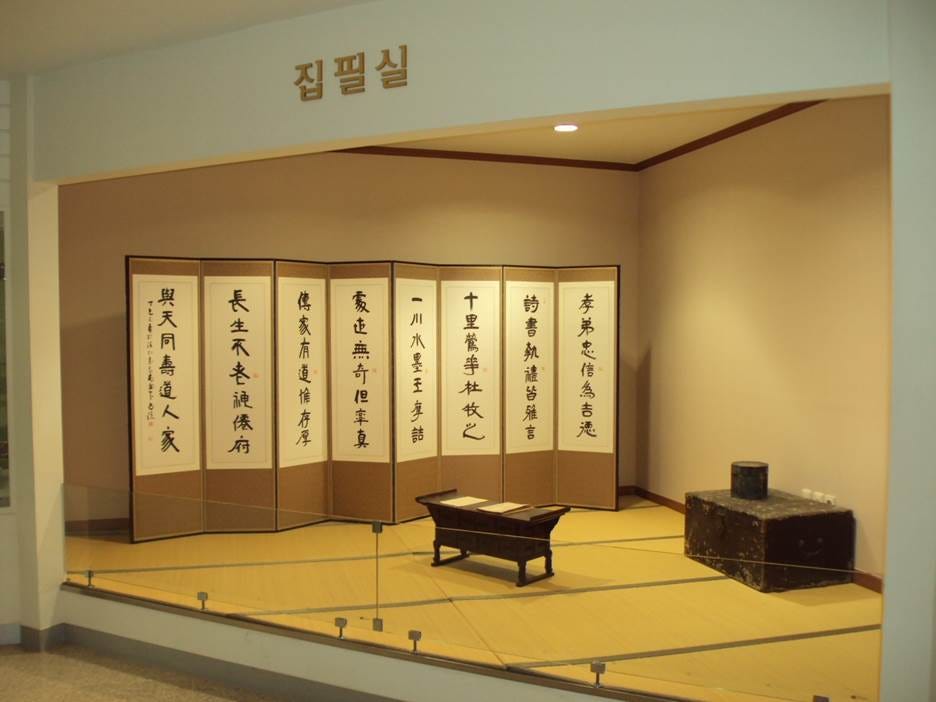
A replica of Kim U-jin’s writing room.
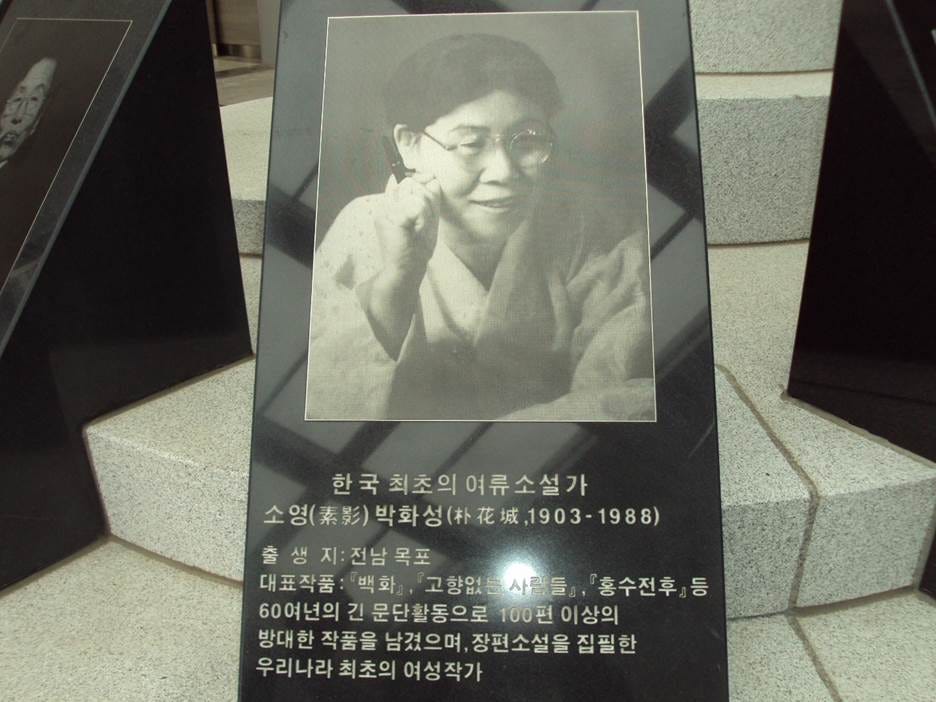
Under the title “The First Woman Novelist in Korea,” the stone panel states that Park Hwa-seong “produced an extensive body of more than 100 works over a literary career spanning more than 60 years and was the first female writer in Korea to publish full-length novels.”
Note:
Park Hwa-seong’s birth year is variously given as 1903 and 1904. Recent Korean scholarship and the Mokpo Museum of Literature identify her birth year as 1903.
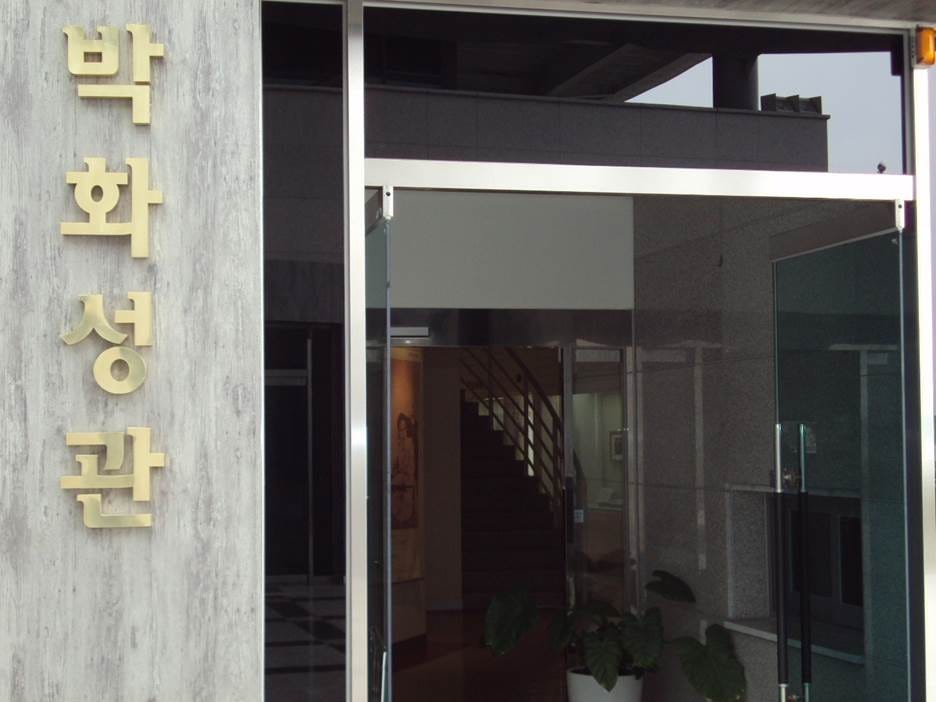
Entrance to the Park Hwa-seong Exhibition Hall.
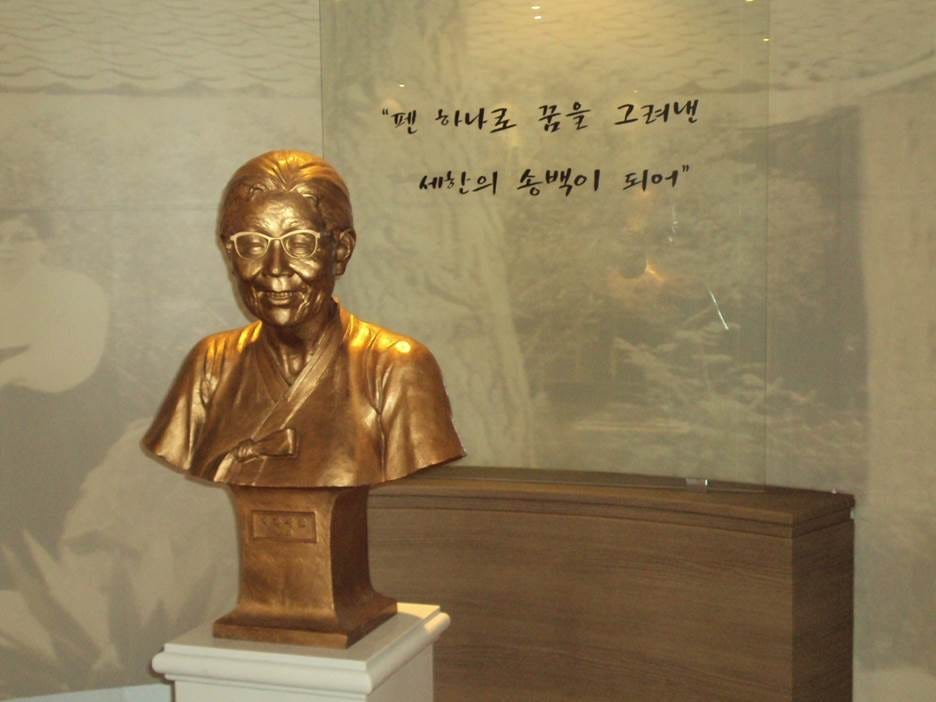
A bust of Park Hwa-seong stands before a wall inscription that reads, “펜 하나로 그려낸 세한 [歲寒]의 송백이 되어.” The phrase may be translated as “With a single pen, become the pine and cypress that endure the bitter winter,” invoking the classical image of steadfastness and integrity in the face of hardship.
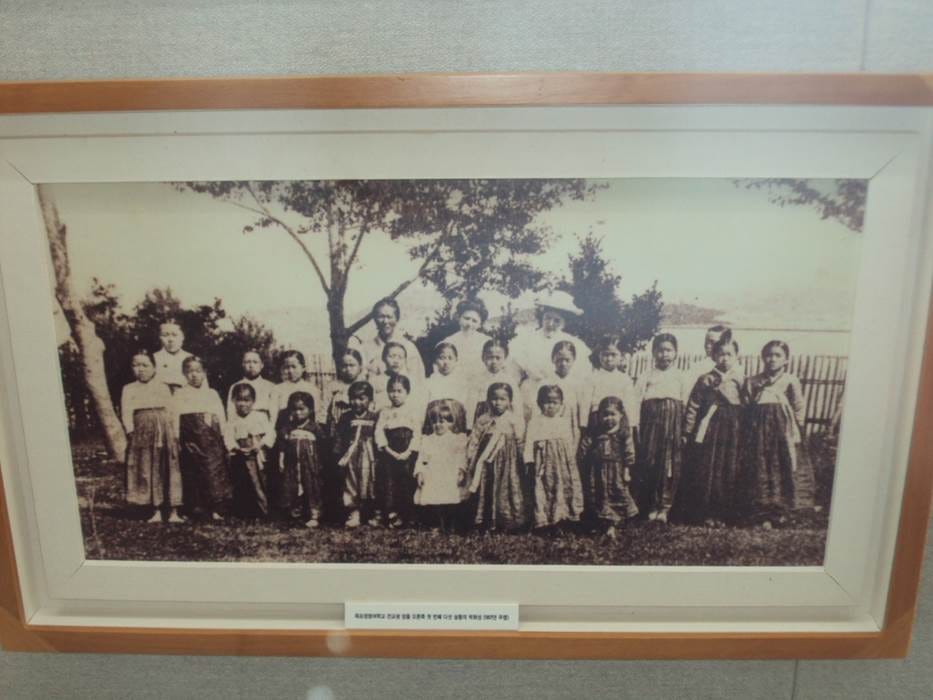
Caption translation:
Group photograph of all students at Jeongmyeong Girls’ School. Park Hwa-seong is the fifth person from the right in the front row (approximately five years old). Circa 1907.
Translator’s note:
Jeongmyeong Girls’ High School in Mokpo (목포정명여자고등학교) was founded in May 1902 as Jeongmyeong Girls’ School (정명여자학교) by F. E. Straeffer, a missionary of the Southern Presbyterian Church of the United States. The school building used at the time was a missionary structure located on the present school site, and the institution began as a private tutelage school with only a few young girls, teaching moral values such as love, tolerance, and purity, along with religious instruction.
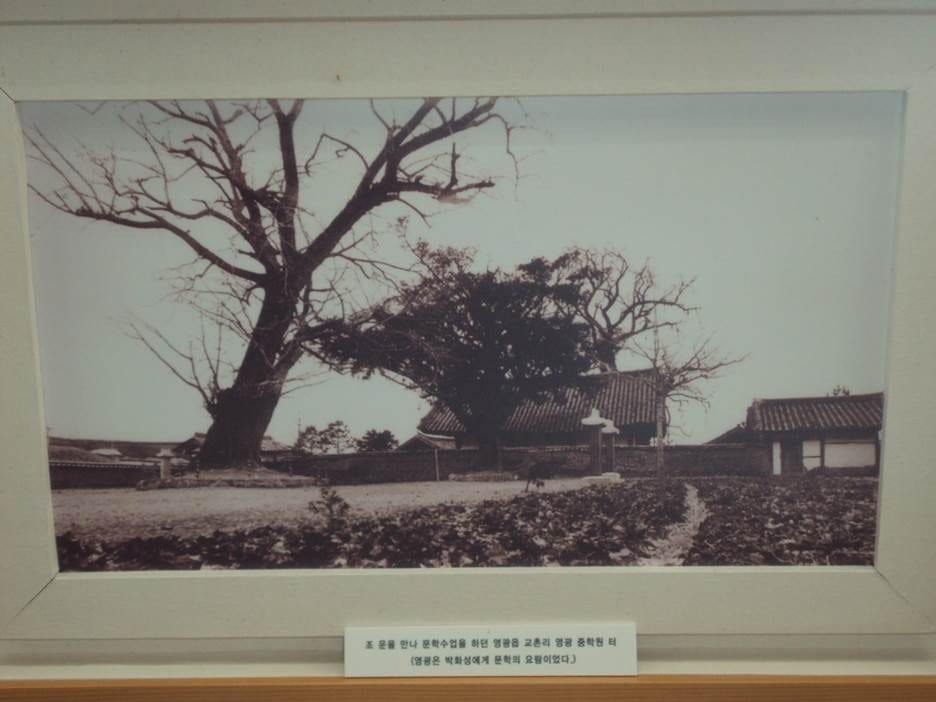
Caption translation:
The site of Yeonggwang Middle School in Gyochon-ri, Yeonggwang-eup, where Cho Woon met Park Hwa-seong and gave her lessons in literature.
(Yeonggwang was Park Hwa-seong’s cradle of literature.)
Translator’s note:
Park Hwa-seong graduated from Sookmyung Girls’ Higher School in Seoul in 1918. She later worked as a teacher at elementary schools in Cheonan and Asan, South Chungcheong Province, before transferring in 1922 to Yeonggwang Middle School in Yeonggwang County, South Jeolla Province. During the three years she stayed in Yeonggwang, she formed friendships with writers such as the sijo poet Cho Woon (曺雲) and began her formal study of literature in earnest.
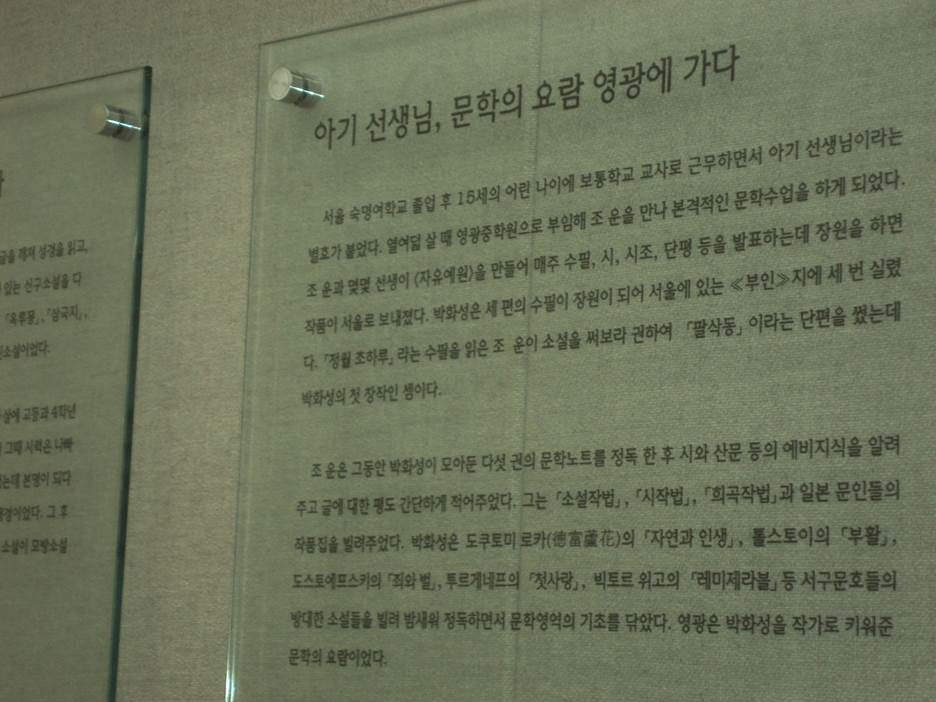
The interpretive sign, titled “The Child Teacher Goes to Yeonggwang, Cradle of Literature,” notes that under the mentorship of Cho Woon, Park read such masterpieces as Tolstoy’s Resurrection, Dostoevsky’s Crime and Punishment, Turgenev’s First Love, and Hugo’s Les Misérables. Park was only 18 years old when she arrived in Yeonggwang, hence the phrase “Child Teacher” in the title.
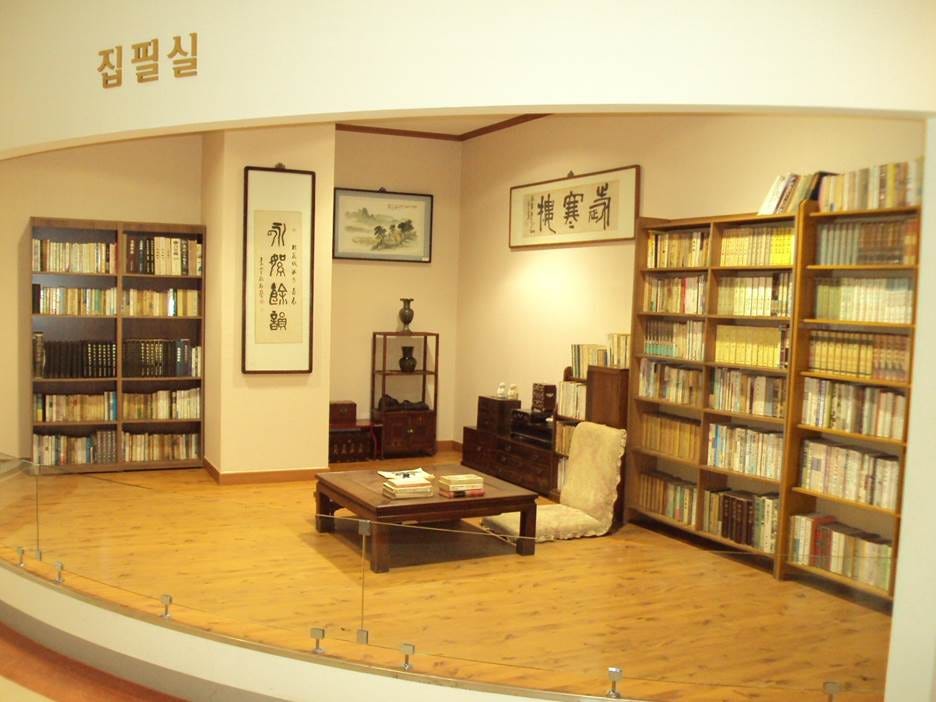
A replica of Park Hwa-seong’s writing room.
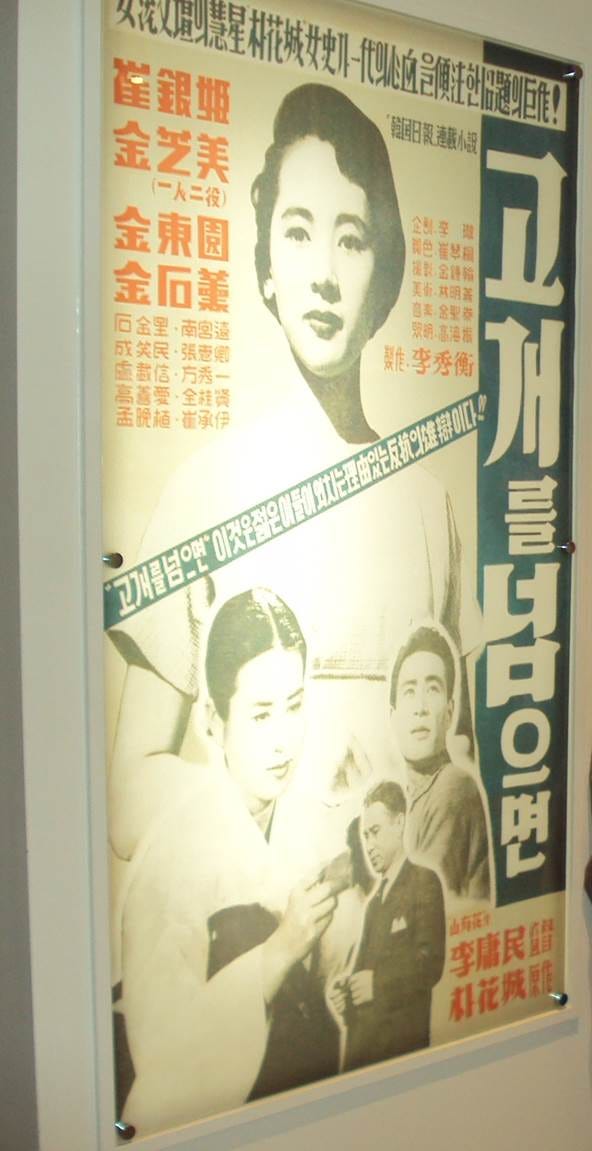
Park Hwa-seong’s full-length novel If You Cross the Pass (Gogaereul Neomeumyeon), serialized in The Hankook Ilbo from 1955 to 1956, was adapted into a 94-minute film in 1959. The cast featured some of Korea’s leading film stars of the era, including Choi Eun-hee, Kim Ji-mi, Kim Dong-won, and Kim Seok-hun. The film’s original poster hails Park Hwa-seong as “a comet in women’s literature” and proclaims her novel as “a masterpiece.”
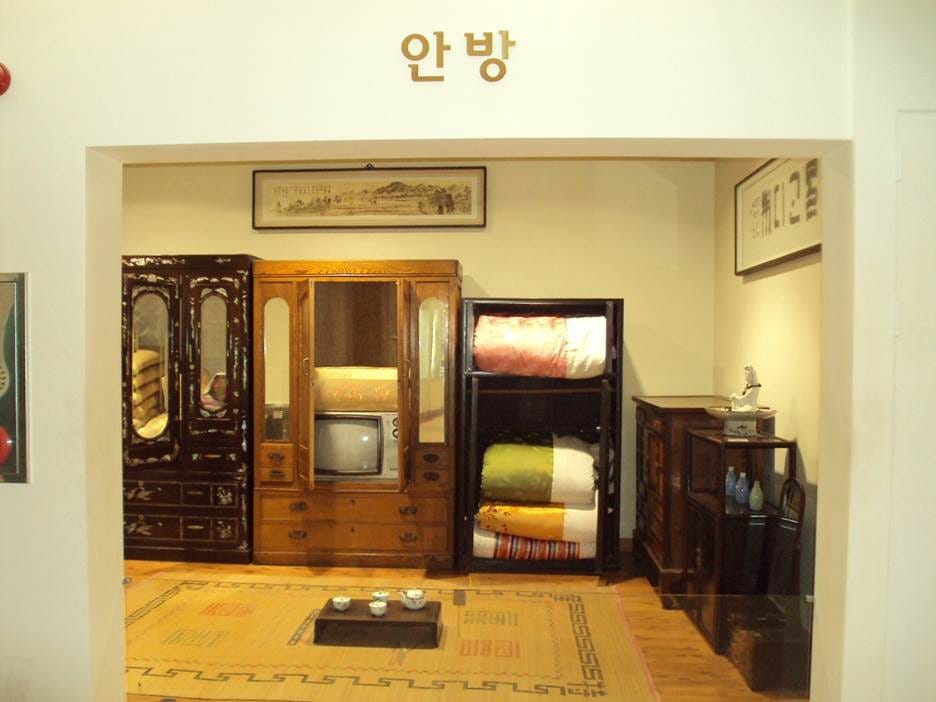
A replica of Park Hwa-seong’s living room.
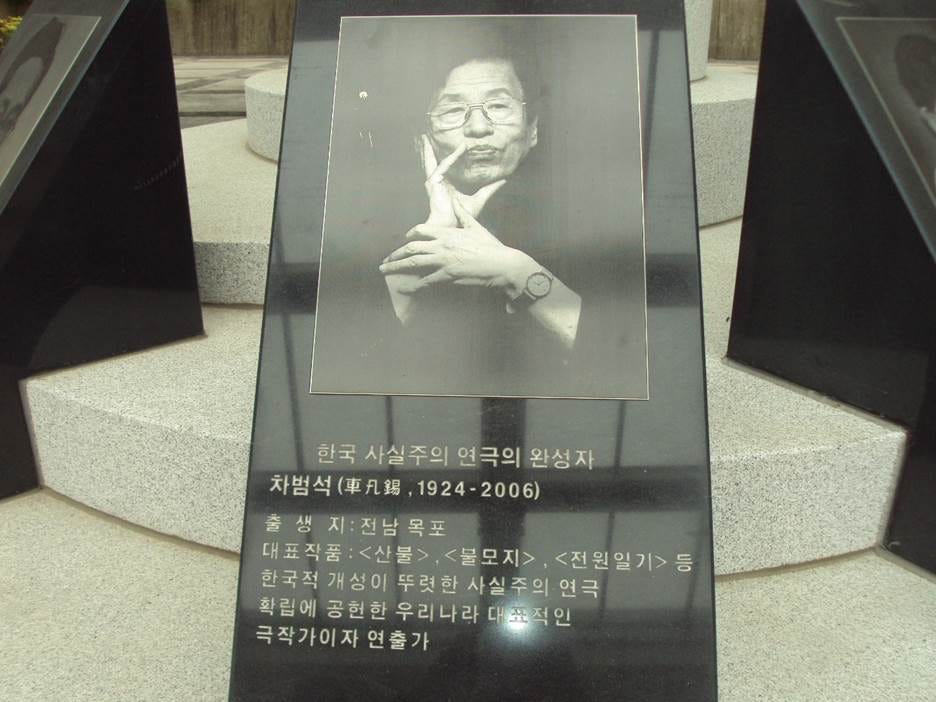
Under the title “The Figure Who Brought Korean Realist Theater to Maturity,” the stone panel states that Cha Beom-seok was “a leading playwright and director of Korea who contributed to the establishment of realist theater with a distinctly Korean sensibility.”
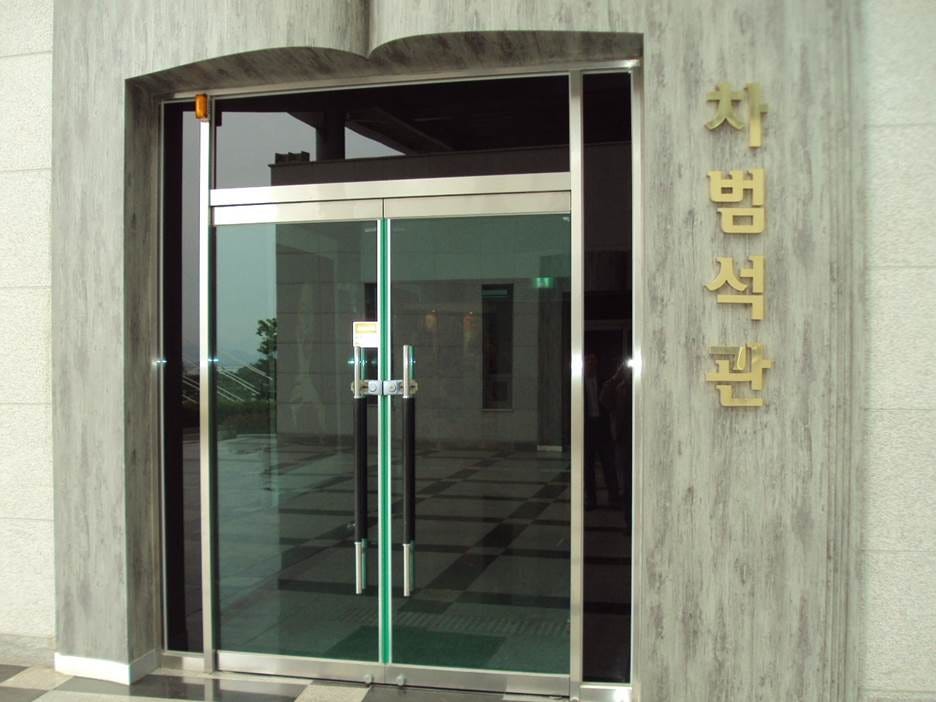
Entrance to the Cha Beom-seok Exhibition Hall.
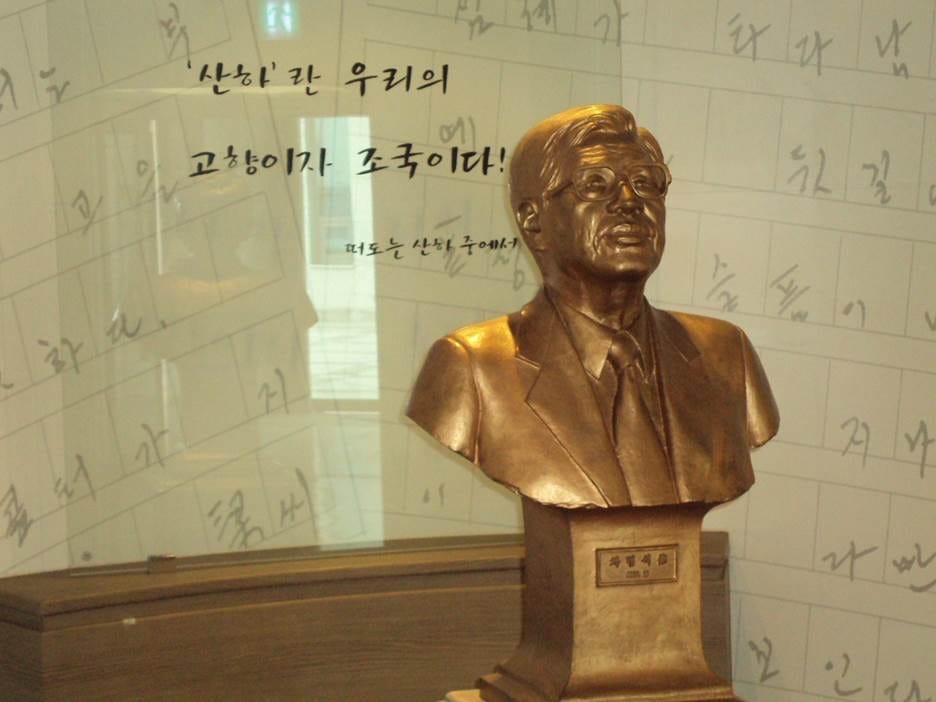
A bust of Cha Beom-seok stands before a wall inscription that reads, “‘산하’[山河]란 우리의 고향이자 조국이다!” The phrase may be translated as “‘Sanha’ is both our hometown and our homeland!”
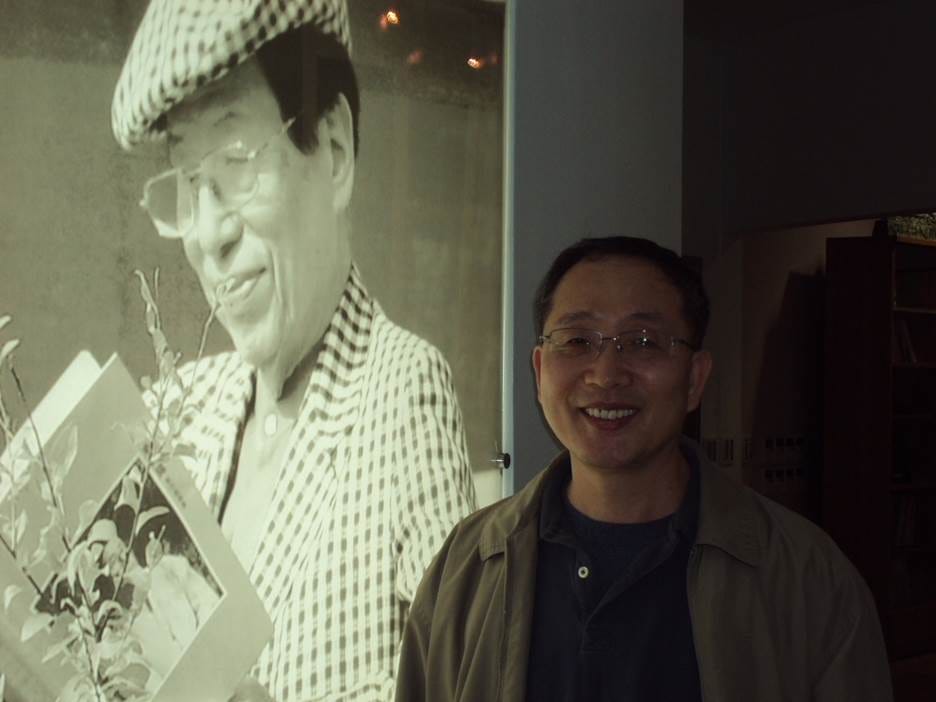
A photograph of Cha Beom-seok.
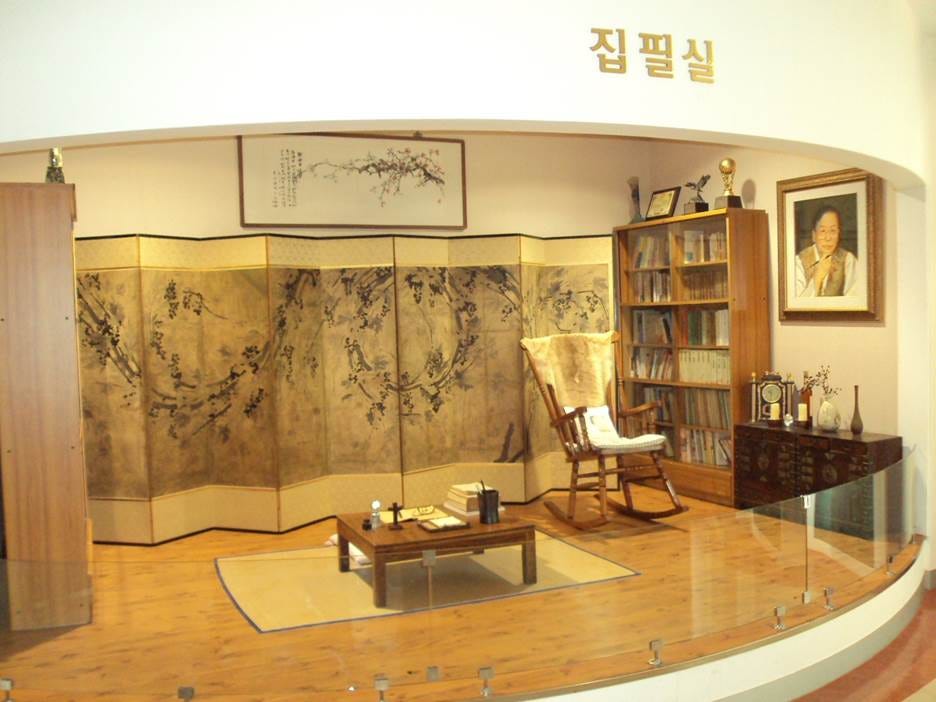
A replica of Cha Beom-seok’s writing room.
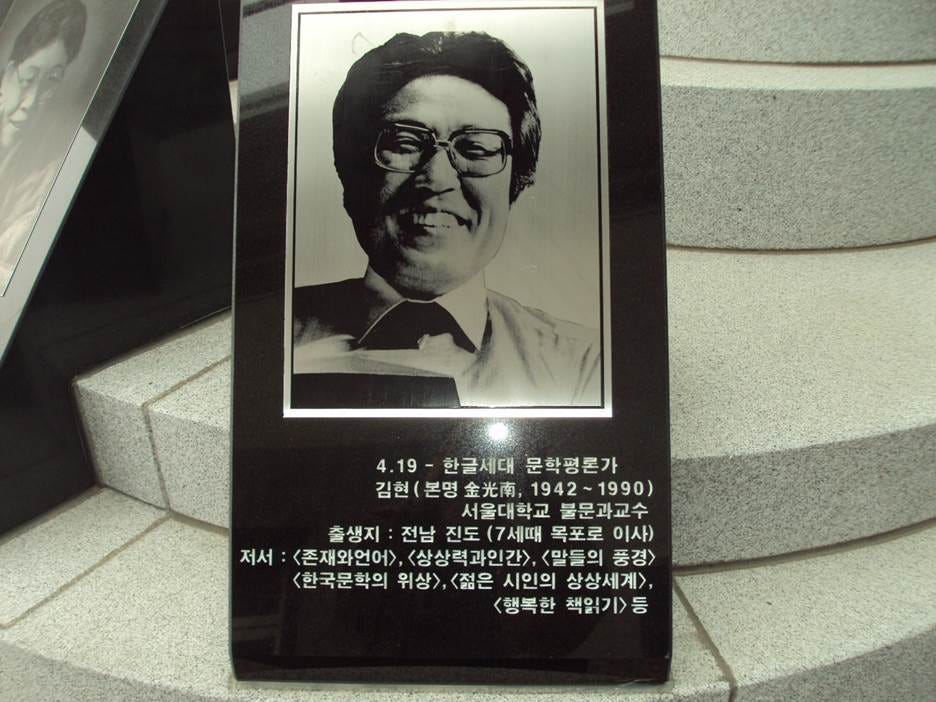
Defining Kim Hyeon as “a literary critic of the April 19 generation, the first generation to establish Korean as the primary language of literary criticism,” the stone plaque lists the titles of his major works, including Existence and Language, Imagination and Humanity, Landscape of Words, The Status of Korean Literature, The Imaginative World of Young Poets, and The Joy of Reading.
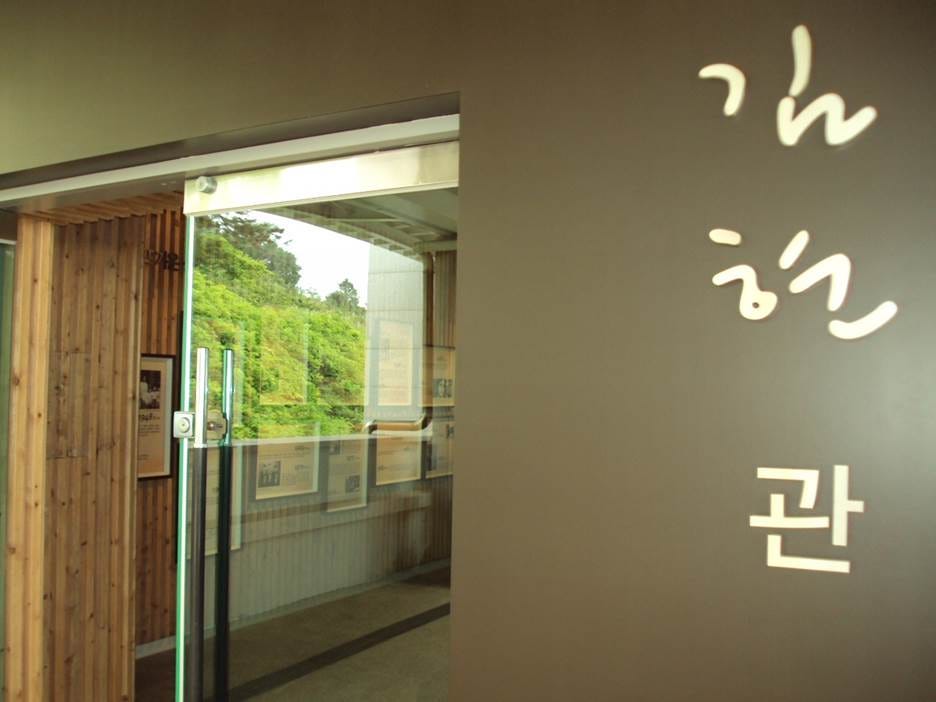
Entrance to the Kim Hyeon Exhibition Hall.
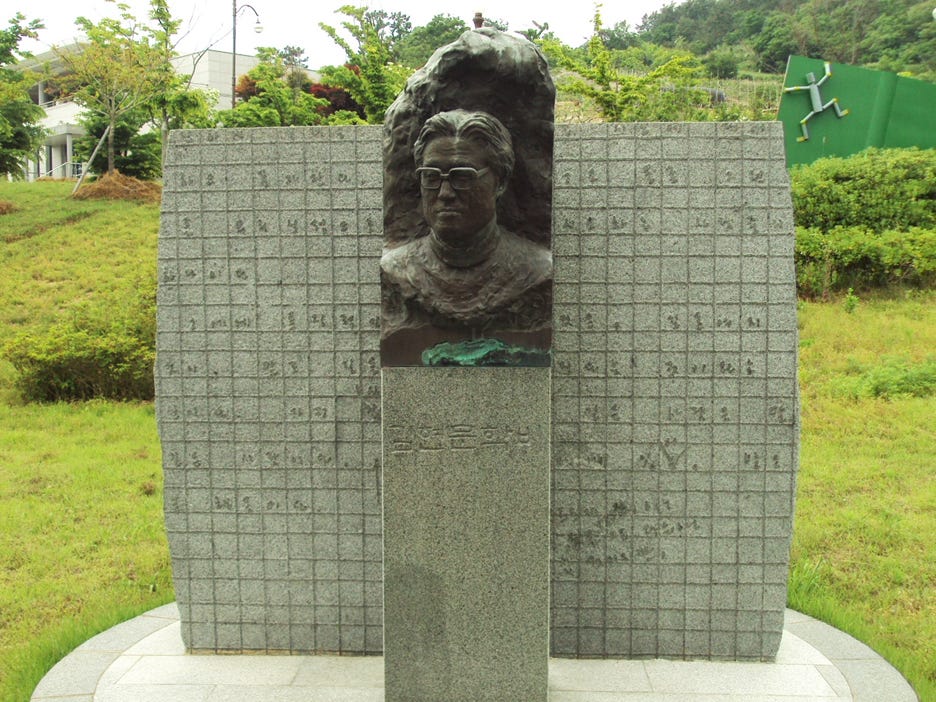
The Kim Hyeon Literary Monument outside the Mokpo Museum of Literature.
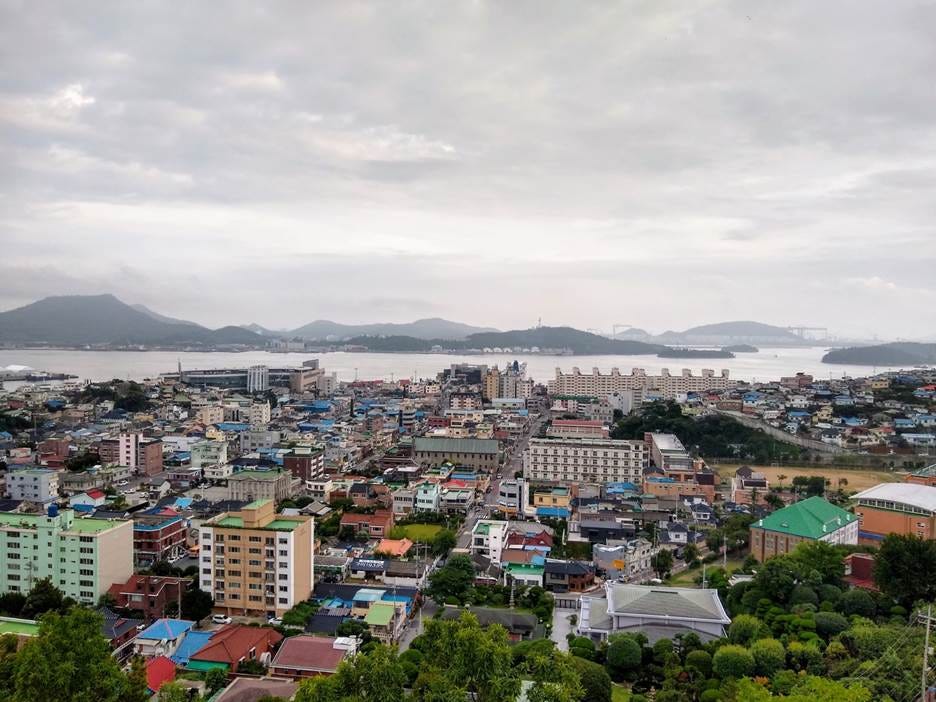
The harbor city of Mokpo viewed from Mt. Yudal. Under Japanese colonial rule (1910-1945), Mokpo was one of Korea’s principal ports and a major center for exporting rice and other agricultural products to Japan.
About the Author
Professor of English and Creative Writing and Associate Dean of the School of Humanities and Theology, Missouri Baptist University
John J. Han, PhD, is the author, editor, co-editor, or translator of 35 books. His forthcoming book, Echoes from the Hills: Critical Essays on Ozarks Literature (co-edited with C. Clark Triplett), will be published by the University of Arkansas Press. He has also published nearly 3,000 poems in a wide range of journals and anthologies. In addition to his long tenure at Missouri Baptist University, he has taught at Kansas State University, the University of Nebraska–Lincoln, Nebraska Wesleyan University, and Washington University in St. Louis. He has also served as a visiting scholar at Georgia College & State University and the University of Ljubljana in Slovenia.
© K-Global Scholars and Professionals Forum. All rights reserved. Content published in the K-GSP Forum may not be reproduced, distributed, or transmitted in any form without prior written permission from the K-GSP Forum, except for brief quotations with full attribution.
좋은 글 감사드립니다.