

Where The Grapes of Wrath Begins [1]: Sallisaw, Oklahoma
Because of their remote locations, John Steinbeck’s fictional settings in Oklahoma are not easily accessible for those who live outside the Great Plains. Fortunately, I have lived in two Great Plains states (Kansas and Nebraska) and the Midwestern state of Missouri for thirty-eight years, which makes it easy to access literary sites in the middle section of the continental United States. It is a pleasure to have captured some of the Steinbeck-related scenes in Oklahoma, where The Grapes of Wrath (1939) begins to unfold.
Sallisaw, the Joads’ Hometown
In March 2022, I traveled from St. Louis on Interstate 44 to visit sites related to the preacher novelist Harold Bell Wright (1872–1944) in Missouri (Lebanon and Mount Vernon) and southeastern Kansas (Pittsburg). After staying one night in Pittsburg, I turned south toward Sallisaw, Oklahoma, to see the town that became famous through The Grapes of Wrath. On the way to Sallisaw were many small towns and villages in southeastern Kansas, southwestern Missouri, northwestern Arkansas, and northeastern Oklahoma. The road was often hilly and winding, but thankfully, there was little traffic. US 59 South, which connects West Siloam Springs, Oklahoma, to Sallisaw, is flanked first by hills and then by farmland.1 After driving nonstop for over three hours, I reached Sallisaw. This town of about 8,500 residents came across as a typical Midwestern town, a quiet, unassuming community surrounded by agricultural land. The residential houses looked modest yet well kept, and anyone who grew up in the countryside should find the fields outside the municipality peaceful and welcoming. Sallisaw served as an early setting for The Grapes of Wrath, but some residents today do not appreciate the way Steinbeck represents it. They find the author’s portrayal of the place inaccurate and unflattering. (Steinbeck is not the only novelist accused of portraying a place in an unbecoming way. Willa Cather, who wrote mostly about the Northern Plains, has also received criticism from some readers in Nebraska.) Regardless, Steinbeck should be given credit for having put Sallisaw on the literary map.
Sallisaw is mentioned thirteen times in The Grapes of Wrath. In Chapter Eight, for instance, Grampa recalls a camp meeting in Sallisaw. When Tom asks Pa where Uncle John is, Pa answers, “John gone to Sallisaw with a load a stuff to sell: pump, tools, chickens, an’ all the stuff we brung over. Took Ruthie an’ Winfield with ’im. Went ’fore daylight.” In Sallisaw, people recognize Al Joad as someone whose brother “killed a fella with a shovel.” In Chapter Ten, Sallisaw appears as a place where one can buy sex; here, Uncle John “would raven with lust for some whore.” Finally, the opening paragraph of Chapter Thirteen describes the route the Joads and numerous other migrants take on their way to California:
The ancient overloaded Hudson creaked and grunted to the highway at Sallisaw and turned west, and the sun was blinding. But on the concrete road Al built up his speed because the flattened springs were not in danger any more. From Sallisaw to Gore is twenty-one miles and the Hudson was doing thirty-five miles an hour. From Gore to Warner thirteen miles; Warner to Checotah fourteen miles; Checotah a long jump to Henrietta—thirty-four miles, but a real town at the end of it. Henrietta to Castle nineteen miles, and the sun was overhead, and the red fields, heated by the high sun, vibrated the air.2
Together, these references make Sallisaw an important stopping point in the Joads’ journey west and a place whose history is closely intertwined with Steinbeck’s portrait of migrant life.3
Notes
[1] Northeastern Oklahoma is part of the Ozark Mountains, which lie mainly in southern Missouri and northern Arkansas.
[2] For more information on the connection between The Grapes of Wrath and Oklahoma, see William M. Hagen’s article “GRAPES OF WRATH, THE” in The Encyclopedia of Oklahoma History and Culture. https://www.okhistory.org/publications/enc/entry.php?entry=GR010.
[3] An earlier version of this photo essay appeared in Steinbeck Studies, vol. 45, 2023, pp. 74-84.
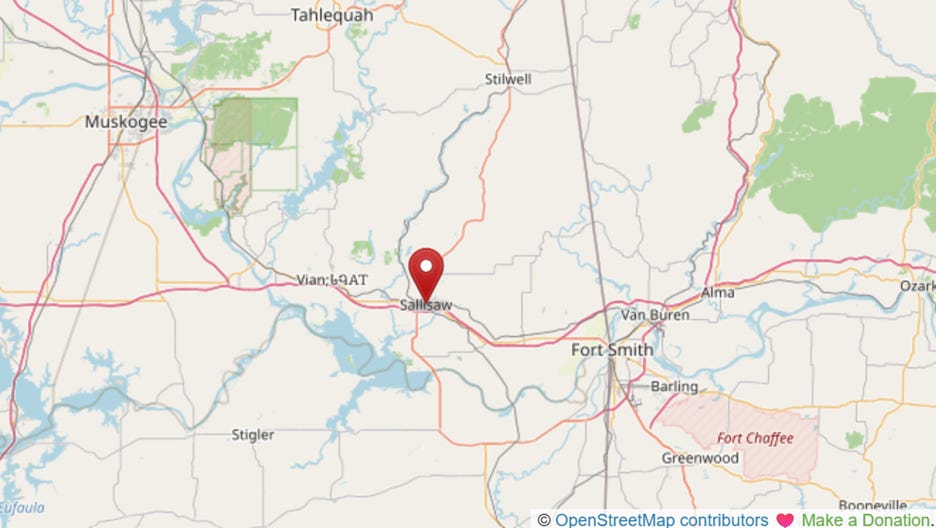
Sallisaw, Oklahoma, a small agricultural town and an early setting in John Steinbeck’s The Grapes of Wrath. Steinbeck’s portrayal of the town has given this otherwise quiet community a lasting place on the literary map. Composite image based on map data © OpenStreetMap contributors.
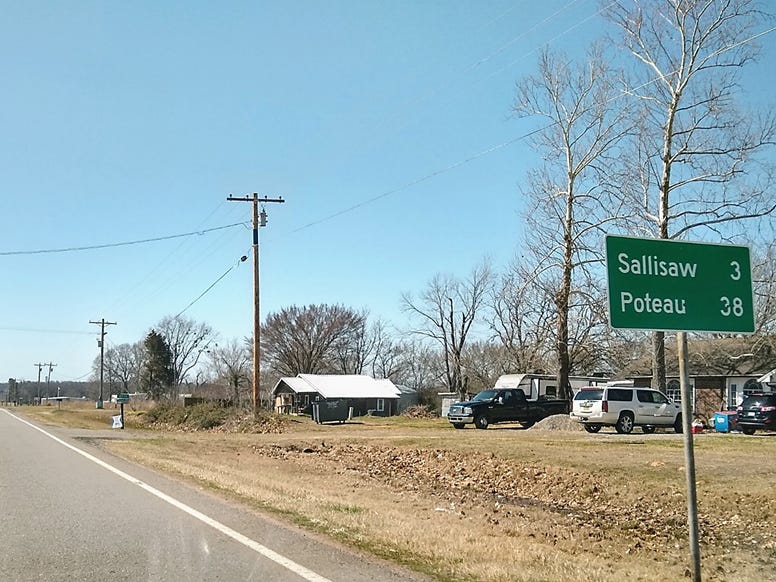
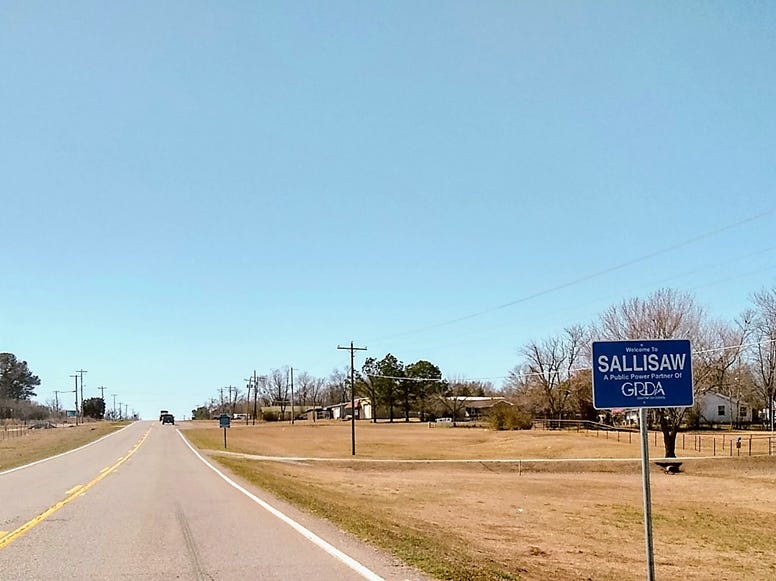
The signs of Sallisaw on U.S. Route 59 that runs from north to south along the northeastern portion of Oklahoma.
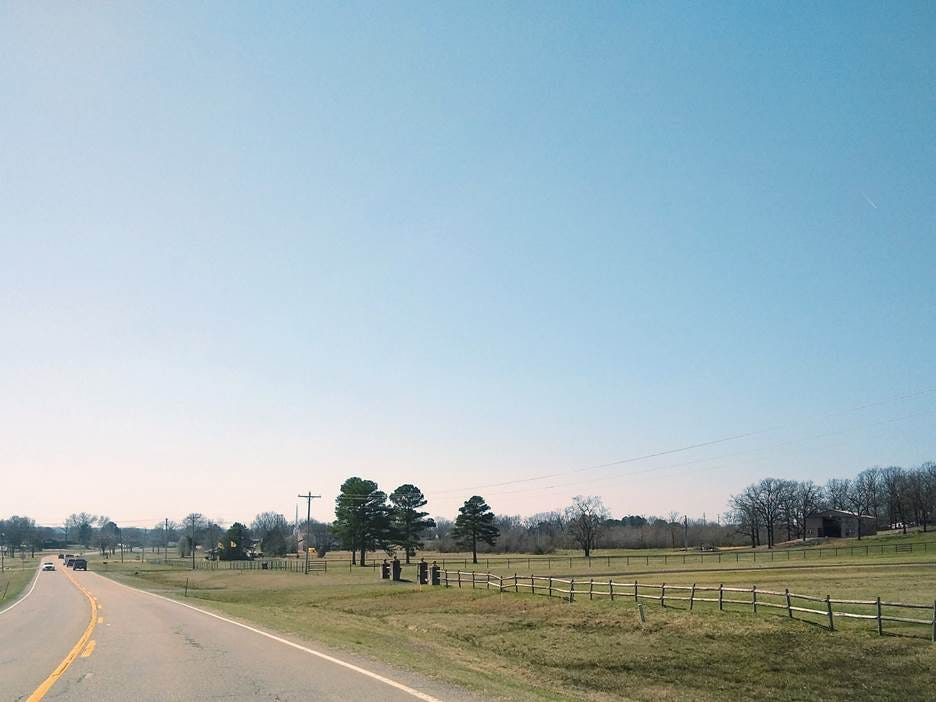
U.S. Route 59 leads to this pastoral scene of northeastern Sallisaw.
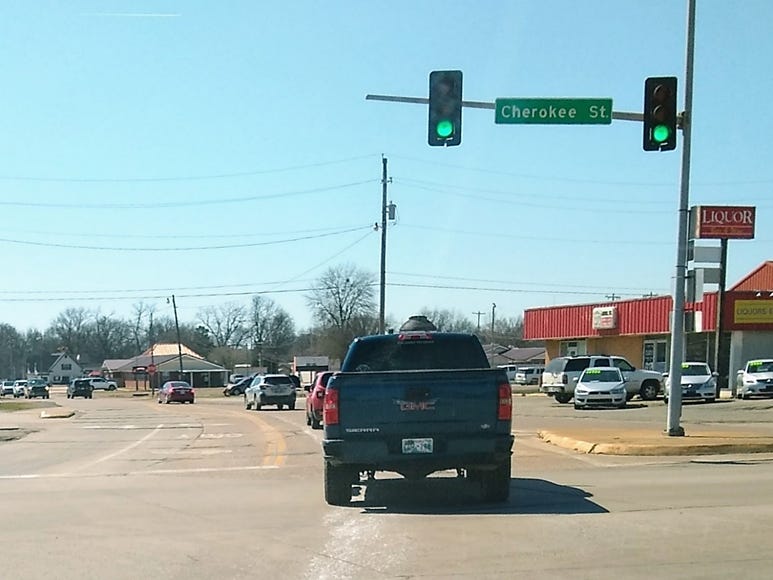
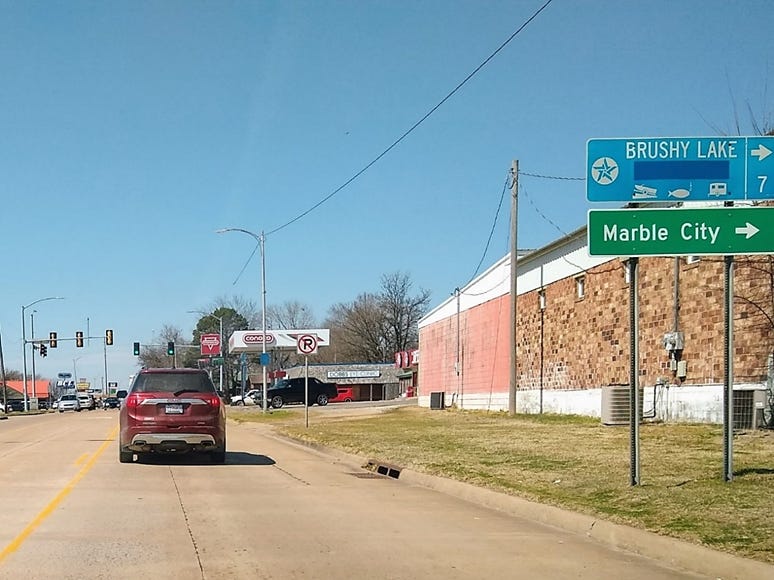
Downtown Sallisaw. Cherokee Street (US-64) leads to Gore, Warner, Checotah, and other towns mentioned at the beginning of Chapter Thirteen of The Grapes of Wrath.
About the Author

Professor of English and Creative Writing and Associate Dean of the School of Humanities and Theology, Missouri Baptist University
John J. Han, PhD, is the author, editor, co-editor, or translator of 38 books. His forthcoming book, Echoes from the Hills: Critical Essays on Ozarks Literature (co-edited with C. Clark Triplett), will be published by the University of Arkansas Press. He has also published more than 3,000 poems, primarily haiku, in a wide range of journals and anthologies. In addition to his long tenure at Missouri Baptist University, he has taught at Kansas State University, the University of Nebraska–Lincoln, Nebraska Wesleyan University, and Washington University in St. Louis. He has also served as a visiting scholar at Georgia College & State University and the University of Ljubljana in Slovenia.
© K-Global Scholars and Professionals Forum. All rights reserved. Content published in the K-GSP Forum may not be reproduced, distributed, or transmitted in any form without prior written permission from the K-GSP Forum, except for brief quotations with full attribution.