
Words in the Cityscape: Modern Literary Sites of Seoul
As an adolescent in South Korea, I devoted as much time to reading Korean literature as I did to my regular schoolwork. I especially enjoyed the fiction of Park Jong-hwa (1901-1981), Yi Hyo-seok (1907-1942), and Choi In-ho (1945-2013), among many others. In addition to subscribing to Hankook Munhak (Korean Literature), I sought out back issues of Hyeondae Munhak (Modern Literature) and other literary magazines, where I discovered not only creative works but also thoughtful discussions of literary trends and criticism. This early immersion in my native literature enriched my later study of English and American literature.
When I arrived in the United States in 1988, Korean literature had yet to attain the international recognition it enjoys today. For many years, the literary traditions of China, Japan, and India dominated discussions of Asian literature, while Korean writing remained largely overlooked. Most college world literature anthologies omitted Korean works altogether. The inclusion of an excerpt from The Memoirs of Lady Hyegyeong (Hanjungnok), the autobiography of Lady Hyegyeong (1735-1816), in the fifth edition of the shorter Norton Anthology of World Literature (2024) reflects the growing acknowledgment of Korea’s literary heritage.
As South Korea has gained prominence on the world stage, its literature has likewise attracted an expanding international readership. Goodreads, the popular American social cataloging website, shows that translated works by authors such as Han Kang and Sohn Won-pyung have found enthusiastic audiences among English-language readers.
This growing readership has been made possible in large part by the increasing availability of high-quality translations. Organizations such as the Literature Translation Institute of Korea (한국문학번역원), along with private foundations and corporate sponsors, have played an essential role in introducing Korean literature to readers around the world. Yet translation efforts predate these institutions. In the 1980s, while serving on the editorial staff of the monthly journal The Study of Current English, I helped publish English translations of well-known Korean novels and short stories in every issue.
The global success of Korean literature today reflects a long tradition of creative excellence that has laid the foundation for the nation’s current literary renaissance. As Korea’s capital for more than six centuries, Seoul has long served as the country’s literary center. This photo essay explores landmarks throughout the city associated with modern Korean writers and poets. Our journey begins in Namsan Mountain Park in central Seoul and continues through other parts of the capital, where literature remains woven into the fabric of everyday urban life. Unless otherwise noted, all English translations of the poems are my own.
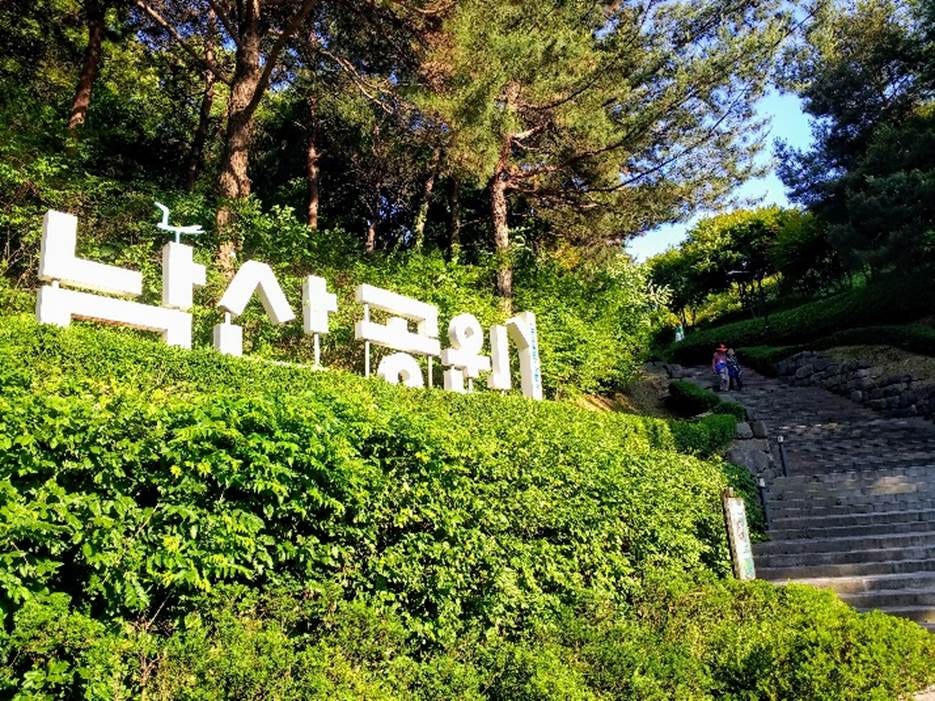
The sign reads, “Namsan Mountain Park.” Rising above central Seoul, Namsan Mountain Park has long served as both a natural refuge and a cultural landmark for writers, poets, and artists. Once a scenic site overlooking Hanyang, the Joseon capital, Namsan has witnessed Seoul’s transformation from a traditional city into a modern metropolis. Its paths, forests, and panoramic views have inspired generations of literary figures drawn to themes of memory, place, and urban change.
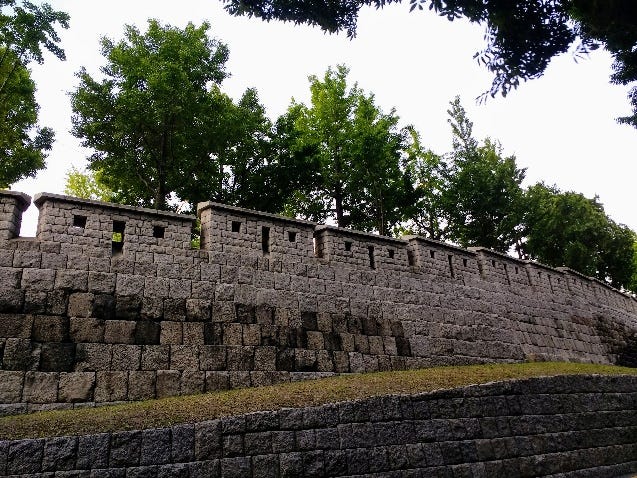
The Hanyangdoseong (Seoul City Wall), which passes through Namsan, has also appeared in both premodern and modern Korean literature as a symbol of the capital’s history and enduring identity. Together, Namsan and its historic wall remain a meeting place where Seoul’s historical landscape and literary imagination converge.
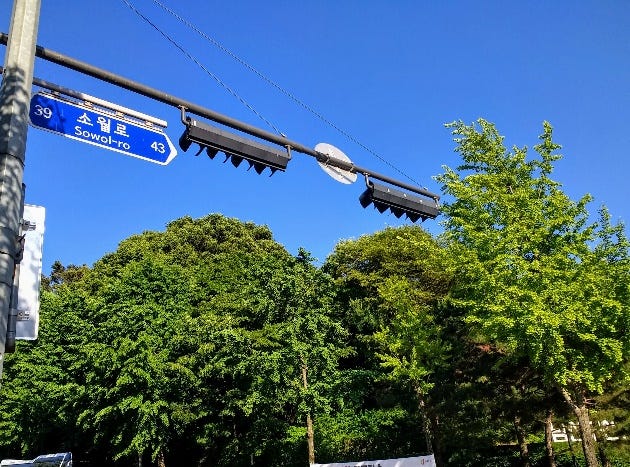
A street in Namsan Mountain Park is named in honor of Kim So-wol (1902-1934), one of Korea’s most beloved modern poets. Best known for his lyrical works that draw deeply from Korean landscapes, traditional rhythms, and themes of longing and separation, Kim left an enduring legacy despite his short life. One of his most celebrated poems appears later in this photo essay, allowing readers to encounter the voice of a writer whose work continues to resonate across generations.
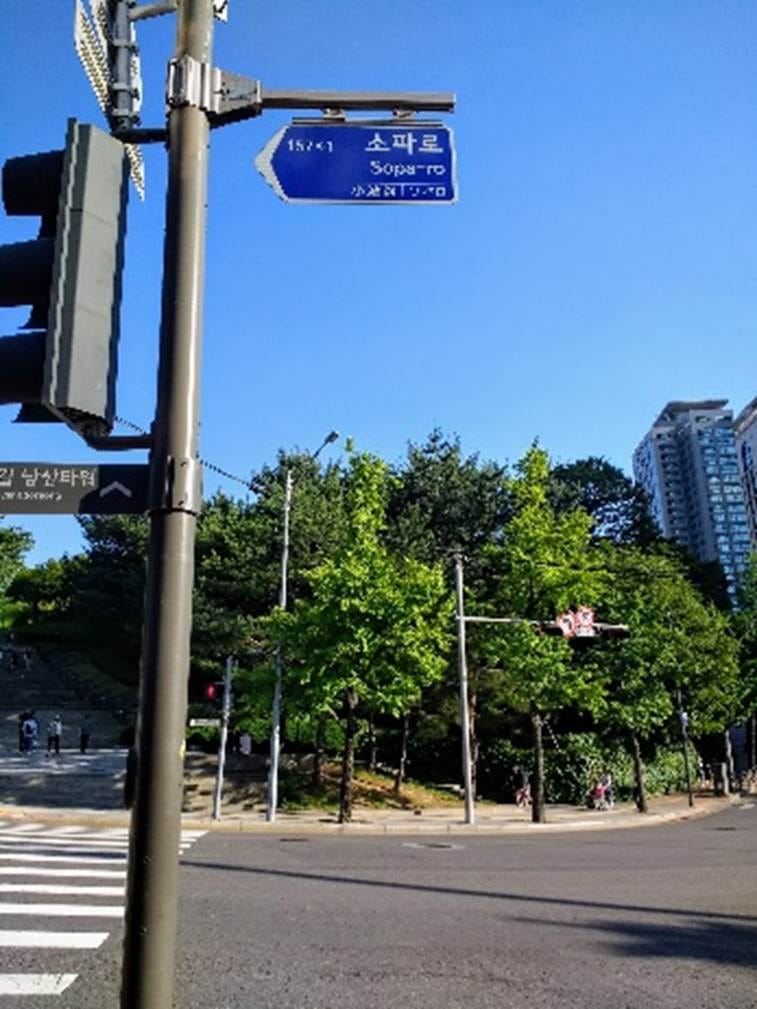
Another street, Sopa-ro, honors Bang Jeong-hwan (1899-1931), a pioneering writer of children’s literature who helped establish Children’s Day in Korea. Sopa (소파, 小波) was one of his pen names, meaning “small wave,” and reflected his lifelong dedication to nurturing the hopes, dignity, and imagination of children. Through his stories, essays, and advocacy, Bang played a central role in creating a literary tradition that recognized children as important members of society.
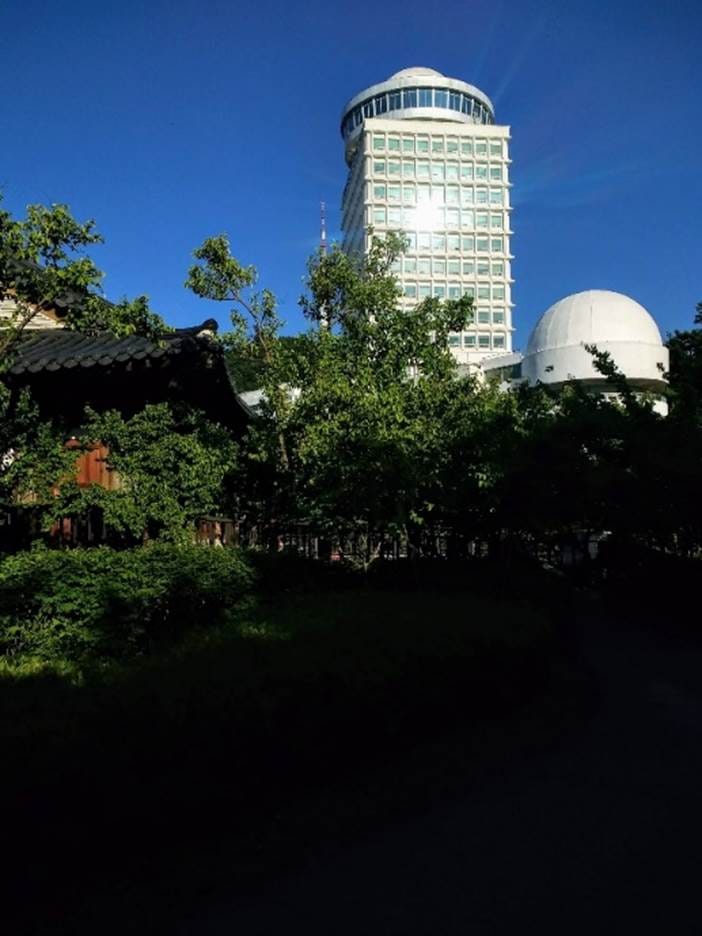
Bang Jeong-hwan and Children’s Literature at Namsan. The Children’s Hall, which opened at Namsan Park in 1970 as Korea’s first comprehensive cultural and science facility for children, also became a meaningful space for children’s literature. During its years at Namsan, the hall operated a library and children’s theater, offering storytelling events and literary programs that introduced young readers to the world of imagination. A statue of Bang Jeong-hwan, the pioneer of modern Korean children’s literature and the founder of Children’s Day in Korea, once stood in the green area beside the hall. Together, the hall and the statue reflected Namsan’s role as a place where literature, education, and cultural memory came together.
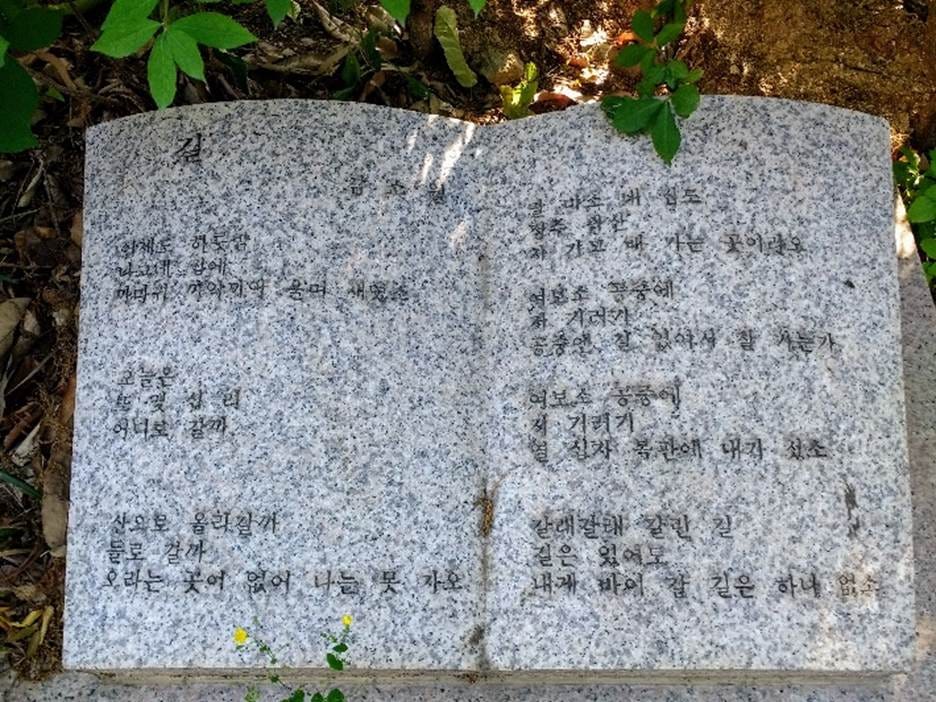
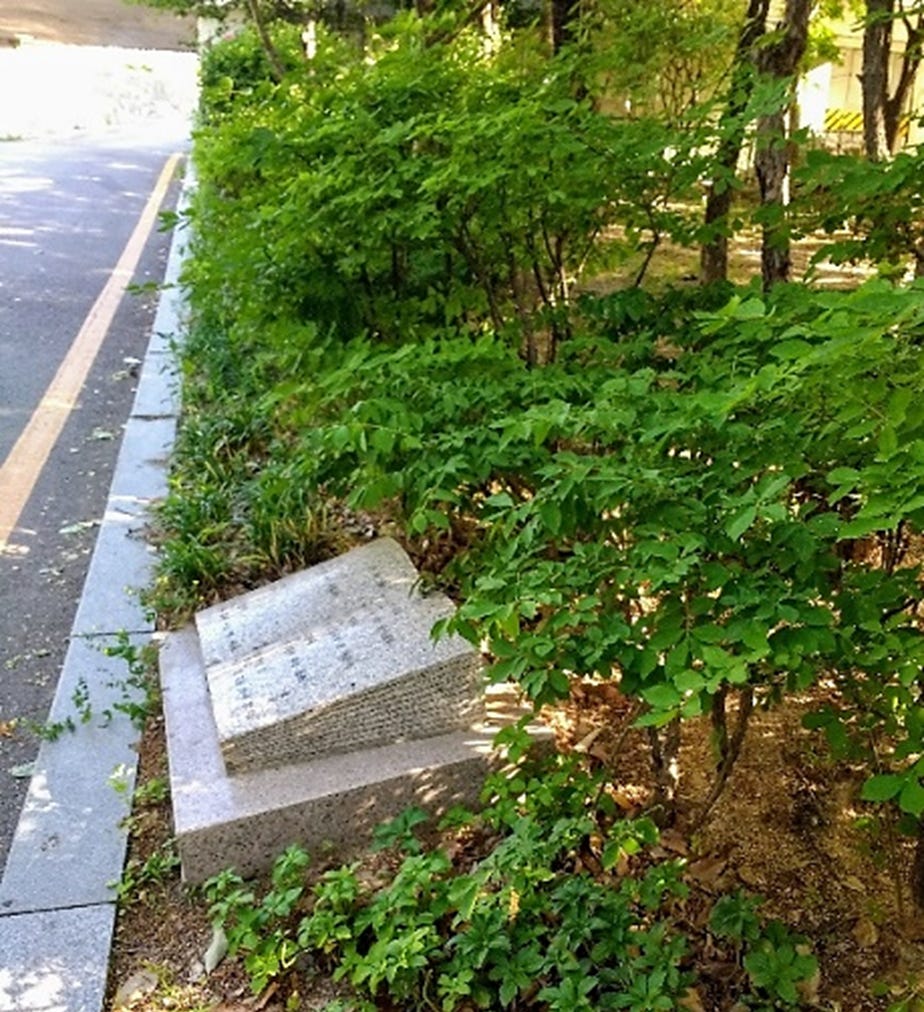
When I visited Namsan Mountain Park in December 2024, I encountered several poetry monuments honoring twentieth-century Korean poets, including Kim So-wol, Yang Ju-dong, and Cheon Sang-byeong. Above is the stone monument dedicated to Kim So-wol (1902-1934), whose poem “The Road” (Gil) is inscribed on the rock. One of Korea’s most beloved modern poets, Kim is known for his lyrical expressions of longing, separation, and the search for belonging. Below is my English translation of the poem.
The Road
by Kim So-wol
Last night, too,
At a traveler’s inn,
Crows cried and called until dawn.
Today,
Another few dozen ri ahead—
Where shall I go?
Shall I climb the mountains?
Shall I walk the fields?
With no place calling me, I cannot go.
Say no more—my home
Is Gwak-san of Jeongju,
Where carts roll and boats set sail.
Tell me, up in the sky,
You passing wild geese—
Do you find your way along a road in the air?
Tell me, up in the sky,
You passing wild geese—
I stand at a crossroads, lost.
Paths stretch in every direction,
Yet among them all,
There is not a single road for me.
Kim So-wol remains one of Korea’s most cherished modern poets, celebrated for poems shaped by the rhythms and emotions of traditional Korean folk songs. His only poetry collection, Azaleas (1925), is regarded as a landmark of Korean literature, and its title poem remains one of the nation’s most familiar and beloved works. Although his life was marked by hardship and ended prematurely, Kim’s poetic legacy has endured, securing his place among the most influential figures in modern Korean literature.
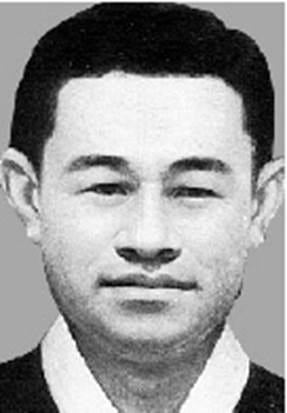
Kim So-wol (1902-1934), photographer unknown. Public domain image via Wikimedia Commons; original source: JoongAng Ilbo.
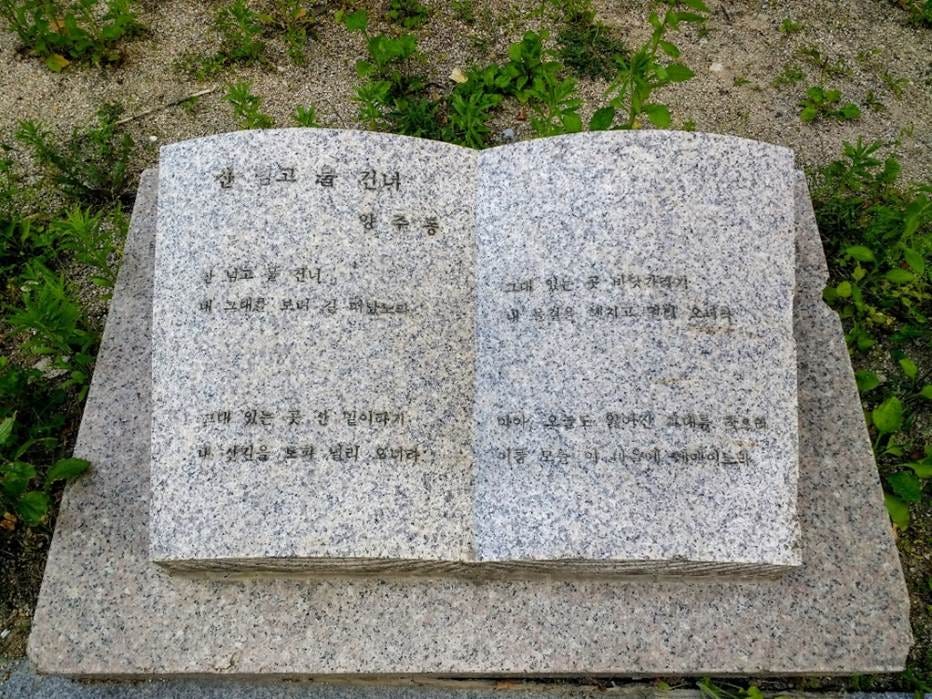
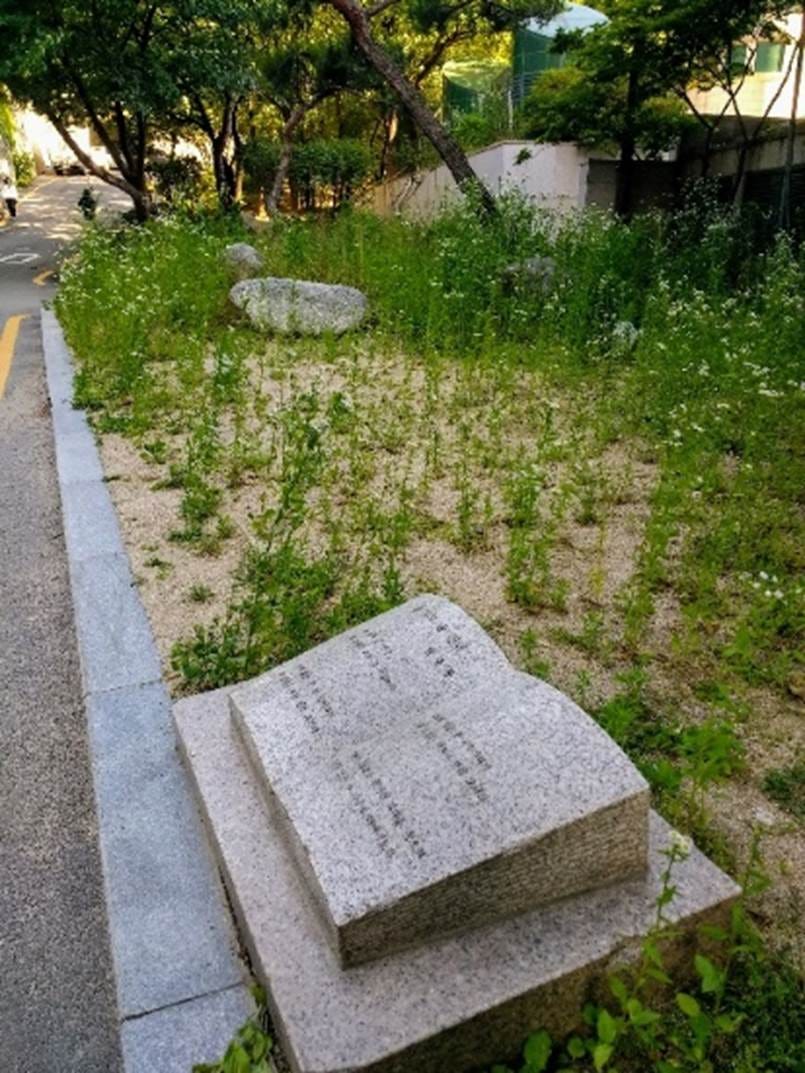
This stone monument honors Yang Ju-dong (1903-1977), whose poem “Over Mountains and Across Waters” (San neomgo mul geonneo) is inscribed on the rock. A poet, professor, and pioneering literary scholar, Yang played a significant role in advancing the study of both Korean and English literature. In his early career, he helped introduce Western literary movements to Korea. Later, he devoted himself to the study of traditional Korean poetry, especially Hyangga and Goryeogayo, preserving and illuminating important works from Korea’s literary heritage. The following is my English translation of the poem.
Over Mountains and Across Waters
by Yang Ju-dong
Over mountains and across waters,
I set out on the road to find you.
They say you live at the foot of the mountains,
so I follow winding paths, coming from afar.
They say you live by the edge of the sea,
so I cross the waves, coming from afar.
Ah, once again today, searching for my lost love,
I wander through this nameless village.
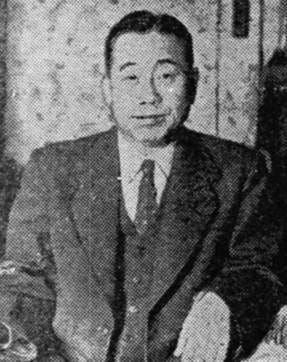
Portrait of poet Yang Ju-dong (1903-1977), December 14, 1959. Photographer: Chosun Ilbo. Public domain in South Korea and the United States. Source: Wikimedia Commons.
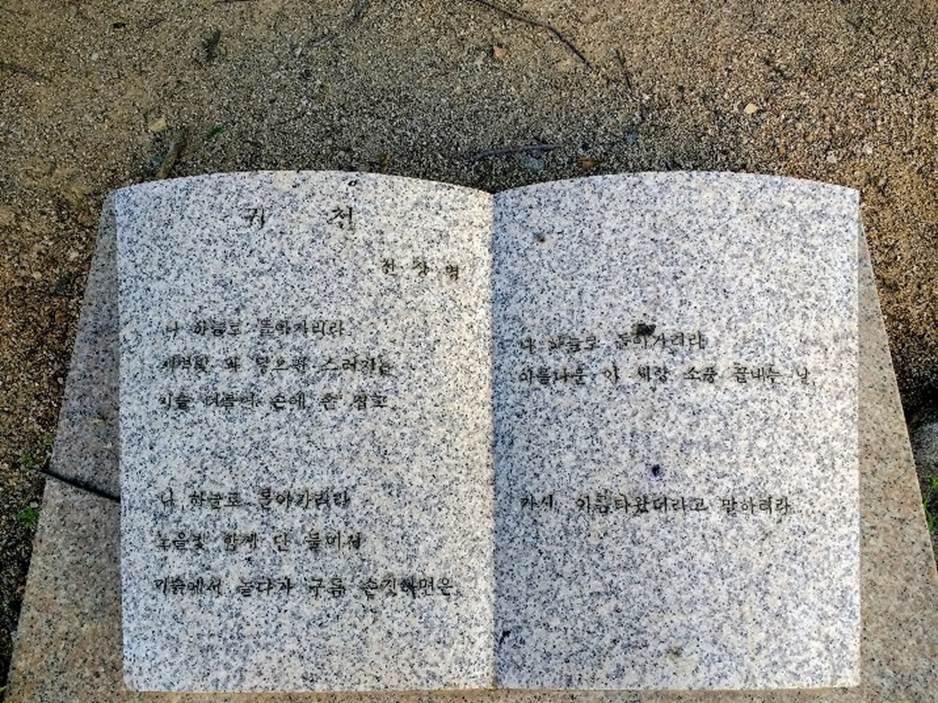
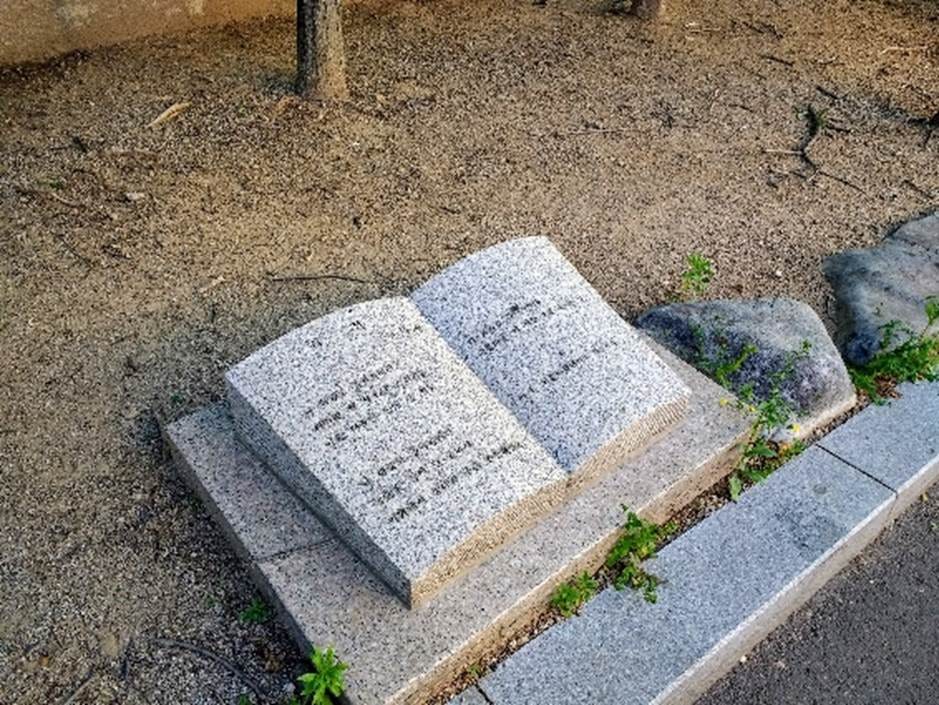
This poetry rock commemorates Cheon Sang-byeong’s (1930-1993) beloved poem “Returning to the Heavens” (Gwicheon, 歸天), one of the most cherished works in modern Korean poetry. Cheon studied at Seoul National University before leaving school and dedicating himself to poetry. In 1967, during South Korea’s military dictatorship, he was falsely accused of espionage in the East Berlin incident and suffered severe torture during his imprisonment, an experience that left lasting physical and emotional scars.
Despite a life marked by hardship, Cheon’s poetry expressed innocence, humility, and a deep sense of gratitude for existence. His wife, Mok Soon-ok (1935-2010), supported him throughout their marriage by operating a traditional tea house named Returning to the Heavens, which became a gathering place for writers and artists. The couple now rests together at Euijeongbu Park Cemetery in Gyeonggi Province. The following is my English translation of Cheon’s most famous poem.
Returning to the Heavens
by Cheon Sang-byeong
I will return to the heavens,
when the dawn’s light touches me,
hand in hand with the fading dew.
I will return to the heavens,
playing with the glow of sunset
as the clouds wave to us by the shore.
I will return to the heavens,
when the beautiful picnic of this world ends,
and I will say, “It was beautiful.”
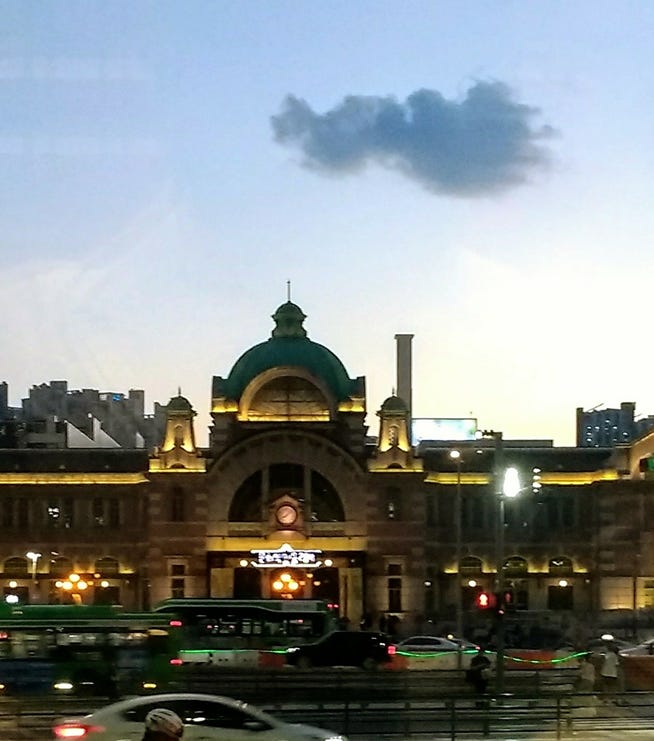
Seoul Station at Dusk. Seoul Station, which was called Gyeongseong Station during the Japanese colonial period, has inspired many modern writers. Among the best-known literary works associated with the station is Pak Tae-won’s (1909-1986) A Day in the Life of Kubo the Novelist (Soseolga Gubossiui ilil, 1934). In this modernist novella, the protagonist wanders through colonial-era Seoul, observing the changing city and its people. He refers to Gyeongseong Station several times, viewing it as a place where the vitality of urban life gathers. A passage reads in English translation:
Seeking a single moment of happiness, Kubo decides to leave Namdaemun, going from the inside to the outside. Yet there, without even a breeze blowing through, the sight of three or four rickshaw carriers huddled on either side looks utterly lifeless.
Kubo feels lonely. He thinks he wants to go somewhere where there are people, somewhere filled with a bustling crowd alive with movement. He looks at Gyeongseong Station before him. Surely, there must be life there. Surely, there must be the breath and emotions of this old Seoul. A city novelist, after all, ought to be familiar with the city’s harbor. But regardless of such professional consciousness, that was not what mattered. All Kubo wanted was simply to escape his loneliness, if he could, among the crowds in the third-class waiting room.
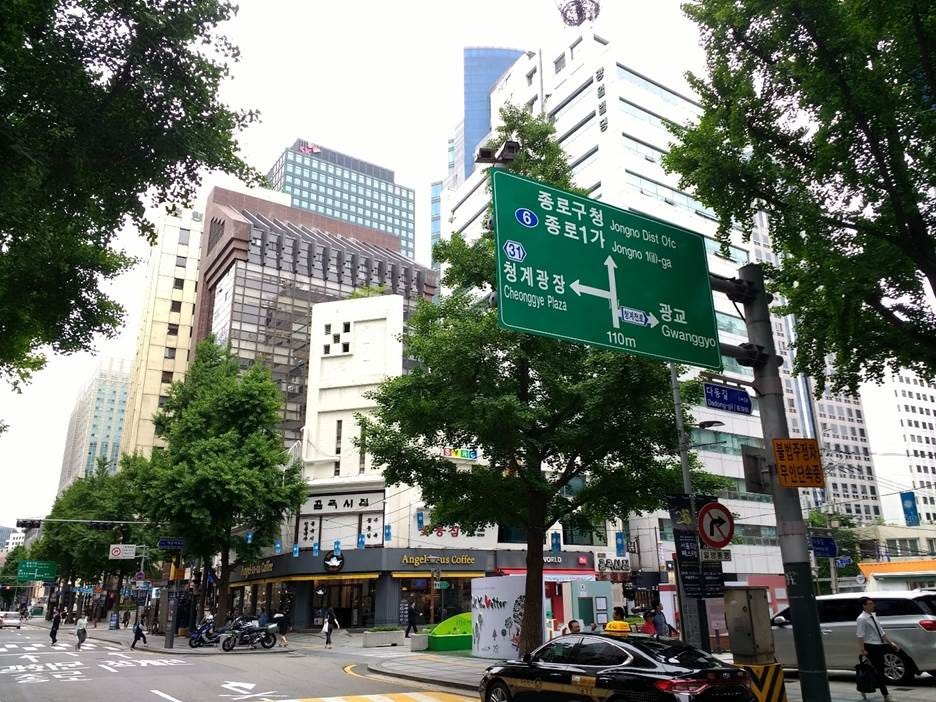
Jongno and Gwanggyo also appear in Pak Tae-won’s A Day in the Life of Kubo the Novelist (Soseolga Gubossiui ilil, 1934). The street sign points toward both locations, connecting the contemporary cityscape with the literary geography of colonial-era Seoul. This area was also part of my professional stomping ground when I was in my twenties. Many memories—lunch outings, taxi rides to pick up manuscripts from university professors, and late-night walks to Gwanghwamun to catch the bus home to western Seoul—flooded back as I wandered through this district in May 2018.
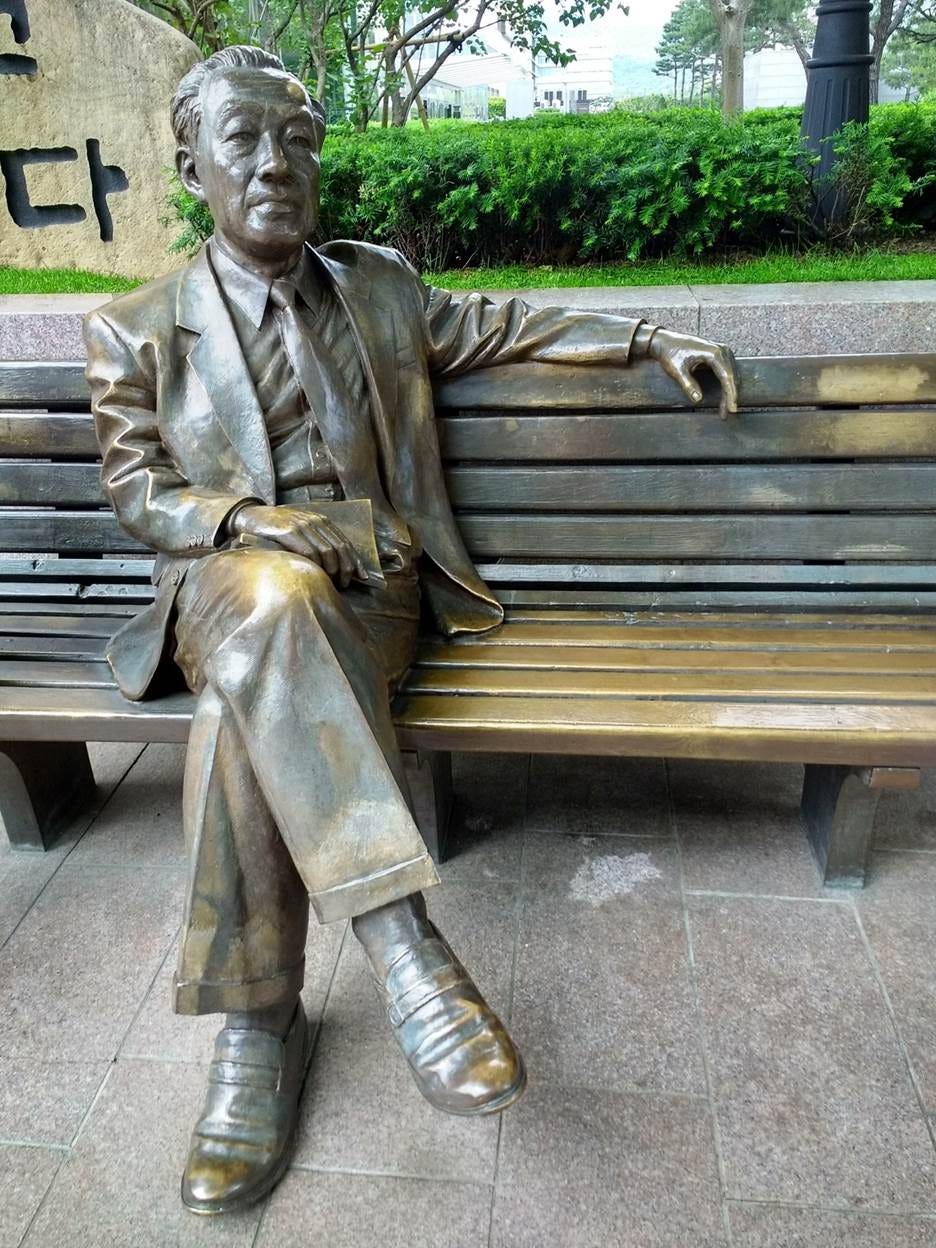
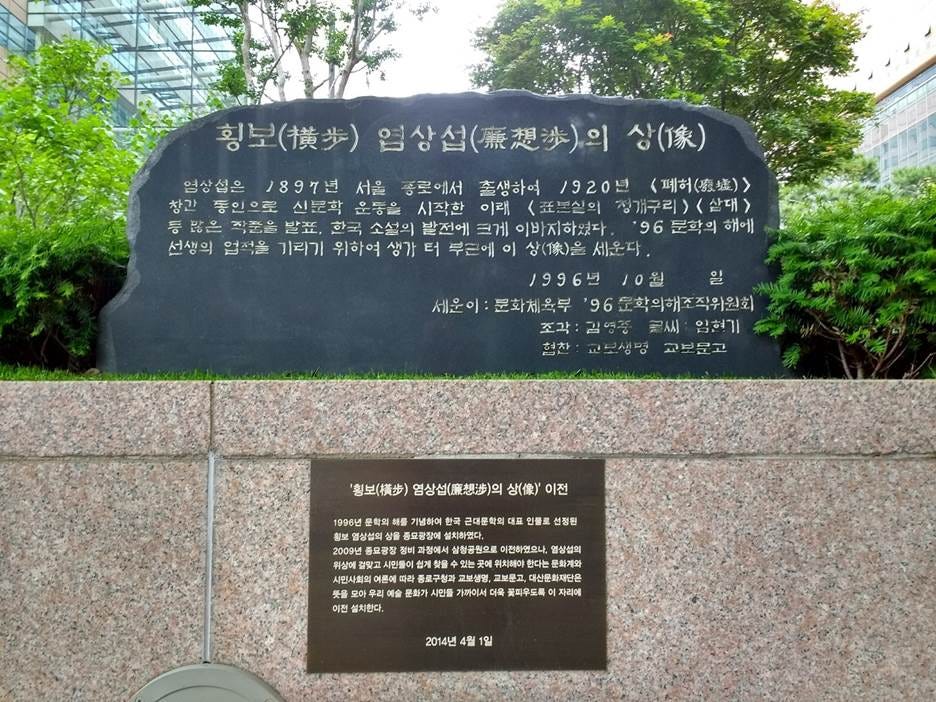
Yeom Sang-seop: Pioneer of Modern Korean Realist Fiction. This statue honors Yeom Sang-seop (1897-1963), one of the most influential writers of modern Korean literature. Born in Jongno, Seoul, Yeom helped shape the development of Korean fiction through works such as “The Frog in the Specimen Room” (Pyobonsil ui Cheonggaeguri, 1921) and Three Generations (Samdae, 1931), establishing realism as a major literary tradition. Originally placed in another part of Seoul, the bronze statue was relocated in 2014 to Gwanghwamun near the site of Yeom’s birthplace and the area where he spent much of his literary career. Sitting on a bench, the statue invites readers and passersby to encounter one of Korea’s great modern writers in the very urban landscape that inspired his work.
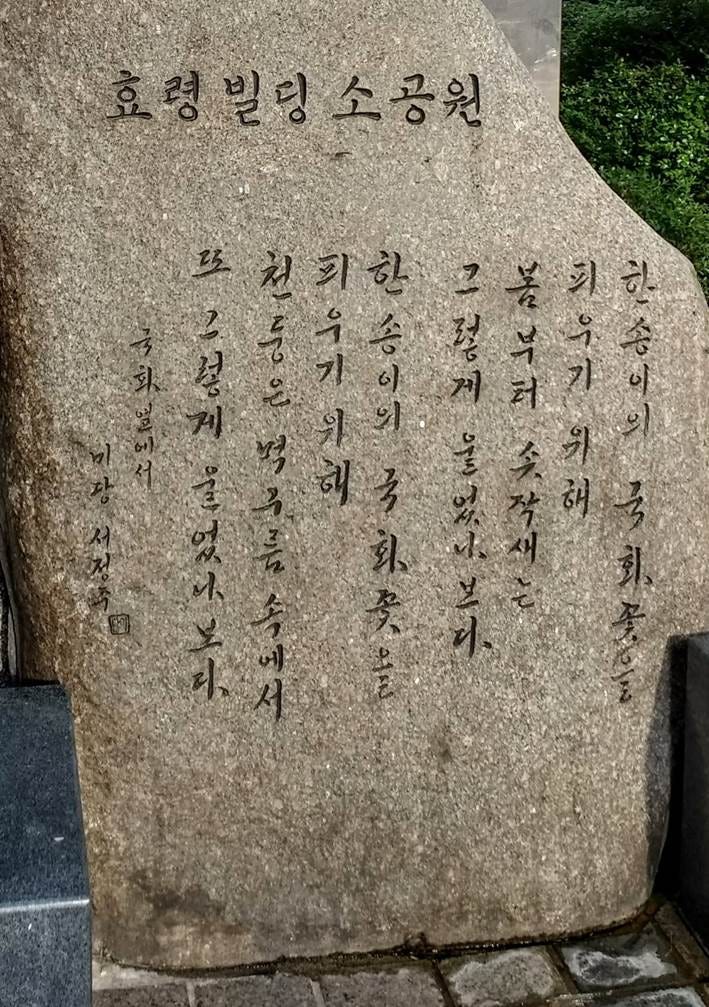
A Monument to Seo Jeong-ju’s “Beside a Chrysanthemum.” In a small garden on the first floor of Hyoryeong Building in Mugyo-dong, Jung-gu, Seoul, stands a stone monument engraved with one of Korea’s most beloved modern poems, “Beside a Chrysanthemum” (Gukhwa yeopeseo, 1947) by Midang Seo Jeong-ju (1915-2000). Widely regarded as one of the greatest Korean poets of the twentieth century, Seo transformed personal emotion, nature, and spiritual reflection into enduring poetic expressions. Located amid the busy streets of central Seoul, this quiet monument allows passersby to encounter a work that has become part of Korea’s literary heritage.
Written shortly after Korea’s liberation from Japanese colonial rule, “Beside a Chrysanthemum” uses the blooming of a single flower as a metaphor for the long process of growth, suffering, and self-discovery. The poet suggests that the chrysanthemum’s beauty is made possible by the hardships that precede it—the cries of birds, the rumble of thunder, the chill of autumn frost, and the passage of time. Blending nature with personal memory, the poem reflects on endurance, loss, and the quiet wisdom that comes with maturity. Widely regarded as one of the masterpieces of modern Korean poetry, it has been included in Korean language textbooks for generations.
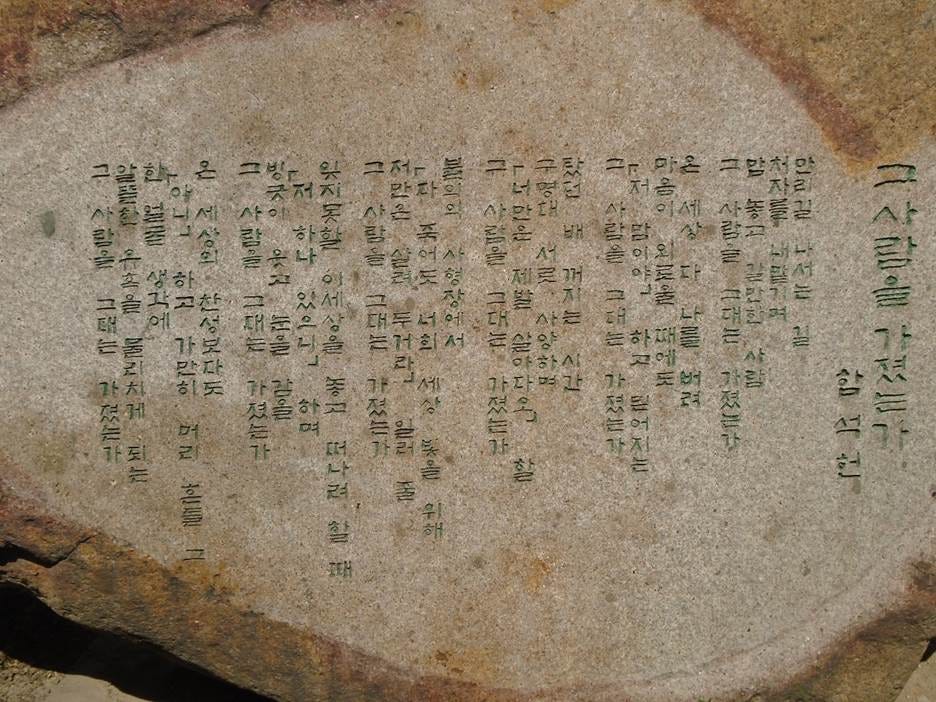
Ham Seok-heon’s “Do You Have Such a Person?” This poetry monument on Daehangno (University Street) in Seoul’s Jongno District honors Ham Seok-heon (1901-1989), one of modern Korea’s most influential public intellectuals. A Christian thinker, independence activist, educator, journalist, and advocate of nonviolent democracy and human rights, Ham devoted his life to truth, freedom, and social justice. His writings, lectures, and civic leadership inspired generations of Koreans to pursue moral courage through peaceful resistance and spiritual renewal.
Engraved on the monument is his poem “Do You Have Such a Person?” (Geu Sarameul Gajyeonneunga), which asks whether one has a friend of unwavering faith, loyalty, and selfless love. Through a series of vivid images, Ham portrays the kind of person who remains steadfast in times of loneliness, danger, sacrifice, and even death. More than a poem about friendship, it is a meditation on trust, integrity, and the enduring strength of human relationships grounded in compassion and moral conviction.
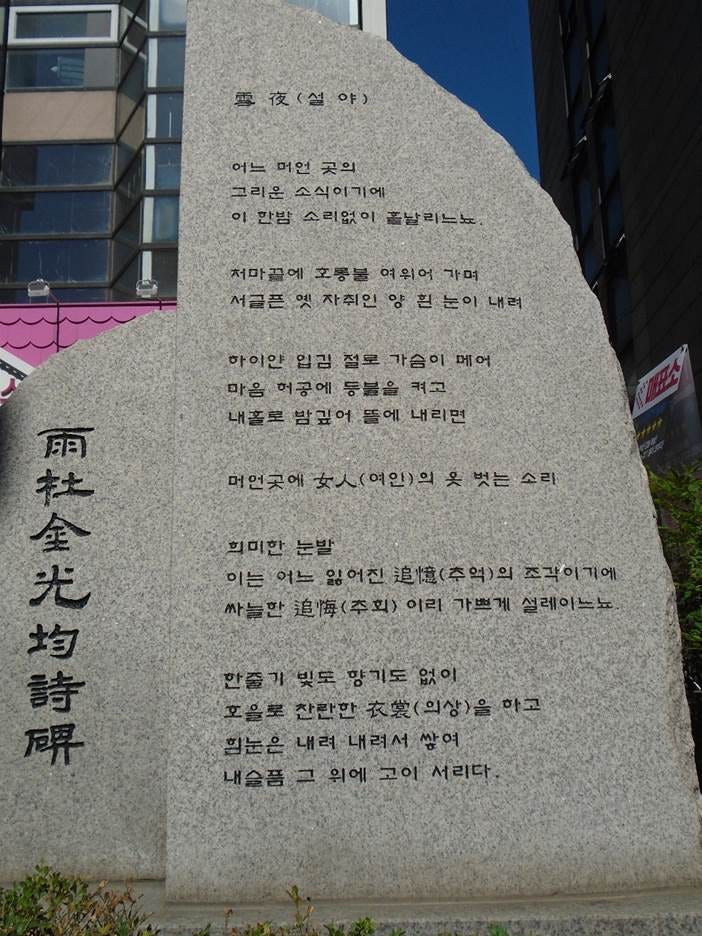
Kim Gwang-gyun’s “Snowy Night.” This poetry monument on Daehangno (University Street) in Seoul’s Jongno District commemorates Kim Gwang-gyun (1914-1993), one of the leading modernist poets of twentieth-century Korea. Influenced by the modernist movement, Kim championed the idea that “poetry is a painting,” creating intellectually rich and visually evocative poems that brought a fresh aesthetic to Korean literature. Although he retired from writing in 1973 to devote himself to business, his poetry continued to influence later generations. In 1990, he received the second Jeong Ji-yong Literary Award in recognition of his lasting contribution to modern Korean poetry.
Engraved on the monument is Kim’s poem “Snowy Night” (Seorya, 1938). Set against the quiet beauty of falling snow, the poem weaves together images of dim lantern light, distant memories, and unspoken longing. Rather than simply describing a winter landscape, Kim transforms the snowfall into a meditation on nostalgia, loss, and the lingering traces of the past. The poem exemplifies his painterly style, inviting readers to experience its imagery as vividly as they would a work of art.
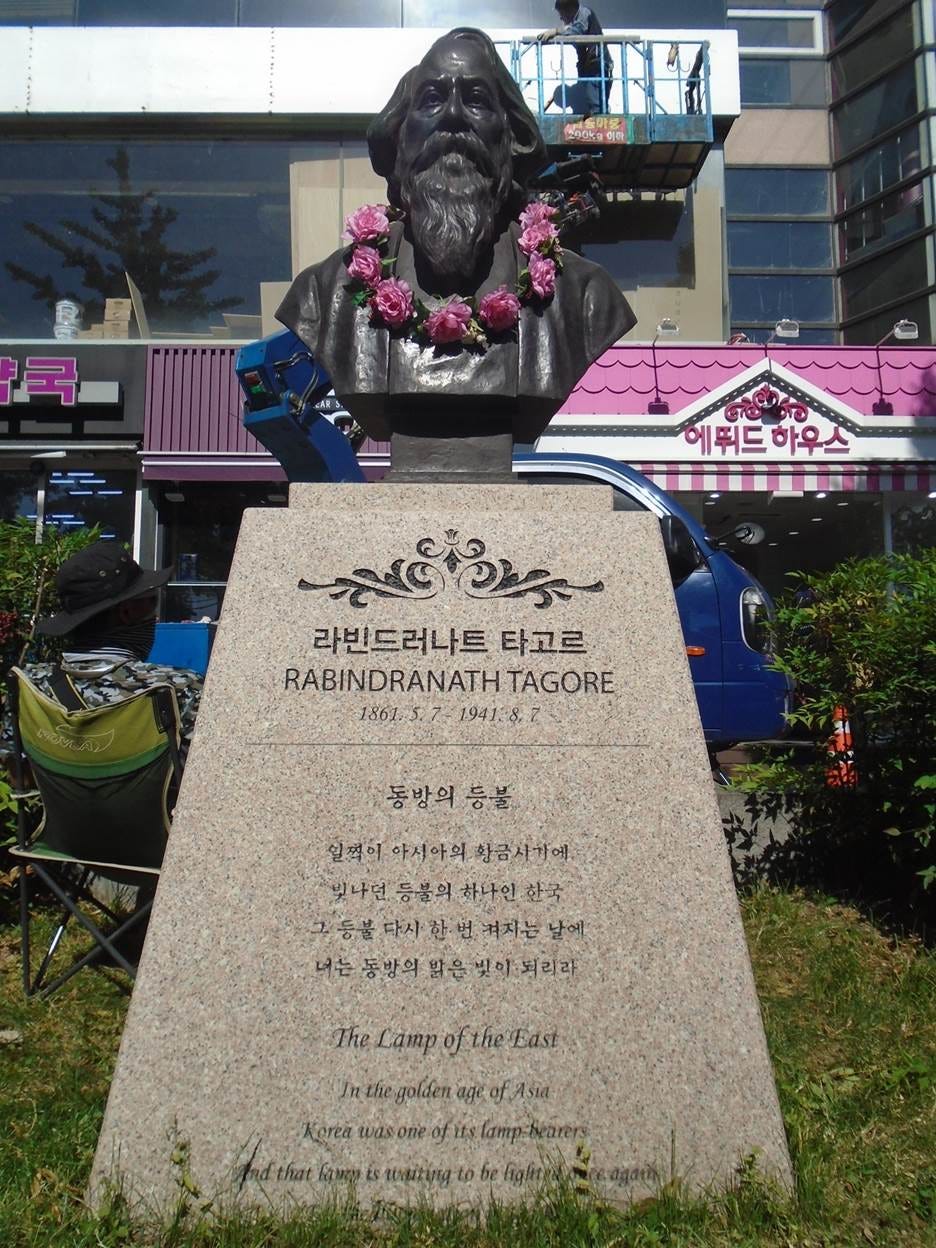
Rabindranath Tagore’s “The Lamp of the East.” Standing near Hyehwa Station on Daehangno (University Street) in Jongno District, Seoul, is a monument honoring Rabindranath Tagore (1861-1941), the Indian poet, philosopher, and Nobel laureate in Literature. Erected in 2011, the monument commemorates Tagore’s connection with Korea during the Japanese colonial period. In 1929, he wrote “The Lamp of the East” (Dongbang ui Deungbul) for Korea, expressing his hope that the nation would once again shine as a source of wisdom and inspiration in Asia.
Published in The Dong-A Ilbo in 1929, the poem offered encouragement to Koreans whose national identity and cultural pride had been suppressed under colonial rule. The monument, with Tagore’s bust and the poem engraved in both Korean and English, serves as a reminder of the solidarity between Asian intellectuals and the enduring power of literature to offer hope.
The Lamp of the East
by Rabindranath Tagore
In the golden age of Asia
Korea was one of its lamp-bearers,
And that lamp is waiting to be lighted once again
For the illumination of the East.
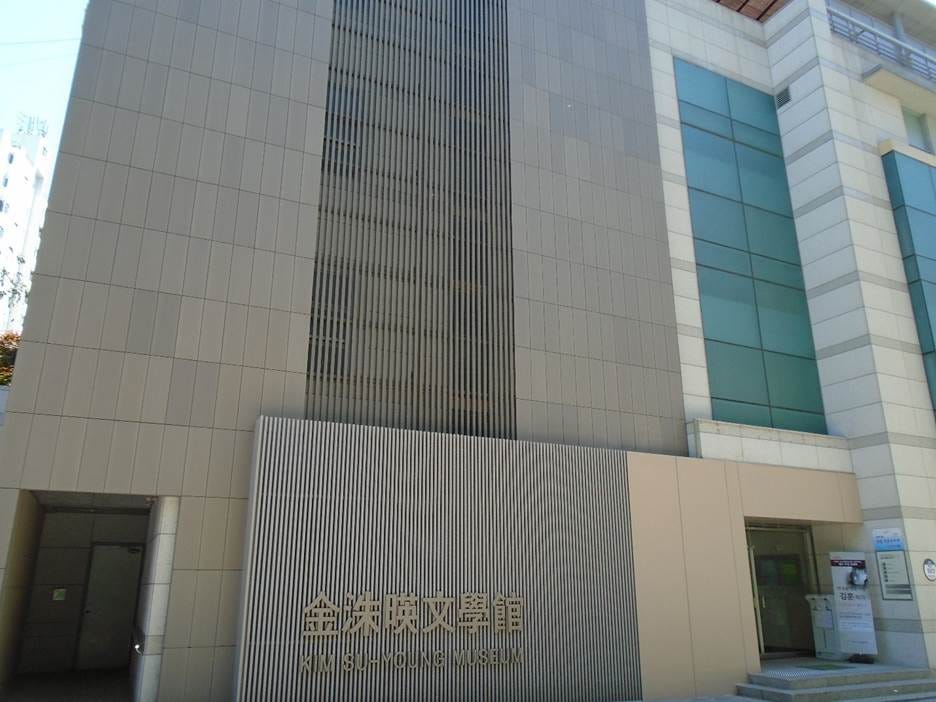
Kim Su-young Literary Hall. Located in Seoul’s Dobong District, Kim Suyeong Literature Hall commemorates Kim Su-young (1921-1968), one of the most influential poets in modern Korean literature. Opened in 2013, the museum preserves the legacy of a writer whose poetry gave powerful voice to freedom, democracy, and the moral responsibility of the individual. Its permanent exhibitions trace Kim’s life from his early modernist experiments to his later poems of social engagement, while manuscripts, photographs, books, and personal artifacts introduce visitors to the creative world behind his enduring works.
Deeply shaped by the Korean War and the democratic aspirations of the April 19 Revolution, Kim transformed poetry into a force for intellectual and civic renewal. His posthumously published essay collection O Poetry, Spit! (Siyeo, Chimeul Baeteora, 1975) remains a landmark of Korean literary criticism. In it, Kim calls on poetry to reject complacency and confront falsehood, injustice, and the realities of modern life with moral courage.
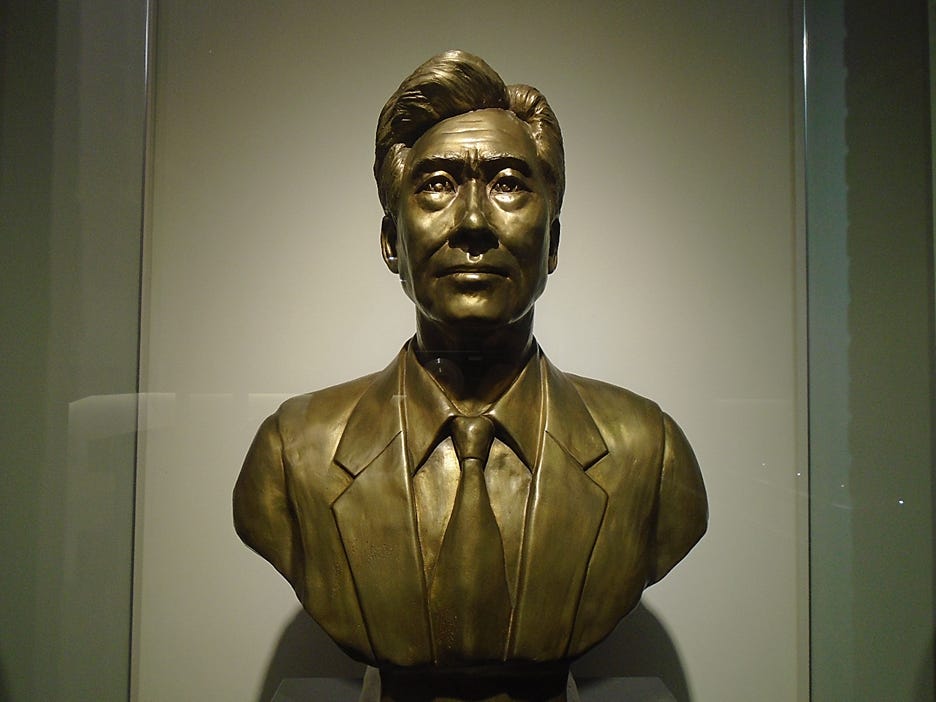
A bust of Kim Su-young welcomes visitors to Kim Su-young Literature Hall, honoring one of the most influential poets in modern Korean literature and his enduring legacy of artistic freedom and social conscience.
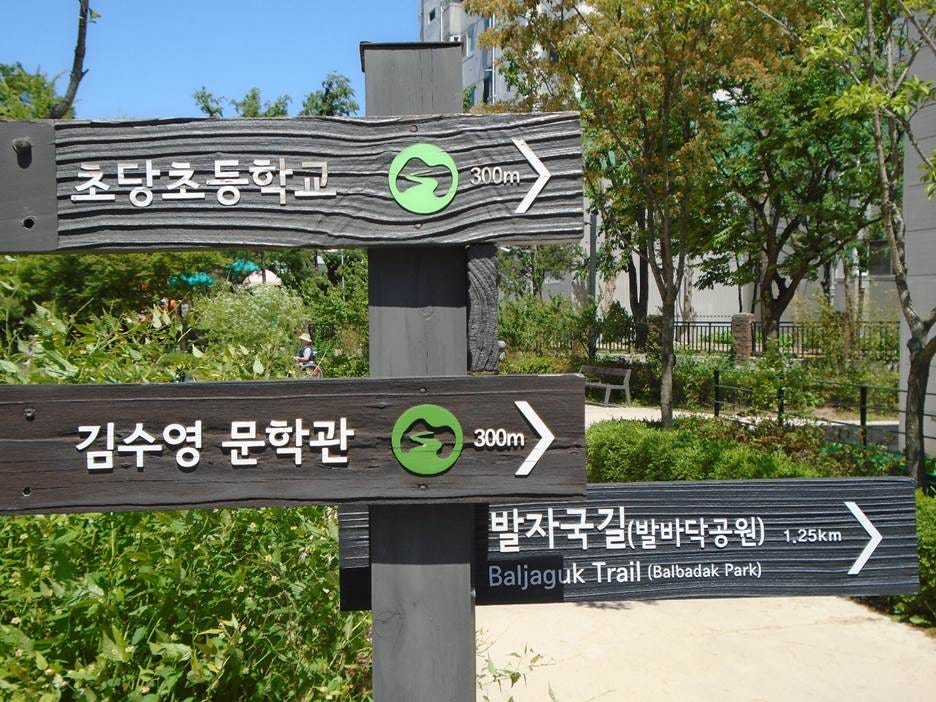
Kim Su-young Literature Hall is located near the Yeonsan Tomb Complex in Dobong District, placing a center dedicated to modern poetry within a landscape rich in Seoul’s historical and cultural heritage.
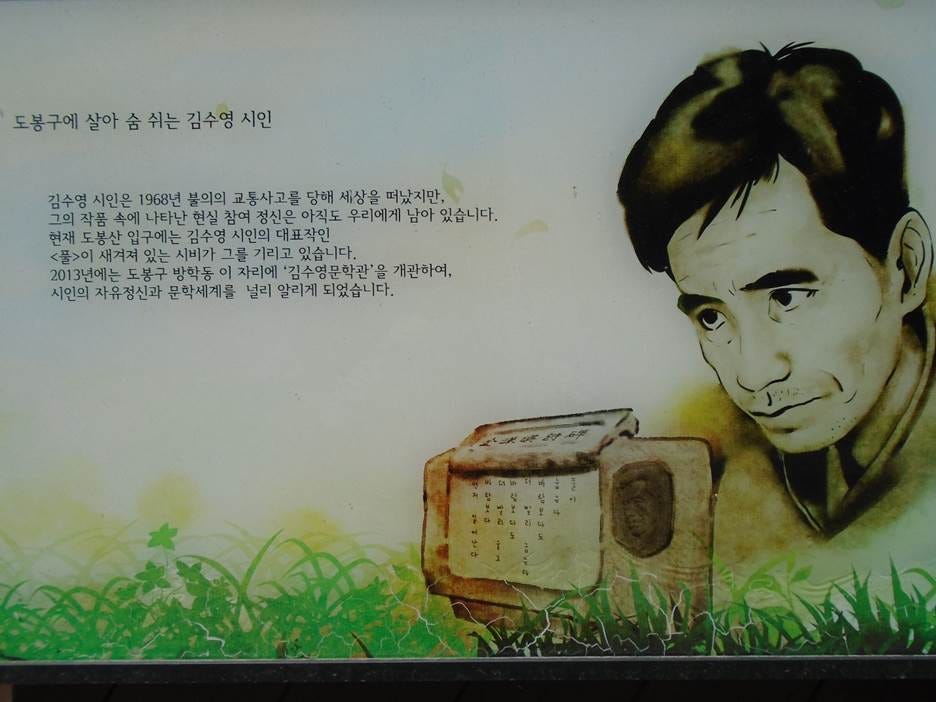
A mural in the surrounding neighborhood introduces Kim Su-young’s life and literary achievements, highlighting his pivotal role in shaping modern Korean poetry through his commitment to freedom, democracy, and moral courage.
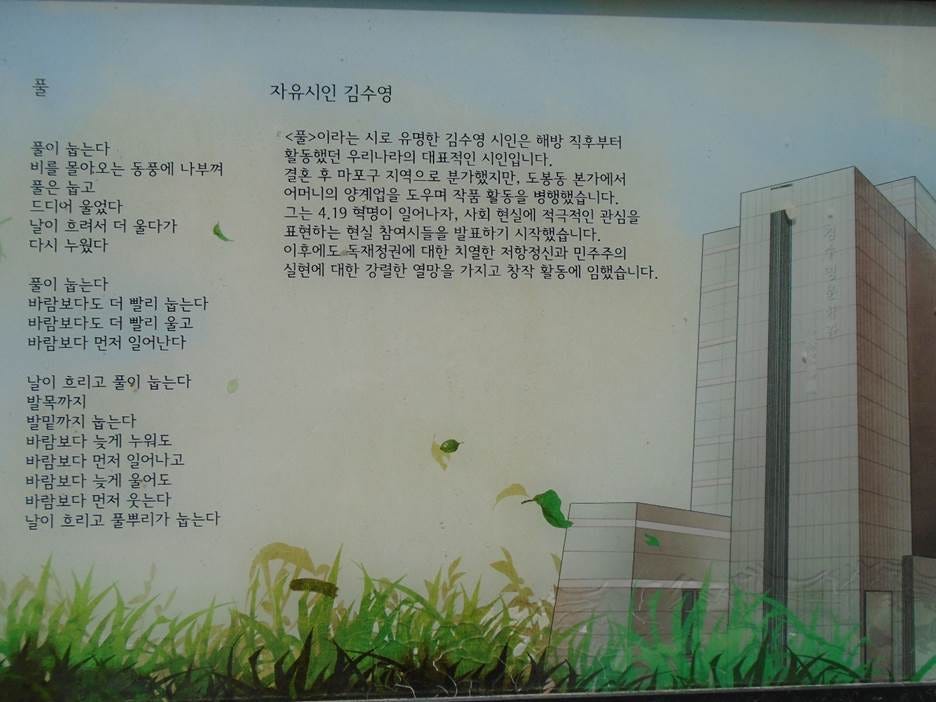
Another neighborhood mural displays the complete text of Kim Su-young’s celebrated poem “Grass” (Pul), written shortly before his death in 1968. One of his finest late poems, it contrasts grass with the wind through the repeated images of bending, rising, weeping, and smiling. Often interpreted as a symbol of the resilience of ordinary people in the face of political oppression, “Grass” has become an enduring expression of perseverance and the human spirit in modern Korean literature.
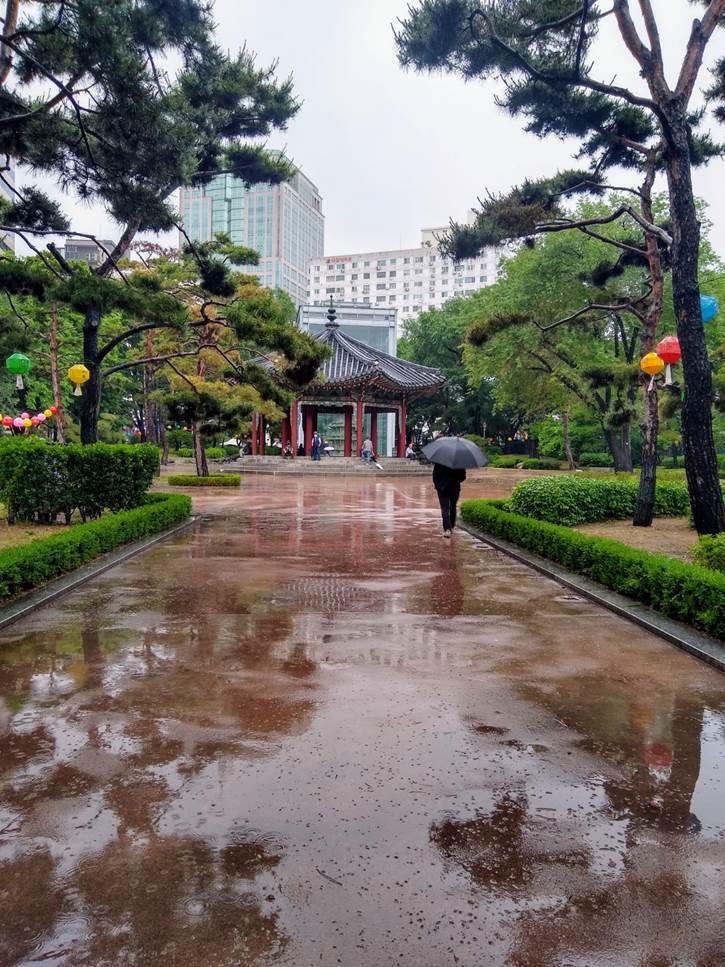
Pagoda Park (Tapgol Park) in Seoul’s Jongno District occupies a central place in Korea’s modern cultural and literary history. Best known as the birthplace of the March First Independence Movement in 1919, the park has long served as a gathering place for writers, poets, intellectuals, and ordinary citizens, appearing in numerous works of modern Korean literature as a symbol of memory, public life, and national identity.
Across Jongno Street from Pagoda Park is the birthplace of the poet Kim Su-young (1921-1968). A small marker now stands near the site, preserving the memory of the place where one of Korea’s most important twentieth-century poets began his life.
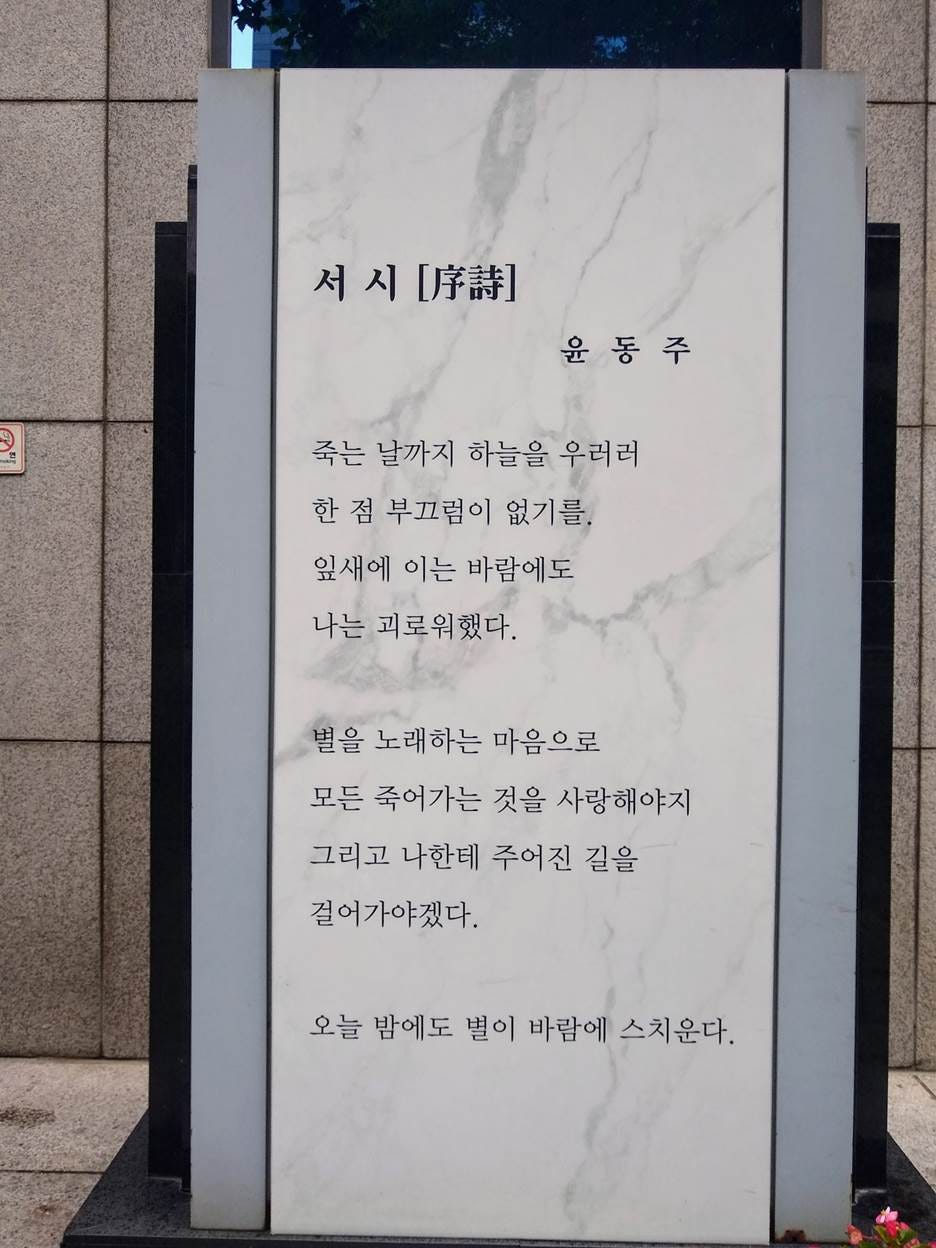
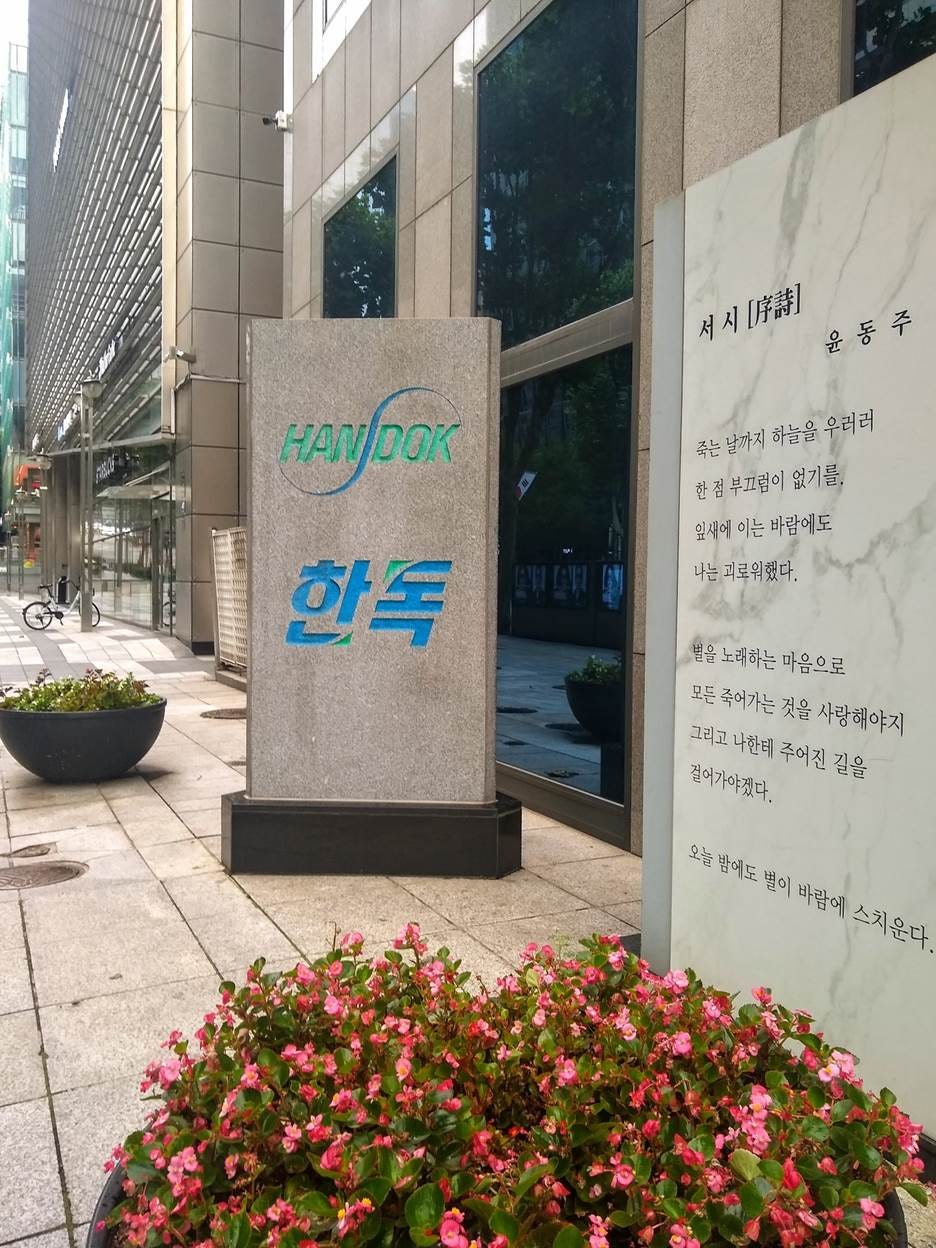
Yun Dong-ju’s “Prologue”: A Poem of Conscience. In front of the Handok Pharmaceutical building near Gangnam Station stands a stone monument engraved with Yun Dong-ju’s (1917-1945) most famous poem, “Prologue” (Seosi, 1941). Although Yun lived a short life and died in a Japanese prison during the colonial period, his poetry has remained deeply cherished for its sincerity, humility, and unwavering commitment to moral integrity.
Written on the eve of Korea’s liberation, “Prologue” (also translated as “Foreword”) expresses the poet’s desire to live without shame while facing the darkness of his time. The monument brings Yun’s quiet voice into the heart of modern Seoul, allowing commuters and visitors to encounter a poem that continues to inspire generations with its message of self-reflection and hope.
About the Author
Professor of English and Creative Writing and Associate Dean of the School of Humanities and Theology, Missouri Baptist University
John J. Han, PhD, is the author, editor, co-editor, or translator of 35 books. His forthcoming book, Echoes from the Hills: Critical Essays on Ozarks Literature (co-edited with C. Clark Triplett), will be published by the University of Arkansas Press. He has also published nearly 3,000 poems in a wide range of journals and anthologies. In addition to his long tenure at Missouri Baptist University, he has taught at Kansas State University, the University of Nebraska–Lincoln, Nebraska Wesleyan University, and Washington University in St. Louis. He has also served as a visiting scholar at Georgia College & State University and the University of Ljubljana in Slovenia.
© K-Global Scholars and Professionals Forum. All rights reserved. Content published in the K-GSP Forum may not be reproduced, distributed, or transmitted in any form without prior written permission from the K-GSP Forum, except for brief quotations with full attribution.