
ABSTRACT
Korea’s growing global influence in culture, technology, business, education, and diplomacy is creating new opportunities and responsibilities for second-generation Korean Americans. This article argues that learning Korean is no longer merely an exercise in heritage preservation but a strategic investment in cultural identity, family continuity, global competitiveness, and engagement with Korea’s evolving role in the world, including the long-term possibility of national reunification. Drawing on research, practical experience, and emerging trends, the article proposes a family-centered and immersion-based approach to Korean language education that integrates conversation, literature, media, cultural participation, and annual experiences in Korea.
Key Words: Korean Language Education; Korean-American Identity; Heritage Language Learning; Korean Soft Power; Global Citizenship
1. Introduction
At a Korean-American community gathering, a successful second-generation professional in his forties reflected on one of his greatest regrets. Although he had earned advanced degrees, built a successful career, and traveled extensively, he could not hold a meaningful conversation with his elderly grandmother in Korea. When she passed away, he realized that decades of family stories, wisdom, and emotional connection had been lost because he never learned Korean well enough to communicate with her. Similar reflections are increasingly common among second-generation Korean Americans who later discover that language is far more than a communication tool—it is a bridge to identity, family continuity, cultural heritage, and belonging (Cho, 2000; Lee, 2002).
This challenge is particularly visible in the United States, where English quickly becomes the dominant language across generations. In contrast, many Korean diaspora communities in countries such as Germany, Brazil, Argentina, Kazakhstan, China, and Japan have maintained stronger heritage-language proficiency through family practices, ethnic schools, community networks, and regular interaction with Korea. At the same time, Korea’s global influence has expanded dramatically through its achievements in technology, business, education, popular culture, and digital innovation. As Korean films, dramas, music, cuisine, and technology gain worldwide recognition, Korean-language proficiency is increasingly viewed not only as a heritage asset but also as a source of cultural, professional, and strategic advantage (Choy & Hong, 2026; Kim, 2001).
The future adds another important dimension. Although the pathway remains uncertain, discussions concerning greater integration or eventual reunification of the Korean Peninsula continue to shape thinking about Korea’s long-term future. Against this backdrop, learning Korean should no longer be viewed merely as an optional cultural activity for second-generation Korean Americans. Rather, it represents an investment in identity, family relationships, cultural literacy, global competitiveness, and preparation for Korea’s evolving role in the twenty-first century. Drawing on research in heritage-language education, immigrant adaptation, and cultural identity, this article proposes practical strategies through which families and communities can help the next generation develop Korean-language proficiency and sustain a lifelong connection to their heritage.
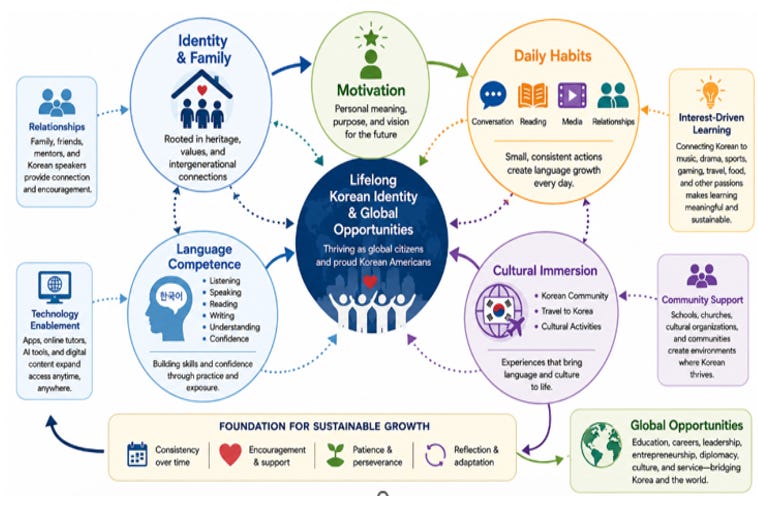
Figure 1 presents an integrated conceptual model showing that sustainable Korean-language development emerges from the interaction of identity, family, daily habits, cultural immersion, motivation, and long-term commitment rather than from formal instruction alone. It illustrates how relationships, technology, community support, and meaningful experiences reinforce one another to create an environment where Korean language and cultural identity can flourish across generations. The model emphasizes that consistent daily practice, supported by families and communities, builds lifelong language competence while preparing the next generation for broader global engagement.
Figure 1. A Sustainable Korean Language Development Model
Source: Authors’ own conceptualization and design, with AI-assisted visualization.
2. Motivational Imperatives for Learning Korean
The decision to learn a heritage language is rarely sustained by obligation alone. Research and practical experience suggest that long-term language retention depends on meaningful motivation rooted in identity, relationships, and future opportunities. For second-generation Korean Americans, the rationale for learning Korean has expanded significantly beyond family expectations. As Korea’s global influence grows, Korean-language proficiency increasingly represents a valuable form of cultural, social, and strategic capital. Three motivational imperatives are particularly important.
2.1. Identity, Family, and Cultural Continuity
Language serves as one of the most powerful carriers of culture, values, memories, and identity. Research consistently demonstrates that heritage-language maintenance strengthens cultural identity, intergenerational communication, and family relationships among immigrant communities (Cho, 2000; Lee, 2002; Park, 2015). For second-generation Korean Americans, learning Korean provides access to family histories, traditions, and relationships that might otherwise be lost across generations.
Many Korean-American parents and grandparents possess life experiences shaped by colonial rule, war, immigration, economic development, and democratic transformation. These stories often contain lessons of resilience, sacrifice, and perseverance that are difficult to communicate fully through translation, making language an essential vehicle for transmitting cultural memory and family wisdom (Cho, 2000; Shin, 2005). When younger generations cannot speak Korean, the transmission of these experiences becomes fragmented, weakening intergenerational bonds and limiting access to valuable personal and historical narratives.
Language also enables a deeper understanding of Korean literature, history, customs, humor, and social norms. While cultural practices can be preserved without language, the ability to engage directly with Korean sources provides a richer and more authentic connection to heritage while fostering a stronger sense of belonging within both Korean and American contexts (Lee, 2002; Park, 2015). For many second-generation Korean Americans, the greatest motivation emerges from the desire to communicate meaningfully with parents, grandparents, relatives, and future generations, making Korean an investment in relationships, identity, and family legacy rather than merely an educational exercise (Cho, 2000; Valdés, 2014).
2.2. Korea’s Rising Global Influence and Expanding Opportunities
The second motivational imperative arises from Korea’s growing global presence. During the past several decades, Korea has transformed itself from a war-torn nation into one of the world’s leading economies and innovators, with globally competitive firms, research institutions, and cultural industries extending their influence across multiple sectors. At the same time, Korean films, dramas, music, cuisine, beauty products, and digital content have attracted worldwide audiences, strengthening Korea’s soft power and increasing international interest in Korean language learning (Choy & Hong, 2026).
As Korea’s economic and cultural influence continues to expand, bilingual Korean Americans possess a distinct advantage in navigating international environments. Bicultural and bilingual individuals are often better positioned to adapt to diverse settings, facilitate cross-cultural collaboration, and serve as bridges connecting Korea with the United States and other nations in business, education, diplomacy, research, media, and cultural exchange (Karimova et al., 2024; Kim, 2001). In a global economy where cultural intelligence, multilingual capabilities, and international engagement are highly valued, Korean increasingly functions as a strategic asset that can create both personal and professional opportunities.
2.3. Preparing for Korea’s Future and Potential Future Integration and Reunification
A third motivational imperative concerns Korea’s long-term future. Although the timing and form remain uncertain, the possibility of greater integration or eventual reunification on the Korean Peninsula continues to shape strategic thinking and highlights the importance of cultivating future generations who can contribute across cultural, economic, and international boundaries.
Should significant changes occur on the Korean Peninsula in the coming decades, Korean Americans with linguistic and cultural competence will be uniquely positioned to serve as educators, entrepreneurs, diplomats, researchers, and cultural ambassadors who help connect Korea with the broader global community. Even apart from reunification, Korea’s future will require globally minded leaders capable of navigating multiple cultures and institutional environments, making Korean-language proficiency a valuable asset for second-generation Korean Americans seeking to build bridges between Korea and the world (Kim, 2001; Karimova et al., 2024).
Taken together, these three motivational imperatives—identity and family continuity, global opportunity, and preparation for Korea’s future—provide a compelling foundation for encouraging second-generation Korean Americans to learn Korean. The challenge is not whether Korean should be learned, but how families, communities, and educational institutions can create environments in which language learning becomes meaningful, sustainable, and rewarding.
Korean is no longer merely a heritage language—it is a strategic asset for identity, global opportunities, and cross-cultural leadership.
3. Challenges, Opportunities, and Practical Expectations
While the case for learning Korean among second-generation Korean Americans is compelling, the process is neither automatic nor easy. Heritage-language acquisition occurs within a complex environment shaped by family dynamics, educational systems, peer influences, and competing demands on children’s time and attention. A realistic assessment requires acknowledging both the challenges and opportunities while establishing attainable expectations.
3.1. Challenges: Why Heritage Language Retention Is Difficult
The primary challenge facing second-generation Korean Americans is the overwhelming dominance of English in daily life. Children spend most of their time in English-speaking schools, communities, social networks, and media environments, making English the natural language of communication, education, and social interaction while reducing opportunities to use Korean regularly (Fishman, 1991; Cho, 2000). Parental constraints further complicate the situation, as many immigrant families lack the time, resources, or confidence to sustain consistent language-learning practices at home, and some intentionally prioritize English to support academic success and social integration (Lee, 2002; Shin, 2005).
Additional challenges arise from the perception that Korean is difficult to learn and has limited practical value, causing many adolescents to question its relevance to their daily lives and future careers. Generational language gaps often emerge when parents communicate in Korean while children respond in English, creating passive understanding without active speaking ability and gradually weakening fluency and confidence (Cho, 2000; Park, 2015). The widespread influence of English-language media and digital entertainment further accelerates this process, making heritage-language attrition a common outcome unless reinforced through motivation, family engagement, and meaningful opportunities for use (Valdés, 2014; Leeman & Showstack, 2022).
3.2. Opportunities: Why the Environment Has Never Been Better
Despite these challenges, today’s environment presents unprecedented opportunities for learning Korean. Unlike previous generations that relied primarily on family conversations or local community schools, contemporary learners can access a vast ecosystem of digital content, educational platforms, and global cultural networks that make Korean more accessible than ever before. The worldwide popularity of Korean music, films, dramas, webtoons, gaming, cuisine, and social media has transformed Korean into a globally visible language while strengthening Korea’s soft power and increasing interest in Korean-language learning among both Koreans and non-Koreans (Choy & Hong, 2026).
Technology and globalization have further lowered barriers to language acquisition by enabling learners to engage with Korean language and culture regardless of geographic location. Online tutoring, language-learning applications, artificial intelligence tools, digital media, and increased opportunities for travel and cultural immersion provide sustained exposure that strengthens language retention and intercultural competence (Kim, 2001; Shin, 2005; Leeman & Showstack, 2022). Moreover, the growing presence of Korean Americans in business, academia, government, healthcare, technology, media, and public service demonstrates that bilingual and bicultural competence can be a significant personal and professional asset in an increasingly interconnected world (Kim, 2001; Karimova et al., 2024).
3.3. Realism: Setting Achievable Goals for the Next Generation
An effective heritage-language strategy requires realistic expectations because overly ambitious goals can discourage both parents and children when progress appears slow. Research on heritage-language development suggests that success is better measured by meaningful communication, cultural engagement, and sustained use rather than by native-speaker fluency or linguistic perfection (Valdés, 2014; Leeman & Showstack, 2022). For most second-generation Korean Americans, the primary objective should be functional bilingualism that enables communication with family members, participation in Korean culture, and maintenance of a lifelong connection to their heritage (Cho, 2000; Lee, 2002; Park, 2015).
Research further demonstrates that modest but consistent effort often produces stronger long-term outcomes than intensive but short-lived programs (Fishman, 1991; Shin, 2005). Daily conversation, regular reading, interaction with Korean speakers, media consumption, and periodic visits to Korea gradually build confidence and proficiency while strengthening family and cultural connections. Although not every second-generation Korean American will achieve native-like fluency, many can attain sufficient competence to strengthen relationships, expand opportunities, and participate meaningfully in Korea’s future through sustained commitment and realistic expectations (Valdés, 2014; Kim, 2001; Leeman & Showstack, 2022).
4. Building Korean Language Competence: A Five-Pillar Framework
Research and practical experience demonstrate that successful Korean-language development depends less on ethnicity, intelligence, or formal instruction than on the interaction of motivation, relationships, cultural engagement, technology, and long-term commitment (Fishman, 1991; Cho, 2000; Shin, 2005). For second-generation Korean Americans, the challenge extends beyond learning vocabulary and grammar to creating an environment in which Korean becomes meaningful, useful, and personally rewarding through family engagement, social networks, and sustained exposure (Lee, 2002; Valdés, 2014; Leeman & Showstack, 2022).
4.1. Building Foundations Through Family, Relationships, and Daily Engagement
The first two pillars emphasize the importance of relationships and daily exposure as the foundation of heritage-language development. Language is fundamentally a social phenomenon, and heritage languages are most effectively transmitted through meaningful interactions within families and communities (Fishman, 1991; Cho, 2000; Park, 2015). For second-generation Korean Americans, regular communication with parents, grandparents, relatives, and community members provides both linguistic practice and a deeper connection to cultural identity and family history.
Equally important is sustained engagement with Korean books, webtoons, films, dramas, podcasts, and other forms of educational and cultural content. Research shows that vocabulary acquisition, listening comprehension, and cultural understanding improve significantly when learners are exposed to large amounts of meaningful and enjoyable language input over time (Shin, 2005; Leeman & Showstack, 2022). Many successful Korean-language learners developed proficiency not through intensive formal instruction alone but through consistent daily exposure, demonstrating that regular engagement with Korean language and culture often produces stronger long-term outcomes than sporadic study.
4.2. Connecting Korean to Interests, Communities, and Real-World Experiences
The third and fourth pillars focus on motivation and immersion, recognizing that language learning is most sustainable when connected to personal interests and meaningful experiences. Many successful Korean-language learners initially developed their interest through Korean music, dramas, films, gaming, cuisine, sports, travel, or technology, and their enjoyment motivated them to invest substantial time in listening, reading, and interacting with Korean-language content (Choy & Hong, 2026; Kim, 2001). This principle is particularly relevant for Korean-American youth because language learning becomes more engaging and sustainable when it supports existing passions rather than being perceived solely as a parental expectation or cultural obligation.
Community participation and immersion further strengthen motivation by transforming Korean from an academic subject into a living language associated with relationships, activities, and cultural belonging. Korean churches, cultural centers, youth organizations, community schools, festivals, and digital communities provide opportunities for authentic language use, while contemporary technologies enable learners to access Korean content and communicate across national boundaries regardless of location (Kim, 2001; Leeman & Showstack, 2022). Combined with periodic visits to Korea and other immersion experiences, these opportunities create a powerful ecosystem in which personal interests, community engagement, technology, and real-world interactions reinforce long-term language development and cultural identity (Shin, 2005; Leeman & Showstack, 2022).
4.3. Developing a Long-Term Growth Mindset
The fifth pillar concerns mindset because many heritage-language programs struggle when families expect immediate results or compare learners to native speakers. Research on heritage-language development suggests that successful learners view language acquisition as a long-term journey characterized by gradual progress, repeated exposure, and consistent practice rather than rapid mastery (Fishman, 1991; Shin, 2005; Leeman & Showstack, 2022). Small habits such as daily conversation, regular reading, and ongoing engagement with Korean media often produce stronger long-term outcomes than intensive but short-lived periods of study.
For most second-generation Korean Americans, the realistic goal is not perfect fluency but functional bilingualism that enables meaningful participation in family, community, and cultural life (Valdés, 2014; Park, 2015). Success means being able to communicate with relatives, understand Korean media, engage in Korean communities, and maintain a lifelong connection to Korean culture while developing confidence in cross-cultural settings (Cho, 2000; Lee, 2002). Together, the five pillars demonstrate that successful Korean-language development depends less on extraordinary resources than on consistent exposure, meaningful relationships, personal relevance, and long-term commitment, enabling future generations to preserve their heritage while participating confidently in an increasingly interconnected world (Kim, 2001; Leeman & Showstack, 2022).
Learning Korean strengthens family continuity today while preparing the next generation to contribute to Korea’s future tomorrow.
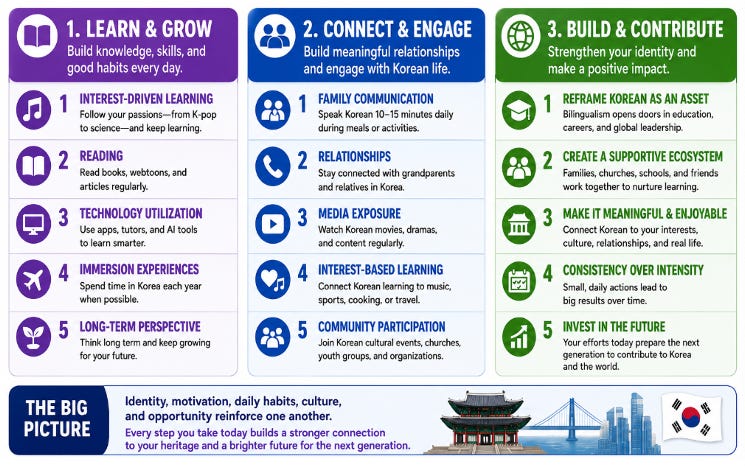
Figure 2. A Practical Framework for Sustainable Korean Language Development
Source: Developed by the authors based on heritage-language education literature and practitioner experience.
Figure 2 translates the conceptual model into a practical five-pillar framework by organizing actionable strategies around family engagement, meaningful relationships, cultural immersion, technology, and a long-term growth mindset. It demonstrates how everyday practices—including family communication, media exposure, community participation, immersion experiences, and realistic expectations—collectively strengthen Korean-language proficiency and cultural continuity. The framework provides families, educators, and community organizations with a clear roadmap for transforming motivation into sustainable habits that prepare younger generations to contribute confidently to both Korea and the global community.
Collectively, these recommendations suggest that successful Korean-language development requires neither extraordinary resources nor perfect conditions. What matters most is consistent exposure, meaningful relationships, personal relevance, and long-term commitment. Families that cultivate these conditions can help the next generation preserve their heritage while preparing them to participate confidently in Korea’s future and an increasingly interconnected global society. Language learning begins at home. Families that intentionally create opportunities for conversation, reading, cultural engagement, and visits to Korea provide an environment where Korean becomes a living language rather than an academic subject. Small, consistent investments made over many years often produce the most lasting results.
5. Conclusion
Korea’s growing global influence in culture, technology, business, and international affairs has transformed Korean-language proficiency from a heritage option into a valuable strategic asset for second-generation Korean Americans. While challenges to heritage-language retention remain significant, the experiences of successful Korean learners worldwide demonstrate that meaningful motivation, supportive relationships, consistent exposure, and long-term commitment can produce sustainable results. The practical framework presented in this article offers families, educators, and community leaders a clear roadmap for strengthening Korean language competence while deepening cultural identity and intergenerational connections. By investing in Korean language development today, the next generation can be better prepared to contribute to Korea’s future, serve as bridges between cultures, and participate confidently in an increasingly interconnected global society.
References
Cho, G. (2000). The role of heritage language in social interactions and relationships: Reflections from a language minority group. Bilingual Research Journal, 24(4), 369–384.
Choy, B. G., & Hong, P. (2026). Soft Power of South Korea in the Digital Age: Reimagining K-Pop, K-Movies, and Cultural Diplomacy through AI-Enabled Diffusion. In Korean Studies in the Artificial Intelligence Era (pp. 178-209). CRC Press.
Fishman, J. A. (1991). Reversing language shift: Theoretical and empirical foundations of assistance to threatened languages. Multilingual Matters.
Karimova, B., Ailauova, Z., Nurlanbekova, Y., & Bazylova, B. (2024). Cultivating students’ cross-cultural and linguacultural competences’: Navigating challenges and opportunities. Journal of Social Studies Education Research, 15(3), 400-423.
Kim, Y. Y. (2001). Becoming intercultural: An integrative theory of communication and cross-cultural adaptation. Sage Publications.
Lee, J. S. (2002). The Korean language in America: The role of cultural identity in heritage language learning. Language, Culture and Curriculum, 15(2), 117–133.
Leeman, J., & Showstack, R. (2022). The sociolinguistics of heritage language education. In The Routledge handbook of second language acquisition and sociolinguistics (pp. 328-340). Routledge.
Park, S. M. (2015). Heritage language maintenance and identity among second-generation Korean Americans. Journal of Multilingual and Multicultural Development, 36(1), 3–17.
Shin, S. J. (2005). Developing in two languages: Korean children in America. Multilingual Matters.
Valdés, G. (2014). Heritage language students: Profiles and possibilities. In Handbook of heritage, community, and Native American languages in the United States (pp. 27–35). Routledge.
Original Article

Citation: Hong, P.C., Choi, D.S., & Park, P.C. (July 14, 2026). Preparing for Korea’s Future: Why Korean Matters for the Next Generation. K-GSP Forum, pp. 1-11.
ABOUT THE AUTHORS

Distinguished Professor, Dr. Paul Hong (Editor in Chief) — University of Toledo
Paul C. Hong is a Distinguished University Professor at The University of Toledo and an affiliated faculty member of its Asian Studies Program. His research focuses on leadership, national competitiveness, institutional development, Korean studies, and decision-making in the AI era, and he has authored numerous scholarly publications in these areas. As the father of two sons and two daughters and grandfather of six grandchildren who are interested in learning Korean language and history, he is committed to promoting Korean studies for younger generations while bringing a scholar’s perspective to culture, film, and soft power as pathways for understanding identity, heritage, and global influence in the twenty-first century.

Daniel S. Choi
SUPPLY CHAIN MANAGER, HANON SYSTEMS
Daniel S. Choi is a supply chain professional with more than 15 years of experience in container port operations, automotive manufacturing, and warehousing. He holds an MBA in Marketing and an MA in Economics from The University of Toledo, along with APICS CPIM and CLTD certifications. As the father of a son and a daughter who have developed an interest in Korean language and heritage through visits to Korea, he supports efforts to promote Korean language education and cultural understanding among younger generations.

Peter C. Park
ENVIRONMENTAL ENGINEER, CITY OF TOLEDO
Peter C. Park is an Environmental Engineer with more than 25 years of experience serving the City of Toledo. He holds an MS in Chemical Engineering and an MS in Occupational Health from The University of Toledo. In addition to his engineering career, he is currently pursuing certification as a Korean language instructor through the Korean Ministry of Education. Inspired by the interest of his two sons and two grandchildren in learning Korean, he is passionate about helping both heritage learners and non-Korean speakers gain access to the Korean language and culture.
요약: 미래 한국을 준비하며: 왜 다음 세대에게 한국어 교육이 중요한가?
본 논문은 폴 홍(Paul C. Hong), 대니얼 최(Daniel S. Choi), 그리고 피터 박(Peter C. Park)이 함께한 연구로, 한국의 문화·경제·기술·외교적 영향력이 세계적으로 확대됨에 따라 한국어가 단순한 모국어를 넘어 정체성, 가족, 글로벌 경쟁력을 연결하는 전략적 자산으로 자리매김하고 있음을 강조한다.
영어 중심 환경에서 성장하는 미국의 2세 한인들은 가족과의 소통과 문화적 유산을 잃기 쉬운 위험에 처해 있지만, 동시에 세계적으로 높아진 한국의 위상은 한국어를 새로운 기회의 언어로 전환시키고 있다. 본 연구는 한국어 교육을 단순한 언어 습득이 아니라 평생 지속되는 정체성 형성과 글로벌 역량 개발의 과정으로 규정하며, 이를 뒷받침하는 지속가능한 한국어 학습모형(Figure 1)을 제시한다.
논문은 한국어를 배워야 하는 세 가지 동기를 제시한다. 첫째는 가족과 정체성의 계승으로, 부모와 조부모의 삶과 역사, 가치관은 한국어를 통해 가장 깊이 전달되며 언어는 세대를 잇는 핵심적인 문화적 매개체이다. 둘째는 한국의 글로벌 영향력 확대로, K-Pop, K-Drama, 첨단기술, 글로벌 기업의 성장으로 한국어는 국제사회에서 실질적인 경쟁력 자산이 되었으며, 이중언어 능력은 다양한 국제 분야에서 새로운 기회를 창출한다. 셋째는 한국의 미래를 준비하기 위함으로, 한반도의 장기적 변화와 통합 가능성 속에서 한국어와 한국문화를 이해하는 차세대는 한국과 세계를 잇는 글로벌 리더로 성장할 잠재력을 지닌다.
도전과 기회에 관한 논의에서는 미국 사회의 영어 중심 환경, 부모의 시간 부족, 또래 문화, 디지털 미디어 등으로 인해 한국어 유지가 쉽지 않다는 점을 인정한다. 무엇보다 중요한 것은 한국인수준의 완벽한 한국어가 아니라 가족과 자연스럽게 소통하고 한국 문화를 이해할 수 있는 기능적 이중언어 능력이며, 단기간의 집중 학습보다 작은 습관을 오랫동안 지속하는 것이 훨씬 효과적이라고 강조한다.
논문의 핵심적인 실천적 기여는 지속 가능한 한국어 교육을 위한 5대 실행 프레임워크이다. 첫째, 가족과 인간관계를 통해 매일 자연스럽게 한국어를 사용하는 환경을 조성한다. 둘째, 독서·미디어·기술 활용을 통해 일상 속에서 꾸준히 한국어에 노출된다. 셋째, BTS, 스포츠, 게임, 요리, 여행 등 개인의 흥미와 한국어를 연결하는 관심 기반 학습을 활용한다. 넷째, 교회, 한국학교, 문화행사, 한국 방문 등을 통한 문화 몰입과 공동체 참여로 살아있는 언어를 익힌다. 다섯째, 장기적 성장 마인드셋을 바탕으로 작은 습관을 꾸준히 실천함으로써 평생 이어지는 한국어 역량과 정체성을 형성한다(Figure 2).
결론적으로 한국어 교육은 단순한 언어 습득이 아니라 가족의 유산을 이어가고 정체성을 확립하며 글로벌 시대를 준비하는 미래 투자이며, 뛰어난 재능보다는 가족의 관심, 꾸준한 습관, 공동체의 지원, 장기적 관점에서 성공이 이루어진다고 강조한다. 오늘의 작은 한국어 실천이 미래 세대를 한국과 세계를 잇는 “글로벌 한국인”으로 성장시키는 든든한 기반이 될 것이라는 메시지로 논문은 마무리된다.
© K-Global Scholars and Professionals Forum. All rights reserved. Content published in the K-GSP Forum may not be reproduced, distributed, or transmitted in any form without prior written permission from the K-GSP Forum, except for brief quotations with full attribution.