

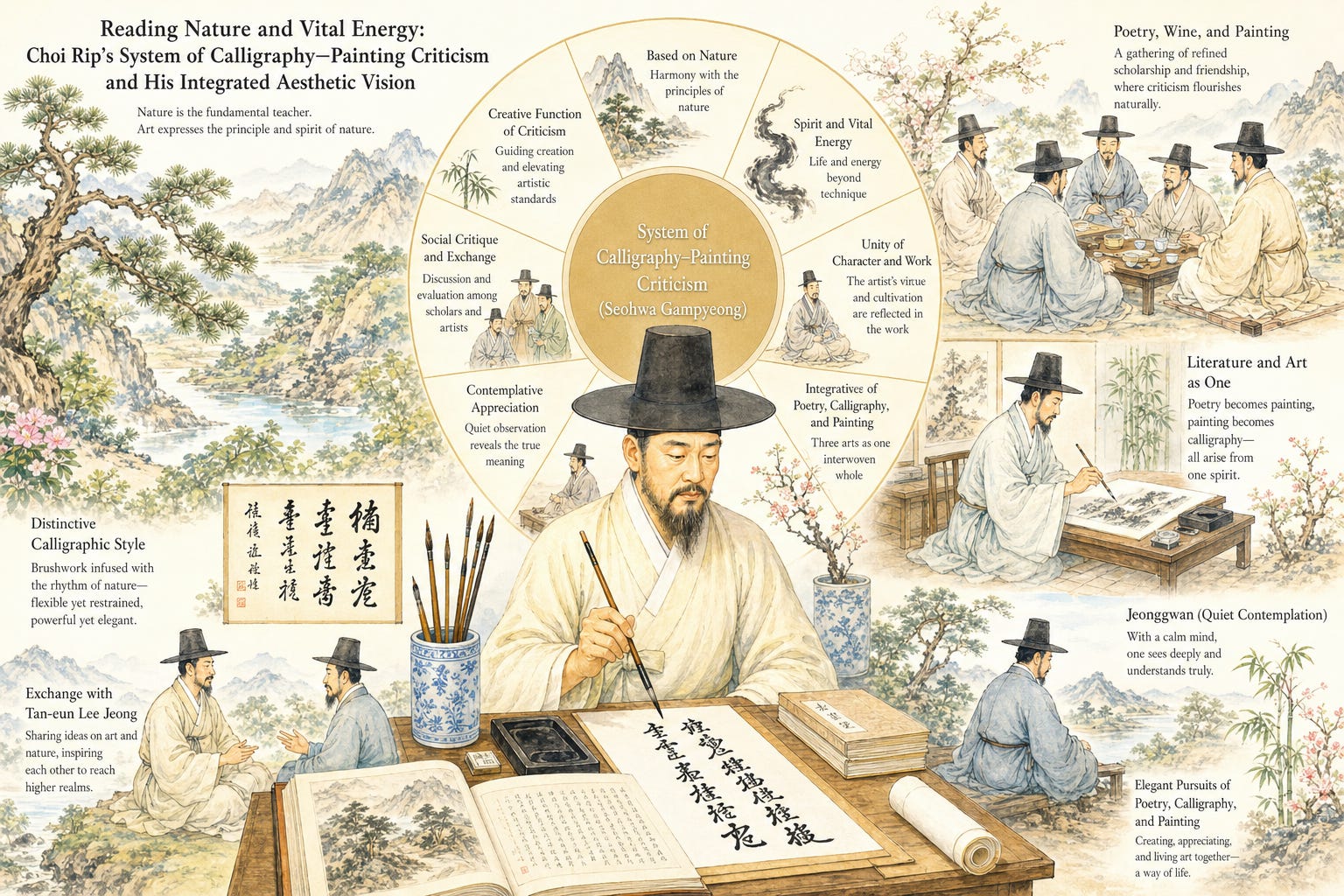
Choi Rip’s aesthetic vision begins with viewing nature not merely as an object of appreciation, but as the fundamental teacher of the human spirit. He discovered within nature the principles of order, change, and harmony, and applied them across literature and the arts. This nature-centered philosophy extended beyond aesthetics to encompass inner cultivation and social order, forming an integrated worldview. For him, art was not the imitation of nature, but the re-creation of its underlying principles through human expression.
Building upon this foundation, Choi Rip established a systematic framework known as the calligraphy–painting criticism system (Seohwa Gampyeong System). Rather than relying on personal taste or authority, he evaluated works based on their alignment with the principles of nature and moral order. This comprehensive system considered not only formal beauty but also spiritual depth and ethical integrity, marking a significant advancement in the intellectual culture of the Joseon period.
He also developed his own distinctive calligraphic style, clearly expressing his artistic identity. His brushwork was not merely technical, but a living expression infused with the flow and energy of nature. The balance of flexibility and restrained strength in his writing visually embodied the harmony between nature and humanity, demonstrating that his theory of criticism was inseparable from artistic practice.
Choi Rip’s artistic world was further enriched through his interactions with Tan-eun Lee Jeong. Their exchanges, grounded in a shared appreciation for nature and art, involved active discussion and critique of each other’s works. These interactions served not only as intellectual companionship but also as a collaborative refinement of aesthetic standards, elevating the artistic culture of their time.
He strongly emphasized the importance of art criticism. For him, true appreciation required penetrating beyond surface beauty to grasp the spirit, energy, and historical meaning embedded within a work. His system institutionalized this role of criticism, guiding creators while deepening the understanding of audiences.
The story associated with the “Poetry and Wine Painting (Siju-do)” vividly illustrates how his aesthetic principles were embodied in everyday life. In gatherings where poetry, wine, and painting converged, art criticism emerged naturally in a free and lively atmosphere. Such settings transformed evaluation into a living, communal practice, dissolving the boundaries between art and life.
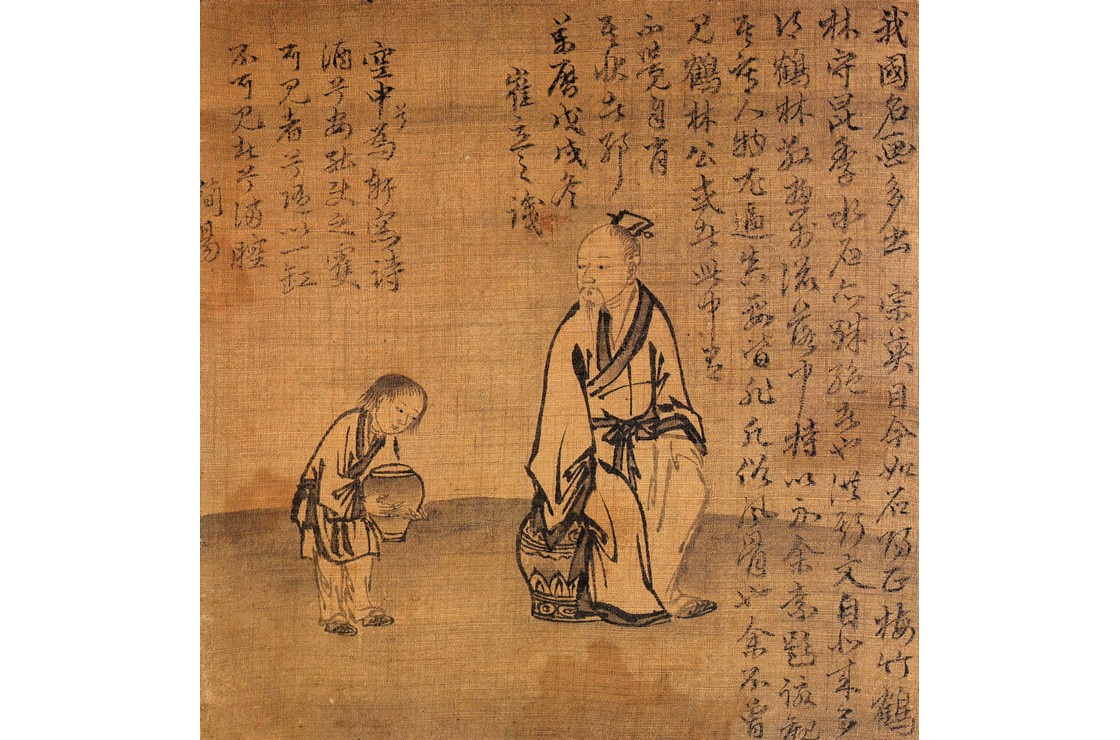
This painting, titled “Poetry and Wine” (Siju-do), is part of a landscape-and-figure album by Yi Gyeong-yun (李慶胤). He was a great-great-grandson of Yi Gwan (李慣, Prince Iseong), the eleventh son of King Seongjong, and was one of the most prominent literati painters of his time.
The painting depicts a scholar dressed in a crane-feather robe (hakchangui), seated on a mound (dun) and gazing at a wine jar supported by a young attendant who bends forward to hold it. The empty background of the composition is densely filled with a colophon and laudatory poem written in elegant calligraphy by Choi Rip (崔岦) in the winter of 1598 (the 31st year of King Seonjo’s reign).
While the natural postures and refined expressions of the figures are remarkable, the brushwork used to depict the folds of their garments is also highly skillful and fluid.
[Source: Korea Database Agency]
For Choi Rip, literature and art were inseparable. Poetry became painting, and painting returned to writing, forming a unified artistic continuum. His criticism system reflected this integration by evaluating poetry, calligraphy, and painting as interconnected expressions of a single creative spirit.
His method of appreciation was grounded in “quiet contemplation (Jeonggwan)”. Rather than rushing to judgment, he observed works with a calm and focused mind, allowing their meaning and vitality to unfold naturally. This contemplative approach served as a methodological core of his criticism, enabling profound insight and balanced evaluation.
The elegant practice of creating poetry, calligraphy, and painting together—what may be called a culture of refined artistic leisure—was another essential dimension of his aesthetic life. Through this integrated process, criticism functioned not as a detached judgment but as part of a dynamic cycle of creation and appreciation.
Ultimately, Choi Rip’s aesthetic vision and his system of calligraphy–painting criticism represent a unified framework connecting nature, humanity, art, and society. Through criticism, he clarified the essence of art; through creation, he embodied it; and through intellectual exchange, he expanded its influence. His thought remains relevant today, reminding us that art is not merely expression, but a profound mirror reflecting the human spirit and society. +++
{Solti}
May 1, 2026

Young Choi, PhD is a Professor at Regent University bringing a rare combination of technical expertise and creative spirit to everything he does. A scholar in AI, cybersecurity, and network & telecommunications service management, he has published 38 books including AI and cybersecurity area books, over 200 refereed articles, and over 20 book chapters. Beyond the academy, Dr. Choi is a passionate poet, essayist, and wooden block engraving artist whose reflective writing invites readers to rediscover life’s beauty in quiet contemplation(靜觀). He lives under the motto: “Study hard and give generously without holding back! (열심히 공부해서 아낌없이 남주자 !)”
Published books: https://www.amazon.com/stores/Young-Choi/author/B0DMZ5S6R7?ref=ap_rdr&shoppingPortalEnabled=true