

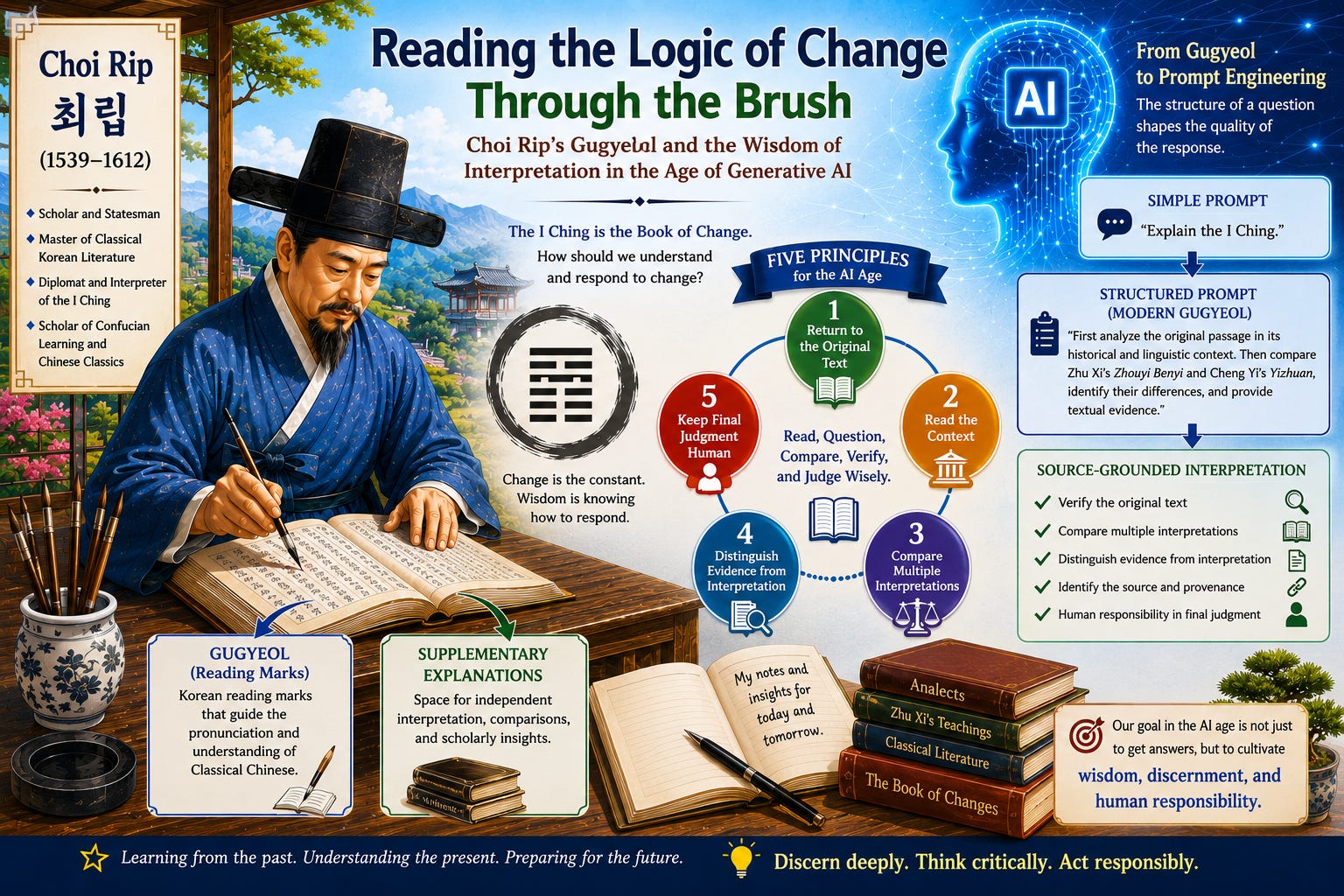
Reading the Logic of Change Through the Brush
Choi Rip’s Juyeok Bonui Gugyeol Buseol (주역본의구결부설 (周易本義口訣附說)) and the Wisdom of Interpretation in the Age of Generative AI
When we think of Gani (簡易) Choi Rip (崔岦, 1539–1612), we often first remember him as one of the great literary figures of the Joseon Renaissance. His prose was powerful, his classical Chinese writing was sophisticated, and his diplomatic writings demonstrated the intellectual and literary capabilities of Joseon Korea. Yet to remember Choi Rip merely as an accomplished writer would be to overlook a significant part of his intellectual world.
Choi Rip also possessed a profound interest in the I Ching (Book of Changes), and this interest produced an important scholarly work, Juyeok Bonui Gugyeol Buseol (주역본의구결부설 (周易本義口訣附說)). The work reveals Choi Rip not simply as a literary master but also as an independent interpreter of classical texts and a scholar of I Ching learning.
According to the Kyujanggak Institute for Korean Studies at Seoul National University, the work applies Korean gugyeol reading marks to Zhu Xi’s Zhouyi Benyi (The Original Meaning of the Book of Changes) and incorporates Choi Rip’s own explanations while consulting Cheng Yi’s Yizhuan (Commentary on the Book of Changes). Several seventeenth-century woodblock editions are preserved in Kyujanggak, and the accompanying preface records Choi Rip’s participation in the Joseon government’s effort to revise and establish a standardized I Ching text (Kyujanggak Institute for Korean Studies, n.d.).
The book therefore allows us to see another Choi Rip.
He was not merely a man who wrote beautiful sentences.
He was a scholar who asked a deeper question:
How should a difficult text be read?
Returning to the Original Text
The I Ching is a book of change.
Heaven and earth change. Yin and yang change. Human circumstances change. Individuals, societies, and nations constantly move from one condition to another.
For this reason, the deepest question of the I Ching is not simply, “What will happen in the future?” It can also be understood as the more fundamental question:
How should human beings understand and respond to change?
Choi Rip approached the classical text with this intellectual seriousness. Rather than merely repeating established commentaries, he worked through Zhu Xi’s Zhouyi Benyi, added gugyeol readings, consulted Cheng Yi’s interpretations, and developed his own explanations (Kyujanggak Institute for Korean Studies, n.d.).
This point is crucial.
The gugyeol provided a method of reading; the supplementary explanations provided a space for thinking.
A classical Chinese sentence can change meaning depending on how it is segmented, how grammatical relationships are understood, and how individual expressions are interpreted within their larger context.
Consequently, Choi Rip’s work should not be viewed merely as an attempt to make a classical Chinese text easier to pronounce in Korean. It can also be understood as an effort to establish a systematic approach to textual interpretation.
He combined reading and interpretation into a single intellectual process.
Choosing Questions Over Authority
One of the most important features of Choi Rip’s scholarship is his courage to question.
Scholarship does not end with memorizing what previous authorities have said.
A great scholar respects tradition but asks again:
“Is this really so?”
“Does the original text actually say this?”
“Could another interpretation be possible?”
“What evidence supports this interpretation?”
Joseon I Ching scholarship developed within a rich tradition of commentaries, particularly those associated with Cheng Yi and Zhu Xi. Recent scholarship on the history of I Ching thought in late Joseon Korea has also examined how interpretations of the I Ching evolved through intellectual lineages involving figures such as Zhu Xi, Yi Hwang, and Jeong Yak-yong (Kim, 2025).
Choi Rip’s Juyeok Bonui Gugyeol Buseol should be understood within this broader intellectual history.
His approach was not necessarily a rejection of tradition. Rather, it represented a form of dialogue with tradition.
Intellectual originality does not require ignoring everything that came before.
It begins by understanding previous knowledge deeply and then asking:
“How do I understand this?”
Reading the I Ching Through the Eyes of a Literary Master
Here we find an important connection between Choi Rip’s literary and philosophical activities.
Choi Rip was a distinguished classical writer. He paid close attention to the structure, rhythm, and subtle meanings of sentences. It is therefore significant that the same sensitivity to language informed his engagement with the I Ching.
He looked at the text itself.
Where does a sentence begin and end?
How does one expression relate to another?
What meaning does a particular word acquire within its context?
How does a particular interpretation correspond to—or differ from—earlier commentaries?
This approach has an intriguing resonance with contemporary hermeneutics.
Recent research on generative AI has begun to examine AI systems not merely as information-retrieval tools but as cultural technologies that participate in processes of interpretation. Kommers et al. (2026), for example, describe computational hermeneutics as an emerging approach that takes situatedness, plurality, and ambiguity seriously when evaluating generative AI.
Across four centuries, the technological environments are radically different, but the underlying question is surprisingly similar:
Where does meaning come from?
From Choi Rip’s Gugyeol to Modern Prompt Engineering
This is where Choi Rip’s concept of gugyeol offers an intriguing conceptual bridge to generative AI.
Gugyeol provided a framework for approaching a complex classical text.
Generative AI likewise responds differently depending on how a question is structured and what contextual instructions are provided.
Consider the difference between asking an AI system:
“Explain the I Ching.”
and asking:
“First analyze the original passage in its historical and linguistic context. Then compare Zhu Xi’s Zhouyi Benyi with Cheng Yi’s interpretation, identify their differences, and provide the textual evidence supporting each interpretation.”
These are fundamentally different intellectual tasks.
The second prompt provides the AI with a reading procedure and interpretive framework.
In this limited methodological sense, one might think of it as a modern “AI gugyeol.”
This comparison should not be understood as claiming that Choi Rip’s gugyeol and modern prompt engineering are historically identical. They emerged in entirely different intellectual and technological environments. Yet the methodological analogy is valuable: both involve establishing structured procedures for approaching complex textual meaning.
Research on generative AI has likewise demonstrated that structured prompting can influence performance on complex reasoning tasks. Wei et al. (2022), for example, showed that chain-of-thought prompting can elicit improved performance on a range of reasoning problems.
The lesson for the AI age is therefore more profound than simply “ask better questions.”
It is:
Design the question itself as an interpretive structure.
From Verifying the Original Text to Verifying AI
Yet one principle must accompany interpretation:
Interpretation requires evidence.
Generative AI can produce remarkably fluent language. But fluency and truth are not the same thing.
Liusie and Gales (2023) demonstrated the importance of detecting hallucinations in large language models—cases in which models generate plausible but unsupported information.
This problem becomes particularly serious in classical-text scholarship.
An AI system might invent a citation, mix different editions, incorrectly attribute an interpretation to a scholar, or produce a quotation that does not actually exist.
Even an elegant interpretation becomes academically dangerous if its textual foundation is false.
This leads to a first principle that modern AI can learn from Choi Rip’s approach:
Before interpreting, verify the original text.
A second principle follows:
Distinguish evidence from interpretation.
A third is:
Identify the source and provenance of the evidence.
These principles resonate with retrieval-augmented generation (RAG). Lewis et al. (2020) proposed RAG as a way of combining language generation with retrieved external knowledge for knowledge-intensive tasks. The approach illustrates a fundamental problem in generative AI: reliable generation requires access to relevant and verifiable sources.
Choi Rip’s return to the original text can therefore be reinterpreted, in the AI age, as a principle of source-grounded interpretation.
Learning from Tradition Without Becoming Trapped by It
Another important lesson from Choi Rip is the balance between tradition and originality.
Ignoring tradition produces shallow scholarship.
But merely repeating tradition produces little intellectual innovation.
Choi Rip consulted Zhu Xi’s Zhouyi Benyi and Cheng Yi’s Yizhuan while adding his own interpretations (Kyujanggak Institute for Korean Studies, n.d.).
This is also highly relevant to contemporary AI.
Generative AI has been trained on enormous quantities of existing knowledge. Its great strength is therefore the ability to synthesize and recombine existing information at extraordinary speed.
But creativity does not consist merely of repeating what already exists.
It emerges through:
comparison,
tension,
recombination,
and the creation of new perspectives.
The foundation-model literature has likewise emphasized that powerful general-purpose AI systems bring not only extraordinary capabilities but also risks involving bias, reliability, misuse, and social impact (Bommasani et al., 2021).
The AI age therefore needs more than more knowledge.
It needs better frameworks for interpreting knowledge.
The Kind of Person Needed in an Age of Change
Why should we read the I Ching today?
Perhaps because we live in an age defined by change.
Artificial intelligence writes.
AI creates images.
AI writes software.
AI translates.
AI assists research.
AI increasingly performs forms of intellectual labor once reserved for humans.
Yet even as technology changes, fundamental human questions remain.
What matters?
What should we believe?
Which decision is right?
How far should technology be used?
And perhaps the deepest question is:
What should human beings become in a changing world?
At this point, the I Ching becomes remarkably contemporary.
Five Principles for Reading in the Age of AI
Choi Rip’s Juyeok Bonui Gugyeol Buseol can be translated into five principles for the age of generative AI.
First, Return to the Original Text
Even when an AI system speaks with confidence, verify the original text and its source.
Second, Read the Context
Do not interpret an isolated sentence without considering its linguistic, historical, and intellectual context.
Third, Compare Multiple Interpretations
Do not automatically treat the first AI-generated answer as the correct one. Compare competing perspectives.
Fourth, Distinguish Evidence from Interpretation
Separate what the source actually says from what a scholar—or an AI system—infers from it.
Fifth, Keep Final Judgment Human
AI can provide information and possible interpretations, but human beings must remain responsible for value judgments and consequential decisions.
Together, these five principles could become the foundation of a Humanistic AI Hermeneutics inspired by Choi Rip’s approach to classical interpretation.
Why Choi Rip Matters Again
Choi Rip matters today not because he predicted artificial intelligence.
He did not know computers.
He did not know the internet.
He could not have imagined generative AI.
Yet he confronted a problem that technology cannot eliminate:
How should human beings read, understand, evaluate, and interpret knowledge?
That question remains.
Indeed, it may be more important now than ever.
AI can process more information than any individual human.
But the quantity of information does not guarantee the quality of judgment.
AI can generate sentences faster than humans.
But fluency does not guarantee truth.
AI can present multiple perspectives.
But deciding which perspective deserves our trust remains a human responsibility.
This is where Choi Rip returns.
He seems to tell us:
“Read—but do not simply believe.”
“Learn from tradition—but think for yourself.”
“Interpret—but never abandon evidence.”
And above all:
“Read change without being swept away by change.”
More than four centuries ago, Choi Rip used a brush to read the I Ching and search for the meaning of change.
Today, we can read the I Ching with generative AI.
The tools have changed completely.
But the essence of responsible scholarship has not.
Return to the original text.
Understand the context.
Compare interpretations.
Ask new questions.
Verify the evidence.
And keep final judgment within the realm of human responsibility.
This may be the enduring wisdom that Choi Rip’s Juyeok Bonui Gugyeol Buseol offers the age of generative AI:
The ancient foundation of a new humanism—one in which intelligence is not merely the ability to generate answers, but the ability to interpret, question, verify, and judge wisely.
References
Bommasani, R., Hudson, D. A., Adeli, E., Altman, R., Arora, S., von Arx, S., Bernstein, M. S., Bohg, J., Bosselut, A., Brunskill, E., Brynjolfsson, E., Buch, S., Card, D., Castellon, R., Chatterji, N., Chen, A., Creel, K., Davis, J. Q., Demszky, D., … Liang, P. (2021). On the opportunities and risks of foundation models. arXiv. https://doi.org/10.48550/arXiv.2108.07258
Kim, Y. (2025). [Article on the historiography and intellectual development of late Joseon I Ching thought]. Korean Journal of Philosophy, 85, 75–101. https://doi.org/10.35504/kph.2025..85.003
Kommers, C., Ahnert, R., Antoniak, M., Benetos, E., Benford, S., Bunz, M., et al. (2026). Computational hermeneutics: Evaluating generative AI as a cultural technology. Frontiers in Artificial Intelligence, 9, Article 1753041. https://doi.org/10.3389/frai.2026.1753041
Kyujanggak Institute for Korean Studies, Seoul National University. (n.d.). Juyeok Bonui Gugyeol Buseol (周易本義口訣附說) [Woodblock editions, Kyujanggak collections]. Seoul National University.
Lee, C. (2012). Two examples of the composition of the method of divination in the I Ching: The divination method of Zhu Xi and Jeong Yak-yong. Semiotic Inquiry, 33, 93–123.
Lewis, P., Perez, E., Piktus, A., Petroni, F., Karpukhin, V., Goyal, N., Küttler, H., Lewis, M., Yih, W.-t., Rocktäschel, T., Riedel, S., & Kiela, D. (2020). Retrieval-augmented generation for knowledge-intensive NLP tasks. Advances in Neural Information Processing Systems, 33. https://doi.org/10.48550/arXiv.2005.11401
Liusie, A., & Gales, M. J. F. (2023). SelfCheckGPT: Zero-resource black-box hallucination detection for generative large language models. In Proceedings of the 2023 Conference on Empirical Methods in Natural Language Processing (pp. 9004–9017). Association for Computational Linguistics. https://doi.org/10.18653/v1/2023.emnlp-main.557
Wei, J., Wang, X., Schuurmans, D., Bosma, M., Ichter, B., Xia, F., Chi, E. H., Le, Q. V., & Zhou, D. (2022). Chain-of-thought prompting elicits reasoning in large language models. Advances in Neural Information Processing Systems, 35. https://doi.org/10.48550/arXiv.2201.11903 +++
{Solti}
August 1, 2026
붓끝에서 변화의 원리를 읽다
간이 최립의 『주역본의구결부설 (周易本義口訣附說)』과 생성 AI 시대의 해석 지혜
조선의 문인 간이(簡易) 최립(崔岦, 1539–1612)을 생각하면 우리는 먼저 뛰어난 문장가를 떠올린다. 그러나 최립을 단지 ‘글 잘 쓰는 문인’으로 기억한다면 그의 학문 세계를 충분히 이해하기 어렵다. 최립에게는 문학만큼이나 깊은 학문적 관심이 있었고, 그 중심에 『주역(周易)』이 있었다.
그 결실 가운데 하나가 바로 『주역본의구결부설(周易本義口訣附說)』이다. 서울대학교 규장각한국학연구원 소장본의 서지자료에 따르면 이 책은 최립이 주희(朱熹)의 『주역본의(周易本義)』에 한글 구결을 붙이고, 『주역본의』와 정이(程頤)의 『역전(易傳)』을 참고하여 자신의 의견을 덧붙인 저술이다. 규장각에는 17세기에 간행된 목판본이 여러 종 전해지고 있으며, 「진주역본의구결소(進周易本義口訣疏)」에는 최립이 1602년 주역 교정청의 작업에 참여한 사실과 1605년에 이르기까지 이 작업을 이어간 과정이 기록되어 있다(서울대학교 규장각한국학연구원, n.d.).
이 책을 바라보는 순간 최립이라는 인물의 모습이 조금 달라진다.
그는 단순히 문장을 잘 쓰는 사람이 아니었다.
그는 텍스트를 어떻게 읽어야 하는가를 고민했던 사람이었다.
원문을 다시 읽는 사람
『주역』은 변화의 책이다.
하늘과 땅이 변하고, 음과 양이 변하고, 인간의 처지가 변한다. 개인의 삶도, 사회도, 국가도 끊임없이 변한다. 그러므로 『주역』의 핵심적인 질문은 단순히 “미래에 무슨 일이 일어날 것인가?”가 아니라, “변화하는 상황에서 우리는 무엇을 어떻게 판단해야 하는가?”라는 질문으로 읽을 수 있다.
최립은 이러한 고전을 읽으면서 기존의 주석을 단순히 반복하지 않았다. 그는 주희의 『주역본의』를 중심으로 구결을 붙이고, 동시에 정이의 『역전』을 참고하면서 자신의 견해를 덧붙였다. 규장각의 해제도 이 책이 바로 이러한 방식으로 구성되었다고 설명한다(서울대학교 규장각한국학연구원, n.d.).
이 점은 중요하다.
구결은 읽기의 방법이고, 부설은 생각의 공간이었다.
한문 원문에 어떤 토를 붙이는가에 따라 문장의 의미가 달라질 수 있다. 문장을 어디에서 끊는가, 어떤 단어를 어떤 관계 속에서 이해하는가에 따라 하나의 구절이 전달하는 의미가 달라진다.
따라서 최립의 구결 작업은 단순히 한문을 한국어로 읽기 쉽게 만드는 작업으로만 이해하기 어렵다. 그것은 텍스트의 의미에 접근하는 하나의 해석 방법이었다.
그리고 그 위에 자신의 설명을 덧붙임으로써 최립은 읽기와 해석을 하나의 학문적 과정으로 결합하였다.
권위보다 질문을 선택하다
최립의 학문적 태도에서 우리가 주목해야 할 것은 질문하는 용기이다.
학문은 앞선 학자의 말을 암기하는 데서 끝나지 않는다.
위대한 학자는 권위를 존중하면서도 다시 묻는다.
“정말 그러한가?”
“원문은 정말 그렇게 말하는가?”
“다른 해석은 가능한가?”
“이 해석은 어떤 근거를 가지고 있는가?”
조선시대 역학은 주희의 『주역본의』와 정이의 『역전』 등 여러 전통적 주석을 중심으로 발전하였다. 최근 조선후기 역학사 연구에서도 주희, 이황, 정약용 등의 사상적 계보와 역학 해석의 변화가 중요한 연구 주제로 다루어지고 있다(김영우, 2025).
최립의 『주역본의구결부설』도 이러한 조선 역학의 흐름 속에서 읽어야 한다.
특히 그는 기존의 해석을 참고하면서도 자신의 의견을 덧붙였다. 이것은 전통을 거부하는 태도라기보다 전통과 대화하는 태도라고 보는 것이 더 적절하다.
학문적 독창성은 아무것도 참고하지 않는 데서 나오지 않는다.
오히려 기존 지식을 충분히 읽은 뒤,
“나는 이것을 어떻게 이해하는가?”
라고 묻는 데서 시작된다.
문장가의 눈으로 『주역』을 읽다
여기에서 최립의 문학과 역학이 만난다.
최립은 뛰어난 한문 문장가였다. 그는 문장의 구조와 표현의 미묘한 차이를 중시했다. 그러한 문장가의 눈으로 『주역』을 읽었다면, 경전의 문장을 단순한 철학적 명제로만 보지 않았을 가능성이 크다.
그는 문장 자체를 보았다.
어떤 단어가 어디에 놓였는가.
앞 문장과 뒤 문장이 어떻게 연결되는가.
하나의 표현이 전체 문맥에서 어떤 의미를 가지는가.
그리고 그 의미가 기존 주석과 어떻게 연결되거나 달라지는가.
이러한 태도는 현대의 해석학과도 흥미롭게 만난다.
최근 생성AI 연구에서는 AI 시스템 자체를 단순한 정보검색 도구가 아니라 ‘맥락을 다루는 문화적 기술’로 바라보는 계산적 해석학(computational hermeneutics)이 제안되고 있다. Kommers 등(2026)은 생성AI의 해석에서 상황성(situatedness), 복수성(plurality), 모호성(ambiguity)을 중요한 문제로 제시하면서, AI 평가 역시 단순한 정답률을 넘어 문화적 맥락과 의미를 고려해야 한다고 주장한다.
수백 년의 시간 차이를 두고 있지만 질문은 놀랍도록 비슷하다.
“문장의 의미는 어디에서 오는가?”
최립의 구결과 오늘날의 프롬트
여기에서 최립의 ‘구결’을 생성AI와 연결해 볼 수 있는 흥미로운 가능성이 열린다.
구결은 복잡한 고전 텍스트를 어떻게 읽을 것인지에 대한 일정한 지침을 제공한다.
생성AI에서도 질문의 형식과 맥락을 어떻게 설계하느냐에 따라 결과가 크게 달라질 수 있다.
예를 들어 AI에게 단순히
“『주역』을 설명하라.”
라고 요청하는 것과,
“『주역』 원문의 문맥을 먼저 분석하고, 주희의 『주역본의』와 정이의 『역전』의 관점을 비교한 뒤, 각각의 해석에 대한 근거와 차이점을 제시하라.”
라고 요청하는 것은 전혀 다른 작업이다.
두 번째 질문은 AI에게 읽기의 규칙과 해석의 절차를 제공한다.
이것은 현대적 의미에서 하나의 ‘AI 구결’이라고 볼 수 있다.
물론 이러한 비교는 역사적 동일성을 주장하는 것이 아니다. 최립의 구결과 현대의 프롬프트는 서로 다른 시대와 기술 환경에서 나온 것이다. 그러나 복잡한 텍스트를 일정한 해석 절차를 통해 이해하려 한다는 방법론적 유사성은 충분히 탐구할 가치가 있다.
생성AI 연구에서도 구조화된 프롬트가 복잡한 추론 과제의 성능에 영향을 줄 수 있음이 연구되어 왔다. Wei 등(2022)은 단계적 추론을 유도하는 chain-of-thought prompting이 여러 추론 과제에서 성능 향상을 가져올 수 있음을 보여주었다.
따라서 최립에게서 우리가 배울 수 있는 현대적 교훈은 단순히 “좋은 질문을 하라”는 정도에 그치지 않는다.
질문 자체를 하나의 ‘해석 구조’로 설계하라.
이것이 중요하다.
원문 확인에서 AI의 사실성 검증으로
그러나 여기에는 반드시 하나의 조건이 따라온다.
해석에는 ‘근거’가 있어야 한다.
생성AI는 매우 유창한 문장을 만들어 낼 수 있다. 하지만 유창함과 진실성은 같은 것이 아니다.
Liusie와 Gales(2023)는 대규모 언어모델이 유창한 답변을 생성하면서도 사실이 아닌 내용을 만들어낼 수 있다는 문제를 지적하고, 이러한 환각(hallucination)을 탐지하기 위한 SelfCheckGPT 방법을 제안했다.
이 문제는 고전문헌 연구에서 더욱 심각해질 수 있다.
AI가 존재하지 않는 문헌을 인용하거나, 서로 다른 판본의 내용을 섞거나, 특정 학자의 견해를 잘못 귀속시키거나, 원문에 없는 구절을 만들어 낸다면 아무리 아름다운 해석이라도 학술적으로는 위험하다.
그러므로 최립의 독법에서 현대 AI가 배워야 할 첫 번째 원칙은 다음과 같다.
“해석하기 전에 원문을 확인하라.”
두 번째는,
“해석과 사실을 구별하라.”
세 번째는,
“근거와 해석의 출처를 밝혀라.”
이는 현대의 retrieval-augmented generation(RAG) 연구가 강조하는 문제와도 연결된다. Lewis 등(2020)은 지식집약적 작업에서 외부 지식을 검색하여 생성 과정에 결합하는 RAG 방식을 제안하면서, 생성 결과의 사실성과 지식의 출처(provenance)를 확보하는 문제가 중요하다고 지적했다.
최립의 ‘원문으로 돌아가기’라는 태도는 이렇게 AI 시대의 source-grounded interpretation으로 다시 읽힐 수 있다.
전통을 읽되 전통에 갇히지 않는 지혜
최립의 또 하나의 중요한 교훈은 ‘전통과 독창성의 균형’이다.
전통을 무시하면 깊이가 사라진다.
그러나 전통을 그대로 반복하면 독창성이 사라진다.
최립은 『주역본의구결부설』에서 주희의 『주역본의』와 정이의 『역전』을 참고하면서 자신의 의견을 덧붙였다(서울대학교 규장각한국학연구원, n.d.).
이것은 현대 AI 연구에서도 중요한 원칙이다.
생성AI는 이미 방대한 기존 지식을 학습하고 있다. 따라서 AI의 강점은 기존 지식을 빠르게 종합하는 데 있다.
하지만 진정한 창의성은 기존 지식을 단순히 반복하는 것이 아니라,
비교하고, 충돌시키고, 재구성하고, 새로운 관점을 만들어 내는 것
에서 나온다.
Foundation model 연구 역시 대규모 사전학습 모델의 강력한 일반화 능력과 함께 편향, 오류, 오용, 사회적 영향 등 다양한 위험을 함께 지적한다(Bommasani et al., 2021).
따라서 AI 시대에 필요한 것은 ‘더 많은 지식’만이 아니다.
‘더 좋은 해석 체계’가 필요하다.
변화의 시대에 필요한 사람
『주역』을 오늘날 다시 읽어야 하는 이유는 무엇일까?
아마도 ‘변화’ 때문이다.
우리는 지금 인류 역사상 가장 빠른 기술적 변화의 시대 가운데 하나를 살아가고 있다.
AI가 글을 쓴다.
AI가 그림을 그린다.
AI가 코드를 작성한다.
AI가 번역한다.
AI가 연구를 돕는다.
AI가 인간의 지적 노동을 보조하고 때로는 대체하기 시작한다.
그러나 기술이 아무리 빨리 변해도 인간에게 남는 질문은 있다.
무엇이 중요한가?
무엇을 믿어야 하는가?
어떤 판단이 옳은가?
기술을 어디까지 사용해야 하는가?
그리고 가장 중요한 질문은 이것이다.
“변화하는 세계에서 인간은 어떤 존재가 되어야 하는가?”
이 질문 앞에서 『주역』은 다시 현대적인 책이 된다.
최립에게서 배우는 AI 시대의 다섯 가지 독법
최립의 『주역본의구결부설』을 오늘날의 생성AI 시대에 적용한다면 다음과 같은 다섯 가지 원칙으로 정리할 수 있다.
첫째, 원문으로 돌아가라
AI가 아무리 확신에 차서 말하더라도 원문과 출처를 확인해야 한다.
둘째, 맥락을 읽어라
한 문장을 고립해서 이해하지 말고 앞뒤 문맥과 역사적 상황을 함께 살펴야 한다.
셋째, 여러 해석을 비교하라
하나의 답변만 정답으로 받아들이지 말고 서로 다른 관점을 비교해야 한다.
넷째, 근거와 해석을 구별하라
“문헌이 말하는 것”과 “연구자가 해석하는 것”을 구분해야 한다.
다섯째, 최종 판단은 인간이 하라
AI가 정보를 제공할 수는 있지만 가치 판단과 책임을 AI에게 완전히 넘겨서는 안 된다.
이 다섯 가지는 최립의 역학적 태도와 현대 AI의 신뢰성 문제를 연결하는 하나의 ‘Humanistic AI Hermeneutics’로 발전시킬 수 있다.
최립은 왜 오늘 다시 필요한가
최립이 오늘날 우리에게 다시 의미를 갖는 이유는 그가 미래의 기술을 예견했기 때문이 아니다.
그는 AI를 알지 못했다.
컴퓨터도 알지 못했다.
인터넷도 알지 못했다.
그러나 그는 인간이 지식을 어떻게 읽고 이해하고 판단해야 하는지에 관한 중요한 질문을 던졌다.
그 질문은 기술이 바뀌어도 사라지지 않는다.
오히려 AI 시대에는 더욱 중요해진다.
오늘날 AI는 우리보다 훨씬 많은 정보를 처리한다.
그러나 정보의 양이 판단의 질을 보장하지는 않는다.
AI는 우리보다 훨씬 빠르게 문장을 만든다.
그러나 문장의 유창함이 진실성을 보장하지는 않는다.
AI는 여러 관점을 동시에 제시할 수 있다.
그러나 어떤 관점을 받아들일 것인지는 여전히 인간의 책임이다.
바로 이 지점에서 최립이 다시 나타난다.
그는 우리에게 말한다.
“읽어라. 그러나 그대로 믿지는 마라.”
“전통을 배워라. 그러나 스스로 생각하라.”
“해석하라. 그러나 근거를 잊지 마라.”
그리고 무엇보다,
“변화를 읽되, 변화에 휩쓸리지는 마라.”
400여 년 전 최립이 붓으로 『주역』을 읽었다면, 오늘 우리는 생성AI와 함께 『주역』을 읽을 수 있다.
그러나 도구가 달라졌다고 해서 독법의 본질까지 달라질 필요는 없다.
원문을 확인하고,
맥락을 이해하고,
기존 해석을 비교하고,
새로운 질문을 만들고,
근거를 검증하고,
마지막 판단은 인간의 몫으로 남겨두는 것.
이것이야말로 간이 최립의 『주역본의구결부설』이 생성AI 시대에 다시 들려주는 오래된 지혜이자 새로운 인간학(Humanistic AI)의 출발점일 것이다.
참고문헌
Bommasani, R., Hudson, D. A., Adeli, E., Altman, R., Arora, S., von Arx, S., Bernstein, M. S., Bohg, J., Bosselut, A., Brunskill, E., Brynjolfsson, E., Buch, S., Card, D., Castellon, R., Chatterji, N., Chen, A., Creel, K., Davis, J. Q., Demszky, D., … Liang, P. (2021). On the opportunities and risks of foundation models. arXiv. https://doi.org/10.48550/arXiv.2108.07258
김영우. (2025). 조선후기 역학사상사 서술을 어떻게 할 것인가? 한국철학논집, 85, 75–101. https://doi.org/10.35504/kph.2025..85.003
Kommers, C., Ahnert, R., Antoniak, M., Benetos, E., Benford, S., Bunz, M., et al. (2026). Computational hermeneutics: Evaluating generative AI as a cultural technology. Frontiers in Artificial Intelligence, 9, Article 1753041. https://doi.org/10.3389/frai.2026.1753041
Lewis, P., Perez, E., Piktus, A., Petroni, F., Karpukhin, V., Goyal, N., Küttler, H., Lewis, M., Yih, W.-t., Rocktäschel, T., Riedel, S., & Kiela, D. (2020). Retrieval-augmented generation for knowledge-intensive NLP tasks. Advances in Neural Information Processing Systems, 33. https://arxiv.org/abs/2005.11401
Lee, C. (2012). 주역 설시법의 두 가지 구성 사례: 주자의 설시법(揲蓍法)과 다산 정약용의 설시법에 대한 기호적 함의 [A example of two kinds of the method of divination in I Ching]. 기호학 연구, 33, 93–123.
Liusie, A., & Gales, M. (2023). SelfCheckGPT: Zero-resource black-box hallucination detection for generative large language models. In Proceedings of the 2023 Conference on Empirical Methods in Natural Language Processing (pp. 9004–9017). Association for Computational Linguistics. https://doi.org/10.18653/v1/2023.emnlp-main.557
서울대학교 규장각한국학연구원. (n.d.). 주역본의구결부설(周易本義口訣附說) [규장각 소장본, 奎4296, 奎4582, 奎5234].
Wei, J., Wang, X., Schuurmans, D., Bosma, M., Ichter, B., Xia, F., Chi, E. H., Le, Q. V., & Zhou, D. (2022). Chain-of-thought prompting elicits reasoning in large language models. Advances in Neural Information Processing Systems, 35. https://doi.org/10.48550/arXiv.2201.11903 +++
2026년 8월 15일
{솔티}

Prof. Dr. Young Choi (Editor in Chief) — Regent University
Young B. Choi is a Professor in the Department of Engineering & Computer Science at Regent University. He published 38 books with ‘Selected Readings in Cybersecurity’ (2018) (over 800 copies archived globally at university/college libraries around the world) and ‘Cybersecurity Applications and Artificial Intelligence’ (2023) available in seven major world languages. He proposed the world’s first global and universal telecommunications “Service Order Handling (SOH)” Model (T-SOH Model) (1995) with Dr. Adrian Tang. With this innovative research work, he received the IEEE NOMS ’96 Best Paper Award and became the first recipient of the Outstanding Contribution Award of the TeleManagement Forum in 1998. His research areas include Natural Language Processing-focused AI, AI-applied cybersecurity, network and telecom service management, and Korean studies on Gani Choi Rip’s Jeonggwan (靜觀: Quiet Contemplation) philosophy and Shilhak ( 實學: Practical Learning).
© K-GSP (K-Global Scholars and Professionals) Forum. All rights reserved. August 2026.
Choi, Y. B. (2026, August 15). Reading the Logic of Change Through the Brush: Choi Rip’s Juyeok Bonui Gugyeol Buseol (주역본의구결부설 (周易本義口訣附說)) and the Wisdom of Interpretation in the Age of Generative AI. K-GSP.