

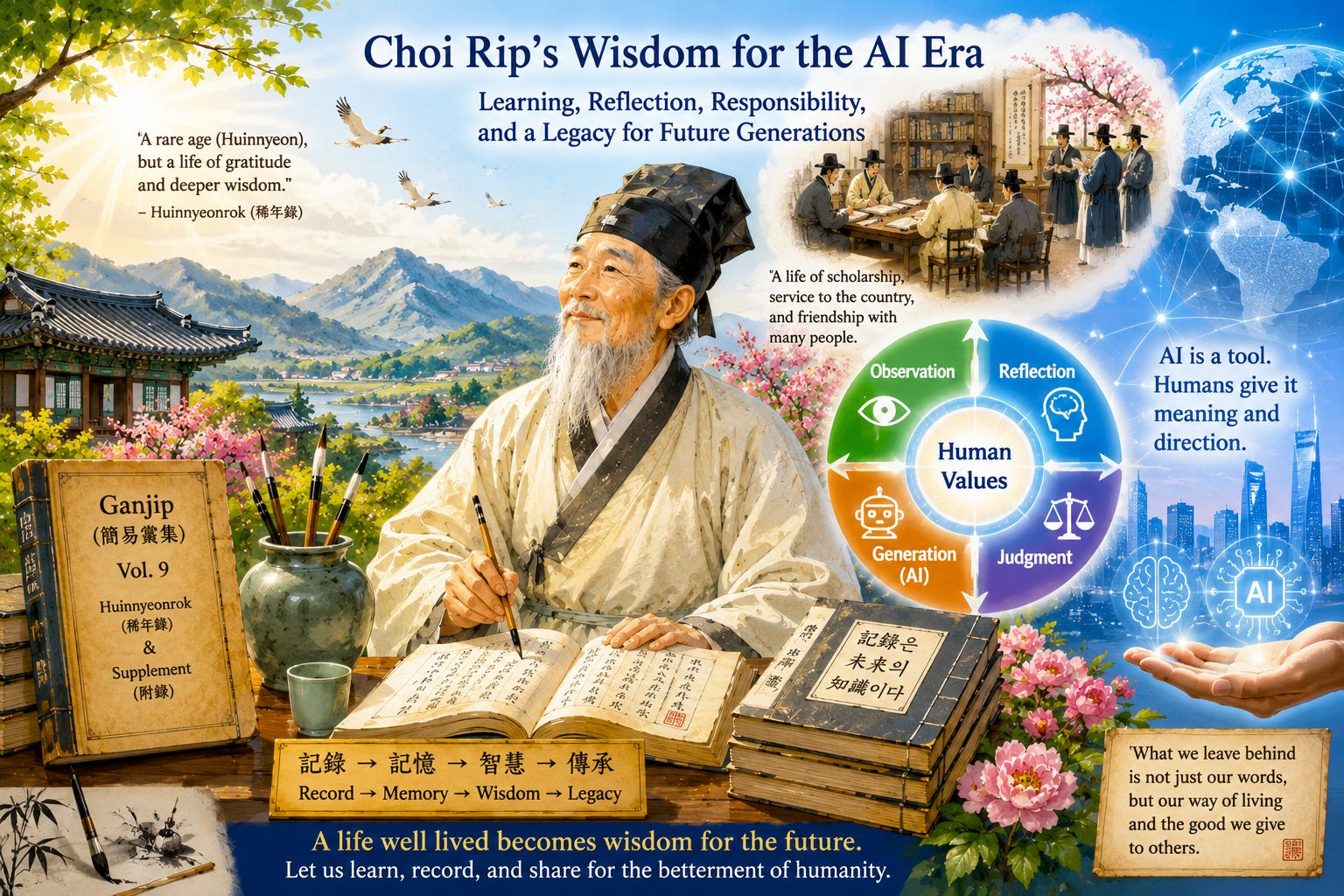
Reading Volume 9 of Korean Translation of Gani-jip: The Moment a Human Life Becomes Data, and Then Wisdom
Rereading Choi Rip’s Huinnyeonrok and Supplement in the Age of Generative AI
Meeting Choi Rip in the Final Volume
Reading Volume 9 of Gani-jip means more than simply reaching the final pages of Choi Rip’s collected works. It is an opportunity to consider how a human life is recorded, remembered, transmitted, and transformed into wisdom for future generations.
Choi Rip (1539–1612) was one of the distinguished scholar-officials and literary figures of the Joseon period. He served in several government positions and was particularly respected for his mastery of classical prose and official writing. During the Imjin War and the political transitions that followed, he also contributed to diplomatic and governmental documents. His literary achievements helped reshape the prose style of his time.
Gani-jip is distinctive among Joseon literary collections. Rather than placing poetry at the center, the collection gives considerable prominence to prose. This arrangement reflects Choi Rip’s long experience producing official, diplomatic, commemorative, and scholarly writings.
When we reach Volume 9, however, the central question naturally changes:
“After living such a demanding and meaningful life, what does a person ultimately leave behind?”
The two major components of Volume 9, Huinnyeonrok and the Supplement, can be read as a final response to that question.
1. Huinnyeonrok: It Is Not About Age, but About the Depth of a Life
The first major section of Volume 9, Huinnyeonrok (희년록 (稀年錄)), invites us to reflect on Choi Rip’s later years and his understanding of life. The traditional expression “huinnyeon” refers to the age of seventy, an age historically regarded as rare and precious.
But the real significance of Huinnyeonrok is not the number seventy.
The important question is:
What did a person learn during those seventy years? Whom did he meet? What did he work for? What did he contribute? And what kind of spirit did he leave behind?
Today, we often think of age simply as a number. Artificial intelligence can calculate a person’s age instantly. Yet calculating the number does not mean understanding the human experiences contained within it.
Seventy years is not simply “70.”
It contains countless choices.
It contains friendships and encounters.
It contains failures and achievements.
It contains years of reading, writing, teaching, serving, reflecting, and growing.
Huinnyeonrok encourages us to see a human life as a cumulative process of experience and wisdom.
2. Choi Rip as a Classical Model of Lifelong Learning
One of the most important characteristics of Choi Rip was his commitment to continuous learning.
He did not regard writing merely as a technical skill. His writings reflected prolonged thought, revision, and careful refinement. Historical evaluations of Choi Rip emphasize that he repeatedly revised his drafts and carefully polished his prose.
Generative AI can produce a paragraph within seconds.
Choi Rip sometimes spent considerable time developing and refining a single passage.
This difference is extremely important.
In the age of Generative AI, the central question should not be:
“How quickly can we produce a piece of writing?”
Instead, it should be:
“What should we think about before asking AI to produce it?”
For Choi Rip, writing was the result of thinking.
Therefore, Huinnyeonrok raises a powerful question for our AI era:
What must human beings continue to learn even when AI can write for us?
The answer is clear:
We must learn judgment more than information, wisdom more than data, and depth more than speed.
3. The Supplement and the Technology of Memory
The latter part of Volume 9, the Supplement (부록 (附錄)), has a different but complementary significance.
If Huinnyeonrok encourages us to look back on an individual life, the Supplement asks us to consider how that life is remembered and preserved by later generations.
When a person dies, his or her physical life comes to an end. Yet writings, ideas, actions, relationships, and the memories preserved by others can continue.
In this sense, a literary collection can be understood as a form of cultural memory system.
Today, we store enormous quantities of data.
We store photographs.
We store emails.
We store videos.
We store social-media posts.
We store documents generated by AI.
Yet storage alone does not create memory.
Data can be stored, but memory requires meaning.
The Supplement of Gani-jip invites us to think carefully about this distinction.
4. Joseon Literary Collections and Today’s AI Databases
Interestingly, there is an unexpected connection between Gani-jip and Generative AI.
Gani-jip is a structured collection of one person’s thoughts, experiences, writings, and intellectual activities.
Generative AI also operates through enormous collections of texts, knowledge, and information.
But there is a fundamental difference.
Gani-jip represents knowledge connected to an identifiable human life, experience, and responsibility.
AI training data, by contrast, can consist of information gathered from an enormous variety of sources.
Therefore, if we were to imagine an AI system learning from Gani-jip, simply learning its vocabulary, characters, and sentences would not be enough.
The AI would need to understand multiple layers:
Text → Context → Experience → Values → Judgment → Wisdom
This is one direction toward truly human-centered AI.
5. Choi Rip Teaches AI About Responsibility, Not Merely Sentence Generation
Choi Rip was not simply a person who knew how to produce elegant sentences.
His writings served important social functions, ranging from diplomatic and governmental documents to epitaphs, biographical writings, commemorative texts, and literary prose.
His writing was connected to real political, diplomatic, and social circumstances.
This provides a crucial lesson for the Generative AI era.
Today, AI can produce reports.
It can draft diplomatic documents.
It can summarize policy papers.
It can analyze legal documents.
But the fact that AI generates a sentence does not mean that AI assumes responsibility for the consequences of that sentence.
For Choi Rip, writing was an action connected to reality.
Therefore, in the AI era, human beings should not merely become users who accept AI-generated sentences.
They should become people who ask:
Who will be affected by these words?
That is the essence of the Human-in-the-Loop (HITL) principle.
6. Huinnyeonrok: Human Memory Matters More Than AI Memory
One of the important themes in contemporary AI development is memory.
AI systems increasingly incorporate memory to personalize interactions and preserve relevant information from previous conversations.
But memory also carries risks.
Remembering everything is not necessarily desirable.
Human beings must decide what should be remembered and what should be forgotten.
Reading Choi Rip’s life encourages us to ask what deserves to be remembered.
Should we remember only his accomplishments?
His official positions?
His most famous sentences?
Perhaps not.
What deserves to be remembered is the spirit with which he lived.
Therefore, future AI systems should not merely ask:
“What should we remember?”
They should also be guided by human values that help us ask:
“Why should we remember it?”
7. Learning from Choi Rip: The Value of “Slow Intelligence”
Generative AI is fast.
We ask a question, and it responds almost immediately.
But a fast answer is not necessarily a good answer.
Choi Rip’s writing process was comparatively slow. He drafted, revised, reconsidered, and refined his thoughts.
In contemporary terms, we might describe this as Slow Intelligence.
Slow intelligence does not mean thinking slowly because one lacks ability.
It means thinking carefully because the issue deserves depth.
In the AI era, humans do not need to become faster than AI.
Instead, we need to become capable of pausing before AI-generated answers and asking:
“Is this really correct?”
“Why is this the case?”
“Who benefits from this?”
“What consequences might follow?”
The human advantage may therefore lie not in producing more answers, but in asking better questions about the answers produced by machines.
8. Choi Rip’s Literary Spirit and Prompt Engineering
Choi Rip’s approach to writing also has an intriguing connection with modern prompt engineering.
A good prompt is not necessarily a long prompt.
It requires a clear purpose.
It requires context.
It requires clearly defined concepts.
And it requires a meaningful description of the desired outcome.
Choi Rip similarly did not simply arrange words randomly. He studied classical prose structures and repeatedly refined his writing. His distinctive literary style became influential enough to contribute to changes in the literary culture of his time.
From this perspective, one lesson from Choi Rip for prompt engineering can be summarized as follows:
Good results begin with good thinking, and good thinking begins with good questions.
Even as AI becomes more sophisticated, this principle will remain important.
9. Observation Before Generation
When Choi Rip’s literary world is reread from the perspective of AI, one particularly important principle emerges:
Observation must come before generation.
AI can easily generate new sentences.
But human beings should first observe the world.
We should observe people.
We should observe events.
We should observe nature.
We should observe social change.
And we should observe our own minds.
Only then should we formulate questions, organize our thoughts, and use AI as a tool.
From this perspective, Volume 9 of Gani-jip can be read as suggesting a valuable sequence of thinking for the AI era:
Observation → Reflection → Judgment → Generation
The message is simple:
Do not let generation replace observation.
10. The Most Important Lesson for Future Generations: A Life Itself Is Data
Today, we frequently use the word “data.”
But the most important data about human beings are not numbers alone.
A person’s experiences are data.
A person’s failures are data.
A person’s choices are data.
A person’s friendships are data.
A person’s beliefs are data.
A person’s entire life can be understood as a rich structure of knowledge.
Choi Rip’s Gani-jip can therefore be understood as a cultural repository preserving the data of a human life.
And Volume 9, at the end of that repository, asks us a profound question:
“What will be recorded about your life?”
This question becomes even more powerful in the age of Generative AI because AI can analyze the traces we leave behind.
The question of what we leave for future generations is no longer merely a personal matter.
It is also a question for digital civilization.
11. Ten Lessons from Volume 9 for the Age of AI
1. Practice lifelong learning.
Knowledge must continually evolve rather than being acquired only once.
2. Think slowly and deeply.
We should not confuse AI’s computational speed with the speed of human understanding.
3. Formulate better questions.
Effective AI use begins with the quality of the questions we ask.
4. Record what matters.
Experiences that are not preserved are difficult to transform into wisdom for future generations.
5. Choose what deserves to be remembered.
Preserving meaningful memories is more important than preserving everything indiscriminately.
6. Take responsibility for your words.
Even when AI generates the text, human beings remain responsible for its use and consequences.
7. Turn knowledge into action.
Learning gains social value when it helps address real-world problems.
8. Value human relationships.
As technology becomes more powerful, trust and human relationships become even more important.
9. Create a meaningful legacy.
The goal should not simply be fame but leaving something valuable behind.
10. Become human before becoming AI-enabled.
Improving human judgment, conscience, and responsibility should come before maximizing AI capability.
12. Choi Rip and Korea’s AI Renaissance
Korea stands at an important turning point in the development of AI.
At this moment, rereading Choi Rip is more than an exercise in recovering traditional culture.
It can become an effort to discover intellectual foundations for a Korean AI Renaissance.
Choi Rip did not simply imitate external intellectual traditions. He studied, adapted, refined, and developed his own literary voice in response to the needs of his time.
That attitude offers an important lesson for Korea today.
Korea should not remain merely a country that consumes AI models developed elsewhere.
We should ask:
“How can Korea’s history, culture, relationships, educational traditions, and intellectual heritage be reinterpreted for the AI era?”
Volume 9 of Gani-jip provides one valuable intellectual resource for beginning that conversation.
The Final Volume Is Not the End, but a New Beginning
Volume 9 of Gani-jip, particularly Huinnyeonrok and the Supplement, is the final section of Choi Rip’s collected works.
Yet paradoxically, this final section opens a new set of questions.
In Choi Rip’s time, the brush and paper were essential tools of knowledge.
Today, Generative AI has become a new instrument for producing, organizing, and connecting knowledge.
But although the tools have changed, the fundamental human values required for a meaningful life have not.
Learning, reflection, responsibility, friendship, recordkeeping, dignity, and wisdom.
These values mattered four hundred years ago, and they matter today.
Choi Rip does not give us a direct answer to the question:
“How should we use AI?”
Instead, he leaves us with a more fundamental question:
“What kind of human being should use AI?”
This may be the greatest value of Volume 9 of Gani-jip in the age of Generative AI.
AI can expand human memory.
AI can assist human writing.
AI can connect human knowledge.
But the responsibility for determining the meaning of human life remains ours.
Huinnyeonrok tells us to reflect on our lives.
The Supplement tells us to preserve and remember those lives.
And the Generative AI era adds one more responsibility:
“Transform memory into wisdom and pass that wisdom to the next generation.”
That may be the most contemporary message Choi Rip can offer us today.
Ultimately, Volume 9 of Gani-jip is not merely the final page of the past.
It is an intellectual bridge showing how human experience becomes wisdom, how wisdom becomes culture, and how culture can teach future forms of intelligence.
And standing on that bridge, we encounter Choi Rip once again.
A literary scholar who held a brush more than four centuries ago quietly asks us:
“What will you learn, what will you record, and what will you leave for the next generation?”
In the age of Generative AI, there may be few questions more important than this one.
References
Choi, Rip. (1999–2002). Korean Translation of Gani-jip (Lee Sang-hyun, Trans.; National Institute of Korean Classics Promotion, Ed.). National Institute of Korean Classics Promotion.
Academy of Korean Studies. (2023). Choi Rip (崔岦). Encyclopedia of Korean Culture.
Knowledge Press. (2008). Gani-jip. Written by Choi Rip and translated by Kim Woo-jung. The volume provides bibliographic and interpretive information concerning the first edition and the structure of Choi Rip’s collected works.
Academy of Korean Studies. (n.d.). Choi Rip (崔岦): Historical and biographical records. Digital resources related to the Annals of the Joseon Dynasty and Choi Rip’s official career and literary activities. +++
{Solti}
July 30, 2026
『국역 간이집』 제9권을 읽고: 한 사람의 삶이 데이터가 되고, 지혜가 되는 순간
생성인공지능 시대에 다시 읽는 최립의 「희년록 (稀年錄)」과 「부록 (附錄)」
마지막 권에서 만나는 최립
『간이집』 제9권을 읽는 일은 최립(崔岦, 1539~1612)의 문집을 마지막 페이지까지 읽는다는 의미 이상의 뜻을 갖는다. 그것은 한 인간의 삶이 어떻게 기록되고, 기억되고, 다음 세대로 전달되는가를 생각하는 일이다.
최립은 조선시대의 대표적인 문신이자 문장가였다. 그는 동지중추부사·강릉부사·형조참판 등을 역임했으며, 임진왜란과 광해군 즉위 무렵에는 외교문서를 담당하는 능문자로 활동했다. 한국민족문화대백과사전은 그가 고문의 형식미를 추구하면서 당시의 평담한 문풍을 변화시킨 인물이라고 평가한다.
그런 최립의 삶을 담은 『간이집』은 매우 독특한 문집이다. 당시 일반적인 문집이 시를 앞세우는 경우가 많았지만, 최립은 산문을 앞에 배치했다. 이는 외교문서와 공적 문장을 오랫동안 담당했던 그의 경험과 글쓰기의 모범을 보여 주려는 의식이 반영된 것으로 평가된다.
그리고 마지막 제9권에 이르면 이야기는 자연스럽게 한 가지 질문으로 향한다.
“그렇게 치열하게 살아온 한 사람은 결국 무엇을 남기는가?”
제9권의 「희년록」과 「부록」은 바로 이 질문에 대한 마지막 답변처럼 읽힌다.
1. 「희년록」은 나이보다 ‘삶의 깊이’를 말한다
제9권의 첫머리를 장식하는 「희년록」은 최립의 만년과 인생에 대한 성찰을 생각하게 하는 부분이다. ‘희년(稀年)’이라는 말 자체가 일흔이라는 나이를 가리키는 전통적 표현이라는 점에서, 이 기록은 단순한 생일의 축하를 넘어 한 생애를 돌아보는 의미를 갖는다.
여기서 중요한 것은 숫자 70이 아니다.
중요한 것은 70년 동안 무엇을 배우고, 누구를 만나고, 무엇을 위해 살았으며, 어떤 정신을 남겼는가이다.
오늘날 우리는 나이를 숫자로 계산한다. 인공지능은 사람의 나이를 쉽게 계산할 수 있다. 그러나 AI가 숫자를 계산한다고 해서 그 숫자 안에 들어 있는 인간의 경험까지 자동으로 이해하는 것은 아니다.
70년은 70이라는 숫자가 아니다.
그 안에는 수많은 선택이 있다.
수많은 만남이 있다.
실패와 성공이 있다.
책을 읽은 시간이 있다.
사람을 설득한 시간이 있다.
나라를 위해 글을 쓴 시간이 있다.
그리고 자신을 돌아본 시간이 있다.
「희년록」은 바로 이러한 삶의 누적성을 생각하게 한다.
2. 최립의 삶은 ‘평생학습’의 고전적 모델이다
최립의 가장 중요한 특징 가운데 하나는 배움을 멈추지 않았다는 점이다.
그는 문장을 단순한 기술로 생각하지 않았다. 실제로 그의 글은 오랜 숙고와 반복적인 수정의 결과였다고 전해진다. 한국민족문화대백과사전은 그가 글을 지을 때 초고를 서너 차례 고치면서 깊이 생각하고 다듬었다고 설명한다.
오늘날 생성AI는 몇 초 만에 문장을 만들어 낸다.
그러나 최립은 한 문장을 만들기 위해 시간을 들였다.
이 차이는 매우 중요하다.
AI 시대의 문제는 “얼마나 빨리 글을 만들 수 있는가?”가 아니라 “무엇을 생각한 뒤 그 글을 만들 것인가?”가 되어야 한다.
최립에게 글쓰기는 사고의 결과였다.
따라서 「희년록」은 생성AI 시대의 우리에게 다음과 같은 질문을 던진다.
AI가 글을 대신 써 주는 시대에도 인간은 무엇을 계속 배워야 하는가?
답은 분명하다.
지식보다 판단을, 정보보다 지혜를, 속도보다 깊이를 배워야 한다.
3. 「부록 (附錄)」은 ‘기억의 기술’을 보여 준다
제9권의 후반부에 있는 「부록」은 또 다른 차원의 의미를 갖는다.
「희년록」이 한 인간의 삶을 돌아보게 한다면, 「부록」은 그 삶을 후대가 어떻게 기억하고 보존하는가를 생각하게 한다.
한 사람이 죽으면 그 사람의 육체적인 삶은 끝난다. 그러나 그 사람이 남긴 글과 생각, 행동과 인간관계, 그리고 다른 사람들이 남긴 기록은 계속 살아남을 수 있다.
이 점에서 문집은 일종의 ‘문화적 기억장치(cultural memory system)’라고 할 수 있다.
오늘날 우리는 엄청난 양의 데이터를 저장한다.
사진도 저장한다.
이메일도 저장한다.
동영상도 저장한다.
SNS 게시물도 저장한다.
AI가 생성한 문서도 저장한다.
그러나 저장한다고 해서 기억되는 것은 아니다.
데이터는 저장될 수 있지만, 기억에는 의미가 필요하다.
『간이집』의 「부록」은 바로 이 차이를 생각하게 한다.
4. 조선의 문집과 오늘날의 AI 데이터베이스
흥미로운 것은 『간이집』과 생성AI 사이에 의외의 공통점이 있다는 사실이다.
『간이집』은 한 사람의 생각과 경험과 글을 체계적으로 모아 놓은 지식의 집합체이다.
생성AI 역시 수많은 문서와 지식을 바탕으로 인간의 질문에 답한다.
그러나 둘 사이에는 결정적인 차이가 있다.
『간이집』은 한 인간의 삶과 책임이 결합된 지식이다.
반면 생성AI의 데이터는 매우 다양한 출처에서 수집된 정보의 집합이다.
따라서 AI가 『간이집』을 학습한다고 가정한다면, 단순히 한자와 문장을 학습하는 것만으로는 충분하지 않다.
AI는 다음과 같은 층위를 함께 이해해야 한다.
텍스트 → 맥락 → 경험 → 가치 → 판단 → 지혜
이것이 바로 인간 중심 AI가 지향해야 할 방향이다.
5. 최립은 AI에게 ‘문장 생성’보다 ‘문장에 대한 책임’을 가르친다
최립의 문학적 특징을 살펴보면 그는 단순히 말을 잘 만드는 사람이 아니었다.
그의 글은 공적인 외교문서에서부터 비문, 묘지명, 서발류, 기서류 등에 이르기까지 다양한 사회적 기능을 수행했다. 그는 실제 정치와 외교의 현장에서 글을 사용했다.
이것은 생성AI 시대에 매우 중요한 교훈을 준다.
오늘날 AI는 보고서를 만들 수 있다.
외교문서를 초안할 수도 있다.
정책문서를 요약할 수도 있다.
법률문서를 분석할 수도 있다.
그러나 AI가 문장을 생성했다고 해서 AI가 그 문장의 사회적 책임까지 지는 것은 아니다.
최립에게 글은 현실과 연결된 행위였다.
따라서 AI 시대의 인간은 AI가 만들어 낸 문장을 그대로 사용하는 사람이 아니라,
그 문장이 누구에게 영향을 주는지 판단하는 사람
이어야 한다.
이것이 바로 생성AI 시대의 Human-in-the-Loop (HITL)이다.
6. 「희년록」은 ‘AI의 기억’보다 ‘인간의 기억’이 중요하다고 말한다
생성AI의 발전에서 중요한 화두 가운데 하나는 memory, 즉 기억이다.
AI가 사용자의 과거 대화와 선호와 지식을 기억하면 더욱 개인화된 서비스를 제공할 수 있다.
그러나 기억에는 위험도 있다.
모든 것을 기억하는 것이 반드시 좋은 것은 아니다.
인간에게도 잊어야 할 것이 있고, 기억해야 할 것이 있다.
최립의 삶을 읽으며 우리는 무엇을 기억해야 하는지를 생각하게 된다.
업적만 기억할 것인가?
직위만 기억할 것인가?
유명한 문장만 기억할 것인가?
아니다.
우리가 기억해야 할 것은 그 사람이 어떤 정신으로 살았는가이다.
따라서 미래의 AI도 단순히 “무엇을 기억할 것인가?”를 넘어 “왜 그것을 기억해야 하는가?”를 판단할 수 있는 인간의 가치 체계와 함께 설계되어야 한다.
7. 최립에게서 배우는 ‘느린 지능’
생성AI는 빠르다.
질문하면 곧바로 답한다.
하지만 빠른 답이 반드시 좋은 답은 아니다.
최립의 글쓰기 과정은 오히려 느렸다. 그는 초고를 쓰고 다시 고치고 깊이 생각했다.
이를 오늘날의 언어로 표현하면 Slow Intelligence, 즉 ‘느린 지능’이라고 부를 수 있다.
느린 지능은 생각하지 못해서 느린 것이 아니다.
더 깊이 생각하기 때문에 느린 것이다.
AI 시대에 인간에게 필요한 것은 AI보다 더 빠른 인간이 되는 것이 아니다.
오히려 AI가 만들어 내는 수많은 답을 멈추어 바라보고,
“정말 그런가?”
“왜 그런가?”
“누구에게 좋은가?”
“어떤 결과를 가져오는가?”
라고 질문할 수 있는 인간이 되는 것이다.
8. 최립의 ‘문장 정신’과 프롬프트 엔지니어링
최립의 글쓰기 철학은 오늘날의 프롬프트 엔지니어링과도 흥미로운 접점을 갖는다.
좋은 프롬프트는 단순히 긴 문장이 아니다.
정확한 목적이 있어야 한다.
맥락이 있어야 한다.
핵심 개념이 명확해야 한다.
원하는 결과를 정의해야 한다.
최립 역시 글을 쓸 때 단어를 무작정 나열하지 않았다. 그는 고문의 형식과 구조를 연구하고 자신의 문장을 반복적으로 다듬었다. 그의 글은 당시 문단의 문풍을 변화시킬 정도의 독자적인 풍격을 갖추었다.
따라서 최립에게서 배우는 프롬프트 엔지니어링의 핵심은 다음과 같이 정리할 수 있다.
좋은 결과는 좋은 생각에서 시작되고, 좋은 생각은 좋은 질문에서 시작된다.
AI가 아무리 발전해도 이 원칙은 변하지 않는다.
9. ‘생성’보다 먼저 필요한 것은 ‘관찰’이다
최립의 문학 세계를 오늘날의 AI 관점에서 다시 읽으면 중요한 원칙 하나가 드러난다.
생성(生成)보다 관찰(觀察)이 먼저다.
AI는 새로운 문장을 쉽게 생성한다.
그러나 인간은 먼저 세상을 관찰해야 한다.
사람을 관찰하고,
사건을 관찰하고,
자연을 관찰하고,
사회 변화를 관찰하고,
자신의 마음을 관찰해야 한다.
그런 다음 질문을 만들고, 생각을 정리하고, AI를 활용해야 한다.
이런 관점에서 『간이집』 제9권은 AI 시대의 인간에게 Observation → Reflection → Judgment → Generation이라는 새로운 사고 순서를 제시하는 고전으로 읽을 수 있다.
10. 후대에 남기는 가장 중요한 교훈: 삶 자체가 데이터다
오늘날 우리는 “데이터”라는 말을 매우 자주 사용한다.
그러나 인간에게 가장 중요한 데이터는 숫자만이 아니다.
한 사람의 경험도 데이터다.
한 사람의 실패도 데이터다.
한 사람의 선택도 데이터다.
한 사람의 우정도 데이터다.
한 사람의 신념도 데이터다.
한 사람의 삶 전체가 거대한 지식의 구조다.
최립의 『간이집』은 바로 그 삶의 데이터를 기록한 문화적 저장소라고 볼 수 있다.
그리고 제9권은 그 저장소의 마지막 부분에서 우리에게 묻는다.
“당신의 삶에는 무엇이 기록될 것인가?”
이 질문은 생성AI 시대에 더욱 강력해진다.
AI는 우리가 남긴 데이터를 분석할 수 있기 때문이다.
따라서 미래 세대에게 무엇을 남길 것인가라는 문제는 이제 단순한 개인의 문제가 아니라 디지털 문명의 문제가 된다.
11. 『간이집』 제9권에서 배우는 AI 시대의 10가지 교훈
① 평생 배워라
지식은 한 번 얻는 것이 아니라 계속 갱신해야 한다.
② 천천히 생각하라
AI의 속도를 인간의 사고 속도로 착각하지 말아야 한다.
③ 좋은 질문을 만들어라
AI 활용 능력은 질문의 질에서 시작된다.
④ 기록하라
기록되지 않은 경험은 다음 세대의 지혜가 되기 어렵다.
⑤ 기억할 것을 선택하라
모든 데이터를 보존하는 것보다 가치 있는 기억을 보존하는 것이 중요하다.
⑥ 문장에 책임을 져라
AI가 작성한 글이라도 최종적인 책임은 인간에게 있다.
⑦ 지식을 행동으로 바꾸어라
학문은 현실의 문제를 해결할 때 사회적 가치를 갖는다.
⑧ 사람을 소중히 여겨라
기술이 발전할수록 인간관계의 가치는 오히려 커진다.
⑨ 자신의 흔적을 만들어라
유명해지는 것보다 의미 있는 흔적을 남기는 것이 중요하다.
⑩ AI보다 먼저 인간이 되어라
AI의 지능을 높이는 것보다 인간의 판단력과 양심을 높이는 일이 먼저다.
12. 한국의 AI 르네상스와 최립
오늘날 한국은 새로운 AI 전환점에 서 있다.
이 시점에서 최립을 다시 읽는 것은 단순한 전통문화의 복원이 아니다.
그것은 한국형 AI 지성의 뿌리를 찾는 작업이 될 수 있다.
최립은 외국의 문물을 받아들이면서도 그것을 그대로 복제하는 데 머물지 않았다. 그는 자신의 시대에 필요한 문장과 지식의 형태를 고민했고, 자신의 독자적인 문체를 만들어 냈다.
이러한 태도는 오늘날 한국이 AI 시대에 취해야 할 자세와 닮아 있다.
한국은 단순히 다른 나라의 AI 모델을 사용하는 국가에 머물러서는 안 된다.
우리는 질문해야 한다.
“한국의 역사와 문화와 인간관계와 교육철학을 AI 시대에 어떻게 새롭게 해석할 것인가?”
『간이집』 제9권은 그 질문을 시작할 수 있는 하나의 지적 자원이다.
맺음말: 마지막 권은 끝이 아니라 새로운 시작이다
『간이집』 제9권 「희년록」과 「부록」은 한 문집의 마지막 장이다.
그러나 역설적으로 이 마지막 장은 새로운 질문의 시작이다.
최립의 시대에는 붓과 종이가 지식의 핵심 도구였다.
오늘날에는 생성AI가 새로운 지식 도구가 되었다.
그렇지만 도구가 바뀌었다고 해서 인간에게 필요한 핵심 가치까지 바뀐 것은 아니다.
배움, 성찰, 책임, 우정, 기록, 품격, 그리고 지혜.
이것들은 400년 전에도 중요했고 오늘날에도 중요하다.
최립은 우리에게 “AI를 어떻게 사용할 것인가?”라는 직접적인 답을 주지는 않는다.
그보다 더 근본적인 질문을 남긴다.
“AI를 사용하는 인간은 어떤 사람이 되어야 하는가?”
바로 이것이 『간이집』 제9권이 생성AI 시대에 갖는 가장 큰 가치다.
AI는 인간의 기억을 확장할 수 있다.
AI는 인간의 글쓰기를 도울 수 있다.
AI는 인간의 지식을 연결할 수 있다.
그러나 삶의 의미를 결정하는 일은 여전히 인간의 몫이다.
「희년록」은 우리에게 삶을 돌아보라고 말한다.
「부록」은 그 삶을 기록하고 기억하라고 말한다.
그리고 생성AI 시대의 우리는 여기에 하나를 더해야 한다.
“그 기억을 지혜로 바꾸어 다음 세대에 전하라.”
이것이 최립이 오늘 우리에게 줄 수 있는 가장 현대적인 메시지일 것이다.
결국 『간이집』 제9권은 과거의 마지막 페이지가 아니다.
그것은 인간의 경험이 어떻게 지혜가 되고, 지혜가 어떻게 문화가 되며, 문화가 어떻게 미래의 지능을 가르칠 수 있는지를 보여 주는 하나의 지적 다리이다.
그리고 그 다리 위에서 우리는 다시 최립을 만난다.
400여 년 전 붓을 들었던 한 문장가가 오늘날 우리에게 조용히 묻는다.
“당신은 무엇을 배우고, 무엇을 기록하며, 무엇을 다음 세대에 남길 것인가?”
생성AI 시대에 이보다 더 중요한 질문은 많지 않을 것이다.
참고문헌
최립. (1999–2002). 국역 간이집 (이상현 역; 민족문화추진회 편). 민족문화추진회.
한국학중앙연구원. (2023). 최립(崔岦). 한국민족문화대백과사전.
지식을만드는지식. (2008). 간이집. 최립 저, 김우정 역. — 『간이집』의 초간본 구성과 문집 편찬의 특징에 관한 서지·해설 자료.
한국역사정보통합시스템/조선왕조실록 관련 자료. 최립의 생애와 관직 및 문학 활동에 관한 자료. +++
2026년 7월 30일
{솔티}

Prof. Dr. Young Choi (Editor in Chief) — Regent University
Young B. Choi is a Professor in the Department of Engineering & Computer Science at Regent University. He published 38 books with ‘Selected Readings in Cybersecurity’ (2018) (over 800 copies archived globally at university/college libraries around the world) and ‘Cybersecurity Applications and Artificial Intelligence’ (2023) available in seven major world languages. He proposed the world’s first global and universal telecommunications “Service Order Handling (SOH)” Model (T-SOH Model) (1995) with Dr. Adrian Tang. With this innovative research work, he received the IEEE NOMS ’96 Best Paper Award and became the first recipient of the Outstanding Contribution Award of the TeleManagement Forum in 1998. His research areas include Natural Language Processing-focused AI, AI-applied cybersecurity, network and telecom service management, and Korean studies on Gani Choi Rip’s Jeonggwan (靜觀: Quiet Contemplation) philosophy and Shilhak ( 實學: Practical Learning).