

Reclaiming the Poetic: A Modest Proposal for Less Prosaic Free Verse in Korea
Abstract:
Contemporary Korean free verse is often characterized by a prosaic style. Even when it is broken into poetic lines, many poems read more like prose divided into segments, relying on explanation and direct statement rather than the compression, suggestiveness, and intensity usually associated with poetry. This paper offers a modest reexamination of current free verse practices in Korea and suggests several techniques that might help restore a more distinctly poetic texture. Drawing on Imagist poetry from the Modernist period, haiku, and selected examples of Western free verse, it emphasizes the value of precise imagery, understatement, and the power of what is left unsaid. It also considers how figures of speech—such as metaphor, simile, personification, and irony—can deepen resonance and enrich poetic language without limiting the freedom of free verse. Rather than calling for a return to strict formalism, this essay encourages Korean poets to broaden their expressive range by embracing concreteness, subtlety, and aesthetic economy. In doing so, contemporary Korean free verse may move beyond prose-like narration toward greater lyrical intensity, emotional depth, and suggestive power.
Keywords: Korean Free Verse; Imagism; Haiku; Internal Rhythm; Figures of Speech
Introduction
Contemporary Korean free verse has gained remarkable freedom from traditional metrical constraints, allowing poets to explore a wide range of themes and personal experiences. Yet this freedom has also had an unintended consequence. Many poems, though arranged in short lines, read like prose broken into verse units, relying heavily on explanation, narration, and abstract reflection rather than the compression, suggestiveness, and verbal intensity often associated with poetry. This tendency is not unique to Korean poetry. Many free verse poems in the United States, especially those by beginning poets, also adopt a prosaic style. Some writers assume that free verse is easy simply because it does not follow fixed patterns. Robert Frost famously expressed skepticism about the notion that the absence of formal constraints automatically makes poetry easier to write.
Indeed, free verse can be more demanding because poets must create their own sense of form, tension, and discipline rather than relying on established structures. Formal verse such as the sonnet or villanelle, while often more time-consuming to compose, at least provides a framework within which language can operate. The issue is not that prose is inferior to poetry, but that poetry loses some of its distinctive force when it abandons the techniques that distinguish it from ordinary discourse. There is a reason we choose to write poetry rather than prose: experiences, perceptions, and ideas that prose can express adequately need not assume poetic form. Poetry justifies itself when it conveys nuances, ambiguities, and intensities that ordinary language cannot fully capture.
This essay argues that Korean free verse can strengthen its poetic identity by selectively drawing on techniques from other traditions. Imagist poets of the early twentieth century, such as Ezra Pound, H.D., Amy Lowell, and William Carlos Williams, freed poetry from the constraints of meter, rhyme, and sentimentalism by emphasizing concreteness, precision, and economy. Haiku, which originated in Japan and is now practiced around the world, demonstrates the power of imagery, understatement, and implication. Western free verse, which emerged in nineteenth-century France and later gained prominence in English through Walt Whitman, offers valuable lessons in internal rhythm and the effective use of figures of speech.
Rather than calling for a return to rigid formalism or lamenting the decline of poetry, this essay proposes practical strategies that contemporary Korean poets can incorporate into their existing practice. The goal is not to limit poetic freedom but to enrich it by expanding the expressive possibilities of free verse. Before turning to the techniques of Imagist poetry, haiku, and Western free verse, however, let us first examine two notable examples of contemporary Korean free verse. The translations are my own.
Well-Wrought Free Verse: Poems by Soo-kwon Song and Jeong-geun Park
Below are two lyrical narrative poems by contemporary Korean poets whose work I deeply admire. The first is by Soo-kwon Song (1940-2016), and the second is by Jeong-geun Park (b. 1955). Born in Goheung, South Jeolla Province, Song served as a professor of poetry writing at Suncheon National University. His poem “Leaning Against the Mountain Temple Gate” (산문에 기대어), which became the title poem of his first collection published by Munhaksasangsa (문학사상사) in 1980, is included in a Korean language textbook. [1] The following is one of his best-known poems:
혼자 먹는 밥
혼자 먹는 밥은 쓸쓸하다
숟가락 하나
놋젓가락 둘
그 불빛 속
딸그락거리는 소리
그릇 씻어 엎다 보니
무덤과 밥그릇이 닮아 있다
우리 생(生)에서 몇 번이나 이 빈 그릇
엎었다
되집을 수 있을까
창문으로 얼비쳐 드는 저 그믐달
방금 깨진 접시 하나 (송수권) [2]
Eating Alone
It is sad to eat alone—
a spoon,
a pair of brass chopsticks,
the clatter of dishes under the light.
After washing a bowl,
I place it upside down.
It looks like a burial mound.
How many times in my life
will I set down an empty bowl
like this, upside down?
The waning crescent seeps through my window.
A plate has just fallen
to pieces. [3]
“Eating Alone” is a restrained poem that conveys solitude through precise domestic imagery rather than overt emotional declaration. Common objects—such as a spoon, brass chopsticks, a bowl, and dishes—carry emotional weight, transforming an ordinary meal into a quiet meditation on isolation. The central metaphor of the inverted bowl as a “burial mound” fuses the domestic and the funerary, suggesting how absence and mortality intrude upon daily life. Throughout the poem, emotion is conveyed through implication rather than explanation or sentimentality, allowing visual detail and gesture to generate mood. The waning crescent moon and the breaking plate extend this atmosphere of fragility and impermanence.
The next poem was composed upon the passing of the poet Tae-yong Cho, one of Jeong-geun Park’s childhood friends from Buan, North Jeolla Province. After a long career as a professor of English at Daejin University in Pocheon, Park retired to his hometown of Buan, which also serves as the setting of this work. [4]
주검으로 온 시인의 귀향
시인은 소리 없이 해풍을 타고
차가워진 몸을 감춘 채
마포 김제 조씨 선산으로 슬며시 내려왔다
갑자기 맞이한 시인의 죽음에
고향 하늘도 슬펐나 보다
무덤을 바라보는 구름이 잔뜩 찌뿌리며
때 이른 귀향을 나무라고 있다
저 건너 성천 바다에서
강풍이 달려와 소리를 내어 우는 까닭은
어린 시절 시인이 뛰어놀던 바다도
슬퍼서 조곡을 부르고 싶은 것이다
언젠가 고향 마포에 돌아와
시를 쓰고 싶던 시인의 오랜 무심함에
자상한 고향도 서운했었나 보다
황망한 주검으로 찾아온 사연을 모르고
그저 이방인처럼 입을 다물었다
쓸쓸한 산소 앞에는
매년 나무가 자라고 꽃들이 피고 지리라
아, 시인은 몸으로 오지 못하고
바람에 한 편의 시를 읊고 있다 (Park)
The Poet’s Homecoming in a Lifeless Body
Riding the sea breeze in silence,
his chilled body concealed,
the poet descended quietly to the ancestral burial ground
of the Gimje Jo clan in Mapo.
Even the sky of his hometown seems to grieve
at the poet’s sudden death—
the clouds, gazing upon the grave,
rebuke his untimely return,
darkened in mourning.
From across the sea of Seongcheon,
a strong wind rushes in, crying aloud;
even the sea beside which the poet once ran and played as a child
seems sorrowful, longing to sing a dirge.
The poet’s long indifference—
once dreaming of returning to Mapo to write poetry—
must have wounded his gentle hometown.
Unaware of the story behind his arrival as a bewildered corpse,
it simply closes its mouth like a stranger.
Before the lonely grave,
trees will grow, and flowers will bloom and wither each year.
Ah, unable to return in the flesh,
the poet is reciting a poem on the wind.
This poem is marked by emotional sincerity, controlled use of figurative language, and a restrained elegiac tone. While it is grounded in sorrow, it avoids excessive sentimentalism by maintaining a steady lyrical discipline and allowing imagery rather than overt emotional declaration to carry much of the expressive weight. Personification, natural symbolism, and metaphor are employed to deepen resonance without overwhelming the poem’s emotional clarity. The result is a work that conveys grief and longing with dignity and composure.
Not Generalities But Particulars: The Core Element of Imagism
One of the most influential developments in modern poetry was the Imagist movement’s emphasis on the direct presentation of experience through concrete images, a principle articulated in the statements and examples gathered in Des Imagistes (1914). Reacting against the abstract diction and explanatory tendencies that had characterized much earlier poetry, Imagist poets encouraged writers to focus on specific objects, moments, and sensations rather than general ideas or commentary about them. Instead of telling readers what to think or feel, poets sought to evoke emotional and intellectual responses through carefully rendered particulars. Such an approach values precision, economy, and immediacy. The image becomes not merely an ornament added to thought but the primary means by which thought and feeling are conveyed and experienced.
Ezra Pound’s two-line poem, published in the April 1913 issue of Poetry magazine, is often regarded as a precursor to Modernist poetry:
In a Station of the Metro
The apparition of these faces in the crowd:
Petals on a wet, black bough. (Pound)
This haiku-like poem creates a somber mood through sharply concrete imagery. Rather than explaining the emotion it evokes, it juxtaposes two images—one from urban life and the other from nature—to generate meaning through suggestion. Although the word apparition is not typical of haiku diction, the poem’s immediacy, compression, and visual resonance strongly recall haiku aesthetics. In this way, it captures the fleeting, shadowy atmosphere of modern urban experience without direct commentary or explanation. As an Imagist poem, it contains no verbs, relying instead on nouns, adjectives, articles, and prepositions. Pound concludes with the concrete image of the bough, echoing the haiku tendency to end with an image rather than an abstract reflection.
An equally well-known and widely anthologized Modernist poem is William Carlos Williams’s “The Red Wheelbarrow,” which reads:
so much depends
upon
a red wheel
barrow
glazed with rain
water
beside the white
chickens (Williams)
This poem appears in The Collected Poems of William Carlos Williams, Volume I, 1909-1939, edited by Christopher MacGowan and published by New Directions (1938). Like Pound’s earlier poem, Williams’s work concludes with a concrete noun, chickens. Consisting of four two-line stanzas, this minimalist poem focuses on a red wheelbarrow glazed with rainwater beside white chickens. The contrast between red and white produces a sharp visual effect, while the simple rural scene is rendered with striking economy. The entire poem consists of a single sentence, carefully broken into short lines that emphasize visual spacing, rhythm, and perception. In this sense, it may be read as a shaped text, though not a strict concrete poem, since its layout contributes to meaning through spatial arrangement and pause. It is, above all, a classic example of Imagist technique. A poet unfamiliar with poetic lineation might arrange Williams’s text into prose as follows:
So much depends upon a red wheelbarrow
glazed with rainwater beside the white chickens.
In this version, the first word is capitalized, and the sentence ends with a period. The same words are used, but they are arranged in a prosaic form, reducing the visual effect and the rhythmic pauses created by Williams’s deliberate line breaks and spatial design.
Yet another well-known Modernist poem is Amy Lowell’s two-line lyric set in Japan:
To a Husband
Brighter than fireflies upon the Uji River [5]
Are your words in the dark, Beloved. (Lowell)
Published in the March 1917 issue of Poetry, this work echoes Pound’s two-line poem in its extreme compression and imagistic structure. As a love poem, it aligns more closely with the Japanese tanka tradition than with haiku, particularly in its emotive intensity and direct address. It also contrasts with Anne Bradstreet’s more expansive devotional treatment of the same theme in “To My Dear and Loving Husband” (1678), a loosely structured sonnet that begins with:
If ever two were one, then surely we.
If ever man were loved by wife, then thee. (Bradstreet)
Unlike Bradstreet’s declarative and argumentative mode of expression, Lowell conveys love through imagery rather than statement. She does not define or explain love; instead, she evokes it through comparison, likening the husband’s words to fireflies brighter than those on the Uji River, and suggesting that they illuminate emotional darkness with radiant, living light.
Contemporary Korean free verse could benefit from a renewed emphasis on imagistic clarity, as exemplified by Imagist poetry discussed above. Rather than telling readers that a speaker feels lonely, sad, or nostalgic, poets may present specific sensory details that allow those emotions to emerge naturally. A cracked bowl on a kitchen shelf, muddy shoes left by a doorway, or a grandmother’s folded handkerchief may communicate emotional complexity more effectively than explicit statements. By grounding abstract experiences in concrete particulars, poets invite readers to participate actively in the creation of meaning rather than passively receiving explanations.
Imagery, Hints, and Suggestions: Techniques from Haiku
Haiku (俳句, “playful verse” or “light phrase”) offers a useful model for free verse poets seeking to avoid excessive discursiveness. Although brief, it achieves depth through implication rather than explanation. The poet presents carefully chosen images and trusts readers to discern the connections among them, creating an effect of openness and resonance in which silence and omission function as expressive devices rather than signs of incompleteness.
The Haiku Society of America defines haiku as “a short poem that uses imagistic language to convey the essence of an experience of nature or the season intuitively linked to the human condition” (“Haiku Definition”). As a nature-based lyric form, haiku often transforms ordinary, easily overlooked moments into sudden perceptual shifts—an “aha” experience for the reader. Instead of expounding or philosophizing, it evokes emotion through concrete imagery, leaving little room for authorial commentary. Rather than stating “I am sad,” a haiku suggests sadness through a natural image. A clear example appears in C. Clark Triplett’s poem:
harvest moon
yard shadows
as footprints fade (18)
This haiku works on several levels by using simple images that suggest deeper meanings. On the surface, it shows a harvest moon over a yard with shadows and fading footprints. The fading footprints hint at impermanence, as if human presence is quickly disappearing. The steady moon contrasts with this, suggesting something lasting against what is temporary. At a deeper level, the poem also invites psychological interpretation, where the yard may function as a mental space in which absence, loss, or emotional departure is quietly registered. A similar layering appears in another haiku by Jane Reichhold:
deep sighing
waves climb the beach
and disappear (Reichhold)
This poem can be read as a simple description of waves moving toward the shore and then receding. However, the phrase “deep sighing” complicates this surface reading. It raises the question of whether the sighing belongs to the waves, the speaker, or both. This ambiguity allows the natural scene to take on an emotional dimension, suggesting that the external environment may reflect an internal state of melancholy. In this way, perception and mood become intertwined, with the landscape functioning as a projection of feeling.
In contrast to these two multi-layered haiku, the following three-liner I concocted offers a deliberately direct and unembellished statement:
I was sad
when I saw
the dead cat.
Although this poem has the outward form of a haiku, it is not haiku in spirit. Its three-line arrangement adds little to the meaning, and the poem can easily be rewritten as a straightforward prose sentence:
I was sad when I saw the dead cat.
A more effective version would allow the image itself to evoke the emotion rather than naming it directly, as in Michael McClintock’s haiku:
dead cat…
open mouthed
to the pouring rain (McClintock 51)
Unlike the “I was sad” poem, “dead cat…” combines two images: a carcass of a cat and rain falling on its mouth. On the surface, McClintock’s work concerns a dead cat. On another level, it reveals the stark reality of death applicable to all living organisms.
The aesthetic of suggestion found in haiku encourages restraint and respect for the reader’s imagination. Contemporary Korean free verse sometimes tends toward explicit interpretation, leaving little room for ambiguity or discovery. By withholding conclusions and allowing images to interact without extensive commentary, poets can create a richer reading experience. Hints, pauses, and understated observations often evoke emotions more powerfully than direct declarations. What remains unsaid may linger in the reader’s mind long after the poem has ended.
Internal Rhythm and Figures of Speech: Techniques from Western Free Verse
The absence of traditional meter does not mean the absence of rhythm. Many accomplished practitioners of Western free verse achieve musicality through repetition, variation, syntactic balance, strategic pauses, and carefully controlled line breaks. Internal rhythm arises from the movement of language itself—the arrangement of sounds, stresses, and sentence structures that shape the reader’s experience of the poem. Such rhythmic awareness distinguishes poetry from prose even when fixed metrical patterns are absent.
A fine example of internal rhythm is found in Walt Whitman’s “Song of Myself,” first published in 1855 as part of his free verse collection Leaves of Grass. In this poem, the lines are liberated from many of the conventions associated with traditional verse. Below is how the poem opens:
I celebrate myself, and sing myself,
And what I assume you shall assume,
For every atom belonging to me as good belongs to you.
I loafe and invite my soul,
I lean and loafe at my ease observing a spear of summer grass. (Whitman)
Although these lines do not follow a fixed metrical pattern, a closer look reveals a carefully orchestrated rhythm created through repetition and parallel structure. In the first line, the verbs “celebrate” and “sing” are both followed by the repeated word “myself.” In the second line, Whitman repeats the word “assume,” while in the third he balances the phrases “belongs to me” and “belongs to you.” The fourth and fifth lines likewise establish a rhythmic flow through the echoing combinations “loafe and invite” and “lean and loafe.” Read aloud, these lines reveal a musicality that arises not from meter or end rhyme but from recurrence, syntactic balance, and the cadence of spoken language. Whitman’s example reminds us that free verse does not dispense with rhythm; rather, it discovers rhythm through alternative means.
Another poet who creates memorable rhythms in free verse is Gwendolyn Brooks (1917-2000), one of the foremost Black poets in American literature. She became the first African American to win the Pulitzer Prize for Poetry in 1950 and was appointed Poet Laureate of Illinois in 1968. [6] Here is one of her best-known poems, published in 1959:
We Real Cool
The Pool Players.
Seven at the Golden Shovel.
We real cool. We
Left school. We
Lurk late. We
Strike straight. We
Sing sin. We
Thin gin. We
Jazz June. We
Die soon. (Brooks)
In this poem, the speaker imitates the voice of a group of young Black boys in Chicago. They drop out of school, hang around together until late at night, and celebrate their “sin,” which is not specified. The speaker suggests that roaming the streets is not truly “cool” but rather a dead-end path. Brooks creates rhythm through repetition, brevity, and sound patterns rather than through traditional meter. The repeated word we, placed at the end of each line and echoed at the beginning of the next, produces a syncopated, jazz-like beat that mirrors the youthful bravado of the speakers. Brooks also relies heavily on alliteration and assonance, as in “Lurk late,” “Strike straight,” “Sing sin,” and “Jazz June,” giving the poem a musical quality that becomes especially apparent when read aloud. The short, clipped lines propel the poem forward with increasing urgency until the abrupt conclusion, “Die soon,” which shatters the playful rhythm and reveals the tragic consequences of the boys’ reckless self-fashioning.
In addition to internal rhythm, figures of speech contribute to the poetic texture of free verse. Metaphor, simile, personification, irony, and paradox expand the possibilities of meaning by encouraging readers to perceive familiar realities in unexpected ways. Langston Hughes’s “Harlem” (1951) serves as a good example:
What happens to a dream deferred?
Does it dry up
like a raisin in the sun?
Or fester like a sore—
And then run?
Does it stink like rotten meat?
Or crust and sugar over—
like a syrupy sweet?
Maybe it just sags
like a heavy load.
Or does it explode? (Hughes)
Hughes’s poem demonstrates how figures of speech can transform an abstract idea into a series of concrete experiences. The central symbol of the poem, the “dream deferred,” represents aspirations denied or postponed, particularly in the context of racial injustice in America. Rather than defining frustration in abstract terms, Hughes repeatedly asks what happens to such a dream and answers through a sequence of vivid similes: it may “dry up / like a raisin in the sun,” “fester like a sore,” or “stink like rotten meat.” These comparisons appeal to the senses of sight, touch, and smell, making emotional and social pain physically tangible. The metaphor “crust and sugar over” suggests the deceptive appearance of healing or sweetness that merely conceals unresolved wounds beneath the surface. The poet’s use of rhetorical questions draws readers into the process of reflection, compelling them to consider the consequences of prolonged injustice for themselves. The poem culminates in its famous final question, “Or does it explode?,” implying that dreams suppressed too long may erupt into anger and social upheaval. In only eleven lines, Hughes demonstrates how figurative language can give free verse both emotional intensity and rhetorical power without resorting to lengthy explanation.
It should be noted that figures of speech should not function merely as decorative embellishments but as instruments of discovery and insight. When used judiciously, they can deepen emotional resonance, sharpen perception, and intensify language. Combined with imagistic precision, suggestiveness, and rhythmic sensitivity, they help transform ordinary statements into memorable poetic experiences.
Conclusion
The concerns raised in this essay do not suggest that contemporary Korean free verse lacks artistic merit or that most poems are excessively prosaic. Many fine poems are being written today, as exemplified by Song’s “Eating Alone” and Park’s “The Poet’s Homecoming in a Lifeless Body.” Rather, the point is that an overreliance on exposition and abstract statement may at times limit the expressive possibilities of free verse. This essay is simply an invitation to broaden the range of techniques available to Korean free verse poets. The question is not whether poets should choose between tradition and innovation, but how they might draw creatively from diverse poetic traditions while remaining attentive to the realities of contemporary life.
By embracing concrete imagery, the suggestive power of understatement, and the musical and figurative possibilities of language, Korean free verse poets may cultivate a more distinctively poetic voice. These techniques do not restrict freedom; they expand it by offering additional ways of shaping experience into art. The modest proposal of this essay is simply that poets rediscover the pleasures of saying less and suggesting more, of seeing clearly and trusting images, rhythms, and figures of speech to convey meanings that direct explanation cannot fully capture.
Ultimately, the question is why we choose to write poetry rather than prose. Ideas that can be expressed adequately through explanation, narration, or argument naturally belong to prose. Poetry, by contrast, seeks to articulate what ordinary discourse often leaves behind: fleeting perceptions, mixed emotions, subtle shades of experience, and moments of heightened awareness. To some people, the word poet may sound more appealing or prestigious than prose writer, but prose is neither superior nor inferior to poetry. Each has its own strengths and territory. Writers can choose the form that best suits what they wish to express, whether through the clarity and expansiveness of prose or the compression and suggestiveness of poetry.
Notes
[1] Along with traditional Japanese poetry, especially haiku, Song’s poems have been a major influence on my development as a poet. Before translating a selection of his poems into English, I had the opportunity to meet him in 2006. After visiting his writing shack along the Seomjin River, we spent the entire day together in Hadong and at Mount Jiri.
[2] The poem originally appeared in Lyric Poetics (Seojeong Sihak, 서정시학) in 2013.
[3] This is the title poem from Soo-kwon Song’s collection translated and included in my book Eating Alone and Other Poems by Song Soo-kwon (Cyberwit, 2015).
[4] While still on the faculty at Daejin University, Professor Park founded the literary magazine Wilderness sixteen years ago, and I had the privilege of serving for twelve years as a contributor, as well as co-director of its haiku group, from across the Pacific. Years ago, while strolling through Korea University, his alma mater, I asked him whether he spent much time revising his work. He replied that he rarely did so, a response that both surprised me and confirmed my impression that he is a born poet.
[5] Uji (宇治) is a small city in Kyoto Prefecture, situated between Kyoto and Nara, Japan. The historic Uji River (宇治川, Ujigawa) flows through the city (see the photos below). The Uji River is best known as the setting of the concluding “Uji Chapter” of Murasaki Shikibu’s The Tale of Genji (published before 1021), where it becomes a landscape of beauty, transience, and melancholy. This literary association lends Lowell’s reference to the Uji River an added resonance, evoking not only a picturesque Japanese setting but also centuries of poetic refinement and wistful beauty.
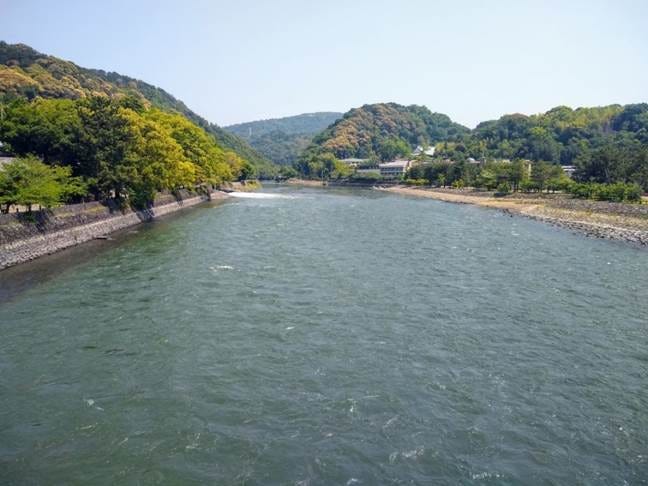
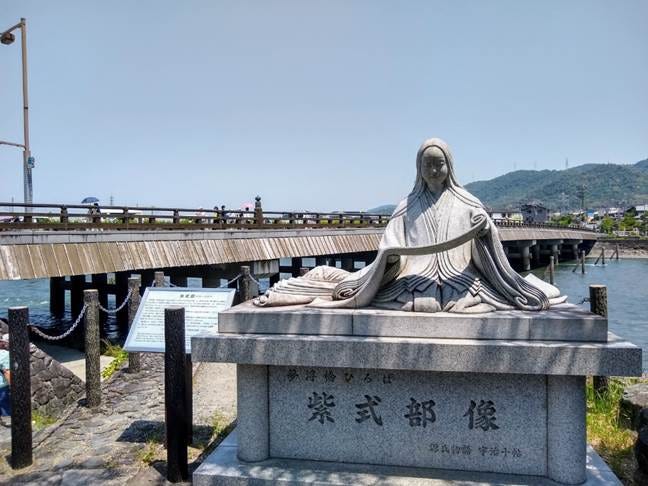
Top: The Uji River. Bottom: Statue of Murasaki Shikibu along the Uji River, with the river landscape behind her, commemorating the author of The Tale of Genji and her enduring literary legacy. Photos by John J. Han, May 2023.
[6] In the early 1990s, while pursuing my PhD at the University of Nebraska-Lincoln, I attended a poetry reading and lecture by Gwendolyn Brooks at nearby Doane College (now Doane University) in Crete. She was nearly eighty, and her gait was slow. Yet she spoke with remarkable clarity, and after the event, I had the honor of having one of her books signed by her.
Works Cited
Bradstreet, Anne. “To My Dear and Loving Husband.” Poetry Foundation, https://www.poetryfoundation.org/poems/43706/to-my-dear-and-loving-husband. Accessed 15 June 2026.
Brooks, Gwendolyn. “We Real Cool.” Poetry Foundation, https://www.poetryfoundation.org/poetrymagazine/poems/28112/we-real-cool. Accessed 16 June 2026.
Song, Soo-kwon. Eating Alone and Other Poems by Song Soo-kwon. Translated by John J. Han, Cyberwit, 2015.
Haiku Society of America. “Haiku Definitions.” The Haiku Society of America, https://www.hsa-haiku.org/hsa-definitions.html. Accessed 16 June 2026.
Hughes, Langston. “Harlem.” Poetry Foundation, https://www.poetryfoundation.org/poems/46548/harlem. Accessed 16 June 2026.
Lowell, Amy. “To a Husband.” Poetry Foundation, https://www.poetryfoundation.org/poetrymagazine/poems/13614/to-a-husband. Accessed 15 June 2026.
McClintock, Michael. “dead cat…” Haiku in English: The First Hundred Years, edited by Jim Kacian, Philip Rowland, and Allan Burns, W. W. Norton, 2013, p. 51.
Park, Jeong-geun (박정근). “Odyssey Park Jeong-geun’s Homecoming Story–12: Literary Fantasies of Adolescence Buried in the Grave of Time.” I-Buan News (부안독립신문), 2026, https://www.ibuan.com/news/articleView.html?idxno=54396. Accessed 16 June 2026.
Pound, Ezra. “In a Station of the Metro.” Poetry Foundation, https://www.poetryfoundation.org/poetrymagazine/poems/12675/in-a-station-of-the-metro. Accessed 15 June 2026.
Reichhold, Jane. “deep sigh.” AHA Poetry, https://www.ahapoetry.com/aadoh/autmood.htm. Accessed 16 June 2026.
Triplett, C. Clark. “harvest moon.” Fireflies’ Light: A Magazine of Short Poems, no. 33, Spring 2026, p. 18.
Whitman, Walt. “Song of Myself.” Poetry Foundation, https://www.poetryfoundation.org/poems/45477/song-of-myself-1892-version. Accessed 16 June 2026.
Williams, William Carlos. “The Red Wheelbarrow.” Poetry Foundation, https://www.poetryfoundation.org/poems/45502/the-red-wheelbarrow. Accessed 15 June 2026.
송수권. “ 혼자 먹는 밥,”“시(詩)와 사색.” 중앙SUNDAY, 3 Feb. 2023, www.joongang.co.kr/article/25138173. Accessed 15 June 2026.
About the Author
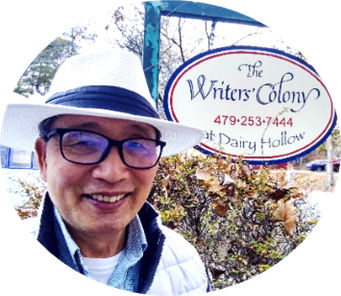
Professor of English and Creative Writing and Associate Dean of the School of Humanities and Theology, Missouri Baptist University
John J. Han, PhD, is the author, editor, co-editor, or translator of 35 books. His forthcoming book, Echoes from the Hills: Critical Essays on Ozarks Literature (co-edited with C. Clark Triplett), will be published by the University of Arkansas Press. He has also published nearly 3,000 poems in a wide range of journals and anthologies. In addition to his long tenure at Missouri Baptist University, he has taught at Kansas State University, the University of Nebraska–Lincoln, Nebraska Wesleyan University, and Washington University in St. Louis. He has also served as a visiting scholar at Georgia College & State University and the University of Ljubljana in Slovenia.
© K-Global Scholars and Professionals Forum. All rights reserved. Content published in the K-GSP Forum may not be reproduced, distributed, or transmitted in any form without prior written permission from the K-GSP Forum, except for brief quotations with full attribution.