
Rediscovering Gani (簡易) Choi Rip’s Distinctive Learning Methods and Educational Philosophy
A Renaissance Model for the Age of Artificial Intelligence
Abstract
Gani (簡易) Choi Rip (崔岦, 1539–1612), one of the most distinguished scholars and literary figures of the Joseon Dynasty, was far more than an accomplished poet and statesman. He was a lifelong learner whose intellectual curiosity, interdisciplinary scholarship, and commitment to educating future generations anticipated many of the principles now considered essential in twenty-first-century education. His philosophy emphasized reflective inquiry over memorization, creativity over imitation, character over credentials, and lifelong learning over short-term achievement.
Ironically, these educational ideals have become even more relevant in the era of artificial intelligence. While AI systems can retrieve, summarize, and generate information within seconds, they cannot replace human wisdom, ethical judgment, creative imagination, or moral leadership. This essay explores five distinctive learning methods employed by Choi Rip and five educational philosophies that guided his mentoring of younger scholars. Through historical examples and practical applications, it demonstrates how his intellectual legacy can inspire innovative learning and teaching strategies in the AI era.
Why Choi Rip Matters Today
Artificial intelligence has transformed how humanity acquires knowledge. Students today can ask ChatGPT, Gemini, or Claude virtually any question and receive an immediate answer. Yet the greatest educational challenge is no longer obtaining information but learning how to ask meaningful questions, evaluate evidence critically, connect ideas creatively, and apply knowledge ethically.
More than four centuries ago, Gani Choi Rip practiced precisely these intellectual habits. Rather than viewing learning as the accumulation of facts, he regarded it as the lifelong cultivation of wisdom, creativity, and character. His educational philosophy therefore offers remarkable insights for the emerging age of AI-assisted learning.
I. Five Distinctive Learning Methods of Gani Choi Rip
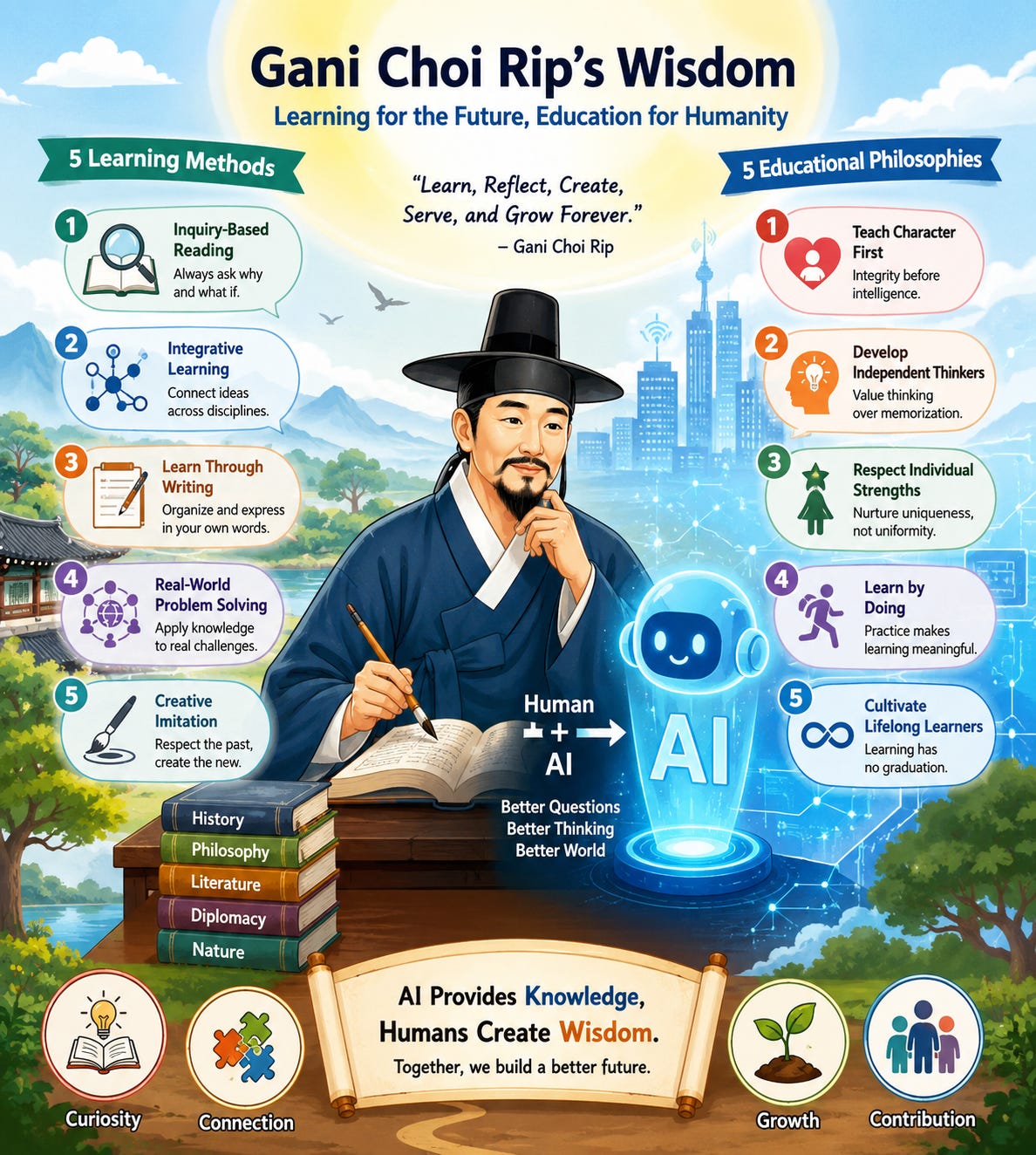
1. Inquiry-Based Reading: Learning Begins with Questions
Choi Rip never accepted texts passively. Instead, he continuously questioned authors, historical events, and established interpretations.
He frequently asked:
Why did the author reach this conclusion?
Would this principle still apply under different historical circumstances?
How can this wisdom solve today’s problems?
Historical Example
While composing diplomatic correspondence for Ming China, Choi Rip did not simply copy earlier diplomatic documents. Instead, he carefully analyzed political circumstances, cultural expectations, and linguistic nuances before crafting original expressions appropriate to each situation.
AI-Era Application
Instead of asking AI,
“Summarize this article,”
students should ask,
“What assumptions underlie this argument?”
or
“How would this theory change if applied to today’s AI society?”
Such questioning transforms AI from a search engine into a catalyst for critical thinking.
2. Integrative Learning Across Disciplines
Choi Rip viewed knowledge as an interconnected network rather than isolated subjects.
He integrated:
Confucian philosophy
History
Literature
Diplomacy
Ethics
Human relationships
into a unified intellectual framework.
Historical Example
His poetry frequently incorporated historical lessons, philosophical reflections, and political wisdom, illustrating how multiple disciplines could enrich one another.
AI-Era Application
Students can compare responses generated by ChatGPT, Claude, Gemini, and scholarly databases to synthesize multiple perspectives, creating interdisciplinary insights rather than relying on a single source.
3. Learning Through Personal Writing
For Choi Rip, reading alone was insufficient.
Knowledge became genuine wisdom only after it had been reorganized and expressed in one’s own words.
Historical Example
His collected writings, the Gani-jip (簡易集), were not mere notes but thoughtful reinterpretations of classical learning, transformed into original literary and scholarly contributions.
AI-Era Application
Rather than submitting AI-generated essays unchanged, learners should revise them by incorporating personal experiences, critical analysis, and original insights. AI should serve as a collaborator, not a substitute for human creativity.
4. Learning Through Real-World Problem Solving
Choi Rip believed scholarship should serve society.
Learning that remained confined to books had little practical value.
Historical Example
Following the Japanese invasions of Korea (1592–1598), he contributed to diplomatic communication, governmental administration, and national reconstruction through his literary and political expertise.
AI-Era Application
Students should use AI not merely to complete assignments but to design solutions for real-world challenges in education, healthcare, cybersecurity, environmental sustainability, and public policy.
5. Creative Imitation Rather Than Mechanical Copying
Choi Rip deeply respected classical Chinese literature, yet he never imitated it mechanically.
Instead, he absorbed its principles before expressing uniquely Korean perspectives.
Historical Example
Inspired by Tang Dynasty poetry, he incorporated Korean landscapes, emotions, and historical experiences, creating an original literary voice.
AI-Era Application
Similarly, AI-generated content should be viewed as the beginning of creative work rather than its conclusion. True innovation emerges when human imagination reshapes machine-generated ideas.
II. Five Educational Philosophies for Cultivating Future Leaders
1. Teach Character Before Knowledge
For Choi Rip, scholarship without integrity was ultimately dangerous.
Historical Example
His students were expected to cultivate humility, sincerity, and moral responsibility before pursuing literary excellence.
AI-Era Lesson
As AI capabilities expand, ethical AI literacy must accompany technical proficiency. Future leaders require moral judgment as much as technological expertise.
2. Develop Independent Thinkers Rather Than Memorization Experts
Choi Rip valued original thinking over correct repetition.
Historical Example
Rather than requiring identical poetic expressions, he encouraged students to develop their own voices and interpretations.
AI-Era Lesson
Students should critically evaluate AI-generated responses, identifying biases, weaknesses, and alternative perspectives instead of accepting them uncritically.
3. Respect Individual Strengths
Every learner possesses unique talents.
Historical Example
Some disciples specialized in poetry, others in history, diplomacy, or classical scholarship. Choi Rip adjusted his mentoring according to each student’s abilities.
AI-Era Lesson
Adaptive AI tutoring systems can personalize instruction, allowing students to progress according to their interests, learning styles, and career aspirations.
4. Learn by Doing
Knowledge becomes meaningful only through practice.
Historical Example
Students were encouraged to compose poems, draft official documents, and participate in real intellectual discussions rather than merely reading classical texts.
AI-Era Lesson
Prompt engineering, collaborative AI research projects, digital storytelling, and community-based innovation projects embody this experiential approach.
5. Cultivate Lifelong Learners
Choi Rip regarded education as a lifelong journey rather than preparation for examinations.
Historical Example
Even in his later years, he continued reading, writing, reflecting, and mentoring younger scholars.
AI-Era Lesson
Because AI technologies evolve continuously, lifelong learning has become an essential professional competency rather than an optional virtue.
III. Reimagining Choi Rip’s Educational Legacy in the AI Era
The educational principles of Gani Choi Rip align remarkably well with the competencies required in the twenty-first century.
Choi Rip’s Philosophy AI-Era Educational Practice Expected Outcome
Inquiry-Based Reading Prompt Engineering Critical Thinking
Integrative Learning AI-Assisted Interdisciplinary Research Creativity
Reflective Writing Digital Knowledge Journals Intellectual Ownership
Practical Application AI-Powered Problem Solving Innovation
Lifelong Learning Personalized AI Tutors Continuous Growth
These principles suggest that AI should not replace human learning but amplify it.
IV. An Imaginative Thought Experiment: If Choi Rip Had Used ChatGPT
Suppose Gani Choi Rip were living today.
He would probably never ask AI,
“Write a poem for me.”
Instead, he might ask,
“Create five metaphors connecting Confucian virtue with responsible artificial intelligence.”
Or,
“Rewrite a Joseon diplomatic letter as if it were a twenty-first-century United Nations peace proposal.”
In other words, Choi Rip would have viewed AI not as an answer generator, but as a thought amplifier—a partner for expanding human creativity rather than replacing it.
A Renaissance Scholar for the AI Age
More than four centuries ago, Gani Choi Rip developed an educational philosophy centered on curiosity, reflection, creativity, ethical leadership, and lifelong learning. These principles anticipated many of the competencies now recognized as essential for success in the age of artificial intelligence.
AI can provide information, summarize research, and generate text with astonishing speed. Yet it cannot cultivate wisdom, integrity, imagination, or moral courage. Those remain uniquely human responsibilities.
Choi Rip reminds us that the future of education depends not on how much information machines can produce, but on how wisely human beings can question, interpret, connect, and apply that information for the common good.
His enduring legacy may therefore be summarized in one timeless insight:
Artificial intelligence provides knowledge, but humanity advances civilization through curiosity, character, creativity, and wisdom. More than four centuries ago, Gani Choi Rip had already begun to illuminate that path. +++
{Solti}
July 18, 2026
간이(簡易) 최립의 독특한 학문 학습법과 후학 양성 철학
인공지능 시대를 위한 르네상스 교육의 재발견
초록
16세기 조선의 대표적인 문인 간이(簡易) 최립(崔岦, 1539–1612)은 단순히 뛰어난 시인이나 문장가가 아니라, 평생 배우고 가르치는 일을 삶의 중심에 둔 교육자였다. 그의 학문은 암기보다 사유를, 독서보다 창조를, 지식보다 인격을 중시하였다. 놀랍게도 이러한 학습철학은 생성형 AI가 일상화된 21세기에도 더욱 큰 의미를 갖는다. AI가 정보를 대신 찾아주는 시대일수록 인간은 질문하고, 연결하고, 판단하며, 새로운 가치를 창조하는 능력이 필요하기 때문이다.
이 글에서는 간이 최립의 독특한 학습방법 다섯 가지와 후학 양성을 위한 교육철학 다섯 가지를 역사적 사례와 함께 살펴보고, 이를 AI 시대의 교육과 연구에 어떻게 적용할 수 있는지를 제안한다.
1. 학문은 평생의 여행이었다
최립은 벼슬보다 학문을 사랑했다.
그는 수많은 문집과 역사서, 경전과 시문을 폭넓게 읽었으며, 단순한 독서에 머무르지 않고 자신의 삶과 시대 속에서 새로운 의미를 만들어냈다.
그에게 공부는 시험을 위한 준비가 아니라 평생 계속되는 자기혁신이었다.
오늘날 AI는 몇 초 만에 수백 권의 책을 요약한다.
그러나 “무엇을 읽을 것인가”보다 중요한 것은 “어떻게 생각할 것인가”이다.
이 점에서 최립은 AI 시대에도 살아있는 스승이다.
2. 최립의 독특한 학문 학습방법 5가지
① 질문 중심의 독서
최립은 책을 그대로 받아들이지 않았다.
항상
“왜 이런 결론에 이르렀는가?”
“오늘이라면 어떻게 달라질까?”
를 스스로 물었다.
사례
명나라 사신들과의 외교문서를 작성할 때 그는 단순히 기존 외교문서를 모방하지 않았다.
상황에 따라 표현을 바꾸고, 상대의 문화와 정치환경을 분석하여 새로운 문장을 만들었다.
AI 시대 활용
AI에게
“이 내용을 요약해 줘”
보다
“이 주장에 반대하는 논리는 무엇인가?”
“이 이론을 현대 사회에 적용하면 어떤 문제가 발생하는가?”
와 같은 질문을 던질 때 진정한 학습이 시작된다.
② 연결형 학습
최립은 유교만 공부하지 않았다.
역사, 문학, 철학, 외교, 자연, 그리고 인간관계를 하나의 거대한 지식망으로 연결하였다.
사례
시를 쓰면서 역사적 사건을 인용하고,
외교문서를 작성하면서 철학을 활용하였다.
오늘날 말하는 융합학문의 선구자였다.
AI 시대 활용
ChatGPT, Claude, 그리고 Gemini를 각각 활용하여 동일한 주제를 다양한 관점에서 비교하면 최립식 통합사고를 실천할 수 있다.
③ 기록을 통한 학습
최립은 읽은 내용을 반드시 자신의 언어로 다시 정리하였다.
바로 『간이집』이다.
사례
독서가 끝나면 자신의 문체로 재해석하여 후세가 읽을 수 있는 작품으로 남겼다.
AI 시대 활용
AI가 작성한 초안을 그대로 사용하지 말고, 자신의 경험과 의견을 덧붙여 새로운 콘텐츠를 만드는 것이 중요하다.
④ 실제 문제 해결 중심 학습
최립의 공부는 현실을 위한 것이었다.
사례
임진왜란 이후 외교, 국가 재건, 그리고 사회 안정에 필요한 문서를 작성하며 학문을 국가 문제 해결에 적용하였다.
AI 시대 활용
학생들은 AI를 이용해 단순히 리포트를 작성하기보다
지역사회 문제, 환경, 보건, 그리고 교육 문제를 해결하는 프로젝트를 수행할 수 있다.
⑤ 창조적 모방
최립은 선인의 글을 존중했지만 결코 복사하지 않았다.
새로운 표현으로 재탄생시켰다.
사례
당나라 시풍을 배우면서도 조선의 자연과 감성을 담아 독창적인 작품을 완성하였다.
AI 시대 활용
AI의 답변은 출발점이다.
최종 작품은 인간의 창의성과 경험이 더해질 때 완성된다.
3. 최립의 후학 양성을 위한 교육철학 5가지
① 사람을 먼저 가르쳐라
최립은 지식보다 인격을 우선하였다.
사례
제자들에게 문장보다 예의와 성실함을 먼저 강조하였다.
AI 시대
AI Literacy보다 AI Ethics가 먼저이다.
② 생각하는 힘을 길러라
정답보다 사고력을 중요하게 여겼다.
사례
같은 시제를 여러 방식으로 표현하도록 지도하였다.
AI 시대
학생에게 AI가 제시한 답을 평가하게 해야 한다.
③ 개성을 존중하라
모든 학생을 같은 방식으로 가르치지 않았다.
사례
시를 잘 쓰는 학생, 역사를 좋아하는 학생, 그리고 외교문서를 잘 쓰는 학생을 각각 다르게 지도하였다.
AI 시대
개인 맞춤형 AI 튜터가 최립의 교육철학을 현실화하고 있다.
④ 실천을 통해 배우게 하라
배운 것을 반드시 현실에서 사용하도록 하였다.
사례
실제 외교문서를 작성하게 하거나 시를 발표하게 하였다.
AI 시대
Prompt Engineering, AI 프로젝트, 창업, 그리고 사회봉사를 통해 배움을 실천으로 연결해야 한다.
⑤ 평생 배우는 사람을 길러라
최립은 “공부에는 졸업이 없다.”는 삶을 살았다.
사례
노년에도 계속 독서와 창작을 멈추지 않았다.
AI 시대
새로운 AI 기술이 매년 등장하는 시대에는 평생학습이 최고의 경쟁력이다.
4. AI 시대에 소환되는 최립의 교육혁명
최립의 철학은 오늘날 다음과 같은 AI 교육모델로 재탄생할 수 있다.
최립의 철학 AI 시대 적용 기대 효과
질문 중심 학습 프롬프트 엔지니어링 비판적 사고 향상
연결형 독서 AI 기반 융합학습 창의성 증진
기록 습관 AI 연구노트·디지털 저널 지식 자산 축적
현실 적용 프로젝트 기반 AI 교육 문제 해결 능력 강화
평생학습 AI 개인 튜터 지속적 자기계발
5. 흥미로운 상상: 최립이 ChatGPT를 만났다면?
만약 간이 최립이 오늘날 살아 있었다면 그는 AI에게 단순히 “시를 써 달라”고 하지 않았을 것이다.
대신 이렇게 질문했을 가능성이 크다.
“조선의 선비 정신과 현대 AI 윤리를 연결하는 새로운 비유를 만들어 보라.”
또는
“임진왜란 당시의 외교문서를 오늘날 국제기구의 평화협정 형식으로 다시 작성해 보라.”
이처럼 그는 AI를 ‘정답 생성기(answer generator)’가 아니라 ‘사고 확장기(thought amplifier)’로 활용했을 것이다.
AI 시대가 다시 부르는 간이 최립
간이 최립의 학문은 단순한 독서법이 아니라 생각하는 기술, 연결하는 기술, 창조하는 기술이었다. 그의 교육은 단순한 지식 전달이 아니라 인격 형성, 비판적 사고, 창의적 실천을 지향하였다.
오늘날 생성형 AI는 방대한 정보를 즉시 제공하지만, 정보의 양이 곧 지혜를 의미하지는 않는다. 최립이 보여준 것처럼 진정한 학습은 질문하는 용기, 깊이 성찰하는 습관, 배운 것을 공동체를 위해 실천하는 책임감에서 완성된다.
AI 시대의 경쟁력은 더 많은 정보를 암기하는 사람이 아니라, AI와 협력하여 새로운 가치를 창조하는 사람에게 있다. 이러한 점에서 간이 최립은 16세기의 문인이 아니라 21세기 교육혁신의 선구자로 다시 읽힐 수 있다.
그의 학문과 교육철학은 오늘날 우리에게 다음과 같은 한 문장으로 요약될 수 있다.
“AI는 지식을 제공하지만, 인간은 질문과 인격, 그리고 창조성을 통해 문명을 발전시킨다. 간이 최립은 그 길을 400여 년 전에 이미 보여주었다.” +++
{솔티}
2026년 7월 18일

Prof. Dr. Young Choi (Editor in Chief) — Regent University
Young B. Choi is a Professor in the Department of Engineering & Computer Science at Regent University. He published 38 books with ‘Selected Readings in Cybersecurity’ (2018) (over 800 copies archived globally at university/college libraries around the world) and ‘Cybersecurity Applications and Artificial Intelligence’ (2023) available in seven major world languages. He proposed the world’s first global and universal telecommunications “Service Order Handling (SOH)” Model (T-SOH Model) (1995) with Dr. Adrian Tang. With this innovative research work, he received the IEEE NOMS ’96 Best Paper Award and became the first recipient of the Outstanding Contribution Award of the TeleManagement Forum in 1998. His research areas include Natural Language Processing-focused AI, AI-applied cybersecurity, network and telecom service management, and Korean studies on Gani Choi Rip’s Jeonggwan (靜觀: Quiet Contemplation) philosophy and Shilhak ( 實學: Practical Learning).