

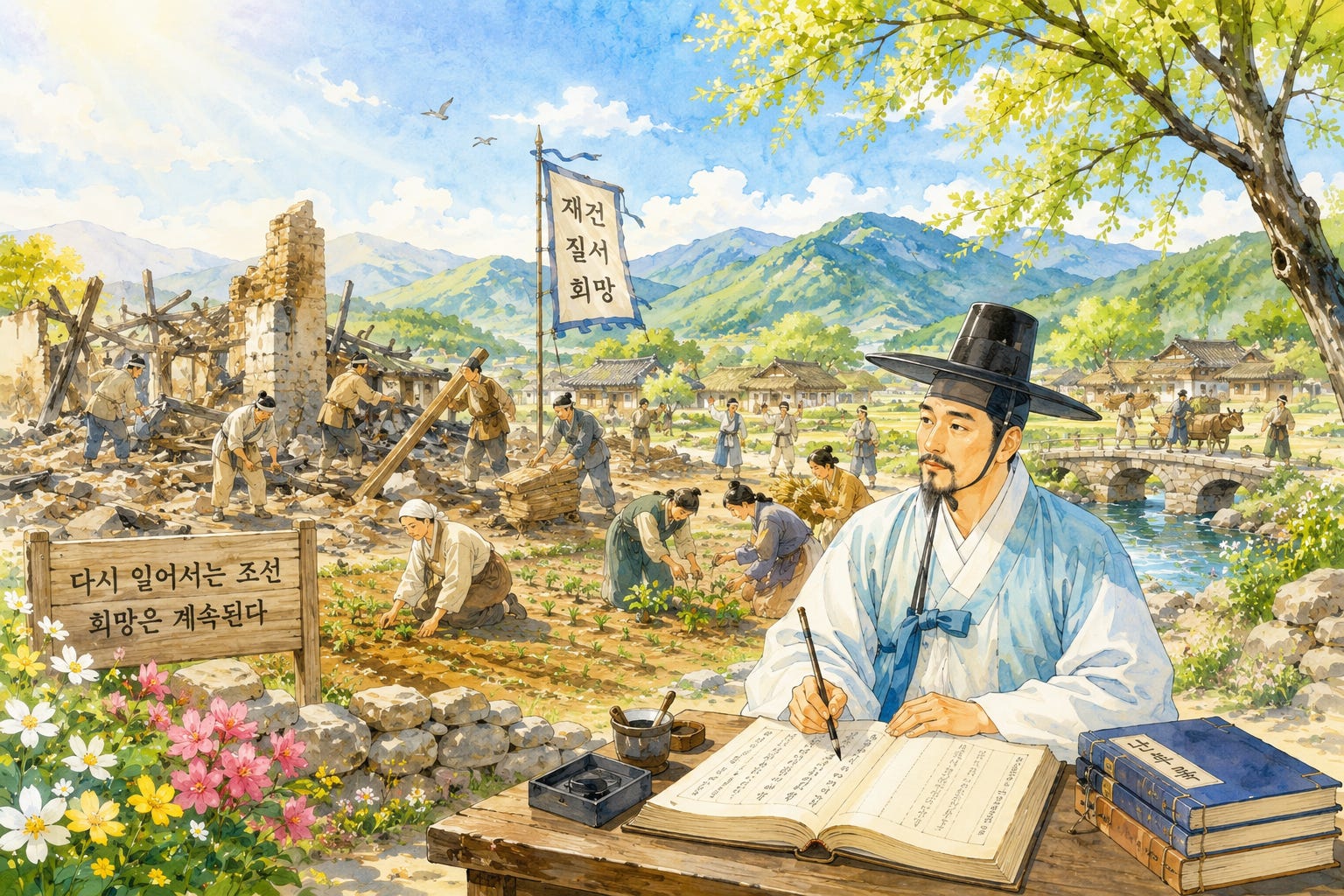
Reflections on Reading Nanhurok (Record After the War) from Volume 6 of Gani-jip
As I read Nanhurok (Record After the War) in Volume 6 of Gani-jip, the first thought that came to mind was, “A war may end, but its wounds do not disappear easily.” We often think of wars as events confined to history books, but this work vividly reveals how deeply war affects a nation and its people long after the fighting has ceased.
Nanhurok records the circumstances following the Japanese invasions of Korea (1592–1598). Even though the war had ended, life did not immediately return to normal. Burned homes, devastated farmlands, families torn apart by loss, and countless people struggling to survive remained throughout the country. Choi Rip documents these realities in a calm and measured manner, yet the sorrow and suffering behind his words are deeply felt by the reader.
What impressed me most was the author’s concern for ordinary people. Many historical accounts focus on kings, generals, and military victories, but Nanhurok does not forget the common people who endured the greatest hardships. Reading about those who lost their homes and livelihoods, yet worked tirelessly to rebuild their villages and cultivate their fields again, I was moved by the resilience of the human spirit. No matter how great the disaster, people find ways to rise again and continue their lives.
The work is not merely a record of past events. Choi Rip uses the aftermath of war as an opportunity to reflect on human life and the responsibilities of government. He continually considers what leaders and officials should do when a nation faces crisis, and what role scholars should play in rebuilding society. These reflections remain meaningful even for readers today.
Perhaps the most memorable aspect of the book is its meditation on the fragility of life. The peaceful daily routines that people once took for granted disappeared almost overnight because of war. This lesson still resonates with us in the modern world. We often assume that peace and stability will always be present, yet Nanhurok reminds us how precious and fragile they truly are.
At the same time, I was struck by Choi Rip’s ability to find hope amid devastation. Even in ruined villages, the seasons continue to change and spring eventually returns. New shoots emerge from the earth, and life begins again. Nature recovers, and people rebuild. This imagery serves as a powerful symbol of resilience, illustrating both the restorative power of nature and the enduring strength of humanity.
Today, while many of us do not face war directly, we confront other challenges such as economic uncertainty, global pandemics, and the rapid transformations brought about by artificial intelligence and technological innovation. Reading Nanhurok, I realized that although circumstances change, the human response to adversity remains remarkably similar. Preserving community, learning from experience, recording history, and preparing for the future are timeless responsibilities.
Ultimately, Nanhurok is far more than a postwar chronicle. It is a story of people seeking hope amid suffering, a reflection on how societies recover from catastrophe, and a valuable historical testimony about resilience and renewal. After finishing the book, one question lingered in my mind:
“How much do we truly value the peace we enjoy today, and what are we doing to prepare for the challenges of tomorrow?”
I believe this question is the most enduring lesson that Nanhurok offers to modern readers. +++
{Solti}
July 21, 2026
『간이집』 제6권 「난후록」을 읽고
『간이집』 제6권에 수록된 「난후록(亂後錄)」을 읽으며 가장 먼저 떠오른 생각은 “전쟁은 끝나도 그 상처는 쉽게 끝나지 않는다”는 것이었다. 우리는 흔히 전쟁을 역사책 속의 사건으로만 생각하지만, 이 글을 읽다 보면 전쟁이 한 나라와 백성들의 삶에 얼마나 깊은 흔적을 남기는지 생생하게 느낄 수 있다.
「난후록」은 임진왜란 이후의 상황을 기록한 글이다. 전쟁이 끝났다고 해서 모든 것이 원래대로 돌아오는 것은 아니었다. 불타버린 집과 황폐해진 농토, 가족을 잃은 사람들, 생계를 잃은 백성들이 곳곳에 남아 있었다. 최립은 이러한 현실을 담담하게 기록하면서도 그 속에 담긴 슬픔과 안타까움을 독자에게 전하고 있다.
특히 인상 깊었던 것은 전쟁 이후 백성들의 삶에 대한 관심이었다. 많은 역사 기록이 왕이나 장수들의 이야기에 집중하는 반면, 「난후록」은 평범한 사람들의 고통을 잊지 않는다. 전쟁으로 삶의 터전을 잃은 백성들이 다시 농사를 짓고 마을을 복구하며 살아가려는 모습을 보면서 인간의 강인한 생명력을 느낄 수 있었다. 아무리 큰 재난이 닥쳐도 사람들은 다시 일어나 삶을 이어간다는 사실이 깊은 감동을 주었다.
또한 이 글은 단순히 과거의 사건을 기록하는 데 그치지 않는다. 최립은 전쟁을 통해 인간의 삶과 국가의 역할에 대해 성찰한다. 나라가 혼란에 빠졌을 때 지도자와 관리들은 어떤 책임을 져야 하는지, 지식인은 무엇을 해야 하는지 끊임없이 고민한다. 이러한 모습은 오늘날을 살아가는 우리에게도 많은 생각거리를 던져 준다.
읽는 내내 가장 마음에 남았던 것은 인간 삶의 덧없음에 대한 부분이었다. 전쟁 전에는 당연하게 여겼던 평화로운 일상이 순식간에 사라질 수 있다는 사실은 지금의 우리에게도 낯설지 않은 교훈이다. 우리는 때때로 현재의 평화와 안정을 너무 쉽게 당연하게 생각하지만, 「난후록」은 그것이 얼마나 소중한 것인지를 다시 일깨워 준다.
한편으로는 절망적인 상황 속에서도 희망을 발견하려는 최립의 시선이 인상적이었다. 폐허가 된 마을에도 계절은 찾아오고, 봄이 되면 새싹이 돋아난다. 자연은 상처를 품은 채 다시 살아나고, 사람들 역시 삶을 재건한다. 이러한 모습은 인간과 자연이 가진 회복력을 상징적으로 보여주는 것처럼 느껴졌다.
오늘날 우리는 전쟁 대신 경제 위기, 감염병, 인공지능과 기술 변화 같은 새로운 도전에 직면하고 있다. 그러나 「난후록」을 읽으며 시대는 달라도 위기를 극복하는 인간의 자세는 크게 다르지 않다는 생각이 들었다. 어려움 속에서도 공동체를 지키고, 기록을 남기며, 미래를 준비하는 일이 중요하다는 사실을 깨닫게 된다.
결국 「난후록」은 단순한 전후 기록이 아니다. 그것은 전쟁이 남긴 상처를 기억하면서도 새로운 희망을 찾아가는 사람들의 이야기이며, 국가와 사회가 어떻게 다시 일어설 수 있는지를 보여주는 귀중한 기록이다. 책을 덮고 나서도 한동안 마음속에 남은 질문은 이것이었다.
“우리는 오늘의 평화를 얼마나 소중히 여기고 있으며, 미래의 위기를 위해 무엇을 준비하고 있는가?”
이 질문이야말로 「난후록」이 오늘의 독자에게 전하는 가장 큰 교훈이라고 생각한다. +++
{솔티}
2026년 7월 21일
{솔티}

Prof. Dr. Young Choi (Editor in Chief) — Regent University
Young B. Choi is a Professor in the Department of Engineering & Computer Science at Regent University. He published 38 books with ‘Selected Readings in Cybersecurity’ (2018) (over 800 copies archived globally at university/college libraries around the world) and ‘Cybersecurity Applications and Artificial Intelligence’ (2023) available in seven major world languages. He proposed the world’s first global and universal telecommunications “Service Order Handling (SOH)” Model (T-SOH Model) (1995) with Dr. Adrian Tang. With this innovative research work, he received the IEEE NOMS ’96 Best Paper Award and became the first recipient of the Outstanding Contribution Award of the TeleManagement Forum in 1998. His research areas include Natural Language Processing-focused AI, AI-applied cybersecurity, network and telecom service management, and Korean studies on Gani Choi Rip’s Jeonggwan (靜觀: Quiet Contemplation) philosophy and Shilhak ( 實學: Practical Learning).