

The Invisible Weight We Carry
Living in a highly industrialized, fiercely competitive society where the value of ownership outweighs the value of survival, it is not easy to maintain good health at ease. People have become accustomed to anxiety or tension without even realizing it. As I experience this so often in this complex and multifaceted world that I cannot clearly put it into words what that feeling is like.

There are times when they feel their emotions are extremely sensitive and have lost their patience, but they do not realize that this is not a natural phenomenon. It is dismissed as mild nervousness or anxiety caused by the physical and mental weariness arising from social life or daily routines. Eventually, not only he but also the people around him realize that something is wrong.
When the Body Begins to Signal
People find it difficult to finish work because they cannot concentrate. They feel anxious if they cannot do their best at what to do. They are tormented by a fear that cannot be clearly grasped. Nervous tension can cause the gait to stiffen and become unnatural. It also changes the way people speak. Unable to fall asleep easily, people can’t sleep deeply and keep waking up. Although the degree varies, most people experience such symptoms at some point.
The Search for Relief
It is natural to feel drained after hard work or to try to escape from stressful thoughts or emotions. People take a breather when they have overcome a difficult hurdle. To relax the mind and body together they change thoughts while taking a short break and drinking a cup of coffee. Holding a drink and sitting comfortably in an armchair, they try to reconnect with the present moment or situation.
For a long time, alcohol has been used as a synonym for taking a breather. However, that trend is now changing. In early January 2025, there was a report from the U.S. Public Health Service stating that even small amounts of alcohol can cause cancer. Even one drink a day can cause liver cirrhosis. It has been found to increase the incidence of esophageal and oral cancers. According to a survey conducted in May of the year, nearly half of Americans are trying to cut their alcohol consumption by more than half. It was a 44% increase compared to the year before last.
As the health risks of alcohol become clearer, new problems arise. It is to find a way to take a breather and temporarily suspend brain functions, or to change the brain to a happy state, without using that beverage. Other methods are often habit-forming, so they are not that easy to find.
Healthier Ways to Take a Breather
The way people cope with stress can vary from person to person, so no single method is suitable for everyone. Experts say that even without alcohol we can find a good way to take a breather by enjoying long forgotten hobbies such as walking, running, and woodworking. It is also nice to have an informal conversation with a like-minded friend while strolling through a park or watching a movie.
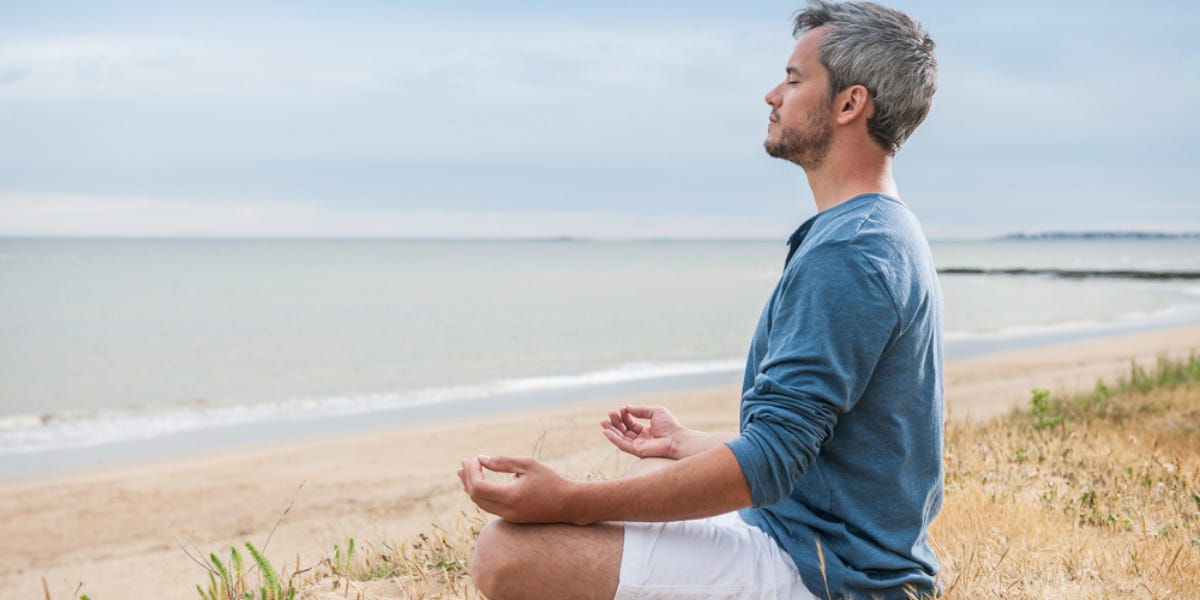
Mindful yoga is a gentle practice that integrates traditional yoga postures with mindfulness meditation, emphasizing present-moment awareness, breath-led movement, and self-compassion. It focuses on inner experience rather than perfecting poses, aiming to reduce stress, improve mental health, and foster a non-judgmental connection with the body.
What Science Has Learned About Stress
The medical community began to take an interest in stress in the mid-20th century. Ainslie Meares (1910–1986), an authority on hypnotism, treated anxiety without the use of drugs. He emphasized the effectiveness of meditation in eliminating pain. Herbert Benson (1935–2022) made great account of relaxation response which is innate in everyone. It has the ability to reduce heart rate, blood pressure, respiratory rate, and metabolism. He found that the response can be induced by meditation. His book, co-authored with William Proctor and published in 1994 (Beyond the Relaxation Response, Crown Publishing), was translated into Korean (Scientific Meditation, Hakjisa, 2003).
The Relaxation Response: How It Works
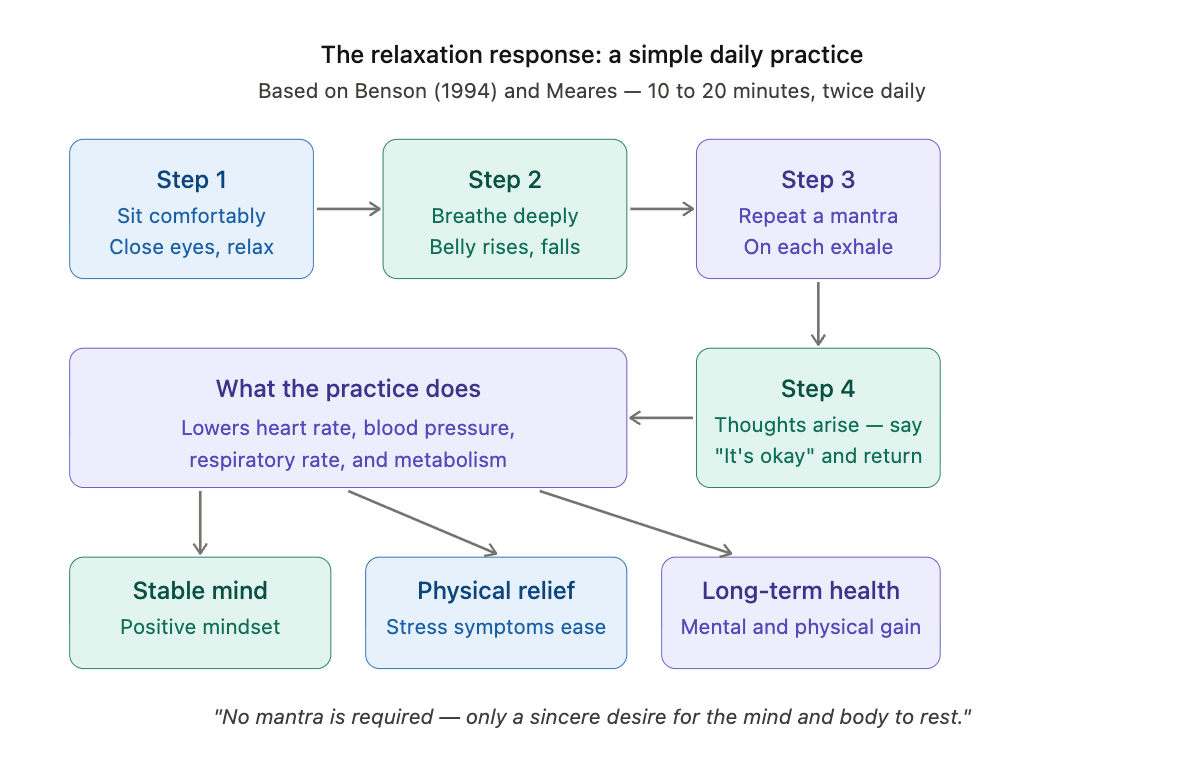
The relaxation response occurs when sitting in a quiet place, consciously relax the tension in your entire body muscles. It can be revealed through a simple practice of about 10 to 20 minutes, while memorizing words or short sentences (mantras) that align with one’s beliefs and remaining unwavering in the face of distracting thoughts. That response cannot change the amount of hormones secreted from nerve endings, but it can alleviate all kinds of harmful physical changes caused by stress. It has been scientifically confirmed that it stabilizes the mind and promotes a positive mindset, providing relief to anxious and tense minds.
Sit down in a comfortable position and tell yourself “I sat here to catch my breath.” Close your eyes and relax your entire body. Breathe deeply and evenly, focusing on your inhalation and exhalation. When exhaling, recite a mantra of one’s choosing, such as “The Lord is my shepherd” or “The Goddess of Mercy” in a single breath. When distracting thoughts arise ignore it and focus on breathing again while saying “It’s okay.” Never try to drive them out.
There is no need to have a mantra. It is important to have a deep desire for the mind and body to relax. Do not focus your mind on any single object, but focus only on your breath. Pay attention to the fact that the stomach expands when you inhale and contracts when you exhale. It is advisable to practice twice a day, every day.
A Personal Note
Among the forces capable of altering human physiological phenomena, there are many that are difficult to say exist objectively. However, it has been scientifically proven that changes occurring in the body can be altered to some extent. I live feeling a distinct improvement in my physical and mental health after thoroughly reading the books written by Meares and Benson and practicing them consistently.
Reference:
Benson, H., & Proctor, W. (1994). Beyond the relaxation response. New York, NY: Crown Publishers.
Meares, A. (1968). Relief without drugs: The self-management of tension, anxiety, and pain. London, England: Souvenir Press.
Original Document in Korean Language:

About the Author:

Dr. Chung Gil Lee is Professor Emeritus of Veterinary Medicine at Chonnam National University, where he served on the faculty until 2007. He holds an M.Sc. and Ph.D. from James Cook University, Australia, and began his career as an Interpreter Officer in the Korean Army. A graduate of Chonnam National University (1963), he is currently a member of the Korean Literature Society of America.
© K-Global Scholars and Professionals Forum. All rights reserved. Content published in the K-GSP Forum may not be reproduced, distributed, or transmitted in any form without prior written permission from the K-GSP Forum, except for brief quotations with full attribution.