

A Deep Analysis of My Contributed Articles Based on the Number of Downloads and PlumX Metrics: Research Papers
Young B. Choi Department of Engineering & Computer Science College of Arts & Sciences Regent University Virginia Beach, VA 23464-9800 ychoi@regent.edu
Abstract
This study analyzes the readership trends of articles contributed by the author to KAUPA Letters between 2020 and 2025. By examining the total number of downloads and PlumX Metrics data, this research identifies the most appealing articles among the Korean American academic readership in the United States, Canada, and Korea. The analysis highlights popular topics, types of research papers, and offers recommendations for future article composition to maximize impact in academic society. Results indicate that healthcare, cybersecurity, and AI-related topics exhibit higher reader engagement, and the application of generative AI technologies in education and cybersecurity is emerging as a prominent area of interest.
Keywords: KAUPA Letters, PlumX Metrics, downloads, Korean American professors, article popularity, AI, cybersecurity, healthcare
Introduction
Academic publishing increasingly relies on quantitative metrics to assess the impact of scholarly contributions. Online platforms and archiving systems, such as the Purdue University Library, enable precise tracking of article downloads, abstract views, and PlumX Metrics, providing insight into readership engagement (Allen et al., 2018).
KAUPA Letters serves as a platform for essays and research papers contributed by Korean American professors. This study evaluates the readership trends of the author’s research paper contributions from October 2020 to December 2025. The primary objectives are to determine which articles are most appealing to readers, understand emerging trends in research interests, and propose directions for future article composition.
Method
The study focuses on 31 articles contributed by the author to KAUPA Letters between Volume 8, Number 1 (October 2020) and Volume 13, Number 2 (December 2025). The articles encompass both essays and research papers on topics including network management, AI technologies, cybersecurity, IT service management, telecommunication services, healthcare data security, and generative AI applications.
Data Collection
Data on article downloads, abstract views, and PlumX Metrics were obtained from the Purdue University Library archiving system. For detailed analysis, the top 11 most downloaded articles as of April 8, 2026, were selected. Download data covered 76 days (January 22 – April 8, 2026).
Analysis
Total downloads and daily average: Total downloads for the 11 articles were calculated (N = 932), yielding a daily average across all articles. Per article engagement: The average number of downloads per article per day was calculated to assess relative reader interest. PlumX Metrics consideration: Abstract views and download metrics were analyzed to distinguish articles with high visibility versus high reader engagement.
Results
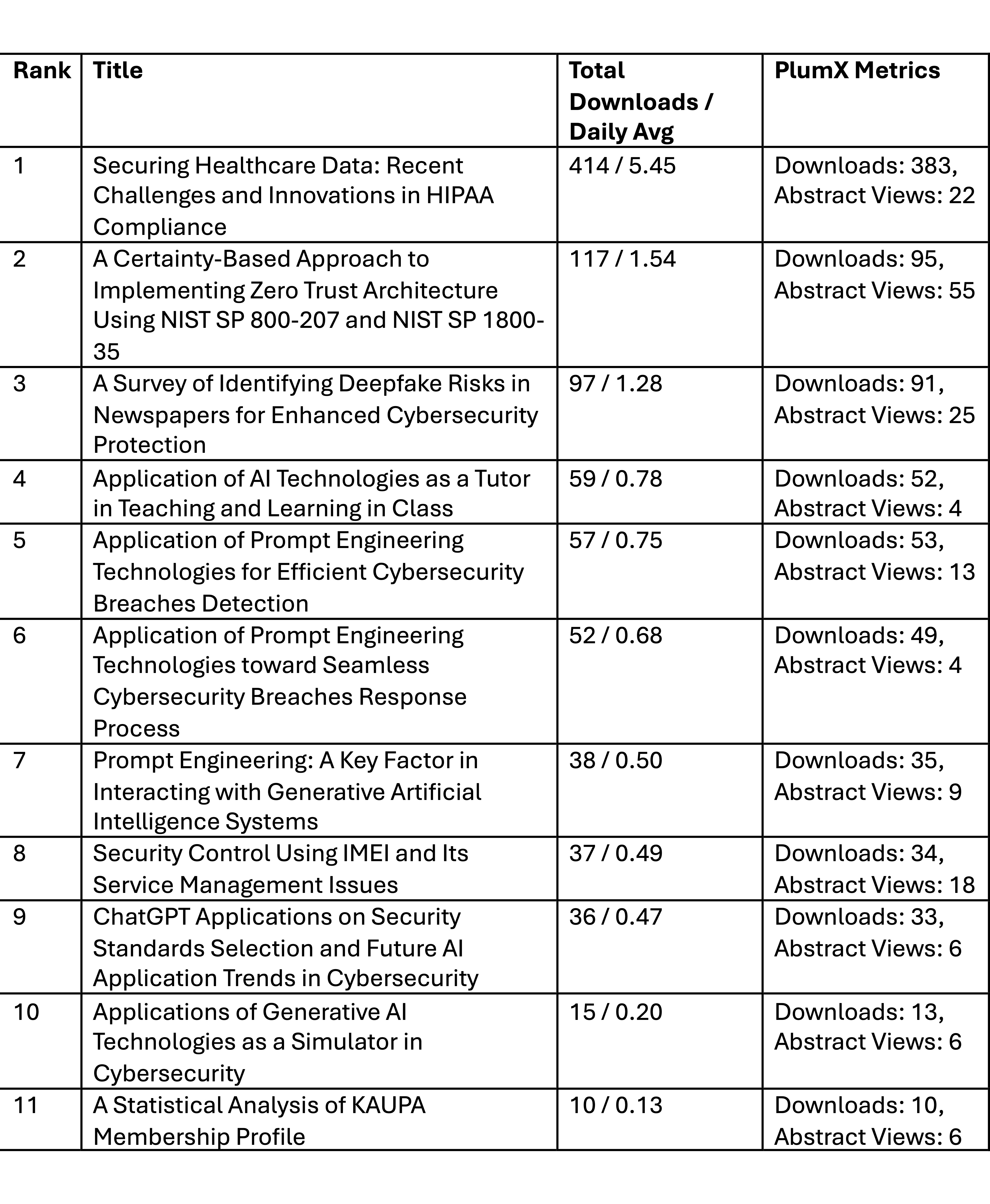
The analysis identified the top 11 most downloaded articles as summarized in Table 1.
Table 1
Top 11 Most Downloaded Articles and PlumX Metrics (January 22 – April 8, 2026)
Discussion
Trends by Topic
The most downloaded articles reflect strong reader interest in healthcare data security, zero trust architecture (ZTA), and cybersecurity. Topics related to generative AI applications in education and cybersecurity also attracted significant attention. Conversely, older or more technical topics (e.g., IMEI service management) had relatively lower engagement.
Article Types
Research papers demonstrated higher engagement than essays, suggesting that the KAUPA readership prioritizes practical and technical insights. Articles addressing emerging technologies such as AI and cybersecurity consistently performed better.
Implications for Future Article Composition
Focus Areas — Future articles should emphasize healthcare security, AI applications, and cybersecurity trends. Format and Accessibility — Research papers with practical applications and clear summaries increase reader downloads and PlumX visibility. Generative AI Integration — Applying AI tools for analysis, simulation, and prompt engineering offers innovative research avenues aligning with reader interests. International Engagement — Targeting Korean American professors across multiple regions requires consideration of accessibility and relevance to both academic and applied contexts.
Conclusion
Quantitative analysis of downloads and PlumX Metrics provides valuable insight into readership engagement with KAUPA Letters. Healthcare security, zero trust architecture, cybersecurity, and generative AI applications emerge as dominant areas of reader interest. Future contributions should leverage these trends to enhance the relevance and impact of academic work among Korean American scholars in the United States, Canada, and Korea.
References
Allen, L., O’Connell, A., & Kiermer, V. (2018). How can we ensure visibility and impact of research? Learned Publishing, 31(2), 131–136. https://doi.org/10.1002/leap.1145
Choi, Y. B. (2020–2025). Various articles. KAUPA Letters - Journal of the Korean American University Professors Association. Purdue University Library Archival System.
HIPAA. (1996). Health Insurance Portability and Accountability Act of 1996. U.S. Department of Health & Human Services. https://www.hhs.gov/hipaa/index.html
NIST. (2020). SP 800-207: Zero Trust Architecture. National Institute of Standards and Technology. https://doi.org/10.6028/NIST.SP.800-207
PlumX Metrics. (2026). KAUPA Letters article metrics. Purdue University Library.
Appendix
Author’s Research Papers
Choi, Y. B. (2020, October 1). A streamlined network management approach using AI based network automation paradigm against security breaches. KAUPA Letters - Journal of the Korean American University Professors Association, 8(1), 48–51.
Choi, Y. B. (2020, December 1). How can you produce your own mini movie using your smartphone? KAUPA Letters - Journal of the Korean American University Professors Association, 8(2).
Choi, Y. B. (2021, February 1). Some key issues and recent developments in the I/O of AI based applications. KAUPA Letters - Journal of the Korean American University Professors Association, 8(3).
Choi, Y. B. (2021, April 1). Security control using IMEI and its service management issues. KAUPA Letters - Journal of the Korean American University Professors Association, 8(4).
Choi, Y. B. (2021, August 1). NFT: Emerging application trends and some outstanding issues. KAUPA Letters - Journal of the Korean American University Professors Association, 8(6).
Choi, Y. B. (2021, December 1). The state of the art of telecommunications service management. KAUPA Letters - Journal of the Korean American University Professors Association, 9(2).
Choi, Y. B. (2022, April 1). Analysis on the accessibility, performance, and security issues of the satellite Internet services. KAUPA Letters - Journal of the Korean American University Professors Association, 9(4).
Choi, Y. B. (2022, June 1). IT service management (ITSM) frameworks and security trends. KAUPA Letters - Journal of the Korean American University Professors Association, 9(5).
Choi, Y. B. (2022, August 1). Secure and robust telecommunications service management technology: A pioneering global service order handling paradigm. KAUPA Letters - Journal of the Korean American University Professors Association, 9(6).
Choi, Y. B. (2022, October 1). Development trends and feasible solutions of the 6th generation of cybersecurity. KAUPA Letters - Journal of the Korean American University Professors Association, 10(1).
Choi, Y. B. (2022, December 1). Big data security and privacy issues with NoSQL movement. KAUPA Letters - Journal of the Korean American University Professors Association, 10(2).
Choi, Y. B. (2023, February 1). An analysis of machine learning based cybersecurity breaches handling frameworks. KAUPA Letters - Journal of the Korean American University Professors Association, 10(3).
Choi, Y. B. (2023, April 1). ChatGPT applications on security standards selection and future AI application trends in cybersecurity. KAUPA Letters - Journal of the Korean American University Professors Association, 10(4).
Choi, Y. B. (2023, June 1). A pilot machine learning algorithm detecting security breaches in Python. KAUPA Letters - Journal of the Korean American University Professors Association, 10(5), 33–44.
Choi, Y. B. (2023, August 1). Applications of AI technologies as a tutor in teaching and learning in class. KAUPA Letters - Journal of the Korean American University Professors Association, 10(6), 46–56.
Choi, Y. B. (2023, October 1). Applications of generative AI technologies as a simulator in cybersecurity. KAUPA Letters - Journal of the Korean American University Professors Association, 11(1), 32–44.
Choi, Y. B. (2023, December 1). Current status of the U.S. IT industry - NAViGATE 2023 observation report. KAUPA Letters - Journal of the Korean American University Professors Association, 11(2), 46–48.
Choi, Y. B. (2024, February 1). Analyzing security breaches as a preliminary step of suggesting countermeasures using deep learning of generative artificial intelligence. KAUPA Letters - Journal of the Korean American University Professors Association, 11(3), 54–55.
Choi, Y. B. (2024, April 1). An efficient security audit system design approach using generative artificial intelligence technologies. KAUPA Letters - Journal of the Korean American University Professors Association, 11(4), 55–63.
Choi, Y. B. (2024, June 1). Prompt engineering: A key factor in interacting with generative artificial intelligence systems. KAUPA Letters - Journal of the Korean American University Professors Association, 11(5), 41–47.
Choi, Y. B. (2024, August 1). Efficient e-book publishing methods utilizing generative AI technology in various original document types and software tool environments. KAUPA Letters - Journal of the Korean American University Professors Association, 11(6), 36–44.
Choi, Y. B. (2024, October 1). Application of prompt engineering technologies for efficient cybersecurity breaches detection. KAUPA Letters - Journal of the Korean American University Professors Association, 12(1), 48–58.
Choi, Y. B. (2024, December 1). Application of prompt engineering technologies toward seamless cybersecurity breaches response process. KAUPA Letters - Journal of the Korean American University Professors Association, 12(2), 49–62.
Choi, Y. B. (2025, February 1). Securing healthcare data: Recent challenges and innovations in HIPAA compliance. KAUPA Letters - Journal of the Korean American University Professors Association, 12(3), 36–40.
Choi, Y. B. (2025, June 1). A survey on identifying deepfake risks in newspapers for enhanced cybersecurity protection. KAUPA Letters - Journal of the Korean American University Professors Association, 12(5), 36–40.
Choi, Y. B. (2025, September 1). A certainty-based approach to implementing zero trust architecture using NIST SP 800-207 and NIST SP 1800-35. KAUPA Letters - Journal of the Korean American University Professors Association, 13(1), 73–77.
Choi, Y. B., & Hong, P. (2025, December 1). Ethics and governance frameworks in leading AI chat models: Comparative insights on Claude, ChatGPT, Gemini, LLaMA, and Mistral. KAUPA Letters - Journal of the Korean American University Professors Association, 13(2), 30–44.
Choi, Y. B., & Hong, P. (2025, December 1). Global data privacy convergence: Comparative insights on emerging patterns, regulatory gaps, and pathways toward global data governance. KAUPA Letters - Journal of the Korean American University Professors Association, 13(2), 45–63.
Hwang, S. N., & Choi, Y. B. (2021, August 1). A statistical analysis of KAUPA membership profile. KAUPA Letters - Journal of the Korean American University Professors Association, 8(6).
KAUPA. (2025, June 1). How to compose sijo in Korean and English. KAUPA Letters, 12(5), 14–20.

Prof. Dr. Young Choi — Regent University
Young B. Choi, PhD is a Professor at Regent University bringing a rare combination of technical expertise and creative spirit to everything he does. A scholar in cybersecurity, network management, and telecommunications, he has published 157 refereed articles, 13 book chapters, and a Cambridge Scholars Publishing volume on cybersecurity. Beyond the academy, Dr. Choi is a passionate poet, essayist, and wooden block engraving artist whose reflective writing invites readers to rediscover life’s quiet beauty.
© 2026 KGSP Forum. All rights reserved. Content published in the KGSP Journal may not be reproduced, distributed, or transmitted in any form without prior written permission from the KGSP Forum, except for brief quotations with full attribution.