

A Structural Analysis of the Thought of Gani (簡易) Choi Rip (崔岦) from the Perspective of Creativity Theory
An Interdisciplinary Application of Boden’s Conceptual Space Transformation Model and Csikszentmihalyi’s Domain–Field–Individual Model
Young B. Choi
Regent University
Abstract
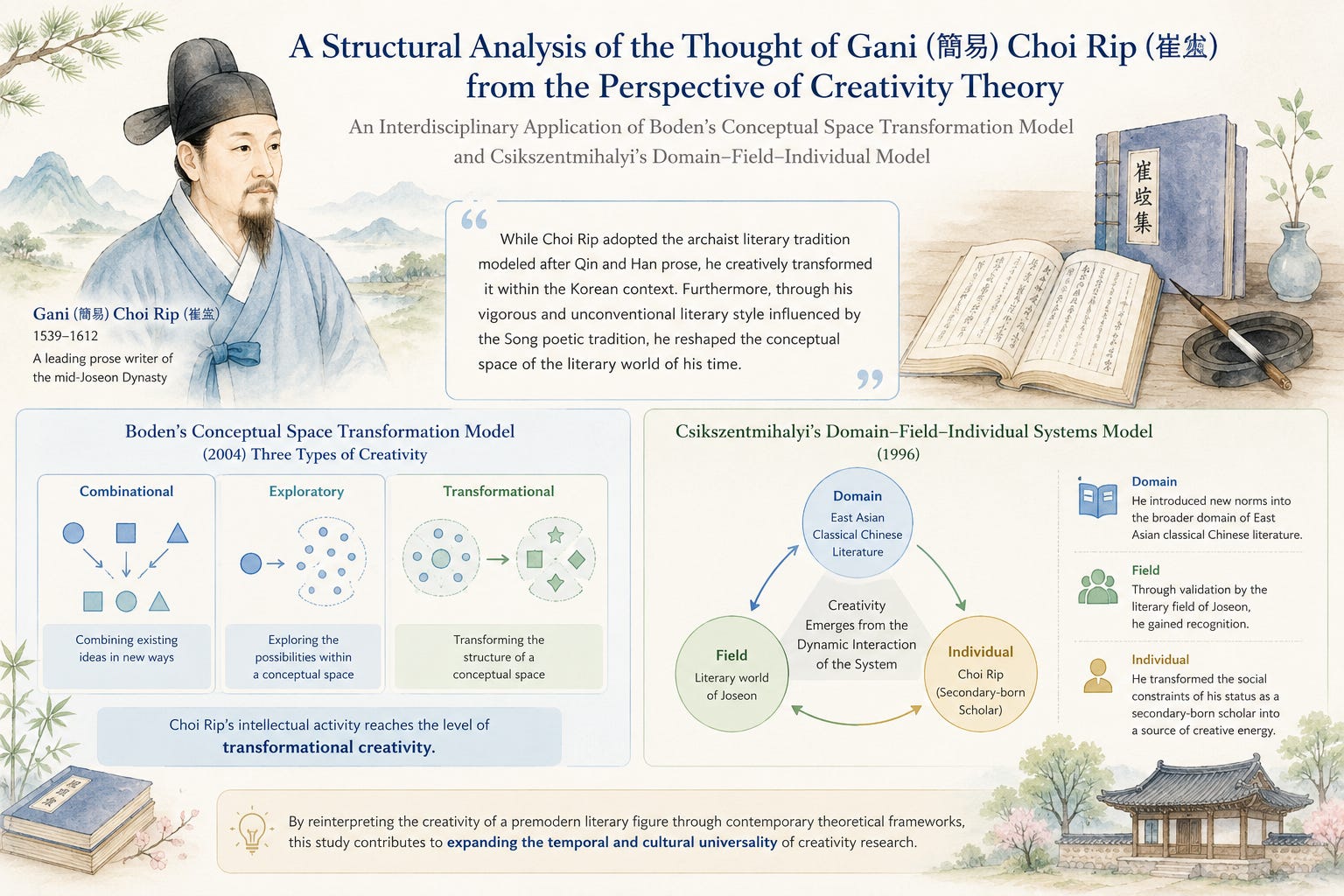
This study aims to analyze the creative cognitive structure of Gani (簡易) Choi Rip (崔岦, 1539–1612), one of the most distinguished prose writers of the mid-Joseon Dynasty, through the lens of modern creativity theories—Margaret Boden’s Conceptual Space Transformation Model and Mihaly Csikszentmihalyi’s Domain–Field–Individual Systems Model. While Choi Rip adopted the archaist literary tradition modeled after Qin and Han prose, he creatively transformed it within the Korean context. Furthermore, through his vigorous and unconventional literary style influenced by the Song poetic tradition, he reshaped the conceptual space of the literary world of his time.
Viewed through Boden’s (2004) three types of creativity—combinational, exploratory, and transformational—Choi Rip’s intellectual activity transcends mere exploration and reaches the level of transformational creativity. From the perspective of Csikszentmihalyi’s (1996) systems model, Choi Rip can be understood as an individual who transformed the social constraints of his status as a secondary-born (seo-eol) scholar into a source of creative energy. Through validation by the literary field of Joseon, he introduced new norms into the broader domain of East Asian classical Chinese literature.
By reinterpreting the creativity of a premodern literary figure through contemporary theoretical frameworks, this study contributes to expanding the temporal and cultural universality of creativity research.
Keywords: Choi Rip, Creativity Theory, Boden’s Conceptual Space, Csikszentmihalyi’s Systems Model, Joseon Classical Chinese Literature, Archaism, Transformational Creativity
창의성 이론의 관점에서 본 간이(簡易) 최립(崔岦) 사상의 구조적 분석
보든(Boden)의 개념공간 변환 모형과 칙센트미하이(Csikszentmihalyi)의 영역–장(場)–개인 모형의 학제적 적용
초록
본 연구는 조선 중기의 대표적인 문장가인 간이(簡易) 최립(崔岦, 1539–1612)의 창의적 인지 구조를 현대 창의성 이론의 관점에서 분석하는 것을 목적으로 한다. 이를 위해 마거릿 보든(Margaret Boden)의 개념공간 변환(Conceptual Space Transformation) 모형과 미하이 칙센트미하이(Mihaly Csikszentmihalyi)의 영역–장–개인(Domain–Field–Individual) 체계 모형을 적용하였다.
최립은 진(秦)·한(漢) 시대의 고문(古文)을 본받은 복고적 문학 전통을 수용하였지만, 이를 조선의 역사적·문화적 맥락 속에서 창의적으로 재해석하고 변용하였다. 또한 송대(宋代) 시문학의 영향을 받은 그의 힘차고 독창적인 문체는 당시 문단의 개념적 공간 자체를 새롭게 재구성하는 역할을 하였다.
보든(2004)이 제시한 세 가지 창의성 유형인 결합적 창의성(combinational creativity), 탐색적 창의성(exploratory creativity), 변혁적 창의성(transformational creativity)의 관점에서 볼 때, 최립의 지적 활동은 단순한 탐색 수준을 넘어 문학적 규범과 사고 체계를 변화시키는 변혁적 창의성의 단계에 도달한 것으로 평가할 수 있다.
한편 칙센트미하이(1996)의 체계 모형 관점에서 보면, 최립은 서얼(庶孼)이라는 사회적 제약을 창조적 에너지의 원천으로 전환한 인물로 이해될 수 있다. 그는 조선 문단이라는 ‘장(場, Field)’의 인정을 통해 자신의 문학적 성취를 정당화하였으며, 나아가 동아시아 한문학이라는 보다 넓은 ‘영역(Domain)’ 속에 새로운 규범과 가능성을 제시하였다.
본 연구는 전근대 문인의 창의성을 현대 창의성 이론의 틀 속에서 재해석함으로써, 창의성 연구의 시간적·문화적 보편성을 확장하는 데 기여하고자 한다.
주제어: 최립, 창의성 이론, 보든의 개념공간 모형, 칙센트미하이의 체계 모형, 조선 한문학, 복고주의, 변혁적 창의성 (Transformational Creativity)
Original Article:

Citation:
Young B. Choi (June 2026). A Structural Analysis of the Thought of Gani (簡易) Choi Rip (崔岦) from the Perspective of Creativity Theory: An Interdisciplinary Application of Boden’s Conceptual Space Transformation Model and Csikszentmihalyi’s Domain–Field–Individual Model. K-GSP Forum, pp. 1–12.
© 2026 K-Global Scholars and Professionals Forum. All rights reserved. Content published in the K-GSP Forum may not be reproduced, distributed, or transmitted in any form without prior written permission from the K-GSP Forum, except for brief quotations with full attribution.