
A Study on the Ideal Qualities of Overseas Korean Leaders
in the Age of Artificial Intelligence
Comparative Analysis of Ahn Chang-ho, Syngman Rhee, Philip Jaisohn,
Kim Kyu-sik, and Park Yong-man
Young B. Choi
Regent University
Abstract
The rapid advancement of artificial intelligence (AI), digital transformation, and global interconnectedness has created new demands for leadership in transnational communities. While contemporary leadership research has increasingly focused on digital leadership, AI governance, and adaptive leadership, little attention has been given to the relevance of historical diaspora leadership models in preparing future leaders. This study addresses this gap by examining the leadership characteristics of five influential Korean diaspora leaders—Ahn Chang-ho, Syngman Rhee, Philip Jaisohn (Seo Jae-pil), Kim Kyu-sik, and Park Yong-man—and evaluating their applicability to the leadership challenges of the AI era.
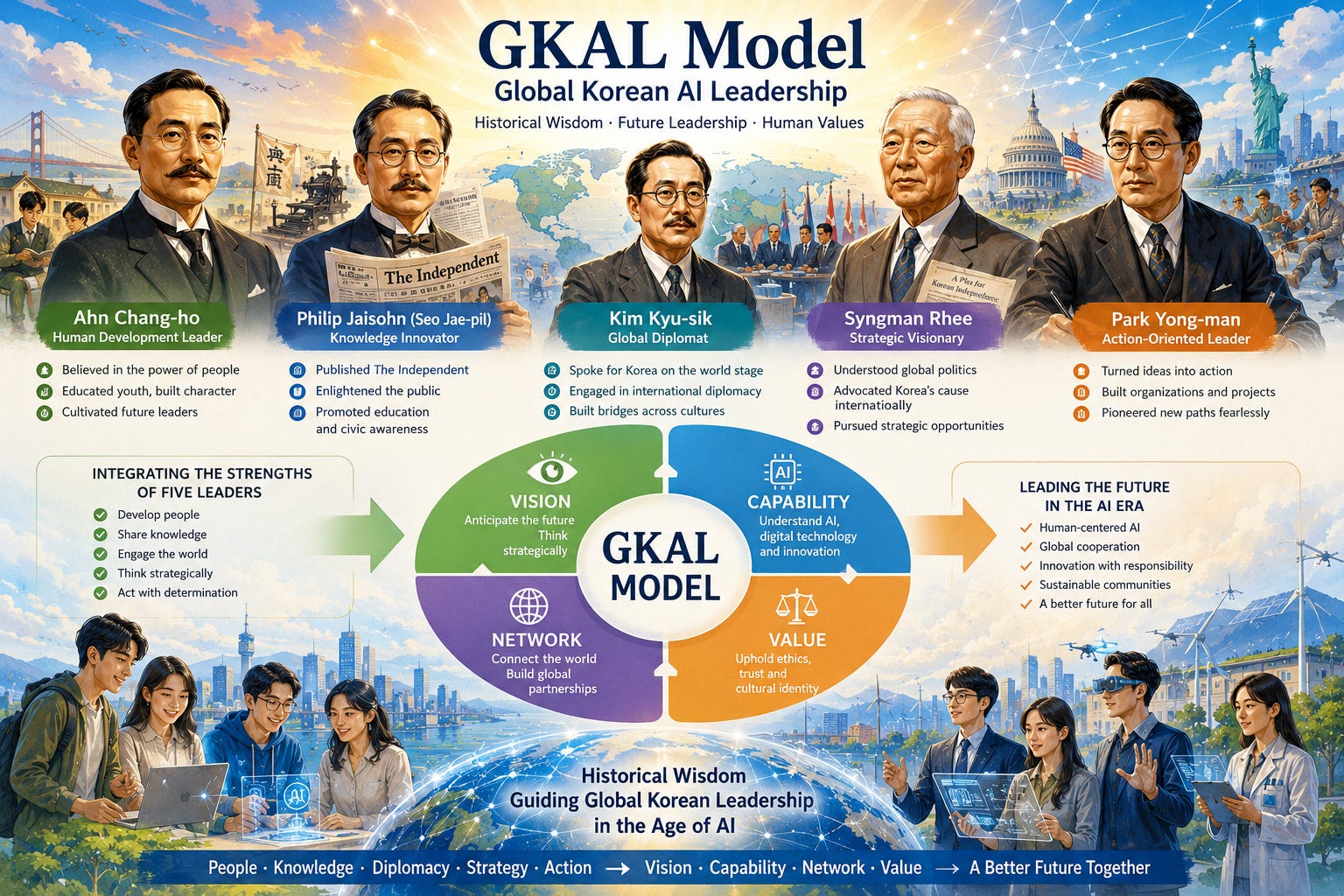
Using a qualitative comparative historical analysis, this study identifies key leadership attributes demonstrated by these leaders and categorizes them into four dimensions: Vision, Capability, Network, and Values. The findings reveal that each leader contributed distinctive strengths, including human capital development, strategic diplomacy, knowledge dissemination, international cooperation, and execution-oriented leadership. Although no single leader embodies all competencies required in today’s complex technological environment, their collective experiences provide a valuable foundation for developing a contemporary leadership framework.
Based on the comparative analysis, this study proposes the Global Korean AI Leadership (GKAL) Model, an integrative framework designed to guide leadership development within overseas Korean communities and other transnational organizations. The GKAL Model consists of four interconnected dimensions—Vision, Capability, Network, and Values—and identifies ten core competencies necessary for effective leadership in the AI era: global strategic vision, human capital development, AI literacy, ethical integrity, international negotiation, cross-cultural communication, innovation, community integration, execution capability, and cultural identity preservation.
The study contributes to the literature by bridging historical diaspora leadership, transformational leadership theory, and emerging AI leadership frameworks. It further offers practical implications for leadership education, diaspora organizations, public policy, and AI governance. By integrating historical wisdom with contemporary technological realities, the GKAL Model provides a culturally grounded and future-oriented framework for cultivating globally competent, ethically responsible, and technologically literate leaders in the twenty-first century.
Keywords: Artificial Intelligence, Leadership, Korean Diaspora, Global Leadership, Ahn Chang-ho, Philip Jaisohn, Kim Kyu-sik, Syngman Rhee, Park Yong-man, GKAL Model, Digital Leadership, AI Governance
인공지능 시대 해외 한인 지도자의 이상적 자질에 관한 연구
안창호, 이승만, 서재필, 김규식, 박용만의 비교분석
초록
인공지능(AI)의 급속한 발전, 디지털 전환, 그리고 글로벌 상호연결성의 증가는 초국가적 공동체(transnational communities)의 지도력에 새로운 요구를 제기하고 있다. 최근 리더십 연구는 디지털 리더십, AI 거버넌스, 적응형 리더십에 대한 관심을 확대하고 있으나, 미래 지도자 양성을 위한 역사적 디아스포라 지도력 모델의 유용성에 대해서는 상대적으로 충분한 연구가 이루어지지 않았다. 본 연구는 이러한 연구 공백을 보완하기 위해 안창호, 이승만, 서재필(Philip Jaisohn), 김규식, 박용만 등 해외에서 활동한 대표적인 한인 지도자 5인의 지도력 특성을 분석하고, 이를 인공지능 시대의 리더십 과제에 적용할 수 있는 가능성을 탐색하였다.
본 연구는 질적 비교 역사분석(Qualitative Comparative Historical Analysis) 방법을 활용하여 다섯 지도자가 보여준 핵심 지도력 특성을 도출하고, 이를 비전(Vision), 역량(Capability), 네트워크(Network), 가치(Values)의 네 가지 차원으로 분류하였다. 분석 결과, 각 지도자는 인재 양성, 전략적 외교, 지식 확산, 국제 협력, 실행 중심 리더십 등 서로 차별화된 강점을 보여주었다. 비록 어느 한 인물이 오늘날의 복합적 기술 환경에서 요구되는 모든 역량을 완벽하게 갖추고 있지는 않지만, 이들의 집합적 경험은 현대적 리더십 모델을 구축하는 데 중요한 토대를 제공하는 것으로 나타났다.
비교분석 결과를 바탕으로 본 연구는 해외 한인 사회와 초국가적 조직의 지도력 개발을 위한 통합적 프레임워크인 GKAL(Global Korean AI Leadership) 모델을 제안한다. GKAL 모델은 비전(Vision), 역량(Capability), 네트워크(Network), 가치(Values)의 네 가지 상호연계된 차원으로 구성되며, 인공지능 시대의 효과적인 지도자에게 요구되는 열 가지 핵심 역량으로 글로벌 전략적 비전, 인재 개발 능력, AI 리터러시, 윤리적 통합성, 국제 협상력, 다문화 의사소통 능력, 혁신 역량, 공동체 통합 능력, 실행 역량, 문화적 정체성 보존 능력을 제시한다.
본 연구는 역사적 디아스포라 지도력, 변혁적 리더십 이론, 그리고 새롭게 부상하는 AI 리더십 프레임워크를 통합함으로써 학문적 기여를 제공한다. 또한 리더십 교육, 해외 한인 단체, 공공정책, AI 거버넌스 분야에 실질적인 시사점을 제시한다. GKAL 모델은역사적 지혜와 현대 기술 환경을 융합함으로써, 21세기 글로벌 사회에서 경쟁력을 갖춘 동시에 윤리적 책임성과 기술적 이해력을 겸비한 미래 지도자를 양성하기 위한 문화적 기반과 미래지향적 방향성을 제공한다.
주제어: 인공지능, 리더십, 한인 디아스포라, 글로벌 리더십, 안창호, 서재필, 김규식, 이승만, 박용만, GKAL 모델, 디지털 리더십, AI 거버넌스
Original Article:

Citation:
Young B. Choi (June 2026). A Study on the Ideal Qualities of Overseas Korean Leaders in the Age of Artificial Intelligence: Comparative Analysis of Ahn Chang-ho, Syngman Rhee, Philip Jaisohn, Kim Kyu-sik, and Park Yong-man. K-GSP Forum, pp. 1–21.
© 2026 K-Global Scholars and Professionals Forum. All rights reserved. Content published in the K-GSP Forum may not be reproduced, distributed, or transmitted in any form without prior written permission from the K-GSP Forum, except for brief quotations with full attribution.