

Benchmarking: An International Journal · 2025 · Research Article
Benchmarking National Semiconductor Strategies: Advancing Innovation Systems and Policy Learning for Global Competitiveness
Paul Hong, University of Toledo, USA · David Hwang, Shippensburg University of Pennsylvania, USA · Young Soo Park, Midwest University, USA · Fernando C. M. Ferreira, University of Southern Indiana, USA · DOI 10.1108/BIJ-02-2025-0131
Purpose & Approach
This study benchmarks national semiconductor strategies through a theory-grounded lens, explaining how different policy mixes build — or fail to build — design, manufacturing, equipment, packaging, and talent capabilities across the United States, South Korea, Taiwan, China, and Japan.
National Innovation Systems (NIS) and Dynamic Capabilities (DC) theory are integrated into a comparative rubric, applied via triangulated documentary evidence and secondary indicators, generating five testable propositions on governance, collaboration, and capability trajectories.
“Countries follow distinct capability pathways shaped by governance choices — state–industry coordination, mission programs, and talent pipelines — and bottlenecks in tools, advanced packaging, and workforce.”
Five Propositions
P1 · Investment → Manufacturing — Government & R&D investment enhances high-tech output & manufacturing innovation.
P2 · Investment → Industry Capability — Funding improves industrial output & innovation performance.
P3 · Manufacturing → Industry — High-tech output drives semiconductor industrial & innovation capability.
P4 · Manufacturing → Advantage — Advanced output & tech innovation bolster national competitiveness.
P5 · Industry → Advantage — Industrial output & innovation drive national economic & innovation leadership.
NIS × DC · Unified Framework — Policy choices → capability formation → ecosystem competitiveness → national performance.
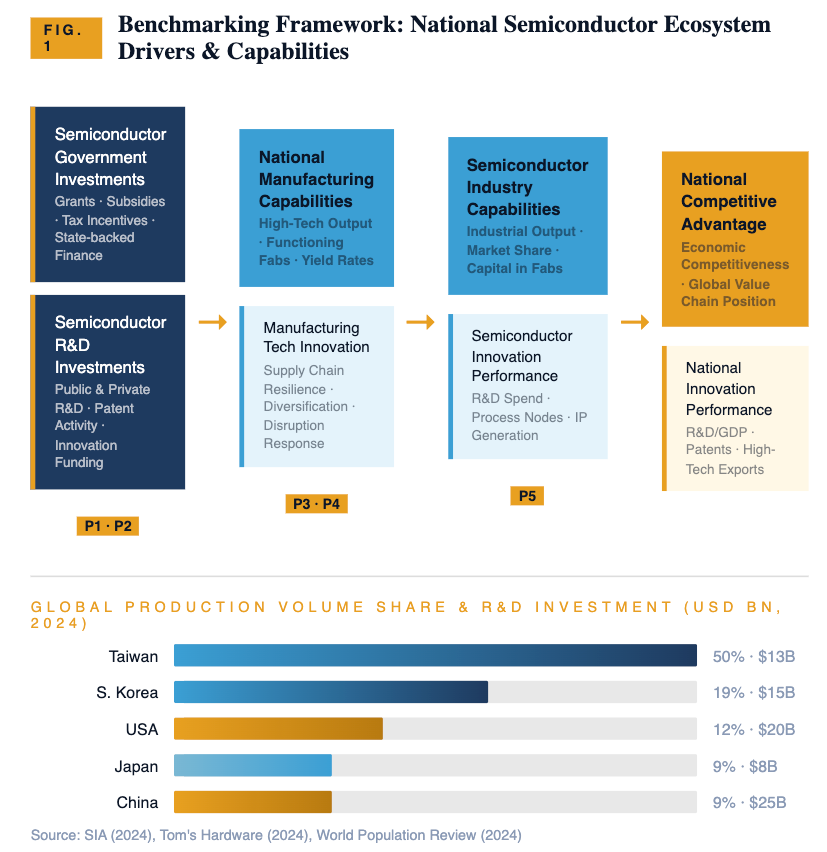
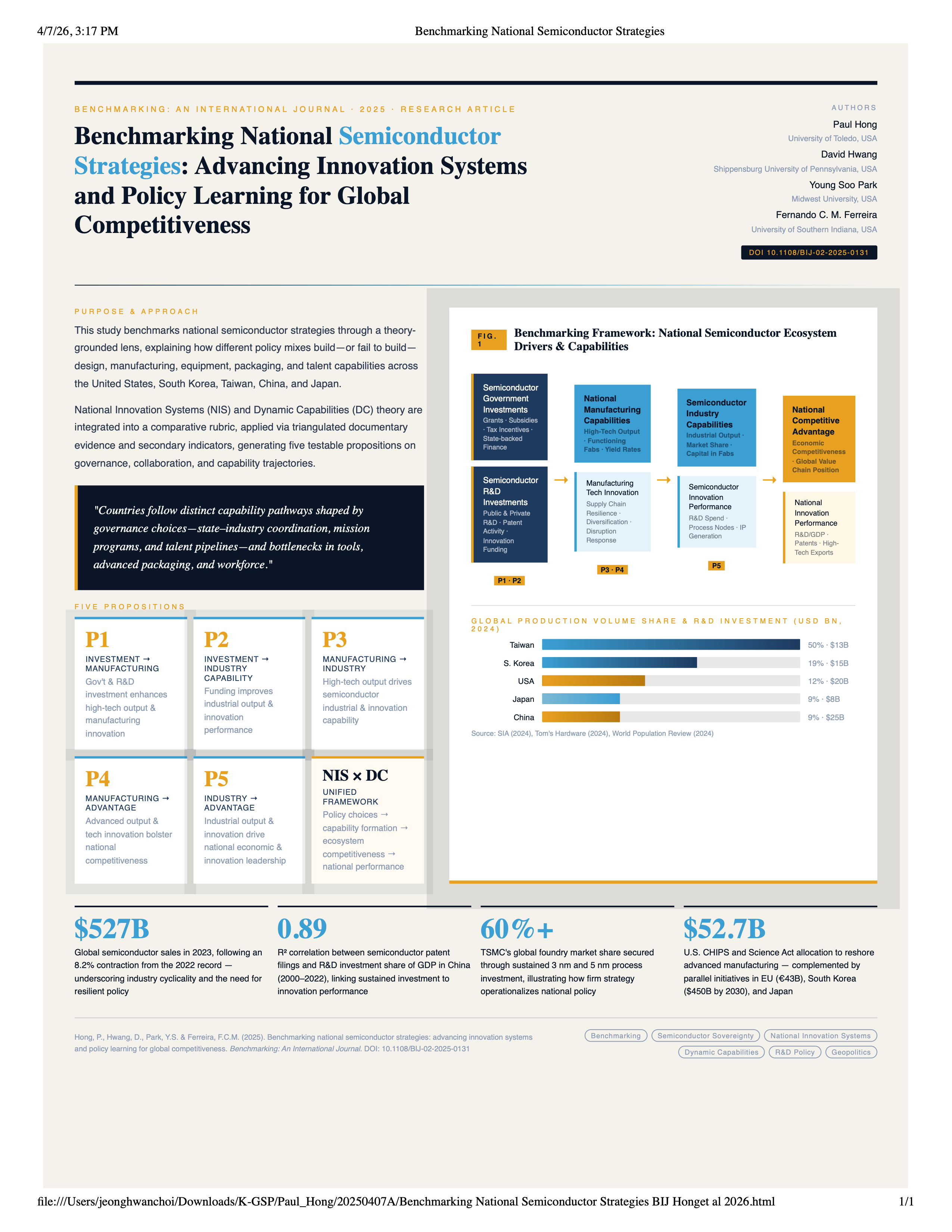
Benchmarking Framework: National Semiconductor Ecosystem Drivers & Capabilities
Semiconductor Government Investments — Grants · Subsidies · Tax Incentives · State-backed Finance. Semiconductor R&D Investments — Public & Private R&D · Patent Activity · Innovation Funding. P1 · P2 →
National Manufacturing Capabilities — High-Tech Output · Functioning Fabs · Yield Rates. Manufacturing Tech Innovation — Supply Chain Resilience · Diversification · Disruption Response. P3 · P4 →
Semiconductor Industry Capabilities — Industrial Output · Market Share · Capital in Fabs. Semiconductor Innovation Performance — R&D Spend · Process Nodes · IP Generation. P5 →
National Competitive Advantage — Economic Competitiveness · Global Value Chain Position. National Innovation Performance — R&D/GDP · Patents · High-Tech Exports.
Global Production Volume Share & R&D Investment (USD Bn, 2024)
Taiwan 50% · $13B · S. Korea 19% · $15B · USA 12% · $20B · Japan 9% · $8B · China 9% · $25B
Source: SIA (2024), Tom’s Hardware (2024), World Population Review (2024)
$527B — Global semiconductor sales in 2023, following an 8.2% contraction from the 2022 record — underscoring industry cyclicality and the need for resilient policy.
0.89 — R² correlation between semiconductor patent filings and R&D investment share of GDP in China (2000–2022), linking sustained investment to innovation performance.
60%+ — TSMC’s global foundry market share secured through sustained 3 nm and 5 nm process investment, illustrating how firm strategy operationalizes national policy.
$52.7B — U.S. CHIPS and Science Act allocation to reshore advanced manufacturing — complemented by parallel initiatives in EU (€43B), South Korea ($450B by 2030), and Japan.
Hong, P., Hwang, D., Park, Y.S. & Ferreira, F.C.M. (2025). Benchmarking national semiconductor strategies: advancing innovation systems and policy learning for global competitiveness. Benchmarking: An International Journal. DOI: 10.1108/BIJ-02-2025-0131
Benchmarking · Semiconductor Sovereignty · National Innovation Systems · Dynamic Capabilities · R&D Policy · Geopolitics
© 2026 KGSP Forum. All rights reserved. Content published in the KGSP Journal may not be reproduced, distributed, or transmitted in any form without prior written permission from the KGSP Forum, except for brief quotations with full attribution.