

Choi Rip’s Four-Point Memorial on Abolishing Factionalism in the Age of Artificial Intelligence
Political Unity, Remonstrance, and Popular Trust in Joseon Korea during the Imjin War
Abstract
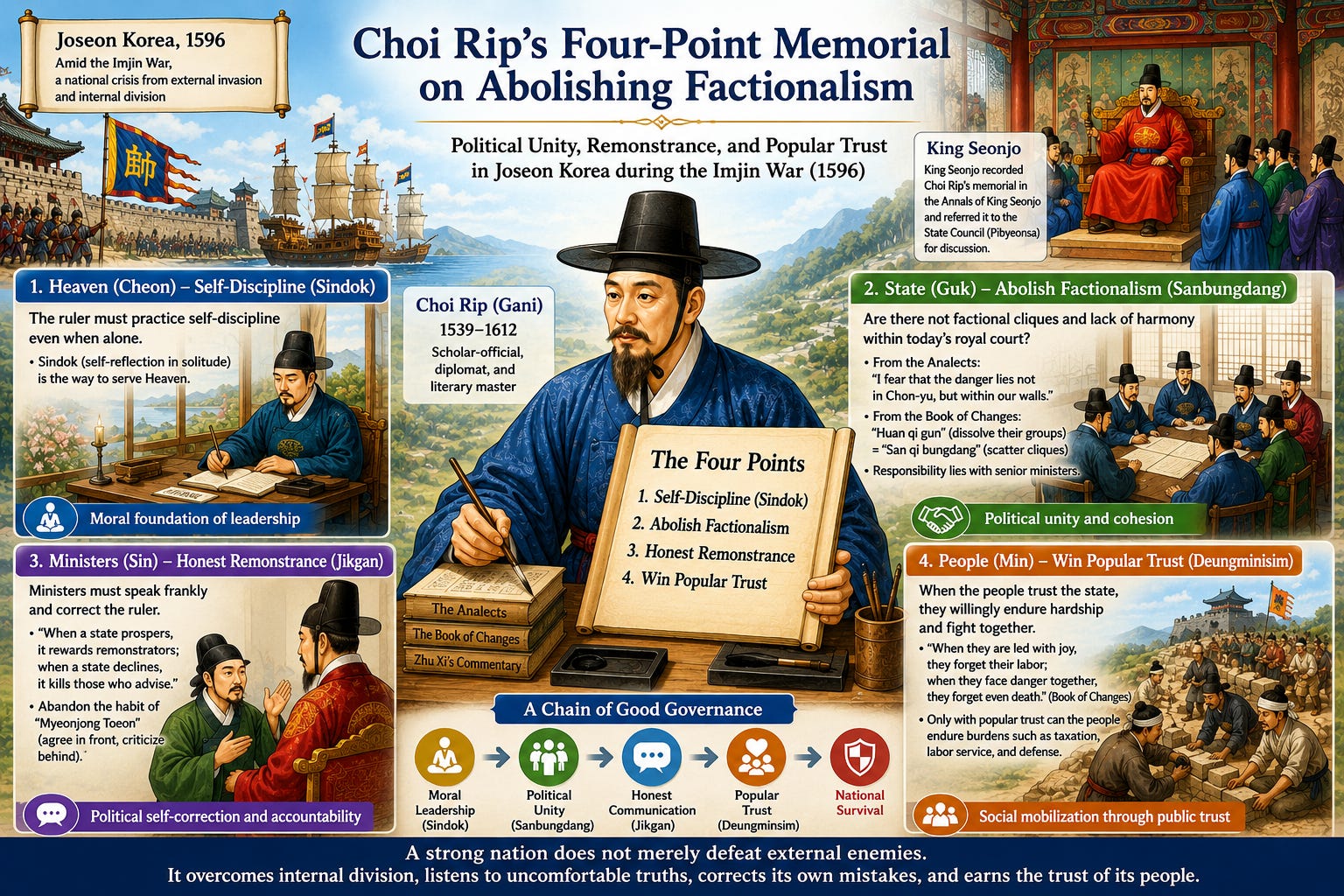
This essay examines a memorial submitted by Choi Rip (崔岦, 1539–1612), known by his literary name Gani (簡易), to King Seonjo in 1596, during the Imjin War. Recorded in the Annals of King Seonjo, the memorial presents four interconnected political questions concerning Heaven, the state, ministers, and the people. Choi Rip explicitly refers to them as “four points” (四條), making the document an important primary source for understanding his political thought and his response to the crisis of wartime Joseon (National Institute of Korean History [NIKH], 1596/2026).
The second point is especially significant. Choi Rip asks whether there was “偏黨, 不相和睦” — factionalism and lack of harmony — within the royal court. Drawing on the Analects, the Book of Changes (Yijing), and Zhu Xi’s interpretation, he invokes “渙其群” and explains it as “散其朋黨,” or dispersing factional associations. He therefore regarded factionalism not simply as personal disagreement but as a potential threat to political cohesion and national survival during wartime.
The other three points complete his political framework. First, the ruler must practice self-discipline, particularly 慎獨 (sindok), or moral vigilance when alone. Second, ministers must not merely obey the king outwardly while criticizing him privately; they must practice honest remonstrance (直諫). Third, the people must possess a willingness to endure hardship and defend the state because they trust their government. Choi Rip thus presents an integrated theory of crisis governance based on ethical leadership, political unity, truthful counsel, and popular trust.
This essay argues that Choi Rip’s memorial should not be interpreted anachronistically as an anticipation of modern democracy or party politics. Rather, it represents a distinctly Confucian theory of political self-correction within the institutional framework of the Joseon Dynasty. Yet its central question remains remarkably relevant: How can a political community preserve unity, hear uncomfortable truths, correct its own mistakes, and maintain public trust when confronted by existential crisis?
Keywords: Choi Rip, 崔岦, Gani, 簡易, King Seonjo, Joseon, factionalism, remonstrance, political unity, public trust, Imjin War, Yijing, Confucian political thought
A Political Question in the Middle of War
In 1596, Joseon Korea was still struggling with the devastating consequences of the Imjin War. The war was not confined to battlefields. Building fortifications, transporting provisions, mobilizing soldiers, training troops, and defending coastal areas placed enormous burdens upon the population.
It was in this environment that Choi Rip asked a fundamental question about the survival of the state.
He began his memorial by describing the situation as one in which:
“國家存亡, 間不容髮 / 국가존망, 간불용발”
The survival or destruction of the state was separated by no more than the width of a hair. He further observed:
“君臣同憂 / 군신동우”
Ruler and ministers shared the nation’s anxiety and were exhausting themselves in search of solutions (NIKH, 1596/2026).
Yet Choi Rip did not limit his proposal to military measures.
He asked a deeper question:
Why does a state become vulnerable to external enemies?
His answer was not simply a matter of military strength. A nation’s survival depended upon the moral condition of its leadership, political cohesion within the court, the willingness of ministers to speak honestly, and the confidence of the people in their government.
This perspective is particularly important when viewed against the political background of early Joseon factional politics under King Seonjo. The growing political influence of the Sarim literati was accompanied by the emergence of the Eastern and Western factions. Modern scholarship has connected this factional development with structural tensions within the political order of Seonjo’s reign (Lee, 2012).
Choi Rip’s 1596 memorial should therefore be understood at the intersection of two crises:
the external crisis of the Imjin War and the internal crisis of political factionalism.
Choi Rip and the Historical Significance of the Memorial
Choi Rip (1539-1612)’s courtesy name was Ipji (立之), and his literary name was Gani (簡易). He was a scholar-official, diplomat, and celebrated literary figure of the late sixteenth-century Joseon Dynasty.
His literary reputation rested particularly on his mastery of classical prose and poetry. His collected writings were preserved in the Gani chip (簡易集).
The 1596 memorial is significant not only as a political document but also as an example of Choi Rip’s sophisticated classical prose and his ability to construct political arguments through extensive references to the Confucian classics.
The Annals of King Seonjo records the memorial and reports that King Seonjo ordered the matter to be referred to the Border Defense Council (Pibyŏnsa) for discussion and recommendation (NIKH, 1596/2026).
The response demonstrates that Choi Rip’s argument was treated as a matter of substantive state policy rather than merely literary commentary.
The First Point — Heaven and the Ruler’s Self-Cultivation
Choi Rip’s first question concerns the relationship between Heaven and political leadership:
“何謂天之欲禍, 未欲禍也? / 하위천지욕화, 미욕화야?”
What distinguishes a situation in which Heaven intends calamity from one in which it does not?
Choi Rip draws upon classical Confucian texts to connect the fate of the state with the moral condition of political leadership.
At the center of his argument is the concept of 慎獨 (sindok), moral vigilance when one is alone.
He writes:
“先儒以謹獨一事, 爲事天之事 / 선유이신독일사, 위사천지사”
Earlier Confucian scholars regarded careful self-discipline when alone as a way of serving Heaven (NIKH, 1596/2026).
The political implication is clear:
Political reform begins with the ruler’s own moral self-examination.
The state cannot be repaired merely through military mobilization or administrative commands. The ruler must first discipline himself.
Although this idea may be compared metaphorically with modern concepts such as leadership integrity or ethical self-audit, Choi Rip’s original framework remained firmly grounded in Confucian theories of Heaven, kingship, and self-cultivation.
The Second Point — The State: Overcoming Factionalism
The second point is the most striking part of Choi Rip’s memorial.
He discusses historical examples and argues that when evaluating another state, one should not look only at its soldiers, provisions, or fortifications. One should also examine whether the ruler and ministers are harmonious.
He then turns directly to the Joseon court:
“今日朝廷之下, 得無有偏黨, 不相和睦之弊 / 금일조정지하, 득무유편당, 불상화목지폐”
“Is there not, within today’s royal court, the problem of factionalism and mutual discord?” (NIKH, 1596/2026).
This statement provides direct evidence that Choi Rip perceived 偏黨 (pyeondang), factional division, as a serious political problem.
He strengthens his argument through classical sources.
From the Analects, he invokes Confucius’ warning:
“吾恐季孫之憂, 不在顓臾而在蕭墻之內也 / 오공계손지우, 불재전유이재소장지내야”
The danger may not lie outside the walls; it may lie within them.
The metaphor of 蕭墻之憂 (소장지우) therefore becomes particularly powerful in the context of wartime Joseon.
The country was under attack from abroad, yet Choi Rip warned that internal division could also be destructive.
He then turns to the Yijing, citing the fourth line of the Huan hexagram:
“渙其群, 元吉 / 환기군, 원길”
and drawing upon Zhu Xi’s interpretation:
“散其朋黨 / 산기붕당”
— dispersing factional associations.
This is the textual foundation for Choi Rip’s call to overcome factionalism (NIKH, 1596/2026).
Factionalism as a National-Security Problem
Choi Rip did not treat factionalism merely as a matter of personal disagreement.
His deeper argument was that:
political fragmentation weakens the state’s ability to respond to external threats.
This interpretation is consistent with modern scholarship on factional politics in Joseon. Political factionalism emerged during the sixteenth century as competing groups of scholar-officials struggled over political influence, legitimacy, and policy.
Lee (2012), for example, examines the causes and development of factional conflict during King Seonjo’s reign and situates the conflict within the transformation of Joseon’s political order.
Jackson (2026) likewise identifies political factionalism as a major feature of Joseon political life that influenced royal decision-making over an extended period.
Choi Rip’s argument is therefore remarkable because he connected factional division directly with the question of national survival during wartime.
For him:
Political fragmentation was not merely an administrative inconvenience. It was a strategic vulnerability.
Who Was Responsible for Ending Factionalism?
Choi Rip does not simply identify the problem. He assigns responsibility.
After discussing the relevant classical texts, he states:
“是皆責在大臣者 / 시개책재대신자”
The responsibility lies particularly with the senior ministers (NIKH, 1596/2026).
This is an important element of Choi Rip’s political philosophy.
He did not simply ask the king to command everyone to cooperate. He placed particular responsibility upon the political leadership.
Senior officials had to rise above factional interests and restore a sense of common purpose.
This may resemble a modern theory of political accountability when viewed retrospectively. Historically, however, Choi Rip’s position remained firmly within the Confucian political order.
He was not proposing competitive party politics or a modern pluralistic parliamentary system.
Rather, he wanted officials to subordinate factional interests to the moral and political interests of the state.
The Third Point — Ministers Must Speak Truth to Power
Choi Rip’s third question concerns the responsibilities of ministers:
“何謂臣之毋以亡道事之也? / 하위신지무이망도사지야?”
What does it mean for a minister not to serve the ruler in a way that leads him toward destruction?
His answer centers on remonstrance (ganjaeng, 諫諍).
A loyal minister must tell the ruler what he needs to hear rather than merely what he wants to hear.
Choi Rip invokes the traditional maxim:
“國將興, 必賞諫臣; 國將亡, 必殺謀臣 / 국장흥, 필상간신; 국장망, 필살모신”
When a state is about to prosper, it rewards those who remonstrate; when a state is about to perish, it destroys those who give counsel.
The principle is straightforward:
A government that cannot hear criticism cannot correct its mistakes.
This becomes especially important in wartime, when a single erroneous decision can produce enormous consequences.
The Danger of “面從退言”
Choi Rip identifies a particularly dangerous political habit:
“面從退言之習 / 면종퇴언지습”
the habit of agreeing with the ruler in his presence but speaking differently after leaving him.
The problem is not merely hypocrisy.
If officials remain silent before the ruler, the ruler cannot receive accurate information. Errors remain uncorrected. Policies continue despite their weaknesses. The political system loses its capacity for self-correction.
Choi Rip therefore regards honest remonstrance as an essential component of good government.
The loyal minister is not the minister who always agrees.
The loyal minister is the one who speaks when speaking is necessary.
Remonstrance and National Security
This argument becomes even more significant in the context of the Imjin War.
During a national emergency, the quality of information reaching political leaders can determine the outcome of policy.
If leaders suppress unpleasant information, officials will learn to conceal problems. If officials fear punishment for disagreement, political institutions become informationally blind.
Choi Rip’s criticism of 面從退言 can therefore be read as an early Confucian reflection on the relationship among truthful communication, political accountability, and national security.
Lee’s (2012) analysis of the political structure during King Seonjo’s reign is relevant here because it highlights the political tensions and institutional dynamics that characterized this period.
Choi Rip’s solution was not institutional engineering in the modern sense.
His solution was ethical:
leaders must create conditions in which truthful counsel can be heard.
The Fourth Point — The People and Political Trust
The fourth question concerns the people:
“何謂民之有與之俱存之心也? / 하위민지유여지구존지심야?”
What does it mean for the people to possess the will to exist together with the state?
He again turns to the Yijing, citing the T’ai hexagram:
“說以先民, 民忘其勞; 說以犯難, 民忘其死. / 열이선민, 민망기노; 열이범난, 민망기사.”
When the people willingly follow a leader into hardship, they can forget their labor; when they willingly face danger, they can even forget death (NIKH, 1596/2026).
Choi Rip connects this classical principle with the examples of Yu and King Tang.
The people endured enormous burdens because they believed that their leaders were acting for the common good.
This leads to one of the most important arguments in the memorial:
A government cannot demand sacrifice indefinitely without maintaining public trust.
The People under the Burden of War
Choi Rip applies this principle directly to the conditions of his own time.
He describes the burdens placed upon the population, including:
constructing and repairing fortifications;
defending coastal areas;
training soldiers;
transporting military supplies; and
performing various forms of wartime labor.
Such policies could be necessary for national defense. But when the people no longer believed that the government could protect them, necessary mobilization could be experienced as exploitation.
Choi Rip therefore recognizes an important distinction:
The same sacrifice can be understood either as patriotic service or as oppressive labor, depending upon the level of trust between government and people.
This insight is remarkably relevant to the study of wartime governance.
National Security Begins with Public Trust
For Choi Rip, public sentiment is not merely a moral ideal.
It is a practical component of national power.
When people trust the government, they are more willing to:
transport provisions;
construct fortifications;
participate in military training;
accept taxation and labor obligations; and
endure the hardships of war.
When that trust collapses, the same policies become sources of resentment and resistance.
Choi Rip’s argument can therefore be represented as a cycle:
Responsible governance → public trust → collective participation → national mobilization → stronger national defense
The opposite cycle is equally dangerous:
Political factionalism → policy distrust → popular alienation → weakened mobilization → national vulnerability
In this sense, Choi Rip’s memorial can be interpreted not merely as a statement of Confucian benevolence but also as an early reflection on state capacity during national crisis.
The Four Points as an Integrated Political Philosophy
At the conclusion of the memorial, Choi Rip explicitly refers to:
“凡臣所列四條 / 범신소열사조”
— “the four points that I have presented” (NIKH, 1596/2026).
These four points can be summarized as follows:
Domain Choi Rip’s Core Principle Central Question Political Function
Heaven 慎獨 self-discipline How should the ruler govern himself? Moral foundation of leadership
State 散朋黨 overcoming factionalism How can political division be overcome?Political cohesion
Ministers 直諫 honest remonstrance How should officials correct the ruler?Political self-correction
People 得民心 winning popular trust Why should people sacrifice for the state? Social mobilization
These four points are not independent.
The ruler’s self-discipline produces moral credibility.
Political unity produces coherent government.
Honest remonstrance enables correction of mistakes.
Public trust transforms government policy into collective action.
Thus, Choi Rip’s political philosophy can be understood as a chain:
Moral leadership → political cohesion → truthful communication → public trust → national survival
Choi Rip and Yi I: Convergence and Difference
Choi Rip’s argument can be compared with the political thought of Yi I (李珥), another major Confucian thinker of the Joseon period.
Modern scholarship has examined Yi I’s efforts to overcome political factionalism through concepts of political reconciliation and institutional reform (Lee, 2012).
Choi Rip shared Yi I’s concern that political division threatened effective government. Yet the circumstances were different.
Yi I addressed the developing political tensions of the sixteenth-century court, whereas Choi Rip wrote his memorial amid the continuing crisis of the Imjin War.
For Choi Rip, therefore, factionalism had become inseparable from the question of national survival.
His use of “渙其群 (환기군)” and “散其朋黨 (산기붕당)” was not simply a call for people to get along.
It was a demand that political actors recognize a larger common purpose when the survival of the state itself was at stake.
Choi Rip’s Critique Should Not Be Equated with Modern Anti-Party Politics
There is an important historical qualification.
Choi Rip’s call to “散其朋黨 (산기붕당)” should not be interpreted as a call for the abolition of political parties in the modern democratic sense.
Modern democratic political parties serve important functions by organizing competing interests, representing citizens, and institutionalizing political disagreement.
Choi Rip lived in a fundamentally different political order.
His target was not political pluralism as such but factional loyalty that subordinated public interests to private group interests.
The historical question he raises nevertheless remains relevant:
What happens when political groups become more committed to defeating one another than to solving the problems of the state?
This question transcends the political institutions of any single historical period.
Choi Rip and the Philosophy of Political Self-Correction
Perhaps the most interesting feature of Choi Rip’s memorial is that he does not present a single policy solution.
Instead, he emphasizes the capacity of government to recognize and correct its own mistakes.
The ruler must examine himself.
Senior ministers must rise above factional interests.
Officials must speak honestly.
The people must have confidence that government serves their welfare.
Taken together, these principles create a political system capable of self-correction.
This can be compared analytically with contemporary concepts such as:
accountability, dissent, feedback, transparency, and institutional trust.
Such comparisons should be understood as analytical analogies rather than claims that Choi Rip anticipated modern political science.
His intellectual framework remained Confucian.
Nevertheless, the underlying problem is strikingly familiar:
How can a political system prevent itself from becoming blind to its own failures?
Re-reading Choi Rip in the Age of Artificial Intelligence
Choi Rip’s memorial is particularly interesting in the age of artificial intelligence because AI systems have intensified questions about information, authority, decision-making, and trust.
Powerful AI does not automatically produce wise decisions.
If leaders receive biased information, if organizations become trapped in informational echo chambers, if dissenting experts are ignored, or if citizens do not trust AI-assisted government, technological capacity may actually amplify existing weaknesses.
Choi Rip’s four principles can therefore be used as a modern interpretive framework, without claiming that he anticipated AI.
慎獨 / 신독 — Leadership Integrity
Leaders should critically examine AI-generated information rather than accepting it automatically.
散朋黨 / 산붕당 — Breaking Information Echo Chambers
Organizations should prevent factional or algorithmic information bubbles from determining policy.
直諫 / 직간 — Institutionalized Dissent
Human experts should be able to challenge AI-generated recommendations, especially when those recommendations affect public safety or national security.
得民心 / 득민심 — Human Trust
AI-based government must earn public confidence. Technical efficiency alone cannot produce legitimate governance.
These applications are contemporary interpretations rather than historical claims about Choi Rip.
Conclusion — The Enemy Within
In 1596, while the Imjin War continued, Choi Rip did not simply tell King Seonjo to build more fortifications or recruit more soldiers.
He asked a more fundamental question:
Why does a state become weak?
His answer had four dimensions.
When the ruler fails to examine himself,
when the court becomes divided by faction,
when ministers are afraid to speak truthfully,
and when the people lose trust in the government,
the state becomes vulnerable even before the enemy breaches its borders.
This is the central message of Choi Rip’s memorial.
His reference to “渙其群 (환기군)” and “散其朋黨 (산기붕당)” was therefore much more than an appeal for political harmony. It was a question about whether a nation could still act as a unified political community.
His criticism of 面從退言 (면종퇴언) was more than a complaint about hypocrisy. It was a question about whether those in power could hear uncomfortable truths.
And his emphasis on the people was more than a conventional expression of Confucian benevolence. It was an argument that public trust can be transformed into real national capacity during a crisis.
Nearly four and a half centuries later, the question remains remarkably powerful:
The strongest state is not necessarily the state with the most weapons. It is the state capable of overcoming internal division, hearing uncomfortable truths, correcting its own mistakes, and maintaining trust between government and people.
In the age of artificial intelligence, that lesson may be more important than ever.
The most dangerous enemy of a nation may not always be waiting beyond its borders. Sometimes it begins with the loss of trust within them.
References
Jackson, A. D. (2026). Political factionalism in Chosŏn Korea. In A. D. Jackson, S. Nguyen, & E. Richards (Eds.), Snapshots and soundbites of Korea (pp. 250–253). Routledge. https://doi.org/10.4324/9781003591689-100
Lee, J.-C. (2012). 선조 대 당쟁의 원인과 전개양상—이이를 중심으로 [The causes and development of factional strife during King Seonjo’s reign: Focusing on Yi I]. 藏書閣, 28, 72–107. https://doi.org/10.25024/jsg.2012..28.72
Liu, S. J. (2019). Su Shi’s (蘇軾) influence on Choi Yip’s (崔岦) poetry. Journal of Chinese Language and Literature, 81, 87–112. https://doi.org/10.15792/clsyn..81.201908.87
National Institute of Korean History. (1596/2026). The Veritable Records of King Seonjo, Vol. 74, Seonjo 29, fourth month, fifth day (辛丑), third article: Memorial of Haenghogun Choi Rip (崔岦). Annals of the Joseon Dynasty. Annals of King Seonjo — Choi Rip’s Memorial
Song, J.-H. (2017). 왜란·호란 양란기 구천(句踐) 담론과 재건의 정치 [The discourse of Goujian and the politics of reconstruction during the Imjin and Manchu Wars]. 한국동양정치사상사연구, 16(1), 91–122.
한국학중앙연구원. (n.d.). 최립(崔岦) [Choi Rip]. 한국민족문화대백과사전. Korean Historical Dictionary — Choi Rip
최립. (1631). 간이집(簡易集) [Collected Works of Gani]. Initial woodblock edition.
인공지능 시대의 간이 최립(崔岦)의 파당(派黨) 해소를 위한 네 가지 조목의 상소(上疏) 고찰
임진왜란기 조선의 정치적 통합, 직간, 그리고 민심
초록
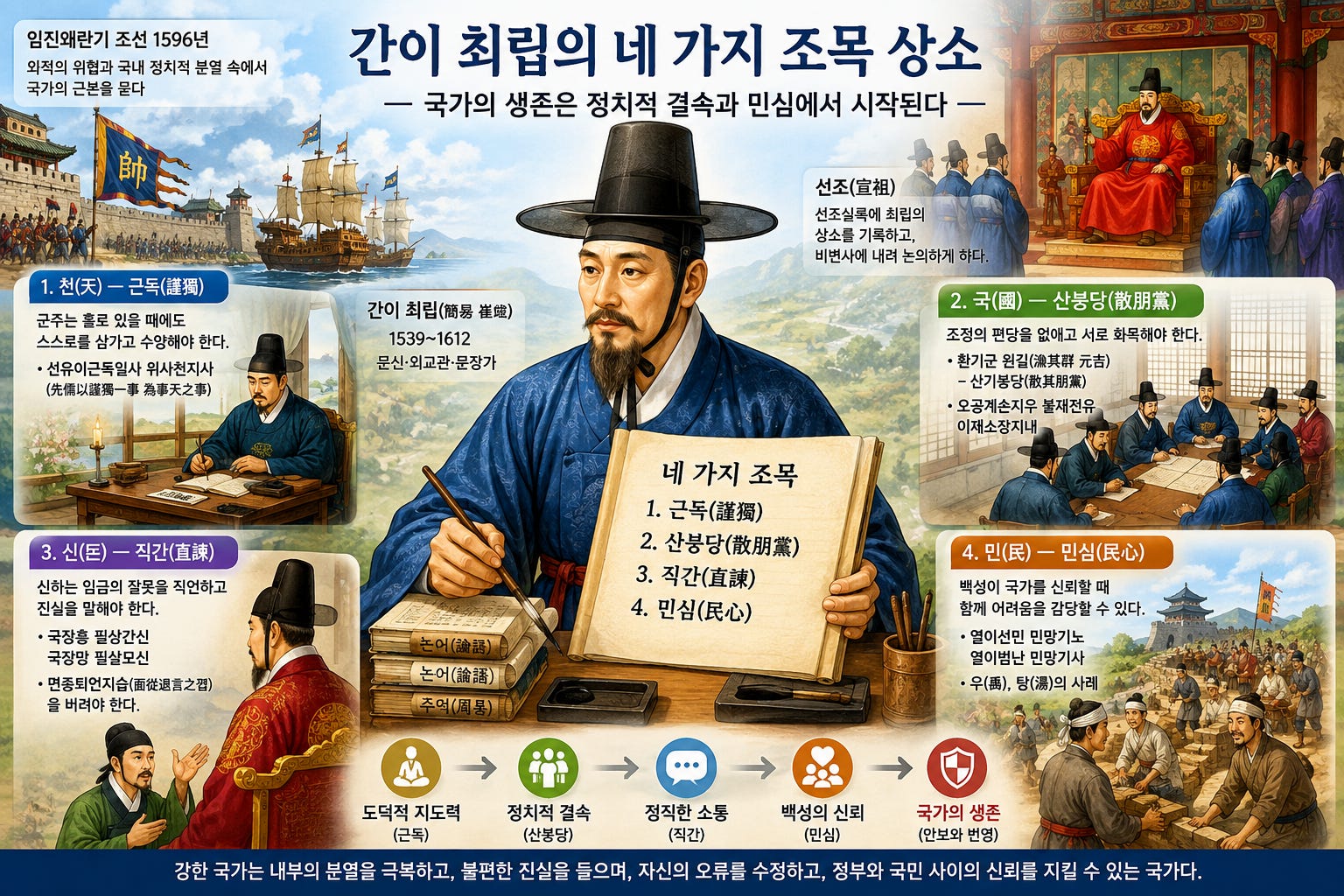
본고는 간이(簡易) 최립(崔岦, 1539–1612)이 임진왜란이 계속되던 선조 29년(1596)에 선조 임금에게 올린 네 가지 조목의 상소(上疏, 상소)를 중심으로 그의 정치사상을 고찰한다. 『선조실록(宣祖實錄)』에 수록된 이 상소에서 최립은 천(天), 국가(國家), 신하(臣下), 백성(民, 민)의 관계를 네 가지 조목으로 나누어 논하면서, 국가적 위기를 극복하기 위해서는 군주의 자기수양, 조정의 파당 해소, 신하의 직간, 백성의 신뢰가 함께 이루어져야 한다고 주장하였다.
특히 두 번째 조목에서 최립은 당시 조정에 편당(偏黨)을 만들고 서로 화목하지 못하는 폐단이 있지 않은지를 직접 묻는다. 그는 『논어(論語)』와 『주역(周易)』 및 주희(朱熹)의 해석을 인용하면서 『주역』 환괘(渙卦)의 “환기군(渙其群)”을 “산기붕당(散其朋黨)”, 즉 붕당을 흩어 없애는 것으로 해석하였다. 이는 최립이 파당을 단순한 개인적 갈등이 아니라 국가의 정치적 결속과 존립을 위협할 수 있는 문제로 인식했음을 보여준다.
나머지 세 조목은 이러한 정치적 통합론을 보완한다. 첫째, 군주는 근독(謹獨)을 통해 홀로 있을 때에도 자신을 삼가고 수양해야 한다. 둘째, 신하는 임금 앞에서는 순종하고 뒤에서는 불평하는 면종퇴언(面從退言)의 폐단을 버리고 직간(直諫)해야 한다. 셋째, 백성은 국가가 자신들을 보호하고 있다는 믿음을 가질 때 국가의 어려움과 희생을 함께 감당할 수 있다.
따라서 최립의 네 가지 조목은 도덕적 지도력 → 정치적 결속 → 정직한 소통 → 백성의 신뢰 → 국가의 생존이라는 하나의 정치적 자기교정 체계를 형성한다. 본고는 이러한 최립의 주장을 현대 민주주의나 정당정치의 선구적 형태로 해석하기보다는 조선(朝鮮)의 유교적 군주정치라는 역사적 맥락에서 이해해야 한다고 본다. 그러나 정치적 분열을 극복하고, 권력자에게 불편한 진실을 전달하며, 백성의 신뢰를 국가역량으로 전환해야 한다는 그의 문제의식은 오늘날에도 중요한 의미를 갖는다.
핵심어: 최립(崔岦), 간이(簡易), 선조(宣祖), 조선(朝鮮), 붕당(朋黨), 파당(派黨), 직간(直諫), 민심(民心), 임진왜란(壬辰倭亂), 주역(周易), 유교 정치사상
전쟁 한가운데서 던진 정치의 질문
1596년 조선은 아직 임진왜란(壬辰倭亂)의 참혹한 충격에서 벗어나지 못하고 있었다. 전쟁은 전쟁터에만 존재한 것이 아니었다. 성을 쌓고, 군량을 운송하고, 군사를 동원하고, 군사훈련을 실시하고, 해안을 방어하는 모든 일이 백성의 삶을 무겁게 짓누르고 있었다.
바로 이러한 상황에서 최립은 국가의 생존에 관한 근본적인 질문을 던졌다.
그는 상소의 첫머리에서
“국가존망(國家存亡), 간불용발(間不容髮)”
이라고 하였다.
이는 “국가의 존망(存亡)이 머리카락 하나가 들어갈 틈도 없을 정도로 위급하다”는 뜻이다. 이어
“군신동우(君臣同憂)”
라고 하여 임금과 신하가 함께 국가의 위기를 걱정하며 해결책을 찾고 있다고 하였다.
그러나 최립은 단순히 더 많은 군사를 모집하고 성을 더 튼튼하게 만들자는 데서 그치지 않았다.
그는 더 근본적인 질문을 던졌다.
왜 국가는 외적의 공격에 취약해지는가?
그의 대답은 군사력에만 있지 않았다.
국가의 생존은 통치자의 도덕적 상태, 조정의 정치적 결속, 신하의 정직한 간언, 그리고 백성의 국가에 대한 신뢰에 달려 있다는 것이었다.
이러한 관점은 선조(宣祖)대 조선 정치의 상황과 함께 살펴볼 필요가 있다. 선조 초에는 사림(士林) 세력이 정치적 영향력을 확대하는 과정에서 동인(東人)과 서인(西人)의 분열이 발생하였다. 이러한 정치적 분열은 선조대 정치질서의 변화와 정치세력 간의 긴장 속에서 발전하였다.
따라서 최립의 1596년 상소는 두 가지 위기가 교차하는 지점에서 읽을 수 있다.
밖에서는 임진왜란이라는 국가적 위기가 진행되고 있었고, 안에서는 정치적 파당과 분열이라는 위기가 존재했다.
최립과 이 상소의 역사적 의미
최립은 1539년에 태어나 1612년에 세상을 떠났다. 자(字)는 입지(立之)이고 호(號)는 간이(簡易)이다. 그는 조선 중기의 문신(文臣)이자 외교관이며 뛰어난 문장가였다.
그의 문학적 명성은 특히 한문(漢文) 산문과 시에서 두드러졌다. 그의 저술은 후대에 『간이집(簡易集)』으로 정리되어 전해졌다.
1596년의 상소는 정치문서인 동시에 최립 특유의 고전적 문장과 논증 능력을 보여주는 중요한 산문이다.
최립은 단순히 자신의 의견을 주장하지 않았다. 그는 『논어(論語)』, 『주역(周易)』 등 유교 경전(經典)과 역사적 고사(故事)를 끌어와 당시의 현실을 분석하였다.
『선조실록(宣祖實錄)』은 이 상소를 기록하고, 선조는 그 내용을 비변사(備邊司)에 내려 논의하도록 하였다.
이는 최립의 주장이 단순한 문인의 개인적인 의견이 아니라 당시 국가정책의 차원에서 검토되었음을 보여준다.
첫 번째 조목 — 하늘과 군주의 자기수양
최립의 첫 번째 질문은 천(天)과 통치자의 관계에 관한 것이다.
그는 묻는다.
“하위천지욕화 미욕화야(何謂天之欲禍, 未欲禍也)”
즉, 하늘이 재앙을 내리려는 경우와 그렇지 않은 경우는 무엇인가라는 질문이다.
최립은 유교 경전을 통해 국가의 흥망(興亡)과 통치자의 도덕적 상태를 연결한다.
그 중심에 있는 개념이 바로 근독(謹獨)이다.
그는 다음과 같이 말한다.
“선유이근독일사 위사천지사(先儒以謹獨一事, 爲事天之事)”
즉, 선대 유학자들은 홀로 있을 때 자신을 삼가는 것을 하늘을 섬기는 일로 보았다는 뜻이다.
정치적 의미는 분명하다.
정치의 개혁은 군주 자신의 자기성찰에서 시작되어야 한다.
국가의 문제를 해결하기 위해서는 군사력이나 행정명령만으로는 부족하다. 통치자 자신이 먼저 자신의 마음과 행동을 살펴야 한다.
두 번째 조목 — 국가: 파당을 해소하라
최립의 상소에서 가장 주목해야 할 부분은 두 번째 조목이다.
그는 역사적 사례를 통해 국가의 힘을 평가할 때 단순히 군사의 수, 군량, 성곽만 보아서는 안 된다고 주장한다.
오히려 임금과 신하가 서로 화목한가를 살펴보아야 한다.
그리고 마침내 자신의 시대의 조정을 향해 직접 묻는다.
“금일조정지하 득무유편당 불상화목지폐(今日朝廷之下, 得無有偏黨, 不相和睦之弊)”
이는 “오늘날 조정에 편당을 짓고 서로 화목하지 못하는 폐단이 있지 않은가?”라는 뜻이다.
여기서 ‘조정(朝廷)’은 왕과 신하들이 국가의 정사를 논의하는 정치공간을 뜻한다.
‘편당(偏黨)’은 특정한 정치집단이나 사적인 세력에 치우치는 것을 의미한다.
최립은 이어 『논어(論語)』의 유명한 구절을 인용한다.
“오공계손지우 불재전유 이재소장지내야(吾恐季孫之憂, 不在顓臾而在蕭墻之內也)”
뜻은 “나는 계손(季孫)의 근심이 전유(顓臾)에 있는 것이 아니라 도리어 자기 집 담장 안에 있을까 두렵다”는 것이다. (여기서 ‘전유(顓臾)’는 계손씨가 공격하려고 했던 외부의 작은 나라를 가리킵니다. 반면 ‘소장(蕭牆)’은 궁궐이나 집 안쪽의 담장을 뜻합니다.)
이 말은 외부의 적보다 내부의 분열이 더욱 위험할 수 있다는 정치적 비유로 읽을 수 있다.
전쟁 중인 조선에서 이 말은 특별한 의미를 갖는다.
외부에는 일본군이라는 명백한 적이 있었지만, 최립은 내부의 정치적 분열 역시 국가를 위태롭게 만들 수 있다고 경고하였다.
“환기군”과 “산기붕당”
최립은 이어 『주역(周易)』 환괘(渙卦)의 구절을 인용한다.
“환기군 원길(渙其群, 元吉)”
여기에서 환(渙)은 흩어지다, 풀어지다라는 뜻이며, 군(群)은 무리 또는 집단을 뜻한다.
최립은 주희(朱熹)의 해석을 통하여 이를
“산기붕당(散其朋黨)”
이라고 설명한다.
즉,
“사적인 붕당(朋黨)을 흩어 없애야 한다”
는 의미이다.
이것이 최립의 파당 해소론에서 가장 중요한 경전적 근거 가운데 하나이다.
파당은 국가안보의 문제였다
최립은 파당을 단순한 인간관계의 불화로 보지 않았다.
그가 더 깊이 우려한 것은 정치적 분열이 외적에 대한 국가의 대응력을 약화시킬 수 있다는 사실이었다.
여기에서 중요한 것은 ‘붕당(朋黨)’과 현대적 의미의 ‘정당(政黨)’을 동일시하지 않는 것이다.
최립이 문제 삼은 것은 특정 집단에 대한 정치적 충성이 국가 전체의 공익(公益)보다 앞서는 상황이었다.
따라서 그의 논리는 다음과 같이 요약할 수 있다.
외부의 적이 강해서 국가가 약해지는 것만이 아니다.
내부의 분열 때문에 국가가 약해질 수도 있다.
이러한 의미에서 최립에게 정치적 화합은 단순한 도덕적 미덕이 아니라 국가안보(國家安保)의 조건이었다.
파당을 없애는 책임은 누구에게 있는가
최립은 문제를 지적하는 데 그치지 않고 책임의 주체까지 명확하게 제시한다.
그는 다음과 같이 말한다.
“시개책재대신자(是皆責在大臣者)”
즉, “이 모든 책임은 대신(大臣)에게 있다”는 뜻이다.
이 대목은 최립의 정치사상에서 매우 중요하다.
그는 단순히 임금에게 모든 사람에게 화합하라고 명령하라고 요구하지 않았다.
오히려 고위 정치지도자들이 먼저 책임을 져야 한다고 보았다.
대신들은 당파적 이해관계를 넘어 국가 전체의 이익을 바라보아야 했다.
이것은 현대적 의미의 정치적 책임성(政治的責任性)과 비교할 수 있는 측면이 있지만, 최립의 사상은 현대 민주주의의 책임정치가 아니었다.
그는 공익을 위해 사적인 당파적 이해를 내려놓아야 한다는 유교적 정치윤리를 주장한 것이다.
세 번째 조목 — 신하는 권력자에게 진실을 말해야 한다
최립의 세 번째 질문은 신하(臣下)의 역할에 관한 것이다.
그는 묻는다.
“하위신지무이망도사지야(何謂臣之毋以亡道事之也)”
이는 “신하가 임금을 망하는 길로 섬기지 않는다는 것은 무엇인가?”라는 질문이다.
최립이 강조하는 것은 간언(諫言)과 직간(直諫)이다.
충성스러운 신하는 임금이 듣고 싶어 하는 말이 아니라 임금에게 필요한 말을 해야 한다.
그는 다음과 같은 전통적인 정치론을 인용한다.
“국장흥 필상간신 국장망 필살모신(國將興, 必賞諫臣; 國將亡, 必殺謀臣)”
즉,
“나라가 장차 흥하려 하면 반드시 간언하는 신하를 포상하고, 나라가 장차 망하려 하면 반드시 계책을 내는 신하를 죽인다.”
는 뜻이다.
최립이 강조하는 원리는 명확하다.
비판을 들을 수 없는 정부는 자신의 잘못을 고칠 수 없다.
“면종퇴언”의 위험
최립은 당시 정치에서 매우 위험한 습관을 지적한다.
“면종퇴언지습(面從退言之習)”
‘면종(面從)’은 사람의 면전에서는 순종하는 것을 말하고, ‘퇴언(退言)’은 그 사람이 물러간 뒤 다른 말을 하는 것을 뜻한다.
따라서 ‘면종퇴언지습(面從退言之習)’은
“임금 앞에서는 순종하는 척하면서 물러난 뒤에는 다른 말을 하는 습관”
을 의미한다.
이것은 단순한 위선의 문제가 아니다.
신하들이 임금 앞에서 사실을 말하지 않으면 임금은 정확한 정보를 얻을 수 없다.
잘못된 정책이 계속된다.
정책의 문제점이 교정되지 않는다.
결국 정치체제 전체가 스스로의 오류를 수정할 능력을 잃게 된다.
따라서 최립에게 ‘직간(直諫)’은 단순한 신하 개인의 용기가 아니었다.
그것은 국가의 자기교정 능력을 유지하기 위한 필수 조건이었다.
충성스러운 신하는 항상 동의하는 신하가 아니다.
필요한 순간에 진실을 말하는 신하가 진정으로 충성스러운 신하다.
네 번째 조목 — 백성과 정치적 신뢰
네 번째 질문은 민(民), 즉 백성에 관한 것이다.
최립은 묻는다.
“하위민지유여지구존지심야(何謂民之有與之俱存之心也)”
이는 “백성이 국가와 함께 존재하고자 하는 마음을 갖게 한다는 것은 무엇인가?”라는 뜻이다.
그는 다시 『주역(周易)』의 원리를 인용한다.
“열이선민 민망기노 열이범난 민망기사(說以先民, 民忘其勞; 說以犯難, 民忘其死)”
여기에서 ‘說 (열)’은 기쁘게 하다 또는 기꺼이 따르게 하다는 뜻이다.
전체적인 의미는 지도자가 백성을 앞세우고 함께 어려움을 감당하면 백성은 자신의 수고를 잊으며, 함께 위험을 무릅쓰면 죽음까지도 잊는다는 것이다.
최립은 이를 우(禹)와 탕(湯)의 역사적 사례와 연결한다.
백성은 엄청난 노동과 희생을 감당했지만, 지도자가 자신들을 위해 행동한다는 믿음이 있었기 때문에 그 고통을 견딜 수 있었다.
전쟁의 부담을 짊어진 백성
최립은 이 원리를 자신의 현실에 적용한다.
그는 당시 백성들이 부담하고 있던 여러 가지 일을 열거한다.
성곽(城郭)의 축조와 보수, 해안 방어, 군사훈련, 군량(軍糧)과 군수물자의 운송, 각종 전쟁 관련 부역(賦役) 등이 그것이다.
이러한 정책 자체는 국가방어를 위해 필요할 수 있었다.
그러나 백성이 국가가 자신들을 보호할 것이라고 믿지 못한다면, 같은 정책도 애국적 봉사가 아니라 억압적인 부역으로 느껴질 수 있다.
최립은 바로 이 차이를 포착한다.
동일한 희생도 정부와 백성 사이의 신뢰 수준에 따라 애국적 봉사가 될 수도 있고 강제적인 고통이 될 수도 있다.
국가안보는 민심에서 시작된다
최립에게 민심(民心)은 단순한 도덕적 가치가 아니었다.
그것은 실제적인 국가역량(國家力量)의 기반이었다.
백성이 정부를 신뢰하면 그들은 군량을 운반하고, 성을 쌓고, 군사훈련에 참여하며, 전쟁의 고통을 함께 견딜 수 있다.
반대로 신뢰가 무너지면 같은 정책이 원망과 저항을 낳는다.
최립의 논리는 다음과 같은 순환구조로 정리할 수 있다.
책임 있는 통치 → 백성의 신뢰 → 공동체적 참여 → 국가동원력 → 강한 국방력
반대 방향의 악순환도 가능하다.
정치적 파당 → 정책에 대한 불신 → 민심 이탈 → 국가동원력 약화 → 외적에 대한 취약성
이러한 의미에서 최립의 상소는 단순한 애민사상(愛民思想)을 넘어 국가적 위기에서 국가역량이 어떻게 형성되는가에 대한 역사적 성찰로 읽을 수 있다.
네 가지 조목은 하나의 정치철학이었다
상소의 마지막 부분에서 최립은 명확하게 다음과 같이 말한다.
“범신소열사조(凡臣所列四條)”
즉 “신이 열거한 네 가지 조목”이라는 뜻이다.
이를 정리하면 다음과 같다.
영역핵심 원리중심 질문 정치적 기능
천(天, 천) 근독(謹獨) 군주는 어떻게 자신을 다스려야 하는가? 통치의 도덕적 기반
국(國, 국) 산붕당(散朋黨) 정치적 분열을 어떻게 극복할 것인가? 정치적 결속
신(臣, 신) 직간(直諫) 신하는 어떻게 임금의 잘못을 바로잡을 정치적자기교정 것인가?
민(民, 민) 민심(民心) 백성은 왜 국가를 위해 희생해야 하는가? 사회적 동원력
이 네 가지는 서로 독립되어 있지 않다.
군주의 자기수양은 도덕적 신뢰를 만든다.
정치적 화합은 일관된 국정운영을 가능하게 한다.
신하의 직간은 정책의 오류를 수정한다.
백성의 신뢰는 국가의 정책을 실제 공동행동으로 전환한다.
따라서 최립의 정치철학은 다음과 같은 연쇄구조로 이해할 수 있다.
도덕적 지도력 → 정치적 결속 → 정직한 소통 → 백성의 신뢰 → 국가의 생존
최립과 이이 — 공통점과 차이
최립의 정치사상은 같은 시대의 대표적인 유학자 율곡 이이(栗谷 李珥)의 정치적 문제의식과 비교하면 더욱 선명해진다.
이이 역시 정치적 분열을 극복하고 정치적 조화를 이루어야 한다고 주장하였다.
최립 역시 정치적 분열이 국정 운영을 위협한다고 보았다는 점에서 이이와 공통점이 있다.
그러나 두 사람의 문제의식에는 차이가 있다.
이이가 선조대 정치적 갈등이 심화되는 상황에서 정치적 조화를 모색했다면, 최립은 임진왜란이라는 전쟁의 한복판에서 정치적 분열을 바라보았다.
따라서 최립에게 파당 문제는 단순한 정치적 비효율이 아니라 국가 존망(國家存亡)의 문제로 더욱 직접적으로 다가왔다.
그가 『주역』의
“환기군(渙其群)”
과
“산기붕당(散其朋黨)”
을 강조한 이유도 여기에 있다.
최립의 파당론을 현대의 반정당주의와 혼동해서는 안 된다
여기에는 중요한 역사적 주의가 필요하다.
최립의 산기붕당(散其朋黨)을 오늘날의 정당 해산이나 정치적 반대파 제거와 동일하게 이해해서는 안 된다. 현대 민주주의에서 정당(政黨)은 서로 다른 정책과 이해관계를 조직하고 시민의 의견을 정치과정에 반영하는 중요한 제도이다.
최립이 살았던 정치체제는 근본적으로 달랐다. 그가 비판한 것은 정치적 다양성 그 자체가 아니라,
공적 국가이익보다 사적인 당파적 이해를 앞세우는 정치적 파벌주의였다.
따라서 최립이 던진 질문은 오늘날에도 다음과 같은 형태로 되살아날 수 있다.
정치집단이 국가의 문제를 해결하는 것보다 상대편을 이기는 데 더 많은 관심을 갖게 되면 국가에는 어떤 일이 발생하는가?
정치적 자기교정의 철학
최립의 상소에서 특히 주목할 부분은 그가 단 하나의 정책적 해법을 제시하지 않았다는 점이다.
그는 오히려 국가가 자신의 잘못을 발견하고 수정할 수 있는 능력을 강조했다.
군주는 스스로를 성찰해야 한다.
대신은 당파적 이해를 내려놓아야 한다.
신하는 정직하게 말해야 한다.
백성은 국가가 자신들을 위해 존재한다는 믿음을 가져야 한다.
이 네 가지가 결합되면 국가는 스스로를 교정할 수 있다.
이러한 관점은 오늘날의 책임성, 이견, 피드백, 투명성, 제도적 신뢰와 비교해 볼 수 있다.
물론 이는 최립이 현대 정치학을 예견했다는 뜻이 아니다.
그의 사상적 기반은 철저히 유교적이었다.
그러나 그가 던진 근본적인 질문은 오늘날에도 그대로 살아 있다.
정치체제가 자신의 실패를 스스로 발견하고 수정하지 못하게 되는 것을 어떻게 막을 것인가?
인공지능 시대에 다시 읽는 최립
최립의 상소가 오늘날 특별히 흥미로운 이유는 인공지능 시대에 정보, 권위, 의사결정, 신뢰의 문제가 더욱 중요해지고 있기 때문이다.
강력한 인공지능(AI)이 등장했다고 해서 현명한 의사결정이 자동으로 이루어지는 것은 아니다.
지도자가 편향된 정보를 받아들이거나, 조직이 정보의 ‘에코체임버(echo chamber)’에 갇히거나, 전문가의 반대 의견이 무시되거나, 시민이 AI를 이용한 행정을 신뢰하지 않는다면 기술은 기존의 약점을 오히려 확대할 수 있다. (원래 echo chamber는 소리가 벽에 반사되어 같은 소리가 반복해서 들리는 공간을 뜻합니다. 이를 사회·정치·미디어 환경에 비유하여, 자신과 비슷한 생각이나 정보만 반복적으로 접하면서, 자신의 기존 생각이 더욱 강화되는 현상을 의미)
따라서 최립의 네 가지 원리를 오늘날의 관점에서 해석적 틀로 활용할 수 있다.
근독(謹獨) — 지도자의 자기성찰과 AI 윤리
지도자는 AI가 생성한 정보를 무비판적으로 받아들여서는 안 된다.
AI의 판단을 다시 검토하고 자신의 판단과 책임을 성찰해야 한다.
산붕당(散朋黨) — 정보 에코체임버의 해체
조직은 특정 집단이나 알고리즘이 만들어내는 정보 편향에 갇히지 않도록 해야 한다.
서로 다른 관점과 독립적인 검증을 보장해야 한다.
직간(直諫) — 제도화된 이견
AI가 제시한 권고에 대해 인간 전문가가 자유롭게 반론을 제기할 수 있어야 한다.
특히 국가안보와 공공안전에 관련된 AI 의사결정에서는 이러한 이견 제도가 중요하다.
득민심(得民心) — 인간의 신뢰
AI 기반 행정과 정책은 시민의 신뢰를 얻어야 한다.
기술적 효율성만으로는 정당한 통치를 만들어낼 수 없다.
이러한 해석은 현대적 적용이며, 최립이 AI 시대를 예견했다는 역사적 주장은 아니다.
결론 — 가장 위험한 적은 내부에서 시작될 수 있다
1596년 임진왜란이 계속되는 상황에서 최립은 단순히 선조에게 더 많은 성을 쌓고 더 많은 군사를 모집하라고 말하지 않았다.
그는 더욱 근본적인 질문을 던졌다.
국가는 왜 약해지는가?
그의 답은 네 가지였다.
군주가 스스로를 성찰하지 않을 때,
조정이 파당으로 갈라질 때,
신하가 진실을 말하기 두려워할 때,
백성이 국가를 신뢰하지 않을 때,
국가는 외적이 국경을 넘어오기 전부터 이미 약해지기 시작한다.
이것이 최립 상소의 핵심 메시지다.
그가 ‘환기군(渙其群)’과 ‘산기붕당(散其朋黨)’을 강조한 것은 단순히 정치인들이 사이좋게 지내라는 뜻이 아니었다.
그것은 국가가 하나의 공동체로 행동할 수 있는가라는 질문이었다.
그가 ‘면종퇴언(面從退言)’을 비판한 것도 단순히 위선을 비난한 것이 아니었다.
그것은 권력자가 불편한 진실을 들을 수 있는가라는 질문이었다.
그리고 그가 ‘민심(民心)’을 강조한 것도 단순한 애민사상이 아니었다.
그것은 위기 상황에서 백성의 신뢰가 실제 국가역량으로 전환되는가에 대한 질문이었다.
약 430년이 지난 오늘날에도 최립의 질문은 강력하다.
강한 국가는 반드시 가장 많은 무기를 가진 국가가 아니다. 내부의 분열을 극복하고, 불편한 진실을 들으며, 자신의 오류를 수정하고, 정부와 국민 사이의 신뢰를 지킬 수 있는 국가가 진정으로 강한 국가다.
특히 인공지능 시대에는 이 메시지가 더욱 중요해질 수 있다.
AI가 아무리 강력해져도 분열된 인간 사회, 비판을 받아들이지 못하는 권력, 그리고 신뢰를 잃은 정부를 대신하여 국가를 구해줄 수는 없다.
결국 최립의 오래된 상소가 오늘 우리에게 던지는 가장 강력한 질문은 이것이다.
“국가를 무너뜨리는 가장 위험한 적은 과연 국경 밖에만 있는가?”
참고문헌
국사편찬위원회. (1596/2026). 『선조실록(宣祖實錄, 선조실록)』 권74, 선조 29년 4월 5일 신축(辛丑, 신축) 3번째 기사: 행호군 최립(崔岦, 최립)이 네 가지 조목으로 상소하다. 『조선왕조실록(朝鮮王朝實錄, 조선왕조실록)』. 『선조실록』—최립의 상소 원문
이정철. (2012). 선조 대 당쟁의 원인과 전개양상—이이를 중심으로. 『장서각(藏書閣, 장서각)』, 28, 72–107. https://doi.org/10.25024/jsg.2012..28.72
송재혁. (2017). 왜란·호란 양란기 구천(句踐, 구천) 담론과 재건의 정치. 『한국동양정치사상사연구(韓國東洋政治思想史硏究, 한국동양정치사상사연구)』, 16(1), 91–122.
Liu, S. J. (2019). Su Shi’s (蘇軾, 소식) influence on Choi Yip’s (崔岦, 최립) poetry. Journal of Chinese Language and Literature, 81, 87–112. https://doi.org/10.15792/clsyn..81.201908.87
Jackson, A. D. (2026). Political factionalism in Chosŏn Korea. In A. D. Jackson, S. Nguyen, & E. Richards (Eds.), Snapshots and soundbites of Korea (pp. 250–253). Routledge. https://doi.org/10.4324/9781003591689-100
최립. 『간이집(簡易集, 간이집)』. 초간 목판본.
한국학중앙연구원. 최립(崔岦, 최립). 『한국민족문화대백과사전(韓國民族文化大百科事典, 한국민족문화대백과사전)』. 한국민족문화대백과사전—최립
2026년 8월 14일
{솔티}

Prof. Dr. Young Choi (Editor in Chief) — Regent University
Young B. Choi is a Professor in the Department of Engineering & Computer Science at Regent University. He published 38 books with ‘Selected Readings in Cybersecurity’ (2018) (over 800 copies archived globally at university/college libraries around the world) and ‘Cybersecurity Applications and Artificial Intelligence’ (2023) available in seven major world languages. He proposed the world’s first global and universal telecommunications “Service Order Handling (SOH)” Model (T-SOH Model) (1995) with Dr. Adrian Tang. With this innovative research work, he received the IEEE NOMS ’96 Best Paper Award and became the first recipient of the Outstanding Contribution Award of the TeleManagement Forum in 1998. His research areas include Natural Language Processing-focused AI, AI-applied cybersecurity, network and telecom service management, and Korean studies on Gani Choi Rip’s Jeonggwan (靜觀: Quiet Contemplation) philosophy and Shilhak ( 實學: Practical Learning).
© K-GSP (K-Global Scholars and Professionals) Forum. All rights reserved. August 2026. Content published in the K-GSP Forum may not be reproduced, distributed, or transmitted in any form without prior written permission from the K-GSP Forum, except for brief quotations with full attribution.
Choi, Y. B. (2026, August 14). Choi Rip’s Four-Point Memorial on Abolishing Factionalism in the Age of Artificial Intelligence: Political Unity, Remonstrance, and Popular Trust in Joseon Korea during the Imjin War. K-GSP.