

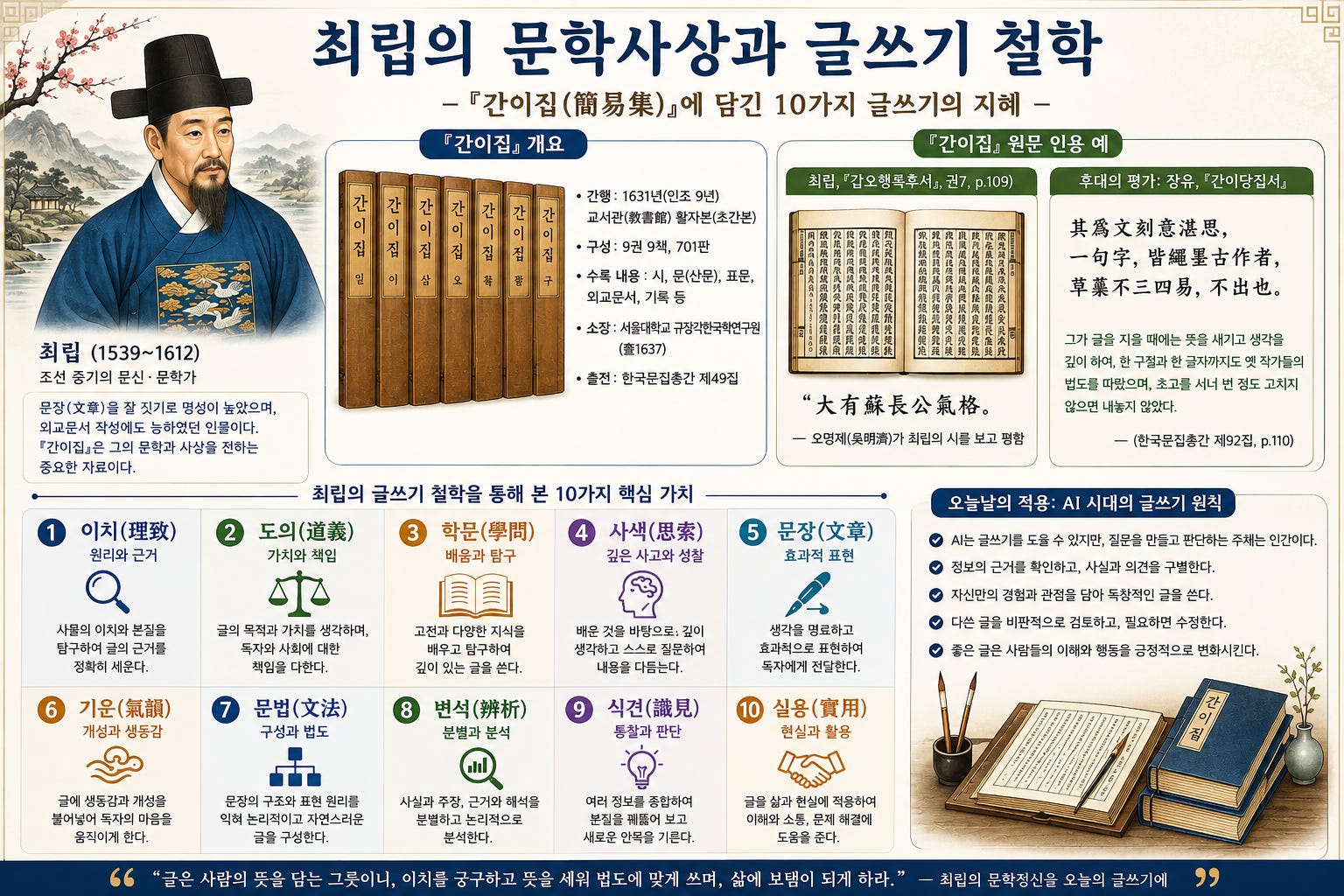
Choi Rip’s Literary Thought and Philosophy of Writing
Rediscovering Gani-jip in the Age of Artificial Intelligence
Abstract
In an age when generative artificial intelligence can produce essays, summaries, poems, and arguments within seconds, revisiting the literary thought of Choi Rip (崔岦, 1539–1612), one of the distinguished prose writers of mid-Joseon Korea, offers a valuable opportunity to reconsider the relationship between knowledge, disciplined thought, literary expression, and human judgment. His collected works, Gani-jip (簡易集), preserve a substantial body of writing through which readers can explore the intellectual and literary world of a scholar-official who worked within the classical Chinese literary tradition. Later assessments of Choi Rip, together with modern scholarship on his prose and poetry, provide a basis for understanding his literary achievement and its historical significance. This essay develops a contemporary interpretive framework around ten principles: reason, moral responsibility, learning, reflection, expression, vitality, compositional discipline, critical discernment, insight, and practical application. These principles are not presented as a formal list written by Choi Rip himself. Rather, they offer a modern framework for interpreting his literary legacy. By bringing this framework into conversation with generative AI, the essay argues that technological fluency alone does not constitute good writing. Meaningful writing requires knowledge, judgment, revision, ethical responsibility, and a distinctive human purpose. Rediscovering Choi Rip therefore offers not a historical recipe for using AI, but a broader intellectual foundation for thinking about writing in an age of increasingly capable machines.
Keywords: Choi Rip, Gani-jip, Joseon literature, classical Chinese prose, literary criticism, writing philosophy, generative artificial intelligence, human judgment
Introduction: Why Read Choi Rip Today?
Every generation inherits the words of earlier generations, but inheritance is not the same as understanding. A classical work may remain on a library shelf for centuries, its pages preserved and its title familiar, while the questions that once gave it life gradually disappear from public conversation. To recover such a work is to do more than protect an old text. It is to ask what its author understood about the world, how that understanding shaped the written word, and whether the work can still illuminate problems that confront us today.
Choi Rip (崔岦, 1539–1612) deserves renewed attention for precisely this reason. A prominent literary figure of the Joseon dynasty, he participated in a scholarly culture deeply influenced by the classical Chinese tradition. His collected works, Gani-jip (簡易集), offer a substantial record of his writing and intellectual activity. The work was first printed in 1631, after his death, and is preserved through the Korean Anthology Series and related bibliographic resources. Its publication history reminds us that literary legacies are not transmitted automatically: they depend on the labor of editors, printers, scholars, and readers who carry texts from one generation to the next (Choi, 1631).
Today, however, the circumstances of writing have changed dramatically. Generative artificial intelligence can produce grammatically polished prose, reorganize information, suggest arguments, and imitate recognizable literary styles. A task that once demanded hours of drafting may now be completed in moments. Yet the speed of production does not necessarily guarantee depth of thought, historical understanding, originality, or ethical soundness.
This technological transformation raises a question that reaches beyond the classroom or the writing profession: What makes writing genuinely good when machines can produce fluent language so easily?
Choi Rip did not encounter this question in its modern technological form. It would be historically misleading to suggest that he anticipated generative AI or developed a system resembling contemporary prompt engineering. Nevertheless, studying his literary legacy can help us examine the intellectual habits that make writing meaningful: careful learning, sustained reflection, deliberate composition, critical judgment, and responsibility for what one communicates.
The value of reading Choi Rip today lies not in forcing a sixteenth-century scholar into a twenty-first-century technological framework. It lies in allowing his historical world to illuminate our own.
Gani-jip: A Literary Legacy Preserved Across Generations
A collected work is more than an accumulation of texts. It preserves evidence of a writer’s intellectual interests, literary choices, social relationships, and engagement with the concerns of an age. Gani-jip provides a foundation for examining Choi Rip’s writing within the literary and political culture of Joseon Korea.
The collection must also be approached with historical care. The 1631 edition appeared after Choi Rip’s death, and the surviving bibliographic record describes a later woodblock reprint associated with the original movable-type edition. Consequently, the edition history should not be simplified into the claim that every surviving copy is an untouched original from 1631. Such distinctions matter because literary scholarship depends not only on interpreting words but also on establishing which texts and editions readers are actually consulting.
Modern scholarship has examined Choi Rip’s life, poetry, prose, and literary influences from several perspectives. Hwang (2022), for example, considers evaluations of Choi Rip by Joseon writers and his orientation toward Song-style poetry. Kim (2002) examines his prose through the question of gi (奇), a concept associated in the article’s framing with the extraordinary or unusual. Liu (2019) investigates the influence of Su Shi (蘇軾), the influential Song-dynasty writer and poet, on Choi Rip’s poetry.
These studies approach different aspects of Choi Rip’s literary achievement. Taken together, they suggest that his work should not be understood as an isolated expression of individual talent. It belongs to a broader conversation involving inherited literary models, contemporary judgments, and the writer’s own choices.
This context is especially important when considering originality. Writers rarely create in a cultural vacuum. They learn from earlier authors, absorb conventions, imitate models, and eventually make choices that distinguish their own work. Originality does not necessarily mean rejecting tradition. It can emerge from understanding a tradition deeply enough to use it with discernment.
For modern readers, this distinction offers a useful corrective to the assumption that novelty alone makes writing original. A new sentence is not necessarily an insightful sentence, just as an unfamiliar expression is not necessarily a meaningful one. The more important question is whether the writer has transformed knowledge into an expression that serves a clear intellectual or human purpose.
What Later Writers Saw in Choi Rip
One revealing way to understand a historical writer is to examine how later writers described his work. Such assessments do not replace the primary texts, but they help establish how his literary qualities were understood by readers closer to his historical and intellectual world.
Jang Yu (張維), a later Joseon scholar and writer, offered a notable assessment of Choi Rip’s compositional practice in a preface associated with Gani-dang jip. The passage, as cited in Song (2004, p. 100), describes Choi Rip as devoting himself intensely to his purpose and thinking deeply. It also emphasizes his attention to the standards of ancient writers and his willingness to revise a draft repeatedly before releasing it.
The important point is not that every writer must follow an identical procedure. Rather, this later evaluation portrays writing as a disciplined activity involving thought, literary knowledge, and revision. The finished work is not treated as the automatic result of inspiration. It is the product of sustained intellectual effort.
The historical attribution must remain clear: these observations are Jang Yu’s assessment of Choi Rip, transmitted here through Song, rather than a direct statement by Choi Rip about his own method. Even with that qualification, the passage offers a valuable perspective on the literary reputation Choi Rip acquired.
Its relevance to contemporary writing is striking. In an environment where AI systems can generate several versions of an essay almost instantly, writers may feel tempted to equate the availability of polished language with the completion of thought. Yet producing a draft and establishing its quality are different tasks.
A draft can be fluent but inaccurate, elegant but empty, persuasive but misleading. Revision requires a writer to ask whether the argument is coherent, whether the evidence supports the claims, whether the language expresses the intended meaning, and whether the work deserves the confidence it asks readers to place in it.
The historical lesson is not that modern writers should romanticize the labor of the past. It is that the value of writing cannot be measured solely by the speed with which words appear.
Choi Rip and the Question of Literary Originality
Literary originality is difficult to define because it involves more than inventing something that has never existed before. It may involve the transformation of inherited forms, a distinctive approach to familiar subjects, an unexpected combination of ideas, or an individual voice developed through sustained engagement with earlier writing.
Kim’s (2002) examination of Choi Rip’s prose through the concept of gi (奇) provides one scholarly entry point into this question. The concept should not be reduced to mere eccentricity or novelty. In literary discussion, the unusual becomes significant when it contributes to the character, force, or structure of a work. A strange expression that serves no purpose is simply strange; an unexpected expression that reveals something otherwise overlooked can become an artistic achievement.
Hwang’s (2022) discussion of Choi Rip’s poetry and its relationship to contemporary literary evaluations further places his work within a tradition of literary judgment. Liu’s (2019) study of Su Shi’s influence also directs attention to the relationship between literary inheritance and individual expression.
These perspectives invite a broader understanding of creativity. A writer may learn from established models without becoming merely derivative. The challenge is to understand the models deeply enough to recognize both their possibilities and their limitations.
This distinction has direct implications for AI-assisted writing. Generative AI systems produce language by drawing on patterns learned during training. They can combine familiar forms, imitate styles, and offer unexpected formulations. These capabilities can be useful, but an unexpected result is not automatically an original intellectual contribution. Nor does stylistic novelty establish that an argument is true.
Human writers must therefore do more than accept a machine’s first plausible answer. They must decide what is worth saying, which sources are trustworthy, what context is missing, and why the resulting expression matters. Originality emerges not merely from generating alternatives but from exercising judgment among them.
Choi Rip’s literary legacy can thus be read as an invitation to distinguish the appearance of novelty from the achievement of meaningful expression.
Ten Principles for Interpreting Choi Rip’s Writing Philosophy Today
The following ten principles constitute a contemporary interpretive framework inspired by the study of Choi Rip’s literary legacy and the scholarship discussed above. They are not a documented ten-point doctrine authored by Choi Rip. Their purpose is to make selected concerns of literary study accessible to modern readers, educators, and writers working with generative AI.
Reason (이치: 理致): Writing should make intellectual sense.
Good writing begins with a meaningful relationship between ideas. A paragraph may contain impressive vocabulary yet fail to establish a coherent argument. Reason requires the writer to clarify what is being claimed, why it matters, and how the evidence supports the conclusion. In AI-assisted writing, it also means checking whether a generated answer follows logically from its premises rather than merely sounding convincing.
Moral responsibility (도의: 道義): Words carry consequences.
Writing is not ethically neutral simply because it is well composed. It can clarify or distort, inform or manipulate, and recognize or diminish the dignity of others. A responsible writer must consider accuracy, fairness, attribution, and the likely consequences of a message. When using AI, this responsibility remains with the person who decides to publish or communicate the resulting work.
Learning (학문: 學問): Strong writing grows from knowledge.
Fluent language cannot substitute for an informed understanding of a subject. Writers need to learn from primary sources, scholarly research, historical records, and relevant experience. Choi Rip’s place within a literary tradition reminds us that serious writing involves engagement with knowledge inherited from others. AI can assist with exploration, but its suggestions must be distinguished from verified evidence.
Reflection (사색: 思索): Thought requires more than immediate response.
A quick answer may be useful, but important questions often require patience. Reflection allows a writer to identify assumptions, compare interpretations, and recognize uncertainties. Instead of accepting the first generated paragraph, an AI-assisted writer can ask what is missing, what alternative explanations exist, and what evidence would change the conclusion.
Expression (문장: 文章): Language should serve meaning.
Writing is the shaping of thought into a form that another person can understand. Elegant phrasing has value when it clarifies, deepens, or intensifies meaning. It becomes a distraction when it conceals weak reasoning or exaggerates the significance of an idea. The goal is not to make every sentence ornate but to choose language appropriate to the subject, audience, and purpose.
Vitality and individuality (기운: 氣韻): Writing needs a living voice.
A text becomes memorable when its parts work together to create a recognizable quality of expression. Voice may emerge through rhythm, perspective, imagery, humor, restraint, or the selection of details. AI can imitate stylistic features, but writers must still decide which voice expresses their own purposes and whether that voice is appropriate to the subject. Individuality is not simply a collection of stylistic tricks; it is connected to the writer’s way of seeing.
Compositional discipline (문법: 文法): Structure supports understanding.
An argument requires organization. Claims, evidence, examples, transitions, and conclusions should form a coherent whole. Structure does not eliminate creativity; it gives creativity a form through which readers can follow the writer’s thinking. AI can propose outlines and reorganize paragraphs, but a human writer must determine whether the structure accurately represents the argument.
Critical discernment (변석: 辨析): Distinguish what is plausible from what is true.
A capable writer does not accept a statement merely because it sounds authoritative. Critical discernment requires comparison, verification, and attention to differences among fact, interpretation, inference, and speculation. This principle is particularly important with AI-generated text, which can present unsupported claims in confident language. Every significant factual claim should be checked against suitable evidence.
Insight (식견: 識見): See beyond the obvious.
Knowledge supplies information, but insight identifies relationships and significance. It asks what a fact means in context, whose perspective has been overlooked, and what broader pattern a particular example reveals. Insight cannot be guaranteed by a longer answer or a more elaborate vocabulary. It develops through informed judgment and the willingness to examine a problem from more than one perspective.
Practical application (실용: 實用): Writing should accomplish a worthwhile purpose.
Writing can preserve knowledge, explain difficult ideas, guide decisions, challenge injustice, or help people understand one another. Its practical value does not require every literary work to provide immediate instructions. Rather, writing should be considered in relation to the purpose it seeks to serve and the readers it hopes to reach. In the AI era, the central question is not simply whether a machine can produce a text, but whether the text contributes something worthwhile.
Together, these principles offer a framework for evaluating writing beyond grammatical correctness and stylistic polish. They bring intellectual coherence, ethical responsibility, knowledge, reflection, expression, individuality, structure, verification, insight, and purpose into a single conversation.
Their value lies not in claiming that Choi Rip formulated these ten principles himself, but in using a historically grounded literary inquiry to develop questions that remain important today.
From Classical Literary Practice to AI-Assisted Writing
The comparison between Choi Rip’s literary world and contemporary AI should be made carefully. A Joseon scholar composing classical Chinese prose worked under intellectual, social, and literary conditions very different from those of a modern writer using a large language model. The technologies, audiences, conventions, and purposes of writing were not the same.
Nevertheless, both settings raise enduring questions about how knowledge becomes expression and how readers judge the results.
Consider the writing process. A student today may ask an AI system to draft an essay, summarize an article, or propose an argument. The resulting text may look complete. Yet a responsible writer still needs to establish the assignment’s purpose, examine the sources, evaluate the reasoning, revise the structure, and ensure that the final work represents an honest account of what the writer knows and can defend.
This process can be understood through five practical stages.
First, establish the purpose. Before generating text, identify the question the writing must answer and the reader it must serve. A prompt that specifies purpose, audience, scope, and evidence requirements is more useful than a vague request for a polished essay.
Second, build a reliable knowledge base. Identify the primary texts and credible secondary sources relevant to the subject. For historical writing, distinguish what the original source says from what later scholars infer. AI-generated bibliographic details and quotations must be checked against actual publications.
Third, develop and test the argument. Ask whether the proposed thesis is defensible, whether alternative interpretations deserve consideration, and whether each important claim is supported. An AI system can help identify counterarguments, but it cannot replace the writer’s responsibility to evaluate them.
Fourth, revise for substance before style. Correct factual errors, remove repetition, clarify transitions, and strengthen weak reasoning before polishing the language. A beautifully written paragraph should not survive simply because it sounds impressive.
Finally, take responsibility for the finished work. Confirm quotations and references, acknowledge assistance where required, respect the relevant academic or professional rules, and ensure that the final text does not misrepresent evidence or authorship.
These stages are a contemporary workflow, not a historical procedure attributed to Choi Rip. Their relationship to his literary legacy is interpretive: both direct attention toward the intellectual work that must occur between an initial idea and a finished text.
The comparison also reveals a crucial distinction between assistance and authority. AI can help a writer generate possibilities, but it should not determine which possibilities deserve belief. It can improve a sentence, but it cannot independently establish that the sentence is historically accurate. It can imitate a literary voice, but imitation alone does not confer the experience or judgment associated with that voice.
A writer who uses AI well is therefore neither a passive recipient nor an uncritical opponent of the technology. The writer is an active participant who directs, tests, revises, and takes responsibility for the result.
What AI Cannot Decide for Us
It is tempting to define progress by the increasing sophistication of machines. If an AI system writes more fluently than an earlier model, produces longer arguments, or imitates a wider range of styles, it may appear to have moved closer to the ideal writer.
Yet fluency is only one dimension of writing. A text can be grammatically flawless and historically wrong. It can be emotionally compelling and ethically irresponsible. It can summarize a complicated debate without recognizing the most important disagreement. It can even invent evidence while presenting its conclusions with confidence.
These limitations do not make AI useless. They make evaluation essential.
The deeper issue concerns responsibility. When a writer publishes an inaccurate historical claim, readers may reasonably ask how it was checked. When an essay misrepresents another scholar, its polished style does not excuse the distortion. When a machine-generated argument influences a decision, the consequences do not disappear simply because a model produced the words.
Human judgment must therefore remain central to the use of AI in writing. This does not mean that human judgment is always correct or that human writers are free from bias. People also misunderstand evidence, repeat errors, and make irresponsible claims. The appropriate response is not to idealize either humans or machines, but to establish practices that make errors more visible and accountability more meaningful.
Choi Rip’s literary legacy provides a useful point of reflection because the writing associated with his reputation has been examined in relation to learning, literary models, composition, and critical evaluation. Modern scholarship helps us approach those questions without pretending that a single historical figure can resolve every contemporary problem.
The lesson is not that the past possesses a ready-made answer to the future. It is that technological change does not eliminate the need for intellectual discipline. In fact, when language becomes easier to generate, the ability to judge language becomes more important.
Rediscovering the Humanities in a Technological Age
The study of classical literature is sometimes treated as a luxury in an era dominated by engineering, automation, and rapid technological change. Yet literature can train readers to notice distinctions that are easy to overlook when efficiency becomes the primary measure of success.
A classical text asks readers to consider historical context, interpret unfamiliar expressions, compare competing interpretations, and recognize the distance between their own assumptions and those of another age. These activities require patience and intellectual humility. They also remind readers that language is shaped by culture, history, relationships, and human purposes.
Reading Choi Rip can therefore become part of a broader education in responsible technological use. Students need technical skills to operate AI systems, but they also need the ability to evaluate the answers those systems produce. They need information literacy to verify sources, ethical reasoning to consider consequences, historical awareness to understand context, and literary sensitivity to recognize the difference between verbal polish and genuine insight.
Such an education should not present the humanities as an obstacle to innovation. Nor should it assume that technological expertise alone can answer every question about how a society ought to use its inventions. Technical capability and humanistic judgment address different but complementary dimensions of progress.
In this setting, the ten principles proposed above can serve as prompts for discussion and practice. Students can use reason to test an AI-generated argument, learning to verify a historical claim, reflection to identify an overlooked assumption, and critical discernment to separate evidence from speculation. They can evaluate expression and structure while asking whether a text serves a worthwhile purpose.
The result is not merely a more polished essay. It is a more thoughtful writer.
Conclusion: When Machines Write, What Must Humans Learn?
The rediscovery of Choi Rip in the age of artificial intelligence begins with a historical work but leads toward a contemporary question. What should human beings value when machines can produce language with extraordinary speed and apparent competence?
The answer cannot be found in speed alone, nor in a romantic belief that earlier generations possessed a wisdom unavailable to modern readers. Choi Rip lived in a different world, and his literary achievement must be understood within the historical traditions and debates that shaped it. His work does not provide a direct blueprint for generative AI.
Yet the study of his literary legacy, considered alongside later assessments and modern scholarship, encourages us to look beyond the finished sentence. Writing is also a process of learning, thinking, selecting, organizing, revising, and accepting responsibility. Its quality depends on more than the appearance of intelligence.
The ten principles developed in this essay—reason, moral responsibility, learning, reflection, expression, vitality, compositional discipline, critical discernment, insight, and practical application—offer one contemporary framework for examining that process. They should be understood as an interpretive synthesis, not as a historical list written by Choi Rip. Their purpose is to connect the study of classical literature with the challenges of modern communication.
In the coming years, AI systems will likely become more capable of producing sophisticated texts. That development may transform education, scholarship, journalism, and creative work. It will also make it increasingly important to distinguish the production of language from the exercise of judgment.
A machine may generate a thousand sentences in the time a person needs to read one. But the number of sentences does not determine the worth of an idea. The essential questions remain: Is it true? Is it fair? Does it deepen understanding? Does it serve a meaningful purpose? Can the person who presents it explain and defend it?
To rediscover Choi Rip is not to turn the past into an answer machine for the present. It is to bring a historical literary inheritance into conversation with the responsibilities of our own age. Gani-jip reminds us that the written word has a life beyond the moment of its production: it is preserved, interpreted, evaluated, and passed on to readers who may ask questions its author could never have imagined.
That is where the past and the future meet—not in the imitation of an old style or the celebration of a new technology, but in the continuing human effort to make language worthy of thought.
When machines become better at producing words, our task is not simply to produce more of them. It is to become wiser in choosing what should be said, more careful in deciding what can be believed, and more responsible for what our words do in the world.
References
Academy of Korean Studies. (2023, September 10). 최립. 한국민족문화대백과사전. https://encykorea.aks.ac.kr/Article/E0057278
Choi, Rip. (1631). Gani-jip [간이집]. Gyoseogwan. Korean Anthology Series, Vol. 49. https://db.mkstudy.com/opendatabase/itkc/chonggan/book/yppY/
Hwang, H. (2022). 최립의 삶과 시문학의 일고찰—조선 문인들의 평가와 송시풍 지향을 중심으로— [A study of Choi Rip’s life and poetry: Joseon literary evaluations and his orientation toward Song poetry]. 동양한문학연구, 61, 251–271. https://doi.org/10.35374/dyha.61..202202.009
Kim, W. (2002). 崔岦 散文의 一硏究—奇의 문제와 관련하여— [A study of Choi Rip’s prose: Focusing on the question of the extraordinary]. 태동고전연구, 18, 1–30. https://www.earticle.net/Article/A69971
Liu, S. J. (2019). 蘇軾 詩文의 崔岦 詩에 대한 영향 [Su Shi’s influence on Choi Rip’s poetry]. 중국어문학, 81, 87–112. https://doi.org/10.15792/clsyn..81.201908.87
Song, H. (2004). 김창협 비평의 산문사적 의의—‘法’의 산문론을 중심으로 [The significance of Kim Chang-hyeop’s criticism in the history of prose: With reference to his theory of literary method]. 한국문학연구, 5, 99–126.
최립의 문학사상과 글쓰기 철학
인공지능 시대에 다시 읽는 『간이집』
초록
생성형 인공지능이 몇 초 만에 수필과 요약문, 시와 논증문을 작성할 수 있는 시대에, 조선 중기의 대표적인 문장가 가운데 한 사람인 최립(崔岦, 1539–1612)의 문학사상을 다시 살펴보는 일은 지식과 사유, 문학적 표현, 인간의 판단 사이의 관계를 성찰할 수 있는 소중한 기회를 제공한다. 최립의 문집인 『간이집(簡易集)』에는 고전 한문 문학의 전통 속에서 활동했던 학자이자 관료의 문필 활동과 지적 세계를 살펴볼 수 있는 다양한 글이 담겨 있다. 최립에 대한 후대 문인들의 평가와 현대 학자들의 산문·시문학 연구는 그의 문학적 성취와 역사적 의미를 이해하는 데 중요한 근거가 된다.
이 글은 최립의 문학적 유산을 현대적으로 해석하기 위한 열 가지 원칙을 제시한다. 이치, 도의, 학문, 사색, 문장, 기운, 문법, 변석, 식견, 실용이 그것이다. 이 열 가지 원칙은 최립 자신이 직접 제시한 공식적인 목록이 아니다. 최립의 문학적 유산을 오늘날의 관점에서 이해하기 위해 구성한 현대적 해석의 틀이다. 이 틀을 생성형 인공지능과 연결하여 살펴보면, 기술적 능숙함만으로 훌륭한 글이 완성되는 것은 아니라는 사실을 알 수 있다. 의미 있는 글쓰기는 지식과 판단력, 퇴고, 윤리적 책임, 그리고 인간 고유의 목적을 필요로 한다. 따라서 오늘날 최립을 다시 읽는다는 것은 인공지능 사용을 위한 역사적 처방전을 찾는 일이 아니다. 그것은 기계의 능력이 날로 발전하는 시대에 글쓰기의 본질을 성찰할 수 있는 지적 토대를 마련하는 일이다.
핵심어: 최립, 『간이집』, 조선 문학, 한문 산문, 문학 비평, 글쓰기 철학, 생성형 인공지능, 인간의 판단력
서론: 오늘날 왜 최립을 다시 읽어야 하는가?
모든 세대는 앞선 세대가 남긴 글을 물려받는다. 그러나 유산을 물려받는 것과 그 의미를 이해하는 것은 서로 다른 일이다. 고전 작품은 수백 년 동안 도서관의 서가에 보존되고 그 제목이 사람들에게 알려져 있을 수 있다. 그러나 그 작품에 생명력을 불어넣었던 질문들은 시간이 흐르면서 사람들의 관심에서 점차 사라질 수도 있다. 그러므로 고전을 되살린다는 것은 단순히 오래된 문헌을 보존하는 일이 아니다. 그 작가가 세상을 어떻게 이해했는지, 그러한 이해가 글에 어떻게 드러났는지, 그리고 그 작품이 오늘날 우리가 마주한 문제를 여전히 밝혀 줄 수 있는지를 묻는 일이다.
최립(崔岦, 1539–1612)은 바로 이러한 이유에서 새롭게 주목할 가치가 있는 인물이다. 조선시대의 저명한 문장가였던 그는 고전 한문 전통의 영향을 깊이 받은 학문적·문학적 환경에서 활동했다. 그의 문집 『간이집(簡易集)』은 그의 문필 활동과 지적 관심을 살펴볼 수 있는 중요한 자료이다. 이 문집은 최립 사후인 1631년에 간행되었으며, 한국문집총간과 관련 서지 자료를 통해 그 판본과 전승의 역사를 확인할 수 있다. 이러한 간행사는 문학적 유산이 저절로 전해지는 것이 아니라는 사실을 일깨워 준다. 문헌을 다음 세대에 전하기 위해서는 편집자와 인쇄자, 학자와 독자의 노력이 필요하다(Choi, 1631).
그러나 오늘날 글쓰기를 둘러싼 환경은 크게 달라졌다. 생성형 인공지능은 문법적으로 세련된 글을 작성하고, 정보를 재구성하며, 논거를 제시하고, 특정한 문체를 모방할 수 있다. 과거에는 몇 시간씩 걸리던 초고 작성이 이제는 단 몇 분 만에 이루어지기도 한다. 하지만 글을 빠르게 생산하는 능력이 곧 깊이 있는 사유와 역사적 이해, 독창성, 윤리적 타당성을 보장하는 것은 아니다.
이러한 기술적 변화는 교실이나 글쓰기 직업의 영역을 넘어서는 질문을 제기한다.
기계가 유창한 문장을 손쉽게 만들어 내는 시대에, 무엇이 진정으로 좋은 글을 만드는가?
최립은 오늘날의 기술적 형태로 제기되는 이 질문을 경험하지 못했다. 그가 생성형 인공지능을 예견했다거나 현대적인 프롬프트 엔지니어링과 유사한 체계를 개발했다고 주장하는 것은 역사적으로 타당하지 않다. 그럼에도 그의 문학적 유산을 연구하면 글을 의미 있게 만드는 지적 습관, 곧 깊이 있는 학습과 지속적인 사유, 의도적인 구성, 비판적 판단, 그리고 표현에 대한 책임을 성찰할 수 있다.
오늘날 최립을 다시 읽는 가치는 16세기의 학자를 억지로 21세기의 기술적 틀에 끼워 맞추는 데 있지 않다. 그의 역사적 세계를 통해 우리 자신의 시대를 더 깊이 이해하는 데 있다.
『간이집』: 세대를 넘어 전승된 문학적 유산
문집은 단순히 여러 글을 모아 놓은 책이 아니다. 문집에는 작가의 지적 관심과 문학적 선택, 사회적 관계, 그리고 당대의 문제에 대한 대응을 보여 주는 증거가 보존되어 있다. 『간이집』은 최립의 글쓰기를 조선의 문학적·정치적 문화 속에서 살펴볼 수 있는 중요한 토대를 제공한다.
다만 이 문집의 판본과 전승 과정은 역사적으로 신중하게 다루어야 한다. 1631년 간행본은 최립이 세상을 떠난 뒤에 출판되었으며, 현존하는 서지 기록은 최초의 활자본과 관련된 후대의 목판본도 설명하고 있다. 따라서 오늘날 전해지는 모든 판본이 1631년에 인쇄된 원본 그대로라고 단순화해서는 안 된다. 이러한 구분이 중요한 이유는 문학 연구가 글의 의미를 해석하는 데 그치지 않고, 실제로 어떤 텍스트와 판본을 바탕으로 논의하고 있는지도 확인해야 하기 때문이다.
현대 학계에서는 최립의 생애와 시문학, 산문, 문학적 영향 관계를 여러 관점에서 연구해 왔다. 예를 들어 황현우(2022)는 조선 문인들의 최립에 대한 평가와 그의 송시풍 지향을 중심으로 최립의 생애와 시문학을 고찰했다. 김우정(2002)은 기(奇)의 문제와 관련하여 최립의 산문을 분석했다. 류소진(2019)은 송나라의 저명한 문인 소식(蘇軾)의 시문이 최립의 시에 미친 영향을 연구했다.
이 연구들은 최립의 문학적 성취 가운데 서로 다른 측면을 다룬다. 그러나 이들을 함께 살펴보면 최립의 작품을 고립된 개인의 재능이 만들어 낸 결과로만 이해해서는 안 된다는 사실을 알 수 있다. 그의 문학은 선행 문학의 전통과 당대의 비평적 평가, 그리고 그 전통 속에서 이루어진 작가 자신의 선택이 서로 만나는 지점에 놓여 있다.
이러한 맥락은 독창성의 문제를 생각할 때 특히 중요하다. 작가는 진공 상태에서 창작하지 않는다. 앞선 작가들에게 배우고, 문학적 관습을 익히며, 기존의 형식을 모방하다가 마침내 자신의 작품을 구별 짓는 선택을 하게 된다. 독창성이 반드시 전통을 거부하는 데서만 나오는 것은 아니다. 오히려 전통을 충분히 이해하여 그것을 분별력 있게 활용할 때 독창성이 탄생할 수 있다.
이러한 구분은 오늘날 글쓰기에 대해서도 중요한 시사점을 준다. 새롭다는 이유만으로 좋은 글이 되는 것은 아니다. 처음 보는 문장이 반드시 통찰력 있는 문장인 것도 아니며, 낯선 표현이 반드시 의미 있는 표현인 것도 아니다. 더 중요한 질문은 작가가 지식을 어떻게 자신의 것으로 소화하여 분명한 지적 목적이나 인간적 목적에 기여하는 표현으로 바꾸었는가 하는 것이다.
후대 문인들은 최립을 어떻게 평가했는가?
역사적 작가를 이해하는 한 가지 유익한 방법은 후대 문인들이 그를 어떻게 평가했는지 살펴보는 것이다. 이러한 평가는 원전을 대신할 수는 없지만, 그 작가와 비교적 가까운 역사적·지적 세계에 살았던 사람들이 그의 문학적 특성을 어떻게 이해했는지 알려 준다.
후대의 조선 문인 장유(張維)는 최립의 문장 구성과 창작 태도에 관해 주목할 만한 평가를 남겼다. 『간이당집』과 관련된 서문에 실린 것으로 알려진 이 평가는 송혁기(2004, p. 100)를 통해 인용되었다. 장유는 최립이 글을 지을 때 의도를 세우고 깊이 생각했으며, 문장과 글자 하나하나에 이르기까지 옛 문장가들의 법도를 따르려 했다고 설명한다. 또한 초고를 서너 차례 고쳐 쓰지 않고서는 글을 세상에 내놓지 않았다는 취지로 평가했다.
여기서 중요한 것은 모든 작가가 똑같은 절차를 따라야 한다는 뜻이 아니다. 오히려 이 평가는 글쓰기를 사유와 문학적 지식, 퇴고가 결합된 훈련의 과정으로 바라본다는 점에서 의미가 있다. 완성된 글은 영감이 저절로 만들어 낸 결과가 아니다. 지속적인 지적 노력을 거쳐 탄생하는 결과물이다.
역사적 사실을 정확하게 전달하기 위해서는 이 평가의 출처를 분명히 해야 한다. 이는 최립이 자신의 글쓰기 방법을 직접 설명한 발언이 아니라, 후대 문인 장유가 최립을 평가한 내용이며, 여기서는 송혁기의 연구를 통해 간접적으로 인용한 것이다. 이러한 점을 명확히 하더라도 이 평가는 최립의 문학적 명성이 어떤 특성과 연결되어 있었는지를 이해하는 데 유익하다.
이 평가는 오늘날 글쓰기 환경과도 놀라울 정도로 잘 맞닿아 있다. 인공지능이 순식간에 여러 편의 글을 생성하는 환경에서는 유창한 문장이 만들어졌다는 사실을 곧 사유가 완성되었다는 뜻으로 받아들이기 쉽다. 그러나 초고를 작성하는 것과 그 글의 완성도를 확인하는 것은 서로 다른 작업이다.
초고는 유창하면서도 부정확할 수 있고, 우아하면서도 내용이 빈약할 수 있으며, 설득력 있어 보이면서도 독자를 오도할 수 있다. 퇴고 과정에서 작가는 논리가 일관적인지, 근거가 주장을 뒷받침하는지, 표현이 의도한 의미를 제대로 전달하는지, 그리고 독자에게 요구하는 신뢰를 정당하게 받을 수 있는지를 물어야 한다.
역사에서 얻을 수 있는 교훈은 오늘날의 작가들이 과거의 고된 노동을 무조건 미화해야 한다는 것이 아니다. 글의 가치는 단지 얼마나 빠르게 문장이 만들어지는가로 측정할 수 없다는 사실이다.
최립과 문학적 독창성의 문제
문학적 독창성은 정의하기 쉽지 않다. 한 번도 존재한 적 없는 것을 만들어 내는 능력만을 의미하지 않기 때문이다. 독창성은 기존 형식의 변형, 익숙한 주제에 대한 독특한 접근, 예상하지 못한 사상의 결합, 또는 지속적인 글쓰기 속에서 형성되는 개성적인 목소리로 나타날 수 있다.
김우정(2002)의 연구는 기(奇)의 개념을 통해 최립의 산문을 살펴보는 중요한 출발점이 된다. 여기서 기를 단순한 기이함이나 새로움으로 축소해서는 안 된다. 문학적 논의에서 비범하거나 이례적인 요소는 그것이 작품의 성격과 힘, 구성에 기여할 때 의미를 갖는다. 아무런 목적도 없는 낯선 표현은 그저 낯설 뿐이다. 그러나 예상 밖의 표현이 다른 방식으로는 발견하기 어려운 사실을 드러낸다면, 그것은 문학적 성취가 될 수 있다.
황현우(2022)의 연구는 최립의 시문학을 당대 문인들의 평가와 연결하여 살펴봄으로써 그의 작품을 문학적 판단과 비평의 전통 속에 놓는다. 류소진(2019)의 연구는 소식의 영향 관계를 통해 문학적 계승과 개별 작가의 표현 사이의 관계를 생각하게 한다.
이러한 관점은 창의성에 대한 더 폭넓은 이해로 이어진다. 작가는 기존의 모범을 배우면서도 단순한 모방에 머물지 않을 수 있다. 중요한 것은 그 모범을 충분히 이해하여 그 가능성과 한계를 모두 알아보는 능력이다.
이러한 구분은 인공지능을 활용한 글쓰기에도 직접적인 시사점을 준다. 생성형 인공지능은 학습 과정에서 익힌 패턴을 바탕으로 언어를 생성한다. 기존의 형식을 결합하고, 문체를 모방하며, 예상하지 못한 표현을 제안할 수 있다. 이러한 능력은 유용하지만, 예상 밖의 결과가 나왔다는 사실만으로 독창적인 지적 성취가 이루어진 것은 아니다. 마찬가지로 문체가 새롭다고 해서 논증이 참이라는 보장도 없다.
따라서 인간 작가는 기계가 처음 제시한 그럴듯한 답변을 그대로 받아들이는 데 그쳐서는 안 된다. 무엇을 말할 가치가 있는지, 어떤 자료를 신뢰할 수 있는지, 어떤 맥락이 빠져 있는지, 그리고 최종적인 표현이 왜 중요한지를 판단해야 한다. 독창성은 단순히 여러 가능성을 만들어 내는 데서 완성되는 것이 아니라, 그 가능성들 가운데 무엇을 선택할 것인지 판단하는 과정에서 형성된다.
최립의 문학적 유산은 새로움의 외양과 의미 있는 표현의 성취를 구별하라는 요청으로 읽을 수 있다.
오늘날 최립의 글쓰기 철학을 해석하기 위한 열 가지 원칙
다음의 열 가지 원칙은 최립의 문학적 유산과 관련된 연구를 바탕으로 현대적 관점에서 구성한 해석의 틀이다. 이 원칙들은 최립 자신이 직접 제시한 열 가지 항목이 아니다. 오늘날의 독자와 교육자, 인공지능을 활용하는 작가들이 그의 문학적 유산을 이해하고 적용할 수 있도록 마련한 현대적 해석이다.
이치(理致): 글은 논리적으로 타당해야 한다.
좋은 글은 생각과 생각 사이의 의미 있는 관계에서 시작된다. 인상적인 어휘를 사용하더라도 논리적인 주장을 세우지 못하면 글은 설득력을 얻기 어렵다. 이치란 무엇을 주장하는지, 그 주장이 왜 중요한지, 근거가 어떻게 결론을 뒷받침하는지를 분명히 하는 것이다. 인공지능이 생성한 글에서도 전제가 결론으로 논리적으로 이어지는지, 아니면 그럴듯하게 들릴 뿐인지를 확인해야 한다.
도의(道義): 말에는 책임이 따른다.
글쓰기는 문장이 잘 구성되었다는 이유만으로 윤리적으로 중립적인 행위가 되지 않는다. 글은 사실을 밝힐 수도 있고 왜곡할 수도 있으며, 정보를 제공할 수도 있고 조작할 수도 있다. 타인의 존엄성을 존중할 수도 있고 훼손할 수도 있다. 책임 있는 작가는 정확성과 공정성, 출처 표시, 표현이 미칠 결과를 고려해야 한다. 인공지능을 활용하더라도 최종 결과물을 발표하고 전달하기로 결정한 사람의 책임은 사라지지 않는다.
학문(學問): 좋은 글은 지식에서 자란다.
유창한 문장만으로는 특정 주제에 대한 충분한 이해를 대신할 수 없다. 작가는 일차 사료와 학술 연구, 역사 기록, 관련 경험을 통해 배워야 한다. 최립이 문학적 전통 속에서 활동했다는 사실은 진지한 글쓰기가 다른 사람들이 축적한 지식과의 만남을 필요로 한다는 점을 일깨워 준다. 인공지능은 탐색을 도울 수 있지만, 인공지능이 제시한 내용을 검증된 증거와 동일하게 취급해서는 안 된다.
사색(思索): 생각에는 즉각적인 반응 이상의 시간이 필요하다.
빠른 답변이 유용할 때도 있지만, 중요한 문제에는 충분한 숙고가 필요하다. 사색은 작가가 자신의 전제를 발견하고, 여러 해석을 비교하며, 불확실성을 인식하도록 돕는다. 인공지능이 생성한 첫 번째 문단을 그대로 받아들이는 대신 무엇이 빠졌는지, 다른 설명은 가능한지, 어떤 증거가 나온다면 결론을 바꾸어야 하는지를 질문할 수 있다.
문장(文章): 언어는 의미를 위해 존재한다.
글쓰기는 생각을 다른 사람이 이해할 수 있는 형태로 다듬는 작업이다. 세련된 표현은 의미를 명확하게 하거나 깊이를 더하고, 전달력을 높일 때 가치를 갖는다. 반대로 약한 논리를 감추거나 생각의 중요성을 과장하는 데 사용된다면 오히려 방해가 된다. 목표는 모든 문장을 화려하게 만드는 것이 아니다. 주제와 독자, 글의 목적에 맞는 언어를 선택하는 것이다.
기운(氣韻): 글에는 살아 있는 개성이 필요하다.
글은 각 부분이 유기적으로 어우러져 독특한 표현의 분위기를 형성할 때 기억에 남는다. 작가의 목소리는 문장의 리듬과 관점, 이미지, 유머, 절제, 세부 묘사의 선택을 통해 드러날 수 있다. 인공지능은 문체적 특징을 모방할 수 있지만, 어떤 목소리가 자신의 목적을 가장 잘 표현하는지, 그리고 그 목소리가 주제에 적절한지는 작가가 판단해야 한다. 개성은 몇 가지 문체적 기교의 집합이 아니라 세상을 바라보는 작가의 방식과 연결되어 있다.
문법(文法): 구성과 질서는 이해를 돕는다.
논증에는 체계적인 구성이 필요하다. 주장과 근거, 사례, 문단 사이의 연결, 결론은 서로 일관된 관계를 이루어야 한다. 구성은 창의성을 억압하는 것이 아니다. 오히려 독자가 작가의 생각을 따라갈 수 있도록 창의성에 형태를 부여한다. 인공지능은 개요를 제안하고 문단을 재구성할 수 있지만, 그 구조가 실제 논지를 정확하게 반영하는지는 사람이 확인해야 한다.
변석(辨析): 그럴듯한 것과 참인 것을 구별해야 한다.
유능한 작가는 어떤 문장이 권위 있게 들린다는 이유만으로 그것을 받아들이지 않는다. 변석은 비교와 검증, 그리고 사실과 해석, 추론과 추측 사이의 차이를 분명하게 하는 능력이다. 이 원칙은 자신감 있는 문장으로 근거 없는 주장을 제시할 수 있는 인공지능의 특성을 고려할 때 특히 중요하다. 중요한 사실적 주장은 적절한 자료를 통해 확인해야 한다.
식견(識見): 눈앞의 사실을 넘어 그 의미를 보아야 한다.
지식이 정보를 제공한다면, 식견은 그 정보 사이의 관계와 의미를 발견한다. 식견은 어떤 사실이 맥락 속에서 무엇을 의미하는지, 누구의 관점이 빠져 있는지, 개별 사례가 어떤 더 큰 패턴을 드러내는지를 묻는다. 더 긴 답변이나 더 화려한 어휘가 통찰을 보장하지는 않는다. 통찰은 충분한 지식에 근거한 판단과 문제를 여러 관점에서 살펴보려는 태도에서 발전한다.
실용(實用): 글은 가치 있는 목적에 기여해야 한다.
글은 지식을 보존하고, 어려운 개념을 설명하며, 의사결정을 돕고, 불의를 비판하고, 사람들 사이의 이해를 증진할 수 있다. 그렇다고 모든 문학 작품이 즉각적인 실용 지침을 제공해야 한다는 뜻은 아니다. 글의 가치는 그것이 추구하는 목적과 독자에게 전달하려는 의미를 함께 고려할 때 평가할 수 있다. 인공지능 시대에 중요한 질문은 단순히 기계가 글을 만들어 낼 수 있는가가 아니라, 그 글이 실제로 가치 있는 기여를 하는가 하는 것이다.
이 열 가지 원칙은 문법적 정확성과 문체적 세련미를 넘어 글의 가치를 평가할 수 있는 틀을 제공한다. 이치와 도의, 학문과 사색, 표현과 개성, 구성과 검증, 통찰과 목적을 하나의 논의 속에 연결한다.
이 원칙들의 가치는 최립이 직접 열 가지 원칙을 정리했다는 주장에 있지 않다. 역사적 문학 연구를 바탕으로 오늘날에도 중요한 질문들을 새롭게 제기한다는 데 있다.
고전 문학의 창작 태도에서 인공지능 활용 글쓰기로
최립이 살았던 문학 세계와 오늘날의 인공지능을 비교할 때에는 신중해야 한다. 고전 한문 산문을 작성했던 조선의 학자는 대규모 언어 모델을 활용하는 현대의 작가와 전혀 다른 지적·사회적·문학적 환경에서 활동했다. 글쓰기의 기술과 독자, 문학적 관습, 표현의 목적도 같지 않았다.
그럼에도 두 시대는 지식이 어떻게 표현으로 바뀌는지, 그리고 그 결과물을 어떤 기준으로 평가해야 하는지라는 지속적인 질문을 공유한다.
오늘날의 글쓰기 과정을 생각해 보자. 학생은 인공지능에 에세이 초안을 작성하거나 논문을 요약하거나 주장을 제안해 달라고 요청할 수 있다. 결과물은 완성된 글처럼 보일 수도 있다. 그러나 책임 있는 작가라면 여전히 과제의 목적을 확인하고, 자료를 검토하며, 논리를 평가하고, 구성을 수정하고, 최종 결과물이 자신이 실제로 이해하고 방어할 수 있는 내용을 담고 있는지 확인해야 한다.
이러한 과정은 다섯 단계로 정리할 수 있다.
첫째, 목적을 분명히 한다. 글을 생성하기 전에 어떤 질문에 답해야 하는지, 누구를 위한 글인지 파악한다. 목적과 독자, 범위, 증거의 요건을 구체적으로 제시하는 프롬트는 단순히 세련된 에세이를 요청하는 모호한 지시보다 유용하다.
둘째, 신뢰할 수 있는 지식의 토대를 마련한다. 주제와 관련된 일차 자료와 신뢰할 수 있는 이차 문헌을 확인한다. 역사적 글쓰기에서는 원전이 실제로 말하는 내용과 후대 학자들이 해석한 내용을 구분해야 한다. 인공지능이 제시한 서지 정보와 인용문은 실제 출판 자료와 대조하여 확인해야 한다.
셋째, 논증을 발전시키고 검증한다. 제시된 논제가 타당한지, 다른 해석도 고려해야 하는지, 각각의 중요한 주장이 근거로 뒷받침되는지 살펴본다. 인공지능은 반론을 찾는 데 도움을 줄 수 있지만, 반론의 타당성을 평가하는 책임까지 대신할 수는 없다.
넷째, 문체보다 내용부터 수정한다. 문장을 세련되게 다듬기 전에 사실 오류를 바로잡고, 반복을 제거하며, 문단 사이의 연결을 명확히 하고, 약한 논리를 강화한다. 인상적으로 들린다는 이유만으로 잘못된 문단을 남겨 두어서는 안 된다.
다섯째, 완성된 글에 책임을 진다. 인용과 참고문헌을 확인하고, 필요한 경우 인공지능의 도움을 적절히 밝히며, 학술적·전문적 규정을 준수한다. 또한 최종 결과물이 증거나 저자성을 왜곡하지 않도록 확인해야 한다.
이 다섯 단계는 현대적인 글쓰기 절차이지, 최립이 역사적으로 사용했던 방법이라고 주장할 수 있는 절차는 아니다. 이 절차와 그의 문학적 유산이 만나는 지점은 해석적 연결에 있다. 두 경우 모두 처음 떠오른 생각과 완성된 글 사이에 지적인 작업이 필요하다는 사실을 강조한다.
이러한 비교는 도움과 권위의 차이도 드러낸다. 인공지능은 작가가 여러 가능성을 탐색하도록 도울 수 있지만, 어떤 가능성을 믿어야 하는지 결정할 수는 없다. 문장을 개선할 수는 있지만, 그 문장이 역사적으로 정확하다는 사실을 스스로 확립하지는 못한다. 문학적 목소리를 모방할 수는 있지만, 모방만으로 그 목소리에 연결된 경험과 판단력을 획득하는 것은 아니다.
그러므로 인공지능을 잘 활용하는 작가는 수동적인 수용자도 아니고 기술을 무조건 거부하는 사람도 아니다. 그는 결과물을 지시하고, 검증하고, 수정하며, 그 결과에 책임을 지는 적극적인 참여자다.
인공지능이 우리 대신 결정할 수 없는 것
기계의 지능이 점점 정교해지는 것을 발전의 기준으로 삼고 싶은 유혹이 있다. 인공지능이 이전 모델보다 더 유창하게 글을 쓰고, 더 긴 논증을 구성하며, 더 다양한 문체를 모방한다면 이상적인 작가에 가까워진 것처럼 보일 수 있다.
그러나 유창함은 글쓰기의 여러 차원 가운데 하나일 뿐이다. 문법적으로 완벽한 글도 역사적으로 틀릴 수 있다. 감정적으로 호소력 있는 글도 윤리적으로 무책임할 수 있다. 복잡한 논쟁을 요약하면서도 가장 중요한 쟁점을 놓칠 수 있다. 심지어 근거를 만들어 내면서도 자신감 있는 어조로 결론을 제시할 수 있다.
이러한 한계가 인공지능을 쓸모없게 만드는 것은 아니다. 오히려 평가와 검증이 필수적이라는 사실을 보여 준다.
더 근본적인 문제는 책임이다. 작가가 부정확한 역사적 주장을 발표하면 독자는 그 주장이 어떻게 검증되었는지 물을 수 있다. 다른 학자의 연구를 왜곡한 글은 문체가 세련되었다고 해서 정당화되지 않는다. 기계가 만든 주장이 어떤 결정에 영향을 미쳤다고 해서 그 결과에 대한 책임이 사라지는 것도 아니다.
따라서 인공지능 활용 글쓰기의 중심에는 인간의 판단이 있어야 한다. 그렇다고 인간의 판단이 언제나 옳다거나 인간 작가가 편견과 오류에서 자유롭다는 뜻은 아니다. 사람 역시 증거를 오해하고, 오류를 반복하며, 무책임한 주장을 할 수 있다. 적절한 대응은 인간이나 기계 어느 한쪽을 이상화하는 것이 아니라 오류를 더 잘 드러내고 책임을 분명히 할 수 있는 실천을 마련하는 것이다.
최립의 문학적 유산은 이러한 성찰의 출발점이 될 수 있다. 그의 문학적 명성과 관련된 연구는 학문과 문학적 전통, 문장 구성, 비평적 평가라는 문제를 다룬다. 현대의 연구는 이러한 문제를 역사적으로 이해하도록 도와주며, 동시에 한 명의 역사적 인물이 오늘날의 모든 문제를 해결할 수 있다고 주장하지 않도록 해 준다.
핵심은 과거가 미래에 대한 완성된 답을 가지고 있다는 것이 아니다. 기술이 변하더라도 지적 훈련의 필요성은 사라지지 않는다는 것이다. 오히려 언어를 생성하기 쉬워질수록 언어를 판단하는 능력은 더욱 중요해진다.
기술 시대에 인문학을 다시 발견하다
인공지능과 자동화, 급속한 기술 발전이 지배하는 시대에 고전 문학 연구는 때때로 사치스러운 활동처럼 취급된다. 그러나 문학은 효율성만을 성공의 기준으로 삼을 때 놓치기 쉬운 차이를 발견하도록 독자를 훈련할 수 있다.
고전 텍스트를 읽으려면 역사적 맥락을 살피고, 낯선 표현을 해석하며, 서로 다른 해석을 비교하고, 자신의 가정과 과거 사람들의 생각 사이에 놓인 거리를 인식해야 한다. 이러한 활동에는 인내와 지적 겸손이 필요하다. 또한 언어가 문화와 역사, 인간관계, 삶의 목적에 의해 형성된다는 사실을 일깨워 준다.
따라서 최립을 읽는 일은 책임 있는 기술 활용을 위한 더 넓은 교육의 일부가 될 수 있다. 학생들은 인공지능 시스템을 다루는 기술뿐 아니라 그 시스템이 제공하는 답변을 평가하는 능력도 필요로 한다. 자료를 검증하는 정보 문해력, 결과를 고려하는 윤리적 추론 능력, 맥락을 이해하는 역사적 감각, 언어적 세련미와 진정한 통찰을 구별하는 문학적 감수성이 함께 필요하다.
이러한 교육은 인문학을 혁신의 걸림돌로 취급해서는 안 된다. 그렇다고 기술적 전문성만으로 사회가 발명품을 어떻게 사용해야 하는지에 관한 모든 질문에 답할 수 있다고 가정해서도 안 된다. 기술적 역량과 인문학적 판단은 서로 다른 차원의 진보를 다루지만, 서로 보완하는 관계에 있다.
이러한 맥락에서 앞서 제시한 열 가지 원칙은 토론과 실습을 위한 기준이 될 수 있다. 학생들은 이치를 활용해 인공지능이 생성한 논증을 검토하고, 학문을 통해 역사적 주장을 검증하며, 사색을 통해 간과된 전제를 발견하고, 변석을 통해 증거와 추측을 구별할 수 있다. 또한 표현과 구성을 평가하면서 글이 가치 있는 목적에 기여하는지도 질문할 수 있다.
그 결과는 단순히 더 세련된 에세이가 아니다. 더 깊이 생각하는 작가의 성장이다.
결론: 기계가 글을 쓸 때, 인간은 무엇을 배워야 하는가?
인공지능 시대에 최립을 다시 발견하는 일은 하나의 역사적 문헌에서 출발하지만, 오늘날의 질문으로 이어진다. 기계가 놀라운 속도와 능숙함으로 글을 만들어 내는 시대에 인간은 무엇을 가치 있게 여겨야 하는가?
그 답은 속도만으로 얻을 수 없다. 과거 사람들이 오늘날의 독자가 알지 못하는 지혜를 모두 가지고 있었다는 낭만적인 믿음에서도 찾을 수 없다. 최립은 오늘날과 다른 세계에서 살았으며, 그의 문학적 성취는 그를 형성한 역사적 전통과 논쟁 속에서 이해되어야 한다. 그의 작품이 생성형 인공지능을 위한 직접적인 설계도를 제공하는 것은 아니다.
그러나 후대의 평가와 현대 학자들의 연구를 함께 살펴보면, 완성된 문장 너머를 바라보아야 한다는 사실을 깨닫게 된다. 글쓰기는 학습하고, 사유하고, 선택하고, 구성하고, 수정하며, 책임을 지는 과정이기도 하다. 글의 가치는 지적인 능력이 겉으로 드러나는 모습만으로 결정되지 않는다.
이 글에서 제시한 열 가지 원칙, 곧 이치와 도의, 학문과 사색, 문장과 기운, 문법과 변석, 식견과 실용은 그 과정을 살펴보기 위한 현대적 해석의 틀이다. 이는 최립이 직접 작성한 역사적 목록이 아니라는 점을 분명히 해야 한다. 그 목적은 고전 문학 연구를 오늘날의 소통과 글쓰기 문제에 연결하는 데 있다.
앞으로 인공지능은 더욱 정교한 글을 생성할 가능성이 크다. 이러한 발전은 교육과 학술 연구, 저널리즘, 창작 활동을 변화시킬 것이다. 동시에 언어를 생산하는 능력과 판단을 내리는 능력을 구별하는 일은 더욱 중요해질 것이다.
기계는 사람이 한 문장을 읽는 데 걸리는 시간에 수천 개의 문장을 만들어 낼 수 있다. 그러나 문장의 수가 생각의 가치를 결정하지는 않는다. 여전히 중요한 질문은 다음과 같다. 그것은 사실인가? 공정한가? 이해를 깊게 하는가? 의미 있는 목적에 기여하는가? 그 글을 제시하는 사람은 자신의 주장에 대해 설명하고 책임질 수 있는가?
최립을 다시 발견한다는 것은 과거를 현재의 문제에 대한 답변 기계로 만드는 일이 아니다. 그것은 역사적 문학 유산을 우리 시대의 책임과 연결하는 일이다. 『간이집』은 글이 생산되는 순간을 넘어서는 생명을 지닐 수 있다는 사실을 일깨워 준다. 글은 보존되고, 해석되고, 평가되며, 작가가 상상하지 못했던 질문을 던지는 후대의 독자에게 전달된다.
과거와 미래가 만나는 지점은 오래된 문체를 모방하거나 새로운 기술을 찬양하는 데 있지 않다. 그것은 언어를 사유에 걸맞은 것으로 만들려는 인간의 지속적인 노력에 있다.
기계가 더 능숙하게 글을 쓰게 될수록, 우리의 과제는 단순히 더 많은 문장을 생산하는 것이 아니다. 무엇을 말해야 하는지 더 지혜롭게 선택하고, 무엇을 믿을 수 있는지 더 신중하게 판단하며, 우리의 말이 세상에서 어떤 결과를 낳는지 더 책임 있게 성찰하는 것이다.
참고문헌
Academy of Korean Studies. (2023, September 10). 최립. 한국민족문화대백과사전. https://encykorea.aks.ac.kr/Article/E0057278
Choi, Rip. (1631). Gani-jip [간이집]. Gyoseogwan. Korean Anthology Series, Vol. 49. https://db.mkstudy.com/opendatabase/itkc/chonggan/book/yppY/
Hwang, H. (2022). 최립의 삶과 시문학의 일고찰—조선 문인들의 평가와 송시풍 지향을 중심으로— [A study of Choi Rip’s life and poetry: Joseon literary evaluations and his orientation toward Song poetry]. 동양한문학연구, 61, 251–271. https://doi.org/10.35374/dyha.61..202202.009
Kim, W. (2002). 崔岦 散文의 一硏究—奇의 문제와 관련하여— [A study of Choi Rip’s prose: Focusing on the question of the extraordinary]. 태동고전연구, 18, 1–30. https://www.earticle.net/Article/A69971
Liu, S. J. (2019). 蘇軾 詩文의 崔岦 詩에 대한 영향 [Su Shi’s influence on Choi Rip’s poetry]. 중국어문학, 81, 87–112. https://doi.org/10.15792/clsyn..81.201908.87
Song, H. (2004). 김창협 비평의 산문사적 의의—‘法’의 산문론을 중심으로 [The significance of Kim Chang-hyeop’s criticism in the history of prose: With reference to his theory of literary method]. 한국문학연구, 5, 99–126.
About the Author

Prof. Dr. Young Choi (Editor-in-Chief) — Regent University
Full list of his K-GSP columns
Full list of his Books at Amazon.com
Young B. Choi is a Professor in the Department of Engineering & Computer Science at Regent University. He published 38 books with ‘Selected Readings in Cybersecurity’ (2018) (about 800 copies archived globally at university/college libraries around the world) and ‘Cybersecurity Applications and Artificial Intelligence’ (2023) available in seven major world languages. He proposed the world’s first global and universal telecommunications “Service Order Handling (SOH)” Model (T-SOH Model) (1995) with Dr. Adrian Tang. With this innovative research work, he received the IEEE NOMS ’96 Best Paper Award and became the first recipient of the Outstanding Contribution Award of the TeleManagement Forum in 1998. His research areas include Natural Language Processing-focused AI, AI-applied cybersecurity, network and telecom service management, and Korean studies on Gani Choi Rip’s Jeonggwan (靜觀: Quiet Contemplation) philosophy and Shilhak ( 實學: Practical Learning).
Suggested Citation
Choi, Y. B. (2026). Choi Rip’s Literary Thought and Philosophy of Writing: Rediscovering Gani-jip in the Age of Artificial Intelligence. K-GSP Forum.
© K-Global Scholars and Professionals Forum. All rights reserved. 2026. Content published in the K-GSP Forum may not be reproduced, distributed, or transmitted in any form without prior written permission from the K-GSP Forum, except for brief quotations with full attribution.