

Choi Rip’s Philosophical Contributions to the AI Age: Toward an Integrated Intelligence Framework for Human-Centered Artificial Intelligence
Young B. Choi
Department of Engineering & Computer Science
College of Arts & Sciences
Regent University
Virginia Beach, VA 23464-9800
USA
e-mail: ychoi@regent.edu
Abstract
The rapid evolution of artificial intelligence (AI) has intensified philosophical inquiries into the nature of intelligence, ethics, and knowledge integration. While contemporary AI research is grounded in computational and statistical paradigms, premodern intellectual traditions offer valuable insights into holistic cognition and ethical reasoning. This paper examines the philosophical system of Choi Rip (1539–1612) and reinterprets his thought as a foundational model of integrated intelligence. Through comparative analysis with foundational figures such as Alan Turing, Claude Shannon, and Norbert Wiener, the study develops a framework based on holistic integration, ethics-by-design, and contextual intelligence. The findings suggest that Choi Rip’s philosophy provides a cross-cultural epistemological foundation for human-centered AI systems.
1. Introduction
Artificial intelligence has entered a transformative phase characterized by large-scale neural architectures, multimodal learning, and increasingly autonomous systems. These developments are reshaping industries and redefining human–machine interaction. However, persistent challenges remain, particularly in integrating knowledge across domains, aligning AI behavior with ethical values, and enabling deep contextual understanding (Floridi et al., 2018).
These challenges reveal that AI is not solely a technical discipline but also a philosophical one. Questions regarding the nature of intelligence, meaning, and ethical responsibility require broader intellectual frameworks beyond computation and data-driven models.
In this context, the philosophy of Choi Rip offers a compelling framework. His integrative approach to knowledge, ethics, and interpretation anticipates many of the challenges faced by modern AI systems and provides a conceptual foundation for addressing them.
Figure 1. Evolution of Intelligence Paradigms
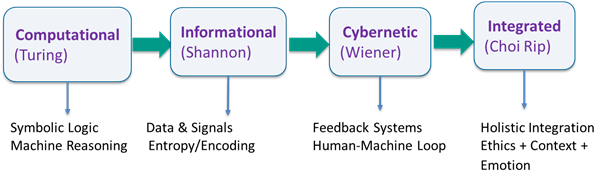
This figure illustrates the historical progression from fragmented models of intelligence toward Choi Rip’s integrated intelligence framework, which unifies ethical, contextual, and cognitive dimensions.
2. Methodology and Analytical Framework
This study employs an interdisciplinary research design that integrates comparative philosophy, conceptual analysis, and systems-oriented reasoning. The objective is not merely to interpret Choi Rip’s philosophy historically, but to reconstruct it as a living theoretical framework applicable to contemporary artificial intelligence. This approach reflects a broader trend in AI ethics and philosophy, where classical thought is increasingly revisited to address modern technological challenges.
The first stage of the methodology involves the textual reconstruction of Choi Rip’s philosophical principles. This includes identifying recurring themes such as integration, relationality, ethics, and contextual interpretation. Rather than focusing on isolated writings, the analysis treats his work as a coherent intellectual system. This systemic reconstruction is necessary to reveal structural parallels with modern AI architectures, which similarly rely on interconnected components.
The second stage is a comparative analysis with key figures in AI and philosophy. Foundational contributions by Alan Turing (1950), Claude Shannon (1948), and Norbert Wiener (1948) are examined alongside philosophical perspectives from Ludwig Wittgenstein (1953) and John Rawls (1971). This comparison highlights both convergences and divergences, allowing for a more nuanced understanding of Choi Rip’s relevance to AI.
The third stage involves conceptual mapping, where elements of Choi Rip’s philosophy are aligned with contemporary AI challenges. For example, his emphasis on relational knowledge is mapped to network-based AI models, while his ethical framework is linked to responsible AI principles (Floridi et al., 2018). This mapping process serves as the foundation for developing a new theoretical model of integrated intelligence.
Finally, the study culminates in framework synthesis, where insights from the previous stages are combined into a cohesive model for AI design. It is evaluated in terms of its theoretical coherence, practical applicability, and potential to address current limitations in AI systems. By integrating historical philosophy with modern technology, the methodology provides a robust foundation for interdisciplinary innovation.
3. Foundations of Artificial Intelligence: A Fragmented Beginning
The development of artificial intelligence has been shaped by several foundational paradigms, each addressing a specific aspect of intelligence. While these paradigms have contributed significantly to technological progress, they have also led to a fragmented understanding of intelligence. This fragmentation poses challenges for developing systems that can integrate multiple dimensions of cognition, ethics, and context.
The computational paradigm, pioneered by Alan Turing (1950), conceptualizes intelligence as a process that can be simulated through symbolic manipulation. Turing’s work established the theoretical foundation for machine intelligence, demonstrating that logical reasoning could be encoded into algorithms. However, this approach primarily focuses on formal reasoning and does not fully account for the complexities of human cognition, such as emotion and context.
The informational paradigm, developed by Claude Shannon (1948), introduced a mathematical framework for understanding communication and data transmission. By defining information in terms of entropy, Shannon enabled the quantification of data processing. While this was a major breakthrough, it also abstracted information from meaning, creating a gap between data processing and semantic understanding.
The cybernetic paradigm, advanced by Norbert Wiener (1948), emphasized feedback and control in dynamic systems. This approach expanded the scope of AI to include interaction and adaptation, laying the groundwork for modern machine learning. However, like the previous paradigms, cybernetics focuses on specific aspects of intelligence and does not provide a fully integrated model.
These foundational paradigms highlight the need for a more comprehensive approach to intelligence. While each contributes valuable insights, their limitations underscore the importance of integration. Choi Rip’s philosophy offers a potential solution by providing a holistic framework that unifies computation, information, ethics, and context into a single coherent system.
4. Choi Rip’s Epistemology: Toward Integrated Intelligence
Choi Rip’s epistemological framework represents a radical departure from the fragmented models of knowledge that characterize much of modern scientific inquiry. At its core lies the conviction that knowledge is inherently unified and relational. Rather than dividing disciplines into discrete categories, Choi Rip approached intellectual inquiry as a holistic endeavor in which ethics, cosmology, language, and human action form an interconnected system. This perspective is particularly evident in his engagement with classical texts, where interpretation becomes an act of synthesizing multiple layers of meaning rather than isolating individual components.
A defining feature of Choi Rip’s epistemology is its emphasis on relational ontology. In this view, entities do not exist independently but are defined by their relationships within a broader system. This contrasts sharply with reductionist approaches that seek to understand phenomena by breaking them down into smaller parts. In modern AI, similar ideas emerge in the form of graph-based models and network representations, where meaning is derived from connections rather than isolated data points. Choi Rip’s philosophy anticipates this shift by several centuries, offering a conceptual foundation for relational intelligence.
Another important aspect of his epistemology is the dynamic nature of knowledge. For Choi Rip, knowledge is not static but evolves through continuous interaction between the observer and the observed. This aligns with contemporary theories of adaptive systems and machine learning, where models update their understanding based on new data. However, Choi Rip’s framework extends beyond technical adaptation to include ethical and contextual dimensions, suggesting that true intelligence must evolve in response to both empirical and moral considerations.
Finally, Choi Rip’s epistemology emphasizes the integration of theory and practice. Knowledge is not merely an abstract construct but must be applied in real-world contexts. This principle has significant implications for AI development, where the gap between theoretical models and practical applications remains a persistent challenge. By framing knowledge as inherently actionable, Choi Rip provides a model for bridging this gap and creating systems that are both intellectually robust and relevant.
Figure 2. Choi Rip’s Integrated Intelligence Framework
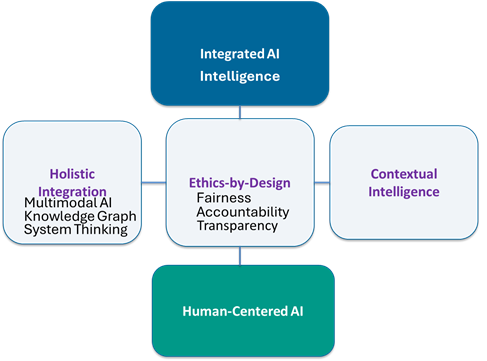
This framework synthesizes Choi Rip’s philosophy into three core AI design principles: integration, ethics, and contextual intelligence, all grounded in human-centered values.
5. Ethics as a Structural Component of Intelligence
Ethics occupies a central position in Choi Rip’s intellectual framework, not as an external constraint but as an intrinsic component of knowledge itself. This contrasts with many contemporary approaches to AI ethics, which often treat ethical considerations as secondary to technical performance. Choi Rip’s philosophy suggests that such separation is fundamentally flawed, as it ignores the interconnected nature of knowledge and action.
One of the key implications of this perspective is the concept of ethics-by-design, where moral principles are embedded directly into the structure of AI systems. Rather than relying on post hoc regulation or external oversight, this approach integrates ethical reasoning into the decision-making processes of the system. For example, fairness constraints can be incorporated into optimization algorithms, while transparency mechanisms can be built into model architectures to ensure explainability.
This approach aligns with modern frameworks for responsible AI, which emphasize principles such as fairness, accountability, and transparency (Floridi et al., 2018; Jobin et al., 2019). However, Choi Rip’s philosophy goes further by suggesting that ethics should not merely guide AI behavior but should shape the very structure of intelligence itself. This represents a change in basic assumptions from reactive to proactive ethical design.
Moreover, the integration of ethics into intelligence has important implications for trust and social acceptance. As AI systems become more autonomous, their decisions have increasingly significant consequences for individuals and society. Embedding ethical reasoning within these systems can enhance trust by ensuring that their actions align with human values. This is particularly important in high-stakes domains such as healthcare, finance, and governance, where ethical considerations are paramount.
Figure 4. Ethics-by-Design Architecture
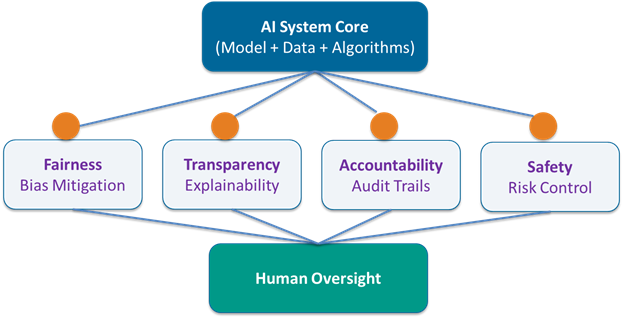
Ethical principles are embedded as structural components rather than external constraints, reflecting Choi Rip’s integration of ethics and knowledge.
6. Contextual Intelligence and Meaning Construction
The challenge of contextual understanding remains one of the most significant limitations of current AI systems. While machine learning models can process vast amounts of data, they often struggle to interpret meaning in a way that reflects human understanding. Choi Rip’s philosophy offers a valuable perspective on this issue through its emphasis on context-sensitive interpretation.
In Choi Rip’s hermeneutics, meaning is not fixed but emerges from the interaction between text, context, and interpreter. This relational approach to meaning contrasts with static definitions and aligns with modern theories of contextual intelligence. For instance, Ludwig Wittgenstein (1953) argued that meaning is determined by use, while Marvin Minsky (1974) proposed that knowledge is organized within context-dependent frames.
Modern AI systems, particularly large language models, have begun to incorporate contextual processing through techniques such as attention mechanisms and embeddings. However, these approaches often rely on statistical correlations rather than deep understanding. Choi Rip’s framework suggests that true contextual intelligence requires integrating cultural, temporal, and situational factors into the interpretation process.
Implementing this level of contextual awareness in AI systems presents significant challenges but also offers substantial benefits. Systems capable of deep contextual understanding would be better equipped to manage ambiguity, adapt to changing environments, and provide more meaningful interactions. This has important implications for applications ranging from natural language processing to decision support systems.
Figure 5. Contextual Intelligence Model
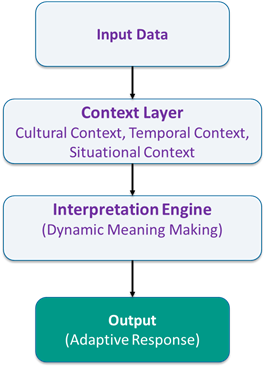
Meaning emerges dynamically through layered contextual processing, reflecting both modern AI techniques and Choi Rip’s interpretive philosophy.
7. Emotion, Aesthetics, and Human-Centered AI
Choi Rip’s intellectual framework extends beyond rational analysis to include emotion and aesthetics as essential components of intelligence. This holistic view challenges the traditional dichotomy between reason and emotion, suggesting instead that they are complementary aspects of human cognition.
In contemporary AI research, this perspective is reflected in the growing field of affective computing, which seeks to develop systems capable of recognizing and responding to human emotions. However, current approaches often treat emotion as an add-on feature rather than an integral part of intelligence. Choi Rip’s philosophy suggests that emotional and aesthetic dimensions should be embedded within the core architecture of AI systems.
The inclusion of emotion and aesthetics has important implications for human–AI interaction. Systems that can understand and respond to emotional cues are more likely to be perceived as trustworthy and engaging. This is particularly relevant in applications such as education, healthcare, and customer service, where human interaction plays a critical role.
Furthermore, thinkers such as Roger Penrose (1989) and David Chalmers (1995) have argued that human consciousness cannot be fully explained by computational processes alone. Choi Rip’s integration of emotion and aesthetics provides a complementary perspective, suggesting that intelligence must encompass both objective and subjective dimensions.
Figure 6. Human-Centered AI Integration Model
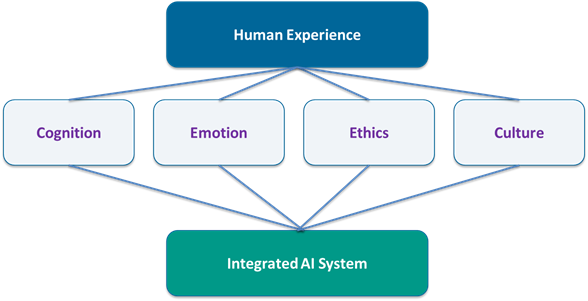
This model emphasizes that AI systems must integrate cognitive, emotional, ethical, and cultural dimensions to achieve true human-centered intelligence.
8. Toward an Integrated Intelligence Framework
Building on the preceding analysis, this section synthesizes Choi Rip’s philosophy into a formal framework for AI design. The integrated intelligence framework is structured around three core principles: holistic integration, ethics-by-design, and contextual adaptability.
Holistic integration emphasizes the unification of diverse knowledge domains within a single system. This involves not only technical integration but also conceptual coherence, ensuring that different components of the system operate within a unified framework.
Ethics-by-design ensures that moral principles are embedded within the system architecture. This approach moves beyond external regulation to create systems that inherently align with ethical standards.
Contextual adaptability enables systems to interpret and respond to dynamic environments. By incorporating contextual information into decision-making processes, AI systems can achieve greater flexibility and relevance.
Together, these principles provide a comprehensive framework for developing AI systems that are not only technically advanced but also ethically grounded and human centered.
Figure 3. Mapping Choi Rip to Modern AI Architecture
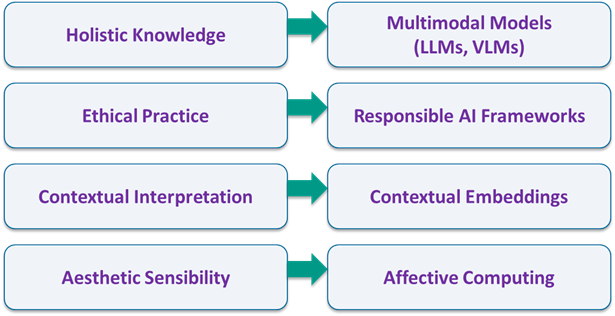
This figure shows the structural correspondence between Choi Rip’s philosophical constructs and contemporary AI technologies.
9. Implications for AI System Design
The integrated intelligence framework suggests a fundamental shift in AI system design from modular optimization to holistic architectures. Instead of isolated subsystems, AI should incorporate unified representational layers enabling seamless interaction among perception, reasoning, and ethical evaluation. This reflects emerging multimodal architectures but extends them into epistemological integration.
A second implication is the structural embedding of ethical reasoning within AI systems. Current approaches relying on external oversight are insufficient for real-time decisions. Ethics-by-design requires fairness-aware algorithms, explainable decision-making processes, and accountability mechanisms integrated into system architecture (Floridi et al., 2018; Jobin et al., 2019).
Third, the framework emphasizes advanced contextual intelligence. While current AI models rely on statistical correlations, deeper contextual modeling is necessary. Hybrid architectures combining symbolic reasoning and neural networks may enable richer interpretation of meaning across cultural and situational contexts.
Finally, human-centered design becomes essential. AI systems must incorporate emotional intelligence, cultural awareness, and user-centric interaction. This approach enhances trust, usability, and societal alignment, ensuring that AI serves human needs rather than merely optimizing computational efficiency.
10. Discussion
This study demonstrates that Choi Rip’s philosophy provides a broader conceptual foundation for AI research. His integrative model challenges reductionist approaches and emphasizes the interconnected nature of knowledge, ethics, and context.
A key contribution is the introduction of cross-cultural epistemology into AI discourse. While AI research has been dominated by Western traditions, incorporating non-Western perspectives enriches theoretical diversity and supports globally relevant AI development.
However, implementing integrated intelligence systems presents challenges. These include designing unified architectures, embedding ethical reasoning at scale, and achieving genuine contextual understanding. Addressing these challenges requires interdisciplinary collaboration across AI, philosophy, and social sciences.
Finally, the study highlights future research directions. These include empirical validation of integrated intelligence models, development of prototype systems, and exploration of additional philosophical traditions to further refine AI theory.
11. Conclusion
This paper has argued that Choi Rip’s philosophy offers a valuable framework for understanding and advancing artificial intelligence. His emphasis on integration, ethics, and context aligns closely with contemporary AI challenges and provides a unified model of intelligence.
The integrated intelligence framework contributes to human-centered AI by emphasizing ethical alignment, contextual awareness, and meaningful interaction. It redefines intelligence as a holistic process rather than a purely computational function.
Furthermore, this study underscores the importance of cross-cultural perspectives in AI research. By incorporating diverse intellectual traditions, AI development can become more inclusive and adaptable to global contexts.
In conclusion, as AI continues to evolve, frameworks grounded in integration and ethical responsibility will be essential. Choi Rip’s philosophy provides such a foundation, guiding the development of AI systems that are not only intelligent but also humane and socially beneficial.
References
Chalmers, D. J. (1995). Facing up to the problem of consciousness. Journal of Consciousness Studies, 2(3), 200–219. https://doi.org/10.1093/acprof:oso/9780195311105.003.0001
Floridi, L., Cowls, J., Beltrametti, M., et al. (2018). AI4People—An ethical framework for a good AI society. Minds and Machines, 28(4), 689–707. https://doi.org/10.1007/s11023-018-9482-5
Jobin, A., Ienca, M., & Vayena, E. (2019). The global landscape of AI ethics guidelines. Nature Machine Intelligence, 1, 389–399. https://doi.org/10.1038/s42256-019-0088-2
Minsky, M. (1974). A framework for representing knowledge. https://doi.org/10.21236/ADA045178
Penrose, R. (1989). The emperor’s new mind. https://doi.org/10.1093/oso/9780198519737.001.0001
Rawls, J. (1971). A theory of justice. https://doi.org/10.2307/j.ctvjf9z6v
Shannon, C. E. (1948). A mathematical theory of communication. https://doi.org/10.1002/j.1538-7305.1948.tb01338.x
Turing, A. M. (1950). Computing machinery and intelligence. https://doi.org/10.1093/mind/LIX.236.433
Wiener, N. (1948). Cybernetics. https://doi.org/10.7551/mitpress/2317.001.0001
Wittgenstein, L. (1953). Philosophical investigations. https://doi.org/10.1002/9780470775561

Young Choi, PhD is a Professor at Regent University bringing a rare combination of technical expertise and creative spirit to everything he does. A scholar in AI, cybersecurity, and network & telecommunications service management, he has published 38 books including AI and cybersecurity area books, over 200 refereed articles, and over 20 book chapters. Beyond the academy, Dr. Choi is a passionate poet, essayist, and wooden block engraving artist whose reflective writing invites readers to rediscover life’s beauty in quiet contemplation(靜觀). He lives under the motto: “Study hard and give generously without holding back! (열심히 공부해서 아낌없이 남주자 !)”
Published books: https://www.amazon.com/stores/Young-Choi/author/B0DMZ5S6R7?ref=ap_rdr&shoppingPortalEnabled=true