
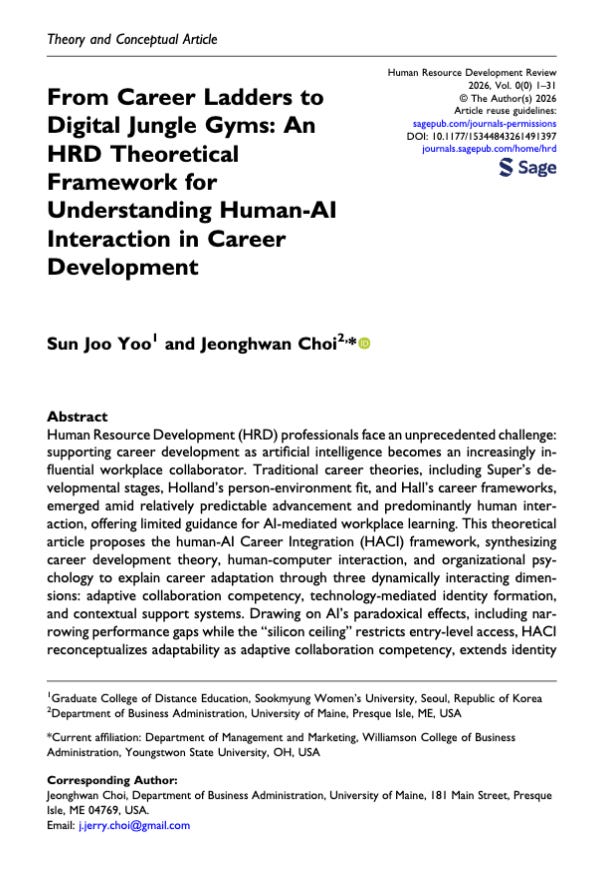
From Career Ladders to Digital Jungle Gyms: Introducing the HACI Framework
We are pleased to share our new article published in Human Resource Development Review. As artificial intelligence increasingly becomes a workplace collaborator, established career theories offer limited guidance on how employees develop competencies, construct professional identities, and sustain their careers in AI-mediated environments.
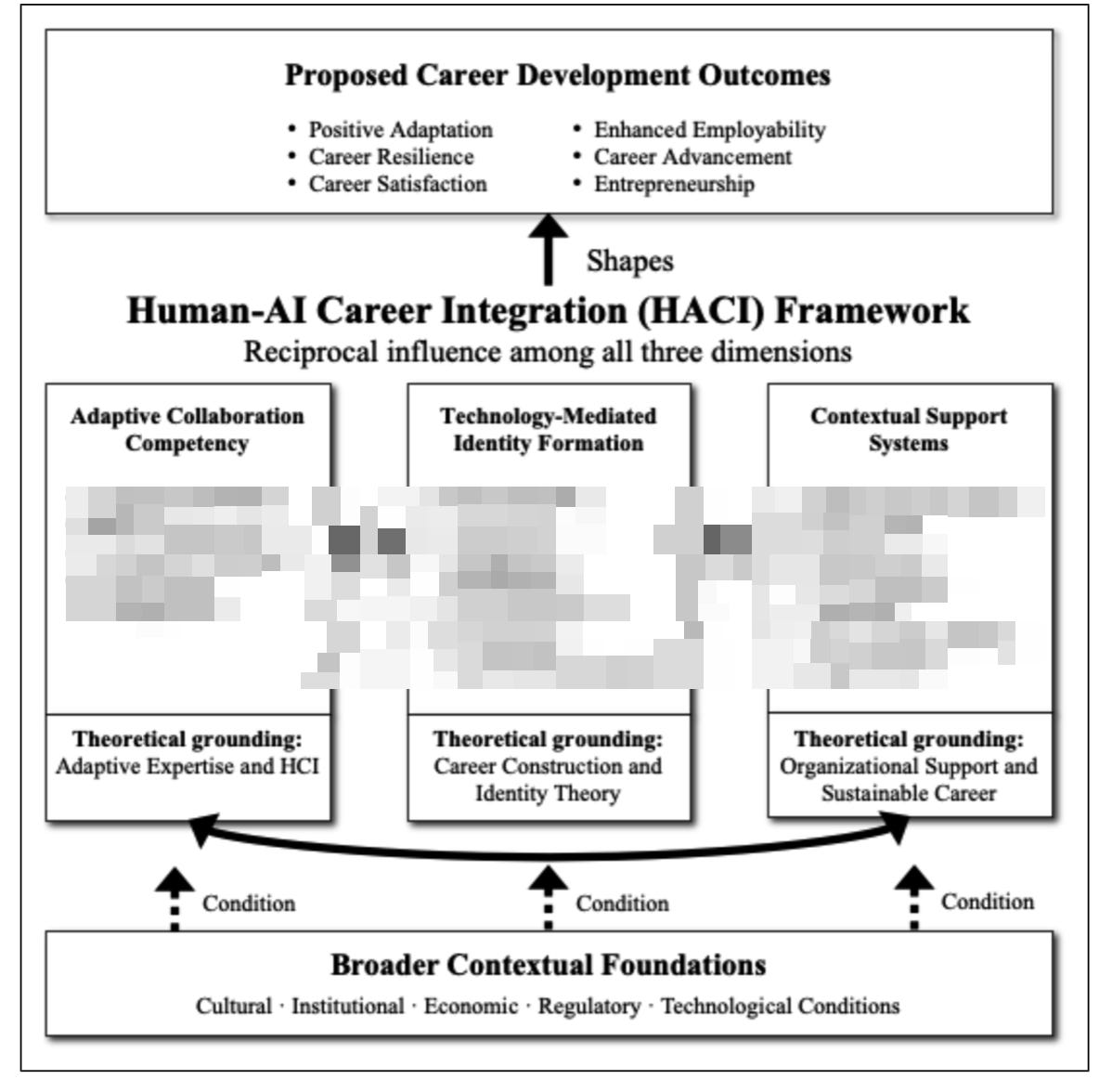
In this conceptual article, Yoo and Choi introduce the Human–AI Career Integration (HACI) framework. The framework explains career development through three dynamically interacting dimensions: adaptive collaboration competency, technology-mediated identity formation, and contextual support systems. It proposes that positive career outcomes depend on alignment among employees’ capacity to collaborate with AI, their ability to maintain meaningful professional identities, and the organizational, educational, social, and policy supports available to them.
The article extends traditional career-development perspectives by moving beyond predictable career ladders toward “digital jungle gyms,” where career movement may be nonlinear, lateral, and shaped by continuing technological change. It also offers HRD professionals guidance for designing training, career-development systems, organizational culture-change interventions, and responsible AI implementation practices.
Yoo, S. J., & Choi, J. (2026). Human Resource Development Review, 1–31.
https://doi.org/10.1177/15344843261491397
#HRD #ArtificialIntelligence #CareerDevelopment #HumanAI #OrganizationDevelopment
Prof. Dr. Jeonghwan (Jerry) Choi (Managing Editor), University of Maine at Presque Isle
Jeonghwan (Jerry) Choi, PhD is an Associate Professor of Business at the University of Maine at Presque Isle and Editor-in-Coordination of K-GSP Forum (contact: jeonghwan.choi at gmail.com). With over 25 years of industry and consulting experience, he specializes in leadership development, human resource management, organizational behavior, and social entrepreneurship. His research focuses on workforce resilience, organizational health, and self-directed leadership — bridging rigorous scholarship with practical insight to cultivate leaders who create meaningful, sustainable, and humane organizations.