

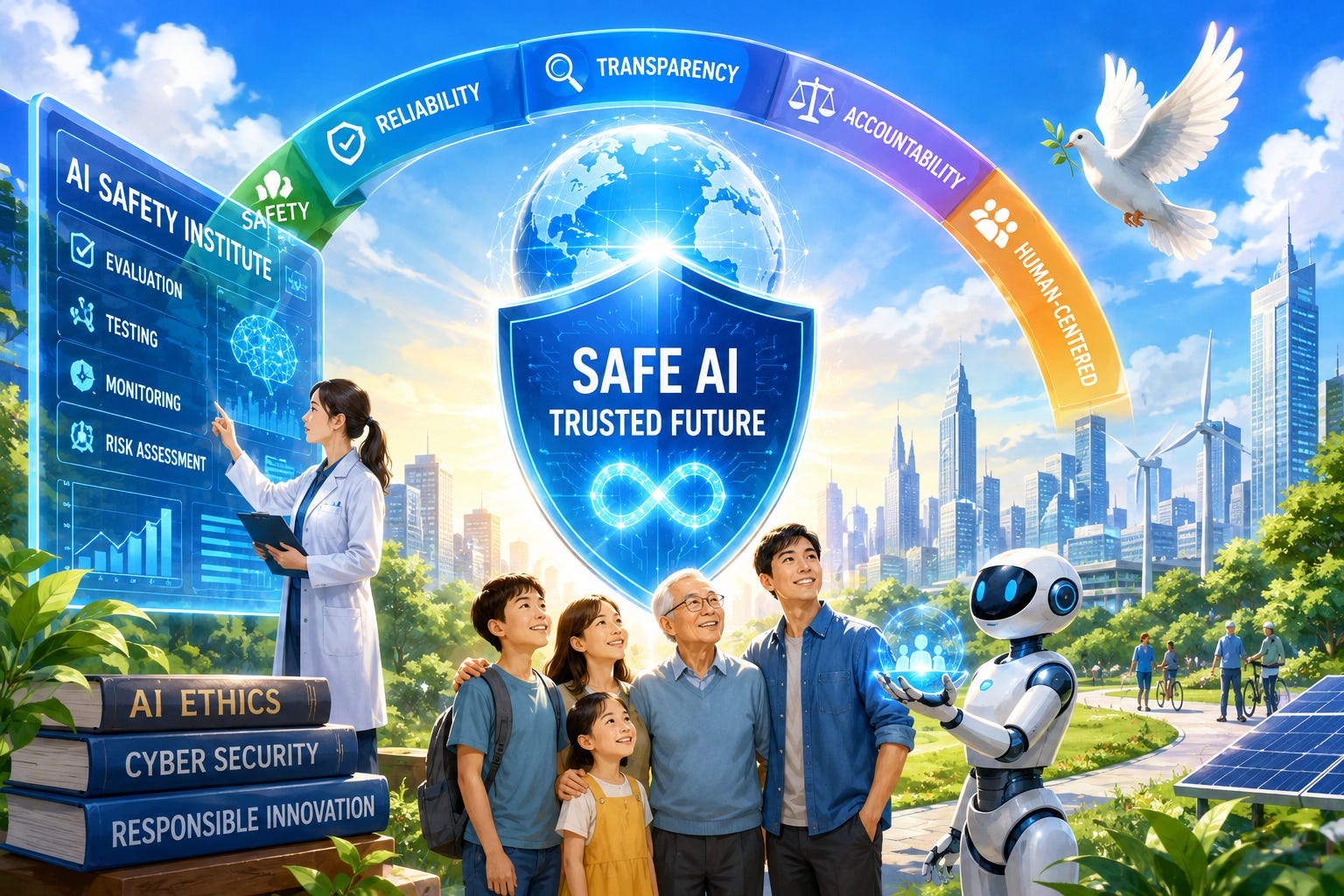
From Smarter AI to Safer AI: The New Global Competition for Trustworthy Artificial Intelligence
Why AI Safety Evaluation May Become the Next Strategic Infrastructure
The Question Has Changed
For much of the past decade, the global artificial intelligence competition was defined by a simple question:
Who can build the most powerful AI?
The answer was measured in model size, computing power, benchmark scores, reasoning ability, multimodality, and the speed with which new capabilities could be commercialized.
But that question is rapidly becoming inadequate.
As artificial intelligence moves from a conversational tool into an autonomous decision-maker, software engineer, scientific assistant, cybersecurity system, medical assistant, and potentially an agent capable of interacting with the physical and digital world, another question is becoming unavoidable:
Can we trust the AI we are building?
This is why the emergence of national AI safety organizations and systematic AI evaluation programs represents something much larger than another branch of technology policy. It signals the beginning of a new institutional architecture for the AI era.
The United Kingdom’s AI safety research and evaluation efforts are particularly important because they illustrate the emergence of an independent capability for testing frontier AI systems rather than simply accepting developers’ own claims about safety. The UK’s AI Security Institute has been conducting evaluations of frontier AI systems since 2023 and has increasingly emphasized systematic, evidence-based measurement of emerging capabilities and risks.
The larger historical significance is clear.
The AI race is gradually becoming a race not only for intelligence, but for trustworthy intelligence.
The Industrial Revolution Had Safety Standards. The AI Revolution Needs Them Too
Every major technological revolution eventually discovers the same lesson: powerful technology cannot become reliable infrastructure without independent mechanisms for testing, certification, monitoring, and accountability.
The automobile industry developed crash testing.
The aviation industry developed rigorous certification and airworthiness standards.
The pharmaceutical industry developed clinical trials.
The financial system developed auditing and regulatory supervision.
AI now needs an equivalent institutional infrastructure.
This does not mean that every AI system should be subjected to the same regulatory burden. A chatbot helping someone write a birthday card is fundamentally different from an autonomous AI system controlling critical infrastructure, conducting cybersecurity operations, or assisting with high-consequence scientific research.
The central principle should therefore be risk proportionality.
The more powerful, autonomous, connected, and consequential an AI system becomes, the stronger its evaluation and assurance requirements should become.
Recent scholarship reinforces this broader conception of AI safety. Gyevnár and Kasirzadeh (2025), for example, argue that AI safety should not be reduced to existential-risk scenarios. AI safety encompasses a much broader spectrum of technical, social, and governance problems.
This is an important conceptual correction.
AI safety is not only about preventing a hypothetical superintelligence from destroying humanity.
It is also about preventing today’s AI systems from making predictable mistakes that can harm individuals, organizations, and societies.
AI Safety Must Move from Principles to Evidence
For years, organizations have published AI principles emphasizing fairness, transparency, accountability, privacy, and safety.
These principles are important.
But principles alone do not make an AI system safe.
The critical transition is from:
“We promise that our AI is safe.”
to:
“Here is independent evidence demonstrating how our AI performs under defined safety conditions.”
This is the difference between AI ethics and AI assurance.
AI assurance asks much more difficult questions:
Can the system resist adversarial manipulation?
Does it remain safe when given unexpected instructions?
Can it be induced to bypass safeguards?
Does it behave differently when deployed with external tools?
Can its outputs be independently verified?
Can failures be reproduced?
Can humans intervene effectively?
What happens when the system is connected to the Internet?
And, perhaps most importantly:
How do we know that the system remains safe after deployment?
A recent AAAI study on AI assurance illustrates this transition from broad principles toward operational mechanisms for assessing transparency, reliability, consistency, and auditability (Cross et al., 2025).
The implication is profound.
The future of trustworthy AI will require not only AI developers, but also AI evaluators, auditors, certifiers, red teams, standards organizations, and independent testing laboratories.
In other words, AI will need an ecosystem of trust.
The New Frontier: Testing AI Under Stress
Traditional software testing generally assumes that a program should behave deterministically under a specified set of inputs.
Generative AI is different.
Large language models are probabilistic, context-sensitive, and capable of producing different outputs under apparently similar conditions. Their behavior can also change dramatically when connected to tools, external databases, agents, or other AI systems.
Therefore, conventional software testing is not enough.
AI safety testing increasingly needs to resemble stress testing.
A model should not merely be tested under normal circumstances.
It should be challenged.
It should be exposed to adversarial prompts.
It should encounter ambiguous instructions.
It should face conflicting objectives.
It should be tested against prompt injection.
It should be placed in unfamiliar contexts.
And, where appropriate, it should be evaluated in realistic environments.
The importance of this approach is demonstrated by Zhou et al. (2026), whose study in Nature Machine Intelligence benchmarked large language models against safety risks in scientific laboratory settings. The study illustrates why AI safety cannot be evaluated solely through abstract language benchmarks; models must also be examined in realistic, domain-specific environments where errors can have consequential effects.
This represents an important change in philosophy:
AI safety should be measured where AI is actually going to be used.
The Expanding AI Attack Surface
There is another reason why AI safety cannot be separated from cybersecurity.
As AI systems become more autonomous, their attack surface expands.
An isolated language model is one thing.
An AI agent with access to email, cloud infrastructure, databases, source-code repositories, financial systems, enterprise APIs, and the Internet is something entirely different.
The agent may be highly capable—but so is the potential attacker who manipulates it.
Recent research on the security of LLM agents highlights this duality: agentic AI can simultaneously strengthen cybersecurity defenses while expanding the attack surface through autonomy, tool use, and system integration (Xu et al., 2026).
This means that AI safety must include cybersecurity by design.
A trustworthy AI system should therefore incorporate:
identity and access control,
zero-trust architecture,
secure tool invocation,
sandboxing,
continuous monitoring,
runtime policy enforcement,
audit logging,
data integrity protection,
and human intervention mechanisms.
The distinction between AI safety and cybersecurity is consequently becoming increasingly artificial.
In the future, AI safety will be impossible without AI security.
From Benchmarking to Continuous Assurance
One of the most important developments in AI governance is the recognition that a single pre-deployment test is not sufficient.
An AI model may pass an evaluation today and behave differently tomorrow.
Why?
Because the surrounding system may change.
The model may be updated.
The prompt architecture may change.
New tools may be connected.
The retrieval database may change.
The operating environment may change.
Users may discover previously unknown failure modes.
Attackers may develop new techniques.
Therefore, AI assurance must become continuous.
This suggests a lifecycle model:
Design → Test → Red Team → Deploy → Monitor → Re-evaluate → Update → Re-certify
Such a model represents a fundamental shift from traditional product certification.
AI safety should not be treated as a certificate obtained once.
It should be treated as a continuous process of accumulating confidence.
This is particularly important because recent research has begun to map AI safety across multiple layers rather than treating “safety” as a single property. Chen et al. (2026), in a recent Artificial Intelligence Review survey, identify concerns spanning functional correctness, robustness, safeguard bypass, training-data integrity, privacy, transparency, content authenticity, misuse resistance, and ecosystem-level control.
The message is clear:
There is no single AI safety test.
There is an entire safety system.
The Independent Auditor May Become as Important as the AI Developer
The financial world provides an instructive analogy.
A corporation does not simply announce that its financial statements are accurate and expect society to accept that claim.
Independent auditors examine them.
Why?
Because trust requires independence.
The same principle will increasingly apply to frontier AI.
If an AI company develops a model, evaluates its own model, defines its own safety criteria, publishes its own results, and certifies its own compliance, a fundamental conflict of interest may emerge.
Independent evaluation therefore becomes strategically important.
The emerging AI assurance ecosystem could eventually include:
AI safety laboratories
independent AI auditors
government testing institutes
academic evaluation centers
industry certification bodies
red-team organizations
and international standards organizations.
Such institutions would not replace AI developers.
They would make AI development more trustworthy.
This is particularly important for frontier AI because many safety-relevant details may not be publicly observable. Rigorous external assessment may require secure access to information that cannot simply be disclosed publicly.
Thus, the future may require a carefully designed balance between transparency and confidentiality.
Trust Is Not a Public-Relations Problem
The ultimate objective of AI safety is not simply to make companies appear responsible.
It is to make AI systems genuinely more trustworthy.
Research on public trust in generative AI reinforces this point. Huynh and Aichner (2025) examine the determinants and outcomes of cognitive trust in generative AI, highlighting the importance of understanding why users trust AI and what consequences that trust produces.
This creates an important paradox.
AI systems must become trustworthy.
But humans must also learn when not to trust them.
Blind trust is not trustworthy AI.
The goal should be calibrated trust.
A user should trust an AI system when evidence supports that trust and question it when uncertainty is high.
This requires AI systems that communicate uncertainty, disclose limitations, preserve provenance, support verification, and make escalation to humans possible.
In this sense, the future of AI is not simply about creating more intelligent machines.
It is about creating intelligent systems that know the boundaries of their reliability—and help humans recognize those boundaries.
The Human Must Remain in the Safety Loop
There is a temptation to believe that increasingly sophisticated AI will eventually eliminate the need for human oversight.
That would be a dangerous assumption.
Human oversight is not merely an emergency brake.
It is part of the architecture of responsible AI.
Human beings provide contextual understanding, ethical judgment, institutional accountability, and the ability to redefine objectives when circumstances change.
This does not mean that humans should manually approve every AI action.
That would be impractical.
Instead, AI systems should be designed according to risk-sensitive human oversight.
Low-risk decisions can be highly automated.
Medium-risk decisions can require human confirmation or sampling.
High-risk decisions should require meaningful human review and the ability to intervene.
This principle becomes even more important as AI moves from generating text to taking actions.
The more an AI system can act, the more important it becomes to define who remains accountable.
What Korea Should Do Now
Korea has an unusual opportunity.
It possesses strong capabilities in semiconductors, telecommunications, cybersecurity, manufacturing, robotics, and digital infrastructure.
These strengths can be combined to create a distinctive national strategy:
not merely becoming an AI power but becoming an AI trust power.
Korea should establish a national AI safety evaluation infrastructure capable of independently testing frontier and high-risk AI systems.
Such an institution should not simply duplicate existing regulatory functions.
It should specialize in technical evaluation.
Its mission could include:
model red teaming,
AI cybersecurity testing,
agentic-AI evaluation,
privacy and data-integrity testing,
adversarial robustness,
hallucination and misinformation assessment,
autonomous-agent safety,
and continuous post-deployment monitoring.
Korea should also connect this infrastructure with universities, government laboratories, semiconductor companies, telecommunications operators, hospitals, financial institutions, and cybersecurity organizations.
The goal should be to create a Korean AI Assurance Ecosystem.
Such an ecosystem could eventually become an exportable national capability.
Korea has already demonstrated that standards and infrastructure can become strategic assets.
AI assurance could be the next one.
From AI Competition to AI Civilization
The deeper significance of AI safety extends beyond technology policy.
Human civilization has repeatedly learned that technological power without institutional responsibility creates instability.
The printing press transformed knowledge.
The steam engine transformed production.
Electricity transformed society.
The Internet transformed communication.
AI is transforming intelligence itself.
That makes AI fundamentally different.
Previous technologies amplified human physical capabilities.
AI increasingly amplifies human cognitive capabilities.
And when cognitive power becomes autonomous, the consequences are potentially much larger.
Therefore, the central question of the AI era is not simply:
How intelligent can machines become?
It is:
How wisely can human beings govern increasingly intelligent machines?
That is a civilizational question.
The New Meaning of AI Leadership
For years, AI leadership was associated with bigger models, larger datasets, faster chips, and greater computing capacity.
Those factors will remain important.
But they will no longer be sufficient.
The next generation of AI leaders will need another capability:
the ability to demonstrate that their AI systems can be trusted.
This will require a new form of infrastructure consisting of:
evaluation,
verification,
auditing,
security,
monitoring,
governance,
and human accountability.
The countries that build this infrastructure early may gain an unexpected competitive advantage.
They will not merely produce AI.
They will make AI deployable.
And in a world where AI enters healthcare, finance, education, defense, transportation, scientific research, and critical infrastructure, deployability will increasingly depend on trust.
Conclusion: Intelligence Must Earn Trust
The greatest mistake of the AI era would be to assume that technological capability automatically creates social legitimacy.
It does not.
A powerful AI system can still be unreliable.
A highly intelligent AI system can still be insecure.
A technically impressive AI system can still be unsafe.
And an AI system that cannot demonstrate why it should be trusted will ultimately face limits on where society is willing to deploy it.
The emerging global movement toward AI safety evaluation therefore represents more than a regulatory trend.
It is the beginning of a new technological institution.
The world is moving from:
AI development → AI evaluation → AI assurance → AI trust.
The question of the next decade will not simply be:
“Who has the smartest AI?”
It will increasingly be:
“Whose AI can we safely trust?”
That is where the next great competition will be fought.
And perhaps the most important lesson is this:
The future will not belong simply to those who build the most intelligent machines. It will belong to those who can make intelligence worthy of trust.
Smart AI may win the race for capability.
Safe AI will win the race for civilization.
References
Chen, C., Gong, X., Liu, Z., Jiang, W., Goh, S. Q., & Lam, K.-Y. (2026). AI safety landscape for large language models: Taxonomy, state-of-the-art, and future directions. Artificial Intelligence Review. https://doi.org/10.1007/s10462-026-11590-x
Cross, M., Gutmann, A., Psychoula, I., & Friere, P. (2025). From AI principles to AI assurance: An online safety case study. Proceedings of the AAAI Symposium Series, 7(1), 2–10. https://doi.org/10.1609/aaaiss.v7i1.36860
Gyevnár, B., & Kasirzadeh, A. (2025). AI safety for everyone. Nature Machine Intelligence, 7, 531–542. https://doi.org/10.1038/s42256-025-01020-y
Huynh, M.-T., & Aichner, T. (2025). In generative artificial intelligence we trust: Unpacking determinants and outcomes for cognitive trust. AI & Society, 40, 5849–5869. https://doi.org/10.1007/s00146-025-02378-8
Zhou, Y., Yang, J., Huang, Y., Guo, K., Emory, Z., Ghosh, B., Bedar, A., Shekar, S., Liang, Z., Chen, P.-Y., Gao, T., Geyer, W., Moniz, N., Chawla, N. V., & Zhang, X. (2026). Benchmarking large language models on safety risks in scientific laboratories. Nature Machine Intelligence, 8, 20–31. https://doi.org/10.1038/s42256-025-01152-1
더 똑똑한 AI에서 더 안전한 AI로: 신뢰할 수 있는 인공지능을 둘러싼 새로운 국제 경쟁
왜 AI 안전성 평가가 차세대 전략 인프라가 될 것인가
질문이 달라지고 있다
지난 10여 년 동안 세계 인공지능(AI) 경쟁은 매우 단순한 질문으로 정의되어 왔다.
“누가 가장 강력한 AI를 만들 수 있는가?”
그 답은 모델의 규모, 컴퓨팅 능력, 벤치마크 성능, 추론 능력, 멀티모달 능력, 그리고 새로운 기능을 얼마나 빠르게 상용화할 수 있는가에 의해 측정되었다.
그러나 이제 이러한 질문만으로는 충분하지 않다.
AI가 단순한 대화 도구를 넘어 자율적인 의사결정자, 소프트웨어 엔지니어, 과학 연구 보조자, 사이버보안 시스템, 의료 보조자, 그리고 디지털 세계와 물리적 세계에 직접 상호작용할 수 있는 에이전트로 발전하면서 새로운 질문이 피할 수 없는 과제가 되고 있다.
“우리가 만들고 있는 AI를 과연 신뢰할 수 있는가?”
이 때문에 국가 차원의 AI 안전 연구기관과 체계적인 AI 평가 프로그램의 등장은 단순히 기술정책의 한 분야가 새롭게 생겨났다는 의미를 넘어선다. 그것은 AI 시대를 위한 새로운 제도적 안전 인프라가 형성되기 시작했음을 의미한다.
영국의 AI 안전 연구 및 평가 노력은 특히 중요하다. 영국은 2023년부터 첨단 AI 시스템에 대한 독립적인 평가 역량을 발전시켜 왔으며, 개발자가 주장하는 안전성을 그대로 받아들이는 것이 아니라 실제 증거에 기반하여 새로운 능력과 위험을 체계적으로 측정하는 방향으로 나아가고 있다.
결국 역사적 의미는 분명하다.
AI 경쟁은 이제 지능만을 겨루는 경쟁에서 신뢰할 수 있는 지능을 만드는 경쟁으로 바뀌고 있다.
산업혁명에는 안전기준이 있었다. AI 혁명에도 필요하다
모든 거대한 기술혁명은 결국 하나의 공통된 교훈을 발견한다.
강력한 기술은 독립적인 시험, 인증, 감시, 책임 체계 없이는 신뢰받는 사회 인프라가 될 수 없다.
자동차 산업은 충돌시험을 발전시켰다.
항공산업은 엄격한 감항성 및 안전 인증체계를 발전시켰다.
제약산업은 임상시험 제도를 발전시켰다.
금융시스템은 감사와 규제감독 체계를 발전시켰다.
이제 AI에도 이에 상응하는 제도적 인프라가 필요하다.
물론 모든 AI 시스템에 동일한 수준의 규제를 적용해야 한다는 의미는 아니다. 누군가의 생일 축하 메시지를 작성하는 AI와 핵심 인프라를 통제하거나 사이버보안 작업을 수행하거나 고위험 과학 연구를 지원하는 자율 AI 시스템은 본질적으로 다르다.
따라서 핵심 원칙은 위험에 비례하는 안전관리(risk proportionality)가 되어야 한다.
AI 시스템이 더욱 강력하고, 자율적이며, 외부 시스템과 연결되고, 사회적 영향력이 커질수록 더욱 엄격한 평가와 보증 절차가 필요하다.
최근 연구 역시 AI 안전을 이러한 보다 넓은 관점에서 바라볼 필요성을 강조한다. Gyevnár와 Kasirzadeh(2025)는 AI 안전을 단순히 존재론적 위험이나 초지능 문제로 한정해서는 안 되며, 기술적·사회적·거버넌스 차원의 다양한 문제를 포함하는 개념으로 이해해야 한다고 주장한다.
이는 중요한 개념적 전환이다.
AI 안전은 가상의 초지능이 인류를 파괴하는 것을 막는 문제만이 아니다.
오늘날 사용되는 AI가 예측 가능한 실수를 통해 개인과 조직, 사회에 피해를 주는 것을 방지하는 것도 AI 안전이다.
AI 안전은 원칙에서 증거로 이동해야 한다
지난 몇 년 동안 많은 기업과 정부기관은 공정성, 투명성, 책임성, 개인정보 보호, 안전을 강조하는 AI 원칙을 발표해 왔다.
이러한 원칙은 중요하다.
그러나 원칙만으로 AI가 안전해지는 것은 아니다.
가장 중요한 변화는 다음과 같은 전환이다.
“우리의 AI는 안전하다고 약속합니다.”
에서
“우리 AI가 정의된 안전조건에서 어떻게 작동하는지를 보여주는 독립적인 증거가 있습니다.”
로 이동하는 것이다.
이것이 바로 AI 윤리(AI ethics)와 AI 보증(AI assurance)의 중요한 차이다.
AI 보증은 훨씬 더 어려운 질문을 던진다.
AI가 적대적인 조작을 견딜 수 있는가?
예상하지 못한 지시가 주어졌을 때도 안전하게 작동하는가?
안전장치를 우회하도록 유도할 수 있는가?
외부 도구와 연결되었을 때 행동이 달라지는가?
AI의 결과를 독립적으로 검증할 수 있는가?
오류를 재현할 수 있는가?
문제가 발생했을 때 인간이 효과적으로 개입할 수 있는가?
그리고 가장 중요한 질문은 이것이다.
배포된 이후에도 AI가 계속 안전하다는 것을 어떻게 확인할 것인가?
Cross et al.(2025)은 AI 원칙을 실제적인 AI 보증 체계로 전환하는 문제를 다루면서 투명성, 신뢰성, 일관성, 감사 가능성 등의 요소를 실제 안전사례(safety case)와 연결할 필요성을 제시했다.
이러한 변화가 의미하는 것은 분명하다.
미래의 신뢰할 수 있는 AI 생태계에는 AI 개발자뿐만 아니라 AI 평가자, 감사자, 인증기관, 레드팀, 표준화기관, 독립적인 시험기관이 필요하다.
다시 말해 AI에도 하나의 신뢰 생태계(trust ecosystem)가 필요하다.
새로운 최전선: 스트레스 상황에서 AI를 시험하라
전통적인 소프트웨어 테스트는 일반적으로 프로그램이 특정 입력에 대해 예측 가능한 방식으로 작동해야 한다는 전제에서 출발한다.
생성형 AI는 다르다.
대규모 언어모델은 확률적이고 문맥에 민감하며, 유사한 입력에서도 서로 다른 결과를 만들어낼 수 있다. 또한 외부 도구, 데이터베이스, 에이전트 또는 다른 AI 시스템과 연결되면 행동이 크게 달라질 수 있다.
따라서 전통적인 소프트웨어 테스트만으로는 충분하지 않다.
AI 안전성 평가 역시 스트레스 테스트(stress testing)와 같은 방향으로 발전해야 한다.
AI는 정상적인 상황에서만 시험해서는 안 된다.
AI를 도전적인 상황에 노출해야 한다.
적대적 프롬트를 제공해야 한다.
모호한 지시를 내려야 한다.
서로 충돌하는 목표를 제시해야 한다.
프롬트 인젝션 공격에 노출시켜야 한다.
익숙하지 않은 환경에서 시험해야 한다.
그리고 필요한 경우 실제 사용환경과 유사한 조건에서 평가해야 한다.
Zhou et al.(2026)은 Nature Machine Intelligence에 발표한 연구에서 대규모 언어모델을 실제 과학 실험실 환경에서 발생할 수 있는 안전 위험에 대해 벤치마킹했다. 이 연구는 AI 안전을 추상적인 언어 벤치마크만으로 평가해서는 안 되며, 실제 사용환경에서 발생할 수 있는 구체적인 위험을 중심으로 평가해야 한다는 점을 보여준다.
따라서 중요한 원칙은 다음과 같다.
AI 안전은 AI가 실제로 사용될 환경에서 측정되어야 한다.
확대되는 AI 공격 표면
AI 안전을 사이버보안과 분리할 수 없는 또 하나의 이유가 있다.
AI 시스템이 더욱 자율화될수록 공격 표면(attack surface)이 확대된다.
독립적으로 작동하는 언어모델과, 이메일, 클라우드 인프라, 데이터베이스, 소스코드 저장소, 금융시스템, 기업 API, 인터넷 등에 접근할 수 있는 AI 에이전트는 전혀 다른 존재다.
AI 에이전트가 강력해지는 만큼 이를 조작하려는 공격자 역시 강력해질 수 있다.
최근 LLM 에이전트 보안 연구는 자율성, 도구 사용, 시스템 통합이 AI의 방어능력을 향상시키는 동시에 새로운 공격 표면을 만들어낸다는 이중성을 지적하고 있다.
따라서 AI 안전은 처음부터 사이버보안을 포함해야 한다.
신뢰할 수 있는 AI 시스템은 다음과 같은 요소를 갖추어야 한다.
신원 및 접근통제
제로트러스트 아키텍처
안전한 도구 호출(tool invocation)
샌드박싱
지속적 모니터링
실행단계 정책 적용(runtime policy enforcement)
감사 로그
그리고 인간의 개입 메커니즘
결국 AI 안전과 AI 보안의 경계는 점점 의미가 없어지고 있다.
미래의 AI 안전은 AI 보안 없이는 달성될 수 없다.
벤치마킹에서 지속적 보증으로
AI 거버넌스에서 가장 중요한 변화 가운데 하나는 배포 전에 한 번 안전성 검사를 하는 것만으로는 충분하지 않다는 인식이다.
오늘 안전성 평가를 통과한 AI가 내일도 동일하게 행동한다는 보장은 없다.
왜 그런가?
AI를 둘러싼 환경이 계속 변화하기 때문이다.
모델이 업데이트될 수 있다.
프롬트 구조가 변경될 수 있다.
새로운 도구가 연결될 수 있다.
검색 데이터베이스가 변경될 수 있다.
운영환경이 변화할 수 있다.
사용자가 이전에 발견하지 못했던 새로운 오류를 발견할 수 있다.
공격자는 새로운 공격기법을 개발할 수 있다.
따라서 AI 보증은 지속적인 과정이 되어야 한다.
이를 하나의 생애주기 모델로 표현하면 다음과 같다.
설계 → 테스트 → 레드팀 → 배포 → 모니터링 → 재평가 → 업데이트 → 재인증
이것은 전통적인 제품 인증과 근본적으로 다르다.
AI 안전은 한 번 획득하고 끝나는 인증서가 되어서는 안 된다.
AI 안전은 신뢰도를 지속적으로 축적해 나가는 과정이어야 한다.
Chen et al.(2026)의 최근 연구 역시 LLM 안전을 단일한 속성으로 보지 않고 기능적 정확성, 강건성, 안전장치 우회, 학습데이터 무결성, 개인정보 보호, 투명성, 콘텐츠 진위성, 오용 방지, 생태계 수준의 통제 등 여러 층위로 분석한다.
메시지는 분명하다.
하나의 AI 안전성 테스트만으로는 충분하지 않다.
필요한 것은 하나의 AI 안전 시스템이다.
독립적인 AI 감사자는 개발자만큼 중요해질 것이다
금융 분야는 중요한 역사적 교훈을 제공한다.
기업이 재무제표가 정확하다고 스스로 선언한다고 해서 사회가 그것을 그대로 받아들이지는 않는다.
독립적인 감사자가 검증한다.
왜 그런가?
신뢰에는 독립성이 필요하기 때문이다.
앞으로 이러한 원칙은 첨단 AI에도 적용될 가능성이 높다.
AI 기업이 모델을 개발하고, 스스로 안전성을 평가하고, 자체적인 안전기준을 만들고, 결과를 발표하고, 스스로 안전성을 인증한다면 이해상충 문제가 발생할 수 있다.
따라서 독립적인 AI 평가가 점점 중요해질 것이다.
미래의 AI 보증 생태계는 다음과 같은 기관들로 구성될 수 있다.
AI 안전 연구소
독립적인 AI 감사기관
정부 AI 평가기관
대학 AI 평가센터
산업계 인증기관
레드팀 조직
그리고 국제표준화기관
이러한 기관들은 AI 개발자를 대체하는 것이 아니다.
오히려 AI 개발을 더욱 신뢰할 수 있도록 만들어주는 역할을 한다.
특히 첨단 AI의 경우 안전성과 관련된 모든 정보를 공개하기 어려울 수 있다. 따라서 독립적인 평가를 위해서는 공개와 기밀성 사이의 정교한 균형이 필요하다.
신뢰는 홍보의 문제가 아니다
AI 안전의 궁극적인 목적은 기업이 책임 있는 것처럼 보이게 만드는 것이 아니다.
목적은 실제로 AI 시스템을 더욱 신뢰할 수 있게 만드는 것이다.
Huynh와 Aichner(2025)는 생성형 AI에 대한 인지적 신뢰의 결정요인과 결과를 분석하면서 사람들이 왜 AI를 신뢰하는지, 그리고 그러한 신뢰가 어떤 결과를 가져오는지를 연구했다.
여기에는 중요한 역설이 존재한다.
AI는 신뢰할 수 있어야 한다.
그러나 인간 역시 언제 AI를 신뢰해서는 안 되는지를 알아야 한다.
맹목적인 신뢰는 신뢰할 수 있는 AI가 아니다.
우리가 지향해야 하는 것은 보정된 신뢰(calibrated trust)다.
사용자는 충분한 증거가 있을 때 AI를 신뢰해야 하며, 불확실성이 높은 경우에는 AI의 판단에 의문을 제기해야 한다.
이를 위해 AI 시스템은 불확실성을 표현하고, 한계를 공개하며, 정보의 출처와 근거를 제공하고, 검증을 지원하고, 필요한 경우 인간에게 판단을 넘길 수 있어야 한다.
따라서 미래의 AI는 단순히 더 똑똑한 시스템이 되어서는 안 된다.
자신의 신뢰성의 경계를 인식하고, 인간이 그 경계를 이해하도록 도와주는 지능형 시스템이 되어야 한다.
인간은 안전의 고리 안에 남아 있어야 한다
점점 더 발전하는 AI가 결국 인간의 감독을 필요 없게 만들 것이라고 생각하기 쉽다.
그러나 이것은 위험한 가정이다.
인간의 감독은 단순한 비상 브레이크가 아니다.
인간의 감독 자체가 책임 있는 AI의 핵심 아키텍처다.
인간은 상황에 대한 맥락적 이해, 윤리적 판단, 제도적 책임, 그리고 상황 변화에 따른 목표 재정의 능력을 갖는다.
물론 모든 AI의 모든 행동을 인간이 수동으로 승인해야 한다는 의미는 아니다.
그것은 현실적으로 불가능하다.
대신 위험에 민감한 인간 감독(risk-sensitive human oversight)이 필요하다.
위험이 낮은 결정은 높은 수준의 자동화를 허용할 수 있다.
중간 수준의 위험을 가진 결정은 인간의 확인이나 표본검사를 요구할 수 있다.
고위험 결정은 의미 있는 인간의 검토와 개입 가능성을 요구해야 한다.
특히 AI가 단순히 콘텐츠를 생성하는 것을 넘어 직접 행동하기 시작할수록 이러한 원칙은 더욱 중요해진다.
AI가 더 많은 행동을 할 수 있게 될수록,
누가 최종적인 책임을 지는가?
라는 질문이 더욱 중요해진다.
한국은 지금 무엇을 해야 하는가
한국은 특별한 기회를 가지고 있다.
한국은 반도체, 통신, 사이버보안, 제조업, 로봇, 디지털 인프라 분야에서 강력한 역량을 보유하고 있다.
이러한 역량을 결합한다면 한국은 단순한 AI 강국을 넘어,
AI 신뢰 강국(AI Trust Power)
으로 발전할 수 있다.
한국은 첨단 및 고위험 AI 시스템을 독립적으로 시험할 수 있는 국가 차원의 AI 안전 평가 인프라를 구축해야 한다.
이 기관은 기존의 규제기관 역할을 단순히 반복해서는 안 된다.
핵심 임무는 기술적 평가와 검증이어야 한다.
예를 들어 다음과 같은 분야가 포함될 수 있다.
AI 모델 레드팀
AI 사이버보안 테스트
AI 에이전트 평가
개인정보 및 데이터 무결성 평가
적대적 공격에 대한 강건성 평가
환각 및 허위정보 평가
자율 AI 에이전트 안전성 평가
그리고 배포 이후 지속적인 모니터링
한국은 이러한 인프라를 대학, 정부 연구기관, 반도체 기업, 통신사업자, 병원, 금융기관, 사이버보안 기업과 연결해야 한다.
목표는 한국형 AI Assurance Ecosystem, 즉 한국형 AI 보증 생태계를 구축하는 것이다.
이러한 생태계는 장기적으로 한국이 해외에 수출할 수 있는 새로운 국가적 역량이 될 수도 있다.
한국은 이미 표준과 인프라가 전략적 자산이 될 수 있다는 사실을 보여주었다.
AI 보증은 그 다음 전략적 자산이 될 수 있다.
AI 경쟁에서 AI 문명으로
AI 안전의 더욱 깊은 의미는 단순한 기술정책을 넘어선다.
인류의 역사는 기술적 힘과 제도적 책임 사이의 균형이 얼마나 중요한지를 반복해서 보여주었다.
인쇄술은 지식을 혁명적으로 확산시켰다.
증기기관은 생산을 혁신했다.
전기는 인간사회를 변화시켰다.
인터넷은 인간의 소통방식을 근본적으로 바꾸었다.
그리고 AI는 이제 지능 자체를 변화시키고 있다.
바로 이 점에서 AI는 이전의 기술과 근본적으로 다르다.
이전의 기술들은 인간의 물리적 능력을 확대했다.
AI는 인간의 인지적 능력을 확대하기 시작했다.
그리고 인지적 능력이 자율적으로 작동하기 시작하면 그 결과는 훨씬 더 커질 수 있다.
따라서 AI 시대의 핵심 질문은 단순히,
“기계가 얼마나 똑똑해질 수 있는가?”
가 아니다.
더 중요한 질문은,
“인간은 점점 더 똑똑해지는 기계를 얼마나 현명하게 통제할 수 있는가?”
이다.
이것은 기술적 질문이 아니라 문명적 질문이다.
AI 리더십의 새로운 의미
지난 수년 동안 AI 리더십은 더 큰 모델, 더 많은 데이터, 더 빠른 칩, 더 강력한 컴퓨팅 능력과 연결되어 있었다.
이러한 요소들은 앞으로도 중요하다.
그러나 더 이상 그것만으로는 충분하지 않다.
차세대 AI 리더에게는 또 하나의 능력이 필요하다.
자신의 AI 시스템이 신뢰할 수 있다는 것을 증명할 수 있는 능력이다.
이를 위해서는 다음과 같은 새로운 인프라가 필요하다.
평가
검증
감사
보안
모니터링
거버넌스
그리고 인간의 책임성
이러한 인프라를 먼저 구축하는 국가가 예상하지 못한 경쟁우위를 확보할 수 있다.
그들은 단순히 AI를 생산하는 국가가 아니다.
AI를 실제 사회에 안전하게 배치할 수 있는 국가가 될 것이다.
그리고 AI가 의료, 금융, 교육, 국방, 교통, 과학 연구, 핵심 인프라로 들어가는 세계에서 AI의 실제 활용 가능성은 점점 더 신뢰에 의해 결정될 것이다.
결론: 지능은 신뢰를 얻어야 한다
AI 시대의 가장 큰 실수는 기술적 능력이 자동적으로 사회적 정당성을 만들어준다고 생각하는 것이다.
그렇지 않다.
강력한 AI도 신뢰할 수 없을 수 있다.
매우 지능적인 AI도 안전하지 않을 수 있다.
기술적으로 뛰어난 AI도 보안에 취약할 수 있다.
그리고 왜 신뢰해야 하는지를 증명하지 못하는 AI는 결국 사회가 허용하는 활용 범위에 한계를 가질 수밖에 없다.
따라서 전 세계적으로 등장하고 있는 AI 안전 평가 움직임은 단순한 규제 흐름이 아니다.
그것은 새로운 기술제도의 탄생이다.
세계는 이제
AI 개발 → AI 평가 → AI 보증 → AI 신뢰
의 방향으로 움직이고 있다.
앞으로의 질문은 단순히
“누가 가장 똑똑한 AI를 가지고 있는가?”
가 아닐 것이다.
점점 더 중요한 질문은
“누구의 AI를 우리가 안전하게 신뢰할 수 있는가?”
가 될 것이다.
바로 이것이 다음 세대 AI 경쟁의 핵심 전장이 될 것이다.
그리고 가장 중요한 교훈은 이것이다.
미래는 단순히 가장 지능적인 기계를 만드는 사람의 것이 아니다.
지능을 신뢰할 수 있는 것으로 만드는 사람의 것이다.
Smart AI가 능력의 경쟁에서 앞설 수 있다면,
Safe AI는 문명의 경쟁에서 승리할 것이다.
참고문헌
Chen, C., Gong, X., Liu, Z., Jiang, W., Goh, S. Q., & Lam, K.-Y. (2026). AI safety landscape for large language models: Taxonomy, state-of-the-art, and future directions. Artificial Intelligence Review. https://doi.org/10.1007/s10462-026-11590-x
Cross, M., Gutmann, A., Psychoula, I., & Friere, P. (2025). From AI principles to AI assurance: An online safety case study. Proceedings of the AAAI Symposium Series, 7(1), 2–10. https://doi.org/10.1609/aaaiss.v7i1.36860
Gyevnár, B., & Kasirzadeh, A. (2025). AI safety for everyone. Nature Machine Intelligence, 7, 531–542. https://doi.org/10.1038/s42256-025-01020-y
Huynh, M.-T., & Aichner, T. (2025). In generative artificial intelligence we trust: Unpacking determinants and outcomes for cognitive trust. AI & Society, 40, 5849–5869. https://doi.org/10.1007/s00146-025-02378-8
Zhou, Y., Yang, J., Huang, Y., Guo, K., Emory, Z., Ghosh, B., Bedar, A., Shekar, S., Liang, Z., Chen, P.-Y., Gao, T., Geyer, W., Moniz, N., Chawla, N. V., & Zhang, X. (2026). Benchmarking large language models on safety risks in scientific laboratories. Nature Machine Intelligence, 8, 20–31. https://doi.org/10.1038/s42256-025-01152-1
2026년 8월 12일
{솔티}

Prof. Dr. Young Choi (Editor in Chief) — Regent University
Young B. Choi is a Professor in the Department of Engineering & Computer Science at Regent University. He published 38 books with ‘Selected Readings in Cybersecurity’ (2018) (over 800 copies archived globally at university/college libraries around the world) and ‘Cybersecurity Applications and Artificial Intelligence’ (2023) available in seven major world languages. He proposed the world’s first global and universal telecommunications “Service Order Handling (SOH)” Model (T-SOH Model) (1995) with Dr. Adrian Tang. With this innovative research work, he received the IEEE NOMS ’96 Best Paper Award and became the first recipient of the Outstanding Contribution Award of the TeleManagement Forum in 1998. His research areas include Natural Language Processing-focused AI, AI-applied cybersecurity, network and telecom service management, and Korean studies on Gani Choi Rip’s Jeonggwan (靜觀: Quiet Contemplation) philosophy and Shilhak ( 實學: Practical Learning).
© K-GSP (K-Global Scholars and Professionals) Forum. All rights reserved. August 2026. Content published in the K-GSP Forum may not be reproduced, distributed, or transmitted in any form without prior written permission from the K-GSP Forum, except for brief quotations with full attribution.
Choi, Y. B. (2026, August 11). From Smarter AI to Safer AI: The New Global Competition for Trustworthy Artificial Intelligence - Why AI Safety Evaluation May Become the Next Strategic Infrastructure. K-GSP.