

Demographic Decline and Knowledge Erosion
How Low Birth Rates Threaten the Continuity of Strategic Scholarly Fields
Paul C. Hong, University of Toledo | Jeonghwan Choi, University of Maine at Presque Isle
Executive Summary
Sustained low birth rates are typically framed as a labor supply problem. This research argues the threat runs deeper. When cohorts shrink over generations, entire fields of specialized knowledge face gradual discontinuation — not because the work loses value, but because too few people enter the pipeline to carry it forward. This paper introduces the concept of knowledge continuity risk and develops a framework for identifying which scholarly fields are most endangered, why the erosion is difficult to reverse, and what universities, governments, and firms must do now to prevent irreversible loss.
Introduction
Across advanced economies — South Korea, Japan, Italy, and increasingly the United States — fertility rates have fallen well below replacement level. The standard concern is economic: fewer workers, strained pension systems, slower growth. Those are real. But there is a quieter structural threat that has received far less attention.
Knowledge does not sustain itself. It is reproduced through people — through doctoral students trained by senior scholars, through mentorship that transmits what cannot be written down, through research communities that maintain the critical mass needed for a field to stay alive. When cohorts shrink, that reproductive chain weakens. Fields that require long training horizons and deep tacit expertise are especially vulnerable. Once the chain breaks, it rarely repairs itself quickly.
Korea makes this concrete. With the world’s lowest fertility rate — hovering near 0.7 — Korea is not facing a distant demographic scenario. It is living one. Regional universities are closing programs. Doctoral pipelines in engineering and foundational sciences are narrowing. Senior scholars are retiring without adequate successors. What looks like an institutional adjustment problem is, at its core, a knowledge continuity crisis.
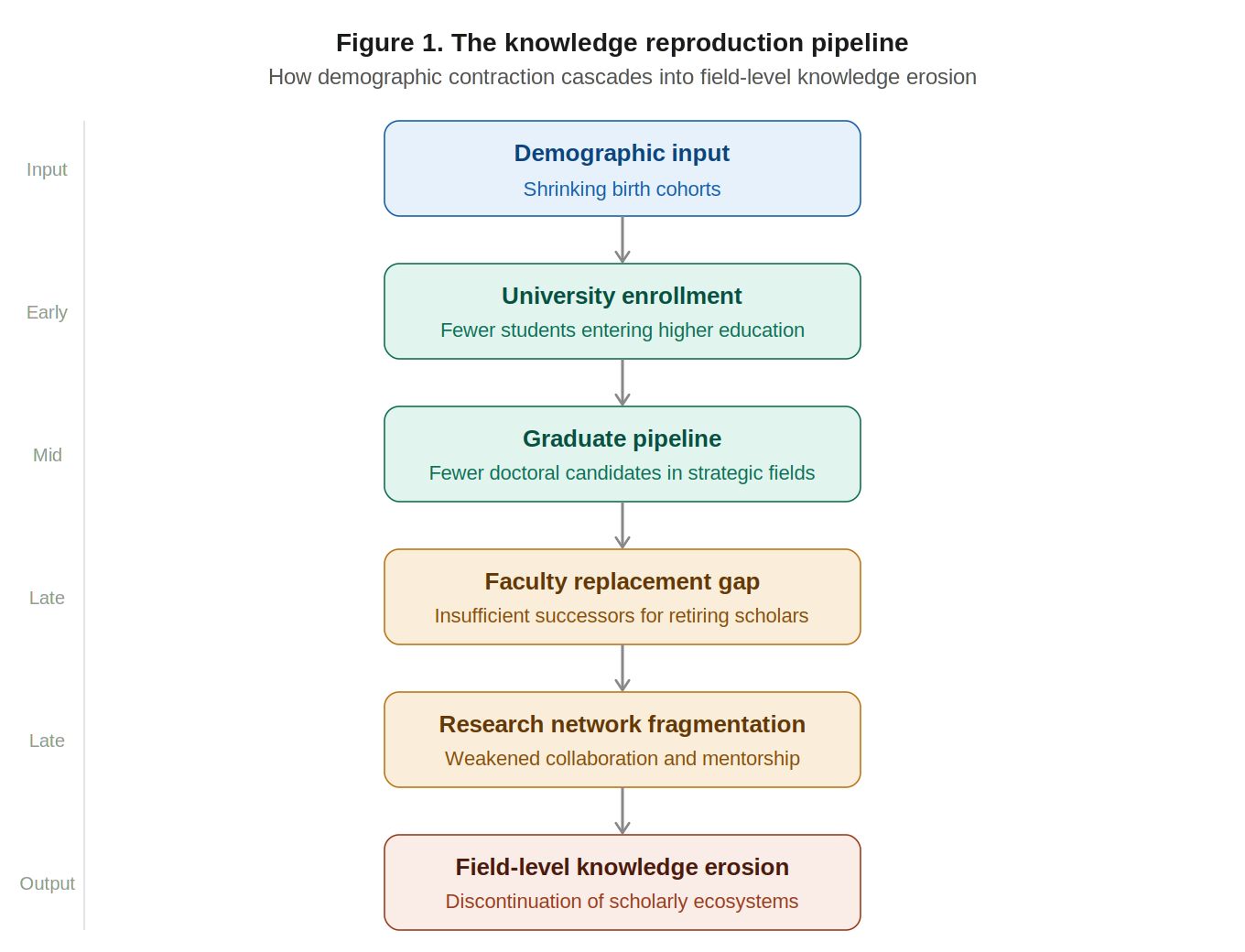
Figure 1 traces the core theoretical claim: demographic decline is not a single-step problem but a cascading pipeline failure across five stages.
Key Ideas
Knowledge continuity risk is defined as the weakening of intergenerational knowledge reproduction within specialized fields — distinct from short-term skill shortages, and far harder to reverse
Demographic decline operates through a cascading pipeline: smaller birth cohorts → reduced university enrollment → fewer doctoral candidates → gaps in faculty replacement → fragmented research networks → field-level decline
Tacit knowledge — expertise transmitted through mentorship and practice, not documentation — is the most vulnerable and least recoverable form of scholarly capital
A 2×2 typology categorizes fields by talent inflow and institutional support: Stable, Fragile, Volatile, and Endangered — with endangered fields facing both low inflow and weak backing
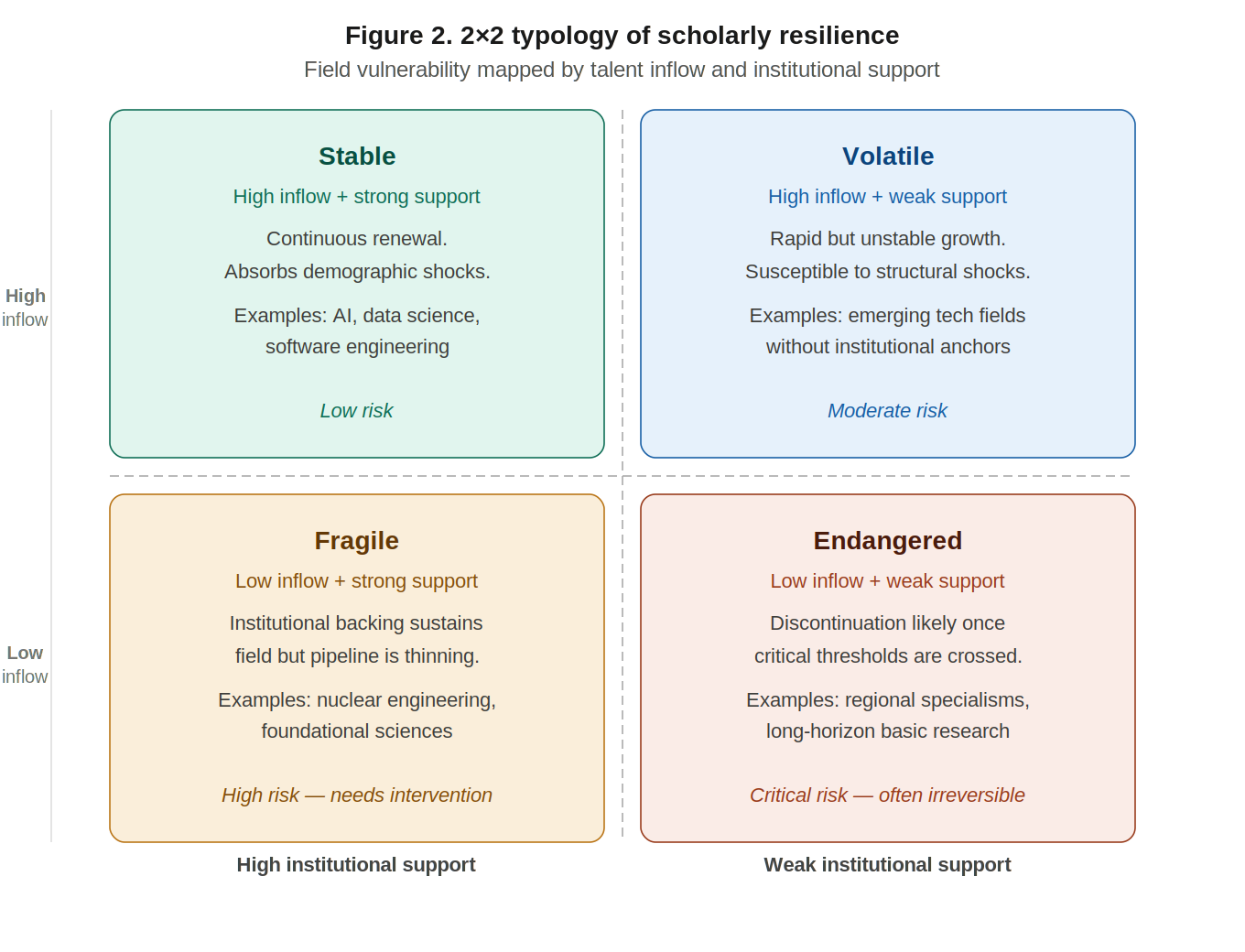
Figure 2 operationalizes the typology — the paper's primary diagnostic tool for identifying which fields face existential risk.
Strategic fields globally — semiconductors, AI, quantum technologies, biotech, defense systems — face very high talent shortages, compounding the risk of academic pipeline failure
Korea’s case illustrates demographic–knowledge coupling: the speed of fertility decline compresses institutional adjustment cycles, producing discontinuities within a single generation
Structural barriers in Korea’s labor market — prolonged credentialing, delayed career entry, early retirement norms — amplify the demographic effect and further discourage entry into demanding fields
Initial Findings
Analysis of global demographic data and academic workforce trends across the U.S., Japan, Korea, China, and India reveals several patterns of concern.
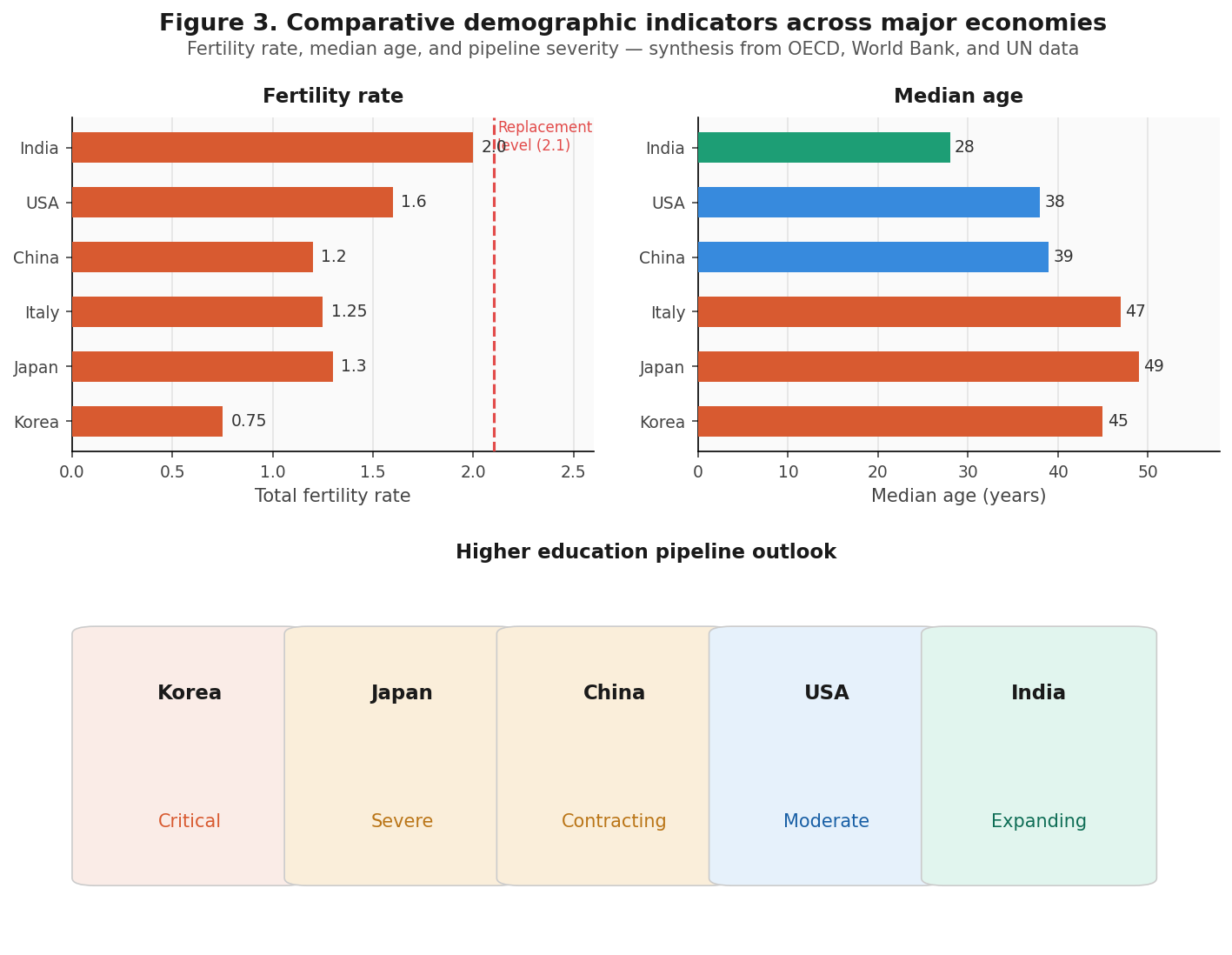
Figure 3 gives the comparative empirical grounding — placing Korea's extreme position in global context and linking demographic severity to pipeline outcomes.
Korea stands out as the most extreme case: ultra-low fertility, rapidly declining working-age population, and a sharply contracting youth cohort have produced a severely contracting higher education pipeline with critical long-term talent shortage risk. Japan shows parallel patterns, particularly in digital transformation and healthcare fields. Even the U.S., with a more moderate demographic trajectory, faces growing pressure in semiconductor, energy, and advanced manufacturing sectors.
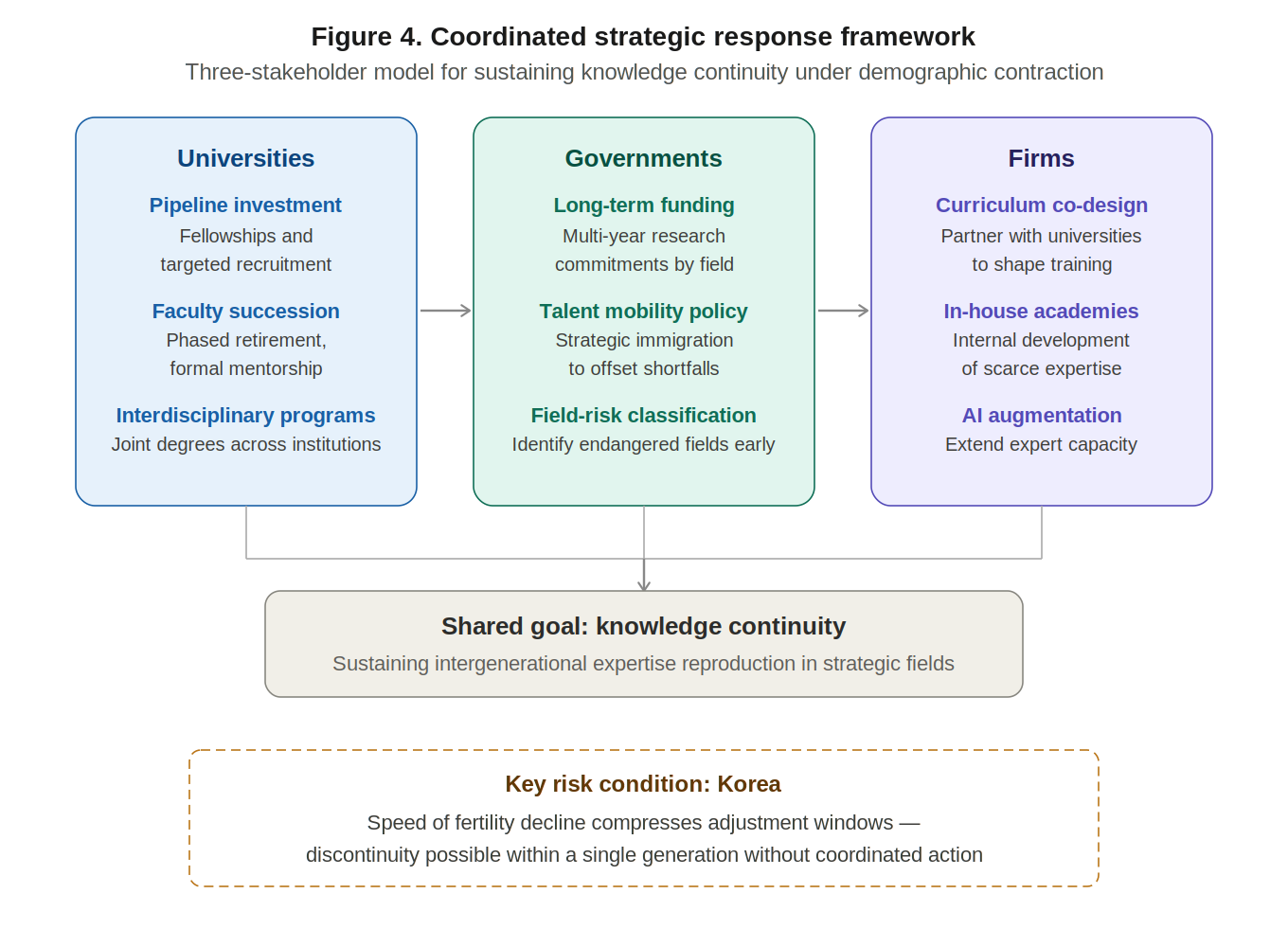
Figure 4 closes the paper's argument — translating the theoretical risk into a concrete, coordinated response model across the three stakeholder groups the research addresses.
Across twenty strategic fields — from AI and cybersecurity to nuclear energy and elder care — shortage ratings cluster at high or very high in every major economy surveyed. The convergence of demographic contraction and field-level talent gaps creates a compounding vulnerability that current policy frameworks have not adequately addressed.
The academic labor market reflects this strain. A substantial share of faculty in many countries is approaching retirement age. Doctoral completion rates in foundational sciences are declining. International students and researchers are filling gaps that domestic pipelines no longer can — a stopgap that carries geopolitical and policy risks of its own.
Concluding Remarks
Demographic decline is no longer a distant warning — it is an unfolding structural crisis with direct consequences for how knowledge is created, transmitted, and sustained across generations. As birth rates fall and scholarly pipelines thin, entire fields of expertise face quiet discontinuation. The human resource development field must treat this as a strategic priority, not a peripheral concern. Securing knowledge succession requires deliberate investment in talent pipelines, mentorship systems, and institutional resilience. The organizations and nations that act now — before critical thresholds are crossed — will define the intellectual and competitive landscape of the next generation.
The central argument is straightforward, and its stakes are high: demographic decline is not only a population problem or a labor problem. It is a knowledge problem — and knowledge, once lost, does not simply return when conditions improve.
© 2025 KGSP Journal · KGSP Forum · All rights reserved.