
Joseon’s Civil Service Examinations, Korea’s Passion for Education, and Generative AI /
From the Age of Examinations to the Age of Questions
Abstract
The civil service examination system of the Joseon Dynasty was more than a mechanism for selecting government officials. It was a central social institution connecting education, social mobility, family prestige, and the selection of national talent. This historical experience resonates in important ways with Korea’s enduring passion for education. This essay examines the Joseon examination system and contemporary Korean educational culture through the broader civilizational transformation brought about by generative artificial intelligence (AI). Particular attention is given to the fact that Joseon examinations were not merely tests of memorization; they also required the interpretation of classical texts, argumentation, writing, and policy-oriented reasoning. This historical perspective raises a fundamental question for contemporary education: What should examinations measure when generative AI can rapidly retrieve information, organize knowledge, and produce sophisticated written responses? The essay argues that education in the AI era should place greater emphasis on the quality of questions, verification of information and AI-generated outputs, critical thinking, human judgment, and the ability to discover and formulate new problems. Rather than suppressing Korea’s strong educational passion, the essay proposes redirecting it—from a competition over who knows more to a competition over who can ask better questions. It further envisions a new form of “civil service examination for the AI era,” in which students are allowed to use AI but are evaluated on their ability to identify errors, verify evidence, justify judgments, and generate questions that AI cannot readily provide. Ultimately, if the Joseon examination asked, “What do you know?”, education in the age of generative AI must ask a more challenging question: “If AI already knows all the answers, what will you ask?” This transformation could turn Korea’s longstanding educational passion into a powerful educational asset for creativity and human-centered learning in the AI era.
Keywords: Joseon civil service examinations, Korean educational passion, generative AI, AI in education, educational assessment, critical thinking, questioning, creativity, AI-era examination
An Age-Old Passion for Examinations: Joseon’s Civil Service Examinations
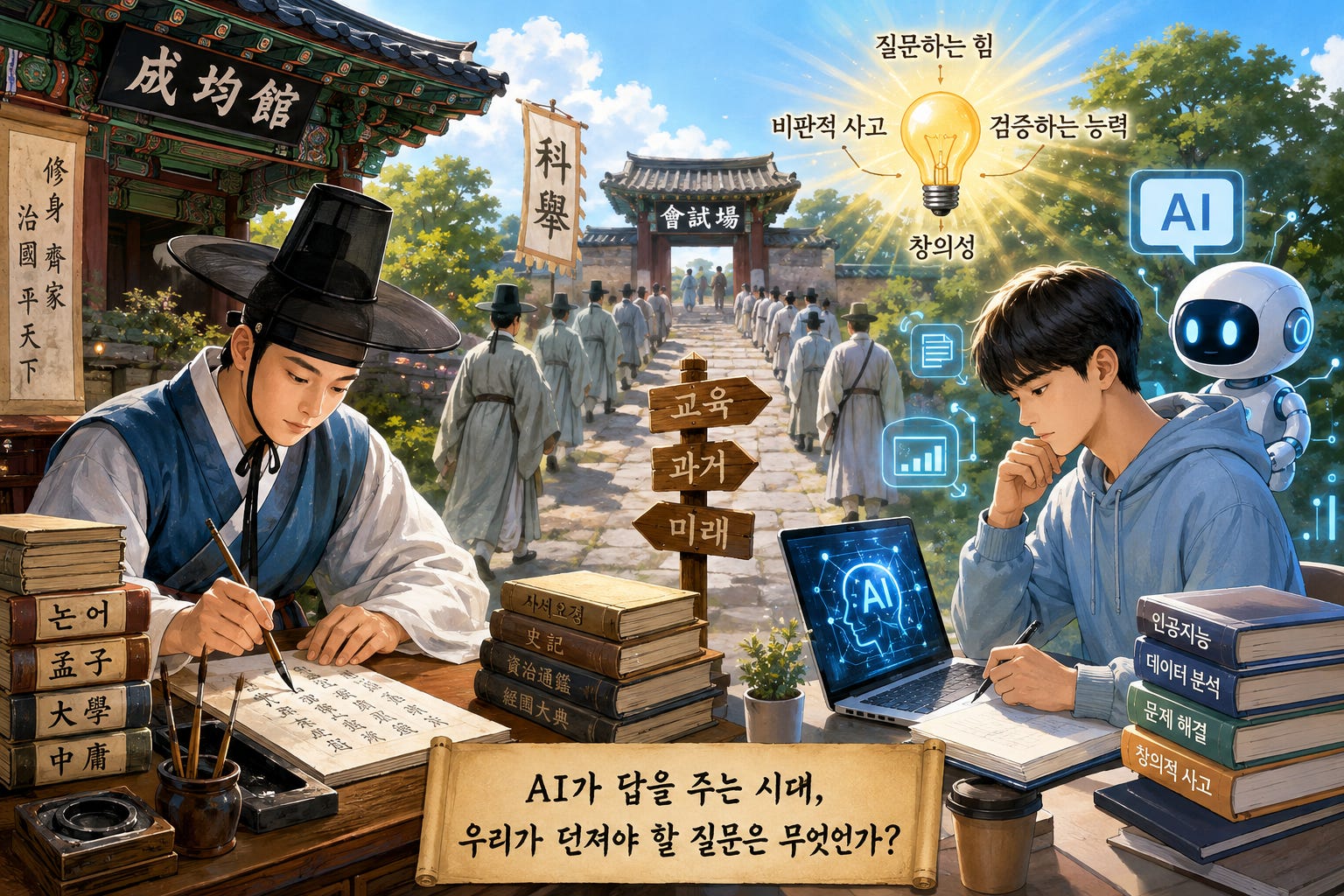
Imagine a Joseon scholar sitting at his desk from before dawn. The Four Books and Five Classics are open before him. He reads the passages again and again. Ink stains his brush, while his mind is filled with the language and arguments of the Confucian classics.
Why does he study so intensely?
It is not simply out of intellectual curiosity. Passing the civil service examination could open the door to government service, changing not only an individual’s future but also the social standing of an entire family.
This scene inevitably reminds us of Korea’s educational passion today.
The civil service examination system was first introduced during the reign of King Gwangjong of Goryeo in 958 and continued throughout the Joseon period until it was abolished during the Gabo Reforms of 1894. During Joseon, the examination system included the literary examination (mungwa), military examination (mugwa), and various technical examinations (japgwa). The saengwon and jinsa examinations also played important roles in the educational and social system (Academy of Korean Studies, 2024).
The examination system was not simply a single test. Joseon maintained government educational institutions such as the National Academy (Seonggyungwan), the Four Schools (Sahak), and local Confucian schools (hyanggyo), alongside private educational institutions such as village schools (seodang). Education and the examination system were closely interconnected (National Institute of Korean History, n.d.).
Education in Joseon therefore functioned as more than the acquisition of knowledge. It was an institutional pathway connecting social mobility, personal achievement, and the selection of talent for government service.
In this respect, Joseon’s examination culture has a remarkable historical resonance with Korea’s contemporary educational culture.
The Examination as Joseon’s Educational Pipeline
For Korean students today, elementary school, middle school, high school, and university entrance examinations can be understood as parts of a long educational pathway.
Joseon had its own educational ladder.
Students educated at the Four Schools and local Confucian schools could advance to higher levels of education. Seonggyungwan, the highest national educational institution, also served as an important center for students preparing for the literary civil service examination (National Institute of Korean History, n.d.).
Education at the Four Schools was likewise closely associated with preparation for the saengwon and jinsa examinations.
In contemporary language, education and competitive examinations formed a single ecosystem.
For this reason, Korea’s strong passion for education cannot be explained simply as a product of modern competition. The historical experience of connecting education, examinations, government service, and social status also deserves consideration.
Of course, contemporary Korean educational competition cannot be reduced to the legacy of the Joseon examination system. Industrialization, the expansion of higher education, labor-market competition, urbanization, and experiences of social mobility have all played major roles.
Yet the two eras share one powerful cultural belief:
Education can change the future of an individual and a family.
Was the Joseon Examination Really Just a Test of Memorization?
Here, another misconception about the Joseon examinations needs to be corrected.
The examinations should not be understood simply as tests of memorization.
For example, the saengwon examination included questions concerning the meaning and interpretation of the Four Books and Five Classics, while the jinsa examination evaluated literary ability. The literary civil service examination also required knowledge of the classics, interpretation, writing, and policy-oriented thinking (Academy of Korean Studies, 2024).
In other words, Joseon examinations required not only memory, but also interpretation, argumentation, writing, and policy reasoning.
This point is particularly important in the age of AI.
Generative AI can already organize information and produce polished prose far more quickly than humans.
What, then, should education evaluate in the age of AI?
This question connects directly with the historical lesson of Joseon’s examination culture.
What If ChatGPT Entered the Joseon Examination Hall?
Let us imagine something extraordinary.
One day, generative AI enters the Joseon examination hall.
The examiner asks:
“Discuss how wise and capable people should be selected to govern the state.”
Before picking up his brush, a scholar asks AI for help.
Within seconds, AI produces an elegant response. It contains quotations from the classics, persuasive reasoning, and historical examples.
Is the person who submits this answer a truly talented scholar?
This hypothetical question is remarkably similar to a problem facing universities today.
Generative AI can significantly assist students with writing and information organization. At the same time, it raises fundamental questions about whether traditional assignments and examinations accurately measure what students actually know and can do. Recent research on generative AI and higher-education assessment has therefore called for the redesign of conventional assessment practices (Xia et al., 2024; Weng et al., 2024).
Xia et al. (2024) found that generative AI is transforming assessment in higher education and argued that assessment practices need to evolve to measure learning, responsibility, and academic integrity more appropriately.
Weng et al. (2024) likewise examined the limitations of conventional assessment in generative-AI environments and emphasized the need to rethink both learning outcomes and assessment practices.
The fundamental question, therefore, is not simply:
“Should AI be banned from examinations?”
The deeper question is:
“What should an examination measure?”
The Machine That Produces Answers and the Human Who Asks Questions
Before generative AI, students needed to demonstrate their ability to produce answers.
After generative AI, some of that ability can be automated by machines.
The center of education therefore needs to shift.
From finding information to asking questions.
From producing answers to verifying answers.
From remembering correct answers to exercising judgment.
From reproducing model answers to discovering new problems.
Hao et al. (2024) analyzed the transformative effects of large language models and generative AI on assessment. They noted that these technologies create new opportunities while also raising important concerns about validity, reliability, transparency, and fairness.
Kaldaras et al. (2024) similarly argued that developing valid assessments in the age of generative AI requires educators to reconsider the purposes of assessment and the abilities they actually want to measure.
The examination of the AI era, therefore, should not be a competition against AI.
It should be an examination that uses AI while measuring distinctly human judgment.
Korea’s Educational Passion Does Not Need to Disappear
Should Korea’s intense educational competition be restrained in the age of AI?
Not necessarily.
In fact, Korea’s passion for education could become an important national asset in the AI era.
The problem is not the intensity of educational ambition. It is the direction in which that ambition is directed.
Education should move:
From memorizing more to understanding more deeply.
From solving problems faster to creating better problems.
From pursuing higher scores to making better judgments.
From submitting AI-generated answers to verifying, challenging, and improving AI-generated answers.
This direction is consistent with emerging research on assessment. Bearman and Ajjawi (2024), for example, discuss the growing importance of students’ ability to critically evaluate AI-generated outputs—a capacity closely related to evaluative judgment.
If Korea’s educational passion moves in this direction, a culture historically centered on competition can evolve into a culture centered on creativity.
Imagining a New Examination for the AI Era
What, then, might a new civil service examination look like in the age of AI?
There is no need to ban AI from the examination hall.
We might actually invite AI into the examination hall.
Students could be asked to use AI to solve a problem and then identify errors in the AI-generated response. They could verify sources, compare competing answers, and finally formulate a new question that AI itself failed to raise.
For example:
“Ask a generative AI system to explain the Joseon civil service examination system. Identify three historical errors or oversimplifications in its response. Correct them using reliable historical sources and scholarship. Finally, formulate one new research question that the AI failed to identify.”
AI would not be prohibited.
Students would be encouraged to use it.
But their grades would not depend on how beautifully AI writes.
They would be evaluated on:
The quality of their questions.
Their ability to evaluate the reliability of sources.
Their ability to identify AI errors.
Their ability to justify their judgments with evidence.
Their ability to formulate new questions.
This could become the new civil service examination of the generative-AI era.
Learning from the Joseon Scholar
Here we can discover an unexpected lesson from the Joseon scholar.
The scholar read books.
But reading was not the end of learning.
He questioned, interpreted, argued, and expressed his understanding in his own words.
Today, AI can read and summarize enormous quantities of information.
What, then, should humans do?
Read more deeply.
The more AI provides answers, the better our questions must become.
The more AI writes, the more carefully humans must examine its evidence.
The more choices AI provides, the more important human judgment becomes.
And no matter how many answers AI can generate, humans must continue to formulate questions that no machine has thought to ask.
This may be one of the most meaningful ways to carry the intellectual spirit of the Joseon scholar into the age of AI.
From the Joseon Examination Hall to the AI Examination Hall
The Joseon civil service examination was more than a test. It was a national mechanism for evaluating what a person knew, how well that person could interpret knowledge, and how persuasively he could express his ideas. At the same time, it was a vast cultural system that connected education with personal achievement, family honor, and social mobility.
Modern Korea’s educational passion has a similar character. The belief that good education, high test scores, and admission to a prestigious university can lead to a better future remains powerful.
But generative AI is fundamentally challenging this traditional educational formula.
AI can now find, organize, summarize, and generate information far faster than humans.
If so, examinations that ask only “How much do you know?” may no longer adequately measure human capability.
A new educational question therefore emerges:
If AI can generate the answer, what should we test humans for?
The first answer is the ability to ask questions.
In the past, people with more knowledge often had an advantage. Now that AI can access enormous amounts of knowledge, a more important human ability is to determine what knowledge is needed and formulate a precise question.
A good question comes before a good answer.
The outstanding student of the AI era, therefore, is not simply the student who finds the correct answer quickly.
It is the student who can ask AI a question that no one had previously thought to ask.
The second answer is the ability to verify.
AI can produce answers that sound convincing but are incorrect. The AI-era intellectual must therefore be able to check sources, compare evidence, identify logical errors, and challenge the machine’s conclusions.
If the Joseon scholar read the classics and debated their meaning, the AI-era learner must read and verify the knowledge produced by AI.
If AI creates the first draft, humans must make the final judgment.
The third answer is the ability to create.
Korea’s educational passion can become a strength rather than a weakness. But the goal of competition must change.
Instead of competing over who has memorized the most, students should compete over who can formulate the best questions.
Instead of competing over who can write an answer fastest, they should compete over who can discover the most important problem.
Instead of competing over who can complete an assignment without AI assistance, they should compete over who can use AI most responsibly and creatively to create new value.
This is the evolution of Korea’s educational passion for the age of AI.
The Final Examination of Education
Seen from this perspective, the Joseon examination is not merely an obsolete institution.
It leaves us with fundamental questions:
What kind of person does a society call talented?
What abilities should education cultivate?
What should examinations measure?
And what is the ultimate purpose of education?
Joseon selected people who could read, interpret, and express the meaning of the classics.
Industrial society needed people with specialized knowledge.
The AI era demands a new kind of human being:
Someone who knows how to use AI but does not surrender judgment to AI.
Someone who can obtain information while questioning its reliability.
Someone who can find an answer while also discovering the problem beyond the answer.
Someone who can use machines without surrendering human imagination and values.
This may be the new scholar of the AI era.
In the Joseon examination hall, the most important tool was the brush.
Today, the keyboard has taken its place, and now generative AI sits beside it.
Yet changing the tool does not eliminate the fundamental abilities that make us human.
Indeed, the more powerful AI becomes, the clearer those human abilities become:
The ability to question.
The ability to doubt.
The ability to verify.
The ability to judge.
And above all, the ability to formulate questions that no one else has thought to ask.
Korea’s educational passion, therefore, does not need to disappear.
It needs to change direction.
From education for memorization to education for deeper thinking.
From competition for higher scores to competition for better questions.
From trying to write better than AI to learning to think more creatively with AI.
At that moment, the Joseon examination becomes more than a historical artifact. It becomes a mirror for the future of education.
The Joseon examination asked:
“What do you know?”
The new examination of the AI era must ask something much more difficult:
“If AI already knows all the answers, what will you ask?”
The person who can answer that question may be the true talent of the AI era.
And perhaps this is the most important civil service examination facing Korean education today.
The age of examinations is not over. Only the questions on the examination are changing.
References
Academy of Korean Studies. (2024). Gwageo [Civil service examination]. Encyclopedia of Korean Culture.
Bearman, M., & Ajjawi, R. (2024). Learning to become an AI assessor: The implications of generative artificial intelligence for assessment. Assessment & Evaluation in Higher Education. https://doi.org/10.1080/02602938.2024.2335321
Hao, J., von Davier, A. A., Yaneva, V., Lottridge, S., von Davier, M., & Harris, D. J. (2024). Transforming assessment: The impacts and implications of large language models and generative AI. Educational Measurement: Issues and Practice, 43(2), 16–29. https://doi.org/10.1111/emip.12602
Kaldaras, L., Akaeze, H. O., & Reckase, M. D. (2024). Developing valid assessments in the era of generative artificial intelligence. Frontiers in Education, 9, 1399377. https://doi.org/10.3389/feduc.2024.1399377
National Institute of Korean History. (n.d.). Education and the civil service examination system in early Joseon. Our History Net.
Weng, X., Xia, Q., Gu, M., Rajaram, K., & Chiu, T. K. F. (2024). Assessment and learning outcomes for generative AI in higher education: A scoping review on current research status and trends. Australasian Journal of Educational Technology, 40(6), 37–55. https://doi.org/10.14742/ajet.9540
Xia, Q., Weng, X., Ouyang, F., Lin, T. J., & Chiu, T. K. F. (2024). A scoping review on how generative artificial intelligence transforms assessment in higher education. International Journal of Educational Technology in Higher Education, 21, 40. https://doi.org/10.1186/s41239-024-00468-z
조선의 과거, 한국의 교육열, 그리고 생성 AI
시험의 시대에서 질문의 시대로
시험을 향한 오래된 열망: 조선의 과거
조선의 어느 선비가 새벽부터 책상 앞에 앉아 있다. 사서삼경을 펼쳐 놓고 문장을 읽고 또 읽는다. 붓끝에는 먹물이 묻어 있고, 머릿속에는 수많은 경전의 문장과 논리가 들어 있다. 그가 공부하는 이유는 단순한 학문적 호기심 때문만은 아니다. 과거에 합격하면 관료로 진출할 수 있고, 그것은 개인의 미래뿐 아니라 가문의 사회적 위상과도 연결되었다.
이 장면은 오늘날 한국의 교육열을 생각하게 한다.
조선의 과거제도는 고려 광종 9년(958)에 처음 실시되었고 조선시대에도 계승되다가 1894년 갑오개혁으로 폐지되었다. 조선의 과거는 문과·무과·잡과로 구성되었으며, 문과와 함께 생원시·진사시가 중요한 시험으로 기능했다(한국학중앙연구원, 2024).
과거는 단순한 시험 하나가 아니었다. 조선은 성균관·사부학당·향교 등의 관학과 서당 등의 사학을 운영하면서 교육과 과거제도를 긴밀하게 연결하였다(국사편찬위원회, n.d.).
따라서 조선에서 교육은 개인적인 지식 습득을 넘어 사회적 이동과 국가 인재 선발을 연결하는 제도적 통로였다.
이 점에서 조선의 과거는 오늘날 한국의 입시문화와 놀라운 역사적 공명을 갖는다.
과거는 조선의 입시 시스템이었다
오늘날 한국 학생에게 초등학교, 중학교, 고등학교, 대학입시는 하나의 긴 교육 경로로 인식된다.
조선에도 이와 유사한 교육의 계단이 있었다.
사부학당과 향교에서 교육받은 학생들이 더 높은 수준의 교육으로 진입하고, 성균관은 국가의 최고 교육기관이자 문과시험을 준비하는 중요한 교육기관이었다(국사편찬위원회, n.d.).
사부학당의 교육도 생원·진사시 준비와 밀접하게 관련되어 있었다. 국사편찬위원회의 자료에 따르면 사부학당에서는 일정한 자격을 갖춘 학생들이 교육을 받고 생원·진사시를 준비할 수 있었다.
오늘날의 표현으로 바꾸면 교육기관과 선발시험이 하나의 생태계를 형성하고 있었던 셈이다.
그러므로 한국인의 강한 교육열을 단순히 현대 한국 사회의 경쟁심으로만 설명하는 것은 충분하지 않다. 조선시대부터 교육과 시험, 관직, 사회적 지위가 긴밀하게 연결되어 온 역사적 경험 역시 중요한 배경으로 살펴볼 필요가 있다.
물론 현대 한국의 교육열을 조선의 과거제 하나만으로 설명할 수는 없다. 산업화, 대학 확대, 노동시장 경쟁, 도시화, 사회이동의 경험 등 수많은 현대적 요인이 함께 작용한다.
그럼에도 두 시대에는 하나의 강력한 공통점이 있다.
교육이 개인과 가족의 미래를 바꿀 수 있다는 믿음이다.
조선의 과거는 정말 암기시험이었을까
여기에서 조선의 과거에 대한 또 하나의 오해를 바로잡을 필요가 있다.
과거를 단순한 암기시험으로만 이해해서는 안 된다.
생원시에서는 사서의와 오경의를 시험했고, 진사시에서는 문예적 능력을 평가했다. 문과에서는 경전 이해와 정책적 식견, 문장 작성 능력 등이 중요한 평가 대상이었다(한국학중앙연구원, 2024).
즉 조선의 과거에는 기억(memory)만이 아니라 해석(interpretation), 논변(argumentation), 문장력(writing), 정책적 사고가 요구되었다.
이 점은 AI 시대에 특별히 중요하다.
왜냐하면 생성 AI가 이미 인간보다 훨씬 빠르게 정보를 정리하고 문장을 작성할 수 있기 때문이다.
그렇다면 AI 시대의 교육은 무엇을 평가해야 하는가?
이 질문은 조선의 과거가 우리에게 던지는 역사적 질문과 연결된다.
ChatGPT가 과거시험장에 들어온다면
상상해 보자.
어느 날 조선의 과거시험장에 생성 AI가 등장한다.
시험관이 묻는다.
“어진 인재를 선발하여 나라를 다스리는 방법을 논하라.”
한 선비가 붓을 들기 전에 AI에게 질문한다.
AI는 몇 초 만에 유려한 문장을 만들어낸다. 고전의 인용도 풍부하고 논리도 그럴듯하다.
그 답안을 제출한 사람은 훌륭한 인재인가?
이 질문은 오늘날 대학이 직면한 문제와 정확히 연결된다.
생성 AI는 학생의 글쓰기와 정보 정리 능력을 크게 보조할 수 있지만, 동시에 기존의 과제와 시험이 실제로 학생의 능력을 얼마나 정확하게 측정하는지에 대한 의문을 제기한다. 생성 AI가 고등교육 평가에 미치는 영향을 검토한 연구들은 전통적인 평가방식을 재설계할 필요성을 제시하고 있다(Xia et al., 2024; Weng et al., 2024).
Xia et al. (2024)은 생성 AI가 고등교육의 평가를 변화시키고 있으며, 평가가 학생의 학습과 책임, 학업적 진실성을 더욱 적절하게 측정할 수 있도록 변화할 필요가 있다고 분석하였다.
Weng et al. (2024) 역시 생성 AI 환경에서 기존 평가방식의 한계를 검토하면서 학습성과와 평가방식을 새롭게 설계할 필요성을 제시하였다.
따라서 핵심 문제는 단순히 “AI를 시험에서 금지할 것인가?”가 아니다.
더 근본적인 질문은 이것이다.
“시험은 무엇을 측정해야 하는가?”
답을 만드는 기계와 질문하는 인간
생성 AI 이전에는 학생에게 답을 쓰는 능력이 중요했다.
그러나 생성 AI 이후에는 답을 만드는 능력의 일부가 기계에 의해 자동화될 수 있다.
따라서 교육의 중심축은 이동해야 한다.
정보를 찾는 능력에서 질문하는 능력으로.
답을 작성하는 능력에서 답을 검증하는 능력으로.
정답을 기억하는 능력에서 판단하는 능력으로.
모범답안을 재현하는 능력에서 새로운 문제를 발견하는 능력으로.
Hao et al. (2024)은 대규모 언어모델과 생성 AI가 평가의 효율성과 새로운 가능성을 제공하는 동시에 타당도, 신뢰도, 투명성, 공정성 등의 중요한 문제를 제기한다고 분석하였다.
Kaldaras et al. (2024) 역시 생성 AI 시대에 타당한 평가를 설계하기 위해 평가의 목적과 측정하고자 하는 능력을 근본적으로 재검토해야 한다고 지적한다.
따라서 AI 시대의 시험은 AI와 경쟁하는 시험이 되어서는 안 된다.
AI를 활용하면서도 인간의 판단력을 측정하는 시험이어야 한다.
한국의 교육열은 사라질 필요가 없다
그렇다면 한국의 교육열을 AI 시대에 억제해야 하는가?
그럴 필요는 없다.
오히려 한국의 교육열은 AI 시대의 중요한 국가적 자산이 될 수 있다.
문제는 교육열의 크기가 아니라 교육열의 방향이다.
더 많이 외우는 교육에서 더 깊이 이해하는 교육으로.
더 빨리 문제를 푸는 교육에서 더 좋은 문제를 만드는 교육으로.
더 높은 점수를 얻는 교육에서 더 정확하게 판단하는 교육으로.
AI가 만들어준 답을 제출하는 교육에서 AI의 답을 검증하고 개선하는 교육으로.
이러한 변화는 교육평가 연구에서 강조되는 방향과도 일치한다. Bearman과 Ajjawi는 생성 AI 시대에 학습자가 AI가 만들어낸 결과물을 비판적으로 평가할 수 있는 능력, 즉 평가적 판단의 중요성이 더욱 커진다고 논의하였다(Bearman & Ajjawi, 2024).
한국의 교육열이 이러한 방향으로 이동한다면, 과거의 경쟁문화는 미래의 창조문화로 전환될 수 있다.
새로운 과거시험을 상상하다
그렇다면 AI 시대의 새로운 과거시험은 어떤 모습이어야 할까?
시험장에서 AI를 무조건 쫓아낼 필요는 없다.
오히려 AI를 시험장 안으로 데려올 수도 있다.
학생에게 AI를 사용하여 문제를 해결하게 하고, 그 과정에서 AI가 제시한 오류를 찾아내게 할 수 있다. 출처를 검증하게 하고, 서로 다른 답변을 비교하게 하며, 마지막에는 AI가 만들지 못한 새로운 질문을 스스로 제시하게 할 수 있다.
예를 들어 다음과 같은 시험문제를 생각해 볼 수 있다.
“생성 AI에게 조선의 과거제도에 관한 설명을 작성하게 하라. 그 답변에서 세 가지 역사적 오류 또는 지나친 일반화를 찾아라. 신뢰할 수 있는 역사자료와 연구를 이용하여 수정하라. 그리고 AI가 제시하지 못한 새로운 연구 질문을 하나 만들어라.”
이 시험에서는 AI 사용을 금지하지 않는다.
오히려 AI를 적극적으로 사용하게 한다.
그러나 학생의 점수는 AI가 얼마나 아름다운 문장을 만들어냈는지가 아니라 다음과 같은 능력에 따라 결정된다.
질문의 질.
자료의 신뢰성을 판단하는 능력.
AI의 오류를 발견하는 능력.
근거를 가지고 자신의 판단을 설명하는 능력.
새로운 질문을 만들어내는 능력.
이것이야말로 생성 AI 시대의 새로운 과거시험이 될 수 있다.
조선의 선비에게서 AI 시대의 인간을 배우다
여기에서 조선의 선비에게서 의외의 지혜를 발견할 수 있다.
선비는 책을 읽었다.
그러나 단순히 읽는 데 그치지 않았다.
질문하고, 해석하고, 논변하고, 자신의 문장으로 표현했다.
오늘날 AI는 엄청난 양의 정보를 읽고 요약할 수 있다.
그렇다면 인간은 무엇을 해야 하는가?
더 깊이 읽어야 한다.
AI가 답을 만들어줄수록 인간은 더 좋은 질문을 해야 한다.
AI가 글을 써줄수록 인간은 그 글의 근거를 검증해야 한다.
AI가 수많은 선택지를 제시할수록 인간은 어떤 선택이 옳은지 판단해야 한다.
그리고 AI가 아무리 많은 답을 제공하더라도 인간만이 발견할 수 있는 새로운 질문을 만들어야 한다.
이것이 조선의 학문정신을 AI 시대에 계승하는 한 방법일 것이다.
과거시험장에서 AI 시험장으로
조선의 과거시험은 단순한 시험이 아니었다. 그것은 한 사람이 무엇을 알고 있는지, 무엇을 해석할 수 있는지, 그리고 자신의 생각을 얼마나 설득력 있게 표현할 수 있는지를 평가하는 국가적 장치였다. 동시에 교육을 개인의 성공, 가문의 명예, 사회적 이동과 연결하는 거대한 문화 시스템이었다.
오늘날 한국의 교육열도 이와 닮아 있다. 좋은 교육을 받고, 좋은 시험 성적을 얻고, 좋은 대학에 진학하는 것이 더 나은 미래로 이어진다는 믿음은 여전히 강력하다.
그러나 생성 AI의 등장은 이 오래된 교육공식을 근본적으로 흔들고 있다.
AI는 이제 인간보다 훨씬 빠르게 정보를 찾고, 정리하고, 요약하고, 문장을 만들 수 있다.
그렇다면 “누가 더 많이 알고 있는가?”를 묻는 시험만으로는 인간의 능력을 충분히 평가하기 어렵다.
여기에서 교육의 새로운 질문이 시작된다.
AI가 답을 만들어준다면, 인간에게 무엇을 시험할 것인가?
첫 번째 답은 질문하는 능력이다.
과거에는 많이 아는 사람이 유리했다. 이제는 AI가 방대한 지식에 접근할 수 있기 때문에, 인간에게 더욱 중요한 능력은 어떤 지식이 필요한지를 판단하고 정확한 질문을 만드는 능력이 된다.
좋은 질문은 좋은 답보다 먼저 온다.
따라서 AI 시대의 뛰어난 학생은 단순히 정답을 빨리 찾는 학생이 아니다.
AI에게 이전에는 생각하지 못했던 질문을 던질 수 있는 학생이다.
두 번째 답은 검증하는 능력이다.
AI는 매우 그럴듯하지만 틀린 답을 만들 수도 있다. 따라서 AI 시대의 지식인은 AI의 답을 그대로 받아들이는 사람이 아니라 자료를 확인하고 출처를 비교하며 논리적 오류를 발견할 수 있는 사람이다.
조선의 선비가 경전을 읽고 그 뜻을 논변했다면, AI 시대의 학습자는 AI가 만들어낸 지식을 다시 읽고 검증해야 한다.
AI가 첫 번째 초안을 만든다면, 인간은 마지막 판단을 내려야 한다.
세 번째 답은 창조하는 능력이다.
한국의 교육열은 약점이 아니라 강점이 될 수 있다. 다만 경쟁의 목표를 바꾸어야 한다.
누가 더 많이 외웠는가를 경쟁하는 대신 누가 더 좋은 질문을 만드는가를 경쟁해야 한다.
누가 더 빨리 답을 쓰는가를 경쟁하는 대신 누가 더 중요한 문제를 발견하는가를 경쟁해야 한다.
누가 AI의 도움 없이 과제를 완성하는가를 경쟁하는 대신 누가 AI를 가장 책임 있고 창의적으로 활용하여 새로운 가치를 만들어내는가를 경쟁해야 한다.
이것이 한국 교육열의 AI 시대적 진화다.
교육의 마지막 시험
이렇게 보면 조선의 과거는 낡은 제도가 아니다.
오히려 우리에게 중요한 질문을 남긴다.
한 사회는 어떤 사람을 인재라고 부르는가?
어떤 능력을 교육해야 하는가?
시험은 무엇을 측정해야 하는가?
그리고 교육의 궁극적인 목적은 무엇인가?
조선은 경전을 읽고 해석하고 글로 표현하는 사람을 선발했다.
산업사회는 전문지식을 가진 사람을 필요로 했다.
AI 시대는 새로운 인간상을 요구한다.
AI를 사용할 줄 알면서도 AI에게 자신의 판단을 맡기지 않는 사람.
정보를 얻으면서도 정보의 진위를 검증하는 사람.
정답을 찾으면서도 정답 너머의 문제를 발견하는 사람.
기계를 활용하면서도 인간만의 상상력과 가치판단을 포기하지 않는 사람.
바로 이러한 인간이 AI 시대의 새로운 선비일 것이다.
조선의 과거시험장에서 가장 중요한 도구는 붓이었다.
오늘날에는 키보드가 그 자리를 차지했고, 이제는 생성 AI가 그 옆에 앉아 있다.
그러나 도구가 바뀌었다고 해서 인간에게 필요한 가장 근본적인 능력까지 사라지는 것은 아니다.
오히려 AI가 강력해질수록 인간에게 필요한 능력은 더욱 선명해진다.
질문하는 능력.
의심하는 능력.
검증하는 능력.
판단하는 능력.
그리고 아무도 묻지 않았던 질문을 만들어내는 능력.
따라서 한국의 교육열은 사라질 필요가 없다.
이제 방향을 바꾸면 된다.
더 많이 외우기 위한 교육에서 더 깊이 생각하기 위한 교육으로.
더 높은 점수를 얻기 위한 경쟁에서 더 좋은 질문을 만들기 위한 경쟁으로.
AI보다 잘 쓰기 위한 교육에서 AI와 함께 더 창의적으로 생각하기 위한 교육으로.
그때 조선의 과거는 단순한 역사적 유물이 아니라 미래교육의 거울이 된다.
조선의 과거시험이 물었던 질문은 “무엇을 알고 있는가?”였다.
AI 시대의 새로운 과거시험은 더 어려운 질문을 던져야 한다.
“AI가 모든 답을 알고 있다면, 당신은 무엇을 물을 것인가?”
이 질문에 답할 수 있는 사람이야말로 AI 시대의 진정한 인재다.
그리고 어쩌면 이것이 오늘날 한국 교육이 마주한 가장 중요한 과거시험일 것이다.
시험의 시대는 끝나지 않았다. 시험의 질문이 바뀌고 있을 뿐이다.
참고문헌
Bearman, M., & Ajjawi, R. (2024). Learning to become an AI assessor: The implications of generative artificial intelligence for assessment. Assessment & Evaluation in Higher Education. https://doi.org/10.1080/02602938.2024.2335321
Hao, J., von Davier, A. A., Yaneva, V., Lottridge, S., von Davier, M., & Harris, D. J. (2024). Transforming assessment: The impacts and implications of large language models and generative AI. Educational Measurement: Issues and Practice, 43(2), 16–29. https://doi.org/10.1111/emip.12602
Kaldaras, L., Akaeze, H. O., & Reckase, M. D. (2024). Developing valid assessments in the era of generative artificial intelligence. Frontiers in Education, 9, 1399377. https://doi.org/10.3389/feduc.2024.1399377
Weng, X., Xia, Q., Gu, M., Rajaram, K., & Chiu, T. K. F. (2024). Assessment and learning outcomes for generative AI in higher education: A scoping review on current research status and trends. Australasian Journal of Educational Technology, 40(6), 37–55. https://doi.org/10.14742/ajet.9540
Xia, Q., Weng, X., Ouyang, F., Lin, T. J., & Chiu, T. K. F. (2024). A scoping review on how generative artificial intelligence transforms assessment in higher education. International Journal of Educational Technology in Higher Education, 21, 40. https://doi.org/10.1186/s41239-024-00468-z
국사편찬위원회. (n.d.). 신편 한국사: 조선 초기의 정치구조—교육제도와 과거제도. 우리역사넷.
한국학중앙연구원. (2024). 과거. 한국민족문화대백과사전.
2026년 8월 16일
{솔티}

Prof. Dr. Young Choi (Editor in Chief) — Regent University
Young B. Choi is a Professor in the Department of Engineering & Computer Science at Regent University. He published 38 books with ‘Selected Readings in Cybersecurity’ (2018) (over 800 copies archived globally at university/college libraries around the world) and ‘Cybersecurity Applications and Artificial Intelligence’ (2023) available in seven major world languages. He proposed the world’s first global and universal telecommunications “Service Order Handling (SOH)” Model (T-SOH Model) (1995) with Dr. Adrian Tang. With this innovative research work, he received the IEEE NOMS ’96 Best Paper Award and became the first recipient of the Outstanding Contribution Award of the TeleManagement Forum in 1998. His research areas include Natural Language Processing-focused AI, AI-applied cybersecurity, network and telecom service management, and Korean studies on Gani Choi Rip’s Jeonggwan (靜觀: Quiet Contemplation) philosophy and Shilhak ( 實學: Practical Learning).
© K-GSP (K-Global Scholars and Professionals) Forum. All rights reserved. August 2026.
Choi, Y. B. (2026, August 16). Joseon’s Civil Service Examinations, Korea’s Passion for Education, and Generative AI: From the Age of Examinations to the Age of Questions. K-GSP.