
Learning from the Ten Geniuses of Joseon in the Age of AI
From King Sejong to Jeong Yak-yong: Reviving Joseon’s Intellectual Legacy through Generative AI
We are living in an age in which artificial intelligence can write essays, create images, compose music, generate computer code, and answer increasingly complex questions faster than any human being.
Yet one question remains uniquely human:
“What should we ask?”
In the age of AI, competitiveness does not simply depend on knowing how to use AI. More importantly, it depends on the ability to formulate meaningful questions, discover new problems, connect knowledge from different fields, and apply technology to improve human life.
In this sense, we need to look again at the remarkable intellectuals of the Joseon Dynasty.
Joseon produced outstanding thinkers in politics, science, literature, medicine, philosophy, and practical learning. Their greatness did not simply come from possessing extensive knowledge. Rather, they were able to connect existing knowledge in new ways, solve the problems of their time, and imagine possibilities beyond their own era.
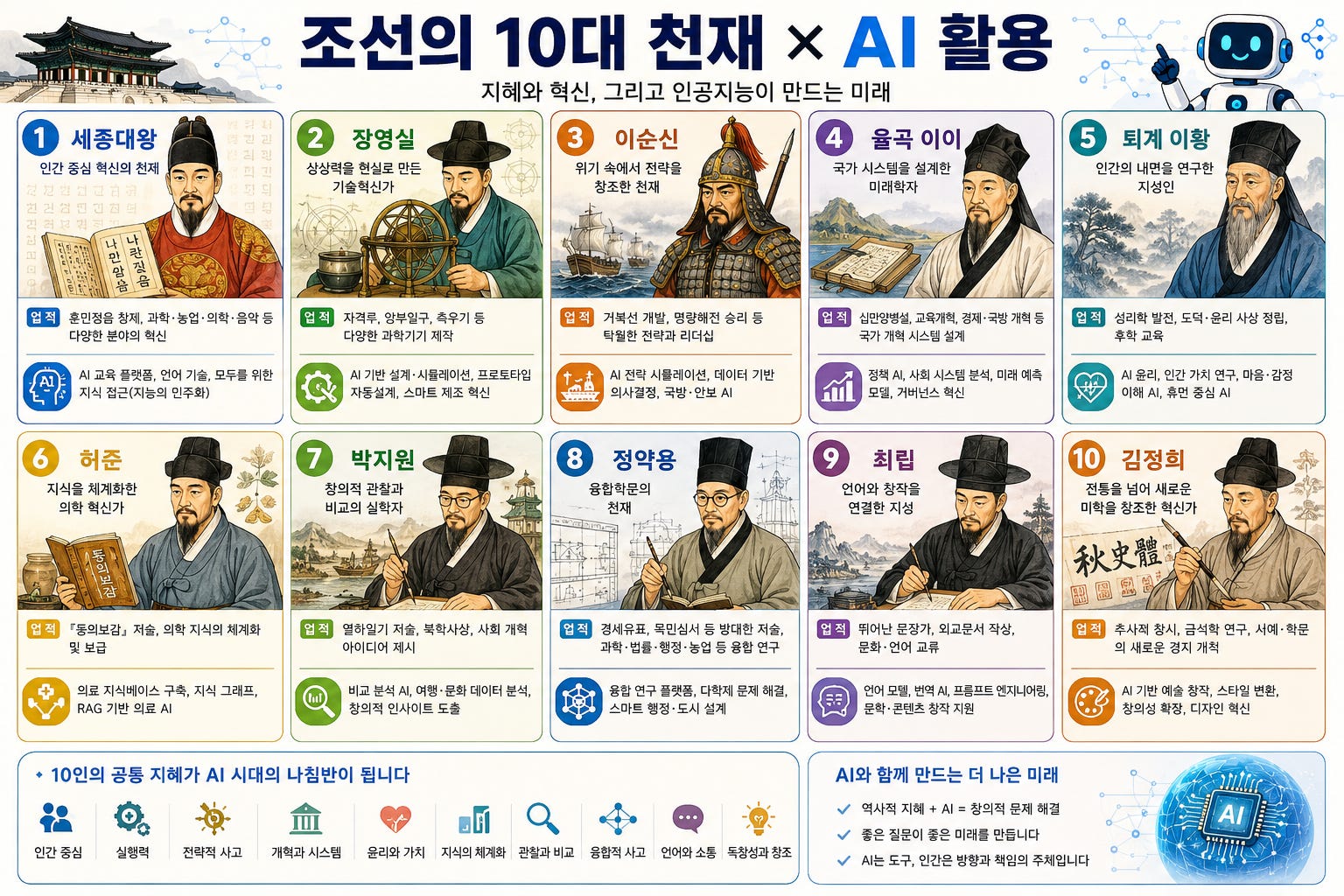
Here, I introduce ten individuals whose creativity, intellectual breadth, problem-solving ability, and social influence make them particularly meaningful for the age of generative AI. This is not intended to be an objective ranking based on IQ. Rather, it is a K-GSP Forum interpretation based on the kinds of intellectual capabilities that can be especially valuable in the AI era.
1. King Sejong — The Genius of Human-Centered Innovation
If we were to select one individual as the greatest genius of Joseon, King Sejong would be the first name that comes to mind.
His greatness cannot be explained by the creation of Hangul alone. He promoted innovation in science, astronomy, agriculture, medicine, music, and public administration, connecting knowledge in different fields to the improvement of the lives of his people.
Hangul itself was an extraordinary innovation based on a deep understanding of human language and cognition.
The first lesson that the AI era can learn from King Sejong is ‘Technology for People.’
No matter how powerful AI becomes, it cannot produce broad social innovation if it remains accessible only to a small group of experts.
Just as Sejong created a writing system that ordinary people could learn and use, the AI era needs to pursue the ‘democratization of intelligence.’
AI education should therefore not be limited to technical specialists. Students, older adults, people with disabilities, immigrants, small-business owners, and people from all walks of life should be able to benefit from AI.
2. Jang Yeong-sil — The Innovator Who Turned Imagination into Technology
Jang Yeong-sil was one of Joseon’s most remarkable scientists and engineers.
He developed scientific instruments such as the clepsydra, the armillary sphere, and the rain gauge, helping elevate the scientific and technological capabilities of Joseon.
His greatest strength was the ability to ‘turn ideas into functioning systems.’
This capability is equally important in the AI era.
As generative AI can produce an enormous number of ideas, the competitive advantage will increasingly lie not in the quantity of ideas but in the ability to turn ideas into products, services, experiments, and real-world solutions.
A Jang Yeong-sil-inspired AI innovation process might look like this:
Problem discovery → AI-assisted ideation → Design → Prototype → Testing → Refinement → Real-world implementation
Jang Yeong-sil offers a simple lesson to today’s AI entrepreneurs and researchers:
“A good idea becomes innovation only when it is built.”
3. Admiral Yi Sun-sin — The Strategic Genius Who Created Solutions in Crisis
Admiral Yi Sun-sin was more than a military commander.
He analyzed the movements of his opponents, understood geography and ocean currents, and developed strategies suited to difficult circumstances.
The Battle of Myeongnyang is one of the most remarkable examples. Despite overwhelming disadvantages, he analyzed the situation, exploited the environment, and created a path to victory.
Modern companies and nations face similar uncertainty and competition.
The lesson from Yi Sun-sin can be described as ‘AI-assisted strategic intelligence.’
AI can analyze enormous amounts of information, but human beings must ultimately decide what that information means and which strategy should be adopted.
The final decision should not simply be delegated to AI.
Yi Sun-sin’s leadership can therefore be translated into a fundamental principle for the AI era:
AI analyzes. Humans decide. Humans remain accountable.
4. Yulgok Yi I — The Futurist Who Thought in Terms of National Systems
Yulgok Yi I was a philosopher, statesman, educator, and reformer.
Rather than limiting himself to abstract theory, he was deeply concerned with how society and government could actually change.
He analyzed real-world problems and proposed reforms that could strengthen the nation.
This kind of thinking is urgently needed in the AI era.
AI can analyze enormous datasets, but it cannot independently determine what kind of society human beings ought to build.
That requires human values and judgment.
Yulgok therefore offers an important lesson:
‘Technological innovation must be accompanied by institutional innovation.’
Even if AI advances rapidly, outdated education systems, labor markets, laws, and government institutions may turn technological progress into a source of social conflict.
5. Toegye Yi Hwang — The Thinker Who Explored the Human Mind
Toegye Yi Hwang was one of the most influential philosophers of Joseon.
Although his Neo-Confucian philosophy cannot simply be transferred into the modern world, his deep reflection on the human mind and ethical life has renewed significance in the age of AI.
As generative AI becomes increasingly integrated into human intellectual activity, we must ask:
What can AI do, and what should remain uniquely human?
AI can generate information and content, but it cannot independently determine what gives human life meaning and value.
Therefore, education in the AI era must go beyond knowledge acquisition. It should strengthen ethics, empathy, self-reflection, and responsibility.
Toegye’s intellectual legacy can provide an important humanistic foundation for ‘Human-Centered AI.’
6. Heo Jun — The Medical Innovator Who Organized Knowledge
Heo Jun’s Donguibogam was a monumental effort to organize extensive medical knowledge into a systematic and usable body of knowledge.
This has striking relevance to generative AI.
One of the major challenges of the AI era is not simply collecting more information but structuring knowledge so that it can be understood, connected, retrieved, and applied.
The internet already contains an enormous amount of information. Yet information does not automatically become knowledge simply because it is abundant.
Effective AI systems require reliable data and structured knowledge.
The lesson from Heo Jun is therefore clear:
‘Organizing knowledge is often more important than merely collecting information.’
In the AI era, this principle can be extended through Knowledge Graphs, Ontologies, Retrieval-Augmented Generation (RAG), and AI-ready knowledge bases.
If Joseon medical knowledge were connected to modern knowledge-graph technologies, entirely new AI systems for history, medicine, and cultural heritage could emerge.
7. Park Ji-won — The Practical Thinker of Observation and Comparison
Park Ji-won was one of the most important thinkers and writers of the late Joseon period.
He did not simply accept established assumptions. He observed, compared, questioned, and developed new ideas.
During his journey to Qing China, he carefully observed another society and used those observations to reflect critically on the problems of Joseon.
His most modern quality was therefore ‘observation and comparison.’
In the AI era, simply asking AI to repeat information it already knows is less valuable than creating new questions.
For example, instead of asking:
“What was the economy of Joseon like?”
we might ask:
“What can a comparison between the commercial systems of Joseon and Qing China teach us about the institutional factors that constrained economic development in Joseon?”
The latter question encourages deeper analysis.
Park Ji-won’s approach can be reinterpreted as a form of ‘Comparative Prompt Engineering.’
8. Jeong Yak-yong — The Genius of Interdisciplinary Thinking
Jeong Yak-yong was one of the greatest polymathic thinkers of late Joseon.
His intellectual work covered philosophy, government, law, economics, science, architecture, agriculture, and many other fields.
His defining strength was his ability to ‘solve problems in one field by drawing upon knowledge from another.’
This is precisely the kind of thinking required in the AI era.
The most important problems of our time cannot be solved by a single academic discipline.
Climate change is not merely a scientific problem. AI ethics is not merely a computer-science problem. Medical AI requires collaboration among medicine, computer science, law, ethics, economics, and domain experts.
Jeong Yak-yong’s approach can therefore be expressed as:
AI + Humanities + Science + Social Sciences + Domain Knowledge = New Problem Solving
9. Choi Rip — A Renaissance Mind Connecting Language and Creativity
Choi Rip was a distinguished literary figure of mid-Joseon, known for his sophisticated writing and his contributions to diplomatic documents and literary culture.
His significance goes beyond literary technique.
Through language, he connected people with people, nations with nations, and cultures with cultures.
This has special relevance in the age of generative AI.
Modern generative AI operates fundamentally through language. Yet obtaining high-quality results requires the ability to use language precisely, creatively, and strategically.
Choi Rip therefore offers a model for ‘Language Intelligence’ in the AI era.
A good question often produces a better answer.
Future education should therefore not merely teach students how to use AI. It should teach them how to ask accurately, compare critically, challenge an answer, and ask a better question.
10. Kim Jeong-hui — The Innovator Who Created a New Aesthetic
Kim Jeong-hui, widely known as Chusa, was an extraordinary scholar, calligrapher, and cultural innovator.
His distinctive calligraphic style did not merely reproduce existing traditions. He transformed them into a new aesthetic language.
The same principle applies to creativity in the AI era.
Generative AI can learn patterns from existing works and generate new combinations. But humans can look at the result and ask:
“Why is this good?”
“What is missing?”
“Can we create something fundamentally different?”
The lesson from Kim Jeong-hui is therefore ‘Originality.’
The more capable AI becomes at generating content, the more valuable an authentically human perspective may become.
Ten Lessons from Joseon’s Ten Geniuses for the AI Era
When these ten intellectuals are placed on a single conceptual map, a remarkable pattern emerges.
Joseon Genius Core Capability AI-Era Application
King Sejong Human-centered innovation AI democratization
Jang Yeong-sil Technological implementation AI prototyping
Yi Sun-sin Strategic judgment AI strategic intelligence
Yi I National reform AI governance
Yi Hwang Human values and ethics Responsible AI
Heo Jun Knowledge organization Knowledge Graph / RAG
Park Ji-won Observation and comparison Comparative AI
Jeong Yak-yong Interdisciplinary thinking Multidisciplinary AI
Choi Rip Language and communication Prompt & Language Intelligence
Kim Jeong-hui Originality and creativity Human-AI creativity
How Can We Bring Joseon’s Geniuses Back to Life through AI?
The goal should not simply be to train AI on historical figures. We need to transform Joseon’s intellectual heritage into a new learning system for the AI era.
For example, several projects could be envisioned.
1. The AI Sejong Project
Historical materials concerning Hangul, the Hunminjeongeum Haerye, science, agriculture, music, and education could be connected through AI to create a ‘Human-Centered AI Education Platform.’
2. The AI Jang Yeong-sil Project
Historical scientific and technological materials could be used to encourage students to design new scientific instruments together with AI.
Students could identify a problem, ask AI to propose alternative designs, build prototypes, and conduct experiments to determine which solution works best.
3. The AI Yi Sun-sin Project
Historical naval battles, geography, weather, and maritime information could be used to create AI-based strategic simulations.
Students would not merely memorize history. They would learn ‘strategic thinking and decision-making.’
4. The AI Jeong Yak-yong Project
Works such as Mokminsimseo and Gyeongseyupyo could be connected through AI with contemporary administrative and social issues.
Students could ask:
“How might Jeong Yak-yong design AI-powered public administration today?”
5. The AI Choi Rip Project
Choi Rip’s writings could be connected with classical Korean, Chinese, and Japanese literature and modern English to develop a ‘multilingual literary AI.’
The Goal Is Not to Let AI Do Everything
There is an important boundary here.
Recreating historical figures through AI does not mean that AI becomes Sejong or Jeong Yak-yong.
Training AI on their writings does not automatically give AI their wisdom.
The real objective is to ‘enable AI to connect historical knowledge with new human questions.’
For example, instead of asking:
“What did King Sejong accomplish?”
we should ask:
“If King Sejong’s principle of human-centered innovation were applied to generative AI education today, what kind of national strategy would be necessary?”
That is a much more meaningful question.
This is the essence of combining ‘Historical Intelligence with Generative AI.’
Korea’s Future Will Not Be Determined Simply by How Well It Builds AI
Korea possesses world-class capabilities in semiconductors and information and communication technologies.
But the true competitive advantage of the AI era will not be determined by computing power alone.
It will increasingly depend on ‘the questions we ask, the values we pursue, and the knowledge we connect.’
The human-centered spirit of Sejong,
the scientific spirit of Jang Yeong-sil,
the strategic thinking of Yi Sun-sin,
the reformist spirit of Yi I,
the ethical reflection of Yi Hwang,
the knowledge organization of Heo Jun,
the observational spirit of Park Ji-won,
the interdisciplinary thinking of Jeong Yak-yong,
the linguistic intelligence of Choi Rip,
and the creative originality of Kim Jeong-hui
can all be connected with AI.
If we succeed, Korea can become more than a nation that consumes AI.
It can become a nation that creates new philosophies, educational models, and applications for AI.
The Genius of the Future Is Not the Person Who Uses AI the Most
The ten great minds of Joseon shared one important characteristic.
They did not simply search for answers to the questions their time had already asked.
They created new questions that their time had not yet learned to ask.
Sejong asked how ordinary people could communicate more easily.
Jang Yeong-sil asked how natural phenomena could be measured.
Yi Sun-sin asked how victory could be achieved under overwhelming disadvantages.
Jeong Yak-yong asked how government could better serve its people.
Today, we need a new question:
“How can we build a society in which AI does not replace human beings, but enables human capabilities to become deeper, wiser, and more creative?”
The geniuses of Joseon have already shown us part of the answer.
AI can remember the knowledge of the past.
But human beings must still decide the future.
The true genius of the AI era, therefore, will not be the person who delegates everything to AI.
It will be the person who asks AI meaningful questions, critically evaluates its answers, connects knowledge across disciplines, and ultimately uses AI to move humanity and society in a better direction.
The geniuses of Joseon have already demonstrated this spirit.
Our task now is not to preserve their wisdom merely in museums and historical books, but to bring that wisdom back to life in the language of the future through generative AI.
That may be the most contemporary way to inherit Joseon’s intellectual legacy—and one of the most creative ways Korea can contribute to the global AI era.
References
Chung, K. (2018). Hangul—How was Hangul created? I. Humanities and Language, 20(2), 85–120.
DOI: https://doi.org/10.16945/201820204Song, B.-K., Won, J.-H., & Kim, S. (2016). Historical medical value of Donguibogam. Journal of Pharmacopuncture, 19(1), 16–20.
DOI: https://doi.org/10.3831/KPI.2016.19.002Ruchniewicz, K. (2026). AI in history education: The American Historical Association’s guidelines, the views of their authors, and their reception within the historical community. Sensus Historiae, 62(1), 37–60.
DOI: https://doi.org/10.14746/sh.2026.62.1.003Werner, W. (2026). AI’s personas and historical knowledge: How models transform textbook questions into narratives. Sensus Historiae, 62(1), 61–78.
DOI: https://doi.org/10.14746/sh.2026.62.1.004Lee, K.-M., & Ramsey, S. R. (2011). Introduction. In A history of the Korean language (pp. 1–12). Cambridge University Press.
DOI: https://doi.org/10.1017/CBO9780511974045.002 +++
2026년 7월 31일
July 31, 2026
{Solti}
조선 역사상 상위 10인의 천재에게서 배우는 AI 시대의 지혜
세종에서 정약용까지, 조선의 지적 유산을 생성인공지능으로 다시 깨우다
인공지능이 인간보다 빠르게 글을 쓰고, 그림을 그리고, 코드를 만들며, 복잡한 문제에 답하는 시대가 되었다. 그러나 AI가 아무리 발전해도 한 가지 질문은 여전히 인간에게 남는다.
“무엇을 질문할 것인가?”
AI 시대의 경쟁력은 단순히 AI를 잘 사용하는 능력에 있지 않다. 좋은 질문을 만들고, 새로운 문제를 발견하며, 서로 다른 지식을 연결하고, 기술을 인간의 삶에 유익하게 적용하는 능력이 더욱 중요하다.
그런 의미에서 우리는 조선시대의 뛰어난 지성인들을 다시 바라볼 필요가 있다.
조선에는 정치가, 과학자, 철학자, 문학가, 의학자, 실학자 등 다양한 분야에서 기존의 지식과 관습을 뛰어넘었던 인물들이 있었다. 이들의 공통점은 단순히 많이 배웠다는 데 있지 않다. 기존의 지식을 새로운 방식으로 연결하고, 당대의 문제를 해결하며, 미래를 상상했다는 점에 있다.
여기서는 조선 역사에서 특히 창의성과 융합적 사고가 뛰어났다고 평가할 수 있는 10인을 선정해 본다. 이는 객관적인 ‘천재 순위’가 아니라 AI 시대에 다시 활용할 가치가 높은 지적 역량을 중심으로 한 K-GSP Forum의 관점에서 본 선정이다.
1. 세종대왕 ― 인간 중심 혁신의 천재
조선 최고의 천재를 한 사람만 꼽으라면 가장 먼저 떠오르는 인물이 세종이다.
세종의 위대함은 훈민정음 창제 하나에만 있지 않다. 그는 과학기술, 천문학, 농업, 음악, 의학, 행정 등 다양한 분야를 국가 발전과 연결했다.
특히 훈민정음은 인간의 인지능력과 언어 구조를 깊이 이해하고 만들어낸 혁신적인 문자 체계였다.
세종에게서 AI 시대가 배워야 할 첫 번째 교훈은 ‘Technology for People’이다.
오늘날 AI가 아무리 강력해도 소수의 전문가만 사용할 수 있다면 사회 전체의 혁신으로 이어지기 어렵다.
세종이 백성을 위해 문자를 만들었다면, AI 시대에는 모든 사람이 AI를 사용할 수 있는 지능의 민주화가 필요하다.
AI 교육 역시 일부 전문가를 위한 교육이 아니라 학생, 노인, 장애인, 이민자, 중소기업인 등 모든 사람이 접근할 수 있는 방향으로 발전해야 한다.
2. 장영실 ― 상상력을 현실로 만든 기술혁신가
장영실은 조선의 대표적인 과학기술자다.
그는 자격루, 앙부일구, 측우기 등 다양한 과학기기를 제작하며 당시 조선의 과학기술 수준을 크게 높였다.
장영실의 가장 중요한 능력은 아이디어를 실제 작동하는 시스템으로 구현하는 능력이었다.
AI 시대에도 이것이 매우 중요하다.
생성AI가 아이디어를 만들어내는 시대에는 ‘아이디어의 양’보다 아이디어를 실제 제품과 서비스로 전환하는 실행력이 중요해진다.
장영실식 사고를 AI에 적용한다면 다음과 같은 과정이 가능하다.
문제 발견 → AI 아이디어 생성 → 설계 → 프로토타입 → 테스트 → 개선 → 실제 적용
오늘날의 AI 스타트업과 연구자들에게 장영실은 중요한 메시지를 던진다.
“좋은 생각은 만들어져야 비로소 혁신이 된다.”
3. 이순신 ― 위기 속에서 전략을 창조한 천재
이순신은 단순한 장수가 아니었다.
그는 제한된 자원 속에서 적의 움직임을 분석하고, 지형과 해류를 활용하며, 새로운 전술을 개발했다.
그의 대표적인 사례가 명량해전이다.
압도적으로 불리한 조건에서도 상황을 분석하고 전략을 바꾸어 승리를 만들어냈다.
AI 시대의 기업과 국가도 끊임없이 불확실성과 경쟁에 직면한다.
이순신에게서 배울 수 있는 핵심은 ‘AI-assisted strategic intelligence’다.
AI가 수많은 데이터를 분석할 수 있다면 인간은 그 정보를 바탕으로 전략을 선택해야 한다.
그러나 최종 판단을 AI에게 맡겨서는 안 된다.
이순신의 리더십은 AI 시대에 다음과 같은 원칙으로 재해석될 수 있다.
AI가 분석하고, 인간이 판단하며, 인간이 책임진다.
4. 율곡 이이 ― 국가 시스템을 설계한 미래학자
율곡 이이는 철학자이면서 정치가였고 교육자였다.
그는 단순한 이론보다 국가가 실제로 어떻게 변화해야 하는지를 고민했다.
특히 현실의 문제를 분석하고 개혁의 방향을 제시했다는 점에서 현대의 정책연구자와 유사한 면이 있다.
AI 시대에 필요한 것도 바로 이런 능력이다.
AI는 데이터를 분석할 수 있지만 ‘어떤 사회를 만들어야 하는가?’라는 질문에는 인간의 가치 판단이 필요하다.
율곡에게서 배우는 AI 시대의 교훈은 다음과 같다.
‘기술혁신은 제도혁신과 함께 이루어져야 한다.’
AI가 발전해도 교육제도, 노동시장, 법률, 윤리, 정부 시스템이 변화하지 않는다면 기술혁신은 오히려 사회적 갈등을 증가시킬 수 있다.
5. 퇴계 이황 ― 인간의 내면을 연구한 지성인
퇴계 이황은 조선 성리학의 대표적 사상가다.
오늘날 그의 사상을 그대로 적용할 수는 없지만, 인간의 마음과 도덕적 삶에 대한 깊은 성찰은 AI 시대에 오히려 새로운 의미를 갖는다.
생성AI가 인간의 지적 활동에 깊숙이 들어오면서 우리는 새로운 질문을 던져야 한다.
‘AI가 할 수 있는 것과 인간만이 해야 하는 것은 무엇인가?’
AI는 정보를 생성할 수 있지만 인간의 삶에서 의미와 가치가 무엇인지 스스로 결정할 수는 없다.
따라서 AI 시대의 교육은 단순한 지식교육을 넘어 윤리, 공감, 자기성찰, 책임감을 강화해야 한다.
퇴계의 철학은 AI 시대의 ‘Human-Centered AI’를 위한 인문학적 토대가 될 수 있다.
6. 허준 ― 지식을 체계화한 의학 혁신가
허준의 《동의보감》은 방대한 의학 지식을 체계적으로 정리하고 활용할 수 있도록 만든 대표적인 지식 프로젝트였다.
오늘날 생성AI 시대의 중요한 과제 중 하나 역시 ‘지식의 구조화’다.
인터넷에는 엄청난 양의 정보가 있지만 정보가 많다고 지식이 되는 것은 아니다.
AI가 효과적으로 작동하려면 신뢰할 수 있는 데이터와 구조화된 지식이 필요하다.
허준에게서 배우는 교훈은 명확하다.
‘정보를 모으는 것보다 정보를 체계화하는 것이 중요하다.’
AI 시대에는 이를 Knowledge Graph, Ontology, Retrieval-Augmented Generation(RAG), AI-ready knowledge base 등의 형태로 발전시킬 수 있다.
조선의 의학 지식 체계화가 오늘날의 지식 그래프와 만난다면 새로운 역사·의학·문화 AI가 탄생할 수도 있다.
7. 최치원과 더불어 생각해 볼 조선의 문인 ― 박지원의 창의적 관찰
박지원은 조선 후기의 대표적인 실학자이자 문학가다.
그는 기존의 관념을 그대로 받아들이지 않고 직접 관찰하고 비교하며 새로운 생각을 발전시켰다.
특히 중국을 여행하며 보고 들은 것을 바탕으로 조선 사회의 문제를 비판적으로 바라보았다.
박지원의 가장 현대적인 능력은 ‘관찰과 비교’다.
AI 시대에는 AI가 이미 알고 있는 것을 반복하는 것보다 새로운 질문을 만드는 것이 중요하다.
예를 들어 AI에게 단순히
“조선시대의 경제는 어떠했는가?”
라고 묻는 것보다,
“조선과 청나라의 상업제도를 비교하면 조선의 경제발전을 가로막은 요인은 무엇이었는가?”
라고 묻는 것이 훨씬 생산적이다.
박지원식 사고는 ‘Comparative Prompt Engineering’으로 발전할 수 있다.
8. 정약용 ― 융합학문의 천재
정약용은 조선 후기의 가장 대표적인 융합형 지식인 가운데 한 사람이다.
철학, 행정, 법률, 경제, 과학, 건축, 농업 등 다양한 분야에 걸쳐 방대한 저술을 남겼다.
그의 대표적인 특징은 ‘한 분야의 문제를 다른 분야의 지식으로 해결하려는 융합적 사고’였다.
AI 시대는 바로 이런 융합적 사고를 요구한다.
오늘날의 중요한 문제들은 어느 한 학문만으로 해결할 수 없다.
기후변화는 과학만의 문제가 아니며, AI 윤리는 컴퓨터과학만의 문제가 아니다. 의료AI는 의학, 컴퓨터과학, 법률, 윤리, 경제가 함께 참여해야 한다.
정약용의 사고방식을 AI 시대에 적용하면 다음과 같은 공식으로 표현할 수 있다.
AI + 인문학 + 과학 + 사회과학 + 현장지식 = 새로운 문제해결
9. 최립 ― 언어와 창작을 연결한 르네상스형 지성
조선 중기의 문인 최립은 뛰어난 문장가이자 외교문서 작성자로 평가받으며, 다양한 문학적·학문적 활동을 남겼다.
그의 강점은 단순한 글쓰기 기술에만 있지 않다.
그는 언어를 통해 사람과 사람, 국가와 국가, 문화와 문화를 연결했다.
이 점은 생성AI 시대에 특별한 의미를 갖는다.
생성AI는 언어를 기반으로 작동한다. 그러나 좋은 AI 결과를 얻기 위해서는 ‘언어를 정확하고 창의적으로 사용하는 능력’이 필요하다.
최립에게서 배울 수 있는 것은 ‘AI 시대의 Language Intelligence’다.
좋은 질문은 좋은 답을 만든다.
따라서 미래 교육에서는 학생들에게 단순히 AI를 사용하게 하는 것이 아니라 ‘정확하게 질문하고, 비교하고, 반박하고, 다시 질문하는 능력’을 가르쳐야 한다.
10. 김정희 ― 전통을 넘어 새로운 미학을 창조한 혁신가
추사 김정희는 서예와 학문에서 독창적인 경지를 개척했다.
그의 추사체는 기존의 서체를 단순히 반복하지 않고 새로운 미학을 창조한 대표적인 사례다.
‘AI 시대에도 창의성은 모방을 넘어서는 데서 시작한다.’
생성AI는 기존 작품의 패턴을 학습하여 새로운 결과를 만들 수 있지만, 인간은 그 결과를 보고 다시 질문할 수 있다.
“왜 이것이 좋은가?”
“무엇이 부족한가?”
“완전히 다른 방식으로 만들 수 있는가?”
김정희에게서 배우는 AI 시대의 핵심은 ‘Originality’다.
AI가 생성하는 시대일수록 인간의 독창적인 관점은 더욱 중요해진다.
조선의 10인 천재가 AI 시대에 주는 10가지 교훈
이들을 하나의 지적 지도 위에 올려놓으면 놀라운 공통점이 발견된다.
조선의 지성 핵심 역량 AI 시대의 적용
세종 인간 중심 혁신 AI 민주화
장영실 기술 구현 AI 프로토타이핑
이순신 전략적 판단 AI 전략정보
율곡 국가개혁 AI 거버넌스
퇴계 인간·윤리 Responsible AI
허준지식 체계화 Knowledge Graph/RAG
박지원 관찰·비교 Comparative AI
정약용 융합적 사고 Multidisciplinary AI
최립 언어·소통 Prompt & Language Intelligence
김정희 독창성 Human-AI Creativity
그렇다면 조선의 천재들을 어떻게 AI로 되살릴 것인가?
여기서 중요한 것은 과거의 인물을 단순히 AI에게 학습시키는 것이 아니다.
우리는 조선의 지적 유산을 AI 시대의 새로운 학습 시스템으로 재구성할 필요가 있다.
예를 들어 다음과 같은 프로젝트를 생각할 수 있다.
1. AI 세종 프로젝트
훈민정음, 《훈민정음 해례본》, 세종 시대의 과학·음악·농업 자료를 AI로 연결하여 Human-Centered AI 교육 플랫폼을 만든다.
2. AI 장영실 프로젝트
조선의 과학기술 자료를 활용하여 학생들이 AI와 함께 새로운 과학기기를 설계하도록 한다.
학생은 문제를 제시하고 AI는 여러 설계안을 제안하며, 학생은 실제 제작과 실험을 통해 최종안을 결정한다.
3. AI 이순신 프로젝트
역사적 전투 자료와 지형·기상·해양 데이터를 활용하여 AI 전략 시뮬레이션을 개발한다.
이를 통해 학생들은 단순히 역사를 암기하는 것이 아니라 전략적 사고를 배울 수 있다.
4. AI 정약용 프로젝트
《목민심서》, 《경세유표》 등 다양한 자료를 AI로 연결하여 현대의 행정·사회문제와 비교한다.
“정약용이라면 오늘날의 AI 행정을 어떻게 설계했을까?”라는 질문을 던지는 것이다.
5. AI 최립 프로젝트
최립의 문장과 조선시대 문헌을 활용해 한·중·일 고전문학과 현대 영어를 연결하는 다국어 문학 AI를 개발할 수 있다.
가장 중요한 것은 ‘AI에게 맡기는 것’이 아니다
그러나 여기에는 매우 중요한 경계선이 있다.
조선의 천재들을 AI로 재현한다고 해서 AI가 세종이 되거나 정약용이 되는 것은 아니다.
AI가 그들의 글을 학습한다고 해서 그들의 지혜까지 자동으로 얻는 것도 아니다.
진정한 목표는 ‘AI가 역사적 인물의 지식을 인간의 새로운 질문과 연결하도록 만드는 것’이다.
예를 들어,
“세종은 무엇을 했는가?”라는 질문보다,
“세종의 인간 중심 혁신 원칙을 오늘날의 생성AI 교육정책에 적용한다면 어떤 국가전략이 필요한가?”라는 질문이 훨씬 중요하다.
이것이 바로 ‘Historical Intelligence + Generative AI’의 결합이다.
한국의 미래는 ‘AI를 얼마나 잘 만드는가’만으로 결정되지 않는다
대한민국은 세계적인 반도체·ICT 역량을 가지고 있다.
그러나 AI 시대의 진정한 경쟁력은 컴퓨팅 파워만으로 결정되지 않는다.
‘어떤 질문을 던지는가, 어떤 가치를 추구하는가, 어떤 지식을 연결하는가’가 더욱 중요하다.
세종의 인문정신,
장영실의 과학정신,
이순신의 전략정신,
율곡의 개혁정신,
퇴계의 윤리정신,
허준의 지식체계화,
박지원의 관찰정신,
정약용의 융합정신,
최립의 언어정신,
김정희의 창조정신을
AI와 연결한다면 한국은 단순히 AI를 소비하는 국가가 아니라 ‘AI의 새로운 철학과 활용모델을 만드는 국가’가 될 수 있다.
미래의 천재는 AI를 가장 많이 사용하는 사람이 아니다
조선의 천재들에게는 한 가지 공통점이 있었다.
그들은 시대가 요구하는 답을 단순히 찾지 않았다.
시대가 묻지 않았던 새로운 질문을 만들었다.
세종은 “백성이 어떻게 더 쉽게 글을 사용할 수 있는가?”를 물었다.
장영실은 “자연의 현상을 어떻게 측정할 수 있는가?”를 물었다.
이순신은 “불리한 조건에서 어떻게 승리할 것인가?”를 고민했다.
정약용은 “국가는 어떻게 백성을 더 잘 섬길 수 있는가?”를 고민했다.
그리고 오늘날 우리에게는 새로운 질문이 필요하다.
“‘AI가 인간을 대신하는 사회’가 아니라, ‘AI를 통해 인간의 능력이 더 깊어지는 사회’를 어떻게 만들 것인가?”
이 질문에 대한 답을 찾는 과정에서 조선의 천재들은 다시 우리에게 말을 걸고 있다.
AI는 과거의 지식을 기억할 수 있다.
그러나 미래를 선택하는 것은 여전히 인간이다.
따라서 ‘AI 시대의 진정한 천재는’ AI에게 모든 것을 맡기는 사람이 아니라,
‘AI에게 좋은 질문을 던지고, AI의 답을 비판적으로 검증하며, 서로 다른 지식을 연결하고, 궁극적으로 인간과 사회를 더 나은 방향으로 변화시키는 사람’이다.
조선의 천재들은 이미 그 방법을 보여주었다.
이제 우리의 과제는 그들의 지혜를 박물관에 보관하는 것이 아니라 생성AI라는 새로운 도구를 통해 미래의 언어로 다시 살아 움직이게 하는 것이다.
그것이 조선의 지적 유산을 계승하는 가장 현대적인 방법이며, 동시에 AI 시대의 한국이 세계에 기여할 수 있는 가장 창의적인 방법일 것이다.
References
Chung, K. (2018). Hangul—How was Hangul created? I. Humanities and Language, 20(2), 85–120.
DOI: https://doi.org/10.16945/201820204Song, B.-K., Won, J.-H., & Kim, S. (2016). Historical medical value of Donguibogam. Journal of Pharmacopuncture, 19(1), 16–20.
DOI: https://doi.org/10.3831/KPI.2016.19.002Ruchniewicz, K. (2026). AI in history education: The American Historical Association’s guidelines, the views of their authors, and their reception within the historical community. Sensus Historiae, 62(1), 37–60.
DOI: https://doi.org/10.14746/sh.2026.62.1.003Werner, W. (2026). AI’s personas and historical knowledge: How models transform textbook questions into narratives. Sensus Historiae, 62(1), 61–78.
DOI: https://doi.org/10.14746/sh.2026.62.1.004Lee, K.-M., & Ramsey, S. R. (2011). Introduction. In A history of the Korean language (pp. 1–12). Cambridge University Press.
DOI: https://doi.org/10.1017/CBO9780511974045.002 +++
2026년 7월 31일
{솔티}
Prof. Dr. Young Choi (Editor in Chief) — Regent University
Young B. Choi is a Professor in the Department of Engineering & Computer Science at Regent University. He published 38 books with ‘Selected Readings in Cybersecurity’ (2018) (over 800 copies archived globally at university/college libraries around the world) and ‘Cybersecurity Applications and Artificial Intelligence’ (2023) available in seven major world languages. He proposed the world’s first global and universal telecommunications “Service Order Handling (SOH)” Model (T-SOH Model) (1995) with Dr. Adrian Tang. With this innovative research work, he received the IEEE NOMS ’96 Best Paper Award and became the first recipient of the Outstanding Contribution Award of the TeleManagement Forum in 1998. His research areas include Natural Language Processing-focused AI, AI-applied cybersecurity, network and telecom service management, and Korean studies on Gani Choi Rip’s Jeonggwan (靜觀: Quiet Contemplation) philosophy and Shilhak ( 實學: Practical Learning).
© K-GSP (K-Global Scholars and Professionals) Forum. All rights reserved. July 2026.