
Reading Is the Art of Asking
What Choi Rip’s Reading Practice Teaches Us About Prompt Engineering in the Age of AI
Abstract
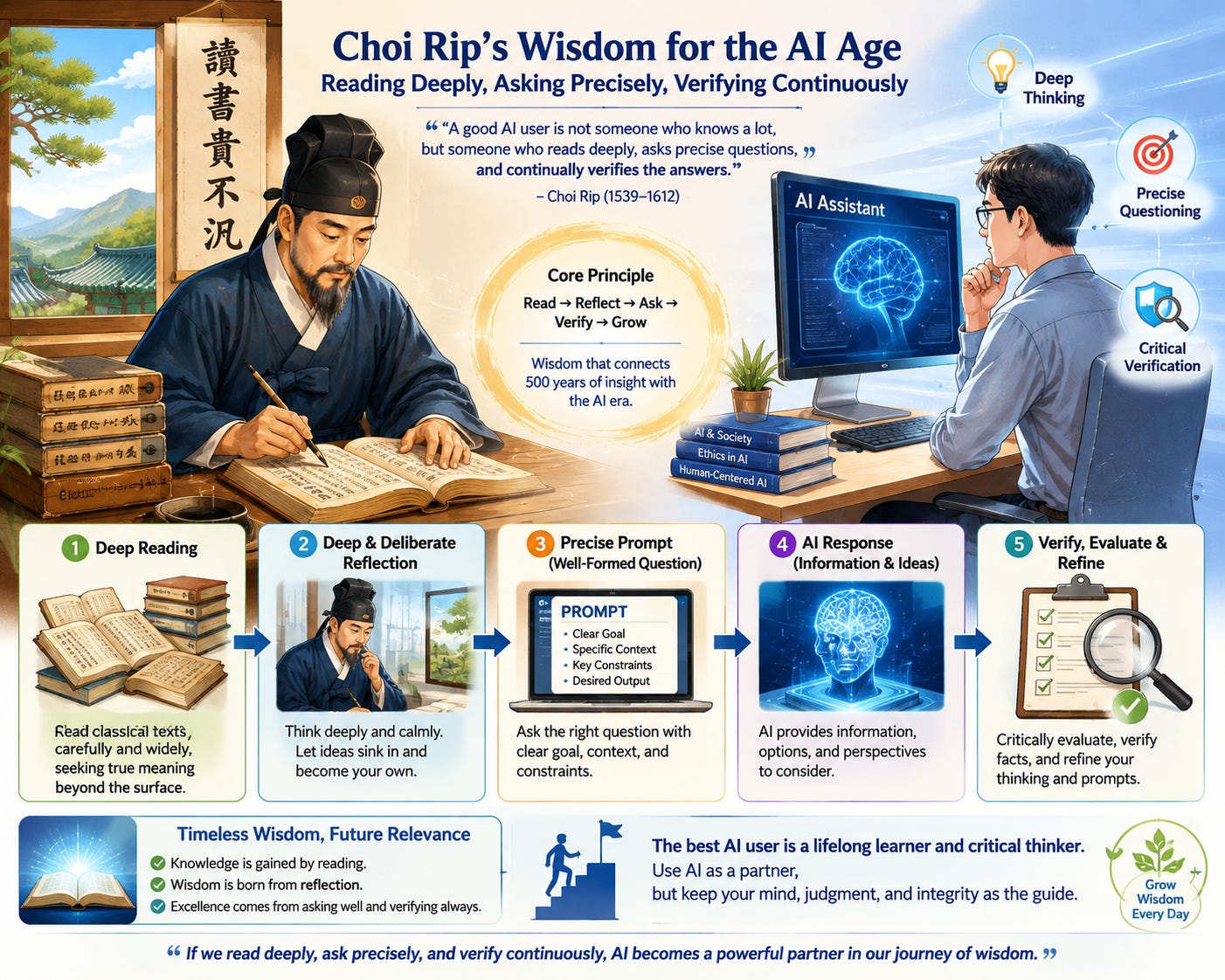
This essay reinterprets the intellectual practices of Choi Rip (崔岦, 1539–1612), a prominent Korean scholar and literary writer of the mid-Joseon period, through the lens of Prompt Engineering in the age of generative artificial intelligence. For Choi Rip, reading was not merely the accumulation of knowledge. It was an active process of closely examining classical texts, selectively absorbing their structures and meanings, reflecting upon them, and reconstructing them through one’s own writing. His principle that reading should not become excessive—expressed in the idea of “reading should not be diffuse” (讀書貴不汎)—and his practice of deep, deliberate reflection and repeated revision, associated with gakui damsa (刻意湛思), offer valuable intellectual principles for an era characterized by information abundance and AI-generated content. This essay translates Choi Rip’s reading practice into five principles of Prompt Engineering: purposeful reading, selective context construction, structured questioning, iterative prompt refinement, and independent verification. It further argues that Prompt Engineering should not be understood merely as a technical skill for instructing AI, but as a humanistic method for structuring and clarifying human thought. Just as Choi Rip refined his ideas through the brush, contemporary users refine their questions and thinking through prompts while interacting with AI. The central argument is that the most valuable human capability in the AI era is not the ability to generate more information, but the ability to read deeply, ask precise questions, construct meaningful context, and critically verify AI-generated results. Choi Rip’s reading philosophy therefore offers a historically grounded and humanistic foundation for responsible and intellectually productive engagement with artificial intelligence.
Keywords: Choi Rip, Gani-jip, reading practice, Prompt Engineering, generative AI, artificial intelligence, humanistic AI, critical thinking, Context Engineering, Joseon literature
There Is a Difference Between Reading Much and Reading Well
We live in an age in which humanity possesses more information than ever before. With a smartphone, we can access thousands of books and an almost unimaginable volume of digital text. With generative AI, information can now be retrieved, summarized, translated, and reorganized within seconds.
Yet a paradox has emerged.
As information has become abundant, the ability to ask the right question has become more important.
We can ask an AI system almost anything and receive an answer immediately. But a vague question often produces a vague answer. A poorly framed question can even produce a confident but inaccurate response. The central intellectual skill of the AI era, therefore, is no longer simply knowing more. It is knowing what to ask, how to ask it, and how to evaluate the answer.
This is where we should rediscover the sixteenth-century Korean scholar and writer Choi Rip (崔岦, 1539–1612).
The Veritable Records of the Joseon Dynasty describe Choi Rip as a man who devoted himself to learning from an early age and never became negligent in his studies. He was not merely a gifted literary writer. He studied classical prose deeply, examined literary models, refined his writing, and cultivated a broad intellectual world.
For Choi Rip, reading was not simply an act of collecting information.
It was a process of reading, thinking, comparing, reconstructing, and rewriting.
That is precisely why his reading practice has something important to teach us about Prompt Engineering today.
Choi Rip Read to Build Questions, Not Merely to Collect Information
One of the distinctive characteristics of Choi Rip’s scholarship was his close study of classical texts. He did not simply admire ancient writings. He examined their structures, styles, rhetorical techniques, and intellectual meanings and then transformed what he learned into his own writing.
His works include Hansayeoljeoncho (漢史列傳抄), Sipgagunchesi (十家近體詩), and the extensive collection known as Gani-jip (簡易集), which contains epitaphs, inscriptions, prefaces, essays, letters, commemorative writings, and other literary forms.
His engagement with classical prose helped reshape the literary environment of his time.
In contemporary language, this resembles what we might call document-based Prompt Engineering.
A skilled prompt designer does not simply ask an AI system random questions. The user first defines the problem, identifies the necessary background, establishes the desired output, supplies relevant examples, and specifies constraints.
Choi Rip did something remarkably similar.
To write well, he first read good writing. He studied its structure and intellectual purpose and then reconstructed it through his own voice.
In other words,
he read good writing in order to learn how good thinking becomes good writing.
This provides the first principle connecting Choi Rip’s reading practice with AI:
Read for structure, not merely for information.
“Do Not Let Reading Become Overflow”
One of the most revealing statements associated with Choi Rip’s literary thought is:
“In reading, it is important not to become excessive; in writing, it is important not to become superficial.”
This principle is remarkably relevant in the age of generative AI.
Providing an AI system with more information does not automatically produce a better answer.
Too much information can become too little understanding.
Modern Prompt Engineering similarly emphasizes the importance of selecting and organizing context rather than simply increasing the amount of information supplied to a model. Different prompting techniques can produce different outcomes depending on the task, model, and context (Sahoo et al., 2024; Vatsal & Dubey, 2024).
Choi Rip’s warning against excessive reading can therefore be translated into a modern principle:
Do not prompt by accumulation; prompt by selection.
A good prompt is not necessarily good because it is long.
It is good because every important piece of information has a purpose.
Choi Rip’s “Deep Thinking” and Prompt Refinement
Perhaps one of the most modern aspects of Choi Rip’s writing practice was his willingness to revise.
Historical accounts describe him as repeatedly revising his drafts, carefully contemplating his intended meaning—a process associated with the expression gakui damsa (刻意湛思), meaning to concentrate one’s intention and think deeply.
This resembles one of the fundamental principles of Prompt Engineering.
The first prompt does not have to be perfect.
A sophisticated AI user examines the response and asks:
What is missing?
What was ambiguous?
What additional context is necessary?
What evidence should be requested?
What assumptions did the model make?
What should be changed in the output format?
The process becomes:
Prompt → Response → Evaluation → Refinement → Better Prompt
This is remarkably similar to:
Draft → Review → Revision → Rewriting
Research on prompt engineering likewise emphasizes iterative improvement, evaluation, and the analysis of why a particular prompt succeeds or fails (Ye et al., 2024).
Thus, Choi Rip’s practice of deep contemplation can be translated into an AI-era principle:
Prompt Engineering is the art of thinking deeply before asking again.
From Classical Reading to Context Engineering
Choi Rip did not read texts as isolated objects. His writings reveal an intellectual world in which literature, history, philosophy, art, diplomacy, and classical learning were interconnected.
Hansayeoljeoncho demonstrates his engagement with historical biographies and classical prose. Sipgagunchesi reflects his interest in poetic traditions. Gan-jip preserves a wide range of literary and intellectual encounters.
This provides an important connection to a rapidly developing concept in AI: context engineering.
A prompt is an instruction.
Context is the larger intellectual environment in which that instruction operates.
For an AI system, context may include documents, retrieved sources, previous interactions, structured data, examples, memory, tools, and constraints.
Seen from this perspective, Choi Rip’s reading practice can be represented as:
Reading → Context Building → Question → Analysis → Revision
In the AI era, it is therefore not enough to ask a good question.
We must create the intellectual context in which a good question can produce a good answer.
Just as Choi Rip built his intellectual world through extensive and selective reading, modern AI users must construct reliable contexts from carefully selected sources.
Five Prompt Engineering Principles We Can Learn from Choi Rip
Read With a Purpose
Choi Rip’s reading was not passive. He read with intellectual purpose.
The same principle applies to AI.
Instead of asking:
“Explain this.”
we can ask:
“Explain the central argument of this study to undergraduate students, identify three supporting pieces of evidence, and discuss one important limitation.”
The second prompt begins with a purpose.
Select, Don’t Accumulate
Choi Rip’s warning against excessive reading has become even more relevant in the information age.
The goal is not to give AI everything.
The goal is to give it what matters.
Ask for Structure
Choi Rip studied the structures of classical prose.
Likewise, AI users can specify the structure they need:
Claim → Evidence → Counterargument → Conclusion
Structure transforms a vague request into a defined intellectual task.
Iterate
Choi Rip revised his writing repeatedly.
The same principle should govern AI interaction.
The first response should often be treated as a draft rather than a final product.
Prompt Engineering is therefore not a one-time command. It is an iterative process of experimentation and refinement.
Verify Before Trust
Choi Rip worked within a scholarly culture in which texts, sources, and traditions mattered.
Modern AI users need the same intellectual discipline.
An AI system can produce fluent prose without producing accurate facts.
Therefore, important historical claims, statistics, quotations, citations, and scientific assertions should be independently verified against authoritative sources.
Fluency is not evidence of truth.
Deep Reasoning and Choi Rip’s Intellectual Discipline
One of the influential developments in modern Prompt Engineering has been the use of prompting techniques that encourage models to approach complex tasks through intermediate reasoning steps. Wei et al. (2022), for example, demonstrated that Chain-of-Thought prompting could improve performance on various complex reasoning tasks.
This offers an interesting parallel with Choi Rip’s emphasis on deep thought.
Of course, we should not claim that Choi Rip practiced modern Chain-of-Thought prompting.
The historical comparison is conceptual, not technological.
The underlying intellectual principle, however, is similar:
Read → Analyze → Compare → Judge → Express
Instead of rushing immediately toward a conclusion, the thinker develops an intellectual path toward the conclusion.
That discipline remains essential even when AI performs much of the linguistic work.
The Future Is Not Simply Asking AI Questions
We often define Prompt Engineering as “the skill of giving instructions to AI.”
Choi Rip’s reading practice suggests a deeper definition.
Prompt Engineering is the discipline of structuring one’s own thinking so that an AI system can meaningfully assist.
To construct a good prompt, the human user must first determine:
What do I want to know?
What evidence do I need?
What perspective should be used?
What assumptions should be avoided?
What output should be produced?
What must be verified?
The process of writing a good prompt therefore forces the human being to become a better reader, researcher, and thinker.
This is why Prompt Engineering should not be regarded merely as a technical skill.
It can also become a form of humanistic intellectual training.
From Choi Rip’s Brush to the AI Prompt
Choi Rip lived in an age when books were among the most important instruments of knowledge.
We live in an age in which AI increasingly functions as an interface to knowledge.
The tools are radically different.
But the intellectual process remains surprisingly similar.
Choi Rip read books.
We read data, documents, and digital information.
Choi Rip analyzed the structure of classical prose.
We analyze the structure and reliability of AI responses.
Choi Rip revised his drafts.
We refine our prompts.
Choi Rip thought deeply before writing.
We construct context before asking AI to generate.
Choi Rip examined and refined his writing.
We verify and revise AI-generated responses.
Thus, Prompt Engineering is not an entirely new human capability.
It is a digital extension of an ancient intellectual tradition:
reading, thinking, questioning, revising, and verifying.
The AI Era Needs Deep Readers More Than Prompt Technicians
The future of Prompt Engineering is particularly interesting because AI systems themselves are increasingly capable of interpreting user intent and optimizing prompts.
Research into automatic prompt optimization and prompt compression already points toward a future in which some aspects of prompt construction may be increasingly automated (Chang et al., 2024).
What, then, remains uniquely important for humans?
The ability to decide what is worth asking.
As AI becomes better at generating language, humans will need more—not less—of the following:
reading ability, judgment, contextual understanding, questioning ability, verification, and intellectual responsibility.
This is where Choi Rip becomes surprisingly contemporary.
He did not stop at reading.
He thought about what he read, transformed thought into writing, and refined that writing.
That principle remains valid in the AI era.
Where the Brush Ends, the Prompt Begins
Choi Rip used a brush to shape sentences.
We use keyboards and interfaces to shape prompts.
The tool has changed.
The intellectual responsibility has not.
Choi Rip read deeply.
We must read deeply.
Choi Rip selected and interpreted.
We must select and contextualize.
Choi Rip revised.
We must iterate.
Choi Rip cared about the quality of expression.
We must care about the accuracy and reliability of AI output.
His intellectual discipline can therefore be condensed into a simple principle:
Read widely, but do not become overwhelmed. Think deeply, do not rush, and revise what you write.
In the language of the AI era:
Read deeply.
Select carefully.
Prompt clearly.
Iterate relentlessly.
Verify independently.
Ultimately, Prompt Engineering is not merely the art of asking a computer a question.
It is the art of making the human question clear.
Choi Rip refined his thinking through the brush.
We refine our thinking through prompts.
The technology has changed, but the fundamental human task has not.
In the age of AI, the person who reads deeply will remain indispensable—not despite artificial intelligence, but because of it.
And perhaps that is the most important lesson we can rediscover from Choi Rip more than four centuries after his death:
The future of AI depends not only on smarter machines, but on humans who know how to read, think, ask, and verify.
Choi Rip’s approach to reading is an ancient wisdom for Prompt Engineering in the age of AI. A good AI user is not simply someone who knows a great deal, but someone who reads deeply, asks precise questions, and continually verifies the answers.
References
Chang, K., Xu, S., Wang, C., Luo, Y., Liu, X., & Xiao, T. (2024). Efficient prompting methods for large language models: A survey. arXiv. https://doi.org/10.48550/arXiv.2404.01077
맹영일. (2011). 간이 최립의 화론 연구. 동양학, 50, 21–42. https://doi.org/10.17320/orient.2011..50.21
Sahoo, P., Singh, A. K., Saha, S., Jain, V., Mondal, S., & Chadha, A. (2024). A systematic survey of prompt engineering in large language models: Techniques and applications. arXiv. https://doi.org/10.48550/arXiv.2402.07927
Vatsal, S., & Dubey, H. (2024). A survey of prompt engineering methods in large language models for different NLP tasks. arXiv. https://doi.org/10.48550/arXiv.2407.12994
Wei, J., Wang, X., Schuurmans, D., Bosma, M., Ichter, B., Xia, F., Chi, E., Le, Q. V., & Zhou, D. (2022). Chain-of-thought prompting elicits reasoning in large language models. Advances in Neural Information Processing Systems, 35. https://doi.org/10.52202/068431-1800
Ye, Q., Ahmed, M., Pryzant, R., & Khani, F. (2024). Prompt engineering a prompt engineer. Findings of the Association for Computational Linguistics: ACL 2024, 355–385. https://doi.org/10.18653/v1/2024.findings-acl.21
한국민족문화대백과사전. (2023). 최립(崔岦). 한국학중앙연구원.
조선왕조실록. (1612). 광해군일기[정초본], 광해 4년 7월 11일: 전 동지중추부사 최립의 졸기.
읽는 법이 곧 묻는 법이다
간이 최립의 독서법에서 배우는 AI 시대의 Prompt Engineering
초록
본 에세이는 조선 중기의 문인·학자 간이 최립(崔岦, 1539–1612)의 독서와 문장 수련에 나타난 지적 방법을 오늘날 생성형 인공지능 시대의 Prompt Engineering과 연결하여 재해석한다. 최립에게 독서는 단순한 지식 축적이 아니라 고전의 구조와 의미를 깊이 읽고, 선택적으로 수용하며, 사유를 거쳐 자신의 문장으로 재구성하는 과정이었다. 특히 ‘독서귀불범(讀書貴不汎)’이라는 독서관과 깊이 생각하고 반복적으로 글을 수정하는 ‘각의담사(刻意湛思)’의 태도는 정보 과잉과 생성형 AI의 자동화가 공존하는 오늘날 중요한 지적 원리를 제공한다. 본 에세이는 이러한 최립의 독서법을 목적 지향적 읽기, 선택적 맥락 구성, 구조화된 질문, 반복적 프롬트 개선, 독립적 검증이라는 다섯 가지 Prompt Engineering 원리로 확장한다. 또한 Prompt Engineering을 단순한 AI 명령 작성 기술이 아니라 인간 자신의 사고를 명료하게 구조화하는 인문학적 방법론으로 재정의한다. 최립이 붓으로 문장을 다듬었다면, 오늘날의 인간은 프롬트를 통해 AI와 대화하면서 자신의 질문과 사고를 다듬는다. 결국 AI 시대에 가장 중요한 역량은 더 많은 정보를 생산하는 능력이 아니라 깊이 읽고, 정확하게 질문하며, 결과를 비판적으로 검증하는 능력이다. 최립의 독서철학은 이러한 인간 중심의 AI 활용을 위한 역사적·인문학적 토대를 제공한다.
주제어: 최립, 간이집, 독서법, Prompt Engineering, 생성형 AI, 인공지능, 인문학적 AI, 비판적 사고, Context Engineering, 조선 문학
책을 많이 읽는 사람과 잘 읽는 사람
오늘날 우리는 역사상 어느 시대보다 많은 정보를 가지고 있다. 스마트폰 하나만 열어도 수천 권의 책과 수십억 개의 문장이 눈앞에 나타난다. 생성형 AI까지 등장하면서 인간이 정보를 얻는 데 필요한 시간은 더욱 짧아졌다.
그런데 이상한 일이 벌어지고 있다.
정보는 폭발적으로 증가했는데, 제대로 질문하는 능력은 오히려 더 중요해졌다.
AI에게 질문하면 거의 즉시 답을 얻을 수 있다. 그러나 질문이 모호하면 답도 모호하다. 질문이 잘못되면 AI는 매우 그럴듯한 잘못된 답을 만들어낼 수도 있다. 따라서 AI 시대의 핵심 능력은 단순히 “많이 아는 것”이 아니라 “무엇을 어떻게 물어야 하는가를 아는 능력”이 되었다.
이 지점에서 16세기 조선의 문인 간이(簡易) 최립(崔岦, 1539–1612)을 다시 만나 배움을 구할 필요가 있다.
조선왕조실록의 최립 졸기는 그가 “글을 읽을 줄 알면서부터 힘써 배우며 게을리하지 않았다”고 기록한다. 그는 뛰어난 문장가였을 뿐 아니라 고문을 깊이 연구하고, 시문을 다듬고, 다양한 문헌을 읽고 분석했던 학자였다.
최립에게 독서는 정보를 모으는 행위가 아니었다.
읽고, 생각하고, 비교하고, 다시 쓰는 과정이었다.
바로 이 점에서 그의 독서법은 오늘날 Prompt Engineering과 놀랍도록 닮아 있다.
최립의 독서는 ‘정보 수집’이 아니라 ‘질문을 만드는 독서’였다
최립의 학문적 특징 가운데 중요한 것은 고문(古文)을 단순히 감상하는 데 그치지 않고 그 구조와 표현 방식을 분석하여 자신의 문장으로 재구성했다는 점이다.
그는 『한사열전초(漢史列傳抄)』를 편찬하고 『십가근체시(十家近體詩)』를 남겼다. 또한 『간이집(簡易集)』에는 비문·묘지·서발·기문·서간 등 다양한 문체의 글이 수록되어 있다. 한국민족문화대백과사전은 그가 고문의 형식미를 추구했고, 윤근수와 함께 고문을 숭상하여 당대 문단의 분위기를 바꾸었다고 설명한다.
이것은 단순한 독서가 아니다.
오늘날의 표현으로 바꾸면 문헌 기반의 Prompt Engineering에 가깝다.
좋은 프롬트를 만드는 사람은 AI에게 무작정 질문하지 않는다. 먼저 문제를 정의하고, 필요한 배경을 제공하며, 원하는 결과의 형식을 지정하고, 필요한 경우 사례를 제시한다.
최립 역시 좋은 글을 만들기 위해 먼저 좋은 문장을 읽었다. 그리고 그 문장의 구조와 정신을 파악한 뒤 자신의 문장으로 다시 만들어냈다.
즉, 좋은 글을 쓰기 위해 좋은 글을 읽고, 좋은 질문을 하기 위해 좋은 질문의 구조를 연구한 것이다.
이것은 인간의 독서법과 AI의 Prompt Engineering을 연결하는 첫 번째 원리다.
Read for structure, not merely for information.
정보를 얻기 위해서만 읽지 말고, 사고의 구조를 배우기 위해 읽어라.
“읽되 범람하지 말라”
최립의 문장론을 연구한 자료에는 매우 중요한 구절이 남아 있다.
그는 “독서에는 범람하지 않는 것이 중요하고, 글을 지음에는 뜨지 않는 것이 중요하다(讀書貴不汎, 而爲文貴不浮)”고 했다. 또한 학문을 뜻한다면 단순히 책과 글에만 머무르지 않고 “조존함양(操存涵養)”을 해야 하며, 마음을 다스리고 조급하지 않는 것이 중요하다고 보았다. (操存涵養의 전체적인 의미는: “마음을 잘 지키고 덕성을 깊이 기르는 것”)
이 말은 AI 시대에 더욱 의미가 커진다.
생성형 AI에게 수많은 정보를 넣는다고 해서 반드시 좋은 결과가 나오는 것은 아니다.
Too much information can become too little understanding.
Prompt Engineering에서도 핵심은 정보를 무조건 많이 넣는 것이 아니다. 과업에 필요한 맥락을 선택하고, 목표를 분명히 하고, 불필요한 정보를 제거해야 한다. 최근의 Prompt Engineering 연구들도 다양한 프롬트 기법이 작업의 성격과 모델에 따라 서로 다른 효과를 보인다는 점을 보여준다 (Sahoo et al., 2024; Vatsal & Dubey, 2024).
따라서 최립의 “不汎”은 오늘날 다음과 같이 번역할 수 있다.
Do not prompt by accumulation; prompt by selection.
좋은 프롬트는 길기 때문에 좋은 것이 아니다. 좋은 프롬트는 필요한 것을 정확히 선택하기 때문에 좋다.
최립의 ‘각의담사’와 Prompt Refinement
최립의 글쓰기에서 특히 현대적인 면모는 초고를 그대로 내놓지 않았다는 점이다.
한국민족문화대백과사전은 최립이 글을 지을 때 초고를 서너 번씩 바꾸며 ‘각의담사(刻意湛思)’, 즉 ‘뜻을 새기고 깊이 생각하는 과정’을 거쳤다고 설명한다.
이것은 오늘날 Prompt Engineering의 핵심 과정과 거의 정확하게 대응한다.
첫 번째 프롬프트가 완벽할 필요는 없다.
오히려 좋은 AI 사용자는 첫 번째 답을 보고 다시 묻는다.
“무엇이 부족했는가?”
“어떤 조건을 추가해야 하는가?”
“어떤 부분이 모호했는가?”
“어떤 근거를 요구해야 하는가?”
“결과의 형식을 어떻게 바꾸어야 하는가?”
그리고 프롬트를 다시 작성한다.
Prompt → Response → Evaluation → Refinement → Better Prompt
이것은 최립의
초고 → 검토 → 수정 → 재작성
과 놀라울 정도로 유사하다.
오늘날 Prompt Engineering이 단순한 질문 작성 기술이 아니라 반복적인 실험과 평가의 과정이라는 연구도 이러한 관점을 뒷받침한다. Ye et al. (2024)은 프롬트 엔지니어링을 효과적인 지시를 만드는 일뿐 아니라 모델의 오류를 분석하고 무엇이 부족한지를 추론하며 프롬프트를 개선하는 복합적인 작업으로 설명한다.
따라서 최립의 “각의담사”는 AI 시대에 이렇게 다시 정의할 수 있다.
Prompt Engineering is the art of thinking deeply before asking again.
고전을 읽는 최립과 Context Engineering
최립은 책 한 권을 독립적으로 읽는 사람이 아니었다. 그의 저술을 보면 역사·문학·철학·예술·외교 등 다양한 지식 영역이 서로 연결되어 있다.
그의 『간이집』에는 다양한 인물과 문헌, 역사적 사건과 문화적 대상이 등장한다. 『한사열전초』에서는 중국 역사 속 인물과 문장을 선별하고, 『십가근체시』에서는 시학적 전통을 정리했다. 그의 역학 연구 역시 이러한 학문적 관심의 폭을 보여준다.
오늘날 AI 연구에서 중요성이 커지는 개념 가운데 하나가 context engineering이다. Prompt가 AI에게 직접 전달하는 명령이라면, context는 AI가 문제를 해결할 수 있도록 제공되는 자료·배경·검색 결과·기억·도구 등의 전체 환경에 가깝다.
따라서 최립의 독서법을 현대적으로 확장하면 다음과 같은 구조가 된다.
Reading → Context Building → Question → Analysis → Revision
AI 시대에는 단순히 “좋은 질문”을 만드는 것만으로 충분하지 않다.
좋은 질문이 작동할 수 있는 좋은 문맥을 만들어야 한다.
최립이 고전을 읽고 자신의 지식 체계를 구축했던 것처럼, 오늘날 우리는 AI에게 필요한 자료를 선별하고 구조화해야 한다.
최립에게서 배우는 다섯 가지 Prompt Engineering
최립의 독서와 문장 수련을 오늘날의 AI 활용법으로 번역하면 다음과 같은 다섯 가지 원칙을 얻을 수 있다.
첫째, 목적을 먼저 정하라 — Read with a purpose.
무엇을 읽느냐보다 왜 읽느냐가 중요하다. AI에게도 마찬가지다. “이것을 설명해 줘”보다 “이 연구의 핵심 주장을 학부생에게 설명하기 위해 세 가지 근거와 한계점을 제시하라”가 훨씬 강력하다.
둘째, 핵심을 선별하라 — Select, don’t accumulate.
최립의 “讀書貴不汎”은 정보 과잉 시대의 중요한 교훈이다. 모든 정보를 넣는 것이 아니라 문제 해결에 필요한 정보만 선택해야 한다.
셋째, 구조를 요구하라 — Ask for structure.
최립은 고문의 문체와 형식을 연구했다. AI에게도 결과의 구조를 명확히 제시할수록 원하는 결과를 얻기 쉽다. 예컨대 “주장–근거–반론–결론”과 같은 구조를 지정하는 것이다.
넷째, 한 번에 끝내려 하지 말라 — Iterate.
최립이 초고를 여러 차례 수정했던 것처럼 AI의 첫 답변도 초안으로 생각해야 한다. Prompt Engineering은 일회성 명령이 아니라 반복적 개선 과정이다 (Ye et al., 2024).
다섯째, 답보다 사고의 질을 검증하라 — Verify before trust.
AI는 유창한 문장을 만들 수 있지만 유창함이 진실성을 보장하지는 않는다. 따라서 중요한 사실·인용·역사적 주장·통계는 반드시 원자료와 대조해야 한다.
Chain-of-Thought와 최립의 ‘깊이 생각하기’
현대 Prompt Engineering에서 중요한 발전 가운데 하나는 복잡한 문제를 단계적으로 다루도록 유도하는 방법이다. Wei et al. (2022)의 연구는 Chain-of-Thought prompting이 복잡한 산술·상식·기호 추론 문제에서 성능을 향상시킬 수 있음을 보여주었다. 이 연구는 이후 LLM reasoning 연구에 큰 영향을 미쳤다.
여기에서 최립의 “湛思”, 즉 깊이 생각한다는 태도와 흥미로운 평행관계를 발견할 수 있다.
물론 최립이 현대적 의미의 Chain-of-Thought prompting을 사용했다는 뜻은 아니다.
중요한 것은 방법이 아니라 원리다.
복잡한 문제를 바로 결론으로 뛰어넘지 않고,
읽고 → 분석하고 → 비교하고 → 판단하고 → 표현하는 것.
최립의 독서법은 바로 이러한 지적 훈련을 강조했다.
AI 시대에도 인간이 반드시 보존해야 할 능력이 바로 이것이다.
AI에게 질문하는 시대가 아니라 AI와 함께 읽는 시대
우리는 흔히 Prompt Engineering을 “AI에게 명령하는 기술”이라고 생각한다.
그러나 최립의 독서법을 통해 보면 조금 다른 정의가 가능하다.
Prompt Engineering은 AI에게 명령하는 기술이 아니라, 자신의 생각을 정교하게 구조화하는 기술이다.
좋은 프롬트를 만들려면 사용자가 먼저 자신의 목적을 알아야 한다.
무엇을 알고 싶은가?
어떤 자료가 필요한가?
어떤 관점에서 보고 싶은가?
어떤 근거가 필요한가?
어떤 결과 형식을 원하는가?
무엇을 검증해야 하는가?
결국 좋은 프롬트를 만드는 과정에서 인간 자신이 더 좋은 독자가 되고 더 좋은 연구자가 된다.
이것이 AI 시대에 Prompt Engineering이 단순한 기술적 스킬을 넘어 인문학적 사고 훈련이 될 수 있는 이유다.
최립의 붓에서 AI의 프롬트로
16세기의 최립은 붓으로 문장을 만들었다.
21세기의 우리는 키보드로 프롬트를 만든다.
도구는 완전히 달라졌다.
그러나 지적 과정은 놀랍도록 비슷하다.
최립은 책을 읽었다.
우리는 데이터를 읽는다.
최립은 고문의 구조를 분석했다.
우리는 AI의 응답 구조를 분석한다.
최립은 초고를 고쳤다.
우리는 프롬트를 고친다.
최립은 깊이 생각한 뒤 문장을 만들었다.
우리는 맥락을 구성한 뒤 AI에게 질문한다.
그리고 최립은 자신의 문장이 제대로 되었는지를 다시 살폈다.
우리는 AI의 답변을 검증한다.
따라서 Prompt Engineering은 전혀 새로운 인간 능력이 아니다.
그것은 오래된 인간의 지적 전통, 즉 읽고, 생각하고, 질문하고, 고치고, 검증하는 능력의 디지털 확장이라고 볼 수 있다.
AI 시대에 필요한 것은 ‘프롬트 기술자’보다 ‘깊이 읽는 인간’이다
Prompt Engineering의 미래는 흥미롭다. AI 모델 자체가 점점 더 사용자의 의도를 이해하고 프롬트를 자동으로 최적화할 가능성이 높기 때문이다. 실제로 연구자들은 자동 프롬트 최적화와 프롬트 압축 같은 방법을 연구하고 있다 (Chang et al., 2024).
그렇다면 인간에게 남는 것은 무엇인가?
바로 무엇을 질문할 것인가를 결정하는 능력이다.
AI가 문장을 더 잘 만들수록 인간에게 필요한 것은 문장 생성 능력만이 아니다.
오히려
독서력, 판단력, 맥락 이해력, 질문력, 검증력, 그리고 지적 책임감
이 더 중요해진다.
이 점에서 최립은 오늘날 우리에게 매우 현대적인 메시지를 던진다.
그는 많이 읽는 것에서 멈추지 않았다.
읽은 것을 생각하고, 생각한 것을 문장으로 만들고, 그 문장을 다시 다듬었다.
AI 시대에도 이 원칙은 변하지 않는다.
붓을 내려놓은 자리에 프롬트가 있다
최립이 살았던 시대에는 책이 지식의 중심이었다. 오늘날에는 AI가 지식의 인터페이스가 되고 있다.
그러나 인터페이스가 바뀌었다고 해서 인간의 지적 책임까지 AI에게 넘길 수는 없다.
오히려 AI가 강력해질수록 인간은 더욱 정확하게 읽고, 더욱 깊이 생각하고, 더욱 좋은 질문을 만들어야 한다.
최립의 독서법을 한 문장으로 압축한다면 이렇게 말할 수 있을 것이다.
많이 읽되 범람하지 말고, 깊이 생각하되 조급하지 말며, 쓴 글은 다시 고쳐라.
그리고 이것을 AI 시대의 언어로 바꾸면 다음과 같다.
Read deeply.
Select carefully.
Prompt clearly.
Iterate relentlessly.
Verify independently.
결국 AI 시대의 진정한 Prompt Engineering은 컴퓨터에게 질문하는 기술이 아니다.
인간이 무엇을 알고 싶은지 스스로 분명하게 만드는 기술이다.
최립이 붓으로 문장을 다듬었다면, 우리는 프롬트로 사고를 다듬는다.
도구가 바뀌어도 깊이 읽는 인간의 가치는 사라지지 않는다. 오히려 AI 시대에는 그 가치가 더욱 커진다.
그리고 바로 그 지점에서 우리는 400여 년 전의 최립에게서 미래를 배울 수 있다.
최립의 독서법은 AI 시대의 Prompt Engineering을 위한 오래된 지혜다. 좋은 AI 사용자는 단순히 많이 아는 사람이 아니라, 깊이 읽고 정확하게 질문하며 끊임없이 답을 검증하는 사람이다.
참고문헌
Chang, K., Xu, S., Wang, C., Luo, Y., Liu, X., & Xiao, T. (2024). Efficient prompting methods for large language models: A survey. arXiv. https://doi.org/10.48550/arXiv.2404.01077
맹영일. (2011). 간이 최립의 화론 연구. 동양학, 50, 21–42. https://doi.org/10.17320/orient.2011..50.21
Sahoo, P., Singh, A. K., Saha, S., Jain, V., Mondal, S., & Chadha, A. (2024). A systematic survey of prompt engineering in large language models: Techniques and applications. arXiv. https://doi.org/10.48550/arXiv.2402.07927
Vatsal, S., & Dubey, H. (2024). A survey of prompt engineering methods in large language models for different NLP tasks. arXiv. https://doi.org/10.48550/arXiv.2407.12994
Wei, J., Wang, X., Schuurmans, D., Bosma, M., Ichter, B., Xia, F., Chi, E., Le, Q. V., & Zhou, D. (2022). Chain-of-thought prompting elicits reasoning in large language models. Advances in Neural Information Processing Systems, 35. https://doi.org/10.52202/068431-1800
Ye, Q., Ahmed, M., Pryzant, R., & Khani, F. (2024). Prompt engineering a prompt engineer. Findings of the Association for Computational Linguistics: ACL 2024, 355–385. https://doi.org/10.18653/v1/2024.findings-acl.21
한국민족문화대백과사전. (2023). 최립(崔岦). 한국학중앙연구원.
조선왕조실록. (1612). 광해군일기[정초본] 55권, 광해 4년 7월 11일: 전 동지중추부사 최립의 졸기.
2026년 8월 14일
{솔티}

Prof. Dr. Young Choi (Editor in Chief) — Regent University
Young B. Choi is a Professor in the Department of Engineering & Computer Science at Regent University. He published 38 books with ‘Selected Readings in Cybersecurity’ (2018) (over 800 copies archived globally at university/college libraries around the world) and ‘Cybersecurity Applications and Artificial Intelligence’ (2023) available in seven major world languages. He proposed the world’s first global and universal telecommunications “Service Order Handling (SOH)” Model (T-SOH Model) (1995) with Dr. Adrian Tang. With this innovative research work, he received the IEEE NOMS ’96 Best Paper Award and became the first recipient of the Outstanding Contribution Award of the TeleManagement Forum in 1998. His research areas include Natural Language Processing-focused AI, AI-applied cybersecurity, network and telecom service management, and Korean studies on Gani Choi Rip’s Jeonggwan (靜觀: Quiet Contemplation) philosophy and Shilhak ( 實學: Practical Learning).
© K-GSP (K-Global Scholars and Professionals) Forum. All rights reserved. August 2026. Content published in the K-GSP Forum may not be reproduced, distributed, or transmitted in any form without prior written permission from the K-GSP Forum, except for brief quotations with full attribution.
Choi, Y. B. (2026, August 14). Reading Is the Art of Asking: What Choi Rip’s Reading Practice Teaches Us About Prompt Engineering in the Age of AI. K-GSP.