

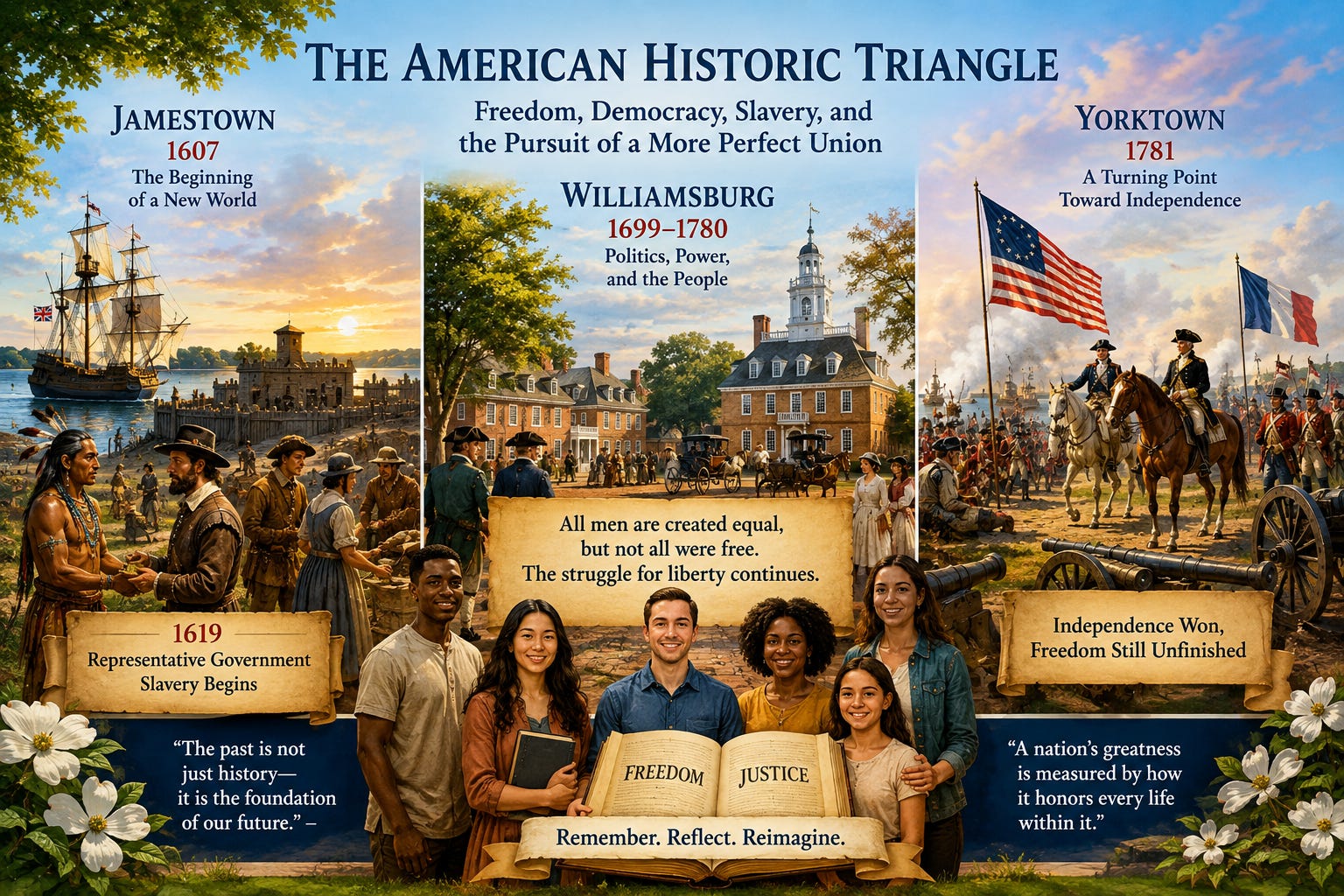
The American Historic Triangle: Understanding the Formation and Challenges of American Civilization
Jamestown, Williamsburg, and Yorktown in Virginia
Abstract
The ‘American Historic Triangle—Jamestown, Williamsburg, and Yorktown—’ provides an important historical landscape for examining the formation and development of American civilization. Jamestown marked the beginning of English colonial settlement in 1607 and became a site of survival, adaptation, and encounters and conflicts with Indigenous peoples. In 1619, the emergence of representative government coincided with the arrival of Africans, marking an important historical turning point connected to the development of racialized slavery that would later become a defining institution of American society. Williamsburg served as the capital of colonial Virginia from 1699 to 1780 and became a center of political debate and self-government, although freedom at the time was restricted by property, gender, race, and other social conditions. At Yorktown, the decisive victory of 1781, achieved with French support, became a major turning point in securing American independence, yet slavery, inequality, and the loss of Indigenous lands and sovereignty remained unresolved.
Taken together, these three places reveal a central paradox in American history: the pursuit of freedom developed alongside systems of exclusion and inequality. Remembering this complex past—where ideals and realities collided—reminds us of our responsibility to build a more just, inclusive, and humane society in the present and for the future.
Keywords: American Historic Triangle; Jamestown; Williamsburg; Yorktown; Freedom; Democracy; Slavery; Indigenous Peoples; American Revolution; Historical Memory; Citizenship
Three Places, One Historical Narrative
The American Historic Triangle, located in Virginia, encompasses Jamestown, Williamsburg, and Yorktown. These three places represent the establishment of English colonial society, the political development of colonial Virginia, and the decisive military victory of the American Revolution. Their significance, however, extends beyond their role as sites of major historical events. Together, they reveal a complex history in which freedom and oppression, democracy and exclusion, economic prosperity and forced labor, and revolutionary ideals and the displacement of Indigenous peoples developed simultaneously.
Jamestown is remembered as the first permanent English settlement in North America, established in 1607. Williamsburg served as the political center of colonial Virginia from 1699 to 1780, while Yorktown became the site of a decisive turning point in the American Revolution when the British army surrendered in 1781. Although these locations represent different historical periods, examining them together helps explain how the United States emerged and which groups were excluded from its promises of liberty and opportunity (National Park Service [NPS], n.d.-a, n.d.-b).
Visiting or studying the Historic Triangle, therefore, should involve more than commemorating historical heroes and military victories. It should also raise questions about the ideals that shaped American civilization and the people to whom those ideals were actually applied. Historical sites preserve the past, but they also function as living classrooms in which contemporary citizens reconsider history and reflect on how the future should be shaped.
Jamestown: Colonial Beginnings and the Uncertainty of Survival
When English settlers arrived at Jamestown in 1607, they sought to establish a new society and an economic foundation in North America. However, the early settlement faced severe challenges, including food shortages, disease, internal conflict, environmental difficulties, and tensions with Indigenous communities. Although Jamestown is often presented as the successful beginning of English colonization, its history was also one of struggle, negotiation, and conflict among different peoples and interests.
Understanding Jamestown requires placing the Indigenous societies of Virginia at the center of the historical narrative. Long before the arrival of English settlers, the region was inhabited by Indigenous communities with established political, economic, and cultural systems. Colonial expansion did not create a new civilization in an empty land; rather, it intruded upon and transformed existing societies, territories, and systems of sovereignty. Describing Jamestown simply as the “beginning” of American history risks marginalizing the long history and continuing presence of Indigenous peoples.
The cultivation of tobacco played a major role in Jamestown’s development. Tobacco expanded the colony’s export economy and increased demand for land and labor. As a result, colonial society gradually developed around an agricultural economy based on landownership and social hierarchy. Economic growth strengthened the colony’s prospects for survival, but it also established conditions that intensified land dispossession, labor exploitation, and social inequality.
The year 1619 is frequently identified as a significant moment in American history because Africans arrived in Virginia during that year, while the colony also convened a representative legislative assembly. Nevertheless, 1619 should not be described simply as the birth of modern democracy or as the complete beginning of American slavery. The representative system of the period included only a limited segment of the colonial population, excluding women, Indigenous peoples, Africans, and many people without property or political standing (NPS, n.d.-c).
The legal status of the Africans who arrived in Virginia in 1619, as well as the subsequent development of slavery, cannot be explained through a single event. During the following decades, the status of Africans in the colony gradually became embedded in a system of hereditary racial slavery. Historians have emphasized that slavery in Virginia developed through the interaction of labor practices, racial ideology, law, Atlantic commerce, and colonial economic structures from the late sixteenth through the mid-seventeenth centuries (Morgan, 2019; Vaughan, 1995).
This history demonstrates that one historical year may carry several distinct meanings. The year 1619 represents an important moment in the development of representative government, but it also reflects political exclusion and the emergence of racial inequality. Historical education should therefore move beyond simple celebration or condemnation and examine how a particular event affected different communities.
Williamsburg: Political Space and the Experiment of Limited Freedom
After a fire damaged the government buildings at Jamestown in 1698, the capital of colonial Virginia was moved to Williamsburg in 1699. Williamsburg remained the political, administrative, and cultural center of the colony until the capital was transferred to Richmond in 1780 (Virginia General Assembly, n.d.; Colonial Williamsburg, n.d.).
Williamsburg brought together colonial legislative institutions, administrative offices, courts, religious institutions, and commercial spaces. Political leaders debated taxation, landownership, trade, public order, religion, and labor. The political environment of Williamsburg contributed to the development of ideas about self-government and colonial rights. It also revealed the growing tensions between imperial authority and colonial demands for political autonomy.
Yet the political freedom represented in Williamsburg was not universal. Colonial representative government was restricted by property ownership, gender, and social status. White male landowners and political elites exercised disproportionate influence over public decision-making, while enslaved Africans, women, Indigenous peoples, and other marginalized groups were largely excluded from political power. Williamsburg’s political institutions therefore demonstrate both the development of representative government and the historical limitations of early democracy.
At this point, it is important to distinguish different meanings of freedom. The freedom demanded by many colonial leaders concerned self-government, property rights, and political representation. It did not necessarily mean equal freedom for every human being. Some individuals demanded liberty for themselves while maintaining systems of forced labor and social subordination for others. This contradiction lies at the heart of the American revolutionary experience.
The historic buildings and restored streets of Williamsburg provide valuable educational opportunities for understanding colonial political culture. However, a reconstructed urban landscape cannot reproduce every aspect of the past. Behind the attractive buildings and ceremonial performances were systems of enslaved labor, gender inequality, Indigenous dispossession, and social hierarchy. Historical restoration becomes more responsible when it explains not only the architecture of the past but also the labor and experiences of the diverse people who built and sustained that society.
Yorktown: Independence and the International Dimension of Revolution
Yorktown played a decisive role in the American Revolution. In 1781, Continental and French forces surrounded the British army commanded by General Charles Cornwallis. Cornwallis surrendered on October 19, 1781. Although the surrender did not immediately end the war, it became a major military and political turning point that made continued British prosecution of the conflict increasingly difficult (NPS, n.d.-d).
The victory at Yorktown was not achieved solely through the efforts of American colonists. French military and naval support was essential in isolating British forces and enabling the allied campaign. This international dimension demonstrates that the American Revolution was not merely a domestic rebellion but also part of a broader Atlantic struggle involving imperial competition and international power politics.
Yorktown is commonly understood as a symbol of freedom and independence. American independence did contribute to the establishment of a new republic and influenced political thought and independence movements in other parts of the world. Nevertheless, a substantial gap remained between revolutionary declarations and the practical expansion of freedom. Slavery continued, territorial expansion threatened Indigenous societies, and women and propertyless people remained excluded from full political participation.
This historical reality encourages a deeper understanding of independence. A nation’s liberation from external imperial control does not automatically make every member of its society free. National independence and individual liberty, political sovereignty and social equality, are related but distinct concepts. Yorktown symbolizes American national independence while also inviting us to ask who benefited from that independence and to what extent.
The Paradox of Freedom and Slavery
One of the most important themes connecting the Historic Triangle is the contradiction between the ideal of freedom and the reality of slavery. During the formation of the United States, concepts such as liberty, rights, representation, and self-government became increasingly influential. At the same time, significant parts of the colonial economy and social order depended on forced labor. In Virginia, the tobacco economy relied heavily on the expansion of land and labor, while racial slavery gradually became a central institution.
Slavery was not merely an economic system that supplied labor. It was a social structure connected to law, property, family relationships, education, religion, violence, and racial hierarchy. Enslaved people were treated as economic property, yet they were also human beings who formed families, developed religious and cultural traditions, and pursued freedom. Excluding their experiences from historical narratives prevents a complete understanding of colonial society.
For this reason, interpretations of Jamestown and Williamsburg should include not only colonial leaders and political thinkers but also agricultural laborers, enslaved Africans, women, artisans, servants, and Indigenous communities. History is not simply a chronology of political leaders and military victories; it is also the record of the experiences of the many groups that constructed and transformed society.
This perspective remains relevant to contemporary discussions of democracy and human rights in the United States. American democracy did not emerge as a fully developed institution. It expanded gradually through a long history of conflict, exclusion, and demands for equal rights. Understanding American democracy therefore requires attention not only to founding documents and political ideals but also to how those ideals were implemented, restricted, and contested in everyday social life.
Indigenous History and Colonial Expansion
The experiences of Indigenous peoples are essential to understanding the history of the Historic Triangle. European arrival created new opportunities for trade and interaction, but it also brought disease, armed conflict, territorial appropriation, political pressure, and competition for resources. Indigenous communities were not simply passive populations who disappeared from history. They responded to changing circumstances through diplomacy, resistance, adaptation, and efforts to preserve their communities.
When colonial history treats Indigenous peoples merely as a background to European settlement, it risks presenting territorial expansion as natural or inevitable. Land and sovereignty did not belong exclusively to colonial settlers. Indigenous communities maintained political systems, cultural relationships, and territorial claims, all of which were directly affected by colonial expansion.
Today, historical parks and museums should continue incorporating Indigenous histories and perspectives more fully. This is not simply a matter of adding more historical figures. It requires reconsidering the causes and consequences of historical events and asking whose perspective is reflected in terms such as “discovery” and “settlement.” The more inclusive historical memory becomes, the more thoughtfully citizens can understand the complexity of national formation.
Historical Memory and the Responsibility of Tourism
The American Historic Triangle is both an important tourist destination and an educational environment. The Colonial Parkway connects Jamestown and Yorktown across approximately 23 miles, linking the region’s historic sites while allowing visitors to experience its natural landscape and cultural heritage (NPS, n.d.-e). The parkway itself also reflects how twentieth-century America preserved, interpreted, and transformed colonial and revolutionary history into a public cultural resource.
Historical tourism can increase public access to the past and contribute to education and regional economies. However, tourism can also make history appear overly beautiful, simplified, or disconnected from human suffering. Reconstructed buildings, historical costumes, and interpretive performances may help visitors understand earlier periods, but they can also encourage the consumption of historical trauma as entertainment.
Historical sites should therefore present a balance between accessible storytelling and difficult historical realities. Visitors should learn not only about colonial architecture and revolutionary military strategy but also about forced labor, Indigenous dispossession, social hierarchy, and political exclusion. This balance is central to the ethical responsibility of historical education.
Historical memory is not fixed. The monuments societies build, the individuals they commemorate, and the events they include in educational narratives are shaped by contemporary cultural and political debates. Historical parks should therefore function not merely as institutions that preserve the past but also as public spaces that encourage dialogue about how the past is remembered and interpreted.
Historical Lessons for the Present
The first major lesson of the Historic Triangle is that democracy is not a completed achievement but an ongoing practice. The representative assembly of 1619 and the political ideals associated with American independence contributed to the development of democratic institutions, but political rights were not initially extended equally to all people. The history of democracy includes not only the creation of institutions but also the struggles of excluded communities to expand participation and secure recognition.
A second lesson is the need to distinguish national freedom from human freedom. American independence represented liberation from imperial rule, but slavery and the forced expansion of colonial territory continued. Contemporary societies must likewise recognize that national development and economic prosperity do not automatically guarantee liberty and dignity for every member of the population. National achievements should be examined in relation to individual rights and the protection of marginalized communities.
A third lesson is that history becomes more accurate when multiple perspectives are considered. If Jamestown is viewed only through the experiences of settlers, the narrative emphasizes exploration, survival, and expansion. Including Indigenous and African American experiences reveals additional dimensions involving territorial dispossession, labor systems, cultural conflict, and social inequality. A balanced historical interpretation does not mean treating every claim as equally supported; it means ensuring that significant evidence and historical experiences are not omitted.
A fourth lesson is that civilization should be evaluated through human values and institutions rather than buildings and military victories alone. The architecture of Williamsburg, the battlefield at Yorktown, and the archaeological remains of Jamestown represent important cultural heritage. Yet the quality of a civilization cannot be measured solely by its buildings, economic achievements, or military success. A more fundamental measure is how a society protects human life, dignity, liberty, and equality before the law.
The Way We Remember the Past Shapes the Future
Jamestown, Williamsburg, and Yorktown represent different chapters in American history, but together they pose a common question: What kind of society should be built, and for whom should its freedom and prosperity exist?
Jamestown reveals the challenges of colonial settlement, economic expansion, and conflict with Indigenous societies. Williamsburg represents the development of self-government and political debate while also exposing restricted citizenship and hierarchical power structures. Yorktown symbolizes independence and the emergence of a republic, yet it reminds us that national independence did not immediately produce freedom for everyone.
Viewed together, the Historic Triangle cannot be reduced either to a heroic story of national achievement or to a simple account of historical failure. It represents a civilization shaped by the continuing tension between ideals and realities, freedom and coercion, development and exclusion, and memory and forgetting. Historical maturity does not require denying the achievements of the past; rather, it requires confronting their limitations and the suffering that accompanied them.
This lesson remains relevant in an age when artificial intelligence and digital technologies are transforming social institutions. New technologies may improve human life, but they do not automatically guarantee justice or freedom. Technological and civilizational progress must be evaluated by asking who receives opportunities, who is excluded, and who is responsible for the consequences.
Visiting the American Historic Triangle is therefore more than a journey through historic buildings and battlefields. It is an opportunity to reconsider the meaning of freedom, reflect on the limitations of democracy, and develop a more inclusive understanding of historical memory. Only societies that remember the past honestly can understand the present responsibly and imagine a more humane future. +++
References
Colonial Williamsburg. (n.d.). About Colonial Williamsburg. https://www.colonialwilliamsburg.org/about/
Morgan, P. D. (2019). Virginia slavery in Atlantic context, 1550 to 1650. In African American life in the early Chesapeake: Essays on slavery and society. University of North Carolina Press. https://doi.org/10.5149/northcarolina/9781469651798.003.0005
National Park Service. (n.d.-a). Colonial National Historical Park. U.S. Department of the Interior. https://www.nps.gov/colo/index.htm
National Park Service. (n.d.-b). Historic Jamestowne. U.S. Department of the Interior. https://www.nps.gov/jame/index.htm
National Park Service. (n.d.-c). The first legislative assembly at Jamestown. U.S. Department of the Interior. https://www.nps.gov/jame/learn/historyculture/the-first-legislative-assembly.htm
National Park Service. (n.d.-d). History of the siege. U.S. Department of the Interior. https://home.nps.gov/york/learn/historyculture/history-of-the-siege.htm
National Park Service. (2025, April 21). Colonial Parkway. U.S. Department of the Interior. https://home.nps.gov/colo/parkway.htm
Virginia General Assembly. (n.d.). Three capital cities: Jamestown, Williamsburg, and Richmond. https://virginiageneralassembly.gov/
Vaughan, A. C. (1995). The origins debate: Slavery and racism in seventeenth-century Virginia. [Reference details should be completed using the specific edition consulted.]
Wood, G. S. (1992). The radicalism of the American Revolution. Vintage Books.
미국 역사 삼각지대에서 읽는 미국 문명의 형성과 과제
버지니아의 제임스타운·윌리엄스버그·요크타운
초록
‘미국 역사 삼각지대—제임스타운, 윌리엄스버그, 요크타운—’는 미국 문명의 형성과 발전을 살펴볼 수 있는 중요한 역사적 공간이다. 제임스타운은 1607년 영국의 식민지 개척이 시작된 곳으로, 생존과 적응, 그리고 원주민들과의 만남과 충돌을 경험했다. 1619년에는 대표제 정부의 출현과 함께 아프리카인들의 도착이 이루어졌으며, 이는 이후 미국 사회를 규정하게 될 인종화된 노예제의 발전과 연결되는 중요한 역사적 전환점이 되었다. 윌리엄스버그는 1699년부터 1780년까지 버지니아 식민지의 수도로서 정치적 논쟁과 자치정부의 중심지가 되었지만, 당시의 자유는 재산, 성별, 인종 등에 의해 제한되었다. 요크타운에서는 프랑스와의 동맹을 바탕으로 1781년 결정적인 승리를 거두면서 미국의 독립을 확보하는 데 중요한 전환점이 마련되었지만, 노예제와 불평등, 원주민의 토지와 주권 상실이라는 문제는 여전히 해결되지 않은 채 남아 있었다.
이 세 장소를 함께 살펴보면 미국 역사의 핵심에 존재하는 역설이 드러난다. 즉, 자유를 추구하는 과정이 동시에 배제와 불평등의 제도와 공존했다는 사실이다. 이상과 현실이 충돌했던 이러한 복합적인 과거를 기억하는 것은 오늘날과 미래에 더욱 정의롭고 포용적이며 인간적인 사회를 건설해야 할 우리의 책임을 일깨워 준다.
주제어: 미국 역사 삼각지대; 제임스타운; 윌리엄스버그; 요크타운; 자유; 민주주의; 노예제; 원주민; 미국 독립혁명; 역사적 기억; 시민권
세 도시가 들려주는 하나의 역사
미국 버지니아주에 위치한 ‘아메리칸 히스토릭 트라이앵글(American Historic Triangle)’은 제임스타운(Jamestown), 윌리엄스버그(Williamsburg), 요크타운(Yorktown)을 연결하는 역사·문화 공간이다. 이 세 장소는 각각 영국 식민지의 성립, 식민지 사회의 정치적 발전, 미국 독립전쟁의 결정적 승리를 상징한다. 그러나 이 지역의 의미는 단순히 미국 역사의 주요 사건들이 발생한 장소라는 사실에 머물지 않는다. 이곳은 자유와 억압, 민주주의와 배제, 경제적 번영과 강제노동, 독립의 이상과 원주민 사회의 붕괴가 동시에 전개된 복합적인 문명의 현장이다.
제임스타운은 1607년 영국인이 세운 북아메리카 최초의 영구적 영국 식민지로 기억된다. 윌리엄스버그는 1699년부터 1780년까지 버지니아 식민지의 정치적 중심지로 기능했으며, 요크타운은 1781년 영국군 콘월리스가 이끄는 군대의 항복으로 미국 독립전쟁의 군사적 전환점을 제공했다. 이 세 장소는 서로 다른 시대와 사건을 대표하지만, 함께 살펴볼 때 미국이라는 국가가 어떻게 형성되었는지, 그리고 그 형성 과정에서 어떤 사람들이 배제되었는지를 더욱 선명하게 보여준다(National Park Service NPSNPS, n.d.-a, n.d.-b).
따라서 히스토릭 트라이앵글을 방문하거나 연구하는 일은 과거의 영웅과 승리를 기념하는 데 그쳐서는 안 된다. 그것은 미국 문명이 어떤 이상을 내세웠으며, 그 이상을 실제 사회에서 누구에게 적용했는지를 질문하는 작업이어야 한다. 역사적 장소는 과거를 보존하지만, 동시에 현재의 시민들이 과거를 어떻게 해석하고 미래를 어떻게 설계할 것인지 묻는 살아 있는 교실이기도 하다.
제임스타운: 식민지의 시작과 생존의 불안정성
1607년 제임스타운에 도착한 영국 정착민들은 새로운 사회와 경제적 기반을 건설하려 했다. 그러나 초기 정착지는 식량 부족, 질병, 내부 갈등, 열악한 환경, 그리고 원주민 사회와의 긴장 속에서 심각한 생존 위기를 겪었다. 제임스타운의 역사는 흔히 영국 식민지의 성공적인 출발로 설명되지만, 실제로는 생존을 위한 투쟁과 다양한 집단 사이의 복잡한 협상 및 충돌이 함께 존재했던 과정이었다.
제임스타운의 성립을 이해하기 위해서는 이미 그 지역에 살고 있던 버지니아 원주민 사회를 중심에 놓아야 한다. 영국 정착민들이 도착하기 전부터 이 지역에는 정치적·경제적·문화적 질서를 갖춘 원주민 공동체가 존재했다. 식민지 확장은 빈 공간에 새로운 문명을 세운 일이 아니라, 기존 사회의 토지와 자원, 주권을 침범하고 재편한 과정이었다. 따라서 제임스타운을 미국 역사의 ‘시작’이라고만 부르는 것은 원주민의 역사와 존재를 주변화할 위험이 있다.
제임스타운의 발전에는 담배 재배가 중요한 역할을 했다. 담배는 식민지의 수출 경제를 확장하고 토지와 노동력에 대한 수요를 증가시켰다. 이 과정에서 식민지 사회는 토지 소유와 계층적 질서에 기반한 농업 경제로 점차 재편되었다. 경제적 성공은 식민지의 생존 가능성을 높였지만, 동시에 토지 수탈, 노동 착취, 사회적 불평등을 심화시키는 기반이 되었다.
특히 1619년은 미국 역사에서 여러 의미가 겹치는 해로 자주 언급된다. 그해 버지니아에 아프리카인들이 도착했고, 동시에 영국령 버지니아에서 대표적 입법기관인 총회(General Assembly)가 소집되었다. 그러나 1619년을 곧바로 현대적 민주주의의 탄생이나 미국 노예제의 완성된 시작으로 단정해서는 안 된다. 당시의 대표제는 제한된 식민지 주민을 대상으로 했으며, 여성, 원주민, 아프리카계 사람들, 재산이 없는 사람들 등 많은 집단이 정치적 권리에서 배제되었다(NPS, n.d.-c).
또한 1619년 버지니아에 도착한 아프리카인들의 법적 지위와 이후 노예제의 제도화 과정은 단순한 한 사건으로 설명할 수 없다. 초기 식민지 사회에서 아프리카인의 지위는 시간이 흐르면서 인종적 세습 노예제의 형태로 점차 굳어졌다. 역사학자들은 16세기 말부터 17세기 중반까지 대서양 세계의 노동, 인종, 법률, 식민지 경제가 상호작용하면서 버지니아의 노예제도가 형성되었다고 설명한다(Morgan, 2019; Vaughan, 1995).
이러한 사실은 역사적 연대 하나가 서로 다른 역사적 의미를 동시에 가질 수 있음을 보여준다. 1619년은 대표제의 발전을 보여주는 시점이면서도, 정치적 참여의 제한과 인종적 불평등이 심화되기 시작한 시기이기도 했다. 그러므로 역사교육은 특정 사건을 찬양하거나 비난하는 단순한 방식보다, 그 사건이 서로 다른 집단에 어떤 결과를 가져왔는지 분석하는 방향으로 나아가야 한다.
윌리엄스버그: 정치적 공간과 제한된 자유의 실험
1698년 제임스타운의 정부 청사가 화재로 피해를 입은 이후, 버지니아 식민지의 수도는 1699년 윌리엄스버그로 이전되었다. 윌리엄스버그는 1780년 수도가 리치먼드로 옮겨질 때까지 약 80년 동안 버지니아의 정치·행정·문화적 중심지로 기능했다(Virginia General Assembly, n.d.; Colonial Williamsburg, n.d.).
윌리엄스버그는 식민지 의회, 행정기관, 법원, 종교기관, 상업 공간이 집중된 도시였다. 이곳에서 식민지 지도자들은 세금, 토지, 무역, 치안, 종교, 노동 문제를 논의했다. 이후 미국 독립의 사상적 기반이 형성되는 과정에서도 이러한 정치적 공간은 중요한 역할을 했다. 정치적 논쟁과 법률적 실천은 영국 제국의 통치와 식민지 주민의 자치 요구 사이의 긴장을 드러냈다.
그러나 윌리엄스버그의 정치적 자유는 보편적인 자유가 아니었다. 식민지 시대의 대표제는 일정한 재산과 성별, 사회적 지위에 따라 참여가 제한되었다. 백인 남성 지주와 정치 엘리트들이 공적 의사결정에서 큰 영향력을 행사했으며, 노예로 살아가던 아프리카계 사람들과 여성, 원주민은 정치적 권리의 주변부에 놓여 있었다. 따라서 윌리엄스버그의 의회정치는 민주주의의 발전을 보여주는 동시에, 민주주의가 역사적으로 얼마나 제한적인 형태로 실현되었는지를 보여준다.
이 지점에서 ‘자유’라는 개념을 구분할 필요가 있다. 식민지 주민들이 영국 의회의 과세와 통제에 반대하며 주장한 자유는 주로 식민지의 자치권과 재산권, 정치적 대표권에 관한 것이었다. 그러나 그 자유가 모든 인간의 평등한 자유를 의미한 것은 아니었다. 일부 사람들은 자유를 요구하면서도 다른 사람들의 강제노동과 사회적 종속을 유지했다. 미국 혁명의 역사적 모순은 바로 이 지점에서 발생한다.
윌리엄스버그의 역사적 건축물과 복원된 거리들은 과거의 정치문화를 이해하는 데 유용한 교육 환경을 제공한다. 하지만 복원된 도시 풍경은 그 자체로 과거의 모든 현실을 재현하지 않는다. 관광객이 보는 아름다운 건물과 의례적 장면 뒤에는 노예 노동, 성별 불평등, 원주민의 토지 상실, 계층적 사회구조가 존재했다. 따라서 역사적 복원은 건축물의 외형뿐 아니라, 그 공간을 만들고 유지했던 다양한 사람들의 노동과 경험까지 함께 설명할 때 더욱 책임 있는 교육이 된다.
요크타운: 독립의 승리와 국제적 차원
요크타운은 1781년 미국 독립전쟁에서 결정적인 역할을 했다. 조지 워싱턴이 이끄는 대륙군과 프랑스군은 영국군을 포위했고, 영국군 지휘관 콘월리스는 1781년 10월 19일 항복했다. 이 사건은 전쟁 전체가 즉시 끝났다는 의미는 아니었지만, 영국이 전쟁을 계속 수행하기 어렵게 만드는 중요한 군사적·정치적 전환점이 되었다(NPS, n.d.-d).
요크타운의 승리는 미국 식민지 주민들만의 노력으로 이루어진 사건이 아니었다. 프랑스의 군사적·해군적 지원은 영국군을 고립시키고 연합군의 작전을 가능하게 하는 데 중요한 역할을 했다. 이 점은 미국 독립전쟁을 단순한 국내적 반란이 아니라 대서양 세계의 국제정치와 제국 경쟁 속에서 발생한 사건으로 이해하게 한다.
요크타운은 흔히 자유와 독립의 승리를 상징한다. 실제로 미국 독립은 새로운 공화국의 형성에 중요한 계기를 제공했으며, 이후 세계 여러 지역의 정치사상과 독립운동에 영향을 주었다. 그러나 독립의 선언과 실질적인 자유의 확대 사이에는 큰 간격이 존재했다. 독립 이후에도 노예제는 유지되었고, 원주민 사회에 대한 영토 확장은 계속되었으며, 여성과 재산이 없는 사람들의 정치적 권리는 제한되었다.
이러한 역사적 사실은 독립이라는 개념을 더욱 깊이 생각하게 한다. 한 국가가 외부 제국의 지배에서 벗어났다고 해서 그 사회의 모든 구성원이 즉시 자유로워지는 것은 아니다. 국가적 독립과 개인의 자유, 정치적 주권과 사회적 평등은 서로 관련되어 있지만 동일한 개념은 아니다. 요크타운은 미국의 국가적 독립을 상징하는 동시에, 독립의 혜택이 누구에게 얼마나 분배되었는지 질문하게 만드는 장소다.
자유와 노예제의 역설
아메리칸 히스토릭 트라이앵글을 관통하는 가장 중요한 주제 중 하나는 자유의 이상과 노예제의 현실 사이의 모순이다. 미국의 건국 과정에서 자유, 권리, 대표제, 자치라는 언어가 발전했지만, 동시에 경제와 사회의 상당 부분은 강제노동에 의존했다. 특히 버지니아의 담배 경제는 토지와 노동력의 확대를 요구했고, 인종적 노예제는 그 경제 질서의 핵심 요소로 자리 잡았다.
노예제는 단지 노동력을 제공하는 경제제도가 아니었다. 그것은 법률, 재산권, 가족관계, 교육, 종교, 폭력, 인종적 위계질서와 연결된 사회체계였다. 노예로 살아간 사람들은 경제적 생산의 도구로 취급되었지만, 동시에 가족을 구성하고 신앙과 문화를 발전시키며 자유를 추구한 인간이었다. 이들의 경험을 역사 서술에서 제외하면 식민지 사회의 실질적인 구조를 이해할 수 없다.
따라서 제임스타운과 윌리엄스버그를 설명할 때는 식민지 지도자와 정치사상가뿐 아니라, 농장 노동자, 노예화된 아프리카인, 여성, 장인, 하인, 원주민 공동체의 관점도 함께 고려해야 한다. 역사는 승리한 정치 지도자들의 연대기만이 아니라, 사회를 실제로 구성하고 변화시킨 모든 집단의 경험이기 때문이다.
이러한 관점은 오늘날 미국 사회가 민주주의와 인권을 이해하는 방식에도 영향을 준다. 미국의 민주주의는 처음부터 완성된 제도로 등장한 것이 아니라, 배제와 갈등을 포함한 긴 역사적 과정을 통해 확대되었다. 그러므로 미국의 민주주의를 평가할 때는 건국 문서의 이상뿐 아니라, 그 이상이 실제 제도와 사회적 관계 속에서 어떻게 적용되고 제한되었는지를 함께 살펴보아야 한다.
원주민의 역사와 식민지 확장
히스토릭 트라이앵글의 역사에서 원주민의 경험은 특별히 중요하다. 유럽인의 도착은 원주민 사회에 새로운 교역 기회를 제공하기도 했지만, 질병, 무력 충돌, 토지 점유, 정치적 압력, 자원 경쟁을 초래했다. 식민지의 성장 과정에서 원주민들은 단순히 사라진 사람들이 아니라, 변화하는 환경 속에서 외교와 저항, 적응과 생존을 시도한 역사적 주체였다.
식민지 역사관이 원주민을 배경으로만 다룰 경우, 미국의 영토 확장을 자연스럽거나 불가피한 과정처럼 묘사할 위험이 있다. 그러나 토지의 소유와 주권은 식민지 주민들에게만 속한 것이 아니었다. 원주민 공동체들은 자신들의 정치적 질서와 문화적 관계망을 유지하고 있었으며, 식민지 확장은 그 질서에 직접적인 영향을 주었다.
오늘날 역사공원과 박물관은 원주민의 역사와 목소리를 보다 적극적으로 포함할 필요가 있다. 이는 단순히 과거의 등장인물을 추가하는 문제가 아니다. 역사적 사건의 원인과 결과를 재구성하고, ‘발견’과 ‘개척’이라는 표현이 누구의 관점에서 만들어졌는지를 검토하는 작업이다. 역사적 기억이 더욱 포괄적이 될수록, 시민들은 국가의 형성을 더욱 복합적이고 성숙하게 이해할 수 있다.
역사적 기억과 관광의 책임
아메리칸 히스토릭 트라이앵글은 중요한 관광지이자 교육 공간이다. 제임스타운과 요크타운을 연결하는 콜로니얼 파크웨이(Colonial Parkway)는 약 23마일에 걸쳐 세 역사적 장소를 연결하며, 자연경관과 역사적 유적을 함께 경험하게 한다(NPS, n.d.-e). 이 도로 자체도 20세기 미국이 식민지 시대와 독립전쟁의 기억을 어떻게 보존하고 관광 자원으로 재구성했는지를 보여주는 문화적 산물이다.
역사관광은 과거에 대한 접근성을 높이고 지역경제와 교육에 기여할 수 있다. 그러나 관광은 역사적 현실을 지나치게 아름답고 단순한 이야기로 만들 위험도 지닌다. 복원된 건물과 의상을 활용한 체험 프로그램은 방문객의 이해를 도울 수 있지만, 과거의 갈등과 고통을 오락적 장면으로만 소비하게 만들 가능성도 있다.
따라서 역사공간은 ‘재미있는 역사’와 ‘불편하지만 필요한 역사’를 균형 있게 제시해야 한다. 방문객은 식민지 건축물의 아름다움과 독립전쟁의 전략뿐 아니라, 강제노동과 원주민의 토지 상실, 계층적 권력구조, 정치적 배제의 문제도 함께 접해야 한다. 이것이 역사교육의 윤리적 책임이다.
역사적 기억은 고정된 것이 아니다. 사회가 어떤 기념물을 세우고, 어떤 인물을 기념하며, 어떤 사건을 교과서에 포함하는지는 현재의 가치관과 정치적·문화적 논쟁에 영향을 받는다. 따라서 역사공원은 과거를 단순히 보존하는 기관이 아니라, 과거에 대한 사회적 대화를 촉진하는 공공기관으로 기능해야 한다.
오늘날을 위한 역사적 교훈
히스토릭 트라이앵글이 오늘날 우리에게 제공하는 첫 번째 교훈은 민주주의는 완성된 상태가 아니라 지속적인 실천이라는 사실이다. 1619년의 대표제와 미국 독립의 정치적 이상은 민주주의 발전의 중요한 요소였지만, 그 권리는 처음부터 모든 사람에게 동일하게 적용되지 않았다. 민주주의의 역사는 제도적 창설뿐 아니라, 배제된 사람들이 권리와 존엄을 요구하며 참여의 범위를 넓혀 온 역사이기도 하다.
두 번째 교훈은 국가적 자유와 인간의 자유를 구별해야 한다는 점이다. 미국의 독립은 제국으로부터의 정치적 독립을 의미했지만, 사회 내부의 노예제와 원주민에 대한 강제적 확장은 계속되었다. 현대사회에서도 국가의 발전이나 경제적 번영이 모든 구성원의 자유와 존엄을 자동으로 보장하지는 않는다. 국가의 성취는 개인과 소수집단의 권리라는 관점에서 지속적으로 검토되어야 한다.
세 번째 교훈은 역사는 여러 관점이 만날 때 더욱 정확해진다는 사실이다. 제임스타운을 정착민의 관점에서만 보면 개척과 생존의 이야기가 중심이 된다. 반면 원주민과 아프리카계 사람들의 경험을 포함하면 식민지 확장과 노동체계, 문화적 충돌, 사회적 불평등이라는 측면이 드러난다. 균형 잡힌 역사 이해는 모든 관점을 동일하게 취급한다는 뜻이 아니라, 중요한 증거와 역사적 경험을 누락하지 않는다는 뜻이다.
네 번째 교훈은 문명은 건축물보다 인간의 가치와 제도 속에서 평가되어야 한다는 점이다. 윌리엄스버그의 아름다운 거리와 요크타운의 군사적 유적, 제임스타운의 발굴 현장은 미국의 역사적 유산을 보여준다. 그러나 문명의 진정한 수준은 건축물의 규모나 전쟁의 승리만으로 판단할 수 없다. 사회가 인간의 생명과 존엄, 자유, 법적 평등을 어떻게 보호했는지가 더욱 근본적인 기준이 된다.
과거를 기억하는 방식이 미래를 만든다
제임스타운, 윌리엄스버그, 요크타운은 미국 역사의 서로 다른 장면을 보여주지만, 세 장소는 하나의 공통된 질문으로 연결된다. 어떤 사회를 건설할 것인가, 그리고 그 사회의 자유와 번영은 누구를 위해 존재하는가?
제임스타운은 식민지 정착과 생존, 경제적 확장, 원주민 사회와의 충돌을 보여준다. 윌리엄스버그는 자치와 대표제, 정치적 토론의 발전을 보여주는 동시에 제한된 시민권과 계층적 권력구조를 드러낸다. 요크타운은 독립과 공화국의 탄생을 상징하지만, 국가적 독립이 모든 사람의 자유를 의미하지는 않았다는 사실을 상기시킨다.
이 세 장소를 함께 읽을 때 미국의 역사는 영웅적 성공담이나 실패의 기록 어느 한쪽으로 환원되지 않는다. 그것은 이상과 현실, 자유와 강제, 발전과 배제, 기억과 망각이 끊임없이 충돌해 온 문명의 과정이다. 역사적 성숙은 과거의 성취를 부정하는 데 있지 않으며, 그 성취가 지닌 한계와 희생을 정직하게 바라보는 데 있다.
오늘날 인공지능과 디지털 기술이 사회의 구조를 재편하는 시대에도 이 교훈은 유효하다. 새로운 기술과 제도는 인간의 삶을 개선할 수 있지만, 그것이 자동으로 공정성과 자유를 보장하지는 않는다. 기술과 문명의 발전은 누구에게 기회를 제공하고, 누구를 배제하며, 누가 그 결과에 책임을 지는지에 따라 평가되어야 한다.
따라서 아메리칸 히스토릭 트라이앵글을 방문하는 일은 과거의 건물과 전쟁터를 보는 여행을 넘어선다. 그것은 자유의 의미를 다시 묻고, 민주주의의 한계를 성찰하며, 역사적 기억을 더욱 포괄적으로 재구성하는 시민적 학습이다. 과거를 정확하게 기억하는 사회만이 현재의 문제를 책임 있게 이해하고, 더 인간적인 미래를 설계할 수 있다. +++
참고문헌
Colonial Williamsburg. (n.d.). About Colonial Williamsburg. https://www.colonialwilliamsburg.org/about/
Morgan, P. D. (2019). Virginia slavery in Atlantic context, 1550 to 1650. In P. D. Morgan, African American life in the early Chesapeake: Essays on slavery and society (relevant chapter). University of North Carolina Press. https://doi.org/10.5149/northcarolina/9781469651798.003.0005
National Park Service. (n.d.-a). Colonial National Historical Park. U.S. Department of the Interior. https://www.nps.gov/colo/index.htm
National Park Service. (n.d.-b). Historic Jamestowne. U.S. Department of the Interior. https://www.nps.gov/jame/index.htm
National Park Service. (n.d.-c). The first legislative assembly at Jamestown. U.S. Department of the Interior. https://www.nps.gov/jame/learn/historyculture/the-first-legislative-assembly.htm
National Park Service. (n.d.-d). History of the siege. U.S. Department of the Interior. https://home.nps.gov/york/learn/historyculture/history-of-the-siege.htm
National Park Service. (2025, April 21). Colonial Parkway. U.S. Department of the Interior. https://home.nps.gov/colo/parkway.htm
Vaughan, A. C. (1995). The origins debate: Slavery and racism in seventeenth-century Virginia. In relevant historical scholarship on early Africans in Virginia.
Virginia General Assembly. (n.d.). Three capital cities: Jamestown, Williamsburg, and Richmond. https://virginiageneralassembly.gov/
Wood, G. S. (1992). The radicalism of the American Revolution. Vintage Books.
2026년 9월 23일
{솔티}

Prof. Dr. Young Choi (Editor in Chief) — Regent University
Young B. Choi is a Professor in the Department of Engineering & Computer Science at Regent University. He published 38 books with ‘Selected Readings in Cybersecurity’ (2018) (over 800 copies archived globally at university/college libraries around the world) and ‘Cybersecurity Applications and Artificial Intelligence’ (2023) available in seven major world languages. He proposed the world’s first global and universal telecommunications “Service Order Handling (SOH)” Model (T-SOH Model) (1995) with Dr. Adrian Tang. With this innovative research work, he received the IEEE NOMS ’96 Best Paper Award and became the first recipient of the Outstanding Contribution Award of the TeleManagement Forum in 1998. His research areas include Natural Language Processing-focused AI, AI-applied cybersecurity, network and telecom service management, and Korean studies on Gani Choi Rip’s Jeonggwan (靜觀: Quiet Contemplation) philosophy and Shilhak ( 實學: Practical Learning).
© K-GSP (K-Global Scholars and Professionals) Forum. All rights reserved. 2026.
Suggested Citation:
Choi, Y. B. (2026, September 23). The American Historic Triangle: Understanding the Formation and Challenges of American Civilization: Jamestown, Williamsburg, and Yorktown in Virginia. K-GSP.