

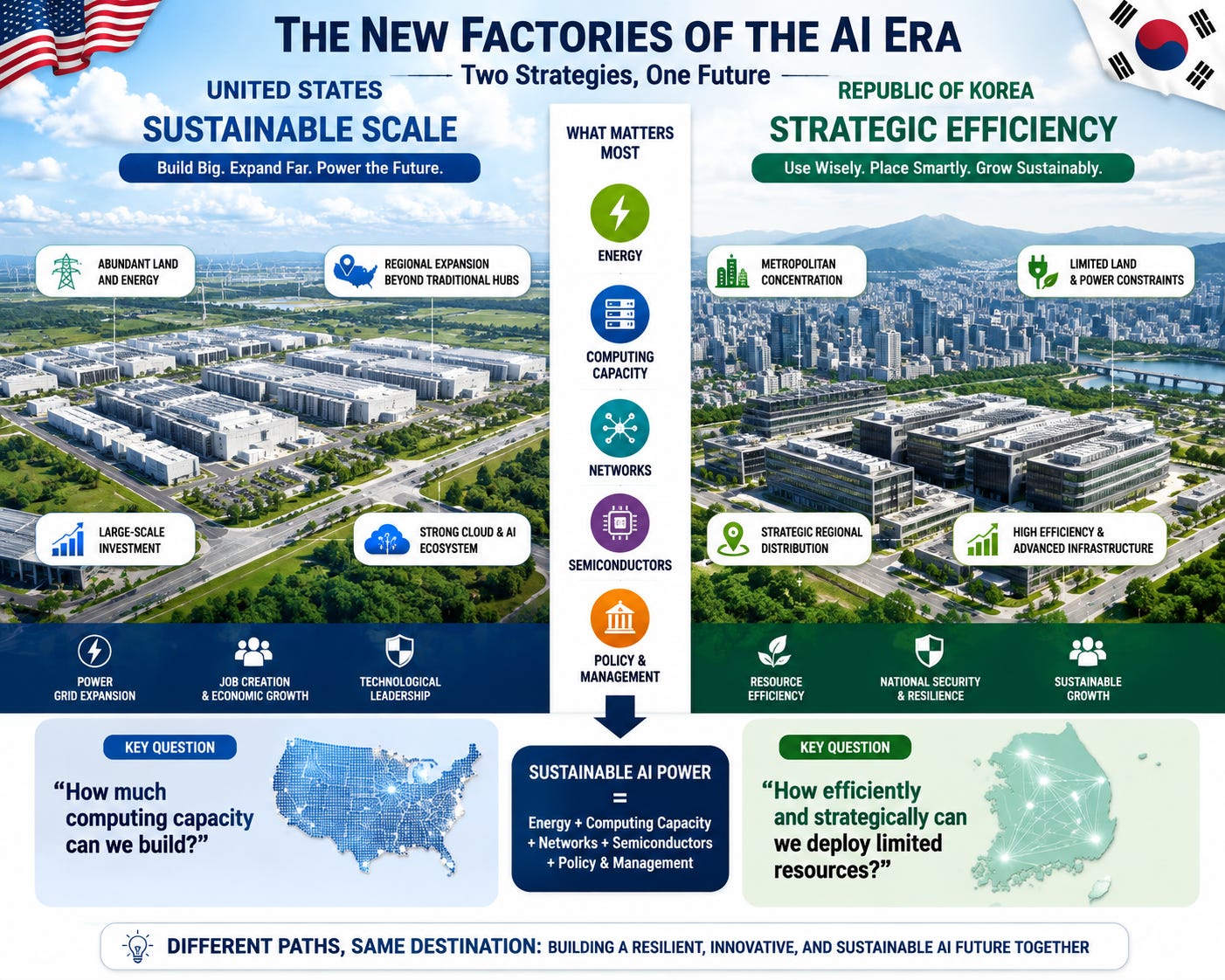
The New Factories of the AI Era - Data Center
How Data Centers Are Reshaping the Future of the United States and Republic of Korea
Executive Summary
Data centers are emerging as the new factories of the AI era. The United States and Republic of Korea are pursuing different but complementary strategies: the United States emphasizes Sustainable Scale, while South Korea emphasizes Strategic Efficiency. The United States is expanding rapidly into regions where electricity and land are available, whereas Korea is confronting the challenges of metropolitan concentration, limited land, and power availability. The central lesson is that data-center competitiveness is no longer determined by computing capacity alone; it depends on the integration of energy, computing capacity, networks, semiconductors, and governance as a Sustainable AI Power.
In the AI Era, Factories Are Changing
Throughout human history, every major transformation of civilization has required new forms of productive and physical infrastructure. The Industrial Revolution brought factories and railroads. The age of electricity was built upon power plants and transmission networks. The automobile transformed cities and industries through highways, while the Internet created a new economic and social infrastructure through telecommunications networks and servers. Now, as the age of artificial intelligence unfolds, another form of infrastructure is moving to the center of history: the data center.
A data center is no longer simply a building filled with computers and servers. It has become one of the fundamental production facilities of the AI economy. Data centers train artificial intelligence models, provide cloud computing services, operate corporate information systems, and support digital services ranging from finance and healthcare to transportation, government administration, and e-commerce. With the rapid expansion of generative AI and AI agents, data centers are evolving from places that merely store data into facilities that continuously produce enormous amounts of computational capacity.
This transformation is taking different forms in the United States and Korea. The United States is building data centers on an extraordinary scale, supported by abundant land, capital, energy resources, and a powerful ecosystem of cloud and AI companies. Korea, by contrast, must build within a much more constrained geography, where population, industry, telecommunications infrastructure, and economic activity are heavily concentrated around the Seoul metropolitan area. The two countries therefore face different structural challenges. The issue is not simply that the United States is “large” and Korea is “small.” More fundamentally, the United States is primarily addressing a problem of scale, while Korea is addressing a problem of spatial and resource efficiency.
The central question for the United States is increasingly, “How much computing capacity can we build?” For Korea, it is becoming, “How efficiently and strategically can we deploy limited land, electricity, and infrastructure?” This distinction provides an important starting point for understanding the two countries’ data-center strategies.
The United States: AI Leadership Is Becoming a Question of Power and Data Centers
The scale of data center construction in the United States has reached historic levels. According to CBRE’s first-half 2026 report, the eight primary North American data-center markets had 10,903 MW, or approximately 10.9 GW, of operational supply, representing a 33.7% increase from the previous year. At the same time, 7,481.1 MW, or approximately 7.48 GW, was under construction, an increase of 24.8% during the first half of the year and an all-time high. Despite this enormous construction pipeline, the vacancy rate had fallen to only 1.4%. Moreover, 80.4% of the capacity under construction had already been preleased, demonstrating the extraordinary strength of demand (CBRE, 2026).
These figures represent much more than a booming real estate market. They illustrate the extraordinary growth of computing demand generated by artificial intelligence. According to JLL, North American data center absorption reached 25 GW in the first half of 2026—twice the level of the same period in 2025 and approximately five times the level recorded in the first half of 2024. JLL also estimates that 66 GW of data-center capacity was under construction across North America, with approximately 95% already precommitted (JLL, 2026).
These two figures should not, however, be interpreted as contradictory. CBRE’s 7.48 GW refers specifically to capacity under construction in eight primary North American markets, whereas JLL’s 66 GW covers a substantially broader North American market. The difference therefore reflects different market scopes rather than inconsistent measurements.
Northern Virginia remains one of the world’s most important data center clusters. As of the first half of 2026, it had approximately 4.50 GW of operational inventory and another 2.42 GW under construction. Atlanta, meanwhile, had approximately 2.88 GW under construction, reflecting the rapid expansion of new markets (CBRE, 2026).
JLL reports that Texas has approximately 26 GW of existing and under-construction capacity, while Virginia has approximately 13 GW. Even more significant is the geographical shift taking place within the industry. Data center development is increasingly moving beyond traditional hubs toward regions where electricity and land are more readily available. According to JLL, frontier markets—including Texas, Ohio, Louisiana, and the Carolinas—account for approximately 77% of all capacity under development (JLL, 2026).
The American data center boom, therefore, is not simply a story of building larger facilities. It is reshaping the geography of American industry by moving computing infrastructure toward places where power and land can be secured.
Korea: Metropolitan Concentration and a New Spatial Strategy
Korea is also experiencing rapid growth in data center construction as demand for AI and cloud computing expands. Yet it cannot simply replicate the American model. Korea has a much smaller landmass, while population, industry, telecommunications networks, and major corporate customers remain highly concentrated in the Seoul metropolitan region.
According to Cushman & Wakefield’s first half 2026 analysis, Greater Seoul had approximately 663 MW of operational data center capacity, an increase of about 10% from the previous year. At the same time, the colocation vacancy rate declined dramatically from 6.9% in the second half of 2025 to only 1.1% in the first half of 2026. This indicates that demand for data center capacity in the Seoul region is rapidly catching up with available supply (Cushman & Wakefield, 2026).
Yet Korea’s central challenge is not simply how many more data centers it can build. The more important question is where those facilities should be located.
According to data from the Korea Datacenter Council’s Korea Datacenter Market 2025, cited in a Korea Exchange disclosure, 34 data center projects were already in concrete stages of development, including actual construction, building approval, or groundbreaking. Of these, 23 were located in Seoul, Incheon, or Gyeonggi Province, meaning that approximately 67.6% were concentrated in the Seoul metropolitan area. These 34 projects were expected to be completed by 2028. At the planning stage, however, another 36 data center projects were identified, with a substantial shift toward areas outside Gyeonggi Province and the greater metropolitan region (Korea Datacenter Council, 2025; Korea Exchange, 2026).
This pattern reveals an important transition in Korea’s data center industry. Historically, the Seoul metropolitan area has been attractive because of its concentration of customers, telecommunications infrastructure, business services, and skilled workers. Increasingly, however, access to electricity, large development sites, and industrial infrastructure is becoming equally important.
Cushman & Wakefield reports growing interest in areas such as Incheon and Ansan in the greater metropolitan region, as well as regional locations with substantial power and industrial infrastructure. The Gyeongsang region, in particular, is gaining attention because of its availability of large-powered sites and supporting infrastructure (Cushman & Wakefield, 2026).
Korea’s strategic direction should therefore move from simply building more data centers in the capital region toward maintaining critical metropolitan capacity while strategically distributing large scale facilities to regions where land and electricity can be secured more efficiently.
Table 1. Data Center Construction and Market Conditions in the United States and South Korea, 2026
Comparison United States / North America Korea
Operational capacity 10.90 GW in eight 663MW in Greater Seoul North American markets
Capacity under 7.48 GW in eight primary 34 projects at active
construction North American markets development stages
Vacancy rate 1.4% in major North American 1.1% in Greater Seoul markets colocation
Demand indicator 25 GW H1 2026 absorption in Strong metropolitan demand in broader North America and declining vacancy
Spatial pattern Expansion from established hubs Continued metropolitan toward power- and land- concentration with
available regions increasing regional development
Major constraints Electricity, transmission, Electricity, land, metropolitan permitting, and concentration, and community community acceptance acceptance
Strategic orientation Sustainable Scale Strategic Efficiency
Note. The U.S./North American CBRE figures are capacity measurements in MW/GW for eight primary North American markets. JLL’s 66 GW figure represents a broader North American market and should not be directly compared with CBRE’s 7.48 GW. The Korean figure of 34 represents the number of projects, not their aggregate MW capacity; therefore, it should not be treated as a direct quantitative equivalent to the U.S. capacity figure. Greater Seoul’s 663 MW represents operational capacity. (CBRE, 2026; Cushman & Wakefield, 2026; JLL, 2026; Korea Exchange, 2026.)
The First Difference: The United States Pursues Scale, Korea Pursues Efficiency
Taken together, these statistics suggest that the difference between the United States and Korea should not be understood merely as a difference in size.
The greatest American advantage lies in its ability to achieve scale through land, capital, energy resources, and a deep industrial ecosystem. Major cloud and AI companies are generating enormous demand for computing capacity, leading to data-center projects measured in hundreds of megawatts and, increasingly, gigawatts. The underlying strategic sequence can therefore be summarized as Scale → Capacity → AI Leadership
Yet the United States can no longer assume that simply building larger facilities will be sufficient. Electricity grids may not expand quickly enough, transmission infrastructure takes years to develop, and local communities are increasingly concerned about noise, water consumption, electricity costs, and land use.
JLL’s research reveals a striking gap between national enthusiasm for AI and local acceptance of data center development. Seventy nine percent of Americans support maintaining U.S. leadership in AI, but only 14% support data-center development in their own communities (JLL, 2026). The next stage of America’s strategy must therefore be not merely Scale, but Sustainable Scale.
Korea begins from a different position. It cannot rely on vast amounts of land, and its electricity and infrastructure must be allocated with much greater precision. Yet Korea possesses major advantages: world-class semiconductor manufacturing, advanced telecommunications networks, a highly connected economy, dense industrial infrastructure, and a strong concentration of technology companies.
Its strategic sequence can therefore be expressed as Integration → Efficiency → Strategic AI Resilience. Korea does not necessarily need to become a smaller version of the United States. Its opportunity lies in designing where different types of computing should be performed, where data should be processed, how electricity should be allocated, and how distributed facilities should be connected into a national computing system.
The Second Difference: Data Centers Are Becoming Power Centers
If one factor must be identified as the most important constraint on future data center construction, it is not the building itself but electricity.
The International Energy Agency estimates that data centers will account for approximately 50% of the growth in U.S. electricity demand through 2030. This means that the expansion of AI and data centers is no longer merely an IT sector issue; it is becoming a major factor shaping the future of the American electricity system (International Energy Agency, 2026).
The Electric Power Research Institute’s Powering Intelligence 2026 estimates U.S. data center electricity consumption at approximately 177–192 TWh in 2024 and projects that it could reach approximately 380–790 TWh by 2030, depending on the scenario. Data centers could rise from roughly 4–5% of U.S. electricity demand in 2024 to approximately 9–17% by 2030 (EPRI, 2026).
This changes the meaning of building a data center. It is no longer simply a matter of constructing a large building filled with servers. It requires coordination among power generation, transmission networks, substations, cooling systems, telecommunications infrastructure, and emergency power systems.
The fundamental question in data center site selection is therefore shifting from “Is the land inexpensive?” to “Can sufficient and reliable electricity be delivered here?”
The United States has the advantage of abundant land and diverse energy resources, but it is confronting the challenge of expanding transmission and generation quickly enough to match AI driven demand.
Korea faces an even more complex version of the problem. Demand and network infrastructure are heavily concentrated in the Seoul metropolitan area, while the ability to add large amounts of electricity in the same region is constrained. Regional data center development is therefore not simply a matter of balanced regional development. It is increasingly becoming a national strategy for electricity, industry, and digital infrastructure.
The Third Difference: Data Centers Are National Infrastructure, Not Simply Real Estate
Another mistake would be to view data centers primarily as a form of commercial real estate. Their functions have already made them much closer to critical national infrastructure.
Financial transactions depend on data centers. Hospitals store and process medical information through digital infrastructure and cloud systems. Government agencies increasingly deliver public services through data intensive platforms. Corporate manufacturing and supply chains depend on cloud computing. As generative AI and AI agents become integrated into more areas of decision making, the reliability of data centers will become increasingly connected to economic and national security.
At least five considerations therefore need to be addressed whenever a major data center is planned. First, power reliability. Stable electricity supply, grid resilience, backup power, and recovery capabilities are fundamental. Second, network connectivity. A data center is not an isolated facility. It is part of a larger network of fiber optic infrastructure, Internet backbones, cloud platforms, and interconnected data centers. Third, land and location. Large data centers require substantial physical space, while their proximity to power, telecommunications, cooling resources, customers, and transportation must also be considered. Fourth, environmental sustainability. High density AI computing generates enormous amounts of heat, increasing the demand for cooling energy and, in some designs, water. Environmental evaluation must therefore include carbon emissions, water consumption, noise, and local land use impacts. Fifth, cybersecurity and physical security. As data centers become repositories of critical corporate and public-sector information, they become potential targets for ransomware, supply chain attacks, insider threats, physical intrusion, and disruptions to power and communications.
The data center of the future should therefore be understood not as a construction project alone but as a national infrastructure project integrating energy, telecommunications, environment, cybersecurity, and industrial policy.
The Fourth Difference: Both Countries Are Moving Toward Geographic Diversification
Perhaps the most interesting development is that the United States and Korea, despite beginning from very different circumstances, are gradually moving in a similar direction.
The United States is expanding beyond traditional hubs such as Northern Virginia because established locations increasingly face constraints involving electricity, transmission capacity, land, and community acceptance. New regions such as Texas, Ohio, Louisiana, and the Carolinas are therefore becoming increasingly important.
Korea is following a comparable pattern on a smaller geographic scale. While Seoul and its surrounding metropolitan area remain dominant, growing interest is emerging in Incheon, Gyeonggi locations such as Ansan, and industrial regions outside the capital area.
The difference is one of scale: the United States is pursuing continental diversification, while South Korea is pursuing strategic national diversification. But geographic diversification should not mean indiscriminate relocation. Moving every data center away from metropolitan areas could create new problems involving network latency, workforce availability, customer access, disaster recovery, and operational costs. The more practical strategy is therefore functional diversification rather than complete geographic decentralization.
For example, large-scale AI model training that requires enormous amounts of electricity could be located in regions with abundant power and available land. By contrast, financial, medical, and public-sector applications requiring extremely low latency and high reliability may need to remain closer to major population centers. Multiple regional data centers could then be connected into a distributed national computing infrastructure. Such an approach could become one of the defining characteristics of the next generation of data center strategy.
What Korea Can Learn from the United States—and What the United States Can Learn from Korea
What Korea should learn from the United States is not simply how to build bigger data centers. More importantly, it should learn how to connect large scale investment with a long term national industrial strategy.
In the United States, data center investment increasingly connects cloud computing, AI, semiconductors, energy, finance, telecommunications, real estate, and software into a single ecosystem. A major data center project can trigger investments in electricity generation and transmission, telecommunications, AI companies, regional employment, and local tax revenues.
At the same time, the United States can learn from Korea’s ability to create high levels of efficiency within limited geographic space. South Korea has developed advanced telecommunications, manufacturing, semiconductor, and urban infrastructure within a relatively small territory. That experience may become valuable in improving the energy, network, and spatial efficiency of future data centers.
In particular, Korea should not treat its semiconductor industry and data center industry as separate domains. AI semiconductors provide the computational engines, while data centers provide the physical environment in which those engines operate at scale. If AI semiconductors are the brains of artificial intelligence, data centers are the enormous bodies that allow those brains to function.
The Real Competition Is the Ability to Design the Nation’s Digital Infrastructure
The future competitiveness of the United States and Korea should not be measured simply by the number of data centers each country possesses. A more meaningful measure is how effectively each country integrates energy, computing, telecommunications, semiconductors, talent, capital, regulation, environmental sustainability, and security into a coherent system.
This relationship can be expressed conceptually as: Sustainable AI Power = Energy + Computing Capacity + Networks + Semiconductors + Governance.
If any one of these elements is weak, the entire system becomes vulnerable. The most advanced AI semiconductor cannot function without electricity. Abundant electricity is of limited value without reliable networks. A large data center can become a national liability if cybersecurity is inadequate. And even technologically sophisticated infrastructure can be delayed or rejected if local communities do not accept it. The future of data centers is therefore not simply a technological question. It is a question of how nations design the geography and infrastructure of their future economies.
The New Railroads of the AI Era
The railroads of the nineteenth century were not merely transportation systems. They connected cities, moved industries, transformed markets, and redrew national economic geography. The electricity networks of the twentieth century were more than wires and power plants. They connected factories, cities, and homes into a new industrial civilization. The Internet was not merely a communications technology. It transformed the very space in which knowledge, information, commerce, and social interaction took place.
Data centers are playing a similar role in the twenty-first century. They are no longer buildings designed merely to store servers. They are becoming the factories of the digital civilization—places where AI thinks, businesses operate, governments deliver services, and new industries emerge.
The United States is rapidly expanding data center capacity through its enormous capital base, geographic scale, energy resources, and technology ecosystem. But its challenge is moving from “How much can we build?” to “How sustainably can we build it?”
Korea faces the opposite structural challenge. It has less land and greater metropolitan concentration, but it possesses world class semiconductor capabilities, telecommunications infrastructure, and industrial density. Its challenge is therefore not to imitate the United States, but to create a more efficient, secure, and strategically distributed model of AI infrastructure.
Ultimately, the two countries are traveling along different paths toward the same destination. The United States must transform Scale into Sustainable Scale. Korea must transform Efficiency into Strategic Resilience.
Both countries, however, must recognize one fundamental truth: The competition of the AI era will not take place only on screens. It will begin in power grids, operate through data centers, move across networks, and ultimately depend on how wisely nations and communities design the infrastructure of the future.
The Industrial Revolution opened an era in which nations that built factories gained economic power. The AI revolution may open an era in which nations that intelligently design and operate data centers gain strategic power.
The question, therefore, is no longer simply: “Where should we build data centers?” The deeper question is: “What kind of AI civilization do we want to build?” And the answer to that question may begin with something as physical—and as consequential—as the data centers we choose to build.
References
CBRE. (2026, August 27). North America data center trends H1 2026. CBRE Research. CBRE Research
Cushman & Wakefield. (2026, August 10). Asia Pacific’s data centre development pipeline reaches record 26.5GW in H1 2026. Cushman & Wakefield
Electric Power Research Institute. (2026). Powering Intelligence 2026: Updated scenarios of U.S. data center electricity use and power strategies. EPRI. EPRI Powering Intelligence 2026
International Energy Agency. (2025). Energy and AI. IEA. Energy and AI
International Energy Agency. (2026). Electricity 2026: Analysis and forecast to 2030. IEA. IEA Electricity 2026
JLL. (2026, August 11). Data center demand exceeds expectations as H1 2026 absorption hits record 25 GW. JLL. JLL Data Center Research
Korea Datacenter Council. (2025). Korea datacenter market 2025. KDCC. Cited in Korea Exchange disclosure. Korea Exchange disclosure
Korea Exchange. (2026). Domestic data center construction status and regional development trends. KIND corporate disclosure, citing Korea Datacenter Council, Korea Datacenter Market 2025. KIND disclosure
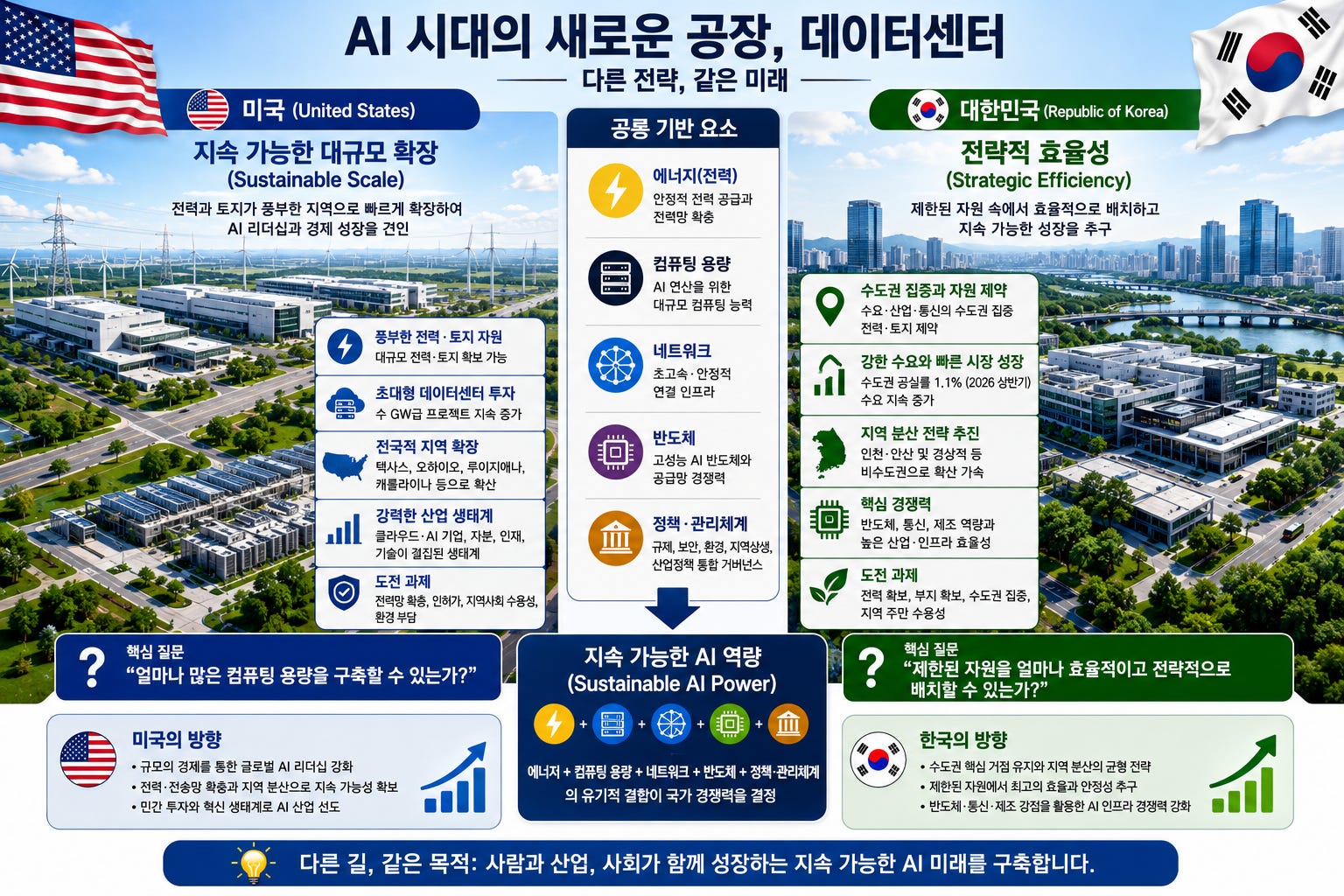
인공지능 시대의 새로운 공장 - 데이터센터
데이터센터가 다시 쓰는 미국과 대한민국의 미래
요약
데이터센터는 인공지능 시대의 새로운 공장으로 부상하고 있다. 미국과 한국은 서로 다른 전략을 추진하고 있는데, 미국은 ‘지속 가능한 대규모 확장(Sustainable Scale)’을, 한국은 ‘전략적 효율성(Strategic Efficiency)’을 중시한다. 미국은 전력과 토지가 확보된 지역으로 데이터센터를 빠르게 확대하고 있는 반면, 한국은 수도권 집중, 제한된 토지, 전력 확보라는 구조적 문제에 직면해 있다.
따라서 데이터센터 경쟁력은 더 이상 컴퓨팅 용량만으로 결정되지 않는다. 핵심은 에너지 + 컴퓨팅 능력 + 네트워크 + 반도체 + 정책·관리체계를 유기적으로 결합하여 ‘지속 가능한 AI 역량(Sustainable AI Power)’을 어떻게 효율적으로 잘 구축하는 데 달려 있다.
AI 시대에는 공장이 달라진다
인류의 역사를 돌아보면 새로운 문명은 언제나 새로운 생산시설과 기반시설을 필요로 했다. 산업혁명 시대에는 공장과 철도가 등장했고, 전기시대에는 발전소와 송전망이 국가의 산업 경쟁력을 결정했다. 자동차 시대에는 고속도로가 도시와 산업의 지도를 바꾸었으며, 인터넷 시대에는 통신망과 서버가 새로운 경제의 혈관이 되었다. 이제 인공지능 시대가 본격적으로 열리면서 또 하나의 거대한 기반시설이 역사의 전면에 등장하고 있다. 바로 ‘데이터센터(data center)’다.
데이터센터는 단순히 컴퓨터와 서버를 모아 놓은 건물이 아니다. 오늘날 데이터센터는 인공지능 모델을 학습시키고, 클라우드 서비스를 제공하며, 기업의 업무 시스템을 운영하고, 검색·금융·의료·교통·전자상거래와 같은 디지털 서비스를 실시간으로 움직이는 일종의 AI 시대의 공장이다. 특히 생성형 AI와 AI 에이전트가 빠르게 확산하면서 데이터센터는 데이터를 저장하는 공간을 넘어 막대한 계산 능력을 지속적으로 생산하는 시설이 되고 있다.
이러한 변화는 미국과 한국에서 서로 다른 모습으로 나타나고 있다. 미국은 광대한 국토와 자본, 풍부한 전력자원, 거대한 클라우드·AI 기업 생태계를 바탕으로 데이터센터를 대규모로 건설하고 있다. 반면 한국은 국토가 좁고 수도권에 인구와 산업이 집중되어 있기 때문에 제한된 토지와 전력을 보다 효율적으로 배분하면서 데이터센터를 구축해야 한다. 따라서 양국의 차이는 단순히 “미국은 크고 한국은 작다”는 문제가 아니다. 보다 중요한 차이는 미국이 규모의 문제(scale)를 해결하고 있다면, 한국은 공간과 자원의 효율적 배분 문제를 해결하고 있다는 점이다.
결국 미국은 “얼마나 많은 컴퓨팅 능력을 구축할 것인가?”라는 질문에 직면해 있고, 한국은 “제한된 공간과 전력을 어떻게 가장 효율적이고 전략적으로 배치할 것인가?”라는 질문에 직면해 있다. 이것이 미국과 한국의 데이터센터 건설을 비교할 때 가장 중요한 출발점이다.
미국: AI 경쟁력은 결국 ‘전력과 데이터센터’의 경쟁력이 된다
미국의 데이터센터 건설은 이미 역사적인 규모에 도달했다. CBRE의 2026년 상반기 자료에 따르면 북미의 8개 주요 데이터센터 시장에서 운영 중인 공급 규모는 10,903MW, 약 10.9GW로 전년 대비 33.7% 증가했다. 같은 기간 건설 중인 용량은 7,481.1MW, 약 7.48GW로 24.8% 증가하면서 역대 최고치를 기록했다. 그런데 놀라운 것은 이처럼 막대한 건설이 진행되고 있음에도 공실률이 오히려 1.4%까지 낮아졌다는 사실이다. 건설 중인 데이터센터 용량의 80.4%가 이미 ‘사전 임대(preleased)’된 상태이기도 하다(CBRE, 2026). (CBRE)
이 수치는 단순한 부동산 시장의 호황을 의미하지 않는다. AI 산업이 요구하는 컴퓨팅 능력이 얼마나 빠르게 증가하고 있는지를 보여주는 지표다. JLL에 따르면 2026년 상반기 북미 데이터센터 시장의 흡수량(absorption)은 무려 25GW에 달했다. 이는 전년 같은 기간의 두 배이고 2024년 상반기의 약 다섯 배에 해당한다. 또한 북미에서 건설 중인 데이터센터 용량은 66GW이며, 그중 95%가 이미 사전 계약된 것으로 나타났다(JLL, 2026). (JLL) 다만 이 두 숫자를 혼동해서는 안 된다. CBRE의 7.48GW는 북미 8개 주요 시장의 건설 중 용량이고, JLL의 66GW는 보다 넓은 북미 시장 전체의 건설 중 용량이다. 따라서 두 숫자는 서로 모순되는 것이 아니라 서로 다른 시장 범위를 측정한다.
미국에서 특히 주목할 지역은 Northern Virginia, Texas, Atlanta 등이다. Northern Virginia는 2026년 상반기 기준 약 4.50GW의 운영 용량을 보유한 세계 최대 수준의 데이터센터 시장이며, 추가로 약 2.42GW가 건설 중이다. 반면 Atlanta는 2026년 상반기에 건설 중인 용량이 2.88GW로 증가하면서 건설 규모에서는 Northern Virginia를 넘어섰다(CBRE, 2026). (CBRE)
JLL 자료에서도 Texas는 기존 및 건설 중인 용량을 합쳐 26GW, Virginia는 13GW에 달하는 것으로 나타난다. 더욱 중요한 변화는 데이터센터가 기존의 전통적인 대도시 중심에서 전력과 토지를 확보할 수 있는 새로운 지역으로 이동하고 있다는 점이다. JLL은 Texas, Ohio, Louisiana, Carolinas와 같은 이른바 frontier markets가 전체 개발 파이프라인의 77%를 차지한다고 분석한다(JLL, 2026). (JLL) 따라서 미국의 데이터센터 건설은 단순한 “대형화”가 아니다. 전력을 확보할 수 있는 곳으로 데이터센터가 이동하면서 미국의 산업지도가 다시 그려지고 있는 것이다.
한국: 수도권 집중과 새로운 공간 전략
한국 역시 AI와 클라우드 수요 증가로 데이터센터 건설이 빠르게 확대되고 있다. 그러나 미국과 동일한 방식으로 확장하기는 어렵다. 한국은 국토가 좁고 인구와 산업, 통신망, 기업 고객이 수도권에 집중되어 있기 때문이다.
Cushman & Wakefield의 2026년 상반기 자료에 따르면 수도권의 운영 데이터센터 용량은 663MW로 전년보다 약 10% 증가했다. 동시에 코로케이션 데이터센터의 공실률은 2025년 하반기의 6.9%에서 2026년 상반기 1.1%로 급격히 낮아졌다. 이는 수도권에서 데이터센터 수요가 공급을 빠르게 따라잡고 있음을 의미한다(Cushman & Wakefield, 2026). (Cushman & Wakefield)
그러나 한국의 핵심 문제는 단순히 데이터센터를 더 짓는 것이 아니다. 어디에 지을 것인가가 훨씬 중요한 문제가 되고 있다. 한국거래소(KRX)가 공개한 KDCC의 Korea Datacenter Market 2025 자료에 따르면 실제 구축이 진행되고 있거나 건축허가·착공 등 구체적인 추진단계에 있는 데이터센터는 34개소이며, 이 가운데 23개소가 서울·인천·경기에 위치한다. 즉 추진 단계 데이터센터의 67.6%가 수도권에 집중되어 있다. 또한 이들 34개소는 2028년까지 준공될 예정으로 제시되어 있다. 한편 신규 구축을 계획하고 있는 데이터센터는 36개소이며, 이 계획 단계에서는 경기도를 제외한 비수도권 지역의 비중이 크게 높아지고 있다(KDCC, 2025, as cited in Korea Exchange, 2025/2026).
이러한 현상은 한국 데이터센터 산업의 중요한 전환을 보여준다. 지금까지는 고객과 네트워크가 집중된 수도권이 가장 매력적인 입지였지만, 앞으로는 전력을 안정적으로 공급할 수 있는 지역, 대규모 부지를 확보할 수 있는 지역, 산업 인프라가 잘 갖추어진 지역이 점점 중요해질 가능성이 높다. 실제로 Cushman & Wakefield는 인천과 경기도 안산 등 수도권 주변 지역으로 개발 관심이 확대되고 있으며, 수도권 이외 지역에서는 경상권과 같은 산업 기반 지역도 주목받고 있다고 분석한다(Cushman & Wakefield, 2026). (Cushman & Wakefield)
따라서 한국의 데이터센터 전략은 “수도권에 더 많이 짓는 것”에서 “수도권의 핵심 기능은 유지하되, 전력과 토지가 필요한 대규모 시설은 전략적으로 분산하는 것”으로 전환될 필요가 있다.
표 1. 2026년 미국·한국 데이터센터 건설 및 시장 현황
비교 항목 미국·북미 한국
운영 용량 북미 8개 주요 시장 10.90GW 수도권 663MW
건설 중 용량 북미 8개 주요 시장 7.48GW 프로젝트 수 기준 34개소
시장 공실률 1.4% (북미 주요 시장) 1.1% (수도권, 코로케이션)
개발 수요 H1 2026 흡수량 25GW (북미 전체, JLL) 수도권 중심의 높은 수요
공간적 특징 기존 허브에서 전력·토지 확보가 가능한 수도권 집중 지속, 동시에 비수도권 신규 지역으로 확대 개발계획 증가
핵심 제약 전력망, 송전, 인허가, 지역사회 수용성 전력, 토지, 수도권 집중, 지역사회 수용성
전략적 특징 Sustainable Scale Strategic Efficiency
주: 미국의 CBRE 수치는 북미 8개 주요 시장을 대상으로 한 MW 기준이며, JLL의 66GW는 보다 넓은 북미 시장을 대상으로 한 건설 중 용량이다. 한국의 34개소는 MW가 아니라 실제 구축·허가·착공 등 추진단계에 있는 프로젝트 수이므로 미국의 7.48GW와 직접 비교할 수 없다. 한국의 663MW는 수도권의 운영 용량이다. (CBRE)
첫 번째 차이: 미국은 ‘규모’, 한국은 ‘효율’을 추구한다
이러한 통계를 종합하면 미국과 한국의 데이터센터 전략을 단순히 규모의 차이로 설명하는 것은 충분하지 않다.
미국의 가장 큰 장점은 규모를 확장할 수 있는 공간과 자본, 기업 생태계다. Microsoft, Amazon, Google, Meta와 같은 대형 클라우드 기업과 AI 기업들은 막대한 컴퓨팅 수요를 만들어내고 있으며, 이를 뒷받침하기 위해 수백 MW에서 GW 단위의 데이터센터 프로젝트가 추진되고 있다. 따라서 미국의 기본적인 전략은 Scale → Capacity → AI Leadership이라고 표현할 수 있다.
그러나 미국도 더 이상 “크게 짓기만 하면 된다”는 단계에 머물 수 없다. 전력망이 따라오지 못하고, 송전시설과 발전시설 건설에 시간이 걸리며, 지역 주민들이 데이터센터의 소음·물 사용·전력 비용 등을 문제 삼기 시작했기 때문이다.
JLL의 조사에서 미국인의 79%는 미국이 AI 분야의 리더십을 유지하는 것을 지지하지만, 자신의 지역사회에 데이터센터가 들어오는 것에 대해서는 14%만이 지지하는 것으로 나타났다. AI 경쟁력에 대한 국가적 지지와 지역사회에서의 데이터센터 수용성 사이에 무려 65%포인트의 차이가 존재하는 것이다(JLL, 2026). (JLL)
따라서 미국의 다음 단계는 단순한 Scale이 아니라 Sustainable Scale, 즉 지속가능한 규모 확대가 되어야 한다.
한국은 출발점이 다르다. 미국처럼 광대한 토지를 활용할 수 없기 때문에 제한된 토지와 전력을 얼마나 효율적으로 활용하느냐가 핵심이다. 한국은 세계적인 반도체 산업과 통신망, 높은 인터넷 이용률, 제조업 기반, 수도권의 강력한 기업 수요라는 장점을 가지고 있다. 따라서 한국의 전략은 Integration → Efficiency → Strategic AI Resilience라고 볼 수 있다.
한국이 반드시 미국처럼 거대한 데이터센터 단지를 만들 필요는 없다. 오히려 핵심은 어떤 데이터를 어디에서 처리하고, 어떤 AI 계산을 어느 지역에서 수행하며, 어떤 전력원을 활용하고, 어떤 네트워크로 연결할 것인가를 국가적 관점에서 설계하는 것이다.
두 번째 차이: 데이터센터는 결국 ‘전력센터’가 된다
AI 시대의 데이터센터 건설에서 가장 중요한 문제를 하나만 꼽는다면 그것은 건물이 아니라 전력이다.
국제에너지기구(IEA)는 2026년 보고서에서 미국의 2026~2030년 전력수요 증가분 가운데 데이터센터가 약 50%를 차지할 것으로 전망했다. 즉 AI와 데이터센터의 확대가 단순히 IT 산업의 문제가 아니라 미국 전력산업의 미래를 좌우하는 요인이 되고 있는 것이다(IEA, 2026). (IEA)
EPRI의 Powering Intelligence 2026 역시 미국 데이터센터의 전력 소비량을 2024년 177~192TWh로 추정하고, 2030년에는 시나리오에 따라 약 380~790TWh까지 증가할 수 있다고 전망한다. 데이터센터가 미국 전체 전력수요에서 차지하는 비중도 현재 약 4~5%에서 2030년에는 9~17% 수준까지 높아질 수 있다는 분석이다(EPRI, 2026). (Powering Intelligence)
이제 데이터센터를 건설한다는 것은 단순히 건물을 짓는 것이 아니다. 발전소, 송전망, 변전소, 냉각시설, 통신망까지 함께 구축해야 한다는 의미다. 따라서 앞으로 데이터센터 입지의 핵심 질문은 “땅값이 싼가?”가 아니라 “충분한 전력을 안정적으로 공급할 수 있는가?”가 될 것이다.
이 점에서 미국은 풍부한 토지와 다양한 발전자원을 활용할 수 있다는 장점을 가지고 있지만, 전력망 확충 속도가 데이터센터 건설 속도를 따라가지 못하는 문제가 나타나고 있다. 한국은 더 복잡하다. 수도권은 데이터센터 수요와 네트워크가 집중되어 있지만 대규모 전력을 추가로 공급할 수 있는 공간에는 제약이 있다. 따라서 한국의 비수도권 분산 전략은 단순한 지역균형발전 정책이 아니라 AI 시대의 전력·산업·디지털 인프라 정책으로 접근할 필요가 있다.
세 번째 차이: 데이터센터는 ‘부동산’이 아니라 국가 인프라다
데이터센터를 부동산 산업의 관점에서만 바라보는 것도 위험하다. 데이터센터가 제공하는 기능은 이미 국가의 핵심 인프라에 가까워지고 있기 때문이다.
금융거래가 데이터센터를 통해 이루어지고, 병원의 의료정보가 데이터센터와 클라우드에 저장되며, 정부의 행정서비스와 기업의 생산시스템이 클라우드에서 작동한다. 생성형 AI와 AI 에이전트가 사회의 다양한 의사결정을 지원하게 될수록 데이터센터의 안정적인 운영은 국가의 경제안보와 직결될 수밖에 없다.
따라서 데이터센터 건설에는 최소한 다음과 같은 요소가 동시에 고려되어야 한다.
전력 안정성은 첫 번째다. 안정적인 전력 공급뿐 아니라 전력망의 복원력과 비상전력 체계가 중요하다. 네트워크 연결성도 필수적이다. 데이터센터는 독립된 섬이 아니라 광섬유망과 인터넷 백본, 클라우드 플랫폼, 다른 데이터센터와 연결된 거대한 네트워크의 일부다. 토지와 입지 역시 중요하다. 대규모 데이터센터는 상당한 부지를 필요로 하며, 전력과 네트워크뿐 아니라 냉각시설과 접근성까지 고려해야 한다. 환경과 물 사용도 빼놓을 수 없다. 고밀도 AI 서버는 막대한 열을 발생시키므로 냉각에 필요한 전력과 물을 고려해야 한다. 데이터센터가 지역사회와 공존하려면 탄소배출뿐 아니라 물, 소음, 교통, 토지 이용에 대한 사회적 비용도 평가해야 한다. 마지막으로 사이버보안과 물리적 보안이 필요하다. 데이터센터가 국가와 기업의 핵심 디지털 자산을 보유하게 될수록 랜섬웨어, 공급망 공격, 내부자 위협, 물리적 침입, 전력 및 네트워크 장애 등에 대한 방어가 중요해진다.
결국 데이터센터는 건축 프로젝트가 아니라 전력·통신·환경·보안·산업정책이 결합된 국가 인프라 프로젝트가 되어야 한다.
네 번째 차이: 미국도 분산하고 한국도 분산한다
흥미로운 점은 미국과 한국이 서로 다른 출발점에 있지만 장기적으로는 비슷한 방향으로 움직이고 있다는 사실이다.
미국은 Northern Virginia와 같은 전통적 데이터센터 중심지가 이미 토지와 전력의 제약을 받고 있기 때문에 Texas, Ohio, Louisiana, Carolinas 등 새로운 지역으로 확산되고 있다. JLL에 따르면 이러한 frontier markets가 전체 개발 중인 데이터센터 용량의 77%를 차지한다(JLL, 2026). (JLL)
한국 역시 수도권 집중이라는 기존 구조를 유지하면서 동시에 인천·안산 등 수도권 주변부와 경상권 등 비수도권 지역으로 관심이 확대되고 있다. 즉 미국은 대륙 규모에서의 분산, 한국은 국가 규모에서의 전략적 분산을 추진하고 있다고 볼 수 있다.
그러나 여기서 중요한 것은 “무조건 지방으로 보내자”는 단순한 접근이 아니다. 데이터센터를 분산시키면 네트워크 지연시간, 운영인력, 고객 접근성, 재해복구 등 새로운 문제가 발생할 수 있다. 따라서 가장 현실적인 전략은 완전한 분산이 아니라 기능별 분산이다.
예를 들어 초대형 AI 모델 학습처럼 막대한 전력이 필요한 작업은 전력과 토지가 충분한 지역에 배치하고, 금융·의료·공공서비스처럼 초저지연과 높은 신뢰성이 필요한 서비스는 주요 도시권에 가까이 두는 방식이다. 동시에 여러 지역의 데이터센터를 연결하여 하나의 거대한 분산형 컴퓨팅 인프라로 운영할 수 있다. 이것이 AI 시대의 새로운 데이터센터 전략이 될 수 있다.
미국에서 배워야 할 것과 한국이 지켜야 할 것
한국이 미국에서 배워야 할 것은 단순히 “더 크게 짓는 방법”이 아니다. 오히려 대규모 투자를 장기적인 국가 전략과 연결하는 방법을 배울 필요가 있다.
미국의 데이터센터 투자는 클라우드, AI 반도체, 전력, 금융, 통신, 부동산, 소프트웨어 산업을 하나의 거대한 생태계로 연결하고 있다. 데이터센터 하나가 건설되면 전력망 투자가 따라오고, 통신망이 확장되며, AI 기업과 클라우드 기업이 입주하고, 지역경제와 세수가 변화한다.
반대로 미국이 한국에서 배울 수 있는 것은 제한된 공간에서 높은 효율을 만들어내는 능력이다. 한국은 좁은 국토 안에 고속 통신망, 제조업, 반도체, 도시 인프라를 밀도 높게 구축해 왔다. 이러한 경험은 앞으로 데이터센터의 전력 효율, 네트워크 효율, 공간 효율을 높이는 데 중요한 자산이 될 수 있다.
특히 한국의 반도체 산업과 데이터센터 산업을 별개의 산업으로 바라보아서는 안 된다. AI 반도체가 계산능력을 제공하고, 데이터센터가 그 계산능력을 현실의 서비스로 전환하기 때문이다. 결국 반도체가 AI의 두뇌라면 데이터센터는 그 두뇌가 작동하는 거대한 신체라고 할 수 있다.
데이터센터의 경쟁은 결국 ‘국가의 설계 능력’ 경쟁이다
앞으로 미국과 한국의 데이터센터 경쟁력을 단순히 몇 개의 데이터센터를 보유하고 있는가로 평가해서는 안 된다. 더 중요한 것은 전력, 컴퓨팅, 네트워크, 반도체, 인재, 자본, 규제, 환경, 보안을 얼마나 하나의 시스템으로 연결할 수 있는가이다.
이를 하나의 공식처럼 표현한다면 다음과 같다.
Sustainable AI Power = Energy + Computing Capacity + Networks + Semiconductors + Governance
여기서 어느 하나라도 부족하면 전체 시스템의 경쟁력이 떨어진다. 아무리 강력한 AI 반도체가 있어도 전력이 부족하면 작동할 수 없고, 전력이 충분해도 네트워크가 부족하면 효율적으로 서비스를 제공할 수 없다. 데이터센터가 아무리 크더라도 사이버보안이 취약하면 국가적 위험이 될 수 있으며, 기술이 아무리 뛰어나도 지역사회의 수용성이 없다면 프로젝트 자체가 지연될 수 있다. 따라서 데이터센터의 미래는 기술만의 문제가 아니다. 그것은 국가가 미래의 산업지도를 어떻게 설계하는가의 문제다.
AI 시대의 새로운 철도
19세기의 철도는 단순히 사람과 물자를 이동시키는 교통수단이 아니었다. 철도는 도시를 만들고 산업을 이동시키며 국가의 경제지도를 다시 그렸다. 20세기의 전력망 역시 단순한 전선의 연결이 아니었다. 전력망은 공장과 도시와 가정을 하나의 산업문명으로 연결했다. 인터넷 역시 단순한 통신기술이 아니라 지식과 정보와 경제활동의 공간 자체를 변화시켰다.
21세기 AI 시대의 데이터센터도 마찬가지다. 데이터센터는 더 이상 서버를 보관하는 건물이 아니다. 그것은 인공지능이 생각하고, 기업이 일하고, 정부가 서비스를 제공하고, 새로운 산업이 탄생하는 디지털 문명의 공장이다.
미국은 막대한 자본과 공간, 에너지, 기업 생태계를 기반으로 데이터센터의 규모를 빠르게 확대하고 있다. 그러나 미국의 과제는 이제 “얼마나 많이 지을 것인가”에서 “얼마나 지속가능하게 지을 것인가”로 이동하고 있다. 한국은 수도권 집중과 제한된 토지·전력이라는 제약을 가지고 있지만, 세계적 수준의 반도체·통신·제조업 생태계라는 강점을 가지고 있다. 따라서 한국의 과제는 미국을 그대로 따라가는 것이 아니라 제한된 자원을 가장 효율적이고 전략적으로 배치하는 새로운 모델을 만드는 것이다.
결국 두 나라의 미래 경쟁력은 서로 다른 길에서 같은 목적지를 향할 것이다. 미국은 Scale을 Sustainable Scale로 바꾸어야 하고, 한국은 Efficiency를 Strategic Resilience로 발전시켜야 한다.
그리고 양국 모두 기억해야 할 사실이 하나 있다. AI 시대의 경쟁은 화면 속에서만 이루어지지 않는다. 그 경쟁은 전력망에서 시작되고, 데이터센터에서 실행되며, 네트워크를 통해 연결되고, 결국 국가와 지역사회가 얼마나 현명하게 미래의 인프라를 설계하느냐에 의해 결정된다. 산업혁명이 공장을 세운 나라의 시대를 열었다면, AI 혁명은 데이터센터를 현명하게 설계한 국가의 시대를 열고 있다.
따라서 앞으로의 질문은 단순히 “데이터센터를 어디에 지을 것인가?”가 아니다. “우리는 어떤 AI 문명을 만들 것인가?” 그 질문에 대한 답은 결국 우리가 어떤 데이터센터를 만들 것인가에서 시작될 것이다.
참고문헌
CBRE. (2026, August 27). North America data center trends H1 2026. CBRE Research. (CBRE)
Cushman & Wakefield. (2026, August 10). Asia Pacific’s data centre development pipeline reaches record 26.5GW in H1 2026. (Cushman & Wakefield)
Electric Power Research Institute. (2026). Powering Intelligence 2026: Updated scenarios of U.S. data center electricity use and power strategies. EPRI. (Powering Intelligence)
International Energy Agency. (2026). Electricity 2026: Analysis and forecast to 2030. IEA. (IEA)
International Energy Agency. (2025). Energy and AI. IEA. (IEA)
JLL. (2026, August 11). Data center demand exceeds expectations as H1 2026 absorption hits record 25 GW. JLL. (JLL)
Korea Datacenter Council. (2025). Korea datacenter market 2025. KDCC. As cited in Korea Exchange disclosure.
Korea Exchange. (2025/2026). Domestic data center construction status and regional development trends. KIND corporate disclosure, citing KDCC, Korea Datacenter Market 2025.
2026년 9월 7일
{솔티}

Prof. Dr. Young Choi (Editor in Chief) — Regent University
Young B. Choi is a Professor in the Department of Engineering & Computer Science at Regent University. He published 38 books with ‘Selected Readings in Cybersecurity’ (2018) (over 800 copies archived globally at university/college libraries around the world) and ‘Cybersecurity Applications and Artificial Intelligence’ (2023) available in seven major world languages. He proposed the world’s first global and universal telecommunications “Service Order Handling (SOH)” Model (T-SOH Model) (1995) with Dr. Adrian Tang. With this innovative research work, he received the IEEE NOMS ’96 Best Paper Award and became the first recipient of the Outstanding Contribution Award of the TeleManagement Forum in 1998. His research areas include Natural Language Processing-focused AI, AI-applied cybersecurity, network and telecom service management, and Korean studies on Gani Choi Rip’s Jeonggwan (靜觀: Quiet Contemplation) philosophy and Shilhak ( 實學: Practical Learning).
© K-GSP (K-Global Scholars and Professionals) Forum. All rights reserved. 2026.
Suggested Citation:
Choi, Y. B. (2026, September 7). The New Factories of the AI Era - Data Center: How Data Centers Are Reshaping the Future of the United States and Republic of Korea. K-GSP.