

Work & Intelligence · April 2026 · University of Toledo
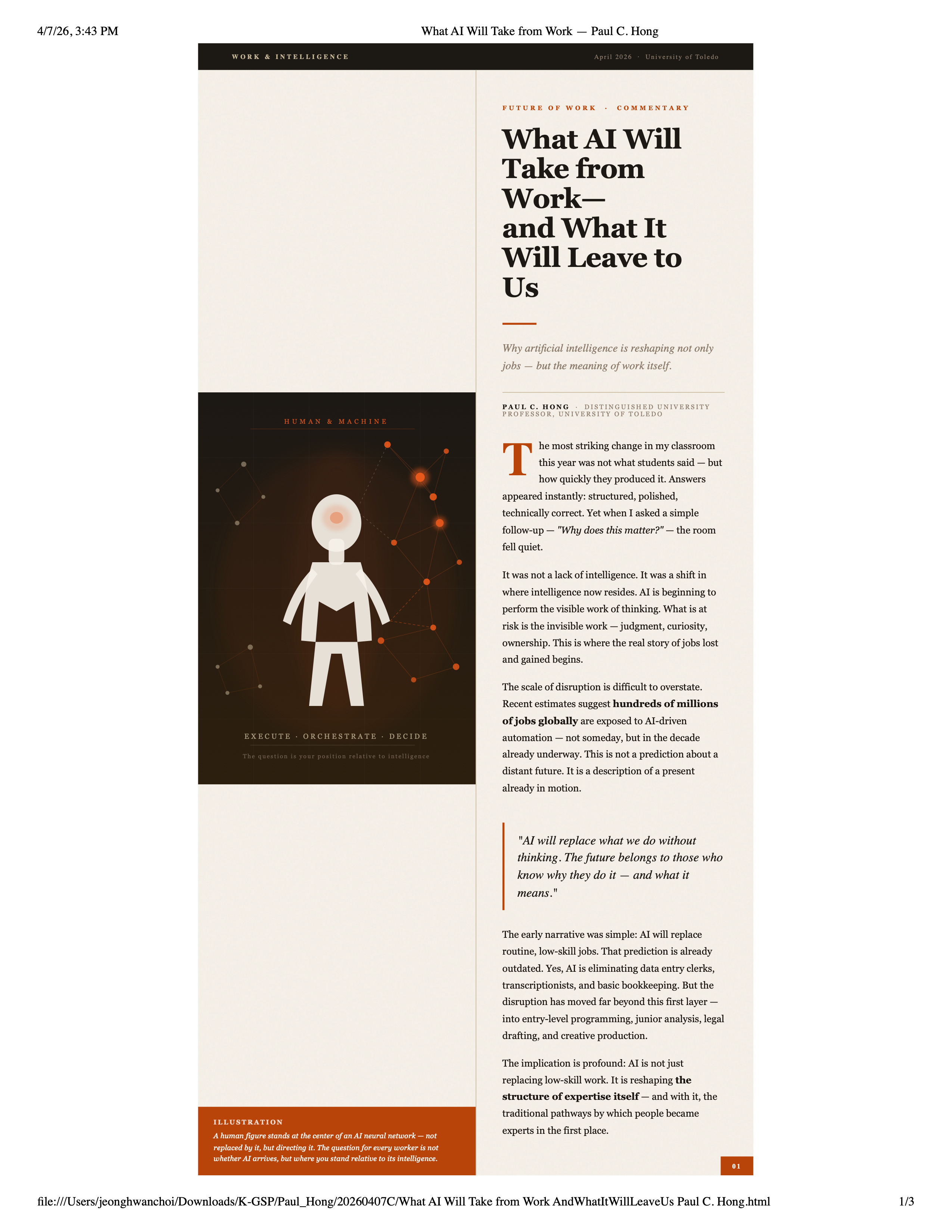
Human & Machine
Execute · Orchestrate · Decide
The question is your position relative to intelligence.
Future of Work · Commentary
What AI Will Take from Work — and What It Will Leave to Us
Why artificial intelligence is reshaping not only jobs — but the meaning of work itself.
Paul C. Hong · Distinguished University Professor, University of Toledo
The most striking change in my classroom this year was not what students said — but how quickly they produced it. Answers appeared instantly: structured, polished, technically correct. Yet when I asked a simple follow-up — “Why does this matter?” — the room fell quiet.
It was not a lack of intelligence. It was a shift in where intelligence now resides. AI is beginning to perform the visible work of thinking. What is at risk is the invisible work — judgment, curiosity, ownership. This is where the real story of jobs lost and gained begins.
The scale of disruption is difficult to overstate. Recent estimates suggest hundreds of millions of jobs globally are exposed to AI-driven automation — not someday, but in the decade already underway. This is not a prediction about a distant future. It is a description of a present already in motion.
“AI will replace what we do without thinking. The future belongs to those who know why they do it — and what it means.”
The early narrative was simple: AI will replace routine, low-skill jobs. That prediction is already outdated. Yes, AI is eliminating data entry clerks, transcriptionists, and basic bookkeeping. But the disruption has moved far beyond this first layer — into entry-level programming, junior analysis, legal drafting, and creative production.
The implication is profound: AI is not just replacing low-skill work. It is reshaping the structure of expertise itself — and with it, the traditional pathways by which people became experts in the first place.
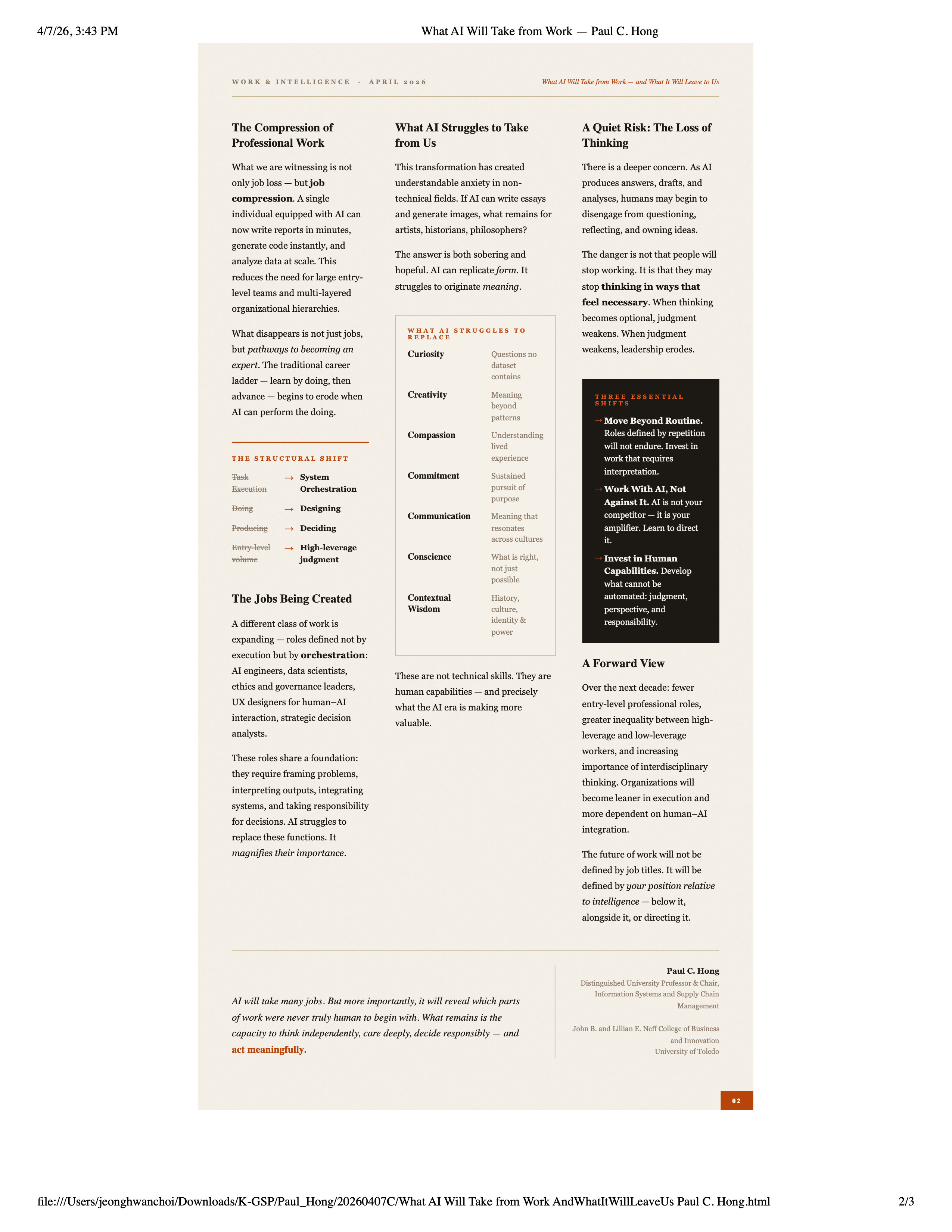
The Compression of Professional Work
What we are witnessing is not only job loss — but job compression. A single individual equipped with AI can now write reports in minutes, generate code instantly, and analyze data at scale. This reduces the need for large entry-level teams and multi-layered organizational hierarchies.
What disappears is not just jobs, but pathways to becoming an expert. The traditional career ladder — learn by doing, then advance — begins to erode when AI can perform the doing.
The Structural Shift
Task Execution → System Orchestration · Doing → Designing · Producing → Deciding · Entry-level volume → High-leverage judgment.
The Jobs Being Created
A different class of work is expanding — roles defined not by execution but by orchestration: AI engineers, data scientists, ethics and governance leaders, UX designers for human–AI interaction, strategic decision analysts.
These roles share a foundation: they require framing problems, interpreting outputs, integrating systems, and taking responsibility for decisions. AI struggles to replace these functions. It magnifies their importance.
What AI Struggles to Take from Us
This transformation has created understandable anxiety in non-technical fields. If AI can write essays and generate images, what remains for artists, historians, philosophers?
The answer is both sobering and hopeful. AI can replicate form. It struggles to originate meaning.
Curiosity — Questions no dataset contains. Creativity — Meaning beyond patterns. Compassion — Understanding lived experience. Commitment — Sustained pursuit of purpose. Communication — Meaning that resonates across cultures. Conscience — What is right, not just possible. Contextual Wisdom — History, culture, identity & power.
These are not technical skills. They are human capabilities — and precisely what the AI era is making more valuable.
A Quiet Risk: The Loss of Thinking
There is a deeper concern. As AI produces answers, drafts, and analyses, humans may begin to disengage from questioning, reflecting, and owning ideas.
The danger is not that people will stop working. It is that they may stop thinking in ways that feel necessary. When thinking becomes optional, judgment weakens. When judgment weakens, leadership erodes.
Three Essential Shifts
Move Beyond Routine — Roles defined by repetition will not endure. Invest in work that requires interpretation. Work With AI, Not Against It — AI is not your competitor — it is your amplifier. Learn to direct it. Invest in Human Capabilities — Develop what cannot be automated: judgment, perspective, and responsibility.
A Forward View
Over the next decade: fewer entry-level professional roles, greater inequality between high-leverage and low-leverage workers, and increasing importance of interdisciplinary thinking. Organizations will become leaner in execution and more dependent on human–AI integration.
The future of work will not be defined by job titles. It will be defined by your position relative to intelligence — below it, alongside it, or directing it.
AI will take many jobs. But more importantly, it will reveal which parts of work were never truly human to begin with. What remains is the capacity to think independently, care deeply, decide responsibly — and act meaningfully.
Author:

Distinguished Professor, Dr. Paul Hong — University of Toledo
Paul Hong, PhD, CMA is a Distinguished University Professor and Chair of Information Systems and Supply Chain Management at the University of Toledo’s Neff College of Business. A certified management accountant and Fulbright-Nehru scholar, he teaches operations management, global supply chain strategy, and new product development across undergraduate, MBA, EMBA, and doctoral programs. He has supervised 25+ doctoral dissertations, published in premier journals including the Journal of Operations Management, and authored six scholarly books with Springer and Taylor & Francis.
© 2026 KGSP Forum. All rights reserved. Content published in the KGSP Journal may not be reproduced, distributed, or transmitted in any form without prior written permission from the KGSP Forum, except for brief quotations with full attribution.
Dr. Paul, I just finished reading your article and I have to say — it truly moved me.
The way you described the quiet shift happening in your classroom, and how AI is taking over the “visible work” while putting at risk the invisible parts like judgment, curiosity, and ownership… it really hit home.
Honestly, this piece gave me a lot to think about, not just about the future of jobs, but about the deeper meaning of work itself. As someone who often wonders what will remain truly human in the AI era, your clear distinction between what AI can replicate and what only humans can offer — especially curiosity, compassion, and conscience — felt both sobering and deeply hopeful.
Personally, it helped me reframe my own anxieties about AI into something more constructive. Thank you for writing something so thoughtful and insightful. It was genuinely moving and helpful to me.
Warm regards,
It is a good and insightful article. I would like to see more articles like this.