

When AI Demands More Memory Than Humanity Can Afford
The Hidden Cost of the AI Revolution
Abstract
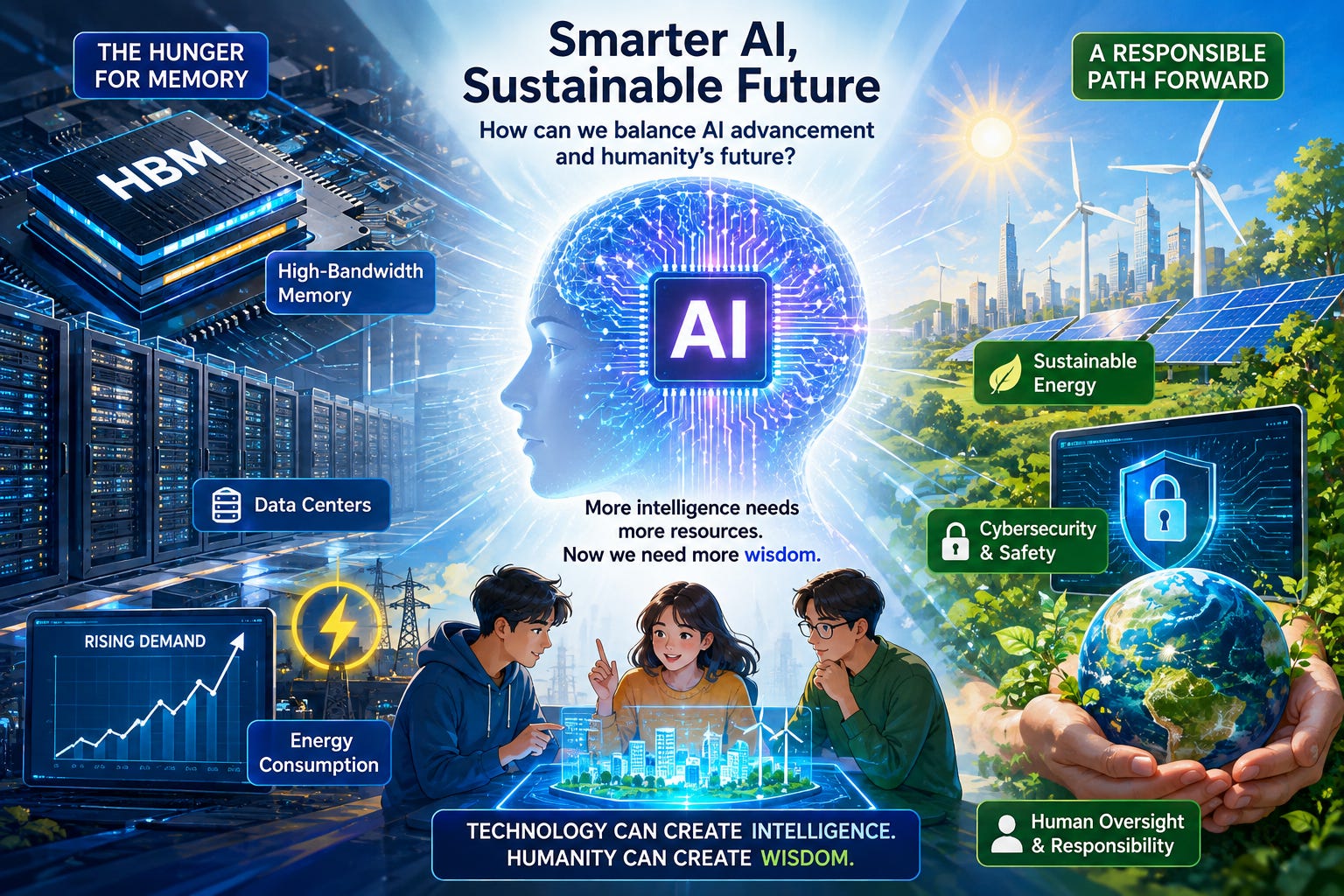
Artificial intelligence is becoming increasingly intelligent. Yet building more powerful AI requires more physical resources, including memory, semiconductors, computers, data centers, and electricity. The recent emergence of GPT-6 Astra illustrates how rapidly AI capabilities are advancing, while also drawing attention to the enormous technological infrastructure required to support that progress. The growing demand for high-bandwidth memory (HBM) and the rising electricity consumption of data centers show that AI is not simply a software technology; it is becoming a large-scale industrial system. This leads to a more important question: not simply “How much larger can we make AI?” but “How can we advance AI while building a sustainable future for humanity?” This essay does not argue that AI development should stop. Instead, it suggests that we should seek to create greater intelligence with fewer resources, reduce AI’s impact on energy and the environment, and strengthen cybersecurity and human responsibility at the same time. Ultimately, the real measure of progress in the AI era is not simply whether we can build bigger AI, but whether humanity can use that intelligence wisely and responsibly.
Keywords: artificial intelligence, GPT-6 Astra, memory, high-bandwidth memory, data centers, energy, cybersecurity, AI governance, sustainability, human oversight
The New Hunger for Memory
Artificial intelligence is often described as a software revolution, but its physical foundation is increasingly difficult to ignore. Every advanced AI model depends on enormous quantities of computation, storage, networking, and memory. Modern AI systems do not exist in an abstract digital space; they operate inside data centers filled with servers, accelerators, networking equipment, cooling systems, and increasingly sophisticated memory architectures. The International Energy Agency (IEA, 2025) emphasizes that AI development is inseparable from electricity consumption because training and deploying AI models occur primarily in data centers. (IEA)
Memory has consequently become one of the strategic resources of the AI economy. High-bandwidth memory (HBM), in particular, is essential for moving large volumes of data rapidly between processors and memory in advanced AI systems. Reuters reported in August 2026 that SK hynix planned to begin mass production of advanced HBM4E chips in Indiana by the third quarter of 2029, backed by a reported $4 billion investment. The company also projected continuing memory demand through 2030. (Reuters)
This development reveals an important characteristic of the AI age: intelligence is becoming an industrial resource. Just as the industrial revolution required coal, steel, factories, railroads, and electricity, the AI revolution requires GPUs, HBM, semiconductor fabrication and packaging, data centers, fiber networks, and enormous quantities of electricity. The apparent weightlessness of software therefore rests upon an increasingly heavy physical infrastructure.
GPT-6 Astra and the Acceleration of Intelligence
The arrival of GPT-6 Astra provides a useful illustration of this acceleration. OpenAI describes Astra as its most capable model and reports state-of-the-art performance in areas including computer use, browsing, software engineering, cybersecurity, science, and professional work. OpenAI also reports scores of 98% on FrontierMath Tier 4, 99.9% on ARC-AGI-3, and 100% on its ExploitBench benchmark. These are OpenAI-reported evaluations, not independent verification of those capabilities. (OpenAI)
The cybersecurity implications deserve particular attention. In its September 2026 safety documentation, OpenAI states that Astra is its first model to reach the “Critical” cybersecurity capability level under its Preparedness Framework. OpenAI defines this level as the ability, with appropriate tools and access, to find previously unknown security vulnerabilities and develop ways to exploit them across well-protected systems without a person guiding every step. (OpenAI)
This does not mean that every deployment of Astra will autonomously attack computer systems. Rather, it demonstrates why the relationship between capability and governance is becoming increasingly important. A more capable system creates greater potential for beneficial applications, but it can also create greater consequences if its capabilities are misused or inadequately controlled.
The Energy Behind Intelligence
The physical cost of AI extends beyond memory. The IEA (2025) notes that data centers have become significant participants in the energy system and projects substantial growth in electricity demand associated with their expansion. The agency also emphasizes that AI can potentially improve energy-system optimization while simultaneously increasing energy demand and creating new energy-security challenges. (IEA)
This creates a fascinating paradox. AI can be used to make electricity generation, transmission, industrial processes, and transportation more efficient. Yet the infrastructure required to develop and operate AI itself consumes additional electricity. The question is therefore not simply whether AI uses energy, but whether the social and economic value created by AI can justify and responsibly manage the resources required to produce that value.
This is why memory and energy should not be considered separate issues. More powerful AI requires greater computational throughput; greater throughput requires advanced processors and memory; larger deployments require more data-center capacity; and larger data centers require more electricity and cooling. The AI ecosystem is therefore a chain in which a shortage at one point can constrain the entire system.
From Bigger Models to Better Systems
The traditional technological imagination often assumes that progress means “bigger”: larger models, more parameters, more data, more GPUs, and more computing power. But the next phase of AI may require a different definition of progress. The question should increasingly become: Can we obtain greater intelligence with fewer physical resources?
This means improving algorithms, memory efficiency, model architectures, inference efficiency, specialized hardware, data-center cooling, renewable-energy integration, and workload management. The IEA (2025) explicitly recognizes that AI itself can contribute to energy optimization and innovation, suggesting that the relationship between AI and energy need not be purely consumptive. (IEA)
The same principle applies to cybersecurity. If increasingly capable AI systems can discover vulnerabilities, then security cannot remain an afterthought added after deployment. Security must become part of the architecture of advanced AI itself.
NIST’s Artificial Intelligence Risk Management Framework provides a useful foundation for this approach. The framework is designed to help organizations manage AI risks while promoting trustworthy and responsible AI development and use (Tabassi, 2023). (NIST)
Human Oversight in the Age of Machine Intelligence
The deepest issue is therefore not memory capacity or electricity consumption alone. It is human responsibility. UNESCO’s Recommendation on the Ethics of Artificial Intelligence places human dignity and human rights at the center of AI governance and emphasizes transparency, fairness, environmental sustainability, and human oversight (UNESCO, 2021). (UNESCO)
This principle becomes increasingly important as AI systems move from answering questions to performing tasks. When an AI system writes software, conducts research, operates digital tools, configures infrastructure, or discovers cybersecurity vulnerabilities, the traditional boundary between “tool” and “actor” becomes less obvious.
Human beings therefore need to remain responsible for the purposes for which AI is deployed, the resources it consumes, the risks it creates, and the consequences of its decisions.
The issue is not whether humans should compete with machines in raw computational speed. They cannot and need not. Human civilization has always advanced by creating tools that exceed individual human physical capabilities. The distinctive human responsibility is instead to decide what those capabilities should be used for.
From Memory Scarcity to Wisdom
The AI revolution is sometimes presented as a race toward artificial general intelligence or increasingly powerful models. Yet another interpretation is possible. We are entering an era in which the fundamental scarcity may no longer be information. Machines can increasingly generate, retrieve, transform, and process information at extraordinary speed. The emerging scarcity may be human judgment.
Memory can store information. Computing can process it. AI can increasingly transform it into sophisticated outputs. But none of these automatically provides wisdom about what should be done.
That is why the central challenge of the AI age is not simply building machines with more memory. It is building a civilization with enough wisdom to manage the intelligence it creates.
The memory industry, semiconductor factories, data centers, and energy infrastructure will remain essential foundations of the AI economy. But technological civilization ultimately requires something beyond infrastructure: institutions capable of governing powerful systems, ethical frameworks capable of protecting human dignity, and human beings capable of accepting responsibility for their choices. The future should therefore not be defined by a race between AI and humanity. It should be defined by a more constructive question: Can humanity become wise enough to use its new artificial intelligence without exhausting the physical, ecological, and moral resources upon which civilization depends? That may be the real test of the AI era. +++
References
International Energy Agency. (2025, April 10). Energy and AI. IEA. https://www.iea.org/reports/energy-and-ai (IEA)
OpenAI. (2026a, September 3). GPT-6 Astra: A new generation of intelligence. https://openai.com/index/gpt-6-astra/ (OpenAI)
OpenAI. (2026b, September 3). Safety overview: GPT-6 Astra. https://openai.com/index/safety-overview-gpt-6-astra/ (OpenAI)
OpenAI. (2026c, September 1). Path to Astra: Critical capabilities and frontier safeguards. https://openai.com/index/path-to-astra/ (OpenAI)
Reuters. (2026, August 27). SK Hynix to start AI chip output in Indiana in 2029, sees memory shortage through 2030. Reuters. (Reuters)
Tabassi, E. (2023). Artificial intelligence risk management framework (AI RMF 1.0) (NIST AI 100-1). National Institute of Standards and Technology. https://doi.org/10.6028/NIST.AI.100-1 (NIST)
UNESCO. (2021, November 23). Recommendation on the ethics of artificial intelligence. https://www.unesco.org/en/artificial-intelligence/recommendation-ethics (UNESCO)
인공지능은 인류가 감당할 수 있는 것보다 더 많은 메모리를 요구하는가?
AI 혁명의 보이지 않는 비용
초록
인공지능은 점점 더 똑똑해지고 있다. 그러나 더 강력한 AI를 만들기 위해서는 더 많은 메모리, 반도체, 컴퓨터, 데이터센터, 전기와 같은 물리적 자원이 필요하다. 최근 등장한 GPT-6 Astra는 AI 능력이 얼마나 빠르게 발전하고 있는지를 보여주는 한 사례이며, 동시에 이러한 발전을 뒷받침하는 거대한 기술 인프라의 중요성을 생각하게 한다. 특히 고대역폭 메모리(HBM)에 대한 수요와 데이터센터의 전력 소비 증가는 AI가 단순한 소프트웨어 기술이 아니라 거대한 산업 시스템임을 보여준다. 그렇다면 중요한 질문은 “AI를 얼마나 더 크게 만들 수 있는가?”가 아니라 “AI의 발전과 인류의 지속가능한 미래를 어떻게 함께 만들어갈 것인가?”이다. 이 글은 AI 발전을 멈추자는 것이 아니라, 더 적은 자원으로 더 많은 지능을 만들어내고, 에너지와 환경에 미치는 영향을 줄이며, 사이버보안과 인간의 책임을 함께 강화해야 한다고 제안한다. 결국 AI 시대의 진정한 발전은 단순히 더 큰 AI를 만드는 데 있는 것이 아니라, 인류가 그 지능을 더 현명하고 책임 있게 사용할 수 있는가에 달려 있다.
주제어: 인공지능, GPT-6 Astra, 메모리, 고대역폭 메모리, 데이터센터, 에너지, 사이버보안, AI 거버넌스, 지속가능성, 인간의 감독
메모리를 향한 새로운 갈증
인공지능은 흔히 소프트웨어 혁명으로 설명된다. 그러나 그 이면에 존재하는 물리적 기반은 점점 더 외면하기 어려워지고 있다. 오늘날의 첨단 AI 모델은 막대한 양의 연산 능력뿐만 아니라 저장장치, 메모리, 네트워크, 데이터센터를 필요로 한다. AI는 추상적인 디지털 공간에서 홀로 존재하는 것이 아니다. 그것은 서버, 가속기, 네트워크 장비, 냉각 시스템, 그리고 점점 더 정교해지는 메모리 구조로 가득 찬 데이터센터 안에서 작동한다. 국제에너지기구(IEA, 2025)는 AI의 발전이 전력 소비와 분리될 수 없다고 지적한다. AI 모델의 학습과 서비스 제공은 주로 데이터센터에서 이루어지기 때문이다.
따라서 메모리는 AI 경제의 핵심 전략 자원으로 떠오르고 있다. 특히 고대역폭 메모리(HBM)는 첨단 AI 시스템에서 프로세서와 메모리 사이에 대량의 데이터를 매우 빠르게 이동시키는 데 중요한 역할을 한다. Reuters는 2026년 8월 SK하이닉스가 인디애나주에서 40억 달러 규모의 투자를 바탕으로 2029년 3분기부터 차세대 HBM4E 반도체를 양산할 계획이라고 보도했다. 또한 AI와 관련된 메모리 수요가 2030년까지 계속될 것으로 전망했다(Reuters, 2026).
이러한 움직임은 AI 시대의 중요한 특징을 보여준다. 지능 자체가 하나의 산업 자원이 되고 있는 것이다. 산업혁명이 석탄, 철강, 공장, 철도와 전기를 필요로 했다면, AI 혁명은 GPU, HBM, 반도체 제조와 패키징, 데이터센터, 광통신망, 그리고 막대한 전력을 필요로 한다. 우리가 가볍고 무형의 소프트웨어라고 생각하는 AI는 사실 점점 더 무거운 물리적 인프라 위에 세워지고 있는 것이다.
GPT-6 Astra와 지능의 가속
GPT-6 Astra의 등장은 이러한 지능의 가속을 보여주는 하나의 사례다. OpenAI는 Astra를 자사의 가장 강력한 모델로 소개하면서 컴퓨터 사용, 웹 브라우징, 소프트웨어 엔지니어링, 사이버보안, 과학, 전문 업무 등에서 최고 수준의 성능을 보인다고 설명한다. 또한 FrontierMath Tier 4에서 98%, ARC-AGI-3에서 99.9%, 자체 ExploitBench 평가에서 100%의 점수를 기록했다고 발표했다. 다만 이러한 수치는 OpenAI가 자체적으로 보고한 평가 결과이며, 독립적인 기관에 의해 모두 검증된 사실로 이해해서는 안 된다(OpenAI, 2026a).
특히 주목해야 할 부분은 사이버보안이다. OpenAI는 2026년 9월 공개한 안전성 자료에서 Astra가 자사의 Preparedness Framework가 정의한 ‘Critical’ 사이버보안 능력 수준에 도달한 최초의 모델이라고 밝혔다. OpenAI는 이 수준을 인간이 모든 단계를 직접 안내하지 않아도 충분히 보호된 시스템에서 알려지지 않은 보안 취약점을 발견하고 이를 악용하는 방법을 개발할 수 있는 능력과 관련된 기준으로 설명한다(OpenAI, 2026c).
그렇다고 해서 Astra가 모든 환경에서 자율적으로 컴퓨터 시스템을 공격한다는 의미는 아니다. 오히려 이러한 사례가 보여주는 것은 AI의 능력이 커질수록 능력과 거버넌스의 관계가 더욱 중요해진다는 사실이다. 더욱 강력한 AI는 사회적으로 유익한 응용 가능성을 확대하지만, 동시에 오용되거나 적절하게 통제되지 않을 경우 더 큰 결과를 초래할 가능성도 높인다.
지능을 움직이는 에너지
AI의 물리적 비용은 메모리에서 끝나지 않는다. 전력도 필요하다. 국제에너지기구(IEA, 2025)는 데이터센터가 에너지 시스템에서 점점 중요한 위치를 차지하고 있으며, 데이터센터의 확대에 따라 전력 수요도 상당히 증가할 것으로 전망한다. 동시에 AI는 에너지 시스템의 최적화와 효율 향상에 활용될 수 있지만, 역설적으로 AI 자체가 더 많은 전력을 요구하면서 새로운 에너지 안보 문제를 만들어낼 수도 있다고 지적한다.
여기에는 흥미로운 역설이 존재한다. AI는 전력 생산과 송배전, 산업공정, 교통 시스템을 더욱 효율적으로 만드는 데 사용될 수 있다. 그러나 AI를 개발하고 운영하는 데 필요한 인프라 역시 추가적인 전력을 소비한다. 따라서 중요한 질문은 단순히 ‘AI가 얼마나 많은 에너지를 사용하는가?’가 아니다.
보다 근본적인 질문은 AI가 만들어내는 사회적·경제적 가치가 그것을 만들어내기 위해 소비되는 자원을 정당화할 만큼 크며, 그 자원을 우리가 책임 있게 관리할 수 있는가이다.
이 때문에 메모리와 에너지는 서로 분리된 문제가 아니다. 더욱 강력한 AI는 더 높은 데이터 처리량을 요구하고, 높은 처리량은 더욱 발전된 프로세서와 메모리를 필요로 한다. 더 많은 AI 서비스는 더 큰 데이터센터를 요구하고, 더 큰 데이터센터는 더 많은 전력과 냉각을 필요로 한다. 결국 AI 생태계는 어느 한 부분의 부족이 전체 시스템의 성장을 제한할 수 있는 하나의 거대한 연결망이다.
더 큰 모델에서 더 나은 시스템으로
전통적인 기술 발전의 상상력은 흔히 ‘더 크게’를 진보의 기준으로 삼아왔다. 더 큰 모델, 더 많은 매개변수, 더 많은 데이터, 더 많은 GPU, 더 많은 연산 능력이 곧 발전을 의미하는 것처럼 여겨졌다.
그러나 AI의 다음 단계에서는 진보에 대한 정의가 달라질 필요가 있다. 더 적은 물리적 자원으로 더 높은 수준의 지능을 얻을 수 있는가? 이를 위해서는 알고리즘과 메모리의 효율성, 모델 구조, 추론 효율, 특화된 하드웨어, 데이터센터 냉각 기술, 재생에너지 활용, 그리고 AI 작업의 효율적인 관리가 함께 발전해야 한다. 국제에너지기구 역시 AI가 에너지 시스템을 최적화하고 혁신하는 데 기여할 가능성을 강조하고 있다. 따라서 AI와 에너지의 관계가 반드시 일방적인 소비 관계일 필요는 없다(IEA, 2025).
사이버보안에서도 같은 원칙이 적용된다. 더욱 강력한 AI가 보안 취약점을 찾아낼 수 있다면, 보안은 AI 개발이 끝난 뒤 추가하는 부가 기능이 되어서는 안 된다. 보안은 처음부터 첨단 AI 시스템의 설계 자체에 포함되어야 한다.
미국 국립표준기술연구소(NIST)의 AI Risk Management Framework는 이러한 접근을 위한 중요한 기반을 제공한다. 이 프레임워크는 신뢰할 수 있고 책임 있는 AI의 개발과 활용을 촉진하면서 조직이 AI와 관련된 위험을 체계적으로 관리하도록 돕는 것을 목적으로 한다(Tabassi, 2023).
기계 지능의 시대, 인간의 감독
그러나 가장 깊은 문제는 메모리 용량이나 전력 소비만이 아니다. 그것은 인간의 책임이다. UNESCO의 「인공지능 윤리에 관한 권고」는 AI 거버넌스의 중심에 인간의 존엄성과 인권을 두고 투명성, 공정성, 환경적 지속가능성, 인간의 감독을 중요한 원칙으로 제시한다(UNESCO, 2021).
이 원칙은 AI가 단순히 질문에 답하는 수준을 넘어 실제 작업을 수행하기 시작하면서 더욱 중요해진다. AI가 소프트웨어를 작성하고, 연구를 수행하고, 디지털 도구를 조작하고, 인프라를 구성하며, 사이버보안 취약점을 발견하게 되면 ‘도구’와 ‘행위자’ 사이의 전통적인 경계가 점점 불분명해질 수 있다.
따라서 인간은 AI가 어떤 목적을 위해 사용되는지, 얼마나 많은 자원을 소비하는지, 어떤 위험을 만들어내는지, 그리고 그 결과에 누가 책임을 지는지를 계속 결정하고 책임져야 한다. 인간이 기계와 순수한 연산 속도로 경쟁해야 한다는 뜻은 아니다. 인간은 그럴 필요도 없고 그럴 수도 없다. 인류의 문명은 언제나 인간의 물리적 능력을 넘어서는 도구를 만들어냄으로써 발전해 왔다. 인간에게 특별히 요구되는 책임은 오히려 그 능력을 무엇을 위해 사용할 것인가를 결정하는 것이다.
메모리의 시대에서 지혜의 시대로
AI 혁명은 때때로 인공지능 일반화(AGI)나 더욱 강력한 모델을 향한 경쟁으로 묘사된다. 그러나 이를 다른 관점에서 바라볼 수도 있다. 우리는 이제 정보 자체가 부족한 시대를 지나고 있다. 기계는 점점 더 빠른 속도로 정보를 생성하고, 검색하고, 변환하고, 처리할 수 있다. 그렇다면 앞으로 더욱 희소해질 수 있는 것은 인간의 판단력인지도 모른다.
메모리는 정보를 저장한다. 컴퓨팅은 정보를 처리한다. AI는 점점 더 정교한 방식으로 정보를 변환하고 새로운 결과를 만들어낸다. 그러나 이 모든 능력이 자동적으로 무엇을 해야 하는가에 대한 지혜를 제공하는 것은 아니다. 바로 여기에 AI 시대의 가장 중요한 과제가 있다. 문제는 단순히 더 많은 메모리를 가진 기계를 만드는 것이 아니다. 우리가 만들어낸 지능을 관리할 수 있을 만큼 충분한 지혜를 가진 문명을 만드는 것이다.
메모리 산업, 반도체 공장, 데이터센터, 에너지 인프라는 AI 경제의 필수적인 기반으로 남을 것이다. 그러나 기술 문명이 궁극적으로 필요로 하는 것은 인프라만이 아니다. 강력한 시스템을 책임 있게 관리할 수 있는 제도, 인간의 존엄을 보호할 수 있는 윤리적 원칙, 그리고 자신이 만든 기술의 결과에 책임질 수 있는 인간이 필요하다. 따라서 미래를 AI와 인간 사이의 경쟁으로 정의할 필요는 없다.
보다 중요한 질문은 이것이다. 인류는 새롭게 창조한 인공지능을 사용하면서도 문명이 의존하는 물질적·환경적·도덕적 자원을 소진하지 않을 만큼 충분히 현명해질 수 있는가? 어쩌면 이것이야말로 AI 시대가 인류에게 던지는 진정한 시험일 것이다. +++
참고문헌
International Energy Agency. (2025, April 10). Energy and AI. IEA. https://www.iea.org/reports/energy-and-ai
OpenAI. (2026a, September 3). GPT-6 Astra: A new generation of intelligence. https://openai.com/index/gpt-6-astra/
OpenAI. (2026b, September 3). Safety overview: GPT-6 Astra. https://openai.com/index/safety-overview-gpt-6-astra/
OpenAI. (2026c, September 1). Path to Astra: Critical capabilities and frontier safeguards. https://openai.com/index/path-to-astra/
Reuters. (2026, August 27). SK Hynix to start AI chip output in Indiana in 2029, sees memory shortage through 2030. Reuters.
Tabassi, E. (2023). Artificial intelligence risk management framework (AI RMF 1.0) (NIST AI 100-1). National Institute of Standards and Technology. https://doi.org/10.6028/NIST.AI.100-1
UNESCO. (2021, November 23). Recommendation on the ethics of artificial intelligence. https://www.unesco.org/en/artificial-intelligence/recommendation-ethics
2026년 9월 20일
{솔티}

Prof. Dr. Young Choi (Editor in Chief) — Regent University
Young B. Choi is a Professor in the Department of Engineering & Computer Science at Regent University. He published 38 books with ‘Selected Readings in Cybersecurity’ (2018) (over 800 copies archived globally at university/college libraries around the world) and ‘Cybersecurity Applications and Artificial Intelligence’ (2023) available in seven major world languages. He proposed the world’s first global and universal telecommunications “Service Order Handling (SOH)” Model (T-SOH Model) (1995) with Dr. Adrian Tang. With this innovative research work, he received the IEEE NOMS ’96 Best Paper Award and became the first recipient of the Outstanding Contribution Award of the TeleManagement Forum in 1998. His research areas include Natural Language Processing-focused AI, AI-applied cybersecurity, network and telecom service management, and Korean studies on Gani Choi Rip’s Jeonggwan (靜觀: Quiet Contemplation) philosophy and Shilhak ( 實學: Practical Learning).
© K-GSP (K-Global Scholars and Professionals) Forum. All rights reserved. 2026.
Suggested Citation:
Choi, Y. B. (2026, September 19). When AI Demands More Memory Than Humanity Can Afford: The Hidden Cost of the AI Revolution. K-GSP.