
When AI Enters the Classroom, What Should Remain Human?
Rethinking Education in the Age of Generative AI
Abstract
Generative artificial intelligence is changing higher education faster than universities can rewrite their curricula, assessment systems, and academic policies. The 2026 Report of MIT’s Ad Hoc Committee on AI Use in Teaching, Learning, and Research Training offers an important response to this transformation. Rather than treating AI primarily as a tool to be prohibited or a technology to be adopted, the report asks a deeper question: What is the purpose of education when machines can increasingly perform tasks that once demonstrated student knowledge? MIT proposes eight guiding principles—including humility, boldness, human-centeredness, intentional teaching, learning-centered design, and “augmentation not automation”—and recommends three broad directions: adapting educational processes for an AI-aware world, strengthening people and community, and building systems for continuous reflection and improvement (MIT’s Ad Hoc Committee on AI Use in Teaching, Learning, and Research Training, 2026). This essay argues that the most important lesson of the MIT report is not how universities should control AI, but how they should redefine learning. In an AI-rich educational environment, the university’s greatest responsibility may be to cultivate judgment, curiosity, creativity, ethical responsibility, human relationships, and the capacity to use intelligence without surrendering agency to the machine.
Keywords: artificial intelligence, generative AI, higher education, AI literacy, human-centered education, assessment, academic integrity, learning, MIT, educational transformation
The Question Behind the Question
Every major technological revolution eventually creates a crisis of education. The printing press changed who could possess knowledge. Industrialization changed what societies expected schools to teach. Computers changed how information was produced and processed. Generative AI is creating another transformation, but with an important difference: the machine is no longer merely storing, calculating, or retrieving information. It can explain, summarize, translate, program, generate images, construct arguments, simulate conversations, and increasingly participate in research and creative work. This creates an uncomfortable question for universities: If a machine can produce the answer, what exactly should the student learn?
MIT’s 2026 report is valuable because it does not reduce this question to whether students should be allowed to use ChatGPT. The committee was originally charged with assessing current AI use, identifying innovations in teaching and assessment, and proposing an AI-use policy. Yet the committee concluded that the deeper issue concerned the structure, meaning, and value of an MIT education in an age in which AI is reshaping intellectual work (MIT’s Ad Hoc Committee on AI Use in Teaching, Learning, and Research Training, 2026). MIT President Sally Kornbluth similarly described generative AI as a “watershed” moment for education and research, emphasizing the need to understand when AI should be used effectively and responsibly—and when it should not be used at all. (MIT Office of the President)
That shift in perspective is perhaps the most important feature of the report. The question is no longer simply, “How do we stop students from using AI?” It is becoming, “How do we design education so that using AI helps students become more capable human beings?”
From AI-Proof Assignments to AI-Aware Education
For decades, universities have often relied on assignments as evidence of learning. A student writes an essay, solves a problem set, creates a program, or prepares a presentation, and the instructor assumes that the submitted product reflects the student’s knowledge and skills. Generative AI disrupts this assumption. A polished essay may have been generated with AI. A computer program may have been produced partly or almost entirely by an AI system. A literature review may have been summarized by a language model. Even an apparently original argument may have emerged from a dialogue between student and machine.
The traditional response is understandable: restrict AI, require disclosure, or attempt to detect AI-generated work. But these measures alone cannot answer the educational question. If the assignment itself no longer measures the intended learning outcome, simply policing the technology does not restore the validity of the assessment.
The MIT report therefore points toward an AI-aware educational process—one in which learning objectives, assignments, assessments, and AI policies are deliberately redesigned for an environment in which AI exists. MIT’s official description of the report emphasizes precisely this need: educational processes must be reconsidered so that students are prepared for an AI-powered world. (MIT Office of the President)
This suggests a fundamental change in educational design. Instead of asking, “How can I make an assignment impossible for AI to complete?” an instructor might ask, “What evidence would demonstrate that the student understands, evaluates, improves, explains, and takes responsibility for the work?” That is a much more productive question.
The End of the Easy Homework Era
Generative AI does not necessarily make homework meaningless. It does, however, make some forms of homework less informative as measures of individual mastery. Consider a conventional programming assignment. A student receives a problem, writes code, submits the solution, and receives a grade. If an AI system can generate much of the code, the final product may tell the instructor less about the student’s actual understanding.
But the situation can also create an educational opportunity. The instructor can ask the student to explain the architecture, identify weaknesses in AI-generated code, test competing solutions, document the prompts used, compare alternatives, find security vulnerabilities, and defend design decisions. The assignment has now moved from production alone to production plus judgment.
This distinction is crucial. AI may automate portions of production while simultaneously increasing the importance of evaluation. A student who merely accepts an AI answer may learn less. A student who interrogates, tests, challenges, revises, and explains the AI output may learn more.
This is the educational meaning of MIT’s principle of “augmentation not automation.” The goal is not to replace human intellectual activity with machine output but to use AI in ways that strengthen human learning and capability (MIT’s Ad Hoc Committee on AI Use in Teaching, Learning, and Research Training, 2026). The principle is especially important because automation and augmentation are not the same educational process. Automation asks: “Can the machine do this for me?” Augmentation asks: “How can the machine help me become better at doing this?” The first can reduce human participation. The second can increase human capability.
From Answers to Questions
Traditional education often rewards students for finding correct answers. AI changes the economics of answering questions because machines can now produce plausible answers at extraordinary speed.
The scarce resource may therefore become something else: the ability to ask valuable questions. A student who asks an AI system, “Explain photosynthesis,” receives an answer. But a student who asks, “What assumptions are hidden in this explanation? What evidence would challenge it? How would the explanation change in another biological environment?” is engaging in a different intellectual activity.
The university of the AI era therefore needs to teach students not only how to obtain information but how to formulate questions that lead to discovery. This is especially important in research. AI can summarize literature, suggest hypotheses, generate code, analyze datasets, and assist with writing. Yet none of these capabilities eliminates the need for researchers to determine whether the question matters, whether the evidence is trustworthy, whether the methodology is appropriate, and whether the conclusion is justified. In other words, AI can accelerate research without automatically creating knowledge. The human researcher remains responsible for deciding what is worth knowing.
The Eight Principles and a New Educational Philosophy
The MIT report identifies eight guiding principles: 1. Be humble; 2. Be bold; 3. Put humanity front and center; 4. Lean into learning; 5. Teach with intentionality; 6. No one size fits all; 7. Augmentation not automation; and 8. Think beyond the classroom and the campus. (NSP) Together, these principles form something more significant than an AI policy. They represent a philosophy of education.
“Be humble” recognizes that the technology is changing too quickly for universities to assume that today’s policy will remain appropriate tomorrow. “Be bold” recognizes that uncertainty cannot become an excuse for educational inaction. “Put humanity front and center” insists that technological efficiency should not become the sole measure of educational success. “Lean into learning” redirects attention from the production of academic artifacts toward actual intellectual development. “Teach with intentionality” is particularly important. If students can obtain information instantly, instructors must become increasingly intentional about why a particular activity exists. “No one size fits all” recognizes that AI’s educational role differs across disciplines. The appropriate use of AI in philosophy, computer science, nursing, art, history, engineering, and laboratory science cannot simply be identical. “Augmentation not automation” establishes the relationship between human and machine, while “Think beyond the classroom and the campus” recognizes that university education must prepare students for workplaces and societies where AI will already be embedded.
The report’s principles therefore point toward a larger transformation: education should become less focused on demonstrating that students can reproduce information and more focused on demonstrating that they can use information wisely.
Human Presence Becomes More Valuable
There is an apparent paradox at the heart of AI education. As machines become better at conversation, universities may discover that genuine human relationships become more—not less—important. MIT’s recommendations explicitly call for centering people, community, and the residential experience. The report recognizes that education is not simply an information-transfer process. Universities are communities in which students encounter mentors, classmates, disagreements, cultures, unexpected ideas, failures, and responsibilities. (MIT Office of the President)
A student can ask an AI system to explain Kant, Shakespeare, cybersecurity, economics, or quantum mechanics at any hour of the day. But education is more than explanation. A professor can challenge a student’s assumption. A classmate can disagree. A research team can encounter failure. A laboratory can produce an unexpected result. A community can require cooperation. A mentor can recognize a student’s potential before the student recognizes it himself or herself. These experiences are difficult to reduce to generated text.
The future university may therefore become paradoxical: the more artificial intelligence enters education, the more important authentic human interaction may become.
The Professor Is Not Disappearing
Predictions about AI sometimes assume that teachers will eventually become unnecessary because machines can explain almost anything. The MIT report points toward a different possibility. The professor’s role may move away from being primarily an information provider and toward becoming a designer of intellectual experiences.
The professor asks: What should students discover? What should they struggle with? What should they experience directly? What should they debate? What should they build? What should they verify? What should they be responsible for? This does not make teaching easier. In some respects, it makes teaching more intellectually demanding.
A professor who simply delivers information can be partially replaced by information systems. A professor who designs meaningful learning experiences, guides inquiry, evaluates reasoning, mentors students, and creates intellectual community becomes more difficult to replace. The future professor may therefore need fewer slides and more questions.
Assessment Must Follow Learning
Perhaps the most immediate consequence of the MIT report concerns assessment. Universities have traditionally evaluated students through essays, examinations, projects, laboratories, presentations, and homework. These forms will not disappear, but their purposes may need to change.
An AI-aware assessment system might evaluate not only the final product but also the process of thinking. A student could submit:
the original problem formulation;
the AI prompts used;
alternative AI responses;
verification procedures;
sources consulted;
errors discovered;
revisions made;
reflections on what the student learned;
and a final defense of the work.
Such assessments do not merely ask, “Did you produce the answer?” It asks, “Do you understand the answer, and can you defend it?” This distinction is fundamental.
A student who uses AI responsibly should not necessarily be treated as a student who has avoided learning. Conversely, a student who submits beautiful AI-generated work without understanding it should not automatically be considered successful. The educational objective is mastery, not merely artifact production.
AI Literacy Is Becoming a Core Academic Skill
MIT’s report also has implications for the meaning of literacy. For centuries, literacy meant the ability to read and write. Digital literacy later expanded this definition to include the ability to navigate computers, networks, and digital information.
The AI era requires another expansion. AI literacy means knowing what AI can do, what it cannot reliably do, how to interact with it, how to evaluate its output, how to verify its claims, how to recognize its limitations, and how to use it ethically.
But AI literacy should not become merely “prompt engineering.” Prompting is useful, but the deeper competency is judgment. A student who writes an elegant prompt but blindly accepts a false answer is not AI-literate in the fullest sense. A student who recognizes uncertainty, requests evidence, checks sources, compares outputs, and knows when not to use AI demonstrates a much deeper form of literacy.
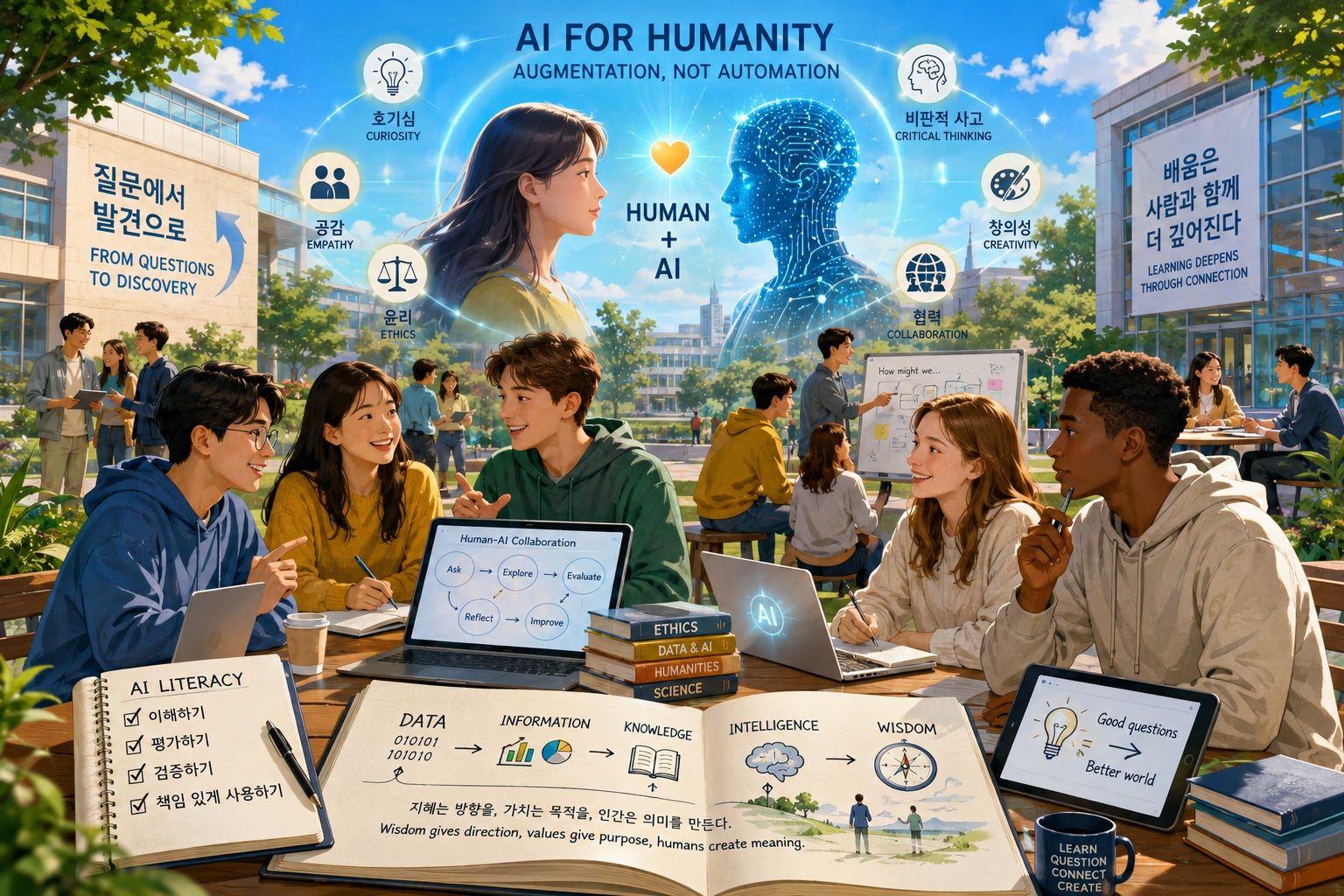
This leads naturally to a broader educational sequence: Data → Information → Knowledge → Intelligence → Wisdom. AI can help transform data into information and information into candidate knowledge. But wisdom requires human judgment about meaning, consequences, values, and responsibility. That final step remains profoundly human.
The University as a Human-AI Laboratory
The most interesting implication of the MIT report may be that universities should not simply react to AI. They can become laboratories for discovering how humans and AI should work together. MIT’s recommendation for continuous reflection, iteration, and improvement is especially important because AI technology will continue changing faster than traditional academic policy cycles. (MIT Office of the President)
A university might therefore establish an ongoing Human-AI Learning Laboratory in which faculty and students systematically examine: How does AI affect learning? Which assignments benefit from AI? Which assignments become less meaningful? When does AI improve creativity? When does AI encourage dependence? Which assessment methods measure genuine understanding? What forms of AI use promote equity? What forms create new inequalities? How should students document AI assistance? When should AI use be prohibited? These questions should not be answered once. They should become part of the institution’s continuing educational research.
A Lesson for American Higher Education
The MIT report was written for MIT, not for every university. Its findings should therefore not automatically be treated as a universal prescription. MIT has distinctive traditions, resources, students, faculty, and residential structures. The report itself emphasizes that “no one size fits all.” (NSP)
Nevertheless, its underlying questions have broad relevance. Every university must decide what learning means when AI is ubiquitous. Every professor must determine what students need to know independently. Every department must reconsider how it assesses mastery. Every student must learn how to use AI without surrendering intellectual independence. And every institution must determine what aspects of education are uniquely human and therefore worth protecting and strengthening.
Community colleges, liberal arts colleges, research universities, professional schools, and online institutions will necessarily respond differently. Yet all face the same historical transformation: the distinction between human-produced and machine-produced intellectual work is becoming increasingly difficult to maintain. The appropriate response is not necessarily to preserve the past unchanged. It is to preserve the purpose of education while redesigning its methods.
From AI Anxiety to Educational Wisdom
The public conversation about AI in education often swings between two extremes. One side fears that AI will destroy learning. The other imagines that AI will revolutionize education simply by making everything faster and more personalized. Both views can be incomplete.
Technology does not determine educational outcomes by itself. The design of the educational environment matters. A calculator can weaken arithmetic practice or enable students to explore more advanced mathematics. The internet can encourage shallow browsing or provide access to extraordinary knowledge. Generative AI can encourage intellectual dependence—or it can become a powerful partner in inquiry.
The decisive question is therefore not simply what AI can do. It is what humans choose to do with AI. That is why the MIT report matters beyond MIT. Its deeper contribution is an invitation to rethink education before technological convenience becomes educational philosophy.
What Should Remain Human?
The central question of the AI era may eventually become surprisingly simple: What should remain human when machines can do more and more of what humans once did? The answer cannot simply be “everything.”
Human beings have always used tools to extend their abilities. Writing extended memory. Books extended knowledge. Computers extended calculation. Networks extended communication. AI extends several of these capacities simultaneously. The goal, therefore, should not be to isolate human beings from machines.
It should be to ensure that human beings remain capable of judgment, responsibility, curiosity, empathy, creativity, skepticism, imagination, and moral choice while using increasingly powerful machines. This is why the MIT report’s emphasis on humanity is more than a philosophical statement. It is an educational strategy.
If AI can produce an essay, students should learn how to develop an argument. If AI can write code, students should learn how systems work and how to test them. If AI can summarize a book, students should learn how to interpret it. If AI can generate an image, students should learn how to view. If AI can propose a hypothesis, researchers should learn how to challenge it. If AI can give an answer, students should learn when to ask a better question. And if AI can imitate human wisdom, education must become even more serious about cultivating the real thing.
From Data to Wisdom
The MIT report arrives at an important historical moment. Universities are standing between two educational worlds. In the first, knowledge is scarce and teachers are primary gateways to information. In the second, information is abundant and intelligent machines are increasingly capable of generating explanations, code, images, arguments, and recommendations. The university cannot remain unchanged between these worlds. But neither should it surrender its human purpose.
The task ahead is not to build an education system in which humans compete with machines at everything machines do well. It is to create an education system in which humans learn to work with machines while developing capabilities that give those tools direction and meaning. This is ultimately a question of civilization, not merely technology.
The MIT report’s most enduring lesson may therefore be expressed in a simple progression: AI can generate information. Education must cultivate understanding. Experience must cultivate judgment. Community must cultivate responsibility. And wisdom must determine how intelligence is used.
The future of education will not be decided by whether universities permit or prohibit artificial intelligence. It will be decided by whether universities can teach a generation to use extraordinary artificial intelligence without losing ordinary human wisdom. That may be the real challenge—and the real opportunity—of education in the age of AI.
References
MIT’s Ad Hoc Committee on AI Use in Teaching, Learning, and Research Training. (2026, August 13). Report of MIT’s Ad Hoc Committee on AI Use in Teaching, Learning, and Research Training. Massachusetts Institute of Technology. https://aiandeducation.mit.edu/report/
Massachusetts Institute of Technology. (2026, January 14). Committee on AI Use in Teaching, Learning, and Research Training. MIT Organization Chart. https://orgchart.mit.edu/letters/committee-ai-use-teaching-learning-and-research-training
Kornbluth, S. (2026, August 25). AI and education: A watershed moment for MIT. Massachusetts Institute of Technology. https://president.mit.edu/writing-speeches/ai-and-education-watershed-moment-mit
Massachusetts Institute of Technology. (2026, August 26). MIT AI Community Hub.
https://aihub.mit.edu/
AI가 교실에 들어온다면, 무엇이 인간으로 남아야 하는가?
생성형 AI 시대의 교육을 다시 생각하다
초록
생성형 인공지능은 대학이 교육과정, 평가 방식, 학사정책을 다시 설계하는 속도보다 훨씬 빠르게 고등교육을 변화시키고 있다. 2026년 8월 13일 발표된 MIT’s Ad Hoc Committee on AI Use in Teaching, Learning, and Research Training 보고서는 이러한 변화에 대한 중요한 대응을 제시한다. 이 보고서는 AI를 단순히 금지해야 할 기술이나 무조건 도입해야 할 기술로 바라보지 않는다. 오히려 AI가 과거에는 학생의 지식과 능력을 보여주는 것으로 여겨졌던 많은 과제를 수행할 수 있게 된 시대에 ‘교육의 목적은 무엇인가?’라는 더 근본적인 질문을 던진다. MIT는 겸손, 대담함, 인간 중심성, 의도적 교육, 학습 중심 설계, 그리고 “자동화가 아닌 증강(augmentation not automation)” 등을 포함한 여덟 가지 원칙을 제시한다. 또한 AI 시대에 맞게 교육 과정을 변화시키고, 사람과 공동체를 강화하며, 지속적인 성찰과 개선을 위한 체계를 구축할 것을 제안한다(MIT’s Ad Hoc Committee on AI Use in Teaching, Learning, and Research Training, 2026). 이 보고서의 가장 중요한 교훈은 대학이 AI를 어떻게 통제해야 하는가에만 있지 않다. 오히려 AI가 존재하는 시대에 학습이란 무엇인가를 다시 정의해야 한다는 점에 있다. AI가 풍부한 교육 환경에서 대학의 가장 중요한 책임은 지식의 전달을 넘어 판단력, 호기심, 창의성, 윤리적 책임, 인간관계, 그리고 기계의 지능을 활용하면서도 자신의 주체성을 잃지 않는 능력을 길러주는 데 있을 것이다.
주요어: 인공지능, 생성형 AI, 고등교육, 리터러시, 디지털 리터러시, AI 리터러시, 인간 중심 교육, 평가, 학문적 진실성, 학습, MIT, 교육 혁신
질문 뒤에 있는 질문
모든 거대한 기술혁명은 결국 교육의 위기를 만들어낸다. 인쇄술은 누가 지식을 소유할 수 있는지를 바꾸었다. 산업화는 학교가 사회에 제공해야 할 교육의 내용을 변화시켰다. 컴퓨터는 정보를 생산하고 처리하는 방식을 바꾸었다. 생성형 AI는 또 하나의 거대한 변화를 일으키고 있다. 그러나 이번 변화에는 중요한 차이가 있다. 기계가 더 이상 단순히 정보를 저장하고 계산하거나 검색하는 데 그치지 않는다는 것이다. 이제 AI는 설명하고, 요약하고, 번역하고, 프로그램을 작성하고, 이미지를 만들고, 논리를 구성하며, 점점 더 연구와 창작 과정에도 참여하고 있다. 이러한 변화는 대학에 불편한 질문을 던진다. “기계가 답을 만들어낼 수 있다면, 학생은 무엇을 배워야 하는가?”
MIT의 2026년 보고서가 중요한 이유는 이 질문을 단순히 “학생들이 ChatGPT를 사용해도 되는가?”라는 문제로 축소하지 않기 때문이다. MIT 특별위원회는 처음에는 AI의 현재 사용 현황을 조사하고, 교육과 평가에서의 혁신을 검토하며, AI 사용 정책을 제안하는 임무를 맡았다. 그러나 위원회는 더 근본적인 문제가 AI 시대에 MIT 교육의 구조와 의미, 그리고 가치 자체를 다시 생각하는 것이라고 보았다(MIT’s Ad Hoc Committee on AI Use in Teaching, Learning, and Research Training, 2026).
이러한 관점의 전환이야말로 이 보고서에서 가장 중요한 부분이다. 이제 질문은 단순히 “학생들이 AI를 사용하지 못하게 하려면 어떻게 해야 하는가?”가 아니다. 오히려 다음과 같은 질문으로 바뀌어야 한다. “AI를 사용하는 것이 학생을 더욱 능력 있는 인간으로 성장시키도록 교육을 어떻게 설계할 것인가?”
AI를 막는 과제에서 AI를 고려하는 교육으로
전통적으로 대학은 과제를 학생의 학습을 증명하는 수단으로 활용해 왔다. 학생이 에세이를 쓰고, 문제를 풀고, 프로그램을 작성하거나, 발표를 준비하면 교수는 제출된 결과물이 학생의 지식과 능력을 반영한다고 가정한다.
생성형 AI는 이러한 가정을 흔들고 있다. 잘 작성된 에세이가 AI로 만들어졌을 수도 있다. 컴퓨터 프로그램이 AI에 의해 상당 부분 작성되었을 수도 있다. 문헌연구가 AI에 의해 요약되었을 수도 있다. 심지어 독창적으로 보이는 주장도 학생과 AI의 대화 과정에서 만들어졌을 가능성이 있다.
따라서 AI 사용을 제한하고, 사용 사실을 공개하도록 하거나, AI가 생성한 글을 탐지하려는 대응은 이해할 수 있다. 그러나 이것만으로는 교육적 문제를 해결할 수 없다. 과제 자체가 더 이상 학생이 습득해야 할 학습성과를 제대로 측정하지 못한다면, 기술을 감시하는 것만으로는 평가의 타당성을 회복할 수 없기 때문이다.
MIT 보고서는 따라서 ‘AI를 고려한 교육 과정(AI-aware educational process)’으로 나아갈 필요성을 제시한다. 즉, AI가 존재하는 환경을 전제로 학습목표, 과제, 평가, AI 사용정책을 의도적으로 다시 설계해야 한다는 것이다.
여기에서 교육설계의 근본적인 변화가 시작된다. 교수는 “AI가 절대로 해결할 수 없는 과제를 어떻게 만들 것인가?”라고 묻기보다 다음과 같이 물을 수 있다. “학생이 이 문제를 이해하고, 평가하고, 개선하고, 설명하고, 그 결과에 책임을 질 수 있다는 사실을 어떻게 증명하게 할 것인가?” 이것이 훨씬 생산적인 질문이다.
쉬운 숙제의 시대는 끝나는가?
생성형 AI가 숙제를 무의미하게 만드는 것은 아니다. 그러나 일부 전통적인 숙제는 학생 개인의 숙련도를 측정하는 도구로서 이전보다 정보가치를 잃을 수 있다. 예를 들어 전통적인 프로그래밍 과제를 생각해 보자. 학생은 문제를 받고 코드를 작성한 뒤 결과물을 제출하고 점수를 받는다. 그러나 AI가 코드의 상당 부분을 생성할 수 있다면 최종 결과물만으로는 학생이 실제로 무엇을 이해하고 있는지 판단하기 어려워진다.
그러나 바로 여기에서 새로운 교육의 기회가 생긴다. 교수는 학생에게 AI가 작성한 코드의 구조를 설명하게 하고, 약점을 찾아내게 하고, 서로 다른 해결책을 시험하게 하고, 사용한 프롬프트를 기록하게 하고, 보안 취약점을 찾아내게 하며, 설계 결정을 스스로 설명하도록 요구할 수 있다.
그러면 과제의 중심이 ‘단순한 생산(production)’에서 ‘생산과 판단(production plus judgment)’으로 이동한다. 이 차이는 매우 중요하다. AI는 생산의 일부를 자동화할 수 있지만, 동시에 평가의 중요성을 더욱 높일 수 있다. AI의 답을 그대로 받아들이는 학생은 오히려 덜 배울 수 있다. 반면 AI의 결과를 질문하고, 검증하고, 비판하고, 수정하고, 설명하는 학생은 더 많이 배울 가능성이 있다.
이것이 MIT가 제시한 ‘자동화가 아닌 증강(augmentation not automation)’이라는 원칙의 교육적 의미이다. 목표는 인간의 지적 활동을 기계의 결과물로 대체하는 것이 아니라, AI를 활용하여 인간의 학습과 능력을 강화하는 것이다. 자동화는 이렇게 묻는다. “기계가 나 대신 이것을 할 수 있는가?” 증강은 이렇게 묻는다. “기계가 내가 이것을 더 잘할 수 있도록 어떻게 도울 수 있는가?” 첫 번째 질문은 인간의 참여를 감소시킬 수 있다. 두 번째 질문은 인간의 능력을 확대할 수 있다.
답에서 질문으로
전통적인 교육은 학생이 올바른 답을 찾는 능력을 중요하게 평가해 왔다. 그러나 AI는 매우 빠른 속도로 그럴듯한 답을 만들어낼 수 있다. 그렇다면 AI 시대에 더욱 희소해지는 능력은 무엇일까? 어쩌면 그것은 좋은 질문을 만드는 능력일 것이다. 학생이 AI에게 “광합성을 설명해 주세요”라고 질문하면 AI는 답을 제공한다. 그러나 학생이 다음과 같이 질문한다면 상황은 달라진다. “이 설명에는 어떤 가정이 숨어 있는가?” “어떤 증거가 이 설명을 반박할 수 있는가?” “다른 생물학적 환경에서는 이 설명이 어떻게 달라지는가?” 이것은 완전히 다른 수준의 지적 활동이다.
따라서 AI 시대의 대학은 학생들에게 정보를 얻는 방법만 가르쳐서는 안 된다. 발견으로 이어지는 질문을 만드는 방법을 가르쳐야 한다. 이는 특히 연구에서 중요하다. AI는 문헌을 요약하고, 가설을 제안하고, 코드를 생성하고, 데이터를 분석하고, 논문 작성까지 도울 수 있다. 그러나 이러한 능력이 연구자에게 질문의 가치, 증거의 신뢰성, 방법론의 적절성, 결론의 타당성을 자동으로 판단해 주는 것은 아니다. AI는 연구를 빠르게 만들 수 있지만, 자동으로 지식을 만들어내지는 않는다. 무엇을 알아낼 가치가 있는지를 결정하는 것은 여전히 인간 연구자의 책임이다.
여덟 가지 원칙과 새로운 교육철학
MIT 보고서는 다음과 같은 여덟 가지 원칙을 제시한다.
1. 겸손하라(Be humble).
2. 대담하라(Be bold).
3. 인간을 중심에 두라(Put humanity front and center).
4. 학습에 집중하라(Lean into learning).
5. 의도적으로 가르쳐라(Teach with intentionality).
6. 하나의 방식으로 모든 것을 해결하려 하지 마라(No one size fits all).
7. 자동화가 아닌 증강을 추구하라(Augmentation not automation).
8. 교실과 캠퍼스를 넘어 생각하라(Think beyond the classroom and the campus).
이 원칙들은 단순한 AI 사용정책 이상의 의미를 가진다. 그것들은 하나의 새로운 교육철학을 구성한다.
“겸손”은 기술이 너무 빠르게 변화하기 때문에 오늘의 정책이 내일도 적절하다고 가정해서는 안 된다는 사실을 인정한다. “대담함”은 불확실성을 교육적 행동을 미루는 이유로 삼아서는 안 된다는 것을 의미한다. “인간 중심성”은 기술적 효율성만을 교육의 성공 기준으로 삼아서는 안 된다는 점을 강조한다. “학습에 집중하라”는 것은 학생이 만든 결과물보다 실제로 무엇을 배웠는지에 관심을 돌리게 한다. 특히 “의도적으로 가르쳐라”는 원칙은 중요하다. 학생이 정보를 즉시 얻을 수 있다면 교수는 각각의 교육활동이 왜 필요한지를 더욱 분명하게 설계해야 한다. “하나의 방식으로 모든 것을 해결하지 마라”는 원칙 역시 중요하다. 철학, 컴퓨터과학, 간호학, 예술, 역사, 공학, 실험과학에서 AI의 역할은 서로 다를 수밖에 없다. “자동화가 아닌 증강”은 인간과 기계의 관계를 규정한다. “교실과 캠퍼스를 넘어 생각하라”는 원칙은 대학이 AI가 이미 깊숙이 들어간 직장과 사회를 준비해야 한다는 사실을 보여준다.
따라서 이 보고서의 여덟 가지 원칙은 하나의 방향을 제시한다. 교육은 학생이 정보를 반복해서 재생산하는 능력보다 정보를 현명하게 사용하는 능력을 길러주는 방향으로 이동해야 한다.
인간의 존재는 오히려 더 중요해진다
AI 교육의 중심에는 하나의 역설이 존재한다. 기계가 대화를 더욱 잘하게 될수록 대학은 오히려 진정한 인간관계의 중요성을 더 강하게 발견할 수 있다. MIT 보고서는 사람과 공동체를 교육의 중심에 놓고, 대학의 실제 공동체 경험을 강화할 필요성을 강조한다. 교육은 단지 단순한 정보전달 과정만이 아니기 때문이다.
학생은 교수에게 질문한다. 친구와 논쟁한다. 연구팀에서 실패한다. 실험실에서 예상하지 못한 결과를 경험한다. 다른 문화와 가치관을 가진 사람을 만난다. 공동체 안에서 협력해야 한다. 멘토는 학생 자신도 아직 발견하지 못한 가능성을 발견해 줄 수 있다. 이러한 경험은 단순한 텍스트 생성으로 쉽게 대체하기 어렵다. 따라서 미래의 대학에는 역설이 생길 수 있다. 인공지능이 교육에 더 깊이 들어올수록 진정한 인간적 상호작용은 더욱 중요해질 것이다.
교수는 사라지는가?
AI에 관한 일부 미래 예측은 기계가 거의 모든 것을 설명할 수 있기 때문에 결국 교수가 필요하지 않게 될 것이라고 가정한다. MIT 보고서는 다른 가능성을 보여준다.
교수의 역할은 단순한 정보 제공자에서 지적 경험을 설계하는 사람으로 이동할 수 있다. 교수는 다음과 같은 질문을 던져야 한다. 학생들이 무엇을 발견해야 하는가? 무엇을 스스로 고민하게 해야 하는가? 무엇을 직접 경험하게 해야 하는가? 무엇을 토론하게 해야 하는가? 무엇을 만들어야 하는가? 무엇을 검증해야 하는가? 그리고 무엇에 대해 책임을 져야 하는가?
이러한 교육은 결코 쉬운 일이 아니다. 오히려 교수에게 더 높은 수준의 지적 설계를 요구할 수 있다. 단순히 정보를 전달하는 교수는 정보시스템으로 부분적으로 대체될 수 있다. 그러나 의미 있는 학습경험을 설계하고, 탐구를 지도하며, 사고를 평가하고, 학생을 멘토링하고, 지적 공동체를 만드는 교수는 쉽게 대체하기 어렵다. 따라서 미래의 교수는 더 적은 슬라이드와 더 많은 질문을 필요로 할지도 모른다.
평가는 학습을 따라가야 한다
MIT 보고서가 가져올 가장 직접적인 변화 중 하나는 평가일 것이다. 대학은 오랫동안 에세이, 시험, 프로젝트, 실험, 발표, 숙제를 통해 학생을 평가해 왔다. 이러한 방법들이 사라질 필요는 없지만 그 목적은 변화할 수 있다.
AI 시대의 평가는 최종 결과물뿐만 아니라 사고의 과정도 평가할 수 있다. 학생은 다음을 함께 제출할 수 있다.
처음 설정한 문제
사용한 AI 프롬프트
AI가 생성한 여러가지 답변
검증 과정
참고한 자료
발견한 오류
수정한 내용
학습에 대한 성찰
최종 결과에 대한 자신의 설명.
이러한 평가의 질문은 단순히 “답을 만들었는가?”가 아니다. 더 중요한 질문은 “그 답을 이해하고 있으며, 그 답을 스스로 설명하고 방어할 수 있는가?”이다. 이 차이는 매우 중요하다. AI를 책임 있게 사용한 학생이 반드시 학습을 회피했다고 볼 수는 없다. 반대로 훌륭한 AI 결과물을 제출했다고 해서 학생이 그것을 실제로 이해하고 있다고 자동으로 판단해서도 안 된다. 교육의 목적은 결과물 자체가 아니라 학습과 숙달이어야 하기 때문이다.
AI 리터러시는 새로운 핵심 학업능력이다
MIT 보고서는 또한 문해력의 의미를 다시 생각하게 한다. 수백 년 동안 문해력은 읽고 쓰는 능력을 의미했다. 이후 디지털 기술의 발전과 함께 컴퓨터와 네트워크, 디지털 정보를 활용하는 능력까지 포함하는 ‘디지털 리터러시’가 등장했다.
AI 시대에는 여기에 또 하나의 층위가 추가된다. ‘AI 리터러시’는 AI가 무엇을 할 수 있고 무엇을 할 수 없는지 이해하고, AI와 효과적으로 상호작용하며, 결과를 평가하고, 주장을 검증하고, 한계를 인식하고, 윤리적으로 활용하는 능력이다.
그러나 AI 리터러시는 단순히 “프롬트를 잘 작성하는 능력”을 의미하지 않는다. 프롬트 작성은 유용하지만 더 깊은 능력은 판단력이다. 아름다운 프롬트를 작성하고도 잘못된 AI 답변을 그대로 믿는다면 완전한 의미의 AI 리터러시라고 하기 어렵다.
반대로 AI의 불확실성을 인식하고, 증거를 요구하고, 출처를 확인하고, 여러 답변을 비교하고, 언제 AI를 사용하지 말아야 하는지를 판단하는 학생은 훨씬 높은 수준의 AI 리터러시를 보여준다. 이러한 관점은 다음과 같은 교육적 발전과 연결될 수 있다: 데이터 → 정보 → 지식 → 지능 → 지혜.
AI는 데이터를 정보로 바꾸고 정보로부터 지식의 후보를 만들어내는 데 도움을 줄 수 있다. 그러나 마지막 단계인 지혜는 의미와 결과, 가치와 책임을 판단해야 한다. 이 마지막 단계는 여전히 인간에게 깊이 연결되어 있다.
대학은 인간-AI 학습 실험실이 될 수 있다
MIT 보고서가 보여주는 가장 흥미로운 가능성 중 하나는 대학이 AI에 단순히 반응하는 기관이 아니라 인간과 AI가 어떻게 함께 일해야 하는지를 발견하는 실험실이 될 수 있다는 점이다. MIT는 지속적인 성찰, 반복, 개선의 필요성을 강조한다. AI 기술은 전통적인 대학 정책이 만들어지는 속도보다 훨씬 빠르게 변화하기 때문이다.
대학은 예를 들어 Human-AI Learning Laboratory와 같은 지속적인 교육연구 체계를 운영할 수 있다. 그 안에서 교수와 학생은 다음과 같은 질문을 계속 연구할 수 있다.
AI는 학습에 어떤 영향을 미치는가?
어떤 과제가 AI의 도움으로 더 좋은 학습경험이 되는가?
어떤 과제는 AI 때문에 교육적 의미를 잃는가?
AI는 언제 창의성을 향상시키는가?
AI는 언제 인간의 의존성을 증가시키는가?
어떤 평가가 실제 이해도를 가장 잘 측정하는가?
AI는 교육의 형평성에 어떤 영향을 미치는가?
어떤 AI 사용은 새로운 불평등을 만들어내는가?
학생은 AI의 도움을 어떻게 기록해야 하는가?
언제 AI 사용을 제한하거나 금지해야 하는가?
이 질문들에는 한 번의 정답이 존재하지 않는다. 오히려 이러한 질문 자체가 대학의 지속적인 교육연구 과제가 되어야 한다.
미국 고등교육을 위한 교훈
MIT 보고서는 MIT라는 특정 대학을 대상으로 작성되었다. 따라서 보고서의 모든 내용을 모든 대학에 동일하게 적용할 수 있는 보편적인 처방으로 받아들여서는 안 된다. MIT는 고유한 교육 전통, 학생, 교수진, 자원, 캠퍼스 문화를 가지고 있다. 보고서 자체도 “하나의 방식으로 모든 것을 해결할 수 없다”고 강조한다.
그럼에도 불구하고 보고서가 제기하는 근본적인 질문은 광범위한 의미를 갖는다. AI가 보편화된 시대에 학습이란 무엇인가? 학생이 독립적으로 습득해야 할 지식과 능력은 무엇인가? 각 학과는 어떻게 학생의 숙달도를 평가해야 하는가? 학생은 AI를 어떻게 활용하면서도 자신의 지적 독립성을 유지해야 하는가? 대학은 어떤 교육 경험이 본질적으로 인간적이며 따라서 더욱 보호하고 강화해야 할 가치가 있는지를 어떻게 결정해야 하는가?
커뮤니티 칼리지, 리버럴아츠 칼리지, 연구중심 대학, 전문대학원, 온라인 대학은 서로 다른 방식으로 대응할 것이다. 그러나 모두 같은 역사적 변화에 직면하고 있다. 인간이 생산한 지적 결과물과 기계가 생산한 지적 결과물 사이의 경계가 점점 더 흐려지고 있는 것이다. 이에 대한 적절한 대응은 과거의 교육을 그대로 보존하는 것이 아니다. 보존해야 할 것은 교육의 목적이고, 변화시켜야 할 것은 그 목적을 실현하는 방법이다.
AI에 대한 불안에서 교육적 지혜로
교육에서 AI에 관한 대중적 논의는 종종 두 극단 사이를 오간다. 한쪽에서는 AI가 학습을 파괴할 것이라고 우려한다. 다른 한쪽에서는 AI가 모든 것을 더 빠르고 개인화된 방식으로 만들어 교육을 혁신할 것이라고 기대한다. 그러나 두 관점 모두 충분하지 않을 수 있다.
기술 그 자체가 교육의 결과를 결정하지 않는다. 중요한 것은 교육환경을 어떻게 설계하는가이다. 계산기는 산술 연습을 약화시킬 수도 있지만 더 높은 수준의 수학을 탐구할 수 있도록 도울 수도 있다. 인터넷은 피상적인 검색을 조장할 수도 있지만 동시에 놀라운 지식에 접근하게 할 수도 있다. 생성형 AI도 마찬가지다. AI는 지적 의존성을 증가시킬 수도 있고, 반대로 탐구를 위한 강력한 동반자가 될 수도 있다.
따라서 결정적인 질문은 단순히 “AI가 무엇을 할 수 있는가?”가 아니다. 더 중요한 질문은 “인간은 AI를 가지고 무엇을 하기로 선택하는가?”이다. 바로 이 점에서 MIT 보고서는 MIT를 넘어서는 의미를 가진다. 기술적 편리성이 교육철학 자체가 되기 전에 교육을 다시 생각하자는 초대이기 때문이다.
무엇이 인간으로 남아야 하는가?
AI 시대의 궁극적인 질문은 의외로 간단할 수 있다. “기계가 인간이 과거에 하던 일을 점점 더 많이 수행할 수 있게 되었을 때, 무엇이 인간으로 남아야 하는가?” 답이 “모든 것”일 수는 없다. 인간은 언제나 도구를 사용하여 자신의 능력을 확장해 왔다.
문자는 기억을 확장했다. 책은 지식을 확장했다. 컴퓨터는 계산능력을 확장했다. 네트워크는 의사소통 능력을 확장했다. AI는 이러한 여러 능력을 동시에 확장하고 있다. 따라서 목표는 인간을 기계로부터 고립시키는 것이 아니다. 목표는 인간이 점점 더 강력해지는 기계를 사용하면서도 판단력, 책임감, 호기심, 공감, 창의성, 비판적 사고, 상상력, 도덕적 선택능력을 잃지 않도록 하는 것이다.
그렇기 때문에 MIT 보고서가 강조하는 인간 중심성은 단순한 철학적 선언이 아니다. 그것은 하나의 ‘교육전략’이다. AI가 에세이를 쓸 수 있다면 학생은 논증을 만들어내는 법을 배워야 한다. AI가 코드를 작성할 수 있다면 학생은 시스템이 어떻게 작동하는지, 그리고 그 시스템을 어떻게 검증하는지를 배워야 한다. AI가 책을 요약할 수 있다면 학생은 책을 해석하는 법을 배워야 한다. AI가 이미지를 생성할 수 있다면 학생은 관찰하는 법을 배워야 한다. AI가 가설을 제안할 수 있다면 연구자는 그 가설에 질문을 던지는 법을 배워야 한다. AI가 답을 제공할 수 있다면 학생은 언제 더 좋은 질문을 해야 하는지를 배워야 한다. 그리고 AI가 인간의 지혜를 흉내 낼 수 있다면 교육은 오히려 진짜 지혜를 길러내는 일을 더욱 진지하게 받아들여야 한다.
데이터에서 지혜로
MIT 보고서는 대학이 역사적으로 중요한 순간에 서 있음을 보여준다. 한쪽에는 지식이 부족하고 교사가 정보에 접근하는 주요 통로였던 교육세계가 있다. 다른 한쪽에는 정보가 넘쳐나고 지능적인 기계가 설명, 코드, 이미지, 논리, 추천 등을 만들어내는 교육세계가 있다. 대학은 이 두 세계 사이에서 과거와 똑같은 모습으로 머물 수 없다. 그러나 그렇다고 해서 인간적인 교육의 목적을 포기해서도 안 된다.
앞으로의 과제는 인간이 기계가 잘하는 모든 일을 기계와 경쟁하도록 만드는 것이 아니다. 오히려 인간이 기계와 함께 일하는 법을 배우면서, 그 강력한 도구에 방향과 의미를 부여할 수 있는 능력을 갖추도록 하는 교육체계를 만드는 것이다. 이것은 단순한 기술의 문제가 아니다. 궁극적으로는 문명의 문제이다.
MIT 보고서의 가장 오래 지속될 수 있는 교훈은 다음과 같이 표현할 수 있을 것이다.
AI는 정보를 생성할 수 있다.
교육은 이해를 길러야 한다.
경험은 판단을 길러야 한다.
공동체는 책임을 길러야 한다.
그리고 지혜는 지능이 어떻게 사용될 것인지를 결정해야 한다.
AI 시대의 교육은 대학이 인공지능을 허용하느냐 금지하느냐에 의해 결정되지 않을 것이다. 교육의 미래는 대학이 한 세대의 학생들에게 엄청난 인공지능을 활용하면서도 평범하지만 소중한 인간의 지혜를 잃지 않는 법을 가르칠 수 있는가에 의해 결정될 것이다. 아마 이것이 AI 시대 교육이 직면한 가장 큰 도전이자 동시에 가장 큰 기회일 것이다.
참고문헌
MIT’s Ad Hoc Committee on AI Use in Teaching, Learning, and Research Training. (2026, August 13). Report of MIT’s Ad Hoc Committee on AI Use in Teaching, Learning, and Research Training. Massachusetts Institute of Technology. https://aiandeducation.mit.edu/report/
Massachusetts Institute of Technology. (2026, January 14). Committee on AI Use in Teaching, Learning, and Research Training. MIT Organization Chart. https://orgchart.mit.edu/letters/committee-ai-use-teaching-learning-and-research-training
Kornbluth, S. (2026, August 25). AI and education: A watershed moment for MIT. Massachusetts Institute of Technology. https://president.mit.edu/writing-speeches/ai-and-education-watershed-moment-mit
Massachusetts Institute of Technology. (2026, August 26). MIT AI Community Hub.
https://aihub.mit.edu/
2026년 10월 7일
{솔티}

Prof. Dr. Young Choi (Editor-in-Chief) — Regent University
Young B. Choi is a Professor in the Department of Engineering & Computer Science at Regent University. He published 38 books with ‘Selected Readings in Cybersecurity’ (2018) (over 800 copies archived globally at university/college libraries around the world) and ‘Cybersecurity Applications and Artificial Intelligence’ (2023) available in seven major world languages. He proposed the world’s first global and universal telecommunications “Service Order Handling (SOH)” Model (T-SOH Model) (1995) with Dr. Adrian Tang. With this innovative research work, he received the IEEE NOMS ’96 Best Paper Award and became the first recipient of the Outstanding Contribution Award of the TeleManagement Forum in 1998. His research areas include Natural Language Processing-focused AI, AI-applied cybersecurity, network and telecom service management, and Korean studies on Gani Choi Rip’s Jeonggwan (靜觀: Quiet Contemplation) philosophy and Shilhak ( 實學: Practical Learning).
© K-GSP (K-Global Scholars and Professionals) Forum. All rights reserved. 2026.
Suggested Citation:
Choi, Y. B. (2026, October 7). When AI Enters the Classroom, What Should Remain Human?: Rethinking Education in the Age of Generative AI. K-GSP.