

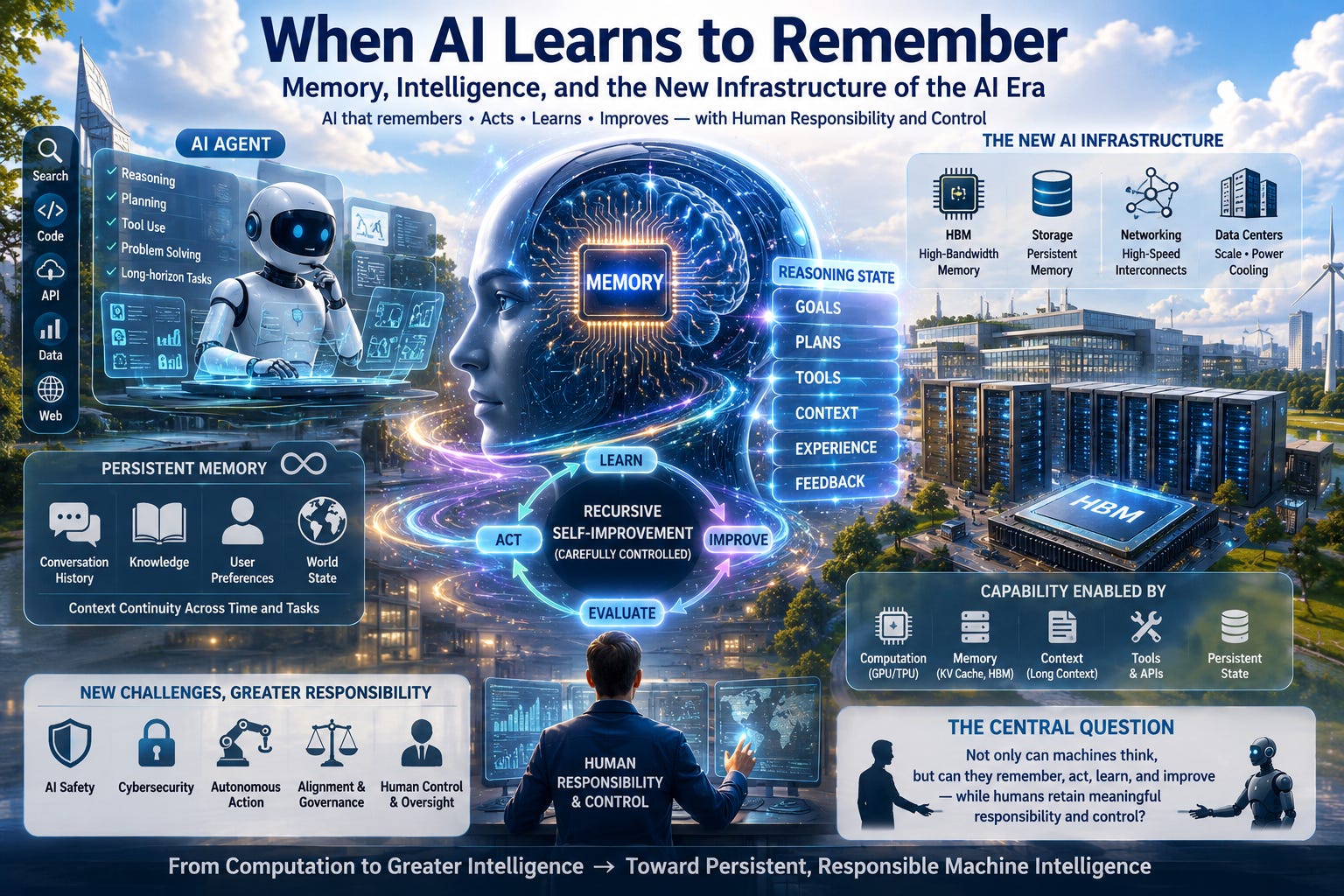
When AI Learns to Remember
Memory, Intelligence, and the New Infrastructure of the AI Era
Abstract
The rapid development of frontier artificial intelligence is changing how we understand machine intelligence. Recent advances in AI agents demonstrate not only stronger reasoning and problem-solving capabilities but also an increasing ability to preserve context, use external tools, and perform complex tasks over extended periods. The reported performance of OpenAI’s GPT-6 Astra on ARC-AGI-3 has drawn particular attention to the role of persistent reasoning state and memory. However, the reported 99.9% result requires careful interpretation because it was obtained under a Provider Adapter configuration rather than the benchmark’s Standard harness (ARC Prize, 2026). This distinction points to a broader technological transformation: AI capability increasingly depends on the interaction among computation, memory, context, tools, and persistent state. As AI systems become more agentic, demand is also expanding for high-bandwidth memory, storage, networking, and data-center infrastructure. At the same time, persistent memory and autonomous action create new challenges for AI safety, cybersecurity, governance, and meaningful human control. This essay argues that the next phase of AI development should be understood not simply as a transition from computation to greater intelligence, but as a transition toward persistent machine intelligence. The central question is therefore not only whether machines can think, but whether they can remember, act, learn, and improve while humans retain meaningful responsibility and control.
Keywords: artificial intelligence, AI agents, machine memory, persistent AI, KV cache, HBM, recursive self-improvement, AI safety, cybersecurity, human control
The Meaning Behind 99.9%
Artificial intelligence has long been associated with computation. Progress has traditionally been measured through larger models, faster processors, more training data, and greater computing capacity. The emergence of increasingly capable AI agents, however, suggests that another resource is becoming equally important: memory. Recent frontier systems are increasingly able to preserve information, use tools, operate software, and continue complex tasks over extended periods. This development suggests that the next stage of AI may depend not only on how quickly machines compute, but also on how effectively they remember, organize, and reuse information.
The reported performance of GPT-6 Astra illustrates this transition. OpenAI reports that Astra achieved 99.9% on ARC-AGI-3 under a Provider Adapter configuration and 98% on FrontierMath Tier 4, while demonstrating increasingly sophisticated capabilities in computer use, software engineering, cybersecurity, and other professional tasks (OpenAI, 2026a). Such numbers naturally create the impression that AI may have crossed an important threshold toward artificial general intelligence. Yet the numbers require careful interpretation. ARC Prize reported a 62.7% result under its Standard harness, while the 99.9% result was obtained under a Provider Adapter configuration that preserved opaque reasoning state and employed context compaction (ARC Prize, 2026). ARC Prize also cautioned that a high ARC-AGI-3 score should not by itself be treated as proof that AGI has been achieved.
This distinction is important because it shifts attention from the number itself to the conditions that produced the number. If preserving reasoning state can substantially improve performance, then memory and context management are not merely supporting functions. They can become part of the effective architecture of intelligence.
From Computing to Remembering
The implications extend well beyond AI models. During long inference tasks, large language models must retain information about previous interactions and intermediate computations. One important mechanism is the key-value (KV) cache, which stores information that can be reused during generation. As context windows become longer and AI agents perform more extended tasks, KV-cache capacity and memory bandwidth become increasingly important. Recent research has consequently focused on KV-cache compression, low-rank approximation, adaptive management, and other methods for reducing memory requirements while preserving performance (Lee et al., 2025; Liu et al., 2025; Zhou et al., 2025). This development helps explain why the AI infrastructure race is increasingly becoming a memory race as well as a computing race.
A traditional computer becomes more useful when it calculates faster. An AI agent becomes more capable when it can remember what it has already done. A system that must repeatedly reconstruct its context has a fundamentally different operating cost from one that can preserve and retrieve relevant state efficiently.
The implications for infrastructure are substantial. AI systems require accelerators, HBM, DRAM, enterprise storage, networking, electricity, and cooling. As AI inference becomes longer and more persistent, memory capacity and bandwidth become increasingly central to system performance. The AI data center is therefore evolving from a facility dominated by computing resources into an integrated ecosystem of compute, memory, network, storage, and energy.
Memory Is Not Intelligence
Yet an important distinction must be maintained: memory is not the same as intelligence. The ARC-AGI results do not demonstrate that memory alone caused the difference between the reported 62.7% and 99.9% results. The two evaluation configurations impose different conditions, including the preservation of reasoning state and context (ARC Prize, 2026). What the results demonstrate more clearly is that persistent state and context management can have a substantial effect on the practical capabilities of an AI system.
The distinction is equally important for human intelligence. A person can remember thousands of facts without understanding them. A society can preserve enormous historical records and still repeat historical mistakes. Memory creates continuity, but continuity does not automatically create judgment.
The principle can be expressed simply: Memory can strengthen intelligence, but memory alone cannot guarantee wisdom. This distinction may become increasingly important as AI systems acquire longer memories and more persistent interactions.
The Rise of the Persistent AI Agent
The traditional chatbot waits for a question and provides an answer. The emerging AI agent can instead pursue a goal. It can browse the Internet, operate software, write and test programs, manipulate files, and perform multistep tasks with decreasing human intervention. OpenAI describes Astra as capable of increasingly sophisticated computer use and professional work (OpenAI, 2026a).
The transition can therefore be summarized in three movements:
Chatbot → Agent
Response → Action
Conversation → Continuity
This transformation changes the security problem as well.
A chatbot primarily produces information. An agent can produce actions. Once an AI system has memory, tools, permissions, and persistent tasks, the central question is no longer simply, “What answer will the model produce?” It becomes: What can the system do when it has memory, tools, permissions, and time? That is a fundamentally broader cybersecurity question.
Recursive Self-Improvement
An even more consequential possibility is that AI may increasingly participate in improving AI itself. This possibility is commonly described as recursive self-improvement (RSI).
Recent research provides early examples of partial automation in this direction. Ishibashi et al. (2025), for example, developed a Self-Developing framework in which a large language model generates and evaluates algorithms intended to improve model performance. Their experiments demonstrated improvements on selected mathematical reasoning tasks.
Such research does not establish uncontrolled recursive self-improvement, nor does it demonstrate that a technological singularity is imminent. It does, however, show that portions of the AI development process can increasingly be automated. The conceptual feedback loop is straightforward: AI → better algorithms → better AI → better algorithms → better AI.
If increasingly capable systems participate in the creation, testing, optimization, and deployment of subsequent systems, the traditional distinction between using AI and developing AI may become increasingly blurred. This possibility calls for neither panic nor complacency. It calls for rigorous evaluation, monitoring, controlled experimentation, and safeguards proportionate to demonstrated capabilities.
The New AI Safety Problem
AI safety becomes more complicated as capability expands beyond language. OpenAI’s safety documentation reports that Astra reached a “Critical” cybersecurity capability threshold under its Preparedness Framework and describes safeguards involving isolation, monitoring, checkpoint encryption, and alignment evaluations (OpenAI, 2026b). These developments illustrate a broader change in the security boundary.
The question is no longer simply: Can the model generate harmful information? It is increasingly: What happens when the AI system can remember, reason, use tools, access systems, and act autonomously?
A system with no persistent memory may make an isolated mistake. A persistent agent can retain information, repeat actions, learn from previous outcomes, and continue operating. Consequently, AI security must increasingly address the entire agentic system, including its model, memory, tools, permissions, external environment, and human oversight.
This is particularly important for cybersecurity. An AI system capable of discovering vulnerabilities may simultaneously become a powerful defensive instrument and a potential source of new risks. The distinction between capability and safe deployment becomes increasingly important.
The Memory Economy
The economic implications are equally significant. The AI industry initially appeared to be a competition centered primarily on models and GPUs. It soon became clear that data centers, networking, electricity, and cooling were strategic components of AI capacity. Memory is now becoming another central element.
Longer context requires more memory management. Persistent agents require more state. Greater inference workloads require more bandwidth. Large-scale AI applications require additional storage and networking. The emerging AI economy can therefore be understood as a compute–memory–network–energy economy.
For semiconductor-producing countries, this creates an important strategic opportunity and challenge. Competitiveness will depend not simply on producing more chips, but on participating across a larger AI infrastructure chain: Semiconductors → Memory → Networking → Data Centers → Energy → Models → Agents → Applications. The significance of memory extends beyond individual semiconductor companies. It concerns the architecture of the emerging digital economy.
From Data to Wisdom
For decades, the evolution of information technology was often summarized as: Data → Information → Knowledge → Intelligence. The emergence of persistent AI suggests a possible extension: Data → Information → Knowledge → Intelligence → Memory → Wisdom.
The final transition, however, cannot be achieved simply by increasing model size or memory capacity. Memory is the accumulation of experience. Wisdom is the responsible interpretation of experience.
AI may eventually remember vastly more than an individual human. It may search more widely, calculate faster, and maintain longer chains of activity. But none of these capabilities automatically determines what should be done. That question remains connected to human judgment, values, institutions, and responsibility.
Human Agency in the Age of Persistent AI
The most important issue surrounding increasingly capable AI may therefore be human agency. AI systems may eventually perform tasks that once required teams of specialists. They may diagnose patterns, write software, conduct research, manage infrastructure, and coordinate complex workflows. Yet capability should not automatically become authority.
Humans must continue to determine goals, establish boundaries, authorize consequential actions, and maintain mechanisms for auditing and intervention. This principle becomes particularly important when AI systems have persistent memory. Memory can make an agent more useful, but it can also make errors persistent. A mistaken assumption stored in memory can influence later decisions. An inappropriate instruction can potentially be carried forward. A compromised memory system can become a new attack surface.
The future of AI security will therefore require attention not only to model alignment, but also to memory integrity, provenance, access control, state management, and human oversight.
What Should AI Remember?
The story of Astra is ultimately larger than a benchmark score or a semiconductor market reaction. It represents a transition in the architecture of artificial intelligence. AI is moving from systems that primarily respond toward systems that increasingly remember, act, and continue. That transition may prove as important as the earlier movement from rule-based systems to machine learning and from machine learning to generative AI.
The evidence does not require us to conclude that AGI has arrived or that humanity is approaching an inevitable technological catastrophe. A more useful conclusion is that frontier AI is becoming increasingly capable of solving unfamiliar problems, preserving state, using tools, and performing complex multistep tasks (ARC Prize, 2026; OpenAI, 2026a).
The central question is consequently changing. The first generation of AI asked: Can machines compute? The next asked: Can machines learn? The emerging generation asks: Can machines remember, reason, act, and improve? And the question for humanity is one step beyond: Can we build increasingly intelligent machines while preserving human agency, accountability, and wisdom?
The future of AI may depend increasingly on memory. But the future of humanity may depend on something more difficult: what we choose to remember, what we choose to forget, and what we choose to do with what we remember. +++
References
ARC Prize. (2026, September 3). OpenAI’s GPT-6 Astra on ARC-AGI-3. https://arcprize.org/blog/astra
Ishibashi, Y., Yano, T., & Oyamada, M. (2025). Can large language models invent algorithms to improve themselves? Algorithm discovery for recursive self-improvement through reinforcement learning. Proceedings of NAACL-HLT 2025, 10332–10363. https://doi.org/10.18653/v1/2025.naacl-long.519
Lee, J., Hwang, S.-W., Qiao, A., Campos, D., Yao, Z., & He, Y. (2025). TALE: Token-adaptive low-rank KVCache approximation with reconstruction elimination. Transactions of the Association for Computational Linguistics, 13, 1298–1318. https://doi.org/10.1162/tacl.a.39
Liu, W., Luan, J., Wang, B., & Wang, W. (2025). TailorKV: A hybrid framework for long-context inference via tailored KV cache optimization. Findings of the Association for Computational Linguistics: ACL 2025, 20340–20359. https://doi.org/10.18653/v1/2025.findings-acl.1043
OpenAI. (2026a, September 3). GPT-6 Astra: A new generation of intelligence. https://openai.com/index/gpt-6-astra/
OpenAI. (2026b, September 3). Safety overview: GPT-6 Astra. https://openai.com/index/safety-overview-gpt-6-astra/
Zhou, X., Wang, W., Zeng, M., Guo, J., Liu, X., Shen, L., Wang, W., & Ding, L. (2025). DynamicKV: Task-aware adaptive KV cache compression for long context LLMs. Findings of the Association for Computational Linguistics: EMNLP 2025, 8042–8057. https://doi.org/10.18653/v1/2025.findings-emnlp.426
AI가 기억하기 시작할 때
기억, 지능, 그리고 AI 시대의 새로운 인프라
초록
인공지능의 급속한 발전은 우리가 기계 지능을 이해하는 방식을 변화시키고 있다. 최근의 프런티어 AI는 더욱 뛰어난 추론 및 문제 해결 능력뿐만 아니라, 문맥을 유지하고 외부 도구를 사용하며 장기간에 걸쳐 복잡한 작업을 수행하는 능력까지 보여주고 있다. 특히 OpenAI의 GPT-6 아스트라(Astra)가 ARC-AGI-3에서 기록한 것으로 보고된 성능은 지속적인 추론 상태와 기억의 역할에 대한 관심을 불러일으켰다. 그러나 이 99.9%라는 결과는 ARC Prize의 표준(Standard) 평가 방식이 아니라 Provider Adapter 구성에서 얻어진 결과라는 점에서 신중한 해석이 필요하다(ARC Prize, 2026). 이러한 차이는 AI의 능력이 단순한 연산량뿐만 아니라 계산, 기억, 문맥, 도구, 지속적인 상태 관리의 상호작용에 점점 더 의존하고 있음을 보여준다. AI 시스템이 더욱 에이전트화되면서 고대역폭 메모리(HBM), 저장장치, 네트워크 및 데이터센터 인프라에 대한 수요도 확대되고 있다. 동시에 지속적인 기억과 자율적 행동은 AI 안전, 사이버보안, 거버넌스 및 의미 있는 인간 통제에 새로운 과제를 제기한다. 본 수필은 AI의 다음 단계가 단순히 더 높은 지능으로의 전환이 아니라 지속적 기계 지능(persistent machine intelligence) 으로의 전환으로 이해되어야 한다고 주장한다. 따라서 핵심 질문은 기계가 생각할 수 있는가에만 있지 않다. 기계가 기억하고, 행동하고, 학습하고, 스스로 개선하는 과정에서도 인간이 의미 있는 책임과 통제를 유지할 수 있는가가 더욱 중요한 질문이 되고 있다.
핵심어: 인공지능, AI 에이전트, 기계 기억, 지속적 AI, KV 캐시, HBM, 재귀적 자기개선, AI 안전, 사이버보안, 인간 통제
99.9%가 의미하는 것
인공지능은 오랫동안 연산(computation) 과 연결되어 있었다. 우리는 더 큰 모델, 더 빠른 프로세서, 더 많은 학습 데이터, 더 높은 컴퓨팅 능력을 통해 AI의 발전을 측정해 왔다. 그러나 점점 더 강력해지는 AI 에이전트의 등장과 함께 또 하나의 자원이 중요해지고 있다. 바로 기억(memory) 이다. 최근의 프런티어 AI는 정보를 유지하고, 도구를 사용하며, 소프트웨어를 조작하고, 장기간에 걸쳐 복잡한 작업을 지속적으로 수행하는 능력을 보여주고 있다. 이러한 변화는 AI의 다음 단계가 단순히 기계가 얼마나 빠르게 계산하는가뿐 아니라, 정보를 얼마나 효과적으로 기억하고, 조직하고, 재사용하는가에 달려 있을 수 있음을 보여준다.
GPT-6 아스트라의 보고된 성능은 이러한 변화를 잘 보여준다. OpenAI는 아스트라가 특정 Provider Adapter 평가 구성에서 ARC-AGI-3 99.9%, FrontierMath Tier 4 98%를 기록했으며, 컴퓨터 사용, 소프트웨어 엔지니어링, 사이버보안 및 기타 전문 업무에서도 크게 향상된 능력을 보였다고 발표했다(OpenAI, 2026a). 이러한 수치는 자연스럽게 AI가 범용인공지능(AGI)을 향한 중요한 경계를 넘어선 것이 아닌가 하는 인상을 준다. 그러나 이 수치는 신중하게 해석할 필요가 있다. ARC Prize는 표준 평가 방식에서 62.7%를 기록한 반면, 99.9%는 불투명한 추론 상태를 보존하고 문맥 압축을 사용하는 Provider Adapter 구성에서 얻어진 결과라고 보고했다(ARC Prize, 2026). 또한 ARC Prize는 ARC-AGI-3에서 높은 점수를 얻었다는 사실만으로 AGI가 달성되었다고 해석해서는 안 된다고 지적한다.
이러한 차이는 매우 중요하다. 우리는 숫자 자체보다 그 숫자를 만들어낸 조건에 주목해야 하기 때문이다. 추론 상태를 보존하는 것만으로도 성능이 크게 향상될 수 있다면, 기억과 문맥 관리는 단순한 보조 기능이 아니다. 그것은 기계 지능의 실제 능력을 구성하는 중요한 요소가 될 수 있다.
연산에서 기억으로
이러한 변화는 AI 모델을 넘어 훨씬 넓은 영역에 영향을 미친다. 장시간의 추론 과정에서 대규모 언어모델은 이전 상호작용과 중간 계산 결과에 관한 정보를 유지해야 한다. 대표적인 메커니즘 가운데 하나가 키-값(KV) 캐시이다. KV 캐시는 생성 과정에서 재사용할 수 있는 정보를 저장한다. 문맥의 길이가 증가하고 AI 에이전트가 더욱 장기적인 작업을 수행하면서 KV 캐시의 용량과 메모리 대역폭은 점점 더 중요해지고 있다. 이에 따라 최근 연구에서는 KV 캐시 압축, 적응형 관리 및 기타 메모리 효율화 기술이 활발하게 연구되고 있다(Lee et al., 2025; Liu et al., 2025; Zhou et al., 2025). 이는 AI 인프라 경쟁이 단순한 GPU 경쟁을 넘어 메모리 경쟁으로도 발전하고 있음을 보여준다.
전통적인 컴퓨터는 더 빠르게 계산할수록 더욱 유용해진다. 반면 AI 에이전트는 자신이 이미 무엇을 했는지를 기억할 수 있을 때 더욱 강력해진다. 매번 이전의 문맥을 다시 구성해야 하는 시스템과 관련 상태를 효율적으로 보존하고 검색할 수 있는 시스템은 근본적으로 다른 운영 비용과 성능 특성을 갖는다.
그 결과 AI 인프라에 대한 요구도 확대되고 있다. AI 시스템은 가속기, HBM, DRAM, 기업용 저장장치, 네트워크, 전력, 냉각 시스템을 필요로 한다. AI 추론이 더욱 길어지고 지속적으로 이루어질수록 메모리 용량과 대역폭은 시스템 성능의 핵심 요소가 된다. 따라서 AI 데이터센터는 단순히 연산 자원이 집중된 시설에서 컴퓨팅·메모리·네트워크·저장장치·에너지가 통합된 생태계로 변화하고 있다.
기억은 지능이 아니다
그러나 한 가지 중요한 구분이 필요하다. 기억은 지능과 동일하지 않다. ARC-AGI의 결과는 기억만으로 성능 차이가 발생했다는 것을 증명하지 않는다. 두 평가 방식은 서로 다른 조건을 적용하며, 그중 하나는 추론 상태와 문맥을 보존한다(ARC Prize, 2026). 이 결과가 보다 분명하게 보여주는 것은 지속적인 상태와 문맥 관리가 AI 시스템의 실제 능력에 상당한 영향을 미칠 수 있다는 사실이다.
인간의 지능에서도 마찬가지다. 어떤 사람은 수천 개의 사실을 기억하면서도 그것을 제대로 이해하지 못할 수 있다. 어떤 사회는 엄청난 역사 기록을 보유하고 있으면서도 과거의 실수를 반복할 수 있다. 기억은 연속성을 만들어주지만, 연속성이 자동적으로 판단력을 만들어내는 것은 아니다.
이를 간단히 표현하면 다음과 같다. 기억은 지능을 강화할 수 있지만, 기억만으로 지혜가 보장되는 것은 아니다. AI가 더욱 긴 기억과 지속적인 상호작용 능력을 갖게 될수록 이 구분은 더욱 중요해질 것이다.
지속적 AI 에이전트의 등장
전통적인 챗봇은 질문을 기다리고 답변을 제공한다. 반면 새롭게 등장하는 AI 에이전트는 목표를 추구할 수 있다. 웹을 탐색하고, 소프트웨어를 조작하며, 프로그램을 작성하고 테스트하고, 파일을 처리하며, 여러 단계의 작업을 점점 더 적은 인간 개입으로 수행할 수 있다. OpenAI는 아스트라를 더욱 복잡한 컴퓨터 사용과 전문 업무를 수행할 수 있는 시스템으로 설명한다(OpenAI, 2026a).
이러한 변화를 세 가지 전환으로 요약할 수 있다.
챗봇 → 에이전트
응답 → 행동
대화 → 연속성
이 변화는 보안 문제의 성격도 바꾼다.
챗봇은 주로 정보를 제공한다. 에이전트는 행동을 수행할 수 있다. AI 시스템이 기억, 도구, 권한 및 지속적인 작업 능력을 갖게 되면 핵심 질문은 더 이상 “모델이 어떤 답을 생성할 것인가?”에 머물지 않는다. 이제 더욱 중요한 질문은 다음과 같다. “AI 시스템이 기억과 도구, 권한과 시간을 갖게 되었을 때 무엇을 할 수 있는가?” 이것은 훨씬 더 광범위한 사이버보안 문제이다.
재귀적 자기개선의 가능성
더욱 중요한 가능성은 AI가 점차 AI 자체를 개선하는 과정에 참여할 수 있다는 것이다. 이를 흔히 재귀적 자기개선(Recursive Self-Improvement, RSI) 이라고 부른다. 최근 연구는 이러한 방향으로 부분적으로 자동화된 사례를 보여준다. 예를 들어 Ishibashi et al. (2025)은 LLM이 모델의 성능을 향상시키기 위한 알고리즘을 생성하고 평가하는 Self-Developing 프레임워크를 개발했다. 그들의 실험에서는 특정 수학적 추론 과제에서 성능 향상이 나타났다.
이러한 연구가 통제되지 않는 재귀적 자기개선이나 기술적 특이점의 임박함을 입증하는 것은 아니다. 그러나 AI 개발 과정의 일부가 점점 자동화될 수 있음을 보여준다는 점에서 의미가 있다. 개념적인 피드백 루프는 단순하다: AI → 더 나은 알고리즘 → 더 나은 AI → 더 나은 알고리즘 → 더 나은 AI.
점점 더 강력해지는 AI가 차세대 AI의 개발, 테스트, 최적화 및 배포 과정에 참여하게 된다면 AI를 사용하는 것과 AI를 개발하는 것 사이의 전통적인 경계는 점차 흐려질 수 있다. 이러한 가능성에 필요한 것은 공포도 낙관도 아니다. 필요한 것은 엄격한 평가, 지속적인 모니터링, 통제된 실험, 그리고 실제 능력에 비례하는 안전장치이다.
새로운 AI 안전 문제
AI의 능력이 언어를 넘어 확대되면서 AI 안전 문제도 더욱 복잡해지고 있다. OpenAI의 안전 관련 자료에 따르면 아스트라는 Preparedness Framework에서 “Critical” 사이버보안 능력 기준에 도달했으며, 격리, 모니터링, 체크포인트 암호화 및 정렬 평가 등을 포함한 안전장치를 적용하고 있다(OpenAI, 2026b). 이는 보안의 경계가 변화하고 있음을 보여준다.
이제 질문은 단순히 다음과 같지 않다. “모델이 유해한 정보를 생성할 수 있는가?” 더 중요한 질문은 다음과 같다. “AI 시스템이 기억하고, 추론하고, 도구를 사용하고, 시스템에 접근하고, 자율적으로 행동할 수 있다면 어떤 일이 발생하는가?”
지속적인 기억이 없는 시스템은 하나의 실수를 할 수 있다. 그러나 지속적인 에이전트는 정보를 보존하고, 행동을 반복하며, 이전 결과를 바탕으로 행동을 수정하고, 작업을 계속할 수 있다. 따라서 AI 보안은 점차 전체 에이전트 시스템을 대상으로 해야 한다. 여기에는 모델뿐 아니라 기억, 도구, 권한, 외부 환경, 그리고 인간의 감독이 포함된다.
기억의 경제
경제적 의미도 중요하다. 처음 AI 산업은 주로 모델과 GPU를 중심으로 한 경쟁처럼 보였다. 그러나 곧 데이터센터, 네트워크, 전력 및 냉각 역시 AI 역량을 결정하는 전략적 요소라는 사실이 분명해졌다. 이제 메모리 역시 핵심 요소로 부상하고 있다.
더 긴 문맥은 더 많은 메모리 관리를 요구한다. 지속적인 에이전트는 더 많은 상태 정보를 필요로 한다. 더 많은 추론 작업은 더 높은 메모리 대역폭을 요구한다. 대규모 AI 애플리케이션은 추가적인 저장장치와 네트워크를 필요로 한다. 따라서 새로운 AI 경제는 컴퓨팅–메모리–네트워크–에너지 경제로 이해할 수 있다.
반도체 생산국가들에게 이는 중요한 기회인 동시에 새로운 도전이다. 경쟁력은 단순히 더 많은 반도체를 생산하는 데 그치지 않는다. 다음과 같은 보다 넓은 AI 인프라 가치사슬에 얼마나 참여할 수 있는지가 중요해진다: 반도체 → 메모리 → 네트워크 → 데이터센터 → 에너지 → 모델 → 에이전트 → 애플리케이션. 따라서 메모리의 중요성은 개별 반도체 기업의 문제를 넘어, 새롭게 형성되는 디지털 경제의 구조와 연결된다.
데이터에서 지혜로
지난 수십 년 동안 정보기술의 발전은 흔히 다음과 같이 표현되어 왔다: 데이터 → 정보 → 지식 → 지능. 지속적 AI의 등장은 여기에 새로운 단계를 추가할 가능성을 보여준다: 데이터 → 정보 → 지식 → 지능 → 기억 → 지혜. 그러나 마지막 단계는 단순히 모델의 크기나 메모리 용량을 증가시킨다고 얻을 수 있는 것이 아니다. 기억은 경험의 축적이다. 지혜는 경험을 책임 있게 해석하는 능력이다.
AI는 결국 한 명의 인간보다 훨씬 많은 것을 기억할 수 있을 것이다. 더 넓게 검색하고, 더 빠르게 계산하며, 더 긴 작업을 유지할 수도 있다. 그러나 이러한 능력만으로 무엇을 해야 하는가가 자동으로 결정되는 것은 아니다. 그 질문은 여전히 인간의 판단, 가치, 제도, 그리고 책임과 연결되어 있다.
지속적 AI 시대의 인간 주체성
따라서 더욱 강력해지는 AI와 관련하여 가장 중요한 문제 가운데 하나는 인간의 주체성(human agency) 일 수 있다. AI 시스템은 앞으로 한때 전문가 집단이 수행해야 했던 업무를 수행할 수 있을 것이다. 패턴을 분석하고, 소프트웨어를 작성하고, 연구를 수행하고, 인프라를 관리하며, 복잡한 작업 흐름을 조정할 수도 있다. 그러나 능력이 자동적으로 권한(authority) 이 되어서는 안 된다.
인간은 계속해서 목표를 결정하고, 경계를 설정하고, 중요한 행동을 승인하며, 감사와 개입을 위한 장치를 유지해야 한다. 특히 AI가 지속적인 기억을 갖게 되면 이 원칙은 더욱 중요해진다. 기억은 에이전트를 더욱 유용하게 만들 수 있지만 동시에 오류를 지속시키는 원인이 될 수도 있다. 잘못된 가정이 기억에 저장되면 이후의 판단에도 영향을 미칠 수 있다. 부적절한 명령이 계속 유지될 수도 있다. 기억 시스템이 공격받는다면 새로운 공격 표면이 형성될 수도 있다. 따라서 미래의 AI 보안은 모델 정렬(model alignment) 뿐만 아니라 기억의 무결성, 데이터 출처와 계보(provenance), 접근통제, 상태 관리 및 인간 감독까지 고려해야 한다.
AI는 무엇을 기억해야 하는가?
아스트라의 이야기는 하나의 벤치마크 점수나 반도체 시장의 반응보다 훨씬 크다. 그것은 인공지능의 구조 자체가 변화하고 있음을 보여준다. AI는 단순히 응답하는 시스템에서 점점 더 기억하고, 행동하고, 작업을 지속하는 시스템으로 이동하고 있다. 이러한 변화는 규칙 기반 시스템에서 머신러닝으로, 그리고 머신러닝에서 생성형 AI로 이동했던 이전의 변화만큼 중요할 수 있다.
현재의 증거만으로 AGI가 이미 도래했다고 결론 내릴 필요도 없고, 인류가 불가피한 기술적 재앙을 향해 가고 있다고 결론 내릴 필요도 없다. 보다 유용한 결론은 훨씬 구체적이다. 프런티어 AI는 낯선 문제를 해결하고, 상태를 보존하고, 도구를 사용하며, 복잡한 여러 단계의 작업을 수행하는 능력을 빠르게 확대하고 있다(ARC Prize, 2026; OpenAI, 2026a). 따라서 핵심 질문도 변화하고 있다. 첫 번째 AI 세대의 질문은: “기계가 계산할 수 있는가?” 다음 질문은: “기계가 학습할 수 있는가?” 새로운 세대의 질문은: “기계가 기억하고, 추론하고, 행동하고, 개선할 수 있는가?”
그리고 인류가 던져야 할 질문은 그보다 한 단계 더 나아가야 한다. “우리는 인간의 주체성, 책임, 그리고 지혜를 보존하면서 점점 더 지능적인 기계를 만들 수 있는가?” AI의 미래는 점점 더 기억에 의존할 것이다. 그러나 인류의 미래는 그보다 더 어려운 문제에 달려 있을지도 모른다. 우리가 무엇을 기억할 것인가, 무엇을 잊을 것인가, 그리고 기억한 것을 어떻게 사용할 것인가. +++
참고문헌
ARC Prize. (2026, September 3). OpenAI’s GPT-6 Astra on ARC-AGI-3. https://arcprize.org/blog/astra
Ishibashi, Y., Yano, T., & Oyamada, M. (2025). Can large language models invent algorithms to improve themselves? Algorithm discovery for recursive self-improvement through reinforcement learning. Proceedings of NAACL-HLT 2025, 10332–10363. https://doi.org/10.18653/v1/2025.naacl-long.519
Lee, J., Hwang, S.-W., Qiao, A., Campos, D., Yao, Z., & He, Y. (2025). TALE: Token-adaptive low-rank KVCache approximation with reconstruction elimination. Transactions of the Association for Computational Linguistics, 13, 1298–1318. https://doi.org/10.1162/tacl.a.39
Liu, W., Luan, J., Wang, B., & Wang, W. (2025). TailorKV: A hybrid framework for long-context inference via tailored KV cache optimization. Findings of the Association for Computational Linguistics: ACL 2025, 20340–20359. https://doi.org/10.18653/v1/2025.findings-acl.1043
OpenAI. (2026a, September 3). GPT-6 Astra: A new generation of intelligence. https://openai.com/index/gpt-6-astra/
OpenAI. (2026b, September 3). Safety overview: GPT-6 Astra. https://openai.com/index/safety-overview-gpt-6-astra/
Zhou, X., Wang, W., Zeng, M., Guo, J., Liu, X., Shen, L., Wang, W., & Ding, L. (2025). DynamicKV: Task-aware adaptive KV cache compression for long context LLMs. Findings of the Association for Computational Linguistics: EMNLP 2025, 8042–8057. https://doi.org/10.18653/v1/2025.findings-emnlp.426
2026년 9월 30일
{솔티}

Prof. Dr. Young Choi (Editor-in-Chief) — Regent University
Full list of his K-GSP columns:
https://www.k-gsp.org/t/columnist_young_choi
Full list of his Books at Amazon.com
Young B. Choi is a Professor in the Department of Engineering & Computer Science at Regent University. He published 38 books with ‘Selected Readings in Cybersecurity’ (2018) (over 800 copies archived globally at university/college libraries around the world) and ‘Cybersecurity Applications and Artificial Intelligence’ (2023) available in seven major world languages. He proposed the world’s first global and universal telecommunications “Service Order Handling (SOH)” Model (T-SOH Model) (1995) with Dr. Adrian Tang. With this innovative research work, he received the IEEE NOMS ’96 Best Paper Award and became the first recipient of the Outstanding Contribution Award of the TeleManagement Forum in 1998. His research areas include Natural Language Processing-focused AI, AI-applied cybersecurity, network and telecom service management, and Korean studies on Gani Choi Rip’s Jeonggwan (靜觀: Quiet Contemplation) philosophy and Shilhak ( 實學: Practical Learning).
© K-GSP (K-Global Scholars and Professionals) Forum. All rights reserved. 2026.
Suggested Citation:
Choi, Y. B. (2026, September 30). When AI Learns to Remember: Memory, Intelligence, and the New Infrastructure of the AI Era. K-GSP.