

Executive Summary
This essay summarizes a six-year trend analysis of business undergraduates at an American university in China, covering the periods before, during, and after the COVID-19 pandemic. Gender differences in morality and psychological capital (PsyCap) shifted as the crisis unfolded. At the crisis peak, female students showed an unexpected negative link between moral values and social entrepreneurial intention. PsyCap consistently linked values to intention. The findings suggest that entrepreneurship education should build psychological resources as well as moral conviction.
Keywords: social entrepreneurship, psychological capital, morality, gender, crisis
1. When Good Intentions Meet a Crisis
Social entrepreneurship courses often assume that students who care about others will want to build ventures that serve them. Our study suggests that this assumption holds in calm periods but can bend under extreme pressure (Choi et al., 2026). Moral conviction did not always turn into social entrepreneurial intention (SEI). Students’ psychological resources did more of the steady work.
2. What Six Years of Survey Data Showed
My colleagues and I surveyed business undergraduates at an American university in China over six years. We compared three phases: before the pandemic, during it, and after it. We examined morality-as-cooperation (MAC), PsyCap, and SEI separately for men and women.
2.1 Gender Gaps That Moved
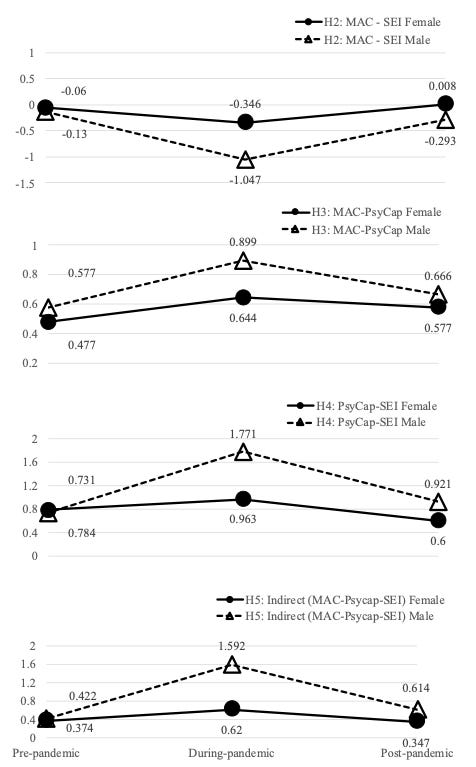
Male students began with higher PsyCap, the combination of hope, efficacy, resilience, and optimism. Over time, that advantage leveled off. Female students moved in a different direction, and their moral standards rose markedly as the crisis intensified. These are trends across phases. They describe how the student population shifted, not necessarily how any individual student changed.
2.2 An Unexpected Negative Link
At the peak of the crisis, MAC and SEI were negatively related among female students. Stronger moral concern went with weaker intention to pursue social ventures. We did not expect this.
One possible reading is that contextual factors outweighed moral motivation under extreme conditions. The study points to this possibility but does not test it, so it remains an open question rather than a finding.
2.3 PsyCap as the Steady Link
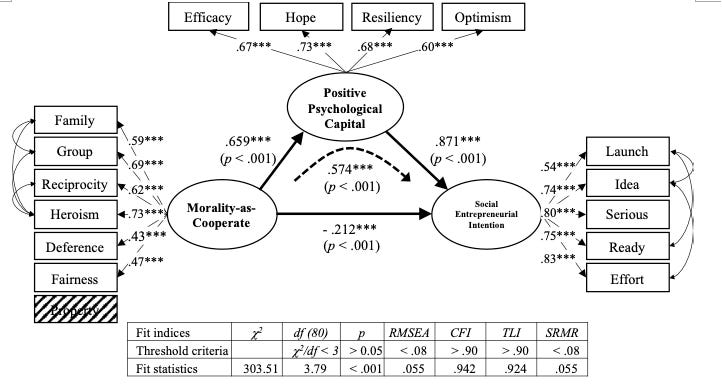
Across all three phases, PsyCap mediated the relationship between moral values and SEI. Values appear to reach intention partly through students’ confidence and resilience. This was the most stable pattern in the data. Because the evidence comes from surveys, the mediation shows a statistical pathway rather than proof of cause.
3. Teaching for Turbulent Times
Moral appeal alone may not carry students toward social ventures when the world is unstable. Educators can also develop PsyCap, which earlier research treats as open to training (Luthans et al., 2006). Gender deserves attention as well. Female students’ moral concern grew during the crisis even as its link to intention reversed, so they may need help turning conscience into feasible action under constraint. For K-GSP readers who teach across borders, the lesson is practical. When a crisis arrives, what students care about matters, and so does whether they believe they can still act on it.
References
Choi, J., Lee, S., Chae, C., & Vaccaro, V. (2026). Gendered morality and positivity in social entrepreneurship: A trend analysis across global crises. Journal of Social Entrepreneurship, 17(3), 1199–1223. https://doi.org/10.1080/19420676.2025.2498742
Luthans, F., Avey, J. B., Avolio, B. J., Norman, S. M., & Combs, G. M. (2006). Psychological capital development: Toward a micro-intervention. Journal of Organizational Behavior, 27(3), 387–393. https://doi.org/10.1002/job.373
About the Author

Prof. Dr. Jeonghwan (Jerry) Choi (Managing Editor), University of Maine at Presque Isle
Full list of his K-GSP columns:
Jeonghwan (Jerry) Choi, PhD is an Associate Professor of Business at the University of Maine at Presque Isle and Editor-in-Coordination of K-GSP Forum (contact: jeonghwan.choi at gmail.com). With over 25 years of industry and consulting experience, he specializes in leadership development, human resource management, organizational behavior, and social entrepreneurship. His research focuses on workforce resilience, organizational health, and self-directed leadership — bridging rigorous scholarship with practical insight to cultivate leaders who create meaningful, sustainable, and humane organizations.
한글요약
윤리, 도덕, 양심만으로는 부족할 때: 위기 속 사회적 기업가정신과 성별, 도덕성, 긍정심리자본
이 글은 중국에 있는 미국 대학의 경영학과 학부생을 6년 동안 조사한 연구를 소개합니다. 코로나19 이전, 팬데믹 기간, 그 이후의 세 시기를 비교했습니다. 처음에는 남학생의 긍정심리자본(희망, 자신감, 회복력, 낙관)이 더 높았지만, 그 차이는 점점 줄었습니다. 여학생은 위기가 깊어질수록 도덕 기준이 뚜렷하게 높아졌습니다. 그런데 위기가 가장 심했던 시기에, 여학생들 사이에서는 도덕적 가치가 높을수록 사회적 창업 의도가 오히려 낮게 나타났습니다. 예상하지 못한 결과였고, 극한 상황에서는 주변 여건이 더 큰 영향을 주었을 가능성이 있습니다. 위기 전, 중간, 이후 내내 긍정심리자본은 도덕적 가치와 창업 의도를 이어 주는 안정적인 통로 역할을 했습니다. 따라서 사회적 기업가정신 교육은 도덕적 호소에만 기대지 말고, 학생들이 어려운 때에도 행동할 수 있다고 믿게 돕는 심리적 힘을 함께 길러야 합니다.
© K-Global Schoalrs and Professionals Forum. All rights reserved. Content published in the K-GSP Forum may not be reproduced, distributed, or transmitted in any form without prior written permission from the K-GSP Forum, except for brief quotations with full attribution.