

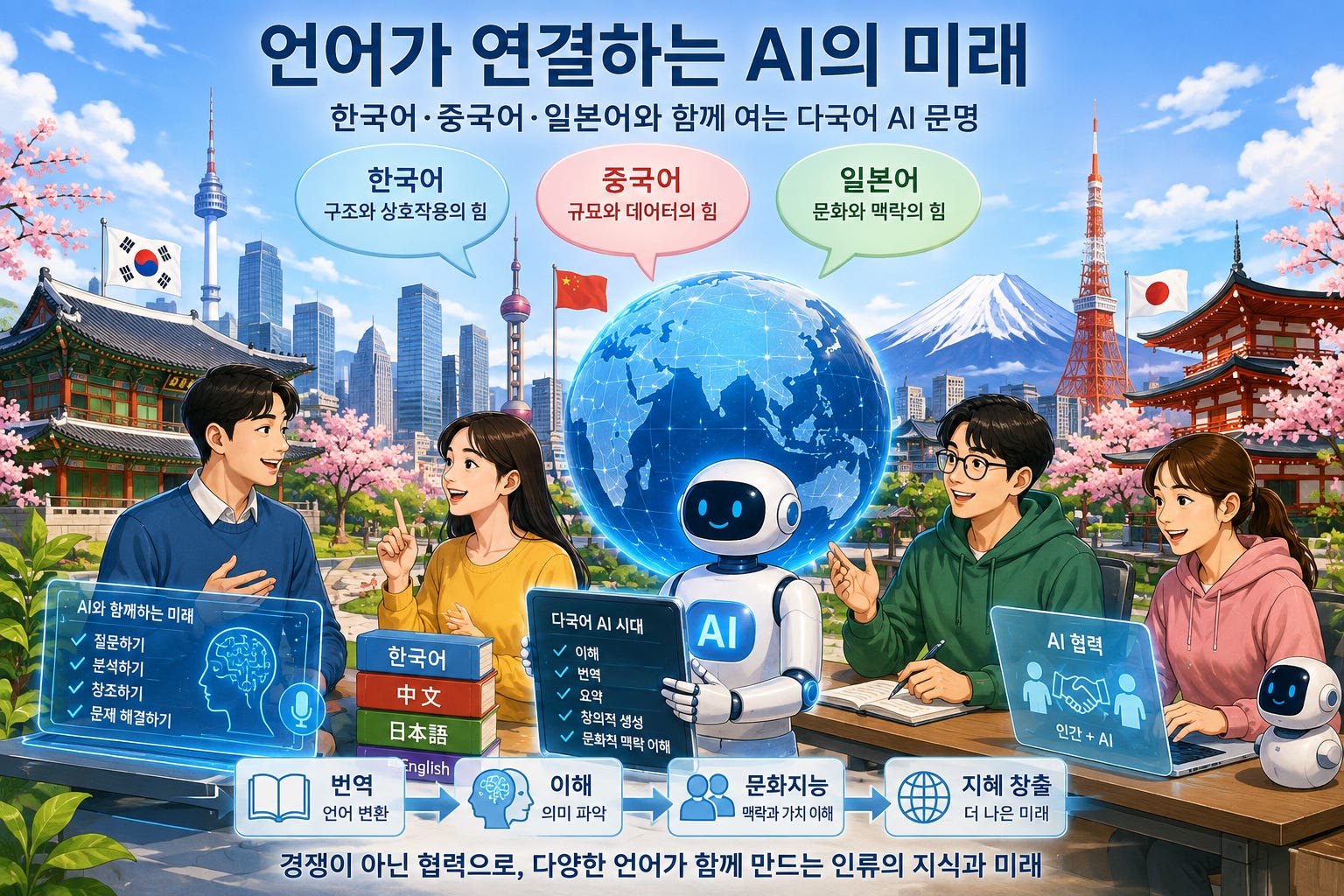
Which Language Is Best Suited for the Era of Generative AI?
Korean, Chinese, and Japanese in the Emerging Multilingual AI Civilization
Abstract
Generative artificial intelligence is transforming human language from a traditional medium of communication into an operational interface between human cognition and machine intelligence. Large language models (LLMs) can now understand, generate, translate, summarize, and reason across multiple languages. This transformation raises an important question: Which language is best suited for the age of Generative AI?
This essay comparatively examines Korean, Chinese, and Japanese from the perspectives of linguistic structure, training-data resources, multilingual alignment, contextual understanding, cultural representation, and human–AI interaction. Recent research demonstrates that multilingual LLM performance depends not simply on the number of speakers of a language but also on corpus quality, cross-lingual alignment, language-specific adaptation, and cultural bias in evaluation (Qin et al., 2025; Xu et al., 2025). Research on multilingual instruction tuning further shows that language adaptation can improve generation while leaving important gaps in language understanding, particularly across languages with different resource levels (Razumovskaia et al., 2025). Global multilingual evaluation has also revealed that translated benchmarks can reproduce Western-centric linguistic and cultural assumptions, demonstrating that genuine multilingual intelligence requires culturally appropriate evaluation (Singh et al., 2025). At the same time, large multilingual datasets and models demonstrate that AI can increasingly operate across a broad spectrum of languages rather than being restricted to a small number of high-resource languages (Nguyen et al., 2024).
The comparison suggests that Korean offers distinctive potential through its systematic writing system, productive morphology, and flexible terminology formation; Chinese possesses extraordinary advantages in data scale and digital-market reach; and Japanese contributes sophisticated contextual expression and globally influential cultural resources. Nevertheless, no single language can be declared universally superior. The emerging multilingual AI civilization will depend less on linguistic domination than on the ability to combine the structural, informational, and cultural strengths of many languages.
Keywords: Generative AI, Large Language Models, Multilingual AI, Korean, Chinese, Japanese, AI Readiness, Human–AI Collaboration, Cultural Intelligence
Language Has Become an Interface to Intelligence
For most of human history, language was primarily a means of communicating ideas from one person to another. Writing allowed knowledge to survive beyond individual lifetimes; printing allowed knowledge to spread across continents; and the internet allowed information to move around the world almost instantaneously.
Generative AI represents another major transition.
A person can now express a question, instruction, hypothesis, or creative idea in natural language and ask a machine to analyze it, expand it, translate it, critique it, or transform it into something new. Language has consequently become more than a communication medium. It is increasingly an interface to machine intelligence.
This development is occurring in a world containing thousands of languages, yet the technological foundations of LLMs have historically been disproportionately concentrated in a relatively small number of high-resource languages. Qin et al. (2025) describe multilingual LLMs as an expanding research field concerned with multilingual alignment, cross-lingual transfer, model adaptation, and the ability of models to operate across languages. Their survey makes clear that multilingual capability is not simply a matter of adding more languages to a model; it involves fundamental questions about how knowledge is represented and transferred across linguistic boundaries.
The question, therefore, is not merely:
Which language has the most speakers?
A more consequential question is:
Which languages can most effectively serve as interfaces between human knowledge and artificial intelligence?
Beyond the Number of Speakers
Historically, the international importance of a language has often been associated with population, political power, economic influence, military strength, and cultural reach.
The AI era introduces additional criteria.
A language’s technological importance may increasingly depend on:
the quantity and quality of digital data available,
the regularity and complexity of its linguistic structure,
the efficiency of its computational representation,
the availability of multilingual training resources,
its cultural and contextual richness, and
the effectiveness with which humans can communicate complex intentions to AI.
Xu et al. (2025) identify several persistent challenges in multilingual LLMs, including language imbalance, multilingual alignment, corpus limitations, and bias. Their analysis demonstrates why a language cannot be evaluated solely by the number of people who speak it. The quality and distribution of training resources matter enormously.
This observation changes the meaning of linguistic competitiveness.
The relevant question is no longer simply:
How many people speak this language?
It increasingly becomes:
How effectively can this language participate in the global architecture of machine intelligence?
Korean: The Potential of Structural Efficiency
Korean presents a particularly interesting case because of the distinctive characteristics of Hangul and Korean grammar.
Hangul is a highly systematic alphabetic writing system. Its consonants and vowels are combined into syllabic blocks according to consistent principles. Korean grammar also makes extensive use of particles and endings to express grammatical and pragmatic relationships.
These characteristics make Korean an interesting candidate for computational linguistic analysis.
However, an important distinction should be made.
It would be scientifically excessive to claim that Hangul is automatically “better for AI” simply because it is systematic. LLM performance depends on tokenization, training data, model architecture, instruction tuning, and evaluation methodology. Current multilingual research does not establish a universal causal relationship between a writing system and overall LLM superiority (Qin et al., 2025; Xu et al., 2025).
Nevertheless, Korean possesses characteristics that may be valuable for human–AI interaction.
Korean can express complex relationships through particles, modifiers, honorifics, and sentence endings. It also demonstrates remarkable flexibility in creating terminology for emerging technologies.
Terms associated with:
생성 AI,
초거대 AI,
AI 안전,
AI 윤리,
프롬트 엔지니어링
can be introduced and adapted rapidly.
This productivity matters in an environment were technological vocabulary changes almost continuously.
Korean and the Future of Prompt Engineering
The potential significance of Korean becomes particularly interesting when viewed through the lens of prompt engineering.
A sophisticated prompt is not simply a question. It can specify:
objective → context → constraints → evidence → reasoning → output format.
Korean can express these relationships with considerable flexibility.
For example, a simple instruction such as:
“Explain AI.”
contains relatively little contextual information.
A much richer Korean instruction can specify a historical perspective, comparative framework, evidence requirements, target audience, and desired conclusion within a single structured request.
The significance is not that Korean is uniquely capable of doing this. English, Chinese, Japanese, and many other languages can also express complex instructions.
The more important point is that the future of AI interaction will reward languages and linguistic practices that enable humans to articulate complex cognitive intentions precisely.
Razumovskaia et al. (2025) provide an important caution here. Their systematic comparison of multilingual few-shot learning approaches found that adaptation can improve target-language generation while language understanding remains more difficult, especially in lower-resource settings.
Thus, linguistic fluency should not be confused with genuine linguistic intelligence.
An AI may produce grammatically impressive Korean, Chinese, or Japanese without fully understanding the cultural or pragmatic meaning of what it is generating.
Chinese: The Power of Scale
If Korean offers an intriguing case of structural efficiency, Chinese represents another major dimension of AI power:
scale.
Chinese has an enormous user population and is embedded within one of the world’s largest digital ecosystems.
For multilingual AI, large quantities of high-quality language data can be a major strategic resource. Qin et al. (2025) emphasize the central role of multilingual corpora and alignment in the development of multilingual LLMs.
Chinese therefore possesses advantages extending beyond its linguistic characteristics.
Its ecosystem combines:
language + population + digital data + research capacity + industrial scale.
This combination is extraordinarily powerful.
Chinese also has distinctive linguistic characteristics that create computational challenges. The relationship between pronunciation and characters can be highly ambiguous, and regional usage, simplified and traditional characters, and contextual meaning all require sophisticated language processing.
Yet these challenges do not diminish China’s importance.
On the contrary, they demonstrate an important principle of AI:
A language can be computationally challenging and still be strategically indispensable.
Japanese: The Power of Context and Culture
Japanese represents another form of linguistic and technological strength.
Japan has generated enormous cultural influence through:
animation,
manga,
video games,
robotics,
design,
architecture,
cinema, and
popular culture.
Consequently, Japanese-language data contains more than linguistic information. It contains cultural patterns, social relationships, aesthetic preferences, historical references, and forms of indirect communication.
Japanese also employs multiple writing systems:
Hiragana, Katakana, and Kanji.
In addition, its honorific system expresses sophisticated distinctions concerning social relationships, respect, humility, and politeness.
These characteristics make Japanese particularly interesting from the perspective of cultural intelligence.
A truly capable multilingual AI must eventually understand not only what words mean but also why a particular expression was selected in a particular social situation.
This distinction is crucial.
A machine can translate a sentence correctly and still misunderstand its cultural significance.
From Translation to Cultural Intelligence
The evolution of multilingual AI can therefore be understood as a movement through three stages:
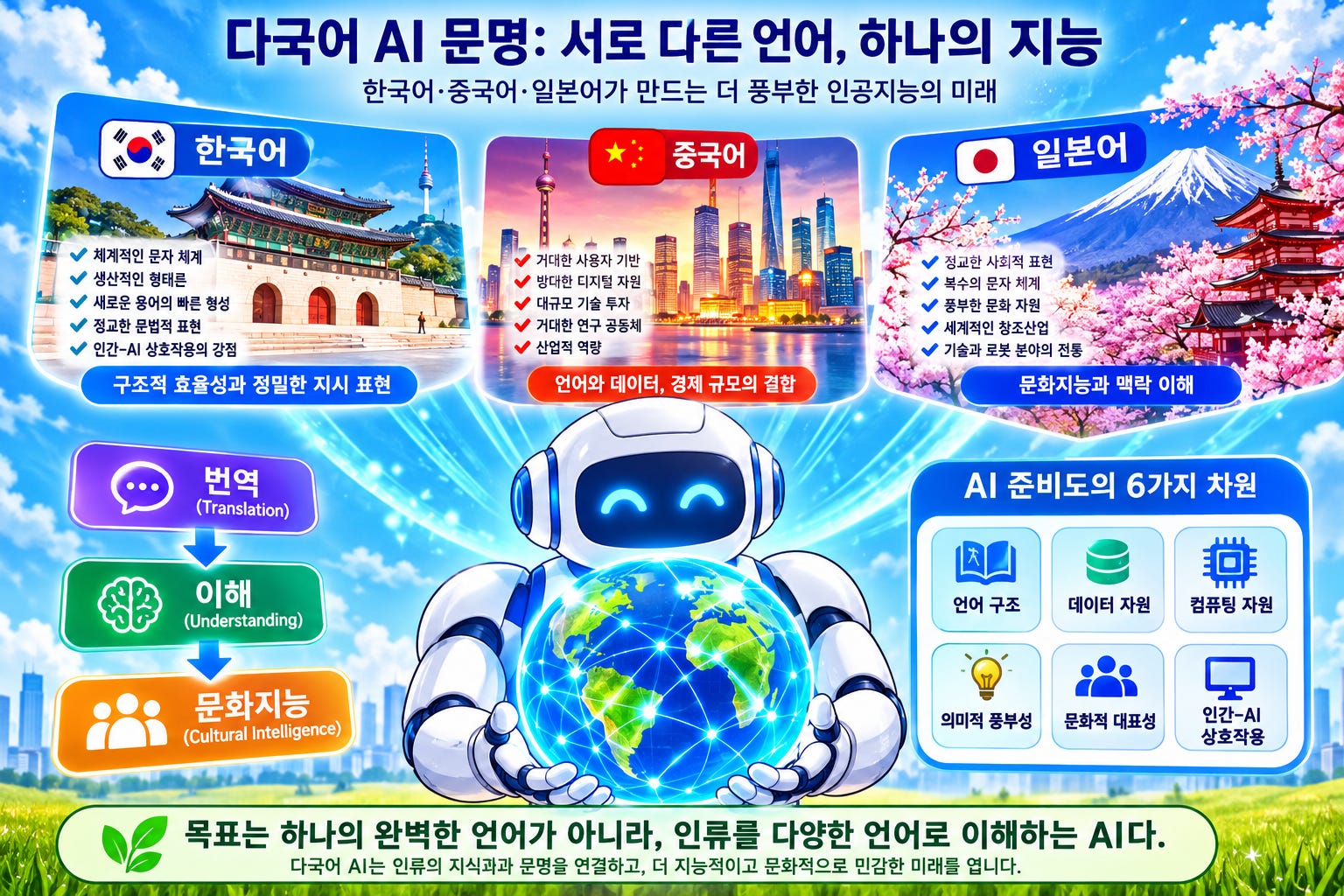
Translation → Understanding → Cultural Intelligence
Early machine translation focused primarily on converting one language into another.
Modern LLMs attempt to understand and generate language within broader contexts.
The next stage will require AI systems to recognize cultural assumptions, pragmatic meanings, social relationships, and region-specific knowledge.
This is where multilingual evaluation becomes particularly important.
Singh et al. (2025), through the Global MMLU project, demonstrate that simply translating an English benchmark into other languages can introduce linguistic and cultural distortions. Their 42-language benchmark was designed to address such problems through improved translation and culturally sensitive annotation.
This finding has profound implications.
If AI is evaluated primarily through the cultural lens of one language, the resulting model may appear intelligent while systematically underrepresenting other civilizations.
Multilingual AI therefore requires not only multilingual training, but also multilingual evaluation.
Data Is the New Linguistic Infrastructure
One of the most important developments in multilingual AI is the emergence of enormous multilingual datasets.
Nguyen et al. (2024) introduced CulturaX, a cleaned multilingual dataset containing approximately 6.3 trillion tokens across 167 languages. The project illustrates the scale at which multilingual resources are now being developed and the importance of data cleaning, deduplication, and language identification for effective multilingual model training.
This changes the traditional relationship between language and technology.
Historically, a language became technologically powerful when people created books, newspapers, schools, universities, and communication networks in that language.
In the AI era, a language also requires:
digital corpora, datasets, benchmarks, models, tokenization resources, and evaluation frameworks.
Language policy is therefore becoming increasingly connected to data policy.
A society that fails to digitize its linguistic heritage may discover that its language is underrepresented in the AI systems that increasingly shape education, business, government, and culture.
The Three Languages Represent Three Forms of AI Power
The comparison among Korean, Chinese, and Japanese can now be reframed.
Korean: Structural and Interactive Power
Korean’s potential strengths include:
systematic writing,
productive morphology,
flexible terminology formation,
sophisticated grammatical marking,
rapid adaptation to technological vocabulary.
Its greatest opportunity may lie in human–AI interaction and precise instruction.
Chinese: Scale and Data Power
Chinese possesses:
enormous user scale,
extensive digital resources,
major technological investment,
large research communities,
substantial industrial capacity.
Its greatest advantage is the combination of language, data, and economic scale.
Japanese: Cultural and Contextual Power
Japanese contributes:
sophisticated social expression,
multiple writing systems,
rich cultural resources,
globally influential creative industries,
extensive technological and robotics traditions.
Its greatest potential lies in cultural intelligence and contextual understanding.
These three forms of power are complementary rather than mutually exclusive.
The English Question
Any discussion of Korean, Chinese, and Japanese must acknowledge English.
English remains extraordinarily important in science, technology, higher education, programming, international business, and AI research.
Much of the world’s scientific literature and technical documentation is written in English. Consequently, English continues to have a major structural advantage within the global AI ecosystem.
But the future does not necessarily require other languages to replace English.
A more realistic possibility is the emergence of a multilingual AI architecture in which English continues to function as a major bridge language while Korean, Chinese, Japanese, and other languages contribute their own knowledge systems and cultural perspectives.
The objective should therefore not be to eliminate English dominance overnight.
It should be to prevent English dominance from becoming intellectual monoculture.
From Linguistic Competition to Linguistic Cooperation
Every language represents a distinctive way of organizing human experience.
Korean carries historical memories and cultural concepts that cannot always be translated perfectly.
Chinese contains philosophical, literary, political, and scientific traditions developed over thousands of years.
Japanese contains distinctive approaches to aesthetics, social relationships, design, technology, and popular culture.
When AI learns these languages, it is not merely acquiring vocabulary.
It is acquiring different representational perspectives on reality.
This creates an extraordinary opportunity.
Instead of building an AI civilization based on a single linguistic worldview, humanity can construct AI systems capable of learning from multiple linguistic traditions.
Such systems could potentially become more culturally aware and less vulnerable to the biases associated with any single linguistic environment.
Toward a New Definition of AI Readiness
The concept of AI readiness should therefore be expanded beyond computing infrastructure.
A language community’s AI readiness should include at least six dimensions:
Linguistic structure
How effectively can the language represent relationships and concepts?
Data resources
How much high-quality digital material exists?
Computational resources
How effectively can models tokenize, train, and generate the language?
Semantic richness
How precisely can complex concepts and nuances be expressed?
Cultural representation
How much historical and cultural knowledge is embedded in the available data?
Human–AI interaction
How effectively can people use the language to communicate complex intentions to AI?
Under this framework, no single language wins every category.
And that is precisely why multilingualism matters.
The Future Is Not One Language
The central lesson of the Korean–Chinese–Japanese comparison is that linguistic competitiveness in the AI era cannot be reduced to a simple ranking.
Korean may offer exceptional potential in structural and interactive efficiency.
Chinese possesses enormous advantages in data and economic scale.
Japanese offers exceptional resources for cultural and contextual intelligence.
English retains extraordinary power in global scientific and technological communication.
Other languages contribute their own forms of knowledge and human experience.
The future of AI will therefore depend increasingly on connecting these linguistic worlds.
The objective should not be to create an AI that speaks one supposedly perfect language.
The objective should be to create an AI capable of understanding humanity in many languages.
Toward a Multilingual AI Civilization
The invention of writing allowed human knowledge to survive generations.
The printing press allowed knowledge to cross borders.
The internet allowed information to circulate globally.
Generative AI now introduces another transformation: machines can interact with human knowledge through natural language and participate in its transformation and creation.
Language has consequently become one of the most important infrastructures of the emerging AI civilization.
This means that the future competition among Korean, Chinese, Japanese, English, and other languages should not be understood merely as a contest for dominance.
It is an opportunity to create a richer intellectual ecosystem.
Perhaps the ultimate question is not:
Which language will win the AI era?
The more important question is:
Can AI learn to understand humanity without requiring humanity to speak with only one voice?
If the answer is yes, Korean, Chinese, Japanese, English, and the world’s many other languages will not simply compete for survival.
They will become different windows through which artificial intelligence learns to see humanity.
And that may be the deepest promise of the multilingual AI age.
References
Nguyen, T., Nguyen, C. V., Lai, V. D., Man, H., Ngo, N. T., Dernoncourt, F., Rossi, R. A., & Nguyen, T. H. (2024). CulturaX: A cleaned, enormous, and multilingual dataset for large language models in 167 languages. In Proceedings of the 2024 Joint International Conference on Computational Linguistics, Language Resources and Evaluation (LREC-COLING 2024) (pp. 4226–4237). European Language Resources Association and International Committee on Computational Linguistics. https://doi.org/10.63317/5iz6z5g7eit3
Qin, L., Chen, Q., Zhou, Y., Chen, Z., Li, Y., Liao, L., Li, M., Che, W., & Yu, P. S. (2025). A survey of multilingual large language models. Patterns, 6(1), Article 101118. https://doi.org/10.1016/j.patter.2024.101118
Razumovskaia, E., Vulić, I., & Korhonen, A. (2025). Analyzing and adapting large language models for few-shot multilingual NLU: Are we there yet? Transactions of the Association for Computational Linguistics, 13, 1096–1120. https://doi.org/10.1162/tacl.a.33
Singh, S., Romanou, A., Fourrier, C., Adelani, D. I., Ngui, J. G., Vila-Suero, D., Limkonchotiwat, P., Marchisio, K., Leong, W. Q., Susanto, Y., Ng, R., Longpre, S., Ko, W.-Y., Bosselut, A., Oh, A., Martins, A. F. T., Choshen, L., Ippolito, D., Ferrante, E., Fadaee, M., Ermis, B., & Hooker, S. (2025). Global MMLU: Understanding and addressing cultural and linguistic biases in multilingual evaluation. In Proceedings of the 63rd Annual Meeting of the Association for Computational Linguistics (Volume 1: Long Papers) (pp. 18761–18799). Association for Computational Linguistics. https://doi.org/10.18653/v1/2025.acl-long.919
Xu, Y., Hu, L., Zhao, J., Qiu, Z., Xu, K., Ye, Y., & Gu, H. (2025). A survey on multilingual large language models: Corpora, alignment, and bias. Frontiers of Computer Science, 19, Article 1911362. https://doi.org/10.1007/s11704-024-40579-4
생성 인공지능 시대에 가장 걸맞은 언어는 무엇인가?
한국어·중국어·일본어와 새롭게 열리는 다국어 AI 문명
초록
생성 인공지능(Generative Artificial Intelligence)은 인간의 언어를 전통적인 의사소통 수단에서 인간의 사고와 기계 지능을 연결하는 핵심 인터페이스로 변화시키고 있다. 대규모 언어모델(Large Language Models, LLMs)은 이제 여러 언어를 이해하고 생성하며, 번역하고 요약하고 추론할 수 있다. 이러한 변화는 하나의 중요한 질문을 제기한다. 생성 인공지능 시대에 가장 걸맞은 언어는 무엇인가?
본 논문은 언어의 구조, 학습 데이터, 다국어 정렬(multilingual alignment), 맥락 이해, 문화적 표현, 인간–AI 상호작용이라는 관점에서 한국어·중국어·일본어를 비교한다. 최근 연구들은 다국어 LLM의 성능이 단순히 해당 언어를 사용하는 사람의 수에 의해 결정되는 것이 아니라, 말뭉치의 질, 언어 간 정렬, 언어별 적응, 그리고 평가 과정에 포함된 문화적 편향 등에 의해 크게 영향을 받는다는 사실을 보여준다(Qin et al., 2025; Xu et al., 2025). 또한 다국어 소수-shot 학습 연구는 특정 언어에 대한 모델 적응이 해당 언어의 생성 능력을 향상시킬 수 있지만, 언어 이해 능력에는 여전히 상당한 격차가 존재할 수 있음을 보여준다(Razumovskaia et al., 2025). 글로벌 다국어 평가 연구는 영어권의 문화적·언어적 관점에서 번역된 벤치마크가 다른 문화권에 서구 중심적인 가정을 재생산할 수 있음을 지적하며, 진정한 다국어 지능을 위해서는 문화적으로 적절한 평가가 필요하다는 점을 강조한다(Singh et al., 2025). 한편 대규모 다국어 데이터셋과 모델의 발전은 AI가 소수의 고자원 언어에만 국한되지 않고 훨씬 다양한 언어를 대상으로 작동할 수 있는 가능성을 보여준다(Nguyen et al., 2024).
한국어는 체계적인 문자 체계, 생산적인 형태론, 새로운 용어를 빠르게 만들어내는 능력에서 독특한 잠재력을 지닌다. 중국어는 압도적인 데이터 규모와 거대한 디지털 시장이라는 강점을 가진다. 일본어는 정교한 맥락 표현과 세계적으로 영향력 있는 문화 콘텐츠라는 강점을 가진다. 그러나 어느 하나의 언어가 절대적으로 우월하다고 말할 수는 없다. 앞으로 등장할 다국어 AI 문명은 하나의 언어가 다른 언어를 지배하는 방향보다는 서로 다른 언어가 가진 구조적·정보적·문화적 강점을 결합하는 방향으로 발전할 가능성이 높다.
주요어: 생성 인공지능, 대규모 언어모델, 다국어 AI, 한국어, 중국어, 일본어, AI 준비도, 인간–AI 협력, 문화지능
언어는 지능으로 들어가는 새로운 인터페이스가 되었다
인류 역사의 대부분에서 언어는 한 사람이 다른 사람에게 생각을 전달하는 수단이었다. 문자는 개인의 생명을 넘어 지식이 살아남을 수 있도록 했고, 인쇄술은 지식을 대륙과 대륙 사이로 확산시켰으며, 인터넷은 정보를 전 세계로 거의 순간적으로 이동시켰다.
생성 인공지능은 또 하나의 거대한 전환을 만들어 내고 있다.
이제 인간은 질문이나 지시, 가설 또는 창의적인 아이디어를 자연어로 표현한 뒤 AI에게 그것을 분석하고, 확장하고, 번역하고, 비판하고, 새로운 형태로 변환하도록 요청할 수 있다.
따라서 언어는 더 이상 단순한 의사소통 수단이 아니다.
언어는 점점 기계 지능에 접근하는 인터페이스가 되고 있다.
이러한 변화는 수천 개의 언어가 존재하는 세계에서 일어나고 있다. 그러나 지금까지 대규모 언어모델의 기술적 기반은 상대적으로 소수의 고자원 언어에 집중되어 왔다.
Qin et al. (2025)은 다국어 LLM을 단순히 여러 언어를 추가하는 기술이 아니라, 다국어 정렬, 언어 간 지식 이전, 모델 적응, 언어 간 지식 표현이라는 근본적인 문제를 다루는 연구 분야로 설명한다.
따라서 중요한 질문은 단순히
“어떤 언어를 사용하는 사람이 가장 많은가?”
가 아니다.
더 중요한 질문은 다음과 같다.
“어떤 언어가 인간의 지식과 인공지능 사이의 가장 효과적인 인터페이스가 될 수 있는가?”
사용자 수를 넘어서는 새로운 언어 경쟁력
역사적으로 한 언어의 국제적 중요성은 인구, 정치적 영향력, 경제력, 군사력, 문화적 영향력과 밀접하게 연결되어 있었다.
그러나 AI 시대에는 새로운 기준이 등장하고 있다.
언어의 기술적 경쟁력은 다음과 같은 요소에 의해 결정될 수 있다.
디지털 데이터의 양과 질
언어 구조의 규칙성과 복잡성
컴퓨터가 언어를 표현하고 처리하는 효율성
다국어 학습 자원의 이용 가능성
문화적·맥락적 풍부함
인간이 AI에게 복잡한 의도를 얼마나 정확하게 전달할 수 있는가
Xu et al. (2025)은 다국어 LLM이 직면한 주요 문제로 언어 불균형, 다국어 정렬, 말뭉치의 한계, 편향 등을 제시한다. 이는 한 언어의 중요성을 단순히 사용자 수로 평가할 수 없다는 것을 보여준다.
결국 언어 경쟁력의 질문은 다음과 같이 바뀐다.
“이 언어를 몇 명이 사용하는가?”
에서
“이 언어가 인공지능이라는 새로운 지능 인프라에 얼마나 효과적으로 참여할 수 있는가?”
로 바뀌고 있는 것이다.
한국어: 구조적 효율성이 지닌 잠재력
한국어는 매우 흥미로운 사례이다.
가장 대표적인 특징은 한글과 한국어 문법이 지닌 체계성이다.
한글은 자음과 모음이 일정한 원리에 따라 결합하는 매우 체계적인 문자 체계이다. 한국어 문법 역시 조사와 어미를 활용하여 문장 내에서 단어와 개념 사이의 관계를 표현한다.
이러한 특성은 한국어를 계산언어학적으로 흥미로운 연구 대상으로 만든다.
물론 한글이 체계적이라는 사실만으로 “한국어가 AI에 가장 우수한 언어”라고 단정해서는 안 된다.
실제 LLM 성능은 토큰화, 학습 데이터, 모델 구조, 지시학습, 평가 방법 등 수많은 요소에 의해 결정된다. 현재의 다국어 LLM 연구 역시 문자 체계 하나가 전체적인 AI 성능의 우위를 결정한다는 인과관계를 입증하지 않는다(Qin et al., 2025; Xu et al., 2025).
그럼에도 한국어는 인간–AI 상호작용 측면에서 주목할 만한 특성을 가지고 있다.
한국어는 조사와 어미, 수식어, 높임법 등을 통해 문법적·화용론적 관계를 매우 다양하게 표현할 수 있다.
또한 새로운 기술 용어를 빠르게 만들어내는 능력이 뛰어나다.
예를 들어,
생성 AI
초거대 AI
AI 안전
AI 윤리
프롬트 엔지니어링
등의 표현을 비교적 빠르게 사회적 언어로 정착시킬 수 있다.
기술 용어가 끊임없이 변화하는 AI 시대에는 이러한 언어적 생산성이 중요한 자원이 될 수 있다.
한국어와 프롬트 엔지니어링의 미래
한국어의 가능성은 프롬트 엔지니어링이라는 관점에서 더욱 흥미롭게 나타난다.
정교한 프롬트는 단순한 질문이 아니다.
그 안에는
목적 → 맥락 → 제약조건 → 근거 → 추론 → 출력 형식
등의 구조가 들어갈 수 있다.
한국어는 이러한 관계를 다양한 조사와 어미, 수식 구조를 활용하여 유연하게 표현할 수 있다.
예를 들어,
“AI에 대해 설명하라.”
라는 명령은 매우 단순하다.
반면 다음과 같은 지시는 훨씬 구체적인 사고 구조를 요구한다.
“생성 AI가 인간의 창의성을 어떻게 확장할 수 있는지를 역사적 관점에서 설명하고, 장점과 위험성을 균형 있게 비교한 후 미래 사회에 대한 시사점을 제시하라.”
여기에는
목적 → 관점 → 비교 → 평가 → 결론
이라는 인지적 구조가 포함되어 있다.
물론 이러한 능력이 한국어에만 존재하는 것은 아니다. 영어, 중국어, 일본어 등도 복잡한 지시를 표현할 수 있다.
중요한 것은 AI 시대의 언어 능력이 단순한 문법적 정확성이 아니라 인간의 복잡한 사고와 의도를 얼마나 정확하게 표현할 수 있는가에 의해 점점 더 평가될 것이라는 점이다.
Razumovskaia et al. (2025)의 연구는 중요한 주의를 제공한다. 특정 언어에 대한 모델 적응이 목표 언어의 생성 능력을 높일 수 있지만, 특히 저자원 언어에서는 언어 이해 능력이 여전히 상당한 어려움을 겪을 수 있다는 것이다.
따라서 언어를 유창하게 생성하는 것과 그 언어를 진정으로 이해하는 것은 동일하지 않다.
중국어: 규모가 만들어내는 힘
한국어가 구조적 효율성이라는 가능성을 보여준다면, 중국어는 또 다른 형태의 AI 경쟁력을 보여준다.
바로 규모(scale)다.
중국어는 거대한 사용자 집단과 세계 최대 수준의 디지털 생태계 가운데 하나를 기반으로 한다.
다국어 AI에서는 대량의 고품질 언어 데이터가 매우 중요한 전략적 자원이다. Qin et al. (2025)이 강조하듯 다국어 말뭉치와 언어 간 정렬은 다국어 LLM 발전의 핵심 요소다.
중국어는 이러한 측면에서 엄청난 장점을 가진다.
그 강점은 단순히 사용자 수에 그치지 않는다.
언어 + 인구 + 디지털 데이터 + 연구 역량 + 산업 규모
가 하나의 생태계를 구성하고 있기 때문이다.
물론 중국어에는 AI 처리상의 어려움도 있다.
발음과 한자의 관계에서 나타나는 중의성, 간체자와 번체자의 차이, 지역적 표현의 다양성, 문맥에 따른 의미 변화 등은 고도의 자연어 처리 기술을 요구한다.
그러나 이러한 어려움이 중국어의 중요성을 감소시키는 것은 아니다.
오히려 이것은 AI의 중요한 원리를 보여준다.
처리하기 어려운 언어라고 해서 전략적으로 중요하지 않은 언어인 것은 아니다.
일본어: 맥락과 문화가 만들어내는 힘
일본어는 또 다른 형태의 언어적·기술적 경쟁력을 보여준다.
일본은
애니메이션
만화
비디오게임
로봇
디자인
건축
영화
대중문화
등을 통해 세계적인 문화적 영향력을 형성해 왔다.
따라서 일본어 데이터에는 단순한 언어 정보만 들어 있는 것이 아니다.
그 안에는 문화적 패턴, 사회적 관계, 미적 취향, 역사적 기억, 간접적인 의사소통 방식 등이 포함되어 있다.
일본어는 또한 여러 문자 체계를 동시에 사용한다.
히라가나, 가타카나, 한자가 대표적이다.
여기에 존경과 겸양, 정중함 등을 표현하는 복잡한 경어 체계가 더해진다.
이러한 특성은 일본어를 문화지능(cultural intelligence)의 관점에서 매우 중요한 언어로 만든다.
진정으로 지능적인 AI는 단순히 단어의 의미만 이해해서는 안 된다.
특정한 사회적 상황에서 왜 특정 표현이 선택되었는가까지 이해해야 한다.
번역에서 문화지능으로
다국어 AI의 발전은 다음과 같은 세 단계로 이해할 수 있다.
번역 → 이해 → 문화지능
초기의 기계번역은 한 언어를 다른 언어로 변환하는 데 집중했다.
오늘날의 LLM은 보다 넓은 맥락에서 언어를 이해하고 생성하려 한다.
그러나 미래의 AI는 여기에 더해 문화적 전제, 화용론적 의미, 사회적 관계, 지역적 지식까지 이해해야 한다.
이 지점에서 다국어 평가가 매우 중요해진다.
Singh et al. (2025)의 Global MMLU 연구는 영어권 벤치마크를 단순히 다른 언어로 번역하는 것만으로는 충분하지 않음을 보여준다. 번역 과정에서 특정 언어와 문화의 편향이 다른 문화권에 그대로 전달될 수 있기 때문이다.
이는 매우 중요한 의미를 가진다.
AI를 특정 언어와 문화의 관점에서만 평가한다면, AI가 매우 똑똑해 보이면서도 다른 문명과 문화의 지식을 체계적으로 과소대표할 수 있다.
따라서 진정한 다국어 AI에는 다국어 학습뿐 아니라 다국어 평가가 필요하다.
데이터는 새로운 언어 인프라가 되고 있다
다국어 AI의 또 하나의 중요한 발전은 거대한 다국어 데이터셋의 등장이다.
Nguyen et al. (2024)은 167개 언어에 걸쳐 약 6조 3천억 개의 토큰을 포함하는 대규모 다국어 데이터셋 CulturaX를 제시했다.
이 연구는 다국어 AI가 이제 얼마나 거대한 규모로 발전하고 있는지를 보여준다.
동시에 데이터의 양만큼이나
데이터 정제, 중복 제거, 언어 식별, 품질 관리
가 중요하다는 사실도 보여준다.
이제 언어와 기술의 관계는 근본적으로 변화하고 있다.
과거에는 한 언어가 기술적으로 강력해지기 위해 책, 신문, 학교, 대학, 통신망이 필요했다.
AI 시대에는 여기에 더해
디지털 말뭉치, 데이터셋, 언어모델, 토큰화 자원, 벤치마크, 평가 체계
가 필요하다.
따라서 언어정책은 점점 데이터정책과 연결되고 있다.
자신의 언어와 문화유산을 충분히 디지털화하지 못하는 사회는 미래의 AI가 교육, 산업, 정부, 문화에 깊숙이 들어갔을 때 자국어가 충분히 반영되지 않는 상황에 직면할 수 있다.
세 언어는 서로 다른 AI의 힘을 보여준다
한국어·중국어·일본어의 비교는 이제 새로운 방식으로 이해할 수 있다.
한국어: 구조와 상호작용의 힘
한국어의 주요 잠재력은
체계적인 문자
생산적인 형태론
새로운 용어 형성 능력
정교한 문법적 표지
기술 용어에 대한 빠른 적응
등에 있다.
한국어의 가장 큰 기회는 인간–AI 상호작용과 정밀한 지시 표현에 있을 가능성이 있다.
중국어: 규모와 데이터의 힘
중국어는
거대한 사용자 기반
방대한 디지털 자원
대규모 기술 투자
거대한 연구 공동체
산업적 역량
을 갖추고 있다.
중국어의 가장 큰 강점은 언어와 데이터, 경제 규모의 결합이다.
일본어: 문화와 맥락의 힘
일본어는
정교한 사회적 표현
복수의 문자 체계
풍부한 문화 자원
세계적인 창조산업
기술과 로봇 분야의 전통
을 가지고 있다.
일본어의 가장 큰 가능성은 문화지능과 맥락 이해에 있다.
이 세 가지 힘은 서로 경쟁하는 것이 아니라 상호 보완적이다.
영어라는 거대한 질문
한국어·중국어·일본어를 논하면서 영어를 빼놓을 수는 없다.
영어는 여전히 과학, 기술, 고등교육, 프로그래밍, 국제 비즈니스, AI 연구에서 막대한 영향력을 가지고 있다.
세계의 많은 과학 논문과 기술 문서가 영어로 작성되어 있다. 따라서 글로벌 AI 생태계에서 영어는 매우 강력한 구조적 우위를 유지하고 있다.
그러나 미래가 반드시 다른 언어가 영어를 대체해야 한다는 것을 의미하지는 않는다.
오히려 보다 현실적인 미래는 다국어 AI 구조의 등장일 수 있다.
영어가 국제적 가교 언어로 계속 중요한 역할을 수행하는 가운데, 한국어·중국어·일본어 및 다른 언어들이 각자의 지식체계와 문화적 관점을 AI에 제공하는 것이다.
중요한 목표는 영어를 갑자기 제거하는 것이 아니다.
영어 중심성이 지적 단일문화로 발전하는 것을 막는 것이다.
언어 경쟁에서 언어 협력으로
모든 언어는 인간 경험을 조직하는 독특한 방식을 가지고 있다.
한국어에는 한국의 역사와 사회가 만들어낸 독특한 기억과 정서가 담겨 있다.
중국어에는 수천 년 동안 축적된 철학·문학·정치·과학적 전통이 담겨 있다.
일본어에는 미학, 사회관계, 디자인, 기술, 대중문화에 대한 독특한 접근 방식이 담겨 있다.
AI가 이러한 언어를 학습한다는 것은 단순히 어휘를 습득하는 것이 아니다.
AI가 서로 다른 현실 인식의 표현 방식을 배우는 것이다.
여기에는 엄청난 가능성이 있다.
하나의 언어적 세계관에 기반한 AI 문명을 만드는 대신, 여러 언어와 문명의 전통을 학습하는 AI 시스템을 구축할 수 있기 때문이다.
그러한 AI는 보다 문화적으로 민감하고, 어느 하나의 언어 환경에 존재하는 편향에 덜 취약할 가능성이 있다.
AI 준비도의 새로운 정의
따라서 AI 준비도(AI readiness)라는 개념도 확장되어야 한다.
한 언어 공동체의 AI 준비도는 최소한 다음 여섯 가지 차원을 포함해야 한다.
언어 구조
언어가 관계와 개념을 얼마나 체계적으로 표현할 수 있는가?
데이터 자원
얼마나 많은 고품질 디지털 자료가 존재하는가?
컴퓨팅 자원
AI 모델이 해당 언어를 얼마나 효율적으로 토큰화하고 학습하며 생성할 수 있는가?
의미적 풍부성
복잡한 개념과 미묘한 의미를 얼마나 정밀하게 표현할 수 있는가?
문화적 대표성
그 언어의 데이터에 역사와 문화에 관한 지식이 얼마나 포함되어 있는가?
인간–AI 상호작용
사람들이 해당 언어를 사용하여 AI에게 복잡한 의도를 얼마나 효과적으로 전달할 수 있는가?
이 기준을 적용하면 어느 하나의 언어가 모든 영역에서 승리하지 않는다.
그리고 바로 그것이 다국어주의가 중요한 이유이다.
미래의 승자는 하나의 언어가 아니다
한국어·중국어·일본어를 비교하면서 얻을 수 있는 가장 중요한 교훈은 AI 시대의 언어 경쟁력을 단순한 순위로 평가할 수 없다는 것이다.
한국어는 구조적·상호작용적 효율성에서 잠재력을 가진다.
중국어는 데이터와 경제적 규모에서 압도적인 강점을 가진다.
일본어는 문화와 맥락지능에서 독특한 자원을 제공한다.
영어는 세계적인 과학·기술 커뮤니케이션에서 여전히 강력하다.
그리고 다른 수많은 언어들도 각자의 지식과 인간 경험을 제공한다.
따라서 AI의 미래는 이러한 언어 세계들을 연결하는 능력에 점점 더 의존하게 될 것이다.
목표는 하나의 완벽한 언어만 사용하는 AI를 만드는 것이 아니다.
목표는 인류를 다양한 언어를 통해 이해할 수 있는 AI를 만드는 것이다.
다국어 AI 문명을 향하여
문자의 발명은 인간의 지식이 세대를 넘어 살아남도록 만들었다.
인쇄술은 지식을 국경 너머로 확산시켰다.
인터넷은 정보를 전 세계로 연결했다.
이제 생성 인공지능은 또 다른 변화를 만들어 내고 있다.
기계가 자연어를 통해 인간의 지식과 상호작용하고, 그 지식을 변형하고, 새로운 지식을 만들어내기 시작한 것이다.
따라서 언어는 새롭게 등장하는 AI 문명의 가장 중요한 인프라 가운데 하나가 되고 있다.
이제 한국어·중국어·일본어·영어와 기타 언어 사이의 경쟁을 단순한 패권 경쟁으로만 바라보아서는 안 된다.
그것은 오히려 더 풍부한 지적 생태계를 만들 수 있는 기회다.
궁극적으로 우리가 던져야 할 질문은
“AI 시대에 어느 언어가 승리할 것인가?”
가 아닐지도 모른다.
더 중요한 질문은 이것이다.
“AI는 인류에게 오직 하나의 목소리로 말하도록 요구하지 않고도 인류를 이해할 수 있는가?”
그 대답이 ‘그렇다’라면 한국어, 중국어, 일본어, 영어, 그리고 세계의 수많은 언어들은 단순히 생존을 위해 경쟁하는 존재가 아닐 것이다.
그들은 인공지능이 인류를 이해하고 바라보는 서로 다른 창문이 될 것이다.
그리고 이것이야말로 다국어 AI 시대가 인류에게 약속하는 가장 깊은 가능성일 것이다.
참고문헌
Nguyen, T., Nguyen, C. V., Lai, V. D., Man, H., Ngo, N. T., Dernoncourt, F., Rossi, R. A., & Nguyen, T. H. (2024). CulturaX: A cleaned, enormous, and multilingual dataset for large language models in 167 languages. Proceedings of the 2024 Joint International Conference on Computational Linguistics, Language Resources and Evaluation (LREC-COLING 2024), 4226–4237. https://doi.org/10.63317/5iz6z5g7eit3
Qin, L., Chen, Q., Zhou, Y., Chen, Z., Li, Y., Liao, L., Li, M., Che, W., & Yu, P. S. (2025). A survey of multilingual large language models. Patterns, 6(1), Article 101118. https://doi.org/10.1016/j.patter.2024.101118
Razumovskaia, E., Vulić, I., & Korhonen, A. (2025). Analyzing and adapting large language models for few-shot multilingual NLU: Are we there yet? Transactions of the Association for Computational Linguistics, 13, 1096–1120. https://doi.org/10.1162/tacl.a.33
Singh, S., Romanou, A., Fourrier, C., Adelani, D. I., Ngui, J. G., Vila-Suero, D., Limkonchotiwat, P., Marchisio, K., Leong, W. Q., Susanto, Y., Ng, R., Longpre, S., Ko, W.-Y., Bosselut, A., Oh, A., Martins, A. F. T., Choshen, L., Ippolito, D., Ferrante, E., Fadaee, M., Ermis, B., & Hooker, S. (2025). Global MMLU: Understanding and addressing cultural and linguistic biases in multilingual evaluation. Proceedings of the 63rd Annual Meeting of the Association for Computational Linguistics (Volume 1: Long Papers), 18761–18799. https://doi.org/10.18653/v1/2025.acl-long.919
Xu, Y., Hu, L., Zhao, J., Qiu, Z., Xu, K., Ye, Y., & Gu, H. (2025). A survey on multilingual large language models: Corpora, alignment, and bias. Frontiers of Computer Science, 19, Article 1911362. https://doi.org/10.1007/s11704-024-40579-4
2026년 8월 9일
{솔티}
Source Paper:


Prof. Dr. Young Choi (Editor in Chief) — Regent University
Young B. Choi is a Professor in the Department of Engineering & Computer Science at Regent University. He published 38 books with ‘Selected Readings in Cybersecurity’ (2018) (over 800 copies archived globally at university/college libraries around the world) and ‘Cybersecurity Applications and Artificial Intelligence’ (2023) available in seven major world languages. He proposed the world’s first global and universal telecommunications “Service Order Handling (SOH)” Model (T-SOH Model) (1995) with Dr. Adrian Tang. With this innovative research work, he received the IEEE NOMS ’96 Best Paper Award and became the first recipient of the Outstanding Contribution Award of the TeleManagement Forum in 1998. His research areas include Natural Language Processing-focused AI, AI-applied cybersecurity, network and telecom service management, and Korean studies on Gani Choi Rip’s Jeonggwan (靜觀: Quiet Contemplation) philosophy and Shilhak ( 實學: Practical Learning).
© K-GSP (K-Global Scholars and Professionals) Forum. All rights reserved. August 2026. Content published in the K-GSP Forum may not be reproduced, distributed, or transmitted in any form without prior written permission from the K-GSP Forum, except for brief quotations with full attribution.
Choi, Y. B. (2026, August 11). Which Language Is Best Suited for the Era of Generative AI?: Korean, Chinese, and Japanese in the Emerging Multilingual AI Civilization. K-GSP.