

RESEARCH
Executive Summary
A new study by Sun Joo Yoo and Jeonghwan Choi in the International Journal of Lifelong Education examines how Korean adults of different ages engage with digital learning and how that engagement relates to career transitions. Drawing on a national survey of 30,829 adults and national employment statistics, the study finds a wide generational gap in digital learning and strong associations between engagement and career outcomes. Older adults appear to gain less from the same engagement.
Keywords: lifelong education, digital learning, career transitions, age, South Korea
1. The Same Course, a Different Return
Picture two learners taking the same online course. One is 32, and the other is 58. Both log in every week and finish every module. Two years later, will they have the same chance of a promotion, a new job, or a better salary?
Our study suggests the answer is probably no. South Korea has one of the most advanced digital infrastructures in the world. It is also one of the fastest-ageing societies. As lifelong education moves online, digital learning has become a gateway to reskilling and re-employment. That makes a fair question harder to ignore: who can walk through that gateway, and who benefits once inside?
I am pleased to share that our article, co-authored with Professor Sun Joo Yoo of Sookmyung Women’s University, has been published in International Journal of Lifelong Education, Volume 45, Issue 6 (Yoo & Choi, 2026a). Here is what we did, what we found, and what we did not find.
2. What the Study Shows
We analyzed two large national sources side by side. The first was the Korean Educational Development Institute’s 2024 Individual Survey on Lifelong Learning, covering 30,829 adults aged 25 to 79. The second was Korea National Statistical Office employment statistics that track career transitions over 24 months. We counted a career transition as successful if a person achieved at least one of five outcomes: a promotion, re-employment within 12 months, a real salary increase, documented skill advancement, or a business that survived at least 12 months.
2.1 A Wide Generational Gap
The age gap in digital learning is large and gradual:
Overall preference. About four in five adults aged 25 to 44 (78.9%) preferred technology-mediated learning. Among those aged 45 and older, only about one in three (35.2%) did.
A slope, not a cliff. Preference falls steadily with each age band, from more than 80% in the youngest group to under 30% among those 65 and older. This points to gradual cohort differences in early exposure to technology, not a single generational divide.
Barriers are about support, not interest. About seven in ten older adults reported that digital learning felt technically complex, that they lacked confidence with digital platforms, or that technical support was inadequate. Fewer than one in three younger adults reported each of these concerns.
These patterns suggest that much digital learning may be designed, often unintentionally, around the habits of younger learners.
2.2 Engagement and Career Outcomes Move Together
Engagement tracked closely with career outcomes. After controlling for education, prior employment, industry, and region, the study found:
Higher odds of success. Adults with high digital learning engagement, meaning seven or more activities a year, had 2.3 times greater odds of a successful career transition than those with low engagement.
A step-by-step pattern. Roughly two-thirds of highly engaged adults made a successful transition within 24 months, compared with fewer than one-third of those with low engagement. Moderately engaged adults fell in between.
Faster return to work. Among those who lost a job, highly engaged learners returned to work in a median of about four months. Low-engagement learners took nearly a year.
Differences by sector. The association was strongest in information technology and financial services and weakest in retail and service work. Even in manufacturing, more engaged workers did better.
2.3 Age Still Matters, Even With Equal Effort
Figure 1 shows the study’s most sobering finding.
Figure 1
Career Transition Success by Age Group and Digital Learning Engagement
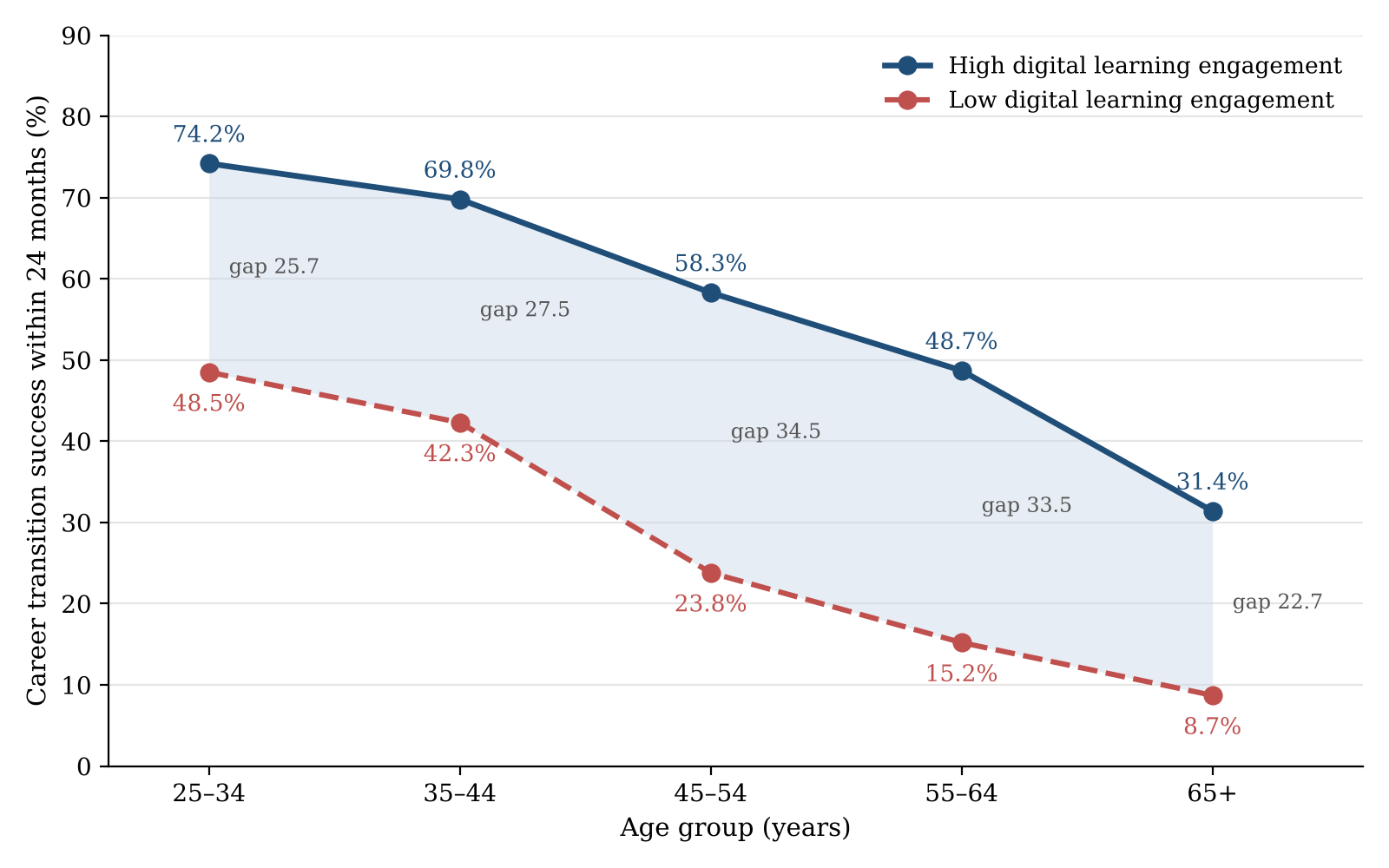
Note. Success means achieving at least one career transition outcome within 24 months. Data from Yoo and Choi (2026a). Figure redrawn by the author.
Three points stand out in the figure:
Engagement helps at every age. In every age group, highly engaged adults succeeded far more often than less engaged adults of the same age. The gap ranges from about 23 to 35 percentage points.
Engagement does not erase age. Success declines with age on both lines. Highly engaged adults aged 55 to 64 succeeded at a lower rate than less engaged adults aged 25 to 34.
A double disadvantage. The low-engagement line drops most sharply after age 45. Older workers with limited digital participation face the weakest prospects of any group, falling below one in ten among those 65 and older.
We read these patterns through two lenses. Bourdieu’s (1986) theory of capital suggests that digital skills, access, and credentials work as a form of capital that can be converted into jobs and income. Elder’s (1994) life course perspective reminds us that when and where people learn shapes the returns they receive. The pattern is consistent with cumulative advantage: early digital exposure builds on itself, while age-graded labor markets, including age discrimination, may limit how much older learners can convert new skills into career gains.
2.4 What We Cannot Claim
These findings are associations, not causes. The two datasets are not linked at the individual level, so we cannot trace one person’s learning to that person’s career. People who are more motivated, healthier, or better supported may both learn more and succeed more. People with stable careers may also have more time and money for learning. Our engagement measure counts participation, not learning quality. Korea’s mix of advanced technology and rapid ageing may also not hold elsewhere. We say this plainly because readers, and policymakers especially, deserve to know what the evidence can and cannot carry.
3. Designing Learning for Every Age
The policy message is a tension, not a slogan. Expanding digital learning can widen access and widen inequality at the same time. Three implications follow, each tied to what we found:
Age-adaptive design. Platforms should be built with older learners in mind, with technical support, scaffolding, and hybrid options that combine online and in-person learning. This responds directly to the confidence and support gaps they reported.
Digital literacy inside career programs. Digital literacy should be built into career development programs rather than taught as a separate subject, so the skill is learned where it is used.
Labor policy, not just education policy. Learning reforms must be paired with action on age discrimination and credential recognition. As Figure 1 shows, learning alone may not secure equal returns for older workers.
This study is a companion to our theoretical work on how people and AI shape careers together (Yoo & Choi, 2026b). Many K-GSP readers are mid-career or later, and many work in two countries. This question is personal for them as well as academic. Lifelong learning only keeps its promise if the people who keep learning at 55 are given a fair chance to use what they learn.
References
Bourdieu, P. (1986). The forms of capital. In J. G. Richardson (Ed.), Handbook of theory and research for the sociology of education (pp. 241–258). Greenwood.
Elder, G. H., Jr. (1994). Time, human agency, and social change: Perspectives on the life course. Social Psychology Quarterly, 57(1), 4–15. https://doi.org/10.2307/2786971
Yoo, S. J., & Choi, J. (2026a). Digital learning engagement and career transitions across age cohorts: Evidence from South Korea’s lifelong education system. International Journal of Lifelong Education, 45(6). https://doi.org/10.1080/02601370.2026.2638851
Yoo, S. J., & Choi, J. (2026b). From career ladders to digital jungle gyms: An HRD theoretical framework for understanding human-AI interaction in career development. Human Resource Development Review. Advance online publication. https://doi.org/10.1177/15344843261491397
About the Author
Jeonghwan (Jerry) Choi, PhD, MBA, ME · Managing Editor of K-GSP
Jeonghwan (Jerry) Choi is Managing Editor of K-GSP. He brings over 25 years of business consulting experience and 15 years of teaching and research in leadership, human resource development, and organizational behavior. His recent work examines digital learning, human–AI collaboration, and career development across the life course.
Suggested Citation
Choi, J. (2026, November 23). Who gets ahead by learning online? Age, digital learning, and career transitions in South Korea. K-GSP Forum. [URL]
Read the article: free ePrint (limited downloads): https://www.tandfonline.com/eprint/GXZVXHTNDK6HGUZAQG47/full?target=10.1080/02601370.2026.2638851
Original Article

한글요약
온라인으로 배우면 누가 앞서 가는가: 한국 성인의 나이, 디지털 학습, 경력 전환
유선주 교수(숙명여자대학교)와 최정환 교수의 논문이 International Journal of Lifelong Education 45권 6호에 실렸습니다. 연구는 한국교육개발원의 2024년 평생학습 개인실태조사(성인 30,829명)와 통계청의 24개월 고용 통계를 함께 분석했습니다. 25~44세는 다섯 명 중 네 명꼴로 디지털 학습을 선호했지만, 45세 이상은 세 명 중 한 명꼴에 그쳤습니다. 나이 든 학습자 열 명 중 일곱 명가량은 기술이 어렵고, 자신감이 부족하고, 도움을 받을 곳이 없다고 답했습니다. 디지털 학습에 많이 참여한 사람은 적게 참여한 사람보다 경력 전환에 성공할 가능성이 2.3배 높았고, 실직 후 다시 일자리를 찾는 데 걸리는 시간도 훨씬 짧았습니다. 그러나 같은 정도로 참여해도 나이가 많을수록 성공률은 낮았습니다. 55~64세의 적극적인 학습자도 25~34세의 소극적인 학습자보다 성공률이 낮았습니다. 다만 두 자료가 개인 단위로 연결되어 있지 않아, 이 결과는 인과관계가 아니라 집단 수준의 연관성입니다. 연구는 나이를 고려한 학습 설계, 경력 프로그램 안에서의 디지털 역량 교육, 그리고 연령 차별에 대한 노동 정책이 함께 가야 한다고 제안합니다.
© K-Global Scholars and Professionals Forum. All rights reserved. Content published in the K-GSP Forum may not be reproduced, distributed, or transmitted in any form without prior written permission from the K-GSP Forum, except for brief quotations with full attribution.