

Who Pays for the AI Revolution?
Electricity, Data Centers, and the New Social Contract
Abstract
Artificial intelligence is often described as a revolution in algorithms, data, and computing. Yet behind every AI service lies an enormous physical infrastructure of data centers, servers, cooling systems, power grids, substations, and power plants. As generative AI and large-scale AI models continue to expand, data-center electricity demand is rising rapidly, raising a new social question: Who should pay for the infrastructure that makes the AI revolution possible?
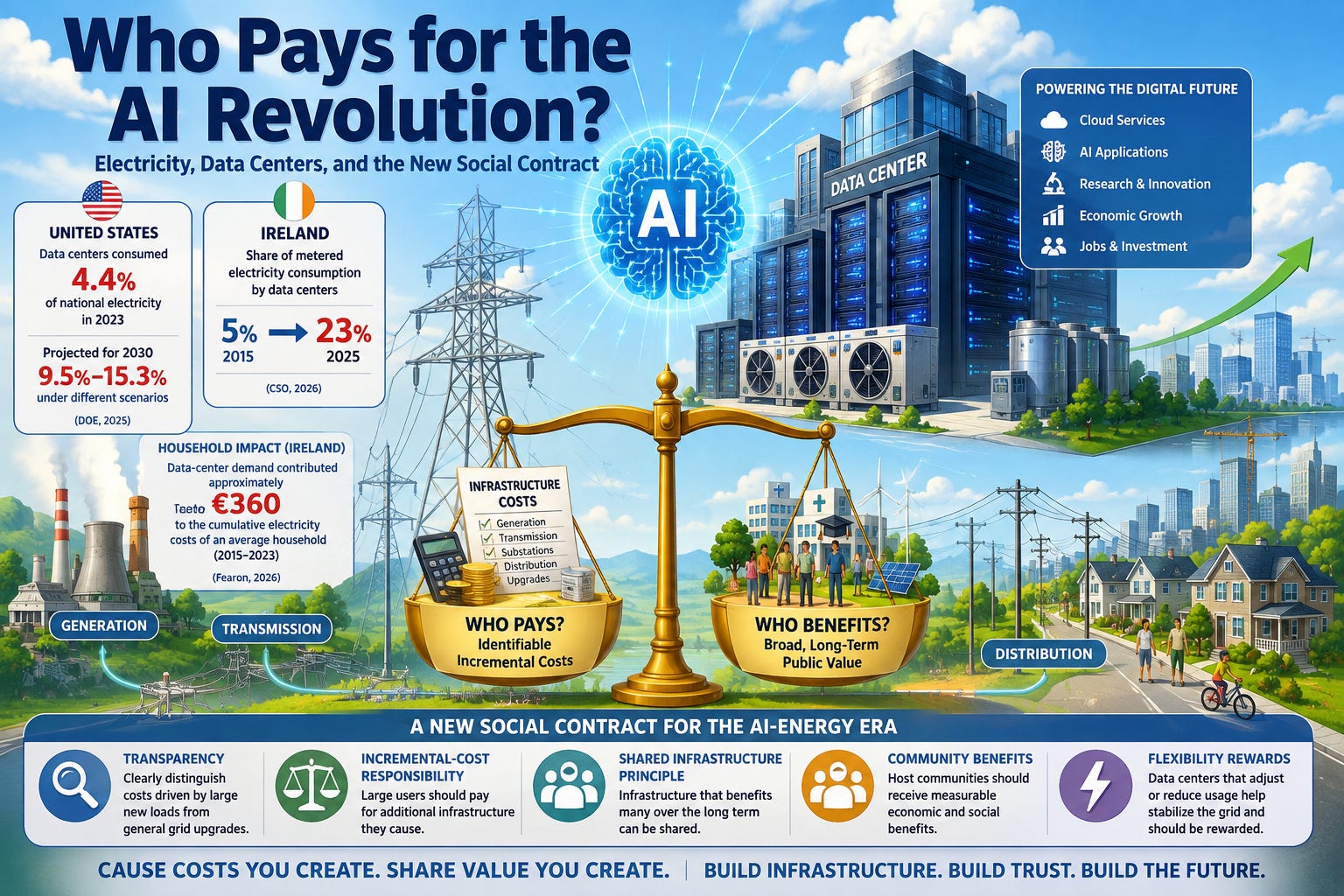
In the United States, data centers already account for a significant share of electricity consumption, and that share is expected to increase substantially in the coming years. In Ireland, data centers’ share of metered electricity consumption increased from 5% in 2015 to 23% in 2025. These developments demonstrate that the growth of the AI industry can affect not only corporate investment and technological innovation but also electricity grids, local communities, and ordinary consumers.
This essay examines AI data-center electricity demand not simply as an energy issue but as a matter of a new social contract. The central principle is straightforward: “Those who cause the costs should bear an appropriate share, while the value created should be shared.” Sustainable AI growth requires a new balance among corporate innovation, grid reliability, consumer costs, community benefits, and social trust.
Keywords: artificial intelligence, data centers, electricity grid, energy transition, social contract
1. The Hidden Cost of the AI Revolution: Data Centers and Electricity
AI appears to operate inside a screen as a digital technology. Yet behind every AI service are servers and GPUs, cooling systems, networks, and data centers that consume enormous amounts of electricity. According to the U.S. Department of Energy, U.S. data centers consumed approximately 176 TWh of electricity in 2023, representing about 4.4% of total U.S. electricity consumption. As AI and data-center industries continue to expand, their share of electricity demand could become substantially larger by 2030.
This transformation invites us to think of data centers as the new factories of the AI era. Factories during the Industrial Revolution required land, raw materials, labor, and energy. AI-era data centers similarly require advanced semiconductors, networks, cooling systems, and reliable electricity. When a large AI data center enters a new region, additional substations, transmission lines, and other electricity infrastructure may be required.
Ireland illustrates this transformation particularly clearly. According to Ireland’s Central Statistics Office, data centers accounted for approximately 5% of metered electricity consumption in 2015, rising to 18% in 2022, 21% in 2023, 22% in 2024, and 23% in 2025. Data centers have therefore become a significant electricity consumer within the national power system.
This development raises a fundamental question: Who should pay for the electricity and grid infrastructure required by the growth of the AI industry? The fact that data centers create substantial economic value does not automatically mean that all related costs should be borne by consumers and society. At the same time, it would not be fair to assign every grid investment to data centers. What matters is transparency about the relationship between the cause of a cost and the benefits it creates.
2. How Should the Benefits and Costs of Growth Be Shared?
AI data centers can create jobs, generate tax revenues, attract investment, and stimulate technological innovation. They can help establish new industries and strengthen regional economies. For these reasons, policies that simply restrict data-center investment could weaken national and regional competitiveness.
However, a different issue arises when a large data center sharply increases local electricity demand and requires new substations, transmission lines, or other infrastructure. If these additional costs are shifted to other electricity consumers, the economic benefits and social costs of AI development may become unevenly distributed. The imbalance becomes particularly concerning when data centers receive low electricity rates or substantial tax incentives while ordinary consumers bear part of the cost of grid expansion.
The guiding principle should therefore be: “Those who cause the costs should bear an appropriate share, while the value created should be shared.” Additional incremental infrastructure costs directly caused by a particular data center should, where appropriate, be borne by the company responsible for creating that demand. At the same time, investments in grid modernization and long-term infrastructure that benefit households, businesses, and multiple industries should be treated as shared infrastructure and financed through reasonable collective mechanisms.
Transparency is essential. Policymakers and regulators should clearly distinguish between investments required for normal grid modernization and those specifically triggered by new large-scale electricity demand. Without such distinctions, the economic success of the data-center industry could unintentionally translate into higher electricity costs for ordinary consumers.
The United States and Korea face similar choices, although under different conditions. The United States can use its large geographic area and diverse energy resources to expand data centers rapidly, but it must address regional grid costs and consumer protection. Korea has major strengths in semiconductors and information and communications technology, yet its limited land area and high concentration of economic activity create additional challenges involving data-center location and electricity supply. The key question, therefore, is not simply “Should we attract data centers?” but rather “Under what conditions should we attract them?”
3. A New AI Energy Social Contract
Addressing the energy challenges of AI will require more than simply building additional power plants. A new social contract is needed—one that connects technological innovation with social responsibility.
First is transparency. Data centers should disclose their electricity demand and the additional infrastructure costs associated with their operations. Second is cost responsibility. Companies should bear an appropriate share of the incremental costs they directly create. Third is shared infrastructure. Investments that provide long-term benefits to multiple users should be financed through reasonable collective arrangements. Fourth is community benefit. When data centers use local land, electricity, water, and infrastructure, local communities should receive meaningful benefits through employment, tax revenues, education, or other public programs. Fifth is flexibility. Some AI workloads can be shifted in time, allowing data centers to reduce or reschedule electricity consumption when the grid is under stress. Appropriate economic incentives could encourage such flexibility.
Demand flexibility could become a new energy resource in the AI era. Future electricity pricing could consider not only how much electricity is consumed, but also when, where, how much, and how flexibly it is consumed. If data centers can operate in ways that reduce pressure on the grid, businesses, consumers, and the electricity system can all benefit.
Efficiency alone, however, will not be enough. More efficient AI chips and algorithms can reduce the electricity required for an individual task, but overall electricity consumption may still increase if AI usage expands dramatically. Sustainable AI therefore requires attention not only to energy efficiency per task but also to total demand and the social value generated by that demand.
In the long term, this issue could contribute to a transition from the digital divide to an energy divide. Countries and regions with reliable and affordable electricity may gain an advantage in AI development. Future AI competitiveness will therefore depend not simply on software capabilities but on the combination of energy + computing + networks + semiconductors + governance.
Ultimately, an AI data center is more than a computer facility. It is the physical heart of the AI economy. Yet the most important infrastructure of the AI era is not the electricity grid alone. Social trust is infrastructure, too.
Conclusion: The True Cost of Intelligence
The AI revolution may appear to take place inside screens, but its foundation is profoundly physical. Data centers require electricity; electricity requires generation and transmission infrastructure; and that infrastructure requires enormous amounts of capital and social resources. We must therefore ask not only, “How much AI should we build?” but also, “Who should pay for the energy and infrastructure that make AI possible?”
A good social contract does not prevent innovation. Instead, it distributes the benefits and costs of innovation more fairly. When data centers require additional grid investment, those costs should be transparently calculated and appropriately allocated. At the same time, infrastructure that benefits society as a whole should be reasonably shared.
Ultimately, sustainable AI development cannot be achieved simply by building more servers or more powerful chips. It requires reliable energy, efficient power grids, responsible businesses, fair policies, meaningful community benefits, and public trust.
The future of AI will therefore depend not only on how much computing power we can build, but also on how wisely we connect technology with energy, infrastructure, and society. The true cost of the AI revolution is not reflected in electricity bills alone. It is reflected in the question of what kind of society we choose to build.
4. References
Central Statistics Office. (2024, July 23). Data centres metered electricity consumption 2023. Government of Ireland.
Central Statistics Office. (2026). Data centres metered electricity consumption 2025. Government of Ireland.
Fearon, S. (2026). The cost of data centres: Modelling the household electricity costs of Ireland’s data centre sector. Zenodo. https://doi.org/10.5281/zenodo.20487363
LeBel, M. (2026, April 2). Making ratepayer protection a reality—Part 1: How do data centers impact residential rates? Regulatory Assistance Project.
Regulatory Assistance Project. (2026a). Data centers and the case for coordinated oversight.
Regulatory Assistance Project. (2026b). Making electricity grids cheaper: RAP’s 10 priority actions.
U.S. Department of Energy. (2024, December 20). DOE releases new report evaluating increase in electricity demand from data centers.
U.S. Department of Energy. (2025). United States data center energy usage report: 2025 update. Lawrence Berkeley National Laboratory.
5. About the Author

Prof. Dr. Young Choi (Editor-in-Chief) — Regent University
Full list of his K-GSP columns:
https://www.k-gsp.org/t/columnist_young_choi
Full list of his Books at Amazon.com
Young B. Choi is a Professor in the Department of Engineering & Computer Science at Regent University. He published 38 books with ‘Selected Readings in Cybersecurity’ (2018) (over 800 copies archived globally at university/college libraries around the world) and ‘Cybersecurity Applications and Artificial Intelligence’ (2023) available in seven major world languages. He proposed the world’s first global and universal telecommunications “Service Order Handling (SOH)” Model (T-SOH Model) (1995) with Dr. Adrian Tang. With this innovative research work, he received the IEEE NOMS ’96 Best Paper Award and became the first recipient of the Outstanding Contribution Award of the TeleManagement Forum in 1998. His research areas include Natural Language Processing-focused AI, AI-applied cybersecurity, network and telecom service management, and Korean studies on Gani Choi Rip’s Jeonggwan (靜觀: Quiet Contemplation) philosophy and Shilhak ( 實學: Practical Learning).
6. Suggested Citation
Choi, Y. B. (2026). Who pays for the AI revolution? Electricity, data centers, and the new social contract. K-GSP Forum.
한글요약
인공지능은 디지털 기술처럼 보이지만 그 기반에는 데이터센터, 서버, 냉각시설, 전력망과 같은 거대한 물리적 인프라가 존재한다. AI와 데이터센터의 급속한 성장은 전력수요를 증가시키고 있으며, 미국과 아일랜드의 사례는 이러한 변화가 이미 현실이 되고 있음을 보여준다. 특히 아일랜드에서 데이터센터의 전력소비 비중은 2015년 5%에서 2025년 23%까지 증가했다. 이러한 변화는 AI 산업의 성장을 위해 필요한 전력망 비용을 누가 부담해야 하는가라는 새로운 사회적 질문을 제기한다.
이 글은 “원인을 만든 만큼 부담하고, 창출한 가치는 함께 나눈다”는 원칙을 제안한다. 특정 데이터센터가 직접 유발한 추가적인 인프라 비용은 가능한 한 해당 기업이 부담하되, 여러 산업과 시민이 함께 이용하는 공동 인프라 비용은 사회가 합리적으로 분담해야 한다. 또한 데이터센터의 전력사용 유연성을 활용하고 지역사회가 일자리와 세수, 교육 등의 혜택을 공유하도록 해야 한다. 궁극적으로 AI의 지속가능한 발전은 더 많은 컴퓨팅 능력뿐만 아니라 에너지, 인프라, 공정성, 지역사회, 그리고 사회적 신뢰를 함께 설계하는 데 달려 있다.
© K-Global Scholars and Professionals Forum. All rights reserved. Content published in the K-GSP Forum may not be reproduced, distributed, or transmitted in any form without prior written permission from the K-GSP Forum, except for brief quotations with full attribution.