
EXECUTIVE SUMMARY
This personal tribute honors the life and spiritual legacy of Sarah Barry (1930–2026), whose unwavering commitment to Jesus Christ embodied John 12:24 through seven decades of sacrificial missionary service, humble leadership, and personal discipleship. Drawing on more than five decades of personal encounters, the article examines her pioneering ministry in Korea, faithful cooperation through organizational challenges, leadership during UBF’s global expansion and succession, and spiritual motherhood, while placing her legacy within the broader tradition of five pioneering Protestant women missionaries. Beyond commemorating an extraordinary missionary, this tribute argues that the most enduring Christian legacy is measured not by institutional prominence or historical recognition but by faithfulness to Jesus, individuals lovingly nurtured, and spiritual fruit multiplied through generations.
Keywords: John 12:24; Sarah Barry; Sacrificial Missionary Leadership; Spiritual Motherhood; Unsung Christian Heroes
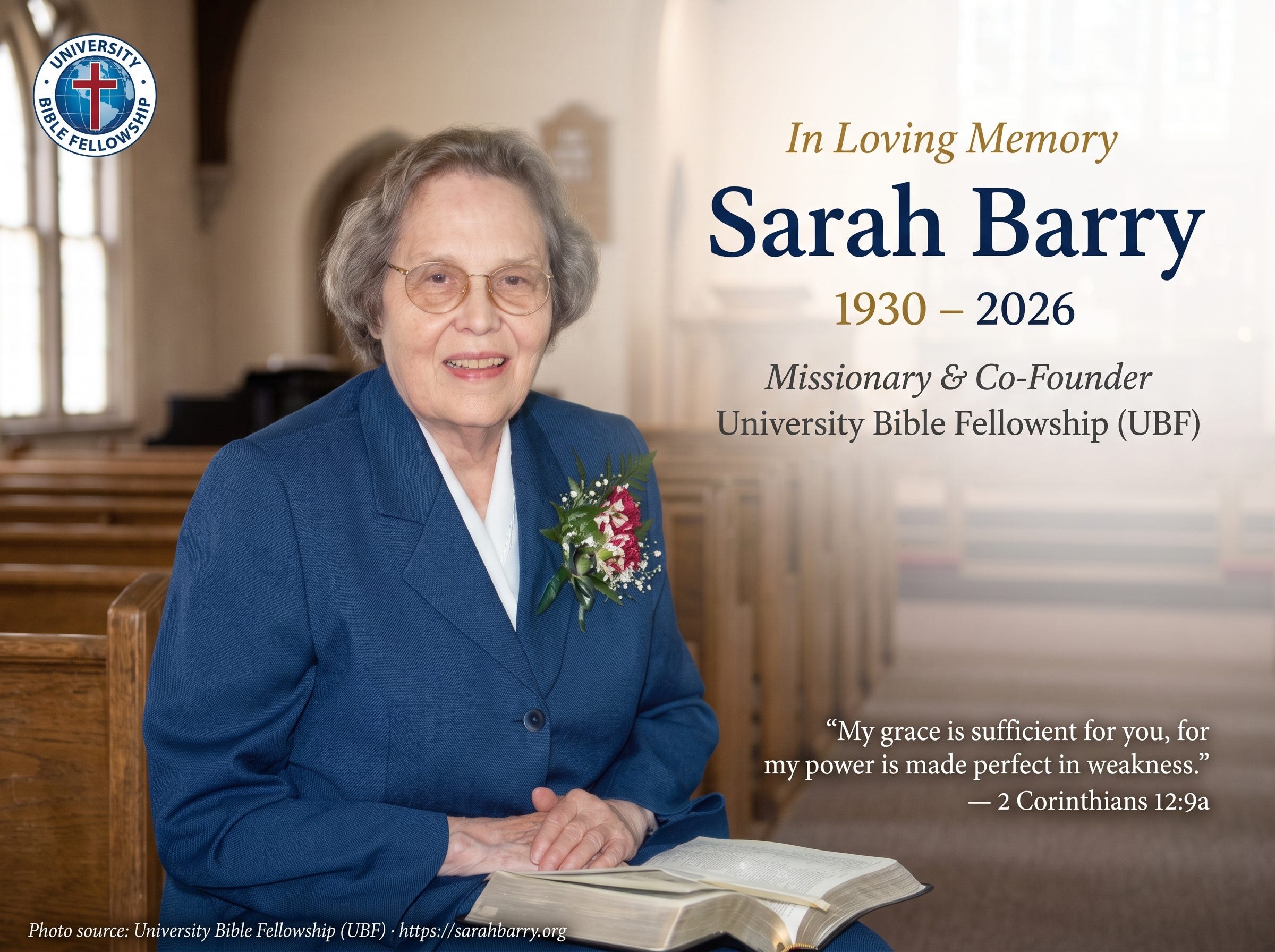
Photo source: University Bible Fellowship (UBF) ; https://sarahbarry.org/
1. Introduction
In 1970, as a freshman at Yonsei University in Seoul, Korea, I first met Sarah Barry, an American missionary whose life would profoundly influence my spiritual journey for more than five decades. Unlike many American missionaries I had encountered, she lived in a modest room within a traditional Korean house, ate kimchi and ordinary Korean food, spoke Korean fluently, and devoted herself to teaching the Bible to Korean university students in their own language. Interestingly, when she later returned to America, she resumed her American diet, a small detail that reminded me that her Korean lifestyle was not simply a matter of personal taste but an intentional identification with the people she served. Only gradually did I appreciate that her life reflected her missionary key verse, John 12:24, which teaches that a kernel of wheat must fall to the ground and die to produce much fruit (Barry, 2000, 2026).
Over the following decades, I personally witnessed Sarah Barry’s commitment to Jesus Christ, including during difficult periods in University Bible Fellowship (UBF). The organization experienced major disagreements and departures in 1976 and in subsequent decades. In my conversations with Sarah Barry, including periods when I questioned my continued involvement, she urged me to return to Jesus Christ, Scripture, prayer, and my own spiritual responsibilities. Her counsel helped my wife and me decide to continue serving within UBF. What remains vivid to me is her attention to our faith and our family, even when circumstances were unsettled.
Sarah Barry’s ministry reached beyond any formal title. She cooperated with Samuel Lee and Grace Lee through Bible teaching, writing, administrative support, and personal encouragement as UBF expanded internationally. Her own historical recollections describe work on English Daily Bread materials and efforts toward organizational registration in the United States (Barry, 2026). After Samuel Lee’s death in 2002, UBF elders asked her to serve as General Director; she held that responsibility until John Jun succeeded her in 2006 (Barry, 2026). In later years, the aspect of her ministry I observed most closely was her willingness to remember, teach, and pray for particular people.
My most treasured memories of Sarah Barry concern her personal love for my family. She remembered the names of our four children and asked about them individually. During a painful spiritual period, she came to our home, listened patiently to my wife and me, prayed with us, and studied Ephesians with my wife. During our final visit, when she was bedridden and had difficulty recognizing familiar people, we had one last opportunity to pray for the woman who had prayed for us over many years. Sarah Barry died on October 18, 2026, at 6:34 p.m. in Chicago, aged 96, according to UBF’s memorial announcement (Ward, 2026). The question her life leaves with me is not how much attention a Christian leader receives, but what it means to remain faithful to Christ and attentive to people over a lifetime.
2. Contextual Overview: The Life and Missionary Calling of Sarah Barry
Sarah Barry’s missionary legacy is best understood through three interconnected dimensions: her family upbringing and spiritual formation, her missionary calling and partnership with Samuel Lee, and her evolving roles as a spiritual leader and mentor. Together, these dimensions demonstrate how John 12:24 became a lifelong pattern of personal sacrifice, faithful cooperation, and the multiplication of spiritual fruit.
2.1. Birth, Family Background, and Spiritual Formation
Sarah Barry was born on January 22, 1930, in Benoit, Mississippi, into a Presbyterian family where her father’s peacemaking spirit, her mother’s Christian devotion, and her grandmother’s nightly Bible reading shaped her early spiritual life. During her sophomore year at Mississippi State College for Women, struggling with academic difficulties, inner restlessness, and doubts about her inherited faith, she encountered James 1:5, prayed for God’s wisdom, joined a Romans Bible study, and subsequently publicly repented and accepted Jesus Christ as her Savior and Lord at a Baptist revival. This personal transformation brought her newfound spiritual peace and purpose, eventually inspiring her missionary response to the Korean War and her lifelong commitment to the kernel-of-wheat principle of John 12:24 (Barry, 2026).
2.2. Missionary Calling, Korea, and Partnership With Samuel Lee
Sarah Barry arrived in Korea in September 1955 as a Southern Presbyterian missionary, embracing Korean language, culture, and daily life while serving people recovering from the devastation of the Korean War. In 1961, she joined Samuel Lee in founding University Bible Fellowship (UBF) in Gwangju, establishing a partnership that combined their complementary gifts and emphasized personal Bible study, university-student discipleship, and the development of Korean spiritual leaders. Their shared vision transformed Korean students from recipients of missionary assistance into Bible teachers and missionaries to other nations, demonstrating how the kernel-of-wheat principle of John 12:24 could produce lasting spiritual fruit through generations of leaders (Barry, 2026).
2.3. Diverse Roles: Coworker, Counselor, General Director, and Spiritual Mother
Throughout her missionary journey, Sarah Barry served in diverse roles as a Bible teacher, writer, counselor, administrator, and eventually General Director of UBF. Working closely with Samuel and Grace Lee, she helped develop Bible study materials, prepare English Daily Bread devotionals, and support UBF’s organizational establishment in the United States. Following Samuel Lee’s death in 2002, she assumed leadership during a period of transition, encouraging cooperation among Korean missionaries and international coworkers. After transferring leadership to John Jun in 2006, she continued supporting successive leaders while remaining devoted to personal Bible study, prayer, correspondence, and spiritual care for missionary families. Her life demonstrated that Christian leadership transcends formal positions, finding its enduring significance in faithfulness to Jesus Christ and the nurturing of future generations (Barry, 2026).
3. Four Patterns of Missionary Leadership
Sarah Barry’s seven decades of missionary service reveal four complementary leadership patterns across two dimensions—historical periods (formation and expansion versus succession and legacy) and leadership orientation (people-centered discipleship versus organizational development)—while demonstrating her unwavering commitment to personal Bible teaching and prayer throughout every stage of her ministry.
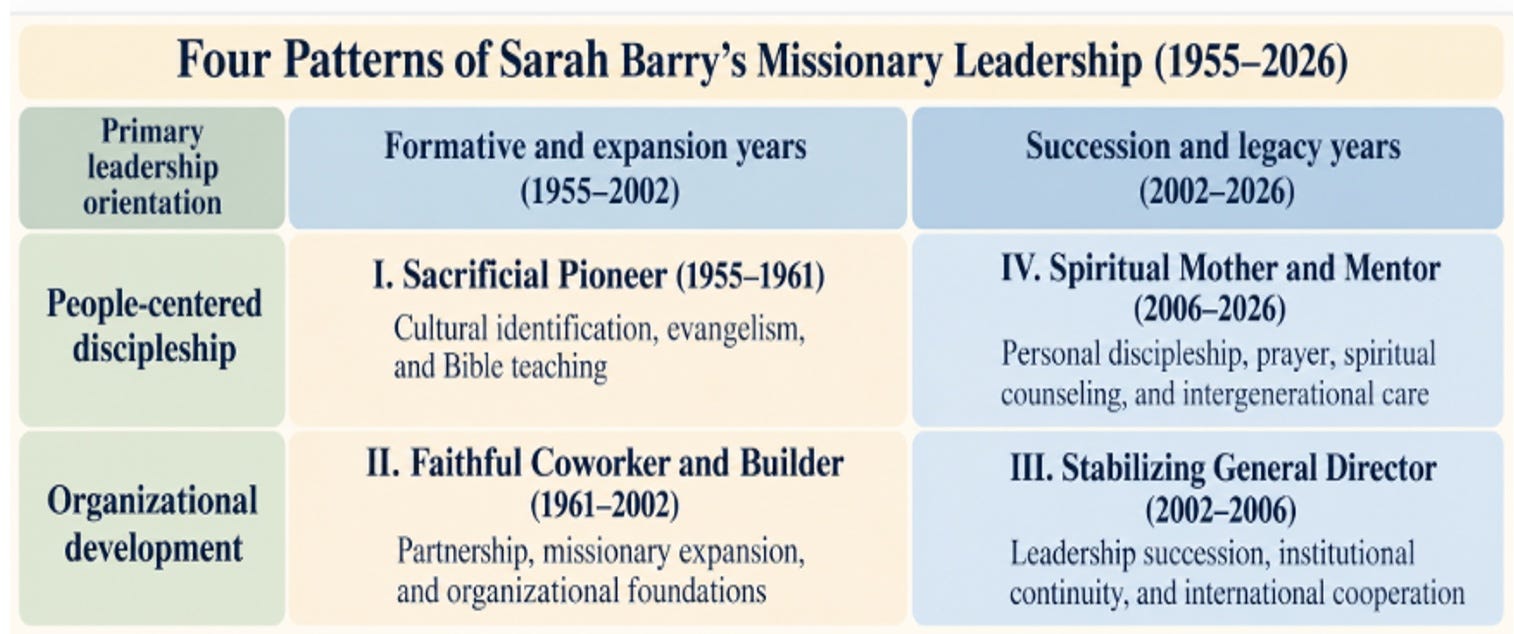
Figure 1. Four Patterns of Sarah Barry’s Missionary Leadership (1955–2026)
Figure 1 illustrates four evolving expressions of Sarah Barry’s missionary leadership, combining two historical periods with two primary orientations of service. The four patterns are complementary rather than mutually exclusive and demonstrate how personal sacrifice and leadership responsibilities contributed to enduring spiritual and organizational fruit.
3.1. The Sacrificial Pioneer (1955–1961)
Sarah Barry’s pioneering period began with her arrival in Korea in 1955, when poverty, social disruption, and the consequences of war created enormous challenges for Korean society. Rather than maintaining the cultural distance and material comforts available to foreign missionaries, she learned Korean, developed personal relationships, and gradually adopted a lifestyle that enabled her to understand the people she served. Her commitment to Bible teaching and university students reflected her conviction that lasting national transformation could emerge through the spiritual development of young people. In her own account, she described accepting John 12:24 as her missionary key verse and seeking to plant a seed of faith in Korean soil (Barry, 2026). Her pioneering leadership began not with institutional authority or abundant resources but with cultural humility, personal sacrifice, and a willingness to nurture individual lives.
3.2. The Faithful Coworker and Organizational Builder (1961–2002)
Sarah Barry’s partnership with Samuel Lee began in 1961 and continued as UBF developed from a Korean campus ministry into an international missionary movement. She contributed through Bible teaching, writing, personal counseling, and organizational coordination while nurturing Korean student leaders and missionaries. Her assistance with UBF’s legal registration in Mississippi and Samuel Lee’s move to Chicago in 1977 reflected her willingness to assume important responsibilities without seeking personal recognition. During periods of organizational difficulty, she consistently encouraged me to remain focused on Jesus Christ, prayer, and spiritual responsibility. Her example demonstrated that faithful Christian cooperation requires humility, perseverance, and mutual respect, and that lasting missionary fruit often grows through quiet service rather than public prominence.
3.3. The Stabilizing General Director (2002–2006)
Following Samuel Lee’s death in January 2002, Sarah Barry assumed the responsibility of General Director during a period of organizational uncertainty and leadership transition. Rather than attempting simply to reproduce the distinctive leadership style of her predecessor, she encouraged cooperation among Korean missionaries, American leaders, and international coworkers while sustaining Bible teaching and missionary engagement. She worked with a relatively small circle of senior leaders, including Korean senior missionaries and American coworkers, to strengthen communication, shared responsibility, and organizational continuity. Her visits to missionary communities and attention to developing national leadership reflected a commitment to serving the wider fellowship rather than concentrating authority in herself. In 2006, she relinquished the position to John Jun and continued encouraging the ministry without insisting on retaining formal control. Her transitional leadership demonstrated that spiritual maturity includes both the courage to assume responsibility during uncertainty and the humility to relinquish authority when others are prepared to lead.
3.4. The Spiritual Mother and Intergenerational Mentor (2006–2026)
After concluding her service as General Director, Sarah Barry continued her missionary calling through personal Bible study, prayer, correspondence, counseling, and spiritual relationships extending across nations and generations. Maintaining her modest residence beside Chicago UBF, she devoted herself to nurturing students, missionaries, ministry leaders, and families, demonstrating that retirement from organizational leadership did not mean retirement from spiritual service. Her personal care for my family was especially meaningful, as she remembered all four of our children by name, visited us during spiritual difficulties, listened patiently to our struggles, and studied the book of Ephesians with my wife.
During our final visit, when advancing age and physical weakness had diminished her ability to recognize familiar people, we were grateful for one last opportunity to pray for the woman who had faithfully prayed for us throughout the years. Her later ministry demonstrated that genuine Christian leadership transcends formal positions, continuing through lives nurtured, faith strengthened, and generations encouraged to follow Jesus Christ. From sacrificial pioneer to faithful coworker, stabilizing General Director, and spiritual mother, Sarah Barry embodied the multiplying power of John 12:24: a kernel of wheat bears lasting fruit not by preserving its own position or prominence, but by continually giving itself for the spiritual growth of others.
4. A Legacy of Sacrificial Love and Leadership Development
I include five pioneering women missionaries to place Sarah Barry’s life within the broader history of Christian missions and illustrate how faithfulness to Jesus Christ bears enduring fruit through education, healthcare, evangelism, and compassionate service. Mary F. Scranton and Rosetta Sherwood Hall served in Korea, Lottie Moon in China, and Ida Sophia Scudder and Amy Carmichael in India, each facing distinct challenges while nurturing future generations. Rather than equating their achievements with Sarah Barry’s ministry, these comparisons illuminate a common principle: faithful service produces lasting fruit when individuals invest in others and entrust the results to God (Robert, 1996; Tucker, 1988, 2004).
4.1. Mary F. Scranton (1832–1909): Pioneering Women’s Education in Korea
Mary Fletcher Scranton arrived in Korea in 1885 as an American Methodist missionary when educational opportunities for Korean girls were severely restricted. In 1886, she established Ewha Haktang with a single student, demonstrating her conviction that women’s education could transform individual lives and society. She also helped establish a women’s medical clinic in 1887, extending her ministry into healthcare at a time when cultural barriers limited women’s access to treatment. Her pioneering educational work eventually developed into Ewha Womans University, which continues to nurture generations of women leaders (Ewha Womans University, 2026). Like Sarah Barry, who invested personally in Korean university students through Bible teaching, Scranton demonstrated that lasting transformation can begin with the patient nurturing of a single individual.
4.2. Rosetta Sherwood Hall (1865–1951): Developing Korean Women as Medical Leaders
Rosetta Sherwood Hall arrived in Korea in 1890 as an American Methodist medical missionary, dedicating her life to improving women’s healthcare and expanding educational opportunities for people with disabilities. After teaching a blind girl Braille, she helped develop educational initiatives that included the Pyongyang School for the Deaf and Blind, established in 1909. Despite personal losses and challenging circumstances, she worked with Korean physicians to establish the Chosun Women’s Medical Training Institute in 1928, opening new opportunities for Korean women to become medical professionals (Boston University School of Theology, 2020). Her ministry combined compassionate medical treatment with the development of local professionals capable of serving future generations. Like Sarah Barry, who prepared Korean students to become Bible teachers and spiritual leaders, Hall understood that missionary influence becomes enduring when those receiving care are equipped to serve others.
4.3. Lottie Moon (1840–1912): Cultural Identification and Global Missionary Mobilization in China
Charlotte Digges “Lottie” Moon began her Southern Baptist missionary service in China in 1873, devoting nearly four decades to evangelism, education, and relationships with Chinese families. She learned Chinese customs, advocated girls’ education, opposed foot-binding, and used simple gestures of hospitality, including sharing tea cakes with children, to build trust within local communities (International Mission Board, 2026). Through persuasive letters to American churches, she called for greater missionary participation and financial support, helping inspire the Christmas missionary offering established in 1888 and later named in her honor. Her ministry demonstrated how cultural identification and personal relationships could connect local evangelism with sustained international missionary cooperation. Like Sarah Barry, whose Korean language, food, and modest lifestyle reflected genuine identification with Korean students, Moon demonstrated that effective missionary service begins with entering the everyday lives of those one seeks to serve.
4.4. Ida Sophia Scudder (1870–1960): Pioneering Women’s Medical Education and Leadership in India
Ida Sophia Scudder, born in India to an American missionary family, initially resisted missionary service but experienced a turning point in 1890 when three women reportedly died during childbirth because their families would not permit treatment by male physicians. Recognizing the urgent need for trained women doctors, she pursued medical education in the United States, graduated in 1899, and returned to India in 1900. Beginning with a small clinic, she established a hospital in 1902 and a medical school for women in 1918, laying the foundations for Christian Medical College in Vellore (Christian Medical College Vellore, 2026). Her achievements demonstrated how Christian compassion, professional competence, and institutional development could work together to address suffering and prepare future generations of healthcare professionals. Like Sarah Barry, who devoted herself to developing Korean students as independent spiritual leaders, Scudder recognized that enduring missionary service requires equipping local people to continue the work beyond its original founder.
4.5. Amy Carmichael (1867–1951): Sacrificial Love and Spiritual Motherhood in India
Amy Wilson Carmichael, born in Northern Ireland, served briefly in Japan before arriving in India in 1895, where she devoted her missionary life particularly to protecting vulnerable women and children. In 1901, she established the Dohnavur Fellowship, which grew into a Christian community providing shelter, education, healthcare, and spiritual guidance for children facing exploitation and neglect. Affectionately known as Amma (mother), she emphasized creating a loving family rather than merely an institution, continuing her ministry through personal suffering and physical limitations until her death in 1951 (Dohnavur Fellowship, 2026; Murray, 1998). Her spiritual writings and personal commitment to vulnerable individuals extended her influence beyond the immediate community she served. Among these five missionaries, Carmichael offers a particularly meaningful parallel to Sarah Barry’s spiritual motherhood, reflected in her patient listening, personal Bible studies, and enduring prayers for families such as ours.
5. Four Principles for Unsung Missionaries
Not every Christian missionary becomes a Sarah Barry, Amy Carmichael, Lottie Moon, or Ida Scudder whose name is remembered across generations; rather, as Ruth Tucker (2004) reminds us, the overwhelming majority serve quietly and faithfully in ordinary places, bearing the struggles, mistakes, sacrifices, and achievements of real human lives, and Sarah Barry’s life therefore offers four practical principles for believers who seek to follow Jesus Christ faithfully without aspiring to historical recognition.
5.1. Seek Faithfulness to God’s Calling Rather Than Historical Recognition
Jesus did not call his disciples to become famous, establish impressive institutions, or secure permanent positions in history; he called them to follow him, deny themselves, and serve others (Mark 8:34). Missionaries may begin their service with sincere spiritual convictions but gradually become distracted by organizational growth, leadership recognition, comparisons with more successful ministries, or the desire to leave a visible personal legacy. Sarah Barry demonstrated an alternative by remaining committed to Bible teaching, personal discipleship, and prayer whether she was serving as a pioneering missionary, a coworker, General Director, or elderly spiritual mother. Her life also reminds us that humility should not mean avoiding responsibility or neglecting professional competence, but using whatever gifts and responsibilities one receives in service to others. The first principle is to pursue obedience rather than recognition, trusting God rather than public opinion to determine the ultimate significance of one’s life.
5.2. Love Individuals Rather Than Pursue Impressive Numbers
Jesus devoted extraordinary attention to individuals, including Nicodemus, the Samaritan woman, Zacchaeus, and Peter, demonstrating that spiritual transformation often begins through attentive relationships rather than large public gatherings. In contemporary ministry, organizational indicators such as attendance, institutional expansion, financial contributions, and missionary deployments can become dominant measures of effectiveness, sometimes overshadowing the spiritual needs and dignity of individuals. Sarah Barry’s extraordinary personal care was evident in her remembering the names of my four children, listening patiently during our family’s spiritual difficulties, and personally studying the book of Ephesians with my wife. Thousands of otherwise unknown missionaries similarly devote years to nurturing a handful of students, supporting struggling families, and encouraging people whose names will never appear in historical accounts. The second principle is to value each individual as someone worthy of love, respect, and spiritual investment, recognizing that one transformed life may produce fruit beyond anything the missionary can foresee.
5.3. Practice Humility, Forgiveness, and Integrity Through Difficulties
Christian communities inevitably encounter disagreements, personal disappointments, and leadership challenges that call for both truthfulness and forgiveness. Jesus demonstrated the foundations of genuine Christian leadership by washing his disciples’ feet and teaching that greatness comes through humble service rather than power (Mark 10:42–45; John 13:12–17). During difficult periods in UBF’s history, Sarah Barry encouraged me to remain focused on Jesus Christ, Scripture, prayer, and my spiritual responsibilities, reminding me that Christian unity grows through shared faith, humility, and integrity. Genuine forgiveness does not mean overlooking wrongdoing or dismissing legitimate concerns, but seeking reconciliation through accountability, respect for conscience, and commitment to truth. Her example reminds us that Christian communities can navigate difficulties constructively by preserving mutual respect, strengthening relationships, and remaining faithful to their common calling to serve God and others.
5.4. Prepare Future Generations and Leave the Results to God
John 12:24 teaches that the multiplication of spiritual fruit requires a willingness to surrender personal control, just as a kernel of wheat must fall to the ground before new life can emerge. Jesus prepared his disciples to continue his mission after his departure, demonstrating that authentic spiritual leadership is measured partly by one’s willingness to equip others rather than retain permanent authority. Sarah Barry exemplified this principle through her cooperation with Samuel Lee, her service as General Director during a difficult transition, her willingness to transfer formal leadership, and her subsequent encouragement of successive generations of leaders. Most missionaries will never establish famous universities, hospitals, or international organizations, but they can faithfully teach Scripture, nurture families, strengthen local communities, develop successors, and entrust unfinished work to God. The fourth principle is to develop successors rather than personal followers, celebrate the growth of others rather than one’s own prominence, and complete one’s earthly journey with gratitude rather than a demand for recognition.
6. Conclusion
Sarah Barry (1930–2026) lived an extraordinary life of sacrificial love, unwavering faithfulness, and humble missionary service, embodying John 12:24 through her willingness to become a kernel of wheat that fell to the ground and bore lasting spiritual fruit across nations and generations. Like Mary Scranton, Rosetta Sherwood Hall, Lottie Moon, Ida Scudder, and Amy Carmichael, she demonstrated that the enduring influence of Christian missionaries comes not primarily through personal prominence or institutional accomplishments but through developing people, nurturing faith, and preparing future leaders. For my wife and me, her most precious legacy remains deeply personal—her compassionate listening during our spiritual struggles, her prayers for our family, her love for our four children, and her steadfast example that helped us remain faithful to our missionary calling. While history remembers a few extraordinary missionaries and countless others remain unsung heroes, Sarah Barry’s life reminds us that our ultimate calling is not to secure a place in history but to follow Jesus Christ faithfully, love the people entrusted to us, and leave the lasting fruit of our lives in God’s hands.
References
Barry, S. (2000, November 7). The kernel of wheat [Bible study message on John 12:20–36]. University Bible Fellowship. https://ubf.org/resources/show/the-kernel-of-wheat
Barry, S. (2026). Biography. In Loving Memory of Sarah Barry. https://sarahbarry.org/life
Boston University School of Theology. (2020, February 21). Hall, Rosetta Sherwood (1865–1951). History of Missiology. https://www.bu.edu/missiology/2020/02/21/hall-rosetta-sherwood-1865-1951/
Christian Medical College Vellore. (2026). Prospectus 2026–2027. https://www.cmch-vellore.edu/wp-content/uploads/sites/14/2026/02/college-prospectus-23-02-2026.pdf
Dohnavur Fellowship. (2026). History of the Dohnavur Fellowship.
https://www.dohnavurfellowship.org/
Ewha Womans University. (2026). History of Ewha. https://www.ewha.ac.kr/ewhaen/intro/history02-1.do
International Mission Board. (2026). Who was Lottie Moon? https://www.imb.org/about/lottie-moon/
Murray, J. (1998). Carmichael, Amy Beatrice (1867–1951). In G. H. Anderson (Ed.), Biographical dictionary of Christian missions (p. 116). Macmillan Reference USA. https://www.bu.edu/missiology/missionary-biography/c-d/carmichael-amy-beatrice-1867-1951/
Neely, A. (1998). Moon, Charlotte (“Lottie”) Diggs (1840–1912). In G. H. Anderson (Ed.), Biographical dictionary of Christian missions (p. 471). Macmillan Reference USA. https://www.bu.edu/missiology/missionary-biography/l-m/moon-charlotte-lottie-diggs-1840-1912/
Robert, D. L. (1996). American women in mission: A social history of their thought and practice. Mercer University Press.
Tucker, R. A. (1988). Guardians of the Great Commission: The story of women in modern missions. Academie Books.
Tucker, R. A. (2004). From Jerusalem to Irian Jaya: A biographical history of Christian missions (2nd ed.). Zondervan.
Ward, R. (2026, October 18). Missionary Sarah Barry went to be with the Lord on Sunday, October 18, 2026, at 6:34 p.m. at her home in Chicago [Memorial announcement and updates]. University Bible Fellowship. https://ubf.org/articles/show/mother-sarah-barrys-health-update
Author’s Note
Author’s Note: This tribute draws on my personal encounters with Sarah Barry over more than five decades, supplemented by her autobiographical accounts and published missionary histories. It represents neither an official statement of University Bible Fellowship nor a comprehensive assessment of its institutional history. My purpose is to honor Sarah Barry’s enduring example of faithfulness to Jesus Christ, compassionate care for individuals, and humble service, while inviting readers across Christian traditions to reflect on the lasting significance of sacrificial love, integrity, and spiritual leadership.
Citation:
Paul C. Hong (2026, October 22). Sarah Barry (1930–2026): A Kernel of Wheat That Fell to the Ground and Bore Much Fruit. K-GSP Forum. pp. 1-11.
Original Article:

한글 요약
배사라 선교사 (1930–2026):
땅에 떨어져 많은 열매를 맺은 한 알의 밀알 그리고 이름 없는 신앙의 영웅들
1970년 연세대학교 신입생 시절 처음 만난 배사라 (Sarah Barry) 선교사는 한국의 언어와 음식, 생활방식을 받아들이며 대학생들에게 성경을 가르쳤고, 그 후 50여 년 동안 저자의 신앙과 선교적 삶에 깊은 영향을 주었다. 1955년 한국에 도착한 그녀는 1961년 이사무엘 목사와 함께 대학생성경읽기선교회(UBF)를 설립하여 한국 대학생들을 성서한국과 세계 선교의 지도자로 양성하는 데 헌신하였다. 그녀의 삶은 요한복음 12장 24절의 말씀처럼 한 알의 밀알이 땅에 떨어져 죽음으로 많은 열매를 맺는 희생과 헌신의 선교적 원리를 보여주었다.
그러한 헌신의 뿌리에는 미시시피주의 장로교 가정에서 익힌 성경 말씀과, 대학 시절 야고보서 1장 5절과 로마서 성경공부를 통해 자신의 신앙을 새롭게 받아들인 개인적 회심이 있었다. 그녀는 한국전쟁으로 고통받는 사람들에게 복음의 소망을 전하고자 문화적 거리와 생활의 불편함을 감수했으며, 한국 대학생들을 단순한 도움의 대상이 아니라 스스로 성경을 가르치고 다음 세대를 이끌 동역자로 존중했다. 이러한 모습은 그녀의 선교가 거창한 제도나 개인의 명성보다 한 사람을 깊이 돌보고 성장시키는 제자양육에서 출발했음을 보여준다.
배사라 선교사는 UBF의 여러 어려움과 지도력의 변화 속에서도 예수 그리스도와 성경 말씀에 대한 헌신을 이어갔으며, 이사무엘 목사 별세 이후에는 총재로서 조직의 안정과 지도력 계승에 기여하였다. 그의 70여 년에 걸친 선교적 삶은 희생적 개척자, 신실한 동역자, 조직의 안정과 계승을 이끈 지도자, 그리고 세대를 이어 신앙을 돌본 영적 어머니라는 네 가지 역할로 조명할 수 있다. 또한 메리 스크랜턴, 로제타 홀, 로티 문, 아이다 스커더, 에이미 카마이클 등 다섯 여성 선교사의 삶과 비교함으로써, 진정한 선교의 유산은 조직적 성취나 개인적 명성을 넘어 사람을 세우고 다음 세대에 믿음과 사랑을 전하는 데 있음을 보여준다.
저자 폴 홍에게 배사라 선교사의 가장 소중한 유산은 공식적인 직책이나 업적보다 한 사람 한 사람을 향한 깊은 관심과 사랑에 있었다. 그는 저자의 네 자녀의 이름을 기억하고 가족의 안부를 살폈으며, 특히 신앙적으로 어려움을 겪던 시기에 직접 가정을 방문하여 부부의 이야기를 경청하고 아내와 에베소서를 공부하며 함께 기도해 주었다. 이러한 개인적 경험은 요한복음 12장 24절의 ‘한 알의 밀알’ 정신이 거창한 업적뿐 아니라 한 사람을 향한 신실한 사랑과 섬김을 통해서도 세대를 넘어 풍성한 열매를 맺는다는 사실을 보여준다.
이 글은 50여 년에 걸친 개인적 만남과 배사라의 자전적 기록 및 선교 역사 자료에 근거한 추모문으로, UBF의 공식 입장이나 과거 조직적 갈등에 대한 최종적 평가가 아니라 서로 다른 길을 걸어온 그리스도인들과 함께 공감할 수 있는 신앙적 성찰을 지향한다. 궁극적으로 이 글은 세상에 알려지지 않은 수많은 신앙의 영웅들을 기리며, 우리의 참된 소명은 역사적 명성을 추구하는 것이 아니라 예수 그리스도를 신실하게 따르고 맡겨진 사람들을 사랑하며 삶의 열매를 하나님께 맡기는 것임을 일깨운다.
© K-Global Scholars and Professionals Forum. All rights reserved. Content published in the K-GSP Forum may not be reproduced, distributed, or transmitted in any form without prior written permission from the K-GSP Forum, except for brief quotations with full attribution.