
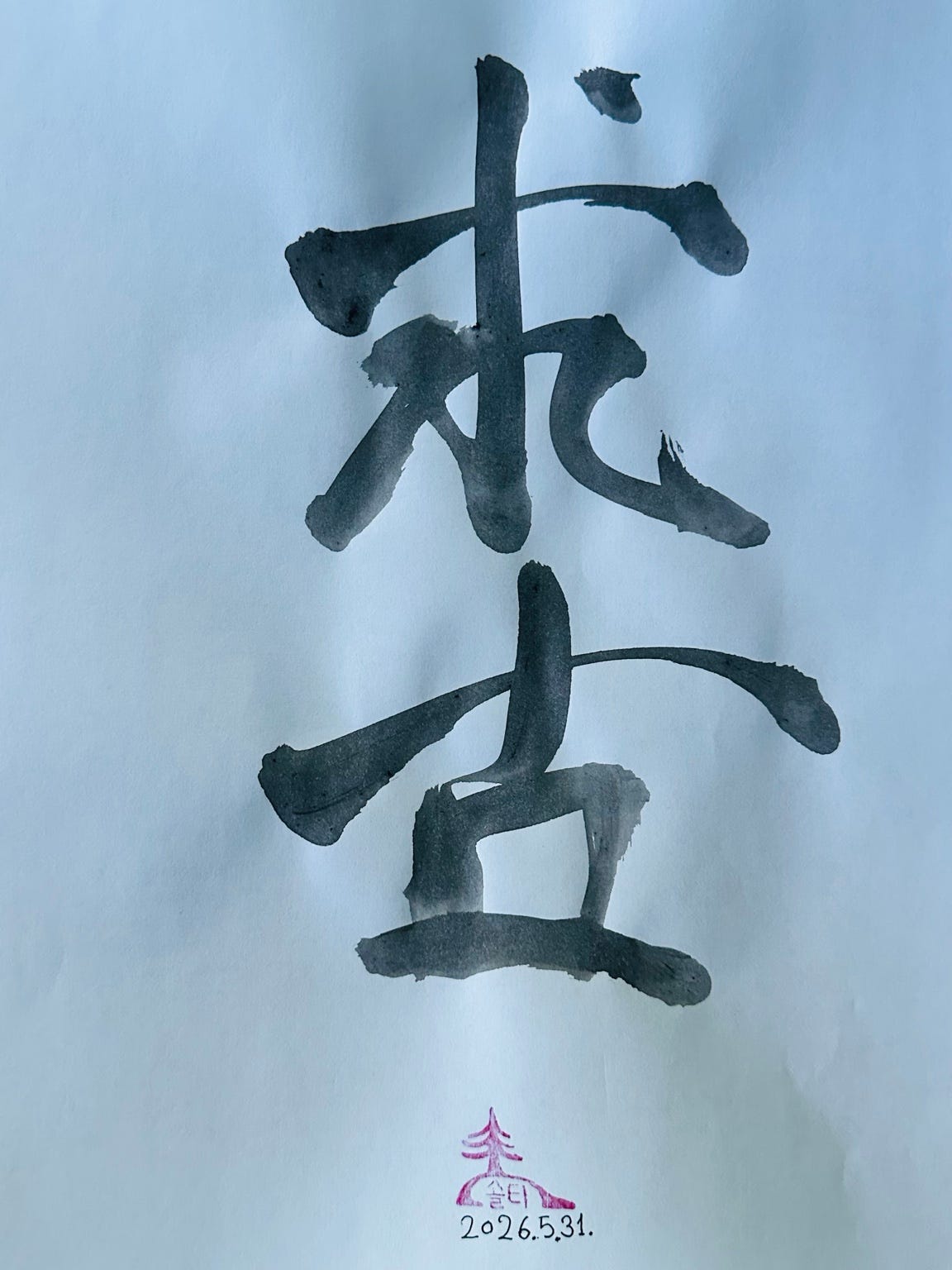
At first glance, what captures the eye in this work is the bold presence of ink. Yet the longer one lingers before it, the more apparent it becomes that this is far more than a simple rendering of two characters. The inscription “Seeking Antiquity” (求古) is, before all else, a question.
Why do we seek the past?
Our modern world is perpetually oriented toward the new. We celebrate faster technologies, more disruptive innovations, and visions of an ever-advancing future. Yet this work quietly points in the opposite direction. It invites us to pause, to turn around, and to look back—not out of nostalgia, but out of a desire to understand.
The upper character, 求 (to seek), is alive with movement. The brush presses, glides, and releases across the paper, creating strokes that resemble the footsteps of a traveler embarking on an uncertain journey. The lines refuse confinement; they stretch outward with curiosity and purpose. Within them, one senses both the scholar’s relentless pursuit of knowledge and the artist’s willingness to venture into the unknown. The character seems less written than enacted, embodying the very act of searching.
By contrast, the lower character, 古 (the ancient), possesses a profound sense of gravity and repose. It stands firm, like an ancient tree that has weathered centuries of wind and rain. If the upper character speaks of movement, the lower speaks of stillness. If one is a question, the other is a response. Together, they create a visual dialogue: the seeker and the sought, the journey and the destination, aspiration and wisdom. Their relationship is not oppositional but complementary. Tradition remains alive because there are those who seek it, and seekers find direction because tradition endures.
Equally compelling is the role of empty space. Much of the composition consists not of ink, but of silence. Yet this silence is anything but empty. It becomes a vessel for centuries of memory and reflection. As viewers gaze into the expansive white field, they may find themselves imagining the studies of ancient scholars, the scent of aging manuscripts, or the quiet perseverance of minds long departed. Calligraphy reveals words, but true art evokes what cannot be seen. This work achieves precisely that.
The tonal variations of the ink further enrich its expressive depth. Some strokes are dark and assertive, while others dissolve softly into the paper. The effect is reminiscent of history itself. Certain memories remain vivid; others fade into obscurity. Yet together they form the collective inheritance of a culture. The nuanced gradations of ink mirror the layered complexity of human experience, lending the work both visual richness and emotional resonance.
What makes this piece particularly compelling is that it never descends into mere antiquarianism. Seeking Antiquity is not a call to retreat into the past. Rather, it is an invitation to engage with the past as a living source of insight. It encourages us to learn from tradition without becoming captive to it, to honor inherited wisdom while continuing to create anew. In this sense, the work is profoundly contemporary.
One is reminded of the Korean scholar and literary master Choi Rip (1539–1612), who devoted his life to the study of classical texts. Yet he did not imitate the ancients for their own sake. Instead, he sought within them enduring principles that could illuminate the challenges of his own age. This calligraphy seems to embody a similar spirit. Its form is rooted in tradition, yet the questions it poses belong unmistakably to our present moment.
Ultimately, Seeking Antiquity is less a calligraphic work than a philosophical meditation rendered in ink.
“If you wish to discover a new path, first learn to understand the old one.”
The message is quiet, yet remarkably powerful. It does not proclaim; it persuades through contemplation. Standing before the work, viewers are naturally drawn into self-reflection. What am I learning? What have I forgotten? Upon what traditions does my own life stand?
Herein lies the true beauty of the piece. Its meaning does not reveal itself all at once. Rather, it unfolds gradually, lingering in the mind long after the eye has departed. Seeking Antiquity is not merely about finding the wisdom of the past; it is about rediscovering ourselves through our encounter with it. That is its deepest aesthetic achievement and its most enduring artistic grace. +++
{Solti}
June 1, 2026
구고(求古) — 옛것을 찾는다는 것은 무엇인가
시간의 강을 거슬러 지혜를 건져 올리는 서예
이 작품을 처음 마주하면, 가장 먼저 눈에 들어오는 것은 거침없는 먹빛이다. 그러나 조금 더 오래 바라보면, 이 글씨는 단순히 두 글자를 적은 작품이 아니라는 사실을 알게 된다. 화면 위에 쓰인 「求古(구고)」는 문자 이전에 하나의 질문이다.
“왜 우리는 옛것을 찾는가?”
현대 사회는 언제나 새로운 것을 향해 달려간다. 더 빠른 기술, 더 혁신적인 아이디어, 더 앞선 미래를 이야기한다. 하지만 이 작품은 조용히 반대 방향을 가리킨다. 앞만 보며 달리는 우리에게 잠시 걸음을 멈추고 뒤를 돌아보라고 말한다.
상단의 求(구) 자는 살아 움직인다. 붓이 종이를 누르고 미끄러지며 만들어낸 선들은 마치 무언가를 찾아 나서는 사람의 발걸음 같다. 획은 단정하게 갇혀 있지 않고 자유롭게 뻗어 나간다. 탐구와 질문, 갈망과 호기심이 화면 속에서 꿈틀거린다. 우리는 그 안에서 학자의 열정과 예술가의 모험심을 동시에 읽게 된다.
반면 하단의 古(고) 자는 묵직하다. 마치 오랜 세월 비바람을 견딘 고목처럼 흔들림이 없다. 위의 글자가 움직임이라면 아래의 글자는 정지이다. 질문이라면 대답이고, 여정이라면 도착이다. 두 글자는 서로 대립하는 것이 아니라 서로를 완성한다. 찾는 자가 있기에 전통은 살아 있고, 전통이 있기에 탐구는 방향을 얻는다.
특히 인상적인 것은 여백이다. 이 작품의 가장 큰 부분은 사실 글씨가 아니라 비어 있는 공간이다. 하지만 그 비어 있음은 공허함이 아니다. 그 안에는 수백 년의 시간이 흐른다. 관람자는 여백을 바라보며 옛 선비들의 서재를 떠올리고, 오래된 책의 종이 냄새를 상상하며, 한 시대를 살았던 사람들의 사유와 마주하게 된다. 서예는 글자를 보여주지만, 진정한 예술은 보이지 않는 것을 느끼게 한다. 이 작품은 바로 그런 힘을 지닌다.
먹의 농담 또한 아름답다. 어떤 부분은 짙고 단단하며, 어떤 부분은 번져 흐릿하다. 마치 역사 그 자체를 보는 듯하다. 어떤 기억은 선명하게 남고, 어떤 기억은 희미하게 사라진다. 그러나 모두가 모여 하나의 문화와 전통을 이루듯, 이 작품의 먹빛도 다양한 층위를 이루며 깊이를 만들어낸다.
무엇보다 이 작품이 매력적인 이유는 복고주의에 머물지 않는다는 점이다. 「求古」는 과거로 돌아가자는 선언이 아니다. 오히려 과거를 통해 현재를 이해하고 미래를 준비하자는 제안이다. 옛것을 사랑하되 옛것에 갇히지 않는 태도, 그것이 이 작품이 보여주는 가장 현대적인 가치이다.
문득 조선의 문인 간이(簡易) 최립이 떠오른다. 그는 평생 고전을 탐독했지만 단순히 옛 문장을 흉내 내지 않았다. 고전 속에서 인간과 사회를 이해하는 지혜를 발견하고 그것을 자신의 시대에 적용하려 했다. 이 작품 역시 그러한 정신을 품고 있는 듯하다. 글씨는 오래된 형식을 따르지만 그 안에 담긴 질문은 지극히 오늘의 것이다.
결국 「求古」는 서예 작품이라기보다 하나의 철학적 메시지에 가깝다.
“새로운 길을 찾고 싶다면, 먼저 오래된 길을 이해하라.”
그 메시지는 조용하지만 깊다. 화려하게 외치지 않기에 오히려 오래 남는다. 관람자는 작품 앞에서 자연스럽게 자신의 삶을 돌아보게 된다. 나는 무엇을 배우고 있는가. 나는 무엇을 잊고 있는가. 그리고 나는 어떤 전통 위에 서 있는가.
이 작품의 미학은 바로 그 지점에 있다. 눈으로 보는 순간보다, 마음속에서 오래 머무를 때 더욱 빛난다. 「求古」는 옛것을 찾는 글씨가 아니라, 우리 자신을 찾게 만드는 글씨이다. 그것이 이 작품이 지닌 가장 깊고 아름다운 예술적 가치이다. +++
{솔티}
2026년 6월 1일

Young Choi, PhD is a Professor at Regent University bringing a rare combination of technical expertise and creative spirit to everything he does. A scholar in AI, cybersecurity, and network & telecommunications service management, he has published 38 books including AI and cybersecurity area books, over 200 refereed articles, and over 20 book chapters. Beyond the academy, Dr. Choi is a passionate poet, essayist, and wooden block laser engraving artist whose reflective writing invites readers to rediscover life’s beauty in quiet contemplation(靜觀). He lives under the motto: “Study hard and give generously without holding back! (열심히 공부해서 아낌없이 남주자 !: 열공아남!)”
Published books: https://www.amazon.com/stores/Young-Choi/author/B0DMZ5S6R7?ref=ap_rdr&shoppingPortalEnabled=true