

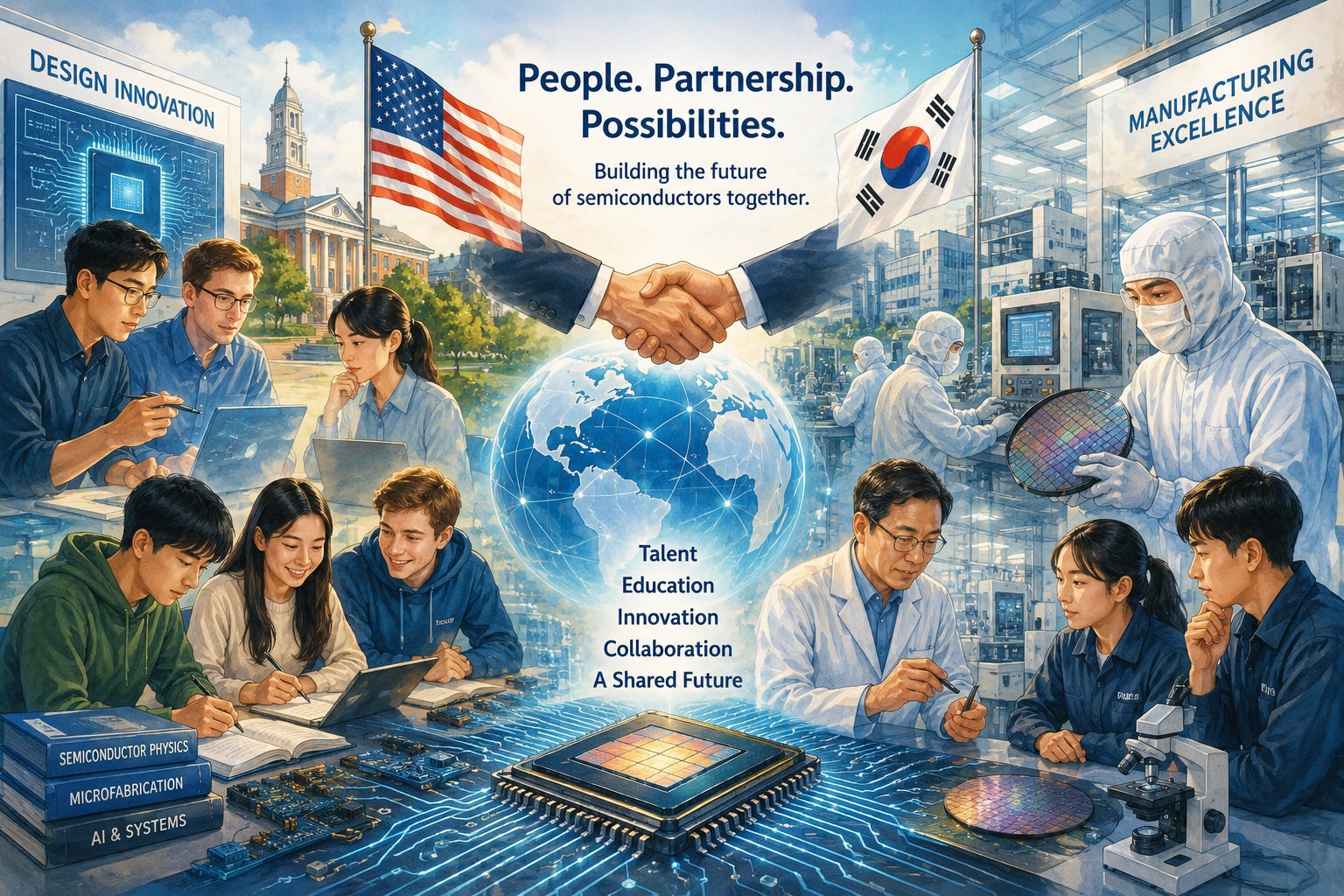
The United States is the world’s leading nation in semiconductor design. Companies such as NVIDIA, AMD, Qualcomm, and Apple continue to drive the global artificial intelligence revolution through relentless innovation. Ironically, however, the country that leads semiconductor design does not yet possess enough advanced manufacturing capacity to dominate semiconductor production. As the U.S. government and industry invest hundreds of billions of dollars to revive domestic semiconductor manufacturing, they are discovering that the greatest obstacle is not the construction of factories—it is the shortage of skilled people.
For more than three decades, the United States embraced a global division of labor in which America focused on design while manufacturing gradually shifted to Asia. Economically, this strategy was highly efficient. Lower production costs and optimized global supply chains strengthened corporate competitiveness. Yet during this transition, the nation’s ecosystem for developing manufacturing engineers, process specialists, and highly skilled technicians steadily weakened. Today, while the United States has ample capital to build state-of-the-art fabrication facilities, it faces a significant shortage of qualified professionals capable of operating them. Industry analysts estimate that by 2030 the U.S. semiconductor sector could face a shortage of more than 150,000 skilled workers.
This reality reminds us of an important truth: the foundation of industrial competitiveness is not merely physical infrastructure but human capital. When discussing advanced industries, we often focus on factories, equipment, and investment. Yet sustainable competitiveness ultimately depends on people. Even the world’s most sophisticated manufacturing equipment is only as valuable as the engineers and technicians who understand, operate, and continuously improve it.
In this respect, South Korea offers an important lesson. Over several decades, Korea has cultivated semiconductors as a national strategic industry by fostering close collaboration among universities, research institutes, and private enterprises. Its globally competitive ecosystem—comprising manufacturing technicians, process engineers, equipment specialists, and quality assurance professionals—was not created overnight. It is the product of decades of investment in education, industrial experience, and a culture that values technical excellence and continuous learning.
The United States, meanwhile, possesses extraordinary strengths of its own. Its world-class research universities, unmatched innovation ecosystem, entrepreneurial culture, leadership in semiconductor design, and remarkable capacity for investment remain unparalleled. The future of the semiconductor industry is therefore unlikely to belong to any single nation. Instead, it will increasingly depend on strategic partnerships that combine complementary strengths.
The partnership between the United States and South Korea represents far more than investment in fabrication plants. Joint research initiatives, faculty and student exchanges, industrial internship programs, workforce development, and collaborative educational platforms can generate long-term benefits for both nations. As emerging technologies—including AI chips, quantum computing, advanced packaging, and next-generation semiconductor architectures—reshape the global economy, international collaboration in developing human talent will become as important as technological innovation itself.
Universities must also evolve. Semiconductor education can no longer remain confined to electrical engineering. Future professionals will require interdisciplinary training that integrates artificial intelligence, data analytics, cybersecurity, supply chain management, sustainability, and advanced manufacturing. New educational models built through close partnerships between academia and industry will play a decisive role in shaping future competitiveness.
Having spent many years studying information technology and artificial intelligence, I have observed that every major technological revolution appears to begin with new machines. Yet history consistently shows that transformative innovation is ultimately driven by human creativity, knowledge, and collaboration. The semiconductor industry is no exception. Regardless of how many advanced fabrication facilities a nation builds, its long-term competitiveness depends on the people who design, manufacture, improve, and reimagine the technologies of tomorrow.
Semiconductors are far more than an industry; they are the foundation upon which future economies and national competitiveness will be built. That future will not be created solely within concrete buildings filled with expensive equipment. It will be shaped in classrooms, research laboratories, manufacturing floors, and the minds of dedicated engineers, scientists, educators, and students who never stop learning.
In the end, the true semiconductor superpower will not be the nation that builds the greatest number of factories, but the one that cultivates the greatest number of talented people. +++
{Solti}
July 9, 2026
반도체는 공장이 아니라 사람이 만드는 것이다
미국은 세계 최고의 반도체 설계 국가이다. 엔비디아(NVIDIA), AMD, 퀄컴, 애플과 같은 혁신 기업들이 세계 인공지능 시대를 이끌고 있다. 그러나 아이러니하게도 이러한 혁신의 중심 국가에는 세계 시장을 주도할 만큼의 첨단 반도체 생산 공장이 충분하지 않다. 최근 미국 정부와 산업계가 수천억 달러를 투자하며 반도체 제조업 부활에 나서고 있지만, 예상보다 더 큰 장벽은 공장이 아니라 사람이라는 사실이 드러나고 있다.
지난 30여 년 동안 미국은 “설계는 미국, 생산은 아시아”라는 글로벌 분업 체제를 선택했다. 경제적으로는 효율적인 전략이었다. 값싼 생산비와 안정적인 공급망은 기업의 경쟁력을 높여 주었다. 하지만 그 과정에서 제조 현장을 책임질 기술자와 숙련 엔지니어를 양성하는 교육 시스템과 산업 생태계는 점차 약화되었다. 이제 미국은 첨단 공장을 건설할 자본은 충분하지만, 그 공장을 운영할 인재가 부족한 현실과 마주하고 있다. 전문가들은 2030년까지 미국 반도체 산업에서 숙련 인력이 최대 15만 명 이상 부족할 수 있다고 전망한다.
이번 기사는 산업 경쟁력의 본질이 무엇인지를 다시 생각하게 만든다. 우리는 흔히 첨단 산업을 이야기할 때 건물, 장비, 투자 규모를 먼저 떠올린다. 그러나 산업의 지속 가능한 경쟁력은 결국 사람에게서 나온다. 세계 최고의 장비도 이를 이해하고 운영하는 인재가 없다면 단순한 기계에 불과하다.
이 점에서 한국은 세계가 주목해야 할 중요한 사례를 갖고 있다. 한국은 오랜 기간 반도체를 국가 전략 산업으로 육성하며 대학, 연구기관, 기업이 긴밀하게 협력하는 생태계를 구축해 왔다. 숙련된 생산기술자와 공정 엔지니어, 장비 전문가, 품질관리 인력이 유기적으로 연결된 산업 구조는 하루아침에 만들어진 것이 아니다. 수십 년간 축적된 경험과 교육, 그리고 현장 중심의 기술 문화가 오늘의 경쟁력을 만들어 냈다.
반면 미국이 가진 강점 역시 분명하다. 세계 최고 수준의 연구개발 능력, 창의적인 설계 기술, 벤처 생태계, 그리고 막대한 투자 능력은 여전히 미국의 가장 큰 자산이다. 따라서 앞으로의 경쟁은 어느 한 나라가 모든 것을 독점하는 시대가 아니라, 서로의 강점을 연결하는 협력의 시대가 될 가능성이 크다.
특히 한국과 미국의 협력은 단순한 공장 투자 이상의 의미를 가진다. 공동 연구, 교수와 학생 교류, 산업 현장 실습, 전문기술 인력 양성 프로그램, 그리고 차세대 반도체 교육 플랫폼을 함께 구축한다면 양국 모두에게 새로운 성장 동력이 될 수 있다. AI 반도체, 양자컴퓨팅, 첨단 패키징과 같은 미래 산업에서는 기술만큼 인재의 이동과 협력이 더욱 중요해질 것이다.
대학교 역시 변화해야 한다. 반도체 교육은 더 이상 전자공학만의 영역이 아니다. 인공지능, 데이터 분석, 사이버보안, 공급망 관리, 환경 지속가능성까지 융합된 교육과정이 요구된다. 산업계와 대학이 공동으로 교육과 연구를 설계하는 새로운 모델이 미래 경쟁력을 결정할 것이다.
필자는 오랫동안 정보통신과 인공지능 분야를 연구하며 기술 혁신의 역사를 지켜보았다. 새로운 기술은 언제나 새로운 기계를 통해 시작되는 것처럼 보였지만, 결국 혁신을 완성한 것은 사람들의 창의성과 협력이었다. 반도체 역시 예외가 아니다. 아무리 거대한 공장을 세워도 숙련된 기술자와 창의적인 연구자가 없다면 경쟁력은 오래가지 못한다.
반도체는 단순한 산업이 아니라 국가의 미래를 설계하는 기반 기술이다. 그리고 미래는 콘크리트 건물에서 만들어지는 것이 아니라 사람의 머리와 손, 그리고 끊임없는 배움 속에서 만들어진다.
결국 진정한 반도체 강국은 가장 많은 공장을 가진 나라가 아니라, 가장 많은 인재를 길러내는 나라일 것이다. +++
{솔티}
2026년 7월 9일

Prof. Dr. Young Choi (Editor in Chief) — Regent University
Young B. Choi is a Professor in the Department of Engineering & Computer Science at Regent University. He published 38 books with ‘Selected Readings in Cybersecurity’ (2018) (over 800 copies archived globally at university/college libraries around the world) and ‘Cybersecurity Applications and Artificial Intelligence’ (2023) available in seven major world languages. He proposed the world’s first global and universal telecommunications “Service Order Handling (SOH)” Model (T-SOH Model) (1995) with Dr. Adrian Tang. With this innovative research work, he received the IEEE NOMS ’96 Best Paper Award and became the first recipient of the Outstanding Contribution Award of the TeleManagement Forum in 1998. His research areas include Natural Language Processing-focused AI, AI-applied cybersecurity, network and telecom service management, and Korean studies on Gani Choi Rip’s Jeonggwan (靜觀: Quiet Contemplation) philosophy and Shilhak ( 實學: Practical Learning).