

Executive Summary
K-Food has emerged as one of Korea’s most successful global industries, but its rise reflects far more than the popularity of Korean culture. This article demonstrates that the global expansion of Korean food products resulted from decades of investments in food processing, fisheries modernization, logistics networks, retail transformation, and digital supply chain coordination that collectively created a globally competitive ecosystem. Drawing on the experiences of leading firms across food manufacturing, fisheries, logistics, and retail, the study shows how infrastructure, institutions, and organizational capabilities transformed Korea from a food-importing nation into a major participant in global food markets.
Keywords: K-Food Ecosystem; Global Food Industry; Supply Chain Infrastructure; Institutional Development; Korean Competitiveness
1. Introduction
In 2026, consumers in New York, London, Paris, Dubai, Singapore, and São Paulo can purchase Korean instant noodles, frozen dumplings, kimchi, seaweed snacks, and fermented sauces in local supermarkets as easily as many domestic food products. Korean food brands increasingly occupy shelf space in major retailers, appear on global e-commerce platforms, and serve customers through restaurants, convenience stores, and food-service networks around the world. To many observers, this remarkable rise of K-Food appears to be a natural extension of the Korean Wave (Hallyu), fueled by the global popularity of K-pop, K-dramas, and Korean culture. Yet a fundamental question remains: How did Korean food products become available so quickly, consistently, and competitively across global markets?
The answer extends far beyond cultural popularity. Long before Korean entertainment achieved worldwide recognition, Korea had spent decades building the industrial, logistical, and institutional foundations necessary to support large-scale food production and international distribution. Investments in food processing, fisheries modernization, cold-chain logistics, retail transformation, export discipline, and digital supply chain coordination gradually created an ecosystem capable of moving Korean food products from local factories and fishing fleets to consumers across continents. The global success of K-Food therefore represents not simply a cultural phenomenon, but the culmination of a long process of infrastructure building, capability accumulation, and dynamic adaptation across industries and institutions (Cavusgil & Deligonul, 2025; Hong et al., 2024).
This article argues that the rise of K-Food should be understood as the historical development of a globally integrated food ecosystem in which value creation depends on the coordinated interaction of multiple complementary actors, resources, and institutions. Drawing on the experiences of leading firms across manufacturing, fisheries, logistics, retail, and global consumer-goods industries, the study traces how Korea transformed its food sector from a domestic food-supply system in the 1960s into a globally connected food ecosystem by 2026. The analysis draws on published research, corporate histories, industry reports, and publicly available information concerning major Korean food, retail, fisheries, and logistics companies. By examining the interaction of infrastructure, institutions, and organizational capabilities, the article demonstrates how decades of coordinated development enabled Korea to emerge as an increasingly influential participant in global food markets.
2. Contextual Overview: The Rise of K-Food as a Global Phenomenon
K-Food’s global rise reflects not only changing consumer preferences, but also the long-term development of production, distribution, and market-adaptation capabilities built on Korea’s industrial transformation and traditional food knowledge, including fermentation, preservation, and nutritional value that supported international commercialization (Park et al., 2014; Kwon et al., 2023).
2.1 From Food Security to Industrial Development
The K-Food ecosystem began with Korea’s postwar efforts to secure a stable food supply and modernize its economy. During the 1960s and 1970s, national policy emphasized increased food production, higher agricultural productivity, and the development of domestic processing industries (Korea Rural Economic Institute, 2015; OECD, 2018). Companies also began building modern food-production capacity: CJ CheilJedang started sugar production in 1953 and flour manufacturing in 1958, while Samyang Foods introduced Korea’s first instant noodles in 1963 in response to widespread food shortages (CJ CheilJedang, 2025; Samyang Foods, n.d.). At the same time, advances in fermentation, seafood processing, packaging, quality control, cold storage, and refrigerated distribution helped transform traditional food production into a modern industrial system. Although these early investments were primarily intended to meet domestic needs, they created the production and distribution foundation that later supported Korea’s expansion into global food markets.
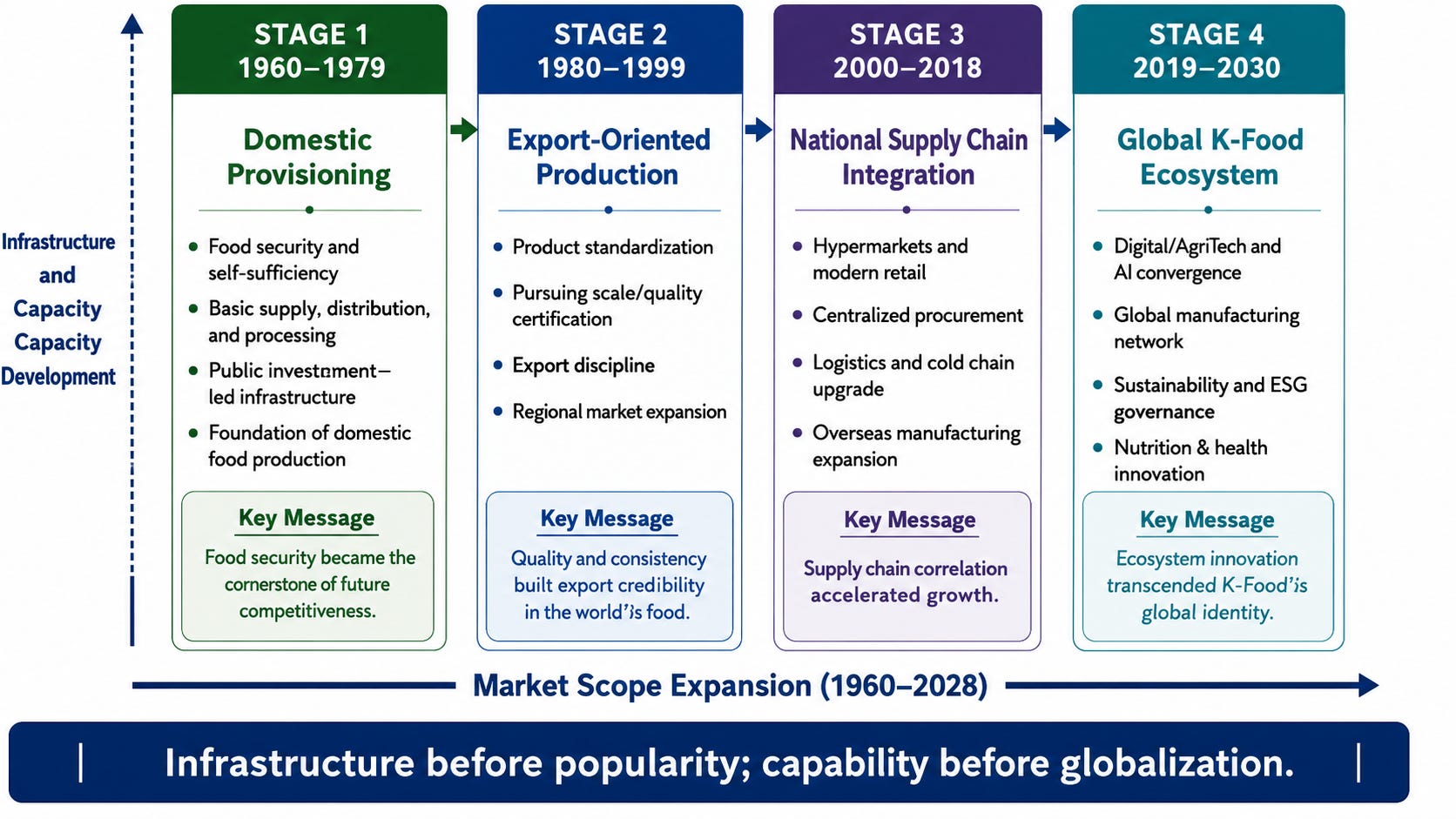
Figure 1 presents the historical evolution of the K-Food ecosystem from 1960 to 2026 through four stages of development. Stage 1, Domestic Provisioning (1960–1979), shows how food security, industrialization, fisheries modernization, and basic processing capabilities laid the foundation for future competitiveness; Stage 2, Export-Oriented Production (1980–1999), highlights product standardization, packaging, quality certification, export discipline, and regional market expansion; Stage 3, National Supply Chain Integration (2000–2014), emphasizes the rise of hypermarkets, centralized procurement, logistics networks, and overseas manufacturing expansion; and Stage 4, Global K-Food Ecosystem (2015–2026), illustrates the transition to digital logistics, e-commerce, global manufacturing networks, sustainability, ESG governance, and worldwide market penetration. Overall, the figure argues that K-Food’s global success emerged not from sudden popularity alone, but from the long-term accumulation of infrastructure, supply chain capability, and ecosystem coordination.
Figure 1
The Evolution of the K-Food Ecosystem (1960–2026)
Note. Source: Authors’ conceptual development; visual presentation assisted by AI tools.
2.2 Export Orientation and Market Transformation
The 1980s through the early 2000s marked a period of export-oriented transformation. As Korea became increasingly integrated into global markets, food manufacturers were required to meet international standards for safety, packaging, quality control, and supply reliability. Firms such as Nongshim, Ottogi, and Orion responded by strengthening product standardization, expanding export activities, and establishing overseas manufacturing facilities that improved responsiveness to international demand.
At the same time, the emergence of modern retail formats fundamentally reshaped domestic distribution systems. The growth of E-Mart, Lotte Shopping, and other large retailers introduced centralized procurement, barcode tracking, advanced inventory management, and coordinated logistics systems. These developments increased supply-chain efficiency while aligning Korean food producers with the operational requirements of global retail networks. As a result, Korean food companies moved beyond simple exporting and began participating in increasingly sophisticated international value chains.
2.3 Global Ecosystem Integration and the K-Food Era
Since the 2010s, K-Food has entered a phase of global ecosystem integration characterized by digital coordination, international logistics, sustainability governance, and worldwide brand expansion. Logistics providers such as CJ Logistics and Hyundai Glovis have enabled efficient cross-border distribution through advanced cold-chain systems, global transportation networks, and real-time supply-chain visibility. Simultaneously, digital commerce platforms have expanded market access beyond traditional diaspora communities, introducing Korean food products directly to consumers around the world.
While Hallyu increased global awareness, the diffusion of Korean food products benefited from broader soft-power dynamics linking Korean culture, media, and national branding (Lee, 2009; Nye & Kim, 2019; Choy & Hong, 2026). The contemporary K-Food ecosystem therefore represents far more than a collection of successful brands. It is a globally integrated network linking producers, processors, logistics providers, retailers, digital platforms, and regulatory institutions. In this sense, K-Food demonstrates how a nation can transform a domestic food system into a globally competitive ecosystem capable of sustaining long-term international growth.
Soft power infrastructure built the foundation;
K-Food transformed it into global visibility.
3. Building the Global K-Food Ecosystem
The global success of K-Food did not emerge from a single company, product, or marketing campaign. Rather, it resulted from the cumulative interaction of firms, institutions, infrastructure investments, and market adaptations that evolved over several decades. As Korea’s food industry expanded from domestic provisioning to international markets, successive layers of capabilities were added across production, processing, distribution, logistics, and governance systems. Korean companies continued to learn new skills, improve their operations, and work more closely with retailers, logistics providers, and government institutions (Cavusgil & Deligonul, 2025).
3.1 Capability Formation through Industrial Development
The first mechanism in the development of the K-Food ecosystem was the formation of industrial capabilities through sustained investment and organizational learning. During Korea’s early industrialization, firms concentrated on securing stable food supplies by expanding food processing, ingredient manufacturing, fisheries modernization, cold-storage capacity, and packaging technologies. Companies such as CJ CheilJedang, Daesang, Samyang Foods, Dongwon Industries, and Sajo Industries built the technological and organizational foundations required for large-scale food production, while export discipline, retail transformation, logistics development, and digital coordination later extended these capabilities into broader market and ecosystem growth.
These investments created competencies that went well beyond domestic food security. Standardized production processes, quality-control systems, cold-chain infrastructure, and processing technologies provided scalable manufacturing platforms that could be reused for new products and international markets. Companies gradually strengthened and adjusted their production, logistics, and quality-control systems, making global expansion possible (Cavusgil & Deligonul, 2025). This pattern resembles the development of other Korean industries, including shipbuilding, where decades of coordinated investment and learning preceded global leadership (Hong et al., 2024). What began as domestic food modernization therefore evolved into the core industrial capabilities underlying K-Food’s global competitiveness.
3.2 Market Expansion: Export Discipline and Retail Transformation
The second stage centered on expanding market reach through export-oriented development and modern retail transformation. As Korea became increasingly integrated into the global economy, food manufacturers faced growing pressure to satisfy international standards related to safety, packaging, quality assurance, and supply reliability. Firms such as Nongshim, Ottogi, and Orion responded by strengthening product standardization, expanding exports, and establishing overseas production facilities.
Simultaneously, the emergence of large-scale retailers such as E-Mart and Lotte Shopping transformed domestic distribution systems. Centralized procurement, barcode technology, inventory management systems, and integrated logistics networks improved coordination throughout the supply chain. These developments aligned Korean producers with international retail requirements and facilitated the transition from domestic manufacturing to participation in global value chains.
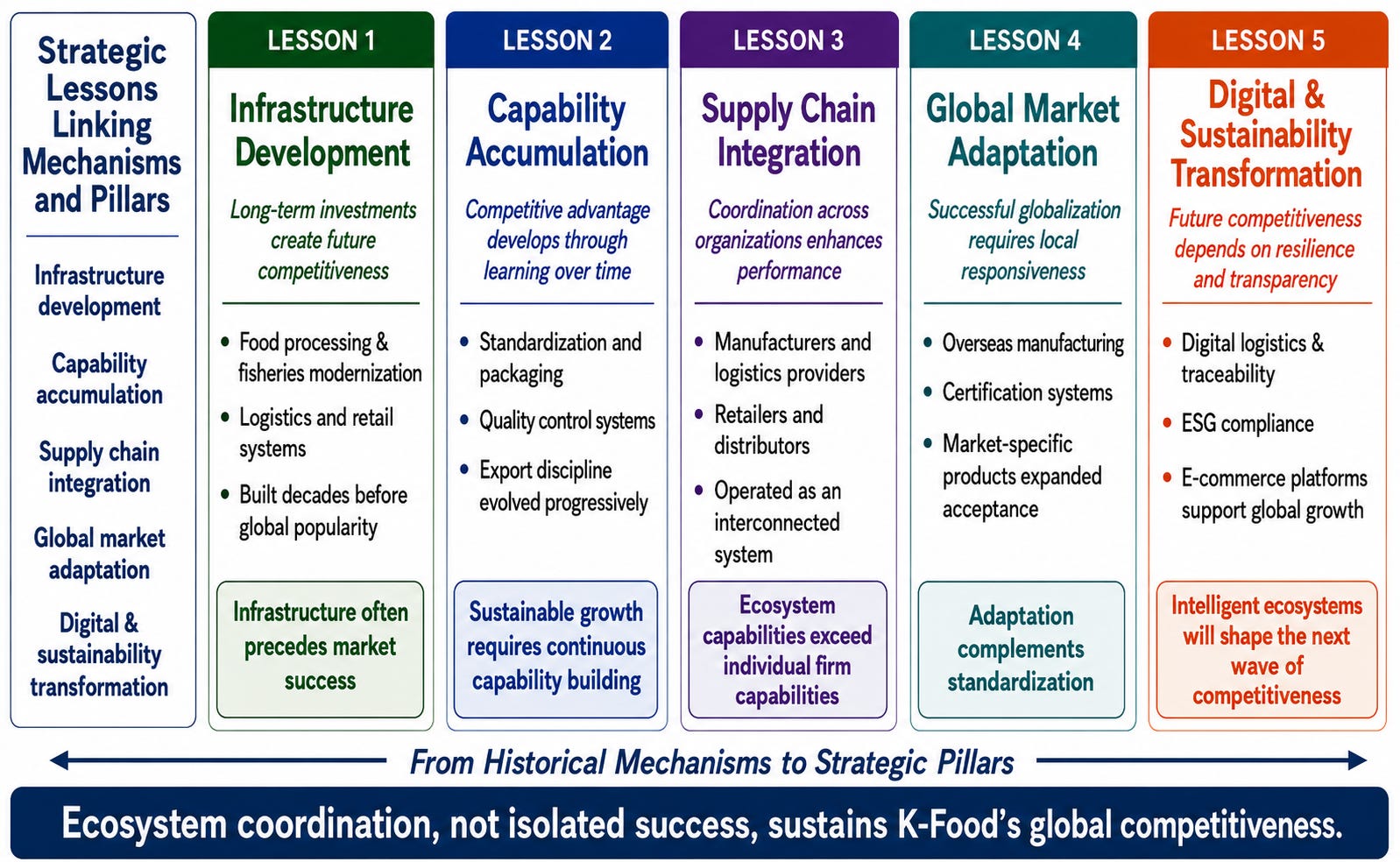
Figure 2
Strategic Lessons Linking the K-Food Mechanisms and Pillars (1960–2026)
Note. Source: Authors’ conceptual development; visual presentation assisted by AI tools.
Figure 2 presents five lessons from Korea’s K-Food development. Long-term investments created the industrial foundation; companies gradually improved quality and export capability; manufacturers, retailers, and logistics providers formed an interconnected system; firms adapted products to different markets; and digital technology and responsible business practices became increasingly important. The central message is that lasting global success depends on an entire system, not on one company or a temporary cultural trend.
3.3 Ecosystem Integration: Logistics, Digitalization, and Global Coordination
The third stage involved the integration of production, logistics, retail, and governance systems into a globally coordinated ecosystem. As Korean food firms expanded internationally during the 2010s and 2020s, managing increasingly complex supply chains required advanced logistics capabilities and digital coordination mechanisms. Logistics providers such as CJ Logistics and Hyundai Glovis developed global transportation networks, cold-chain systems, and international distribution hubs that enabled reliable worldwide delivery of Korean food products.
These developments also reflect a newer approach to industry that combines advanced technology with resilience, environmental responsibility, and attention to human needs. As global food systems face increasing uncertainty, balancing efficiency with adaptability and sustainability becomes essential to the long-term strength of the overall system (Ivanov, 2023). Real-time inventory tracking, enterprise resource planning systems, demand forecasting tools, and cross-border e-commerce platforms have enabled firms to coordinate production and distribution on a global scale. Together with sustainability initiatives, traceability systems, and ESG governance practices, these tools have helped transform K-Food into a mature global ecosystem in which success depends on close coordination among manufacturers, logistics providers, retailers, digital platforms, government agencies, and supporting organizations.
4. Strategic Pillars of the Global K-Food Ecosystem
K-Food’s global competitiveness emerged not from individual firms alone, but from the coordinated development of industrial capability, supply chain integration, and global market adaptation, supported by institutions and infrastructure that transformed a domestic food system into a global ecosystem (Hong et al., 2024; Cavusgil & Deligonul, 2025).
4.1 Industrial Capability: Transforming Tradition into Scalable Products
The first pillar involves the development of industrial capabilities that convert traditional foods into standardized products suitable for large-scale production and distribution. Firms such as CJ CheilJedang, Daesang, Nongshim, Ottogi, and Samyang Foods invested heavily in food processing technologies, packaging innovation, quality control systems, and product standardization. These capabilities enabled Korean food producers to maintain consistency, safety, and reliability while serving increasingly diverse consumer markets.
Industrial capability also allowed firms to balance standardization with adaptation. While preserving the distinctive characteristics of Korean cuisine, producers modified flavors, packaging formats, certifications, and product offerings to meet local preferences and regulatory requirements. This combination of authenticity and scalability became a critical foundation for the international growth of K-Food.
4.2 Supply Chain Integration: Connecting Production, Logistics, and Distribution
The second pillar concerns the integration of supply chain activities across production, logistics, retail, and distribution systems. Global food industries depend on reliable coordination among suppliers, manufacturers, transportation providers, retailers, and digital platforms. Korea’s food sector strengthened this coordination through investments in cold-chain infrastructure, centralized distribution centers, inventory management systems, and advanced logistics networks.
Organizations such as CJ Logistics, Hyundai Glovis, E-Mart, and Lotte Shopping played important roles in building these capabilities. Their investments improved efficiency, product traceability, and supply-chain visibility while enabling Korean food products to move rapidly across domestic and international markets. The resulting integration increased operational reliability and supported large-scale global expansion.
4.3 Global Market Adaptation: Building Sustainable International Growth
The third pillar focuses on the ability to adapt products, operations, and governance systems to changing global market conditions. As Korean food firms expanded internationally, they faced diverse consumer preferences, regulatory environments, sustainability expectations, and competitive pressures. Successful firms responded by developing flexible production systems, overseas manufacturing facilities, localized marketing strategies, and internationally recognized quality certifications.
Teece (2025) argues that digitalization enables multinational enterprises to reconfigure capabilities, strengthen governance mechanisms, and respond more effectively to global disorder. The evolution of K-Food demonstrates how Korean firms leveraged digital coordination and global network management to support international expansion. These developments allow firms to respond quickly to demand fluctuations, improve transparency, and align with emerging sustainability requirements. Consequently, K-Food has evolved from a collection of export products into a globally integrated ecosystem capable of sustaining long-term growth and international competitiveness. Such adaptive capabilities are increasingly recognized as essential determinants of sustained international competitiveness in dynamic global environments (Cavusgil & Deligonul, 2025).
K-Food is more than a product;
it is a globally integrated ecosystem.
5. Discussion: Lessons from the Rise of K-Food
K-Food’s sustained global competitiveness emerged not from cultural popularity or isolated breakthroughs, but from the gradual accumulation of capabilities and the coordinated development of infrastructure, institutions, manufacturers, fisheries firms, retailers, logistics providers, and digital platforms, creating a scalable, reliable, and adaptable ecosystem with broader lessons for other industries and nations.
5.1 Infrastructure Before Popularity
One of the most important lessons from the K-Food experience is that infrastructure preceded popularity. Long before Korean food products became widely recognized internationally, firms and policymakers invested heavily in food processing facilities, fisheries modernization, cold-chain logistics, packaging technologies, and retail distribution systems. These investments created the operational foundations necessary to support large-scale production and international market participation.
The global visibility of Korean food products in the 2010s and 2020s was therefore not the beginning of the story but rather the visible outcome of decades of institutional and infrastructural development. The Korean case suggests that sustainable international success is rarely driven by marketing or cultural influence alone; instead, it depends upon the prior development of capabilities that allow firms to meet global demand consistently and efficiently.
5.2 Ecosystems Create Competitive Advantage
K-Food succeeded not because of one company alone, but because manufacturers, logistics providers, retailers, suppliers, distributors, regulators, and consumers became part of a coordinated ecosystem (Adner, 2017). Companies such as CJ CheilJedang, Nongshim, Orion, Pulmuone, and Dongwon played important roles in expanding K-Food internationally, but their success depended on complementary contributions from many other organizations across production, logistics, retail, distribution, and regulation. No single firm could have created the global K-Food phenomenon independently.
This ecosystem perspective highlights the importance of coordination across organizational boundaries. Value creation emerged from the interaction of production, logistics, retail, and digital systems that collectively supported global distribution and market responsiveness. The finding is consistent with research on Korean industrial development, which shows that globally competitive ecosystems emerge when firms, infrastructure, and institutions co-evolve over extended periods (Hong et al., 2024; Hong et al., 2025). As industries become increasingly interconnected, ecosystem-level capabilities may become more important than firm-level advantages in determining long-term competitiveness.
5.3 From K-Food to National Competitiveness
The K-Food experience offers broader implications for national competitiveness in the twenty-first century by showing how globally competitive ecosystems emerge through the cumulative development of infrastructure, technological capabilities, institutions, organizational learning, and market adaptation. Similar patterns can be seen in Korea’s shipbuilding, semiconductor, defense, automobile, battery, and consumer electronics industries, as well as in internationally expanding firms such as Samsung, Hyundai, LG, SK, and Hanwha. Across these sectors, sustained investment and ecosystem coordination have supported long-term global competitiveness rather than isolated or short-lived success (Hong et al., 2024; Hong et al., 2025).
Looking ahead, K-Food’s future competitiveness will depend on combining artificial intelligence, digital supply-chain technologies, sustainability, resilience, and attention to human needs, an approach often associated with Industry 5.0 (Ivanov, 2023). Rising demand for health, traceability, convenience, sustainability, and culturally distinctive food experiences creates opportunities to combine Korea’s strengths in fermentation science, food processing, digital infrastructure, and cultural influence with biotechnology, precision agriculture, smart logistics, and digital commerce. If effectively coordinated, these capabilities could move K-Food beyond export growth toward a broader contribution to global food security, sustainable consumption, and human well-being, while strengthening Korea’s soft power and long-term international competitiveness (Adner, 2017; Ivanov, 2023; Teece, 2025).
K-Food’s greatest achievement is not global popularity, but sustainable competitiveness.
6. Conclusion
The global rise of K-Food reflects a long historical process through which Korea transformed a domestic food supply system into a globally integrated ecosystem supported by manufacturing, logistics, retail, and digital coordination capabilities. Rather than resulting solely from the popularity of Korean culture, the international success of K-Food was built upon decades of infrastructural investment, institutional development, and organizational learning. The Korean experience demonstrates that sustainable global competitiveness emerges when complementary actors across an ecosystem coordinate their capabilities to create scalable and resilient value-creation systems. As industries enter an era increasingly shaped by artificial intelligence, sustainability requirements, and digital platforms, the K-Food case illustrates how continuous capability development and ecosystem integration remain essential foundations for long-term international success. K-Food demonstrates that sustainable global leadership is rarely created by popularity alone; it emerges when infrastructure, institutions, capabilities, and culture evolve together as an integrated ecosystem.
References
Adner, R. (2017). Ecosystem as structure: An actionable construct for strategy. Journal of Management, 43(1), 39–58.
Cavusgil, S. T., & Deligonul, S. Z. (2025). Dynamic capabilities framework and its transformative contributions. Journal of International Business Studies, 56(1), 33–42.
CJ CheilJedang. (2025). History. Retrieved July 17, 2026, from https://www.cj.co.kr/en/aboutus/cj-cheiljedang/history
Choy, B. G., & Hong, P. (2026). Soft power of South Korea in the digital age: Reimagining K-pop, K-movies, and cultural diplomacy through AI-enabled diffusion. In Korean Studies in the Artificial Intelligence Era (pp. 178–209). CRC Press.
Hong, P. C., Park, Y. S., Hwang, D. W., & Sepehr, M. J. (2024). A growth theory perspective on the competitive landscape of shipbuilding: A comparative study of Japan, Korea, and China. Maritime Economics & Logistics, 26(3), 462–489.
Hong, P. C., Singh, N., Kim, S. C., Lee, A., & Park, Y. W. (2025). Pathways to global leadership for Korean firms: Unveiling the strategic evolution of LG and SK in the market dynamics. Asia Pacific Business Review, 1–29.
Hong, P. C., Park, S., Wert, J. L., & Kim, M. K. (2026). Implementing dynamic capability driven innovation model: A case study of South Korea’s defence industry. Technology Analysis & Strategic Management, 1–17.
Ivanov, D. (2023). The Industry 5.0 framework: Viability-based integration of the resilience, sustainability, and human-centricity perspectives. International Journal of Production Research, 61(5), 1683–1695.
Korea Rural Economic Institute. (2015). Agriculture in Korea. https://repository.krei.re.kr/handle/2018.oak/21312
Kwon, D. Y., Kim, S.-H., Chung, K. R., et al. (2023). Science and philosophy of Korean traditional foods (K-food). Journal of Ethnic Foods, 10, Article 26. https://doi.org/10.1186/s42779-023-00194-3
Lee, G. (2009). A theory of soft power and Korea’s soft power strategy. Korean Journal of Defense Analysis, 21(2), 205–218.
Nye, J., & Kim, Y. (2019). Soft power and the Korean Wave. In South Korean popular culture and North Korea (pp. 41–53). Routledge.
Organisation for Economic Co-operation and Development. (2018). Innovation, agricultural productivity and sustainability in Korea. OECD Publishing. https://doi.org/10.1787/9789264307773-en
Park, K. Y., Jeong, J. K., Lee, Y. E., & Daily, J. W., III. (2014). Health benefits of kimchi (Korean fermented vegetables) as a probiotic food. Journal of Medicinal Food, 17(1), 6–20.
Samyang Foods. (n.d.). Company. Retrieved July 17, 2026, from https://www.samyangfoods.com/eng/information/company/index.do
Teece, D. J. (2025). The multinational enterprise, capabilities, and digitalization: Governance and growth with world disorder. Journal of International Business Studies, 56(1), 7–22.
Original Article:

Citation: Paul C. Hong, Kyu Hee Joo, and Myeong Cheol Choi. (July 21, 2026). “The Global Rise of K-Food: From Cultural Visibility to Ecosystem Competitiveness.” K-GSP Forum, pp. 1–11.
About the Author

Distinguished Professor, Dr. Paul Hong (Editor in Chief) — University of Toledo
Paul C. Hong is Distinguished University Professor of Information Systems and Supply Chain Management at the University of Toledo. His research focuses on global supply chains, innovation, organizational capabilities, and international competitiveness, with particular attention to Korea’s industrial development and global business ecosystems. His recent work focuses on leadership formation through the integration of history, management, philosophy, and faith-based narratives, emphasizing the development of purpose, priorities, wisdom, character, stewardship, and legacy. In the age of artificial intelligence, he examines how uniquely human capacities such as ethical judgment, trust-building, relational stewardship, and purposeful action complement technological advances to promote responsible leadership and human flourishing across generations.

Kyu Hee Joo
Lecturer, Seoul National University of Science and Technology, Korea
Kyu Hee Joo is a lecturer and scholar specializing in international business and strategic management, currently affiliated with several South Korean institutions, including Seoul National University of Science and Technology. She holds a Ph.D. in Business Administration with a focus on international strategic management from Sookmyung Women’s University. Her scholarly interests include foreign direct investment, location-choice analysis, and global strategy.
Myeong Cheol Choi
Associate Professor, Gachon University, Korea
Myeong Cheol Choi is an Associate Professor of Global Business at Gachon University’s College of Business Administration. He received a BA in Chinese Language and Literature from Korea University, Seoul, Korea, an MA from Chinese Academy of Social Sciences, and a Ph.D. in Business Administration from Tsinghua University, China. His recent research projects focus on Asian global firms such as Huawei and Samsung in terms of their supply chain, human resources, and leadership practices.
© K-Global Scholars and Professionals Forum. All rights reserved. Content published in the K-GSP Forum may not be reproduced, distributed, or transmitted in any form without prior written permission from the K-GSP Forum, except for brief quotations with full attribution.
한국음식의 세계적 부상: 문화적 가시성에서 생태계 경쟁력으로(한글요약)
이 글은 K-Food의 세계적 성공을 K-pop과 K-drama 등 한류의 인기만으로 설명하지 않는다. 오늘날 라면, 만두, 김치, 김, 장류와 같은 한국 식품이 세계 주요 유통매장과 온라인 플랫폼에서 안정적으로 판매되는 것은 수십 년 동안 축적된 식품 제조기술, 수산업 현대화, 냉장·냉동 물류, 품질관리, 유통 혁신, 해외 생산과 디지털 공급망의 결과이다. 한류가 한국 음식에 대한 관심을 높였다면, 실제로 제품을 대량 생산하고 세계 각지에 지속적으로 공급하게 만든 것은 산업 인프라와 기업·기관 간 협력체계였다.
K-Food 생태계의 출발점은 1960~1970년대의 식량안보와 산업 현대화였다. 한국 정부와 기업들은 국내 식량 공급을 안정시키기 위해 제분, 설탕, 발효식품, 라면, 수산가공과 냉동보관 분야에 투자하였다. CJ제일제당, 대상, 삼양식품, 동원산업과 사조산업 등은 대규모 식품가공과 수산업 현대화의 기반을 마련하였다. 이러한 투자는 처음에는 국내 소비를 위한 것이었지만, 표준화된 생산공정, 포장기술, 품질관리와 냉장·냉동시설을 발전시키면서 이후 수출을 가능하게 한 핵심 자산으로 전환되었다.
1980년대부터 2000년대 초반까지 한국 식품기업들은 국제 식품안전 기준, 포장규격, 품질인증과 안정적 공급 요구에 대응하며 수출 역량을 강화하였다. 농심, 오뚜기, 오리온 등은 제품 표준화와 해외 판매를 확대하고 일부 시장에 생산시설을 구축하였다. 동시에 이마트와 롯데쇼핑 같은 대형 유통업체들은 중앙구매, 바코드, 재고관리, 물류센터와 통합 배송망을 도입하여 국내 공급망의 효율성을 높였다. 이러한 경험은 한국 식품기업들이 글로벌 소매기업의 요구를 이해하고 국제 가치사슬에 참여하는 기반이 되었다.
2010년대 이후 K-Food는 단순 수출을 넘어 글로벌 생태계 통합 단계로 발전하였다. CJ대한통운과 현대글로비스 같은 물류기업들은 국제 운송망, 냉장·냉동 물류, 해외 거점과 실시간 추적 시스템을 구축하였고, 전자상거래와 디지털 마케팅은 한국 식품을 교민시장 밖의 일반 소비자에게 직접 연결하였다. 이 과정에서 한국 기업들은 원료가공, 발효, 수산가공, 포장, 품질관리와 조직학습을 통해 생산 역량을 축적하고, 국제인증과 유통 혁신을 통해 시장을 확대하며, 디지털 기술을 활용해 생산·물류·유통을 통합하였다. 이에 따라 이력추적, 지속가능성, ESG와 공급망 회복탄력성도 중요한 경쟁요인이 되었다.
K-Food 사례가 주는 가장 중요한 교훈은 인프라가 인기보다 먼저 구축되었고, 경쟁우위는 개별 기업보다 생태계 전체의 조정에서 형성되었다는 점이다. 생산자, 제조기업, 수산기업, 물류업체, 유통업체, 디지털 플랫폼, 정부와 인증기관이 유기적으로 연결될 때 세계적 확장이 가능했다. K-Food의 발전은 조선, 반도체, 자동차, 배터리와 방산산업처럼 장기 투자, 기술축적, 조직학습과 공급망 통합이 국가경쟁력으로 이어지는 과정을 보여준다. 앞으로 한국이 발효과학, 식품가공, 디지털 인프라와 문화적 영향력을 인공지능, 바이오기술, 정밀농업, 스마트 물류와 결합한다면 K-Food는 단순한 수출산업을 넘어 건강, 지속가능성, 식품안전과 세계 식량문제에 기여하는 차세대 글로벌 식품 생태계로 발전할 수 있다.
I really enjoyed this article. It helped me see that K-Food's global success is the result of decades of vision, hard work, and ecosystem building—not simply the popularity of the Korean Wave. I especially appreciated the author's insight that sustainable global competitiveness is built on strong foundations rather than short-term trends. It was both informative and inspiring.