

Executive Summary
When a university receives a report of sexual harassment, it owes two duties at once: fairness to the person accused, and protection for the students, staff, and whistleblowers who speak up in good faith. This article draws on three sources: the author’s direct observation at an American university’s overseas campus, an anonymized 2024 Title IX report from that campus, and the current Cornell University case (2026). Together they show why evidence must be preserved early, investigations must be independent, and retaliation must be prevented. An allegation is not a finding. It is never a reason for silence.
Keywords: title ix, sexual harassment, whistleblowing, transnational higher education, korean diaspora
1. The Week Nobody Wanted to Talk About It
The concern did not arrive as a formal complaint. It surfaced in conversations among members of a cross-border university community, where accounts of blurred professional boundaries raised a difficult question: when students or staff fear that speaking may affect their academic or professional future, who can they safely turn to? The specific allegations require fair, confidential, and independent investigation. But the wider institutional responsibility is already clear: every university needs reporting procedures that protect people before silence becomes the safer choice.
I have watched this pattern up close at an American university’s overseas campus. A concern rarely arrives as a formal complaint. It comes as a hesitant message late at night, a screenshot passed to a trusted professor, or a remark in a hallway that something happened and others may know more. What the institution does in the next few days often matters more than anything it says afterward.
Two mistakes are tempting. One is to treat the report as proof. The other is to treat it as noise. Both fail. An allegation of sexual harassment is not a finding of misconduct and should never be written or repeated as one. A serious allegation still calls for a prompt, impartial, and documented response: preserving records, checking for immediate safety risks, explaining reporting options, protecting confidentiality, reaching out to possible witnesses, and guarding against retaliation.
This matters to the Korean diaspora in a particular way. Many of us teach, advise, and lead in American universities and their overseas or satellite partnerships. We mentor international students who may fear that speaking up could cost them a visa, a recommendation, or a career. Some of us were trained in academic cultures where seniority carries great weight and open conflict is avoided. Those experiences give us reason to ask whether our campuses make it safe to report, and whether we respond well when someone trusts us with a concern.
2. What the Record Shows, and What a Responsible Response Requires
In 2024, several self-described whistleblowers filed a Title IX report with the U.S. home institution about its overseas campus. The report asked the university to investigate allegations involving a senior administrator and to protect witnesses’ identities. It described accounts from three anonymized former students or graduates. One described alleged pursuit by the administrator and raised concerns about inappropriate relationships with students and staff. A second alleged that the administrator had a sexual relationship with a former student. A third described an after-hours social invitation to students, which the students reportedly declined.
The report presented these accounts as a possible pattern. They remain allegations that require fair verification, not established facts. The materials available for this article contain no final investigative finding and no response from the person accused. Several accounts may justify a closer look, but they do not remove the need for authentication, context, corroboration, notice, and a genuine chance for the accused to respond.
Figure 1
Illustration of an Anonymized Workplace Sexual-Harassment Report

Note. This image is illustrative only. It does not depict an actual person, incident, reporting party, institution, or accused individual.
The supporting materials included chat screenshots and summaries of conversations. These can be valuable leads, especially when reporting parties fear exposure. But screenshots do not prove themselves. A fair investigation must establish their origin, completeness, dates, participants, and metadata, and test how they fit with other evidence. It must also separate firsthand accounts from secondhand reports, rumor, and later interpretation.
2.1 Preserve the Evidence Before the Story Hardens
Evidence does not wait. Messages are deleted, phones replaced, accounts closed, witnesses scattered, and memories reshaped by later conversations. On an overseas or satellite campus, the clock runs faster: students graduate and leave the country, contracts end, and local and home-campus records sit in different systems.
I observed that concerns raised on the satellite or overseas campus did not always appear to move through a clear, documented channel to the U.S. home institution. Information often seemed to remain within local conversations and informal exchanges, leaving uncertainty about who had received a report, what record existed, and whether follow-up would occur.
At a minimum, an institution should preserve:
original files, screenshots, messages, photographs, and metadata from reporting parties;
relevant institutional email, calendars, travel and visitor records, reporting-channel logs, and employment records;
a record of when the report arrived, who was told, what interim steps were taken, and who held decision-making authority;
confidential witness contact information, stored securely on a need-to-know basis;
written instructions prohibiting retaliation, intimidation, evidence destruction, and unauthorized disclosure.
None of these steps presumes misconduct. They protect the institution’s ability to decide fairly whether misconduct occurred.
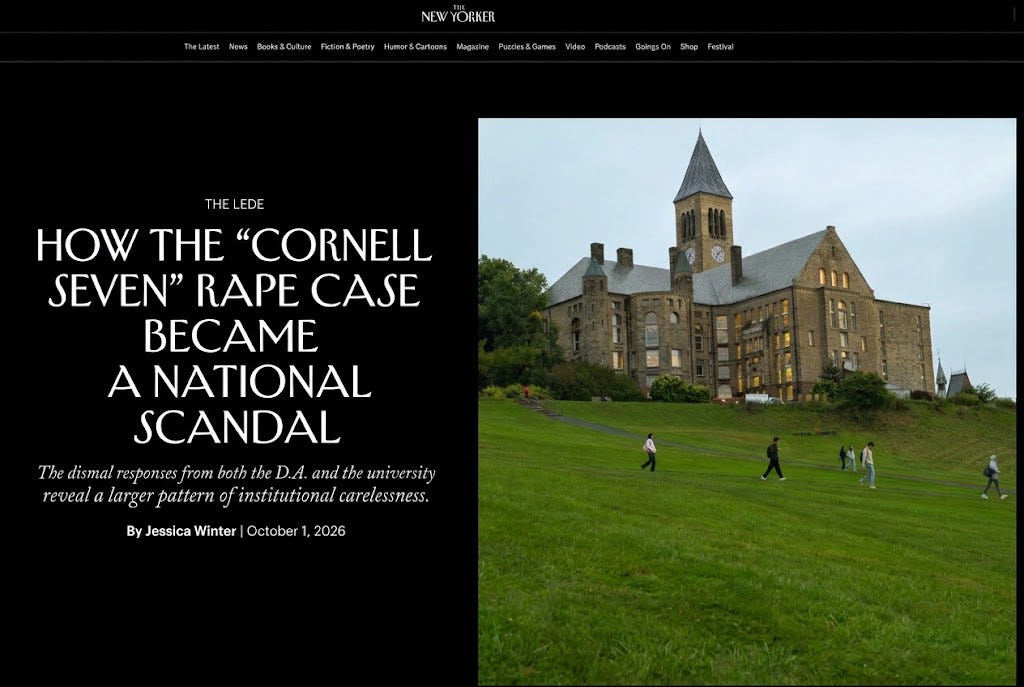
Original Link: New Yorker(Oct. 02, 2026), https://www.newyorker.com/news/the-lede/how-the-cornell-seven-rape-case-became-a-national-scandal
The Cornell case shows how early evidence decisions can echo for years. Reuters reported that a former Cornell student, using the pseudonym Jane Doe, filed a civil lawsuit in mid-September 2026 alleging that fraternity members gave her alcohol and drugs and sexually assaulted her in October 2024 (Ax, 2026). The accused men have denied wrongdoing, and the allegations remain unresolved. Reuters also reported that a police transcript recorded her saying she was certain she had been raped, a statement that did not appear in the sworn statement sent to prosecutors (Ax, 2026). According to NPR, New York’s governor then appointed the state attorney general as special prosecutor after criticizing how campus police and the local prosecutor had handled the case, and Cornell committed to an outside review of its own handling (Diaz & Mann, 2026). None of this establishes the truth of the allegations. It shows what happens when confidence in an early process breaks down.
2.2 Independence Has to Be Real
A university should never assign allegations against a senior administrator to an investigator who reports to that person, depends on that person professionally, or could reasonably be seen as unable to act freely. On an overseas or satellite campus, this risk is sharper. Governance is often shared between a U.S. home institution and a local partner, and local management authority, contracts, funding, and reputation overlap. When everyone in the reporting chain answers, directly or indirectly, to the same few leaders, a nominally independent review can be independent in name only.
In meetings and routine campus exchanges, I observed that questions involving student welfare, personnel concerns, or institutional policy often moved through a small number of senior offices. It was not always clear to faculty and staff where authority for review, escalation, or final decisions rested once a concern moved beyond the local campus.
A credible process for a U.S. university operating an overseas or satellite campus should include:
an investigator outside the local senior-administration reporting line;
a written conflict-of-interest assessment for every decision-maker;
clear notice to reporting parties about supportive measures, confidentiality limits, and reporting options;
secure procedures for interviews, evidence, and witness communication;
a reasoned written outcome that distinguishes substantiated findings, unsubstantiated allegations, insufficient evidence, and questions the record cannot resolve;
documentation of which institutional body held authority at each stage.
This protects the accused as well. A sound procedure keeps decisions from resting on rumor, informal pressure, or campus politics. Independence protects reporting parties, and it protects the legitimacy of the outcome.
2.3 Protecting Whistleblowers Protects Students
A reporting system fails when people must choose between raising a serious concern and protecting their education, livelihood, immigration status, reputation, or safety. For international students and early-career scholars from immigrant communities, including many Korean students and colleagues, that choice can feel especially heavy.
The record behind this article includes a letter from a national faculty organization about the suspension of a tenured faculty member at the same overseas campus. The faculty member described the suspension as retaliation for whistleblowing. The organization did not decide whether retaliation had occurred. It stressed that suspension is a severe sanction and urged the university to follow academic due-process standards, including a proper hearing and a stated justification for any suspension before a hearing.
Whether an employment action is linked to whistleblowing must be examined, not assumed. Useful questions include:
Did decision-makers know about the reports?
What reasons were given, and were they applied consistently to similar cases?
Was the action unusually fast, severe, or procedurally irregular?
Did internal communications discuss the faculty member’s reporting?
Were records preserved and real procedural protections provided?
An institution cannot credibly encourage reporting while treating the person who reports as the main risk to manage.
Figure 2
The Stairs of Accountability
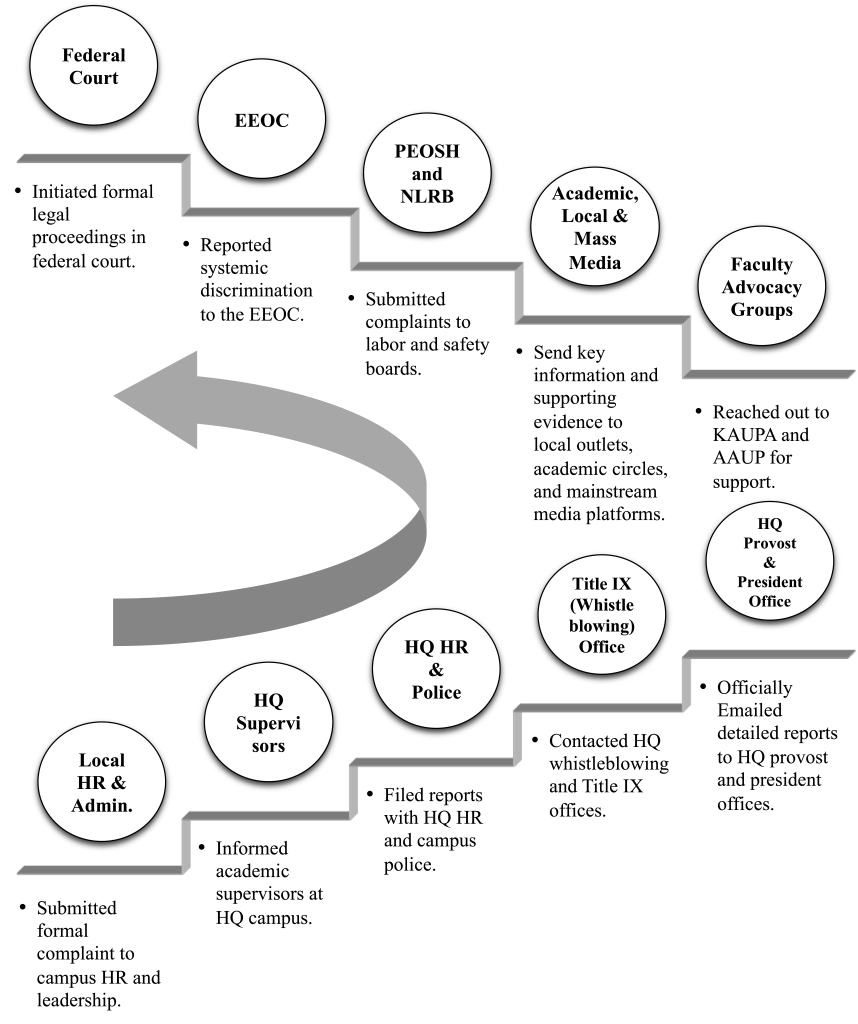
Note. This figure illustrates the steps to seek accountability and support, beginning with a satellite or oversea campus offices and extending, when needed, to the U.S. headquarters (HQ), faculty advocacy groups, public agencies, media outlets, and legal channels. The stairs represent a personal reporting journey rather than a required sequence, and not every step necessarily occurred in the order shown or resulted in a particular outcome. “HQ” refers to the U.S. home institution or central administration. Names and identifying details have been omitted to protect privacy.
3. The Test Every Campus Faces
The lesson from Cornell is not that every campus allegation becomes a criminal case, or that public attention proves misconduct. The lesson is that an institution’s response will itself be judged. A university can support complainants, preserve evidence, notify proper authorities, run a fair process, respect due process, and prevent retaliation, all at once. None of these duties cancels the others.
For the overseas or satellite campus, the public-interest question is simple: after the 2024 Title IX report, what did the university do to preserve evidence, assess risk, protect witnesses, ensure independence, and communicate an appropriate outcome? A university need not disclose confidential records to answer that. It should be able to show that a working system exists.
The available materials support only a careful conclusion. Former students and whistleblowers submitted allegations and asked for review. The submission included summaries and screenshots that still need authentication. A faculty organization separately raised due-process concerns about a suspension. The materials do not establish that harassment occurred, that the institution failed to investigate, that retaliation took place, or that anyone is legally liable.
Uncertainty is not a reason to do nothing. It is the reason to preserve records, investigate independently, protect those who report, and explain decisions in a way that earns trust. What I observed on that campus taught me that silence rarely announces itself. It settles in quietly, one unanswered message at a time. For those of us in the Korean diaspora who teach and lead on these campuses, the work begins close to home: we can be the colleague a student is not afraid to tell.
References
Ax, J. (2026, October 2). Explainer: What we know about the Cornell University rape investigation. Reuters.
Diaz, J., & Mann, B. (2026, October 1). NY Attorney General Letitia James to oversee inquiry into Cornell rape case. NPR. https://www.npr.org/2026/10/01/nx-s1-5987703/cornell-fraternity-rape-case-updates
About the Author

Prof. Dr. Jeonghwan (Jerry) Choi (Managing Editor)
Full list of his K-GSP columns:
Jeonghwan (Jerry) Choi, PhD is Editor-in-Coordination of K-GSP Forum (contact: jeonghwan.choi at gmail.com). With over 25 years of industry and consulting experience, he specializes in leadership development, human resource management, organizational behavior, and social entrepreneurship. His research focuses on workforce resilience, organizational health, and self-directed leadership — bridging rigorous scholarship with practical insight to cultivate leaders who create meaningful, sustainable, and humane organizations.
Suggested Citation
Choi, J. (2026, October 3). Silence is not neutral: What the Cornell case teaches about reports, whistleblowers, and campus accountability. K-GSP Forum.
Original Article:

한글요약
침묵은 중립이 아니다: 코넬 사건이 일깨우는 신고, 내부고발, 그리고 캠퍼스의 책임
대학이 성희롱 신고를 받았다고 해서 곧바로 사실이 확정되는 것은 아닙니다. 하지만 구체적이고 무거운 신고를 소문이나 개인 갈등으로 덮어서도 안 됩니다. 대학은 자료를 보존하고, 관련된 사람들의 안전을 살피고, 독립적인 절차로 사실을 확인해야 합니다.
이 글은 필자가 미국 대학의 해외 캠퍼스에서 직접 보고 겪은 경험, 그 캠퍼스와 관련해 2024년에 제기된 Title IX 신고, 그리고 최근 코넬대학교 사건을 함께 살펴봅니다. 신고에는 졸업생과 제보자들의 주장, 대화 캡처와 증언 요약이 담겨 있었습니다.
코넬 사건은 초기 대응과 증거 보존이 왜 중요한지 보여 줍니다. 보도에 따르면 뉴욕 주지사는 처음 수사가 부실했다고 비판하며 주 법무장관을 특별검사로 임명했고, 코넬은 외부 검토를 받겠다고 밝혔습니다. 분교 (Satelite campus)나 해외 캠퍼스 (Overseas campus) 는 지배구조와 권한이 얽혀 있어 독립적인 조사가 더욱 어렵고, 그만큼 더 중요합니다.
한인 디아스포라 학자에게 이 문제는 남의 일이 아닙니다. 비자나 추천서, 진로를 걱정하는 학생들이 안심하고 말할 수 있어야 제도가 작동합니다. 캠퍼스는 불편한 목소리가 사라질 때가 아니라, 누구나 목소리를 잃지 않고 말할 수 있을 때 더 안전해집니다.
© K-Global Scholars and Professionals Forum. All rights reserved. Content published in the K-GSP Forum may not be reproduced, distributed, or transmitted in any form without prior written permission from the K-GSP Forum, except for brief quotations with full attribution.