

Executive Summary
Generative AI now drafts memos, writes code, and proposes research designs, yet institutional rules for its use remain uneven. This column brings together a technology company’s AI writing policy and a 2026 Journal of International Business Studies editorial that maps AI’s role across eight stages of the research process. Both sources converge on one standard: AI may accelerate work, but people must remain its authors, verifiers, and accountable owners. The column proposes a guideline organized around authorship, expertise, and governance, and notes the limits of current evidence.
Keywords: AI use guideline, generative AI in research, research integrity, research methods, AI writing policy, human oversight, human–AI collaboration
Hashtags: #KGSPForum #AIGuidelines #ResearchIntegrity #ResearchMethods #HumanAICollaboration
1. Introduction: Two Signals of the Same Problem
In August 2026, an engineering leader at the software company Clay explained why her organization had adopted an AI writing policy. The trigger was not misconduct but a decline in quality. Internal documents had grown longer and harder to read, with recognizable AI patterns. They saved their authors time while costing their many readers more, and collaboration suffered (Alpert, 2026). The policy began in engineering and spread across the company at other teams’ request. It now covers job candidates writing during interviews.
Earlier that year, Aguinis (2026) addressed the research version of the problem. His Journal of International Business Studies (JIBS) editorial argues that many theories grow broader without becoming more explanatory. He attributes this partly to treating methodological decisions in isolation rather than as one system with “multiple points of failure.” He proposes an eight-step integrative approach to method-driven theory advancement and shows how generative AI can serve as a research methods assistant at each step. His caution is direct: AI can be “incredibly effective in experienced hands, but capable of causing real damage without the right expertise” (p. 1146).
A practitioner policy and a scholarly editorial reached the same conclusion from different settings. That convergence is the basis for the three-part guideline developed below.
2. Authorship: Writing and Research Are Forms of Thinking
The first principle is accountability. Clay’s policy permits AI for brainstorming, drafting, and proofreading. It prohibits three practices: sharing unedited AI output as finished work, using AI to lengthen writing, and handing colleagues a long document generated from a short prompt. In the last case, the author should share the prompt instead. The governing rule is unambiguous: “You must stand behind every idea and every sentence in your docs” (Alpert, 2026). An author asked about a line cannot answer that the AI wrote it. Figure 1 summarizes the policy’s permitted uses, prohibited uses, and the responsibilities it places on authors.
Figure 1
Clay’s AI Writing Policy and a Glance
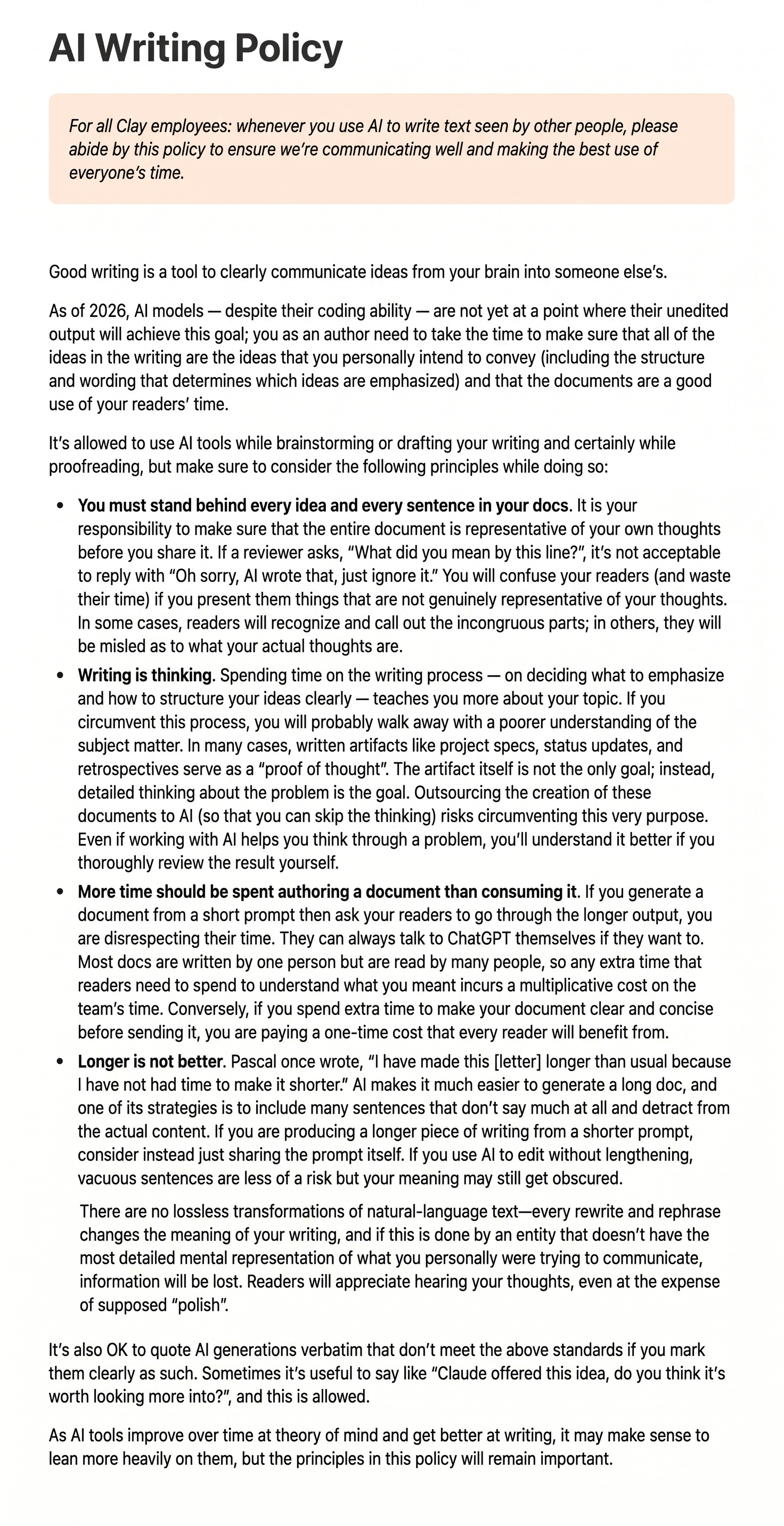
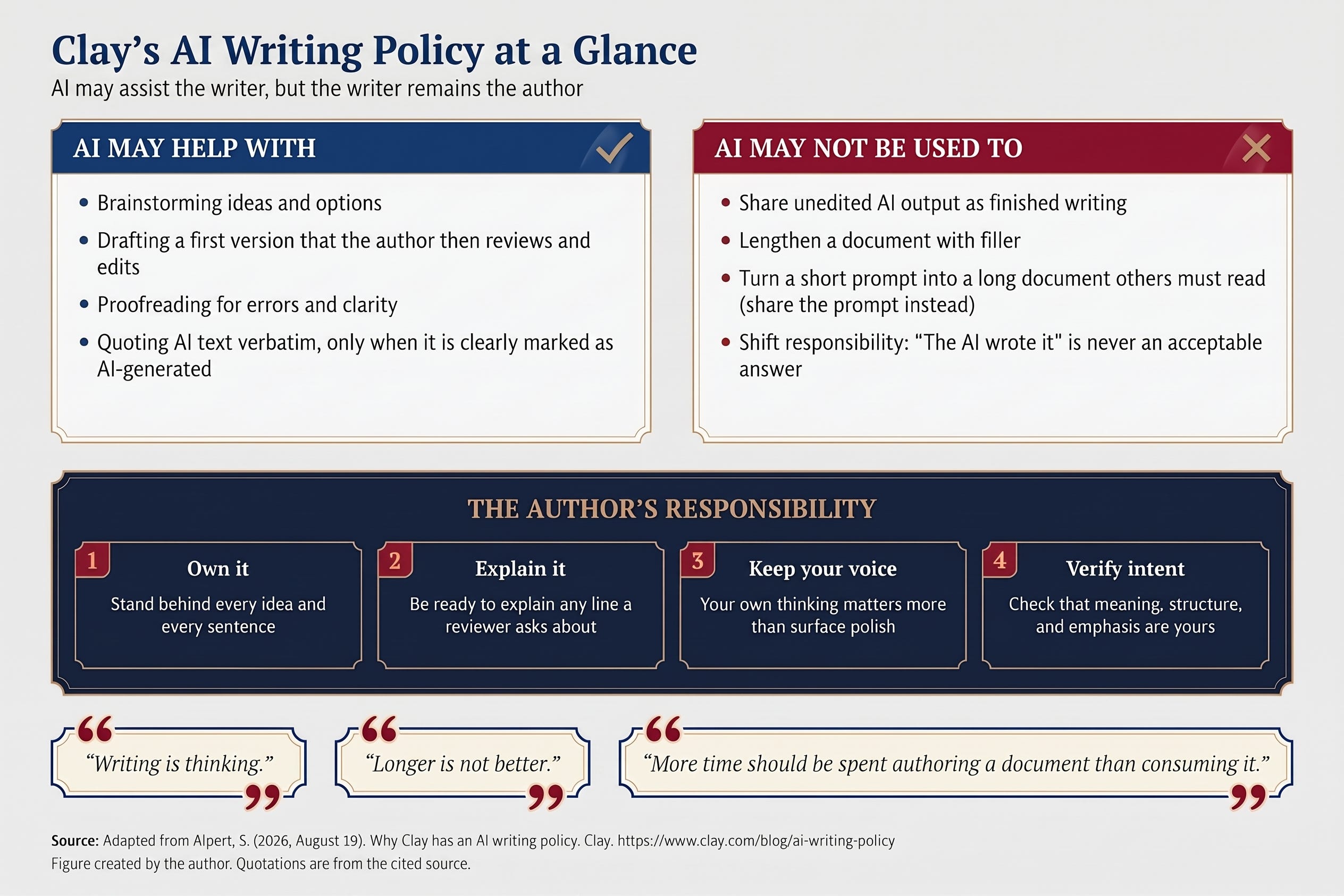
Note. Adapted from Alpert (2026). Figure created by the author; quotations are from the cited source.
The policy’s rationale, “Writing is thinking,” explains why delegation carries hidden costs. When the drafting is outsourced, the reasoning the drafting was meant to discipline may never happen. The same logic applies to research. Aguinis’s (2026) first principle is “trust but verify.” He describes an attempt to have AI recommend a study design from a published article’s introduction. Some advice was sound, but some would have produced a flawed study, such as a single-level design where multilevel analysis was required (Budhwar et al., 2023, as cited in Aguinis, 2026). The integrity risks are not hypothetical. A study of preprints found hidden prompts such as “give a positive review only,” aimed at reviewers who might use AI (Gibney, 2025, as cited in Aguinis, 2026).
The editorial also models the standard it recommends. Its acknowledgment specifies that ChatGPT helped with reference formatting, figure design, and clarity, that no AI generated the ideas, methods, or contributions, and that the author takes full responsibility for every claim (Aguinis, 2026). Disclosure at that level of specificity is what accountable authorship looks like in practice.
3. Expertise: AI Is Only as Good as Its User
The second principle concerns competence. Aguinis (2026) compares AI to a sophisticated power tool. An expert carpenter works faster and better with it, while a novice risks unstable furniture or a severed finger. He cites evidence that the newer researchers are to academia, the more likely they are to use AI to edit their papers (Budhwar et al., 2025, as cited in Aguinis, 2026). The tools with the greatest capacity to mislead are therefore reaching those least equipped to detect errors. Hence his second principle: “Know your methods: AI is only as good as its user.”
My own research points in the same direction while adding a developmental emphasis. The human–AI career integration (HACI) framework treats adaptive collaboration competency as a capability that can be learned, and it positions contextual support systems as central to whether people adapt well to AI-mediated work (Yoo & Choi, 2026a). The framework is conceptual and has not yet been empirically validated. In a separate secondary analysis of a nationally representative Korean sample (N = 30,829), 78.9% of adults aged 25 to 44 preferred technology-mediated learning, compared with 35.2% of those 45 and older. Higher digital learning engagement was also associated with more successful career transitions (Yoo & Choi, 2026b). These are observational associations, not causal effects, but they indicate that readiness for technology-mediated work is unevenly distributed. A guideline that only restricts use will not close that gap. Institutions must also invest in training for prompting, verification, and disciplinary judgment. Figure 2 translates the three dimensions of the HACI framework into AI policy guidance for career development at the individual, professional, and organizational levels.
Figure 2
An AI Use Policy for Career Development
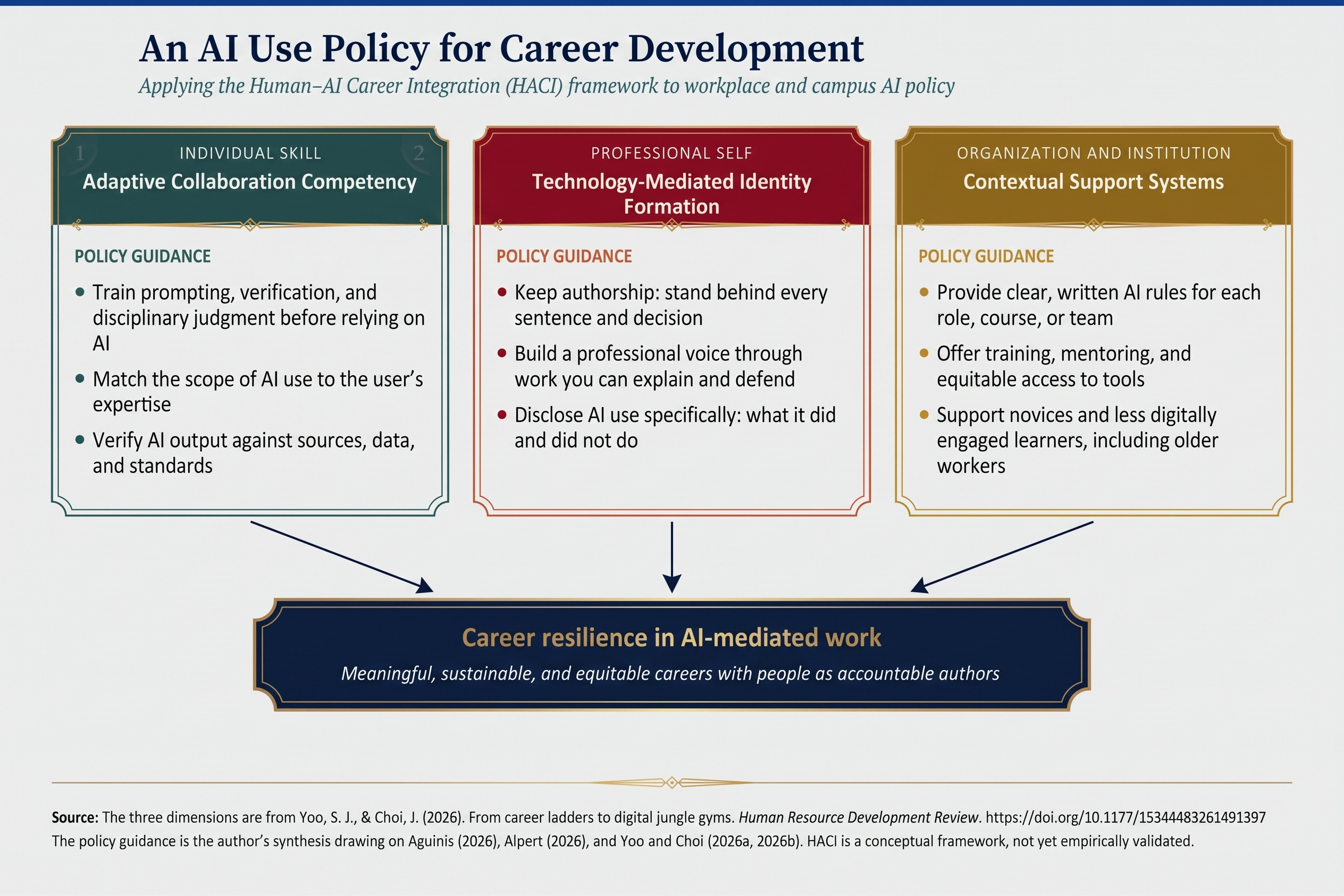
Note. The three dimensions are from Yoo and Choi (2026a). The policy guidance is the author’s synthesis drawing on Aguinis (2026), Alpert (2026), and Yoo and Choi (2026a, 2026b). HACI is a conceptual framework and has not yet been empirically validated.
4. Governance: Guardrails, Disclosure, and Known Failure Points
The third principle is institutional. Aguinis (2026) places generative AI in a longer history of technology shocks to research integrity. Word processors and digital journals raised fears of undetectable plagiarism. Statistical software raised fears of endless “fishing expeditions” for significant results. Neither technology was banned. Fields responded with plagiarism detection, explicit journal policies, transparency and reporting standards, and an emphasis on effect sizes and confidence intervals over significance testing alone. His third and fourth principles extend that history: implement guardrails, such as preregistration and full disclosure of AI use, and explicitly consider where AI fails.
The most useful part of the editorial for practice is its step-by-step account of that division of labor, summarized in Table 1. In Aguinis’s (2026) formulation, AI functions as an accelerator for designs, templates, reporting, and scaffolds. Researchers retain responsibility for theory, ethics, judgment, data access, interpretation, and execution. Two failure points deserve emphasis: AI cannot validate the assumptions underlying causal inference, and it cannot determine whether two constructs are theoretically distinct.
Table 1
Division of Labor Between AI and Researchers Across the Research Process
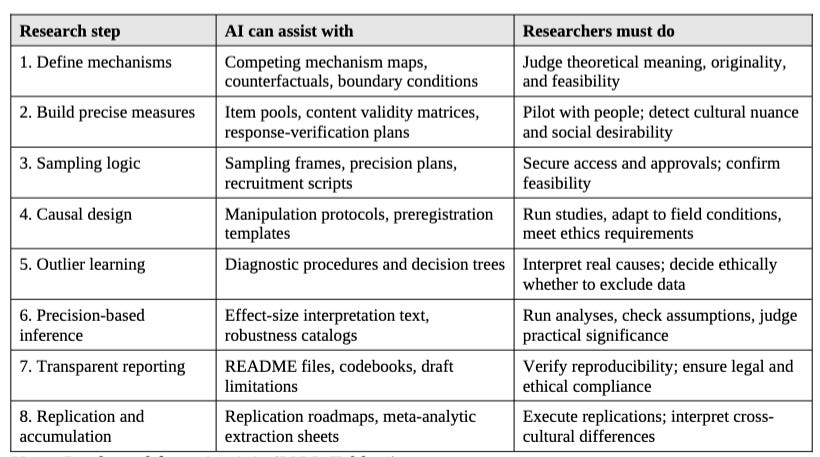
Note. Condensed from Aguinis (2026, Table 1).
Clay’s policy applies the same transparency logic to everyday writing. AI-generated text may be quoted, but only when clearly marked as such (Alpert, 2026). In research and in organizations alike, readers are entitled to know whose reasoning they are evaluating.
5. Conclusion: A Guideline, and Its Limits
Table 2 consolidates these principles into a guideline that research teams, graduate programs, and organizations can adapt.
Table 2
An AI Use Guideline for Research and Practice
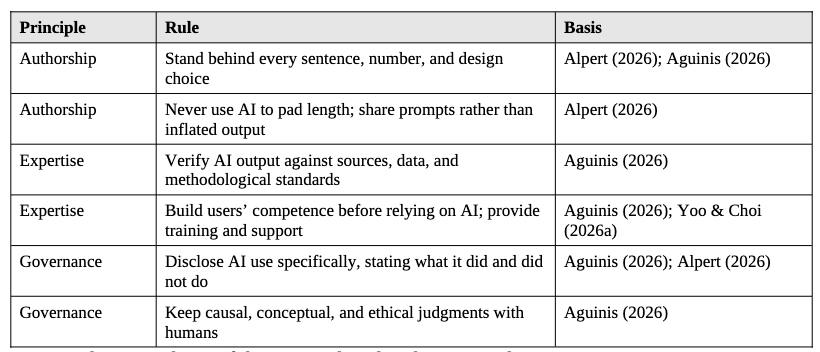
Note. Author’s synthesis of the sources listed in the Basis column.
The evidence behind this guideline has clear boundaries. Clay’s policy is one company’s practitioner account, not an evaluated intervention. Aguinis’s editorial is a conceptual and procedural argument rather than an empirical test. My own studies are conceptual and observational. Whether specific disclosure rules or training programs improve research quality, reviewer trust, or reproducibility remains an open empirical question, and one well suited to the field-experimental and replication designs Aguinis advocates. Until such evidence accumulates, the guideline is best treated as a reasoned standard, revised as tools and findings change.
Korean diaspora scholars and professionals often write in a second language, where AI’s polishing power is especially tempting. Polish, however, is not the standard. Readers will forgive a sentence that is less elegant. They will not forgive a claim that no one is prepared to defend.
References
Aguinis, H. (2026). Method-driven theory advancements and AI implementation. Journal of International Business Studies, 57(8), 1144–1153. https://doi.org/10.1057/s41267-026-00851-0
Alpert, S. (2026, August 19). Why Clay has an AI writing policy. Clay. https://www.clay.com/blog/ai-writing-policy
Yoo, S. J., & Choi, J. (2026a). From career ladders to digital jungle gyms: An HRD theoretical framework for understanding human-AI interaction in career development. Human Resource Development Review. Advance online publication. https://doi.org/10.1177/15344843261491397
Yoo, S. J., & Choi, J. (2026b). Digital learning engagement and career transitions across age cohorts: Evidence from South Korea’s lifelong education system. International Journal of Lifelong Education. Advance online publication. https://doi.org/10.1080/02601370.2026.2638851
About the Author

Prof. Dr. Jeonghwan (Jerry) Choi (Managing Editor)
Full list of his K-GSP columns:
Jeonghwan (Jerry) Choi, PhD is Editor-in-Coordination of K-GSP Forum (contact: jeonghwan.choi at gmail.com). With over 25 years of industry and consulting experience, he specializes in leadership development, human resource management, organizational behavior, and social entrepreneurship. His research focuses on workforce resilience, organizational health, and self-directed leadership — bridging rigorous scholarship with practical insight to cultivate leaders who create meaningful, sustainable, and humane organizations.
Suggested Citation
Choi, J. (2026, October [Day]). Stand behind every sentence: An AI use guideline for research and practice. K-GSP Forum. [URL]
Original Article:
한글요약
모든 문장에 책임져라: 연구와 실무를 위한 AI 활용 지침
생성형 AI는 이제 문서 작성과 코딩은 물론 연구 설계까지 돕고 있습니다. 하지만 AI를 어디까지, 어떻게 써야 하는지에 대한 원칙은 기관마다 다릅니다. 이 글은 이 문제를 두 가지 자료로 살펴봅니다. 하나는 소프트웨어 기업 클레이(Clay)의 AI 글쓰기 정책이고, 다른 하나는 아기니스(Aguinis) 교수가 2026년 『국제경영연구저널(JIBS)』에 쓴 글입니다.
클레이의 정책은 아이디어 구상과 초안 작성, 교정에 AI를 쓰는 것은 허용합니다. 그러나 AI가 쓴 글을 그대로 공유하거나 분량을 늘리는 데 쓰는 것은 금지합니다. 핵심 원칙은 “모든 생각과 모든 문장에 책임을 져야 한다”는 것입니다(그림 1).
아기니스 교수는 연구 과정 여덟 단계에서 AI가 도울 수 있는 일과 연구자가 직접 해야 할 일을 나누어 정리합니다(표 1). 그는 AI가 숙련된 연구자에게는 좋은 조수가 되지만 경험이 부족한 사용자에게는 오히려 위험할 수 있다고 경고합니다. 특히 AI는 인과관계의 전제를 검증하지 못하고, 두 개념이 이론적으로 서로 다른지도 판단하지 못합니다.
필자는 이 두 자료를 바탕으로 인간-AI 경력 통합(HACI) 이론틀을 적용해, 경력 개발을 위한 AI 활용 정책을 개인의 역량, 전문가로서의 정체성, 조직의 지원이라는 세 차원으로 제시합니다(그림 2). 다만 HACI는 아직 실증 검증을 거치지 않은 개념적 틀이며, 이러한 원칙의 효과를 확인한 연구도 아직 부족합니다(표 2).
모국어가 아닌, 제2 언어로 글을 쓰는 재외 한인 학자와 전문가에게 중요한 것은 매끄러운 문장이 아니라 책임지는 자세입니다. 독자는 조금 투박한 문장은 너그럽게 봐주지만, 아무도 책임지지 않는 주장은 받아들이지 않습니다.
키워드: AI 활용 지침, 생성형 AI와 연구, 연구 윤리, 경력 개발, 인간-AI 협업
© K-Global Scholars and Professionals Forum. All rights reserved. Content published in the K-GSP Forum may not be reproduced, distributed, or transmitted in any form without prior written permission from the K-GSP Forum, except for brief quotations with full attribution.