

EXECUTIVE SUMMARY
This article presents the diary of George F. Frye, a sailor aboard the destroyer USS Dehaven (DD-727), who recorded the Incheon Invasion in a small notebook from September 12 to 15, 1950. His entries give the actual times of the bombardment and landing waves, together with his own fear and relief. His son, Fredene I. Frye, preserved the notebook and map, transcribed the record 76 years later, and presented it to the New Mexico Korean War Veterans Association on October 13, 2026. Dr. Chunggil Lee, a guest at that meeting, shares the account here. The article also places the diary within the larger Incheon Landing Operation and its use of reconnaissance and diversion.
Incheon Invasion, 인천 침공 작전, 그 생생한 기억
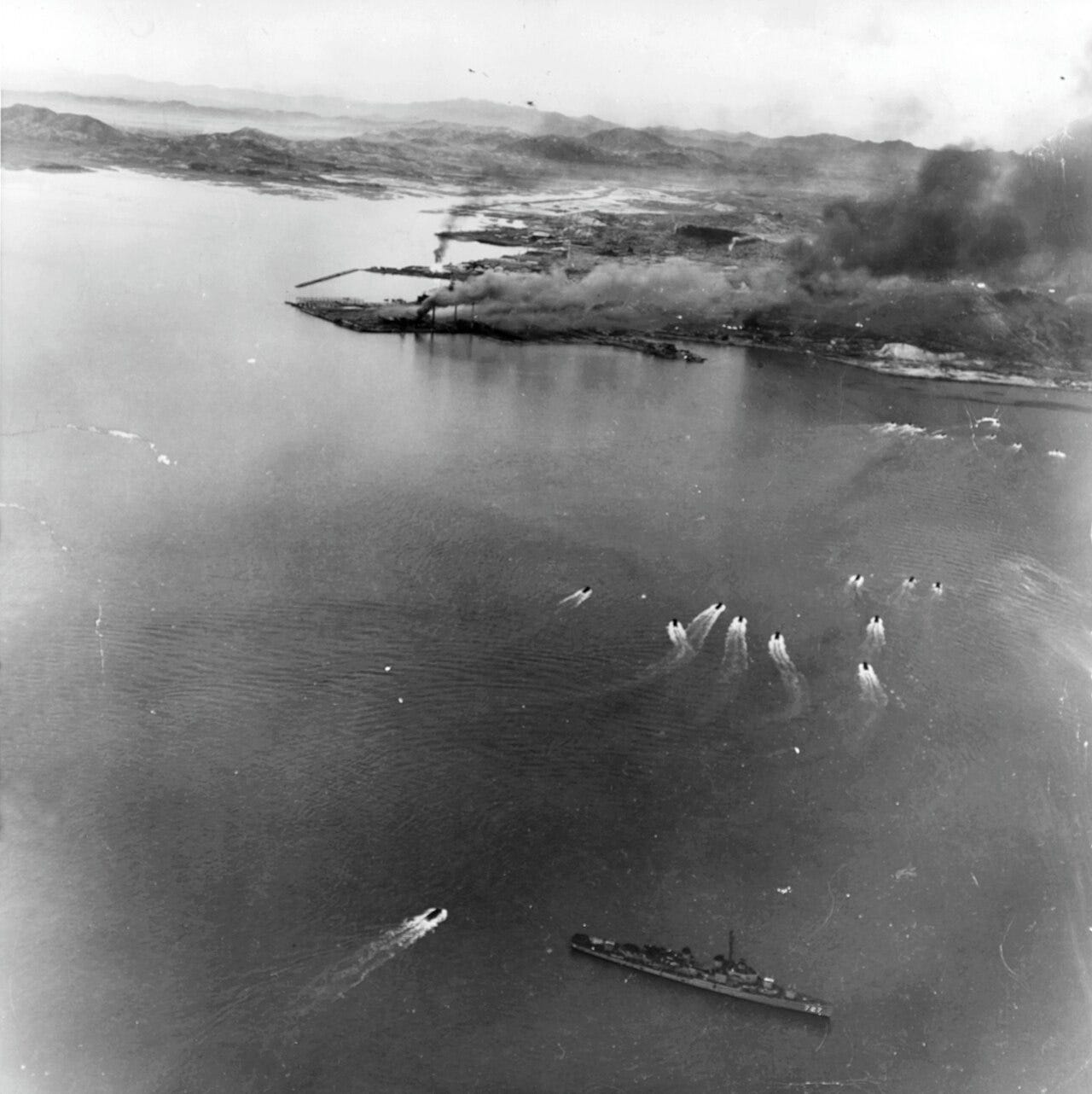
By U.S. Navy photo NH 42351, Public Domain,
Source: https://en.wikipedia.org/wiki/USS_De_Haven_%28DD-727%29
Sept 12, 1950
They told us where we were bound for today-an invasion attempt at Inchon, the port city for Korea’s old capital of Seoul. We go in tomorrow, the 13th, six destroyers, 2 light (English) cruisers and 2 heavy cruisers (ours) Rochester and Toledo.
I will try to keep a running account of this as it happens.
We’re to try to land marines and army at the same time at a similar landing is being made on the east coast of Korea. The object is to cut Korea in half at about the 37th parallel and insulate the North Koreans south of the 37 for a quick and final mop up. It’s going to cost us and it may fail completely. But if it’s a success this war here will be over shortly.
We’re going in at noon, which is surprising to us, but we hope it will be twice as surprising to them!
Sept 13
We kept our date of noon. Our planes were pounding them hard and we anchored the planes left to refuel and load up. We only stayed one hour (which was long enough). Editor: The USS Dehaven fired at the 1st shots of the Naval bombardment firing at Wolmi-do Island which guarded the harbor. The Destroyer was within 800 yards of the Island. Three of the six destroyers were hit, the Swenson, Gerke & Collete. The Collete was hit in her plotting room, so it missed Kiddes who was in the after engine room; the Gerke took a hit in a fuel tank, while Swenson took one on the bridge, that killed one of her officers. The Collete reported five casualties, not saying whether they were dead or wounded. We got by lucky.
Tomorrow we do the same thing, and at noon again.
Sept 14
Jesus, if this shit keeps up I’ll lose 50 pounds. We hit them again today, at one o’clock, stayed till 2:30. I found out why we have gone in around noon, yesterday & today, I’ll explain later. Anyway, they missed us again today. Only five cans went in today, the Collete stayed out with the cruisers due to the hit she got yesterday. The plotting room controls the guns and that’s where she got hit yesterday.
Tonight we’re laying out off the coast waiting for the troop transports and the landing craft. We start in at three in the morning, anchor at five o’clock and commence saturation bombardment.
Sept 15
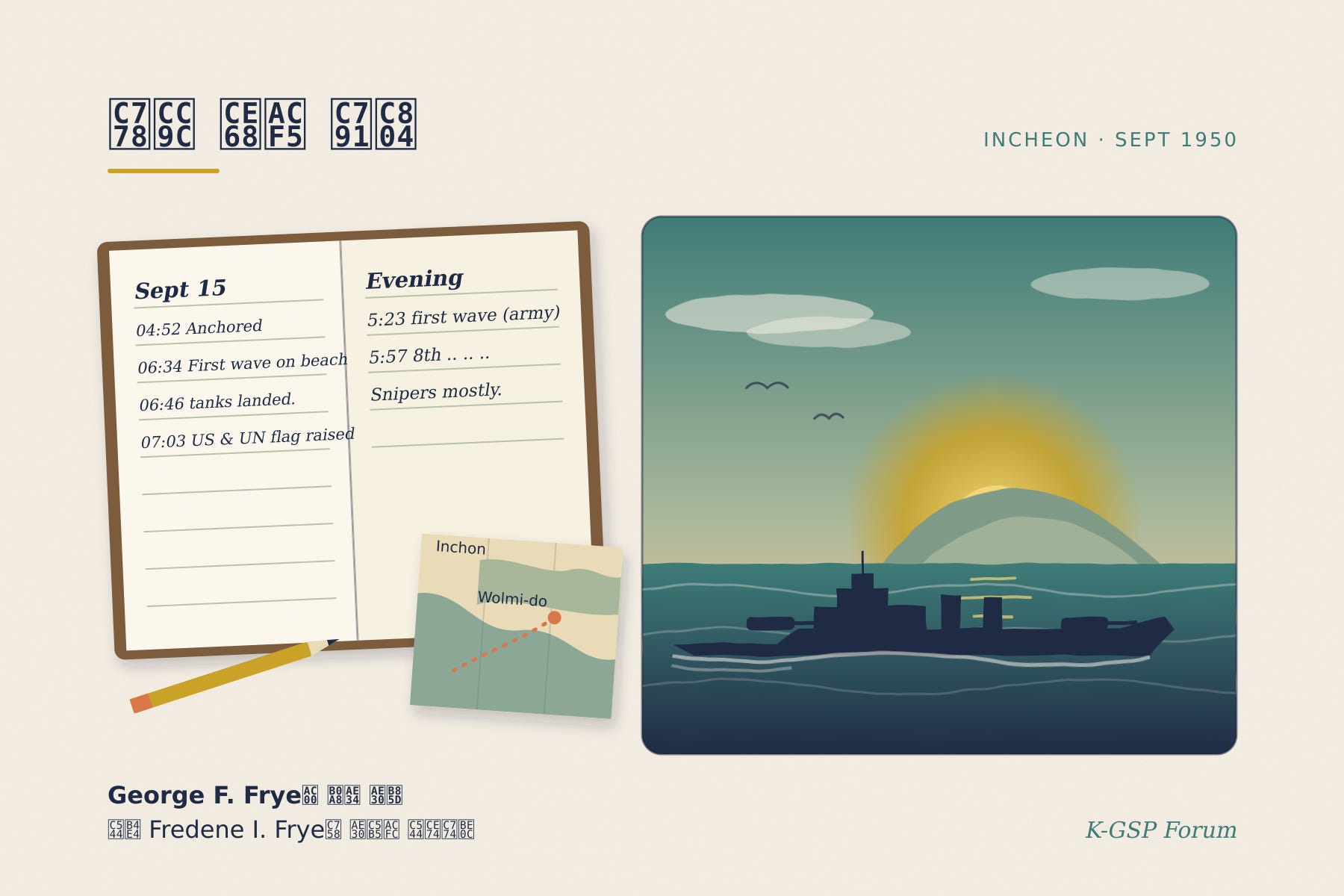
Whoopie! We put the Marines ashore with hardly no trouble, but God I was scared! Here’s the schedule of how it went this morning;
04:52 Anchored
05:45 Commenced bombardment.
06:28 Stopped bombardment.
06:29 Planes commenced bombing.
06:30 First wave on way to beach
06:34 First wave on beach
06:36 Second wave on beach
06:43 Third wave (LCTs with tanks headed for beach)
06:46 tanks landed.
07:03 US & UN flag raised on island.
08:33 Island (Wolmi-do) completely taken.
This was the actual time, by my watch, that it took to take the island. Now, this evening, the army comes in at 5P.M. and lands at Inchon. We are laying in here anchored waiting to help them. I’ll try to get a schedule of that landing too, Our planes and guns are raising hell with the town, big fires all over the place. I can see the marines firing into the town too.
Evening 15 Sept
Well, the job seems to be over, except for keeping them supplied, and that will go on all night and for many days to come.
At three PM we sighted the convoy on it’s way in.
At 4;45 everything in the harbor cut loose on the town. Jesus, what a mess, you’d think nothing could live thru that shelling and bombing.
5:23 the first wave (army) started in
5:25 second wave started in
5:28 first wave on the beach.
5:31 third wave is on the way in
5:37 fourth .. .. .. .. .. ..
5:43 5th .. .. .. .. .. ..
5:47 6th .. .. .. .. .. ..
5:52 7th .. .. .. .. .. ..
5:57 8th .. .. .. .. .. ..
6;01 LSTs on the way in with tanks.
That is the way it went. Quite a bit of firing from the beach on the first and second waves but it didn’t last long after they got in. Snipers mostly.
The 6 destroyers earned the nickname “The Sitting Duck” because they were in highly exposed and vulnerable positions. The term gained widespread use in the military during the World War II. Those destroyers later received naval unit citations.
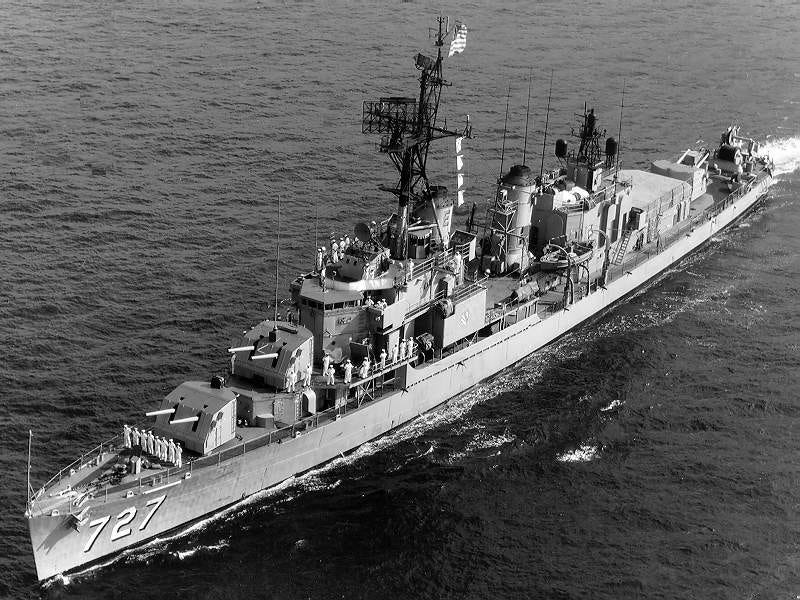
By PH3 C.P. Weston, U.S. Navy - U.S. Navy photo NH 107136, Public Domain, Source: https://commons.wikimedia.org/w/index.php?curid=1990569
This is a brief description of the events of the Inchon Invasion by George F. Frye, who participated in the operation aboard the destroyer USS Dehaven DD-727. His son, Fredene I. Frye, recently revised the record. “My Dad George F. Frye MMC was aboard the Dehaven at the Inchon invasion. He kept a small notebook as a sort of log of the daily happenings during the invasion. It isn’t anything new, but he does list the “actual” times of waves of landing craft according to his watch along with how he was feeling at the time. I recently transcribed it in a Word document and contributed to Wikipedia.”
Fred brought his father’s old, worn-out, and tattered notebook with a map containing operational situations, and gave a presentation at the New Mexico Korean War Veterans Association meeting held at 1:00pm on October 13, 2026. The Veterans Association meets on the second Tuesday of every month, and I am a guest for the meeting.
Led by UN Commander General Douglas MacArthur, the Inchon Landing Operation deployed approximately 75,000 troops and 261 naval vessels on the Korean Peninsula, instantly turned the tide of the Korean war. The U.S. military leadership strongly opposed the operation, citing low odds of success. However, General MacArthur achieved great success by approaching the situation with the ingenious idea that since landing appeared impossible, the enemy would not imagine choosing that location. Without General MacArthur’s wise stratagem, the tide of the war would never have been so easily reversed. The Incheon Invasion had a profound impact on the successful execution of the Incheon Landing Operation by reconnaissance and diversionary tactics.
Large-scale operations are invariably accompanied by feigning an attack on the east while striking on the west tactic. Reconnaissance is conducted by sending scouts to observe and gather operational data regarding the enemy’s situation and terrain. Diversionary tactics must also be employed to deceive the enemy by emphasizing movements unrelated to the original operation, thereby concealing one’s own intentions. The Incheon Invasion had a profound impact on the successful execution of the Incheon Landing Operation.
Editors’ Note: The destroyer USS De Haven (DD-727) was an Allen M. Sumner-class ship built by Bath Iron Works and commissioned on 31 March 1944. The U.S. Navy decommissioned her on 3 December 1973, and she was transferred to the Republic of Korea Navy on 5 December 1973. Renamed Incheon (인천), after the same city whose harbor she had helped attack in 1950, she served in the Korean fleet until she was stricken and scrapped in 1993. (Source: Wikipedia, “USS De Haven (DD-727).”)
About the Author

Dr. Chung Gil Lee is Professor Emeritus of Veterinary Medicine at Chonnam National University, where he served on the faculty until 2007. He holds an M.Sc. and Ph.D. from James Cook University, Australia, and began his career as an Interpreter Officer in the Korean Army. A graduate of Chonnam National University (1963), he is currently a member of the Korean Literature Society of America.
Original Article

한글판
인천 침공 작전, 그 생생한 기억…
요약
이 글은 구축함 USS Dehaven(DD-727)에 승선했던 조지 프라이(George F. Frye)가 1950년 9월 12일부터 15일까지 인천 침공 작전을 작은 수첩에 기록한 일지를 소개한다. 그의 기록에는 포격과 상륙 부대의 실제 시각, 그리고 당시의 두려움과 안도감이 담겨 있다. 아들 프래드 프라이(Fredene I. Frye)는 이 수첩과 지도를 간직해 왔으며, 76년 만에 기록을 옮겨 적어 2026년 10월 13일 뉴멕시코 주 한국전 참전 용사회에서 발표했다. 당시 모임에 손님으로 참석한 이청길(Chunggil Lee) 박사가 이 이야기를 이곳에 전한다. 글은 이 일지를 인천 상륙 작전 전체의 맥락과 척후 및 양동 전술 속에서 함께 조명한다.
한국 전쟁이 한창이던 1950년 9월 12일이었다. 오늘은 어디로 갈 것인지 명령을 받아 보니 항구 도시 인천을 침공할 곳으로 이동하라는 전갈이었다. 여섯 척의 구축함과 네 척의 순항정을 대동하고 가라는 내용으로, 내 임무는 그때 거기서 벌어지는 일을 기록하는 것이었다.
동해안에서 벌어질 전투와 똑같은 시간에 똑같은 방법으로 작전을 수행하라는 명령이 떨어졌다. 37도선을 따라서 나라를 둘로 끊어 남쪽에 격리되어 있는 북한군을 재빨리 소탕하는 것이 작전의 목적이었다. 그러노라면 우리도 대가를 치루게 될 것이고, 완전히 실패할 수도 있다. 하지만 성공하면 전쟁은 쉽게 끝난다. 정오에 작전을 개시하라는 지시가 놀라웠으나, 적들이 우리보다 배나 놀라기를 바랐다.
우리는 약속 시간을 지켰다. 13일 정오에 우리 비행기가 월미도를 맹렬히 폭격하기 시작했다. 내가 탄 구축함 Dehaven DD-727은 약 700미터 떨어진 바다에서 포격했다. 연료를 보충하고 탄약을 실으면서 한 시간 동안 머물렀다. 여섯 척의 구축함 중 세 척이 적의 공격을 받았는데, 각각 해도실, 연료 탱크, 선교에 폭탄이 떨어졌다. 다행히 큰 피해는 없었고, 다음날도 낮 12시에 공격한다.
14일에는 오후 1시에 시작한 공격이 2시 30분까지 계속되었다. 맙소사, 이와 같은 작전이 계속되면 살이 23kg은 빠질 것 같네. 왜 어제 오늘 이틀에 걸쳐 한낮에 침공하는가 알았지만 그건 차후에 설명할 것이고, 오늘은 적의 반격도 없었다. 구축함 중에 어제 해도실에 폭탄이 떨어진 Collette를 제외한 다섯 척만 출동했다. 저녁에는 해안가에 정박하여 병력 수송선과 상륙정을 기다린다.
다음날인 15일에는 우리가 처음으로 해병대를 어려움 없이 상륙시키기는 했으나 나는 어쩐지 두려웠다. 아침에 수행된 작전은 다음과 같다.
04:52 정박
05:45 포격 시작
06:28 포격 중지
06:29 비행기 폭격 시작
06:30 첫 부대 해안으로 이동
06:34 첫 부대 상륙
06:36 제2 부대 상륙
06:43 탱크를 실은 전차 양륙선 해안으로 이동
06:46 탱크 상륙
07:03 월미도에 미국기와 유엔기 게양
08:33 월미도 완전 장악
오후 5시 이후에 맥아더 장군의 본대가 도착하여 인천에 상륙한다. 우리는 그들을 돕기 위하여 대기한다. 나는 그 상륙 작전을 계획하고, 우리의 비행기와 대포가 섬 전체를 불구름으로 뒤덮는 것을 보았다. 해병대가 섬을 향해 사격하는 것도 목격했다.
우리가 할 일은 끝난 것으로 보였으나 보급품을 수송하는 일이 며칠 계속될 것이다. 오후 3시에 호위대가 도착하고, 4시 45분에는 항구에 있던 모든 함정이 일제히 월미도에 달려들었다. 엉망진창의 저 지경을 겪고 나면 과연 성한 것이 하나라도 남아날지 싶었다. 오후의 작전은 다음과 같다.
5:23 첫 육군 부대 도착
5:25 다음 부대 도착
5:28 첫 부대 상륙
5:31 세 번째 부대 도착
5:37 네 번째 .. ..
5:43 다섯 번째 .. ..
5:47 여섯 번째 .. ..
5:52 일곱 번째 .. ..
5:57 여덟 번째 .. ..
침공 작전에 참여했던 여섯 척의 구축함은 노출이 매우 심해서 취약한 위치에 있었던 탓으로 “겨누기 쉬운 표적 The Sitting Duck” 이라는 별명을 얻었다. 영어 사전, 어휘 안내서, 관용구 참고서에서 널리 사용되는 어구로, ‘부유한 미망인은 사기꾼의 손쉬운 먹잇감이 된다.’ 는 용례도 있다. 그 구축함들은 나중에 해군 부대 표창을 받았다.
구축함 Dehaven DD-727을 타고 인천 침공 작전에 참여한 조지 프라이 George F. Frye 가 남긴 기록이다. 그의 아들 프래드 프라이 Fredene I. Frye는 그것을 최근에 고쳐 썼다. “나의 아버지는 인천 침공 작전이 진행되는 며칠 동안 날마다 일어나는 일을 낱낱이 기록하는 임무를 맡았다. 조그마한 수첩에 기록된 내용이 새로운 것이라고 할 수는 없지만, 자기의 느낌과 함께 실시간으로 기록한 것을 내가 76년 만에 워드 문서로 써서 위키피디아에 기고했다.”
프래드는 오래 되어 헐고 너절한 자기 아버지의 수첩이며 작전 상황을 담은 지도까지 챙겨 와 2026년 10월 13일 오후 1시에 열린 뉴멕시코 주 한국전 참전 용사회에서 발표했다. 참전 용사회는 매월 둘째 주 화요일이면 열리는데, 나는 거기에 손님으로 참석한다.
인천 침공은 본격적인 전쟁인 인천 상륙 작전이 시작되기 전에 열린 소위 전초전이었다. 유엔군 사령관 더글러스 맥아더 장군 주도로 한반도에서 수행된 그 작전에는 75,000여 명의 병력과 261척의 해군 함정이 투입되어 전황을 단숨에 뒤집었다. 미군부는 확률이 낮다는 이유로 그 작전을 강력히 반대했다. 그러나 맥아더 장군은 상륙하기가 불가능해 보이기 때문에 적들도 우리가 거기를 선택하리라고는 상상하지 못할 거라는 기발한 생각으로 접근하여 큰 성과를 거두었다. 맥아더 장군의 슬기로운 계략이 아니었던들 결코 전세를 쉽게 뒤집지는 못했을 것이다.
대규모 작전에는 반드시 그 준비에 성동격서聲東擊西 전술이 따른다. 필요한 자료를 얻기 위해 척후를 보내 적의 정세나 지형을 살핀다. 자기 편의 의도를 숨기기 위해 본래의 작전과는 관계없는 움직임을 강조하여 적을 속이는 양동 작전을 편다. 인천 침공은 인천 상륙 작전이 성공적으로 수행되는 데에 지대한 영향을 미쳤다.
편집자 주: 구축함 USS De Haven(DD-727)은 Bath Iron Works에서 건조되어 1944년 3월 31일에 취역한 앨런 M. 섬너급 함정이다. 미 해군은 1973년 12월 3일에 이 함정을 퇴역시켰고, 1973년 12월 5일에 대한민국 해군으로 이관되었다. 1950년에 자신이 공격에 참여했던 바로 그 도시의 이름을 딴 '인천'으로 이름이 바뀐 이 함정은 한국 함대에서 복무하다가 1993년에 제적되어 해체되었다. (출처: Wikipedia, “USS De Haven (DD-727).”)
© K-Global Scholars and Professionals Forum. All rights reserved. Content published in the K-GSP Forum may not be reproduced, distributed, or transmitted in any form without prior written permission from the K-GSP Forum, except for brief quotations with full attribution.