

Executive Summary
A working adult student recently asked me whether a doctorate makes sense later in life, and which kind to pursue. Drawing on my own zigzag protean career, from engineer to consultant to professor to returnee, this article answers that question. My doctorate did not begin with a career plan. It began with a question I could not stop asking. I outline realistic doctoral options for working adults and argue that “life inquiry” should come before career strategy.
Keywords: doctoral education, non-traditional students, protean career, life inquiry, human resource development
1. A Question From a Working Adult
The message came from a master of orgnaizaitonal leadership student who, like many in my classes, works full time and studies online. The question was honest and practical. Is a doctorate worth it at this stage of life? Should it be a PhD or a professional doctorate such as an EdD? Can it be done online while keeping a job and caring for a family? And what career would it lead to afterward?

Behind these questions sat real considerations: time, money, family obligations, and a quiet worry about starting something so demanding “too late.” These are the right things to weigh. But I noticed that every question pointed toward an outcome, and none asked what the doctorate would be for.
That is where my answer begins. My own path to a doctorate was neither early nor straight. It was a zigzag, and what kept me moving was not a career plan but a question. I want to share that story, offer some practical options, and suggest an order of priorities that I wish someone had given me.
2. A Zigzag Career Driven by Questions
Career scholars describe a “protean” career as one directed by the person’s own values rather than by an organization’s ladder (Hall, 2004). Looking back, mine fits that description, though I did not have the word at the time (Choi, 2025).
2.1 From Engineer to Consultant
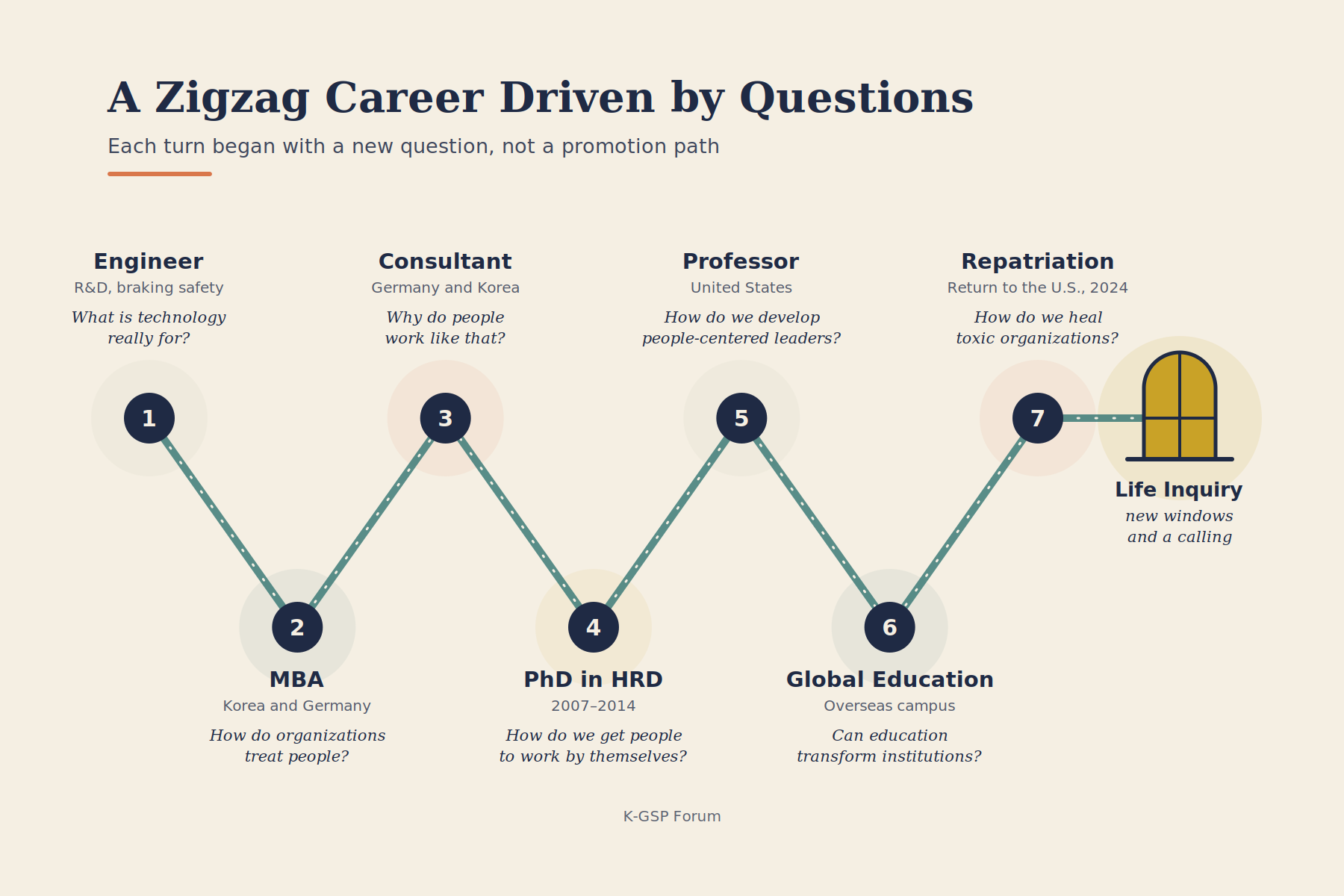
I started as a mechanical engineer who wanted to build powerful machines. A personal loss turned my attention from power to safety, and after graduate study in control systems, I joined BOSCH Korea as an R&D engineer working on anti-lock braking systems. For the first time, my work felt aligned with protecting lives.
Then the questions changed. I learned that safety technologies could be adapted for military use, and I watched a global production project I managed move overseas in a cost-driven realignment. More than 60 colleagues lost their jobs. I realized that I understood machines far better than I understood organizations.
That gap led me to MBA study at the KDI School of Public Policy and Management in Korea and at HHL Leipzig Graduate School of Management in Germany. In Germany, I encountered a stakeholder-centered model of management that treated people as more than costs. I then worked as a business consultant for companies large and small in Germany and Korea. Each move followed a new question, not a promotion path.
2.2 “Why Do People Work Like That?”
Consulting showed me a recurring pattern. Projects failed less because of markets than because of leadership. Some leaders used people to extract value instead of developing them. Two questions began to follow me home: Why do people work like that? And how do we get people to work by themselves?
Those questions would not leave me, so in 2007, at an age when many people settle into their careers, I entered a PhD program in Human Resource Development at the University of Illinois at Urbana-Champaign. I chose HRD rather than HR management because I wanted theory that put people’s growth ahead of organizational metrics. My dissertation, completed in 2014, examined self-directed employee behavior, essentially how people come to work by themselves (Choi, 2025).
The doctorate opened doors I had not planned. I became a faculty member in the United States, then helped launch an American university’s overseas business campus, and later returned to the United States in 2024, a repatriation that brought its own lessons. None of these steps were on a map. Each grew from the inquiry that brought me to doctoral study in the first place.
2.3 Choosing a Doctorate That Fits Your Life
A doctorate does not have to mean leaving work for a full-time residential program. Several respected programs serve working adults in leadership and HRD:
Louisiana State University has a long-standing School of Leadership and Human Resource Development offering a PhD, and LSU Shreveport offers a fully online EdD in Leadership Studies through LSU Online.
Valdosta State University offers an online EdD in Leadership with cognates such as executive and higher education leadership.
Regent University offers an online PhD in Organizational Leadership and a Doctor of Strategic Leadership with an HRD concentration, delivered online with virtual residencies.
The University of Texas at Tyler offers a PhD in HRD in a hybrid format designed for working professionals.
Texas State University offers online friendly doctorate programs for non-traditional students. .
Other online-friendly doctorates exist as well. Before choosing, check accreditation, residency requirements, dissertation support, total cost, and whether the program trains you to do research (typical of a PhD) or to apply it in practice (typical of an EdD).
3. Life Inquiry Comes First
My honest advice to this student, and to anyone considering a doctorate, is to place one question ahead of the others: What question about life and work do I need to answer?
Career success after the degree matters. But a doctorate takes years, and the hardest seasons are carried not by a job title waiting at the end but by a question you genuinely want answered. When my own path broke apart, through job losses, ethical doubts, and later a difficult chapter abroad, it was the inquiry that held me steady.
Here are several suggestions:
Start with your question, not the program: Write down the question about leadership, work, or people that keeps coming back to you. If you would pursue it even without a career payoff, that is a strong sign you are ready.
Match the degree to your goal: A PhD generally prepares you to create new knowledge through research and is the usual path into a research-focused faculty role. A professional doctorate, such as an EdD or a Doctor of Strategic Leadership, focuses more on applying research to practice. Both are valuable; they simply lead in different directions.
Look at programs designed for working adults: A few worth exploring in leadership and HRD include Louisiana State University (PhD in Leadership and Human Resource Development, plus a fully online EdD in Leadership Studies through LSU Shreveport), Valdosta State University (online EdD in Leadership), Regent University (online PhD in Organizational Leadership and a Doctor of Strategic Leadership with an HRD concentration), and UT Tyler (a hybrid PhD in HRD). When comparing programs, check accreditation, residency requirements, dissertation support, total cost, and the faculty you would work with.
Be honest about timing.: “Now” is the right time when you have a clear question, a realistic plan for time and finances, and support from the people around you. If one of those is missing, a short period of reading in your area of interest, talking with current doctoral students, or attending an information session can help you decide without losing momentum.
In my experience, once the inquiry is clear, new career windows open, often ones you could not have predicted, and something like a calling begins to take shape. You do not need to see the whole path. You need a question worth walking toward.
References
Choi, J. (2025). Inquiry and calling driven global protean academic career. In G. L. Lee & Y. B. Choi (Eds.), Journeys of successful Korean professors: Experiences, reflections, and advice (pp. 163–167). Independently published. https://tinyurl.com/choibook2025b
Hall, D. T. (2004). The protean career: A quarter-century journey. Journal of Vocational Behavior, 65(1), 1–13. https://doi.org/10.1016/j.jvb.2003.10.006
About the Author

Prof. Dr. Jeonghwan (Jerry) Choi (Managing Editor), University of Maine at Presque Isle
Full list of his K-GSP columns:
Jeonghwan (Jerry) Choi, PhD is an Associate Professor of Business at the University of Maine at Presque Isle and Editor-in-Coordination of K-GSP Forum (contact: jeonghwan.choi at gmail.com). With over 25 years of industry and consulting experience, he specializes in leadership development, human resource management, organizational behavior, and social entrepreneurship. His research focuses on workforce resilience, organizational health, and self-directed leadership — bridging rigorous scholarship with practical insight to cultivate leaders who create meaningful, sustainable, and humane organizations.
Suggested Citation
Choi, J. (2026, October 05]). A doctorate begins with a question: A letter to a non-traditional student. K-GSP Forum.
Original Article:

한글요약
박사 과정은 질문에서 시작됩니다: 늦깎이 학생에게 보내는 편지
조직 리더십 석사(MAOL) 과정을 마친 한 학생이 물었습니다. 지금 이 시점에 박사 과정이 의미가 있을지, PhD와 EdD 같은 전문 박사 중 무엇이 맞을지, 직장과 가정을 지키며 온라인으로도 할 수 있을지, 그리고 학위를 받은 뒤 어떤 길이 열릴지. 모두 현실적이고 중요한 고민입니다. 다만 그 질문들은 모두 ‘결과’를 향해 있었고, 박사 과정이 ‘무엇을 위한 것인지’를 묻는 질문은 없었습니다.
저의 길도 곧지 않았습니다. 기계공학 엔지니어로 BOSCH에서 ABS를 개발했고, 담당하던 프로젝트가 해외로 옮겨 가며 동료 60여 명이 일자리를 잃는 것을 보며 다시는 부끄럽지 않기위해서, 경영학(MBA)를 했습니다. 한국과 독일에서 컨설턴트로 일하면서 “저 사람들은 왜 저렇게 일할까?”, “어떻게 하면 사람들이 스스로 일하게 할 수 있을까?”라는 질문을 품게 되었고, 이 질문이 늦은 나이에 일리노이대학교 인적자원개발(HRD) 박사 과정으로 저를 이끌었습니다. 이후 미국 대학 교수, 해외 캠퍼스 설립, 다시 미국으로의 귀환까지 이어진 지그재그 여정은 모두 그 질문에서 시작되었습니다.
박사 과정을 고민하는 분들께 몇 가지를 권합니다. 첫째, 프로그램보다 ‘나의 질문’에서 출발하십시오. 승진이나 물질적 보상과 상관없이 계속 붙잡고 싶은 “질문”이 있다면 준비가 된 것입니다. 둘째, 목표에 맞는 학위를 고르십시오. PhD는 연구를 통해 새로운 지식을 만드는 과정이고, EdD 같은 전문 박사는 연구를 현장에 적용하는 데 초점을 둡니다. 셋째, LSU, Valdosta State University, Regent University, UT Tyler 등 일하는 성인을 위한 온라인·하이브리드 과정을 살펴보되, 인증, 비용, 출석 요건, 논문 지도를 꼭 비교하십시오. 넷째, 시기는 정직하게 판단하십시오. 분명한 질문, 현실적인 계획, 주변의 지지가 갖춰졌을 때가 바로 ‘지금’입니다.
질문이 분명해지면 새로운 진로의 창과 삶의 소명은 뒤따라옵니다. 길 전체가 보이지 않아도 괜찮습니다. 의미있는 길을 걸어갈 만한 “질문” 하나면 충분합니다.
© K-Global Scholars and Professionals Forum. All rights reserved. Content published in the K-GSP Forum may not be reproduced, distributed, or transmitted in any form without prior written permission from the K-GSP Forum, except for brief quotations with full attribution.